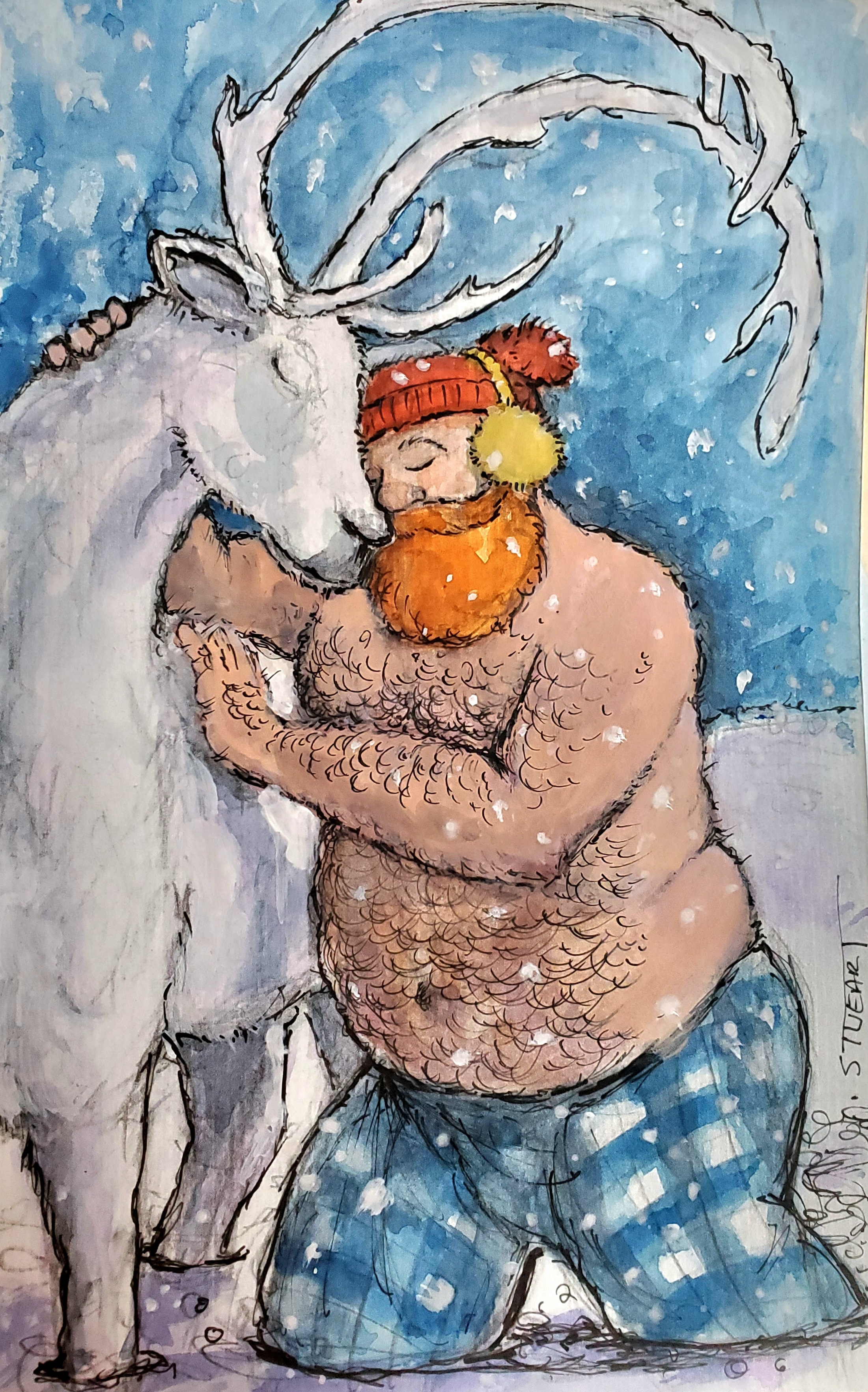
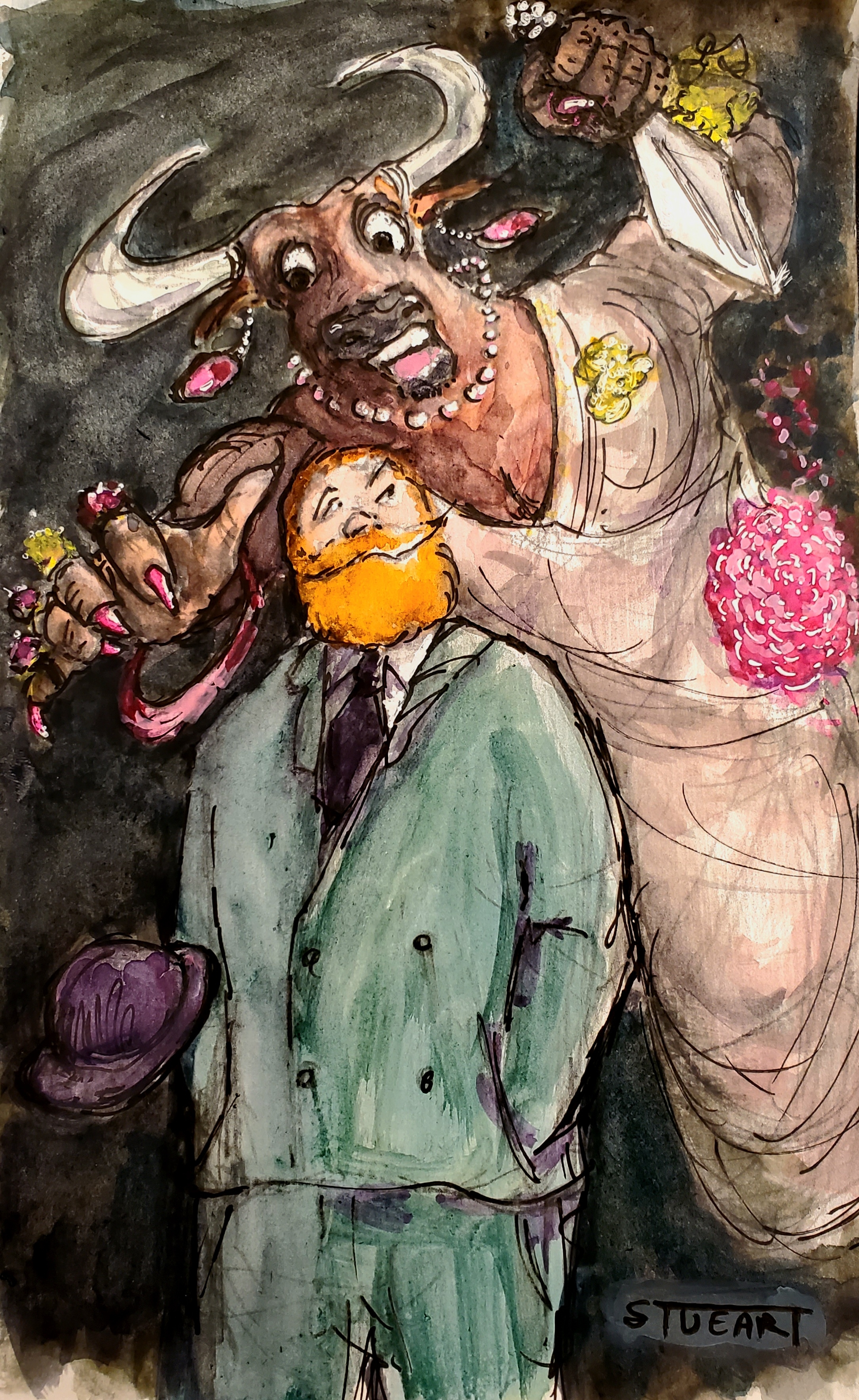
October 30:  Yukon Cornelius watches Bumble paint a Mural

Bumble does not live in my time zone even when he is in bed with me. This makes setting times very difficult in our home. Not only can he be as much as three hours different than I am, but he might be exactly in synch with me and I wouldn’t know. His times are fluid, moving with the patterns of sunlight and darkness. I tried to teach him about time zones using a globe pointing out the clever 24 time zones that used longitude to separate them equally. He got that, <very clever,> but he pointed to the North and South ends of the globe and shook his head. He asked, <Why aren’t there latitudinal time zones as well?  Far north sunlight doesn’t follow the silly time zones “human society” created.  More sun in the north in summer; much less sun in winter—sometimes no sun in the winter.> He tells me I should know that. I grew up there. I say that I am matching the rhythm of the people around me—that’s what time zones are for—to help us stay together. He shakes his head. He believes time zones were created to accommodate people living in temperate zones within one thin band around the world, not even those on either side of those zones. Why should he change his whole life and rhythm to merge in with something humans created—and created badly?  It only meets the needs of only a small portion of the humans on the earth. So I keep track of his patterns in a notebook called Bumble Time, like one would watch the weather, noting times and changes, patterns that alter—trying to keep us at least partially in rhythm together. I tell him, “So the days won’t get away from us.” Daylight Savings always throws us out of whack. He signs to me, <You cannot use the daylight you are saving.> He smiles, picks up a cupcake, eats it. <You are saving the wrong things>

At his current work site across the state, he paints a mural in the heart of the older part of a downtown now mostly abandoned during the last big economic slump, they told him. The shops were all boarded up, except for Payday Lending places, phone outlets, and the occasional fast food restaurant. But people were still here. They lived and grew up here. Their homes were in this neighborhood. They no longer had a grocery close by, but they had a lot of old buildings just sitting around unused. The neighborhood hired him, contacting him through his website. Anyone can contact him and propose a place to put a mural—but he doesn’t have to take the work.  He can choose. Bumble likes to take places, like this one, that need some bright color, where he can make people happy. His price is always on a sliding scale. This one will not bring in much money. <But the next one will,> he tells me. <It all works out.> It’s true. Some of his murals are inside big office buildings, restaurants, art museums, private homes. He has collectors. He brings in some very big money, most of which he gives away to environmental causes. He takes jobs where he can be himself, and which are safe for him, and where he can stand comfortably. He is close to 10 feet tall now—that limits some indoor spaces. He researches the site, makes sure they are ‘monster-friendly’ and that he can work in peace, and that they have a sign language interpreter on call. When he first started doing them, he drew crowds. “Well,” I told him, “you are–.” He finished, <Different.> “New,” I said. I thought it couldn’t hurt his marketing for people to post pictures of him working or take selfies. <It is difficult to think. I distract them from the Art I’m trying to make.>  He didn’t mind drawing crowds in neighborhoods, but he didn’t like being gawked at in offices. <I feel too big—in the way of myself.>

He lets me watch today, as he is finishing up this one. He calls it, “Dreaming of Escape.” Many of his murals have Hiddens in them. <It helps Hiddens if they have good art about them in public spaces.> He said it got people used to them and helped put them in context. In Trenton there is a mural over three stories tall of dancing Jersey Devils and it is warm and inviting and make people smile. He was invited to the Mothman Festival in Point Pleasant WV to create a permanent mural. It was controversial at first. It depicted several Moth Men interacting with townspeople in the downtown area, drinking coffee, walking down the street, real hometown kind of Norman Rockwell stuff, done in a hybrid Rockwell/ Bumble’s ‘Northern style’. It wasn’t the scary Moth Man they wanted. It was friendly. It didn’t match any of their marketing. He told them, <If you want a Moth Man to come live here you need to show him he will be accepted and welcome.> They didn’t know they had that option—to get their own Moth Man again! So they changed every bit of marketing to follow Bumble’s lead. They now have a very active and inquisitive Moth Family living near them.

I see the hot orange sky, the ice breaking up, the black continent Earth from the Northern perspective. <People aren’t watching this clock very well,> he tells me. <The land is telling them that time is running out to change bad habits, but they won’t see the clock.> He shakes his head. <Out of time.>  He points to different places of his mural, and tells me about it. <They are escaping the hot land. The Tern drops its eggs when it has to leave. The fox jumps into the water. The Bumble tries to balance on ice flows.>  “And these stars that are falling?” I ask. He smiles. <Those are people. They opened a box here. And now they are all falling into the box here.>  When I ask him what the box was, he says, <Everything they wanted.> Now the box just collected their bodies, I guessed. <People need a new Climate Time Zone national campaign that has a day that gets smaller every year. Less time to work. Less time to play. Less time to change. No 24 hour day but a 12 hour day, maybe. Short time. Shorter time. Shortest time. Then no time.>

I look around me at the people who are watching. He signs to me, <They get it from the pictures. They know. They have been in Climate Time Zone for awhile. They are part of the clock now. Others with money and power—they don’t know they’ve been in the Climate Time Zone too. The effects don’t reach them for awhile.> He looks at the people, and the neighborhood. <The clock is all around us. The trees are the clock. The ice is the clock. These people are the clock to watch too. No one is watching the clock. This is the time to be saved.> He looked again at the people. <No one is saving this Time.>

Later, as sunset comes, the crowd brings several long tables and chairs and covers the tables in food to share. Everyone sits down together.  They come to Bumble and me. “We want to thank you for making our neighborhood more colorful.” Bumble shows his surprise, and then spots a table full of banana bread. He points at it and roars, laughing. He signs <You know me too well. How can I say no?> I tell them what he’s said. They smile and clap and lay a big blanket over the concrete for him to sit on. He signs to me, <Time to eat and play—> sits down and children come to him bearing plates of food. They lay them down around him, almost interconnecting on the blanket. He thanks them, smiles big and stuffs his face. He turns to me, barbecue sauce on the fur under his nose, takes my hand and pulls me to the blanket to sit beside him, and signs <Eat and play, before the day gets away.>
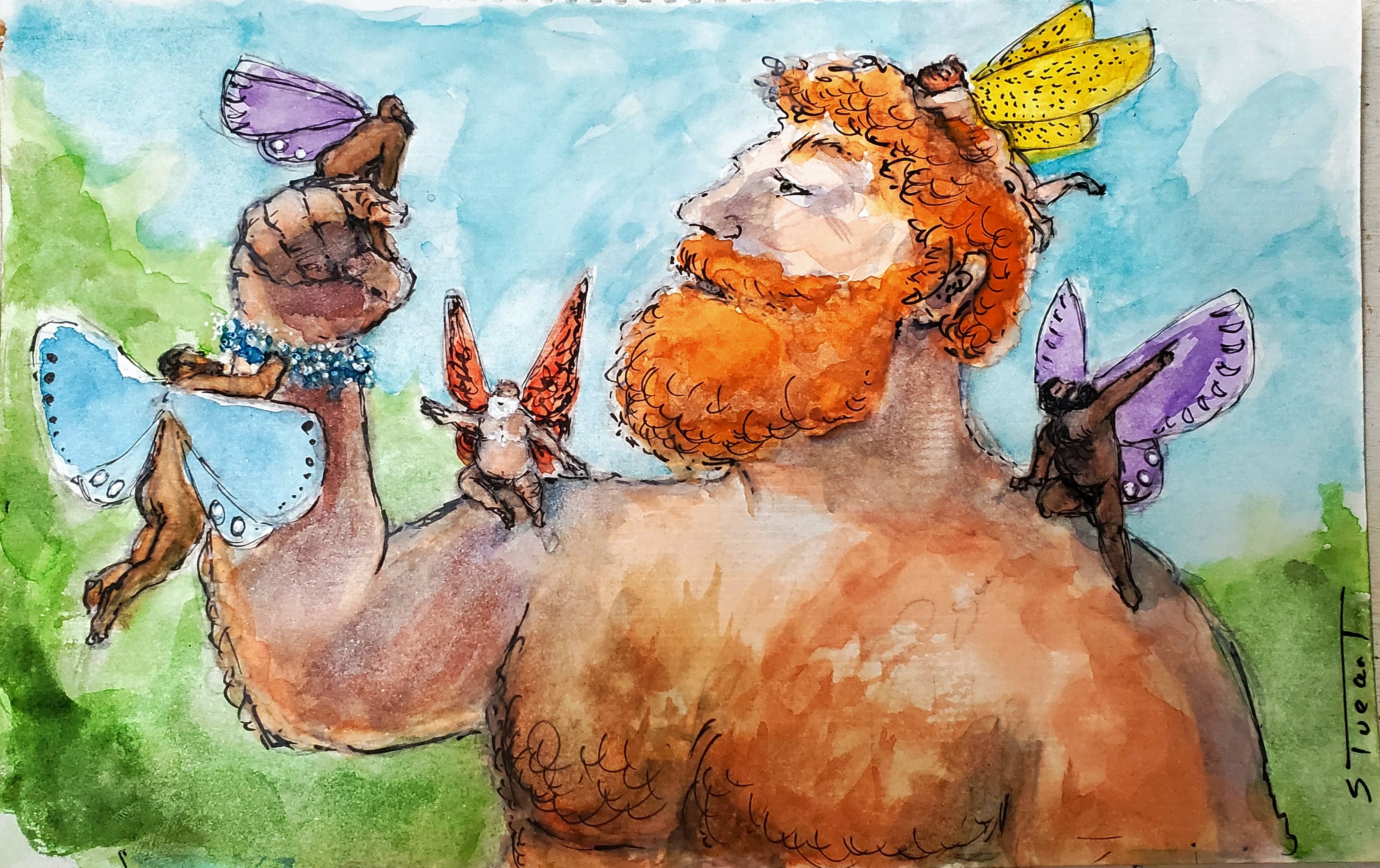
October 29:  Yukon Cornelius connects Fairies

If you want to see fairies, you have to think about fairies. But to think about fairies is to forget what you’ve learned about fairies. They don’t like it if you bring presumptions, or an insensitive amount of education and book reading about them. They don’t come here to affirm your previous beliefs about them. Each group is different, they will tell you. Each culture is different, and by culture I mean the Fairies of the Last Rosebush on the Front Library Lawn are very different from the Edge of the Glade fairies, the Old Tired Oak fairies, and the Dirt Road to the Cemetery fairies. You can’t think they are the same. “We look for an open mind, not a self-assured, have-all-the-answers mind,” they tell me. I have met sixteen different fairy groups who are vastly different from each other like families are different from each other, like twins who are separated at birth and grow up in the country and the city are different from each other. I can’t really generalize about fairies at all except to say I don’t know fairies—I know these specific sixteen groups, but I couldn’t tell you about something definitive about ‘fairy culture’ because to them there is no accepted definition. The good and beautiful Fairy Guidebooks I know are there to show us the diversity of fairies, stories told by one group, but I can’t use them when I go visit a completely different group. “Oh he thought we wore spiderweb dresses!” Heavy is the shade one group would give me for trying to show my knowledge of their group. “There are thousands of ways to be Fairies,” I heard one say. Another chimed in, “A thousand thousand.” But sometimes I also heard kindness for the investigation. “Asking questions is okay. We can tell you what WE do.” But they had little tolerance for anyone who was rude, or who wanted to tell them how they Should Be Acting. “If you can’t take the time to learn about us, we don’t want to meet you,” is something I did hear, though, and this common refrain, of learning about them—without assumptions, without preconceptions—to get closer to knowing them— seemed to be the only thing I’d found in common. And yet, I was open to the possibility of meeting fairies one day who didn’t mind what you thought about them, or a group that might even act like you expect them to act just to make you feel at home. To seek out fairies is to expect anything to happen and nothing to be what you thought it would be. Blank notebook. Bring it. A pencil, bring it. Then—and only then—think about fairies.

The Garden Fairies (their name), chubby, hairy and bearded—all male—gay and polyamorous, live in a place that may not be connected to the outside world. I have slipped through the veil to their garden before, accidentally, and have slipped back out again with no idea about the context of the garden, the place on a map, the relation with any known geographical markers, and none of the fairies have been outside the garden very far, so they too have no idea how they connect to anything else. I visit them because they are fun—they have hundreds of games they invented and play constantly. They are joyous and they make me laugh.  They are white, black, and brown fairies with bright butterfly wings and they live in a well-tended garden with no apparent gardener. They make me think that this is what I would look like if I were a fairy, and seeing yourself in others has a way of bonding and reassuring you that you “fit in.”

It’s a strange tension between wanting to be alike and wanting to be unique. When I first met them, I let it slip that I had not seen fairies like them. That rippled through the group in two streams: there are other fairies? And that they were strange or different. I assured them all the groups of fairies—even individual fairies–were strange and different. “I think that’s what it means to be a fairy—to be happy being strange and different.” They wanted to hear about other fairies, and I told them I would share what I knew if they also shared with me their practices, customs, traditions, and thoughts about their own group.

When I told them about the shimmering clothing of other fairies, they said would never wear clothes. “Hot, hot, hot.” They all agreed. I told them that a third of the fairies I had met felt the same way. The other two thirds, I said, had various fashion, either from fabrics they created, or from found objects, or sometimes from fashion they stole and copied from the outside world.  I mentioned the Hazelnut Fairies and their dances—and they were fascinated–and they showed me some of their dances. They were astonished at the Galaxy Gazing Fairies at Machu Pichu and their knowledge of planets and stars and the maps they drew. They loved hearing about the marriage ceremonies and dating customs of several groups of fairies. I saw some of them taking notes. I told them I’d met two groups of fairies before that were single gendered—both female presenting, and two other groups that were non-binary. The rest were mixed-gender groups. The more I told them, the more they were delighted and soon became interested in meeting other fairies—exchanging stories and ideas.

But no one knew how to get out of the Garden. They didn’t even know how I got in. I thought about taking one of them with me out of the garden, but they were afraid. They didn’t know if they would be able to get back in. They had oral histories and stories about fairies who left and who never came back.  I could tell they were curious about the outside world, but they were nervous too about what they might lose by leaving the garden. I completely understood. “Home,” I said to them, “is a hard place to leave, and you don’t have to leave home to be happy.”

So today, on my seventh visit, I slip into the garden with a gift. I’m met by Everyone. They’ve created a friendship bracelet for me. I know Bumble will want one of his own. I tell them I also brought them something. I open my backpack. “Or I should say, someones…,” I say. Sixteen fairies flew out of my backpack. Representatives from four other groups of fairies agreed to come meet the fairies who were “disconnected” as they put it. When I had told the other groups about the Garden Fairies they were concerned and wanted to make sure that they had contact with others like them. “No group should be completely alone– unless they want to be.” I knew the garden fairies were curious of others, so I figured this might be a good temporary solution.

Four from the Enchanted Peony Bushes, with their beautiful, bejeweled headdresses and silk sheer robes, four (an entire Heavy Metal band) from the Under the Roof of Oddbodies Bar group, four from the Hazelnut fairies, and four far-flung fairies from the Galaxy Gazing Fairies of Machu Pichu. One of the elder women of the Enchanted Peony addressed the Garden Fairies, “We are very happy to meet you, members of the Garden Fairies. We heard you wanted to meet other fairies like yourself. We also heard of the great obstacles that prevented you from meeting us, and the mysterious conditions involved in entering or leaving your garden. We decided that if you couldn’t come to us, we would try to come to you.” They all applauded my backpack.

I stayed there for five nights with them so that I could take the visiting fairies back through the veil that connected worlds. While I was there, the Garden Fairies taught everyone new games, the Hazelnut fairies taught us many dances, the Oddbodies played heavy metal cover songs acoustically without speakers or electricity (which turned out to be a lot of deep growls, roars and shouting accompanied by two melodic guitars and drums) and finally, late at night, the Galaxy Gazers unrolled their maps across the grasses of the garden, and as the others gathered, they pointed out constellations and planets and told stories about the stars above them that “connected all four groups together” for they had discovered that they indeed were the same stars on both sides, and so, even after the other fairies left, the Garden Fairies could be sure that they wouldn’t be too far away, and need only look up, at the constellations that connected stars and fairies together.

October 28:  Yukon Cornelius makes friends and allies of the Babas

They called themselves the Babas and their cottage slunk into our backyard softly on cat paws in the middle of the night.  Bumble saw it come in, stepping over the neighbors’ fences, padding through the wavy grass. Then the legs laid themselves down like a cat would, and the house settled lower and steps unfolded over the resting legs until they touched the ground. It did nothing.  He fell asleep. It was there when we awoke.

Houses on feet? I’d heard of such a house. The house on chicken legs, a house of a witch with a dangerous reputation in Russia. I’d never met her, and I wasn’t sure I ever wanted to. She made me afraid.  But then we knew many who had gotten a bad reputation from encounters with people. We knocked on the door anyway. When the three women answered the door introduced themselves with Baba in their names, I asked if they were related to Baba Yaga. They rolled their eyes. Baba Sola said, “Our Sister of Perpetual Trouble? We know her.”  Baba Luna said, “Do we know her! Ha! Do we claim her?” Baba Stella said, “We assure you; we are not going to hurt you. Please don’t be afraid of us. We made breakfast. Would you join us? We came a long way to see you, Yukon and Bumble.” The three of them looked so sincere. In the stories of witches who harmed others, had they ever walked their house over to see you?  

Banana Bread was enough to convince Bumble it was safe. He’s easy.  Coffee, muffins, pastries and little quiches.  We might have been in danger of being fed too much. Bumble and I soon found ourselves stuffed. Baba Stella kept bringing more and more out of the oven till her sisters stopped her, asked her to come join us in the living room. Baba Luna made sure we felt comfortable, offering us different, better pillows, “I think this one will be better for your back,” she said to me. Bumble sat on all the pillows Sola could carry, and he signed, thank you. As the two sisters fussed over our food and comfort, Baba Sola told us, “Sabitha, our house, is mobile and we love to travel!  We just never wanted to settle in one place—so many good places, how do you choose one forever?  So a moving house seemed like the best idea. This way, Sabitha travels the world and we can still find our favorite teas whether we’re in Belgium or Bangkok, and have our own pillows to sleep on at night.”  Luna echoed, “It really is the best of all worlds. Our house is good natured, affectionate travel luggage.”  Stella said, “We meet such nice people too. If they aren’t afraid of Sabitha’s legs.” We talked for hours about each other, and I felt they sincerely wanted to get to know us. They had heard of us, through their well-connected network. “You have empathy. You have heart. You solve problems in a way that is beneficial for most of the people involved.  We like that.”  They nodded and smiled. “It’s not the way things have always been done.” They asked us very detailed questions about how we dealt with certain situations, why we made these decisions. They were very intense questions.

Then, Baba Sola, the eldest of the sisters, folded her hands in her lap, “Why we’ve come.” She paused and took a great breath. “You were right to think of Baba Yaga first. We are here because of our wayward sister. She’s in trouble.” Luna chimed in, “Trouble she caused. Trouble she made.” Stella said, “We think there’s hope though.” Luna did not agree, “I’m afraid she might have gone too far.”  

Sola began telling a story, moving her hands now comfortably to the crocheted armchair covers. “Baba Yaga does not like to travel, but her hut does wander the forest where she lives. She’s always trying to get farther away from people, but the encroach of civilization has reduced her forest to not much more than a park. People have built bridges and fountains and trails and families walk through all the time. She could see them, hear them, laughing through her yard. It sapped her very strength.”  Luna said, “She’s very much an introvert. She needs her space.”  Sola continued, “But there was none.  Everywhere the hut looked were apartment complexes and strip malls and endless suburban housing. She wanted her forest back. So our sister—who has rarely encountered a guest she didn’t curse and make miserable, or chase down, or torture—starts a candle-making business—creating hundreds and hundreds of candles in a jars with names like “To rid yourself of bad dreams” and “Cure for an Aching Soul” and “What You Really Need” and “Everyone Else Thinks this Smells like Apples”—and she stood in front of her hut and sold as many candles as she could to everyone.  

“They bought them not because they needed them. Who buys candles for that? They bought them because of how they smelled — like—” her hands reached up above her as she looked upwards, “like everything they wanted, everything they dreamed of. She’d made them irresistible.

“Baba Yaga walked her hut to a suburb, set down and sold even more candles. Once she had sold 1000 candles, she and her hut walked back to the most secluded part of the park, within a sacred ring of trees.”  Luna interrupted, pointing at me with a brownie, “And then she screwed everyone.” Sola looked over at her, “Luna,” she chided. “A story is like a good tapestry; it must be unraveled slowly.”  She turned back to me, “That night she sent a spell out into the city to activate all her candles at once. They burned down every home they were in with inextinguishable fires. No matter the fire trucks and the water and the pink goop.  Every home burned to the ground. She knew, though, that even after the charred possessions were removed and the homes torn down that they would rebuild again, because she believed with the deepest part of her being that they were uncontrollable, unstoppable monsters. They would return forever, again and again if she didn’t do something.  But Baba Yaga had thought of this ahead of time! Each of those candles housed the seeds of a forest, and as the wax melted and dripped into the soil, a magical forest began growing in suburbia. She combed her hair the whole night long, and as she did, the forest and her hair became thicker and thicker and thicker. In one night, she had regrown two thirds of the original ancient forest that she’d settled into long ago, and her long luscious hair fell in tresses down to her feet. She was happy.”

Sola frowned. “The city was not. They have reacted quite strongly towards Hiddens because of our sister’s actions. She got her privacy, but they—other Hiddens—received the punishment. A great fear of Hiddens has started again and is being stoked by those who have always hated us—anyone different. But they are using Yaga’s drastic measures as reason to make everyone afraid of Hiddens even more.”

Luna said, “I fear it’s partly our fault. We’ve not always been the best sisters at curbing Yaga’s appetites. At compelling her to make decisions that don’t harm others. That is not the way she has done things. For most of our lives, she only harmed those who came to her doorstep. We looked the other way because often—these people thought they could take advantage of an old woman. She fought back.  She was justified.” They looked at each other. “This time is different. She has attacked others.”

“Um… so the eating children?” I asked, regretting it as soon as I did.

Luna said, “You of all people, Yukon. You do know that every Hidden gets that reputation. We all eat children. Even Abominable Snowmonsters,” she said looking at Bumble. He nodded, pointed to his mouth, and then rubbed his tummy.  I rolled my eyes. She said, “If you can make children frightened of us, they will then grow up as adults afraid of us who tell those stories to their children. Does Yaga have a cruel streak? She does. She likes being seen as powerless so she can flip the tables. She might even be the very definition of ‘entrapment’. We fear this will only get worse.” She leaned towards me, “We can’t think of them as monsters, Yukon—as she does. We can’t think of people who try to harm us as inhuman. We can’t afford to. We just entrench them as a permanent enemy and justify their reactions. We become the monsters they want us to be.  We have to live together at some point. We must educate them, illuminate the truth if we can. It doesn’t matter if we feel like we shouldn’t have to–that they should know already.  It always benefits us if we can make an ally out of someone who didn’t know.  So, in light of our sister’s decisions, we have also made decisions.  We have decided to align ourselves with a side that is not fighting fear with fear or violence with violence.” They suddenly all smiled at me.

Sola put her cup on the table, “We’d like to join you.  Do the work you’re doing.  Help with the load.  Our house is your house. Our services are your services. If you want us to go check on anyone, we will go. If you want to come with us, use our house to get there faster, we want you to do that. We don’t want you to be burdened with mundane travel—especially as it has gotten so tedious and sinister.  You can’t always jump on the next Gryphon to Egypt. We would also, frankly, enjoy the company and the travel. And the chance to cook for others. Dinners, breakfasts!”

Stella said, “But we also have some ideas on helping out in our own way.  We three sisters want to tell stories to children, take Sabitha from neighborhood to neighborhood, and from our porch, tell them about the amazing Hiddens out there who just want to be loved! And who will love them back.”

Sola said, “We’re weary of being hated in every story. We can’t fight it by fighting them. By burning down everyone and making a bigger place to hide. Baba Yaga is going backwards—she is the past. We want to move forward. We believe that’s here. Would you allow us, occasionally, to let Sabitha rest here in your big back yard?” Stella looked at Bumble, “We can bake a lot of banana bread.” He looked at me and nodded.
I asked them, “What do you think her response will be when she finds her sisters have abandoned her? Are you afraid of that? Should we all be afraid of that?”
Sola sighed. “She has not seen us for a long time.  We’ve not spoken in many years.  And now that she is sequestered in her forest again, she will have to make a choice first—she would have to leave her hiding places to confront us. And if she came here, she would see a different path opening up.  She’s never really seen people getting along with Hiddens. Maybe she would see what we are doing.”

Luna said, “The thing with Yaga—you can’t go to Yaga and win any argument.  You have to let Yaga come to you. When she’s ready, she will.”

I was happy to welcome the Babas to the neighborhood.  It was nice to have friends so close. All of ours were scattered across the world.  Now we had people who cared for us right next door.  That’s a special kind of love and I can understand every grandmother who wants to move in to love her family closer.  Bumble received so many wrapped loaves of banana bread, I would shake my head at him, playfully accuse him of taking advantage of them.  He denied he was using them for sweet breads, signed that they were giving this to him, but crumbs of banana bread would just shake from his fur onto the table. And we’d laugh. This is what is like to be loved by others.  I believed this is what we were trying to get Hiddens to feel–to feel loved whether they wanted to stay in their forests or if they wanted to join this chosen family of unique people.  Sometimes I would look out and notice the Babas’ home was not there. They were off telling stories, or checking in on one of those we cared for. Then they would creep back in during the night, and in the morning, there was Sabitha exhausted on the lawn. I wanted to get used to having them around, to relax enough to allow myself to be cared for by others.  Sometimes, though, I thought about what might happen if Yaga came calling to our home.  We would, no doubt, do our best to love her just the same. She’d already made such a journey to find us. We would need to show her who we are when our walls, our forests, are down. That wouldn’t be easy.

I only hoped, if that happened, that two walking houses, a cat and a bird, would get along without kickboxing in the backyard.

October 27:  Yukon Cornelius introduces the Gryphon to the Sphinx

Pink and yellow lights synchronized to the beat of the music flashed everywhere.  People danced. A thousand people?  Yes. And not just people. There were a couple of Jersey Devils spinning across the courtyard. They wouldn’t miss a chance to dance. I spotted a table of swamp crocs. And flying over the crowd I knew I caught a glimpse of some faeries. I moved through the dancers and the lights. If the Boogeyman were in Egypt, he’d be here. I made a note to tell him about it next time I saw him. Finally, I was at the place where you could stare right at the DJ’s Lion Paw toes.  He was three stories tall.  His lion body swayed to the music and, lit from below, his body cast a dancing shadow, complete with his wings.  He held a red set of headphones to the ear of his very human face.  I wondered if he would remember me at all.  I was going to see.  I saw a wheelchair lift and a set of stairs up to a platform where you could request a song, no doubt. I started up the stairs.

A man touched my arm. “Hey, you. Do you have a riddle?” I turned. He wore a black tshirt with white letters that spelled Security. He repeated, “You have to have a riddle ready to suggest a song. See the sign? No riddle, no song request.”  I told him, “I don’t have a song request. I’m an old friend. I’m just coming to say hello.”  He laughed. “We’re all old friends. You know how many old friends of his I meet here, about two hundred a week.”  I laughed, “No really, I’m a friend.”

“You need a riddle, sir. Or you don’t go up. He can’t be bothered by every gawker and he can’t include thousands of songs, so you gotta have a riddle to ask him.” That was strange. I said, “I thought it was the other way around–you had to answer his riddle?” He looked away. “He doesn’t have time for this. Please move away from the stairs.” I put up my hands, “Okay, I’ve got a riddle.” I turned back to the stairs.  He crossed his arms, “What is it?” I looked back and said, “It’s for him.” He said, “I have to approve all the riddles.”  He touched my arm in a way that said, Come back down the stairs. I’d just walked eight blocks in the summer heat. I wasn’t going to be able to run up the stairs and get to the Sphinx first or wrestle this guard.  He was serious. You had to tell him your riddle to make sure you had one. “If I can solve it, it’s not gonna stump him. And let me tell you, I was a star winner on American Jeopardy.”

***

Alexandria, Egypt, on the coast of the Mediterranean Sea, is spectacular from the back of a Griffin at night, hundreds of feet in the air. Mela, the Griffin I met at Dragon Con, insisted I come with her a week later to meet the Sphinx.  She felt nervous her first time trying to date after realizing that she couldn’t stay single for the rest of her life after her mate died.  This was new territory for her. She needed a buddy.  I couldn’t let her down now.

***

“What soars on eagle’s wings, runs with lion’s legs, and crushes with an eagle’s beak?” He shook his head. “No riddles about people you know. That’s not a riddle. A riddle is an answer everyone can recognize but your description has to be slightly misleading, causing most people, not myself, to be unable to recognize the common thing.” I threw up my hands, “I know what a riddle is!” I said.  “Then give me a better riddle and you can see ‘your friend,’” he told me, moving between me and the stairs. A woman in a wheelchair came through the crowd. “I have a song request,” she said. He said, “Do you have a riddle?” She nodded, and looked at me, and then motioned for him to come closer. She didn’t want me to hear. He leaned down, and soon came back up. “That’s a good one! He’s gonna love that.” He secured her into the chair lift and she Wooted all the way up. He looked at me, gave me a cocky grin. “Got your riddle?”

“What mixes together to make the darkest midnight, but can also mix together and make the brightest morning?” I said.

He thought about it, his eyes shifting up to the right. “Okay,” he said. “You can go up.”  We saw the red light flash beside him and he looked up to see that the young woman was ready to come back down. He lowered the chairlift and waved me onto the stairs. “Don’t take too long with him. Other people have song requests.” I walked up the stairs and saw the young woman coming back on the way down. She beamed. “He’s really dreamy in person!” she said.  She slipped a black and white photo, now signed, back into an envelope.

Until the “dreamy” Sphinx, Egypt had a very bad, cruel policy about how they dealt with “monsters.” Any Hidden that came out would be captured, held, tortured, and then released. Eqyptians called this mild, tolerant behavior. At least they didn’t kill them like Russia, they said. Then the Sphinx came along—or should I say, came back home about twelve years ago.  The Egyptian government loved him.  He was a Monster, but he was their monster, everything they loved about themselves. What a tourism benefit! they must have thought. They used him in all their marketing. This 30-foot god. What do you do when you’ve been hiding in fear of persecution from a place, and then come out and become a god there?  The Sphinx immediately proclaimed every Hidden an aspect of Divine Expression—and the people, I guess, listened to the him. They wouldn’t touch him for fear of damning themselves or their city.  For the last ten or so years, it had been safe for Hiddens within Alexandria. At night, they danced with everyone here at the palace gardens beside the beach. He protected them. He turned Alexandria into one big safe dance club.

I got to the top of the stairs. There he was: a three-story giant lion with wings and a human face—with his headphones on—rocking out to the music he was blending and creating. He looked up at me, “Yukon! Hey!!” I smiled, “Puddin’!” He laughed, slapped his belly. “They don’t make enough chocolate pudding here.”  He leaned in, “What’s your riddle?”  I told him.

He nodded, saying, “The color spectrum—the first is when you mix paints, and the second is when you mix light. But it’s a good one! What can I play for you?”  I said, “Asim, I have someone I want you to meet.”

***

Mela the Gryphon from Dragon Con had flown all the way from the US, taking me with her as moral support, only to turn around at the last minute and land about eight blocks away. She was scared. “I don’t know if I can do it.”  She needed some time to think.  I gave it to her.  She said, eventually, “I want you to go up there and reconnect with him first. See if he’s still the kind of person you thought he was.  Sometimes you change and you may not be the person you were.” She wasn’t sure even if she was the same person she was, “I was singing mourning songs a month ago. Now I’m breaking all my traditions. People can change in an instant. I don’t want to put myself in a vulnerable position if he is not the same kind of person you said he was.”  I agreed. It was important for me to find out.

***

So here I was doing that.  I told Asim, “She really needs a friend.”  He smiled, a warm smile, the kind I remembered when Goody and I knew him, when he was wandering in the Mojave, hiding in the Sierra Nevadas, unsure if there was anyone like him at all, or if they would hate him as he believed his home country would.  Asim said to bring her up. He would love to meet her.  He’d even give her a riddle to get past the guard.  I said, “She’s nervous. She’s been through a really hard time in her life.  But she really wants to meet you.”  He said he was doing autographs in about two hours if I wanted to wait.

“She can’t come up the stairs. But she can fly. She’s as big as you are!” His eyes got wide. “As big as me?” I said, laughing, “That’s what she said when I told her about you!”

I felt a big gust of wind and I thought it was him at first with those wings, but no—it was her with her wings. She had landed directly above us on the roof of the Inn.  He looked up, surprised, as I was—could she hear us? I looked at his jaw drop. Had he ever seen a Hidden as big as he was?  Had he ever met a Gryphon?  Judging from his face, I would say no.  I said, “Asim, this is my friend, Mela!”

He was stunned into silence. She also was not talking. The music around them kept the beat going. He awkwardly called up, “What’s your riddle?” Oh, why did he do that? She didn’t have a riddle ready. I looked at him and he seemed to be tongue-tied. She—she was pulling back. I looked at her, trying to tell her not to worry. “Mela, this is my friend, Asim. He’s a sphinx.” I got stuck trying to create conversation, “You both have wings of eagles, or hawks,” I said, punting, “and you both have the bodies of lions.” They both looked at me, insulted. Asim said, “Lions have our bodies.” She said, “Eagles have Gryphon wings.” Asim looked at her, “Exactly.” He lifted a finger for both of us to wait as he switched back to the turntable and programmed something in, listening carefully through his headphones, as he cued up the next song, and then pressed a button, and the music shifted, and a low, steady beat met a progression of chords, and then a man’s voice in Arabic sang. Asim turned around, “Okay, where were we?”

Mela had straightened back, spread out her wings, her claws clinging to the edge of the roof as she looked over the courtyard, and sang—a high lilting descant that matched the melody perfectly. The melody was sad, but powerful. This was a mourning song, I realized. She was singing her mourning song over the dance music, a countermelody—a counter feeling to the joy of the Arabic song he played.  Above us, lit by the lamps, she was full and huge and powerful and her wings spread across the rooftops. I looked back at Asim. His eyes had gone soft, watery. He was smiling.

Well, that went better than I thought. Down on the dance floor, some dancers had stopped to look up at her, pointing. Her voice carried across the courtyards, the gardens. I saw people turning as far as the palace. The combination of her mourning and the electric happiness did not clash at all. People started dancing again—but slower. How can these two emotions exist in the same place at the same time? Isn’t that the most human riddle of all?  The existence of pain and joy in the same person. Pain and joy in the same moment. Pain and joy in the same face. When she stopped, the crowd of thousands burst into applause and Bravos as if an opera singer had just debuted. She looked down at Asim. I knew then that we would wait two hours or three till Asim was done. That they would talk and I would find a room somewhere in the Paradise Inn and sleep. And they would be together all night, till morning had broken through.

October 26: Yukon Cornelius sees a White Stag

Hiddens and Cryptids and Monsters can all have a spiritual side, if they choose. Some Moth Men believe in an all-compelling Great Light; others believe they are the vessel of warning to those careening into darkness. Chupacabrae and Vampires regard blood as a wellspring of emotions and memories, and drinking others bring them closer to something they think of as Bliss. Many Moon Fairies and Sun Fairies worship their deities in the skies, while other fairies are pure hedonists and affirm their own self-guidance as the best way to live. I’ve seen some Bigfoots revere asceticism until they can disappear into the world they are a part of; hermit sphinxes, searching for The Answers; questing leprechauns, abandoning their gold for something more substantial; daemons who search the minds of sleepers as research to a grand theory of everything. Spirituality seeds every being, grows in many. Our inability to see it in those unlike ourselves speaks more to our own primitive minds than it does to the quality or quantity of others’ mysticism.

Bumble believes in synchronicities. If he hears something three times, or sees it, or reads something that correlates two other things, he stops and listens to the universe for further conversation.  He attunes. He will sign to me that the World is Speaking. Does he seem more meditative to me because he doesn’t have much of a vocal language?  Because he is quiet? I don’t know, but I do think he has watered and tended his spiritual side more than I have.  

My mother was a mystic. She spoke with Bigfoots long before I was aware of her conversations with them. She was chatty outside in the garden, at the clothesline, or picking cranberries, and I thought she was just telling herself about her day. They were invisible. They can do that. Most of her mysticism she picked up from them. They taught her, especially when I was away. They taught her about life, about death, and how to walk away with them into the wild, possibly to never die. That’s where she is now. With them in some nether place. I don’t know if she died. I may never know. I can’t mourn her—she might be alive. I don’t know. I just miss her. We never got to say goodbye. I don’t blame her. I blame them, sometimes, though I know it was her choice, and her health was failing.

I was off on a quest. A quest I was warned about. Told not to go. I wasn’t afraid of something bad happening to me, though. Turns out, it wasn’t me that something happened to. When I came back she was gone. I searched for her. Maybe that warning WAS about something happening to me—pain and loss and regret that I’d never truly released. And some anger. They’re the only cryptid I didn’t go check on. Bigfoots were notoriously self-reliant and more hidden than Hiddens. I didn’t go looking for them. They didn’t come to me. I’ve always thought it was better that way.

But this morning, something happened that I can’t explain. I was drinking coffee on the deck looking out across our country yard. ‘Snow had fallen, snow on snow,’ as the song goes. After the colder weather we’d had lately, this morning was warmer, the snow seeming to usher in a warmth so enticing, half naked men want to come outside and sit on the deck in flannel pajama bottoms and house shoes. I watched jays and sparrows and chickadees at Bumble’s City of Feeders jostling for seeds.

Then, in the distance, across the snow, I saw a white stag standing, looking at me. Many deer species have a white genetic pattern that is rare, but it happens. I thought to myself all the times in mythology and folklore that someone would see a white stag and how it symbolized something different for everyone depending on their belief system. Purity, innocence, some saw it as a sign to convert to a particular faith. It did look otherworldly, standing out there, even with its legs deep in the snow. It kept looking at me. What an incredible moment just to witness, I thought. I continued to drink coffee and look at it. The pursuit of a white stag is a fairly common trope in fairy tales too. You can never catch them—but they lead you to someplace new. A spiritual quest sometimes. Well, as I’d mentioned, I wasn’t the most spiritual person—more in awe of the wonder I saw everyday (and with all the Hiddens I knew existed, there was plenty of wonder in every day!) I thought, Go on, Big Deer, I’m not going to follow you on some spiritual quest.

But it stood there. Looking at me. I got up and walked to the railing at the edge of the deck, hoping I didn’t spook it away. It didn’t move. It looked like a caribou (reindeer to most folks) but I couldn’t be sure at this distance and with the white deer against the white snow, I was lucky to see it at all. As the seconds ticked by, I started to wonder if this were a Hidden. I waited to see if they would come to me. I waved to let them know I saw them. Drank coffee. Waited. They continued to stare at me. If they were a Hidden, perhaps they were fulfilling a role for someone in this community. I did have houses nearby, who could see the deer. I wondered what kind of role it might be playing for someone. I confess we didn’t know our neighbors well because our house is frequently visited by Hiddens in the night. We chose a place where we could keep everything covert for them.

You know, I thought, white stags were also seen as messengers from the Otherworld in some cultures.

The stag never wavered. It simply looked at me across the long yard. Maybe 30-40 yards away. “Why are you here?” I whispered to myself. Who needed a message? If Bumble were here, I’d ask him—is it meaning something to you? But he wasn’t. Just me.

Was I the person the stag was here for?  I thought about that. Messages from the otherworld. They weren’t coming to me. Who would send me a message? And then, suddenly, I knew it was about my mom. I was sure. I tried to put the coffee cup down but missed the railing and the cup disappeared into the snow.

“Stay right there,” I called out.  “I’ll be right–,” I looked around for snow boots or galoshes. I hopped around tossing my slippers behind me. I found my snow boots, looked over my shoulder. The White Stag was still there. “I’m just putting on some boots!” I didn’t want it to leave, so I skipped the shirt, launched right into the yard. The first few yards were fine, and then the snow got deeper, and deeper. My steps slowed. It started snowing again. Big flakes. Much deeper now than the boots could handle, and I could feel the snow through my PJ pants.  I was stepping over hurdles. Lifting my legs high enough for the next step was so slow. I fell several times. I looked up and they were still there, calm, and now only half the distance away. They came up to my waist. Apparently my plan for taking the most direct route to get to them was through a small valley. How much did it snow??

I fell face first into a drift, and looked up, my body covered in snow, and it was still at least 10 yards away, “Do you have a message for me?” Was she alive? Had she died? Is this the way they tell someone that there was a death?  Assholes. The Bigfoots could just come find me themselves. I was frustrated, cold, the snow on my skin pierced through. The stag just looked at me. “Did you need my help?” I called, standing up and trying to leap into the air. “I can help—” and fell deeper into the snowdrift. The snow was up to my chest. “Please,” I begged. “Is she okay? Is there a message for me?” The next leap was shallower, and I realized the deer was on a small hill. I climbed, pushing the snow out of my way, till I could almost touch them. “What do you need?” Their eyes were kind.  “Bumble can speak some sign—he’s not here—but I can’t speak Hidden or deer or whatever you speak. I hope you understand me.”

I reached out my hand, asking, “Can I touch you?” They lowered their head. I lurched through the drift now at my knees and my hand connected to their body. Warm. I pushed the last few feet, my other hand touching them. They stood steady. “I’m here. I’m here,” I said, out of breath. “Do you—is there a—do you have a message?” They didn’t speak. Nothing. “But I thought you might have a message for me. Are you here because of my mom?  Did they send you? Did she send you?” It closed its eyes and touched my head with its warm head. I cried, “Is there—anything?” I just erupted—like a well full of tears was being pulled out of me. I must have cried heavy for more than a few minutes, and the stag kept their head against mine. Maybe there was no message for me at all.  I wondered what I was there for. This was all mystery and no answers. I felt just like I did that day discovering she was gone, with her little jaunty note, “It’s okay. I’ve gone to live with the Bigfoots. Don’t worry about me. This is the best way. Love, Mom.” I had no real answers then; of course I worried. I went off into the forest to find her, to find them, for a week. If this is about her, I can’t have the message in front of me and not be able to hear it.  No. No. This is my message. This message is for me. “Why won’t you tell me the message?” I asked. They opened their eyes. I thought they would speak, and they didn’t.  This made no sense.  How can a Messenger from the Otherworld come to you and not have a message?

I said to myself, “Because they don’t have it yet.”

I asked, “Can you take messages?” They blinked slowly. “To my mom?” They blinked again. I  laughed, held my hand over my mouth for a minute, fighting back tears again. “Tell her I love her.  Tell her I miss her. Ask her if I get to see her again. Ask her to send me something to tell me she’s okay.” I stopped. “Oh. Wait,” I said, realizing. “That’s you. She sent you to tell me she was okay.” They blinked. I held onto the neck of the stag, buried my face in its fur and cried hot tears. In a few minutes, I lifted my head and laughed. “Twenty-five years to tell me she’s okay.” Then I thought, “Hey, she’s made it twenty-five more years! She’s made it a long time.” I wiped my eyes. “I guess it was the right thing,” I said quietly. “Tell the—tell the Bigfoots,” I looked at the snow coming down. “Tell them thank you for taking care of her.” The snow gathered on the deer’s back. “Maybe they can come see me sometime and we can talk.  Yeah, I’d like to see them. And her if it’s possible. Can you say all that? Can you tell them everything?” The snow on their eyelids tumbled as they blinked once for me. “Okay. Take those messages with you, please. Thank you for coming.”

The path back to the house was easier because I had shoved all the snow aside with my falling stumbling body. I’d made my own good path to the house, a path only visible on the way back. But it felt like someplace new, or I was new. I don’t know. That was perhaps the most spiritual thing I’d ever experienced—a complete mystery that I attached some meaning to, hoping I was right, hoping the blinks were yes. All I know is that it gave me relief and some peace. I don’t know if she got the message, but I believe she did.  I hear my friends who are spiritual talk in this same way. It’s why I think of this as a spiritual experience–so much balances on mystery and belief.

When Bumble comes back from his trip, I will tell him I’ve heard the World Speaking.  Maybe he will sit down on the couch and help me understand what I’ve heard.

October 25:  Yukon Cornelius reminisces with a Sarangay

“The city rained on itself. The thunder clapped back. Lightning shaded everything it couldn’t reach. Floods of water in the street poured into the sewers. What a night. Then She walked in. She was a dame like no other. ‘Goody’ Goodknife. Seven feet tall, prime beef and pearls, and two sparkly ruby earrings that she guarded with her life. ‘Oh Yukon, these old things?  They’re only six or seven thousand years old. I didn’t even know I was wearing ‘em.’  She was lying. She always lied about her treasure. She’d told me, ‘If I ever told you the truth about what I guarded, I’d have to take your life with my goodknife.’ She’d pull it out and we’d both admire its shine in the streetlamps of the City Without a Soul. She cooed, ‘It has a sparkle all its own—like a jewel. It finds me the finest rubies in the hearts of men.’ I had no doubt Goody made fast work of anyone who tried to take her treasure.”

“Guard your hearts, ladies,” Goody told her girls tonight at the Home for Queens. “There be thieves afoot.”

I remembered our “Monster Noir” years together. Only a short time ago, it seemed: my life.  Now, here visiting Goody at the Home for Queens, it was hard not seeing her as I did twenty years ago, when we were partners in a short-lived detective agency we dubbed ‘Find the Monster’ Noir. We tried to locate pockets of Hiddens and make sure they had what they needed, that they were well and got treatment for injuries, that they survived.  It was a tightrope to walk though, finding them but not revealing them to the public.  We had to be hidden ourselves. How DO you hide a Sarangay?  “Oh, you don’t hide me,” she’d say, “you accessorize me.” Most people called her a minotaur, but she’d correct them. “Honey,” she’d look at them, eyes half-lidded, “it’s a state of mind. Minotaurs are trapped little men raging in their mazes, confused and lost. Sarangays know exactly where they’re going,” and she’d advance on them, casting a shadow, if she could, across their heads, “I’m a saran-Gay, sweetie,” with a sway, “from the House of Sugar Ridge.” She’d pull out that knife, “My horns are longer, my arms are stronger, and I’m here to conquer.” And they’d run, if they knew what was good for them.  She’d softly call out to them, “Get back to your mazes. You’re safe there.”  I’d warn her about pulling out a knife. She’d say, “I wasn’t gonna cut myself, sweetie. I promise.” She’d slip it back into its sheath under her arm. “Every good queen knows how to work a knife.”

Tonight we were a little older. Around Goody, a dozen young queens were at their make-up mirrors, shaping their noses, dusting their cheeks, savoring their Midnight Passion lipstick. They were all human, teens and young adults. They had a big performance tonight. “Ladies, you have thirty minutes,” she called out. They’d all say, “Thank you, Goody.” I remember her requiring the same response out of the people she allowed to live after catching them harassing Hiddens. After she was through with them, bruised, some broken–but alive–they all said, “Thank you, Goody.”

She looked at me across the table. “When am I gonna meet your beau? You just can’t help yourself but go for the tall ones,” she looked smug. I turned the conversation back to her, again. She said, “Oh, this is my life now, chaperoning the young ones into the fold,” she reached over and took a silk flower off one of their shoulders. “You’re not a garden party,” she told her. She looked at me, “I miss the days of skulking down alleys with you, drumming up informers, solving riddles—who was that young one?” she thought quickly. “Oh yes, a sphinx. He’s doing quite well now. I’m sure you’ve heard.”  Some Hiddens made the transition into the public easily. Others struggled. The ones who did well almost always had a skill. “A trick,” she said. “You have to have a trick—something useful. Something entertaining. It distracts them. It offsets the weirdness of you.”

All the queens came to her for a last spot check. She touched up their hair, their corsets, but finally sighing. “Well, that’s what it is! You don’t sparkle enough,” she told them all. “But I know just the thing.” She opened up a box covered in a collage of suns, moons, stars. Inside, exquisite jewelry—earrings, brooches, necklaces—glimmering with an ancient spark. The girls gasped. “Oh Goody, you have the best booty.” She smiled at me. “I do.”

She helped each of them find the perfect touch of elegance and sent them off into the next room with the small stage and the crowd of elderly queens who lived at the Home for Queens. “They usher each other, you know,” she told me. “I don’t do that much at all. The old teach the young. The young revive the old.  I’m just encouragement. I just add a little touch of something divine.” I asked her if those were the same jewels— She winked, “They’re doing nothing sitting in piles in a big cave. Here the jewels get more appreciated, meet the light, sparkle, and make someone happy. They never made anyone happy in a cave.”  She looked at me. “Oh I still guard them, but I also guard the jewels who are wearing the jewels too.  It’s the divine commission I gave myself, Yukon. To guard all the jewels I could.” The room next door erupted in applause.  She said, “Make sure they shine.”  

She invited me to watch them perform. The older queens in the audience were dressed as fine as the young queens on the stage. They beamed at every dynamic turn of a heel.  I didn’t know how many of these nursing homes for queens existed.  Perhaps Goody’s was one of the first.  “My old queens will give these ingénues a good critique afterwards. I have to stare down some of these biddies, though, when they start ripping into my girls a little too fiercely. Goody has to use the eyes. You remember the eyes, Yukon.” I almost couldn’t look at her.  She could stretch her eyes so wide, the pupil quivering inside the whites, she’d scare anyone.  “The Sarangay of Sugar Ridge berserks when she’s protective.”

Later, when the mirror lights were off but one set, and nearly all the dresses were back in their wardrobes, and most of the jewels back in their box, we sat down and shared a glass of wine. She took off her necklace and placed it in a black box. “You wore a purple bowler, Yukon. A deep purple felt bowler. I remember it. Don’t deny it. I always remember–,” she paused, “–interesting fashion choices.” She slipped off her rings. Her hands were thick and massive. She picked off the pink nails carefully, placed the bangles and the bracelets on a metal tree. She rubbed off the lipstick. “We were a good pair of detectives, weren’t we?” she asked. I told her we were. “You don’t see a lot of detectives any more…not like us. It’s all police now.” She removed the silk peony from her side, and effortlessly, for a muscled, massive bovine, slipped her sheer gown over her head without catching it on either horn. “I always felt like we were fighting for the Hiddens we found. We were advocates. I don’t see that as much in the rest of the world. I see,” she folded her gown, “law and order and right and wrong, but I don’t see justice and I don’t see understanding or empathy. And I wonder,” she sat in the chair now next to me, looking at the mirror lights, “I wonder if I’m protecting my jewels from them too.” Her face was now without makeup, her body without a dress, or jewelry.  She always said she had the body of a wrestler.  She was formidable. “I don’t know if there’s enough sarangays in the world to protect all the jewels. If I could foster them like I do queens, I would do it.” She looked at me, as if to say, I think, that she meant it and that she wanted me to know she meant it.  She reached up and touched my hair to push it back like she was fixing a queen for the stage, “You make a pretty good Goodknife yourself.”  I thanked her.  “Keep finding the jewels, Yukon, and do what you can to protect them.” Her eyes met mine, steady, warm from the last mirror lights. “Guard your heart, sweetie. There be thieves afoot.”


October 24:  Yukon Cornelius restores the Joy of Satyrs

It is a truth universally acknowledged, that a man in possession of a rigid dogma must be in want of others to harass. It is also a fact that you can’t shout into a forest for every creature, animal, bird and insect to stop having sex. It is a forest. They will not listen to you. Nevertheless, some people try it. I watched with my satyr friends from the trees as a man in his thirties in a checked polyester shirt and brown slacks bent down, turned on an amplifier and squeaked the megaphone in his other hand to test that it was working. He stood up and faced the meadow, “Little DEVILS!” the megaphone shouted and squeaked. He bent down and adjusted the volume. He stood up and cleared his throat. “Little FORNicating devils! Good morning! I know you can hear me. I came here from a Holy Place to tell you that the Lord does NOT love you.” You can probably guess the rest. This went on for ten minutes, spewed almost in one continuous breath. He seemed to enjoy it too, as he gyrated his body whenever the word “sex-u-al” came up, like he was working a hula-hoop around his waist. He said all manner of nasty things about sex in general, about their sex definitely, and about their lustful ways. Apparently he did this three times a day, and had been doing it for the last three months.

“He’s honestly wearing us down, Yukon,” Cosmo said. Estevan confessed that he was starting to think the man spoke the truth. He didn’t know this man’s god very well. This is the first time he’d heard about it. But gods should be respected, and now, there was a god who didn’t want them to play in the meadow anymore. Art said, “They enjoy words like ‘lasciviousness’,” and all of them repeated the word the way the youth would say it, “and fornication. They quote a poem to us that describes us but they spit when they say it—“for they exchanged all manner of lusts with each other and lied down together.” They nodded. Art continued, “We love doing that! I exchange lust with Wendell the Tall and Dark, and Wendell the Tall and Dark exchanges lust with Cosmo, and sometimes two of us exchange lust with a third at the same time.” They were all very robust looking men with goat legs and horns, grinning about their passions. Estevan said, “But when they say it—it makes me feel I should be ashamed of myself.”

Had I ever heard of anything shaming the sexuality of a Satyr? I had not. Art said, “It’s what we enjoy. We have a lovely day of just having pleasure and playing our flutes and dancing and singing.” Cosmo said, touching my arm, “We lost two of our group a few weeks ago, Tadd and Flavian. One day, they just came into the meadow and said that they realized they had been going through a sexual phase for the last three hundred years and had now, that week, grown out of it. They were more mature now, and well, they didn’t want to stay in the forest with us anymore. They urged us to grow up, settle down, and to get meaningful work and contribute to society.” Where did they go, I asked. They said, “Corporate administration.”

They asked me what they should do. How could they get rid of these people? I told them, “I’m more concerned about the effects on you. It’s vile and toxic, but you should know that there is nothing wrong with your horny sexy ways. You should feel free to have as much sex as you want with each other in your meadow, in your forest, all day and all night. These people didn’t speak for their god. Love cannot enjoy hurting others. It can’t.” Outsiders had no right to take away what’s been giving the satyrs joy every day. I told them that these people are speaking from their fear and their lack of comfortability with their own bodies. And they want you to be as uncomfortable with your bodies. “They are intimidated by your freedom to express yourselves. They are jealous of your pure joy. I don’t see any real joy in them—except the pleasure they get from inflicting pain and ‘being right’ in their dogma, do you?” They shook their heads, agreeing.

Before they sunk into a funk, I told them. “But, I see so much joy in you. I don’t want you to lose that joy because of what someone else says. It doesn’t matter in whose authority they say they come in. Sexuality isn’t theirs to govern. It isn’t anyone’s to govern. As long as you make each other happy, and everything is consensual, you should be able to do what you like.” I knelt and drew a circle in the dirt and placed four rocks in it. “But you live in a place where people are often afraid of sexuality. A lot of humans right now are under similar situations—being harassed, even controlled, by the fears of others—fears about others’ bodies, their own bodies.” They could not understand why anyone would be afraid of their own body or the bodies of others. Afraid of pleasure. I said, “For them, it’s tied up in old ideas of shame, ownership, people as property, sexism, and a fear of the wrath of a loving god they were talking about. Unfortunately, you live in that place surrounded by that. We all live in that place.” They sighed. “But,” I pointed to my head, “They don’t live in this place.” I touched my heart. “They don’t live in this place. You can’t let them into those spaces, okay? No matter how loud they are. You can’t let them take over those spaces. You must remember the joy you have and not let anyone take it away.”

“What do we do with them? It’s hard to ignore them when they have a megaphone.” I told them to leave that to me. I had some friends that might help. I think they could change the situation. “Come see me in two weeks if things haven’t changed,” I said.

***

I needed an incentive for the evangelists to move, and I needed a disruption to push them to move. I also needed to stamp it with an authority they understood. I dressed up in my oldest out-of-fashion suit and found a leather-bound book that could look like a Bible from a distance. It was “Wind in the Willows,” but it would work. I went to Horace, a friendly, chatty ghost I knew. He let me borrow something he was attached to—a letter from his father—to take with me. I slipped that into the book. I found the church they were associated with. I walked in as a traveling evangelist and, with the right words, was accepted immediately. I told them dramatically why I had to come and see them. This vision I had received concerning them! It was so positive! How well they were doing! So God decided He would put his best people in the most needed place—downtown—to rail about Corporate Greed! He needed it loud! He needed his best humble servants! I slipped Horace and his letter under the cushion of the pew. Of course they weren’t going to be convinced right away. You have to synchronize messages from other places. After I left, Horace worked on them for a week, whispering to them about how greedy the corporations were, how He was upset about it, and started to win them over by correlating with my “vision.”

Finally, I contacted the poltergeist, Tammy, I met at GenCon. She was still hanging out with Ellen listening to old vinyl records and only slightly restless. I asked if she might visit this church. She asked Ellen and me, “Can I stay with them for a bit?” Ellen told her, “Yes! You can.” Tammy clung to me till we got there, met the pastor for a follow up visit,  and then she transferred herself to him.  She ramped up so much chaos at the church, each day, enough for them to believe that their god wanted them to move immediately –out of this possessed place. One night, during a service, all the hymnals floated out of their racks and opened above them, and the organ played something sinister. They ran out of the church and quickly positioned themselves downtown against The Beastly Greed of This Age. They were happy doing the work they did best. I went back to the church, now with its doors wide open but empty, retrieved and returned Horace’s letter. Tammy had moved with them. I hoped she would pace herself, give them some time to get comfy downtown before she started up again.

My satyr friends came to see me very soon afterwards, and invited me back to their recently reclaimed meadow and forest. I got a little carried away! But it was fun, and we all had a great time. Be good to yourselves, and be kind to others.

Tammy is watching you.

______________________

*not all faiths or all Christians are like this. You know specifically who I am talking about. And while our satyrs and Yukon love sex, we have folks and friends who are Ace (asexual) and are perfectly happy. None of these groups try to push their sexual values or ideas onto others or force behaviors or shame others for their differences. God bless you. May Tammy never bother you.

October 23:  Yukon Cornelius considers traditions with the Gryphon

Everyone thought she was part of Dragon Con—this 50 ft tall Gryphon that wandered into the Atlanta Marriott Atrium. Something animatronic. Something amazing. But definitely something there for a photoshoot. I found her surrounded by Jedis and Sith. I was on my way to get my Captain Kirk cosplay. Bumble, dressed as a Mugato, was waiting for me at a panel on the “Art of Charles Vess.” How did she even get into the conference center?  She was about to attack people with colored swords aimed at her. So, I did what I do in these situations: I ran up, waving my arms, and yelled louder than anyone else.

She saw me. I told all the Force-Users to back up slowly and exit farther into the connected hotel. I told them not to get security involved. But then I saw five security men stood staring at the Gryphon. I waved and yelled at them too.  She snatched my shirt with her beak and lifted me up as I told the security officers not to shoot.  And then she sat down and put me in between her front talons, and began to bellow, “I have searched for you!” she cried. “Across the Himalayas, the Caucasus, the Alps, the vast ocean, to find you here— finally— in your castle fortress!” She looked around the conference center at all the Jedis and Siths,  “Filled with your monks.” Her eagle eyes came back to me, resting between her paws. “You must help me.”

Her name was Mela. She had lost her mate several years ago, she said, and had relegated herself to a life alone, as was the way of Gryphons.  She had resisted searching for another.  She was content to fly above her mountains and sing her mourning songs in the hollowed aerie at the top of the craggy reach.  Until, that is, she wasn’t content.  “I can’t—I can’t stay alone,” she said. It happened to her over the years that she wanted to try again—with someone new. But then she would think about her traditions and about what made her a regal Gryphon and that this was part of her too—that she must live the rest of her life—which could be hundreds of years still–alone.  She sobbed. “I don’t know what will become of me if I break the very solemn oaths and vows I gave my mate, my mother, my father, myself. But I also don’t know what will become of me if I don’t.” She had taken up sculpting rock as a way to keep her mind off her loneliness. Now, in her aerie, were twenty three stone gryphons carved into the rock of the mountain, looking at her, watching her, and, she felt, waiting for her to die.

A crowd had gathered around us, a crowd Mela ignored very easily, but which I was very aware of. Hundreds on the main floor of the lobby at the base of the atrium sat on the floor in their costumes. Hundreds more were standing and watching us.  I looked around and I saw my beautiful Mugato, with his one rhinoceros horn directly above his eyes. He signed to me, Are you okay?  I nodded.

“It’s your decision,” I told her, touching her talon. “But which one can you live with for a hundred years?  Can you live with not being a perfect traditional Gryphon?”  She shook her head, “I don’t know. I’ve never been anything else.  I wouldn’t know how to be anything else?” I shook my head. “I wouldn’t know what to expect from a traditional gryphon—you get to tell me.  All I know is that I’m in awe of the first gryphon I’ve ever met, and she wants to be something different—or she wouldn’t be here.” Her eyes widened and watered. She said, “I’m different, yes. I’m a disgrace.”

I assured her she wasn’t. Then, a rebel fighter pilot stood up and told her about starting over at 53, leaving his job which was killing him, and the town his parents lived in, and starting a new life far away in Durango Colorado, in the mountains, working with horses. Two Spider-Women stood up, cradling each other’s hands, and told about meeting each other at Dragon Con years ago, and how it changed their whole lives. They realized they couldn’t be the people their parents wanted them to be anymore, or their churches—and that their relationship revealed to them who they were, and they liked that change. “But it hurt and it was scary,” they said. Others around them agreed. A Groot and an Incredible Hulk talked about moving across the country to be with each other. Princess Leia talked about divorce. Scarlet Witch took up pottery after her husband died, but she also joined a salsa dancing group because she needed both, and this upset her family.  A Wonder Woman from the Middle East said that coming to Dragon Con and wearing this costume was violating her traditions, her faith, her family.  “I couldn’t live under those restrictions any more,” she said. “But I kept the part of my traditions and my faith that I still believed in.”  Voice after voice, witness after witness, this sudden panel on Breaking Traditions had a thousand panelists and an audience of one.

I said to Mela, “Perhaps carving twenty three gryphons into your home walls was you trying to tell yourself to find someone. You were crafting the perfect mate.” She thought about that. “But what if I search the world,” she asked all of us, “and I don’t find another one like me?”

The Mugato I loved now stood next to her talons and took off his rhinoceros horn and his mask. And he was just the Abominable Snowmonster now, and he smiled at her. He pointed to me, in his way asking if he could join me inside the talons. “He’s with me,” I said to her.  She opened her talons. I said, “I live with him. We are mates.  He makes me happy.” I told her, taking Bumble’s big hand. “It doesn’t take an exact match to help with loneliness.” He sat behind me now his arms completely around my chest, his nearly 8-foot frame and thick body dwarfing my 5’10 ½ size, and I felt warm and safe inside his arms, the first of three nesting circles made up of his arms, her talons, and the circle of the souls of Dragon Con.  I winked up at her. “You might expand your search a bit.  Find someone who isn’t like you because you …. are becoming something new.”  She sighed, but it wasn’t a sad sigh, or a resigned sigh, but a resolved sigh. She looked around the atrium at the thousands of people listening. She looked back at me and Bumble. I said, “Tell me, Mela, have you been to Alexandria, Egypt?  There’s a big outdoor night club there now with a DJ about your size.”  She said, “My size?” I said, “Have you ever heard of — The Sphinx?”

October 21:  Yukon Cornelius delivers letters for the crew of the Flying Dutchman

I thought I had a big curse in my early twenties, after my mom died, and monsters came to find me. Everywhere I went, a new monster. They always found me. I figured the only way to get away from monsters was to go to the open sea, so I joined the Merchant Marines. Yeah that didn’t work. Do you know how many sea serpents there are? Long necked dinosaur sea life? And Leviathan? We “discovered” so many of these creatures that the crew felt like the ship was magical. Until a sea serpent came to talk to me, and then I was magical. I was a “monster whisperer”—and some of the crew liked it, and some of them were wary… what kinds of monsters would I bring to the ship that could endanger the crew? Since we ran commercial shipping in peacetime and wartime, sometimes in the thick of battle,  what would these monsters do? I attracted loose cannons—who might do anything to protect themselves. This wasn’t a good thing.

“I can’t control it,” I told my mates, my captain. It wasn’t like I could cover some beacon light with mud or a sheet. It was a curse I had no control over. I considered resigning from the Merchant Marines, but I was a good able seaman, and there was this other guy who attracted sea gulls, so they figured it wasn’t right to let us go for what came to find us. Simmons was just going to have to manage the gulls so they weren’t a problem, and me— I had to manage the “other things.”

Well, one of those was a ghost ship. One late afternoon, a time for storms to whip themselves up on the water, in the clouds and a time for ships to hunker down, or get out of the way, we spotted another ship in the storm. Some storms are unavoidable. The ship had old rigging and sails, and rumors passed among the crew that it was the Flying Dutchman, a fabled ghost ship from the 16th century when the Dutch and the East India Tea Co were the kings of shipping on the seas. The ship had a curse too—that they were never allowed to go home again, cursed always be adrift on the sea, never able to be with family or those they loved. And if another ship saw them, it spelled certain doom.

I asked, “If it’s certain doom, then how did you hear the stories? Wouldn’t everyone have died—so who’s coming back with the stories?” This caused my bunkmates to think. Someone said, “They.” Another nodded, “Yes, they.” Who is they? They didn’t know. “Survivors,” they agreed and that convinced them the stories were true. The ship looked in trouble and was flying a flag signifying that they needed assistance. “You don’t help the Flying Dutchman!” someone said when more of us  surrounded the Captain and the Mates. “Why?” I asked on the deck. “Why don’t you help them?” And I told them if it involved the whole ship being doomed then where’s the stories coming from?  I concluded, “Maybe others have seen them, but no one’s helped them.” One of the older men spoke up, “They will try to give you letters. Letters that they’ve written to family members who are already dead. If you take the letters, the ship you’re on will sink.” I held up my hand, “If the ship sank, then how do you know someone took the letters?” A long pause. Someone with a scratchy voice said, “I say we send Yukon out there to see them. He’s good with monsters.” They agreed. “And we put him in a tender. If the tender sinks, we go pick him up.” They agreed quickly. I asked, “What if this isn’t a monster– or a ghost ship and they need our help?”  They would send two tenders. Five other crewmates would be in a larger dinghy, but I had to stay in my little dinghy, and go on ahead, and they would wait for a signal that it was okay to approach closer.

I did not want to go out and meet a ghost ship. But if this meant that I was keeping the monsters away from my crew, then I was willing to do it. I told myself, just go see what they want.

I rowed the tender out on a sea becoming choppy. The other dinghy followed at a safe distance. The ship that was in distress slowed as I approached. They also glowed as I approached. I felt I could hear the gasps of the five men in their dinghy behind me. A luminescent seaman climbed the ladder down the side of the big ship, and in his hand he held a bag. I got closer and closer. “You asked for assistance! How can I help you?” I yelled out. They didn’t say anything, but the man held up the bag. The man glowed green. The bag was green, and the wind was swinging it back and forth. “Do you want me to take the bag?” The man nodded and held out the bag to drop it into my dinghy when I got closer. “Do you need me to come aboard?” I asked. He shook his head. The bag dropped from his hand—almost missing–into my dinghy with a thud. I thought I heard a whisper, Letters home. I looked at him, probably closer than any other person not on his ship had been to him, I guessed.  I thought I had a curse. These men could never see their families or loved ones again. They were forbidden. They had no idea that so much time had passed. The crew of the ghost ship lined the railing above us, watching. Hoping. I was overcome with empathy at their suffering, so much that my “curse” disappeared. I asked them, “Do you want me to deliver the letters for you?” The man nodded. I had a wild idea. I said, “I’m going to bring letters back to you,” I said. “Will you come back to this spot in two months?” They nodded and whispered, We will.

I rowed the tender back to the ship where the other five men had gotten aboard. They would not let me climb up. “He has the letters,” someone said. They talked about whether it was safe to bring me aboard. It was not. But it also wasn’t safe for me to stay in a tender in the approaching storm. “Throw the letters into the sea!” they yelled, “And we’ll pull you up.” I said I couldn’t do that. I made a promise. “But you also promised not to let any monsters hurt us. How do we know the letters won’t hurt us?” I called up. “They need us to deliver the letters.” And, I added, I knew that this gift I had would never kill me—because monsters needed me— so therefore, I knew the boat I was on wouldn’t sink. I was hoarse now and couldn’t speak any more and the storm was loud, and the sea was getting rougher. They decided they could not let me die. They hoisted me up. They all stared at the bag which was now just an old burlap bag. They wanted to open the bag. I kept it firmly shut. Not till we were safely on shore, I urged. I tied the bag even tighter with rope and put in a plastic bag to keep it water resistant.

Some monsters don’t start out as monsters. They are made monsters. These men did something to be rejected by the shore, but was it a just punishment, or overkill? Who decided that punishment? “They might say it in the letters!” they said. Yes, I said, but that’s for a family member to read.  When we got to shore, I had a few days. I took them to a museum, and we opened the bag in the presence of curators and historians. Handwritten letters, sealed, folded without envelope into the shape of an envelope. They agreed to use special scanning techniques to read the letters without opening them, and translate them from various languages, and also find the descendants of the recipients. “In two months, please” I said. They nodded, understanding how important it was, “In two months.”  

In two months, a storm sprang up exactly where we had been, and I sailed out to the Flying Dutchman with a bag of new letters from the great-great-great (to the 11th generation) grandchildren of the recipients, or cousins, or some relation. They hoisted the bag up eagerly and it again glowed green in their hands. I told them I could come back every two months. They all looked at me for a moment, stopping what they were doing, and smiled and nodded. Then turned and continued passing the letters to each other, each man who would hear for the first time a response from a relation. And if, as it happened in many cases, a relation could not be found, they  found someone who might be able to answer the lonely letters of outcast sailors that read, “We are still out here waiting to come home.”