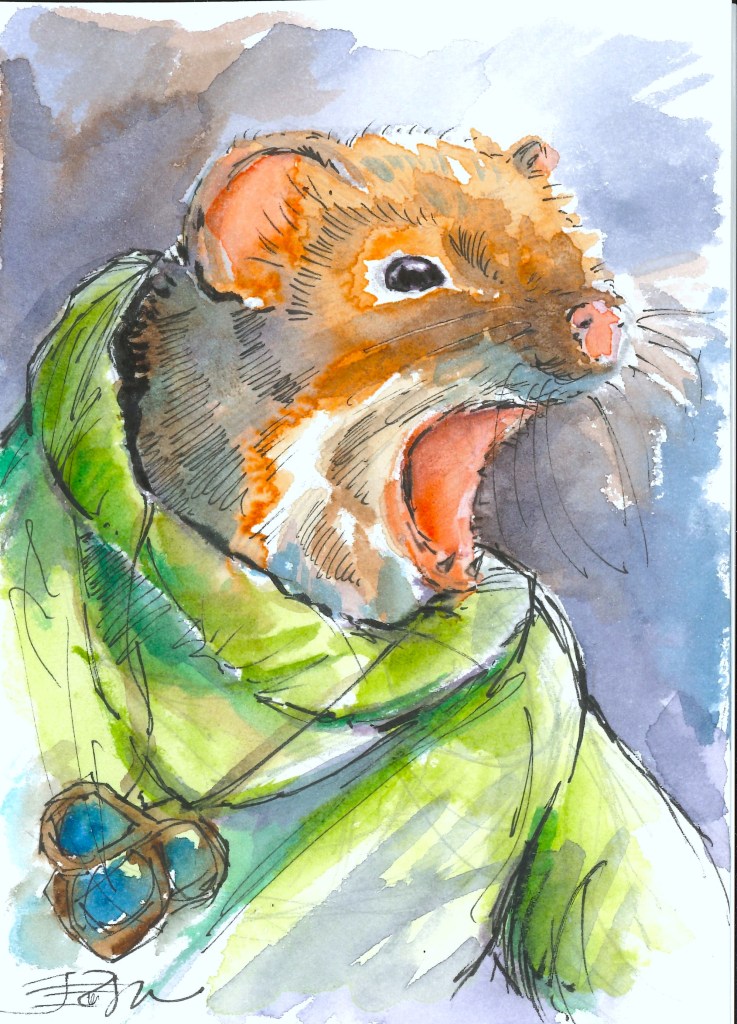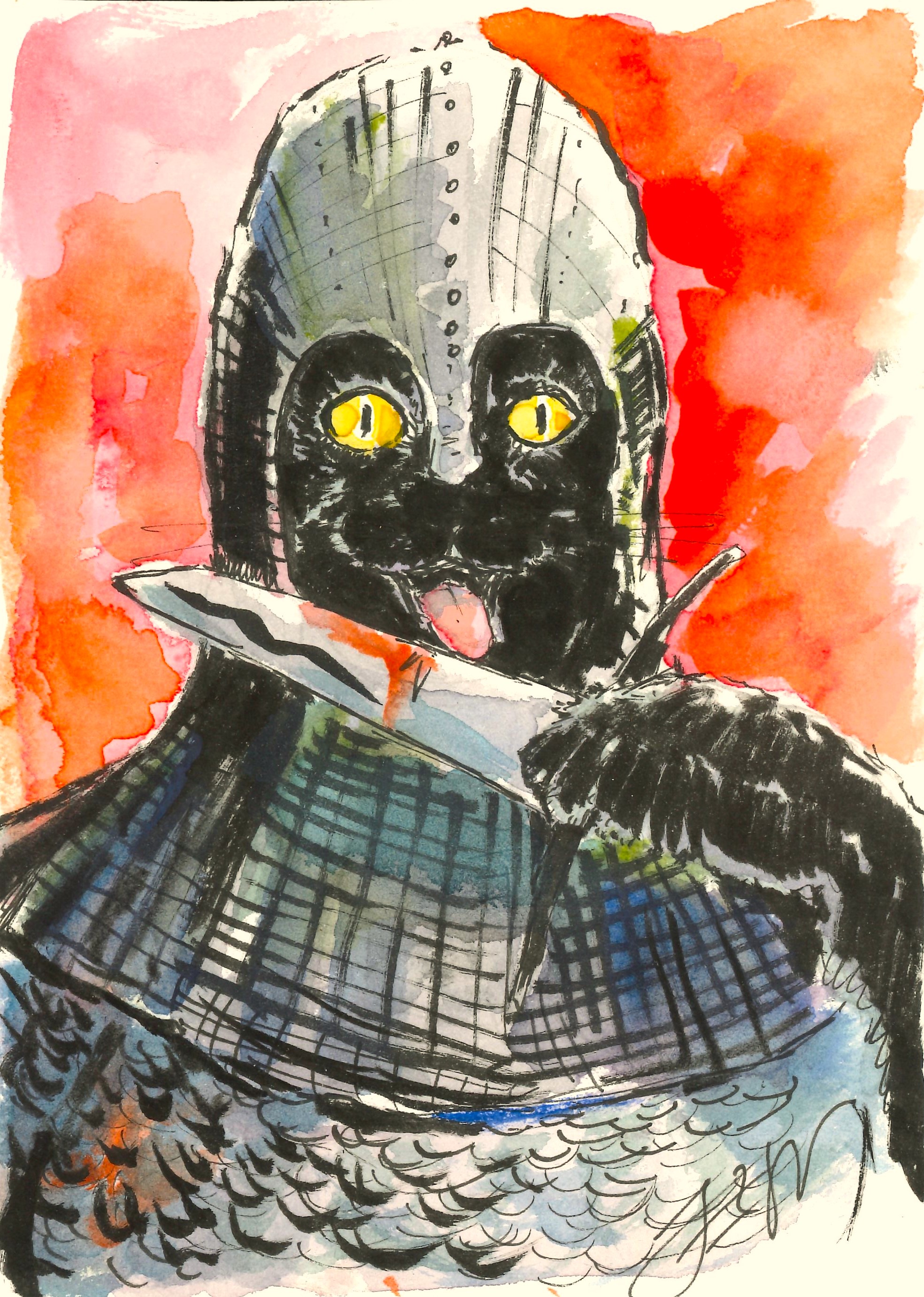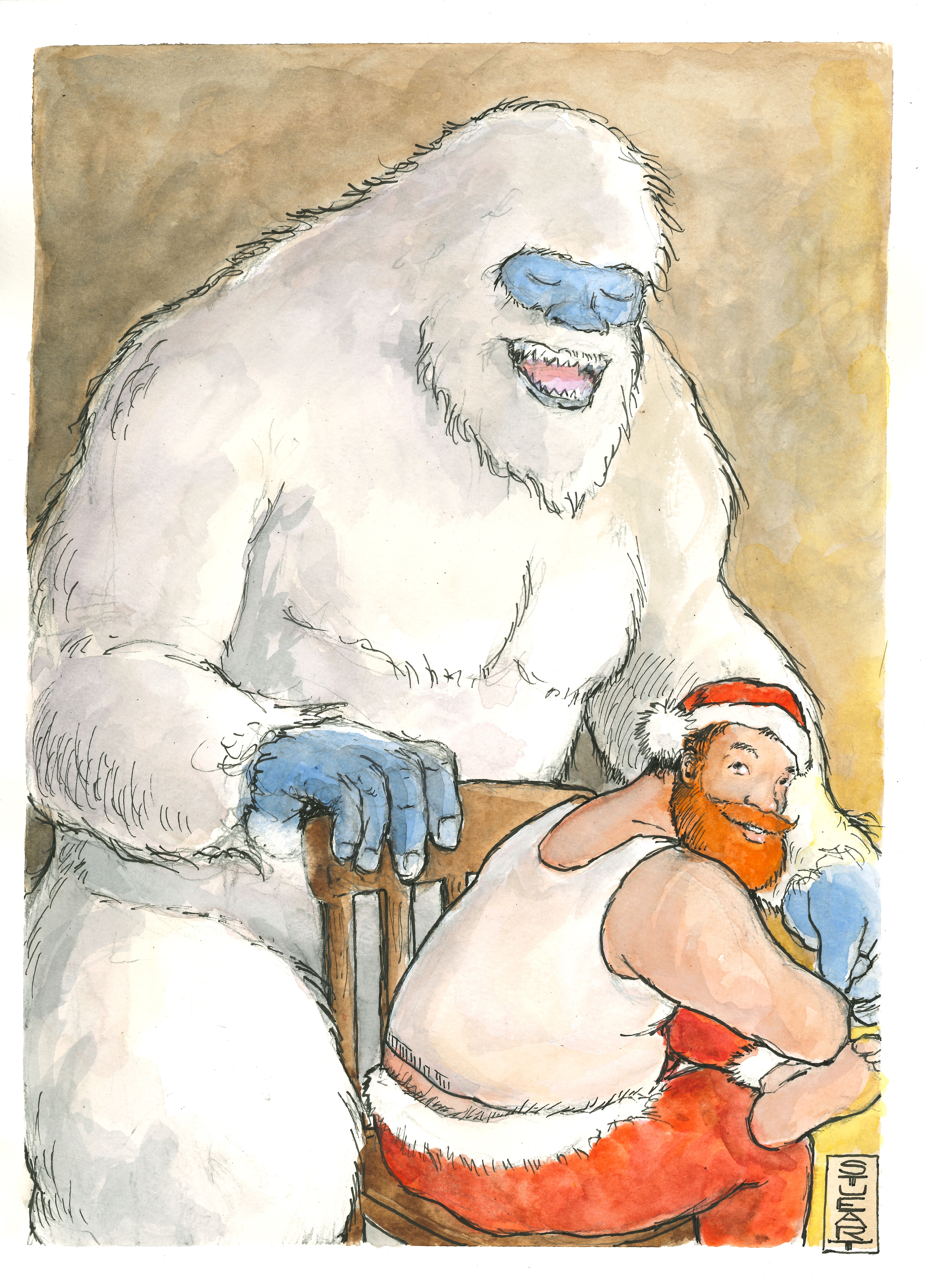
Yukon Cornelius is the Better Santa

You’ve seen the 1964 Rankin/Bass stop motion Christmas special, Rudolph the Red-Nosed Reindeer, written by Romeo Muller. It’s been aired on TV every year since it was first shown. You may have wondered, though, why Santa seems to be so MEAN-spirited in this movie (probably the only anti-Santa movie we show at Christmas time). There is a better Santa in this movie, though, hiding in plain sight.

CEO Santa Rules the North with a Manufacturer’s Mindset

Santa is the boss of toy-making and toy distribution, of all the elves and reindeer. When Rudolph is born, Santa blames Donner for having a “weird” son, and makes fun of Rudolph’s nose — — and of course, all of his “employees” do too. They’re just following Santa’s lead. His meanness and prejudice gets passed down to the reindeer. How can Santa himself be so narrow-minded!? This doesn’t feel like the Santa we know.

In a tale about manufacturing and production, this glowing reindeer and fabulous, dentist-oriented elf are merely flawed products. They are a version of an elf and reindeer who don’t do what those products should do. They are misfits like the toys they will meet later. The other elves, the other reindeer, do not want to accept them, as they have been taught to reject flawed toys.

Who do you think created the misfit toys? Those toys are typical manufacturing mistakes, tossed away. Losses. Victims of Quality Control. There is no love for a flawed product in a warehouse toy factory at the north pole. The elves must be VERY AWARE of their “mistakes”, even if they aren’t aware of the Island the misfit toys all eventually run to for safety.

I believe Santa is written this way on purpose — revealing the commercialized CEO Santa that’s kinda already there. Muller just reveals more of him because he has a doppleganger to compare Santa to. If Santa is the villain, and Rudolph is the hero of the story who has to grow and learn, then he needed a role-model for Rudolph to learn from, to really accept himself and others, since Santa won’t be modeling that.

This is the role given to the OTHER sleigh-driving big bearded man in the movie, Yukon Cornelius. I think this is done on purpose.

Yukon’s a character made up by writer, Romeo Muller, to expand the story beyond the original Robert May song. Muller doesn’t let this just be a song of Rudolph waiting till he’s useful to be discovered. That’s not fair to Rudolph. He creates someone better, a guide, a guru, a model to show Rudolph how to treat others, and himself, with radical acceptance and love.

Radical acceptance and love
Members of a group, a society, a culture, may“naturally” accept people who reflect back to them the kind of group they want to be seen as. So they might accept those who are like “us”, those who stay within expectations of social and moral cultural systems. Those who stay within the lines our group has drawn.

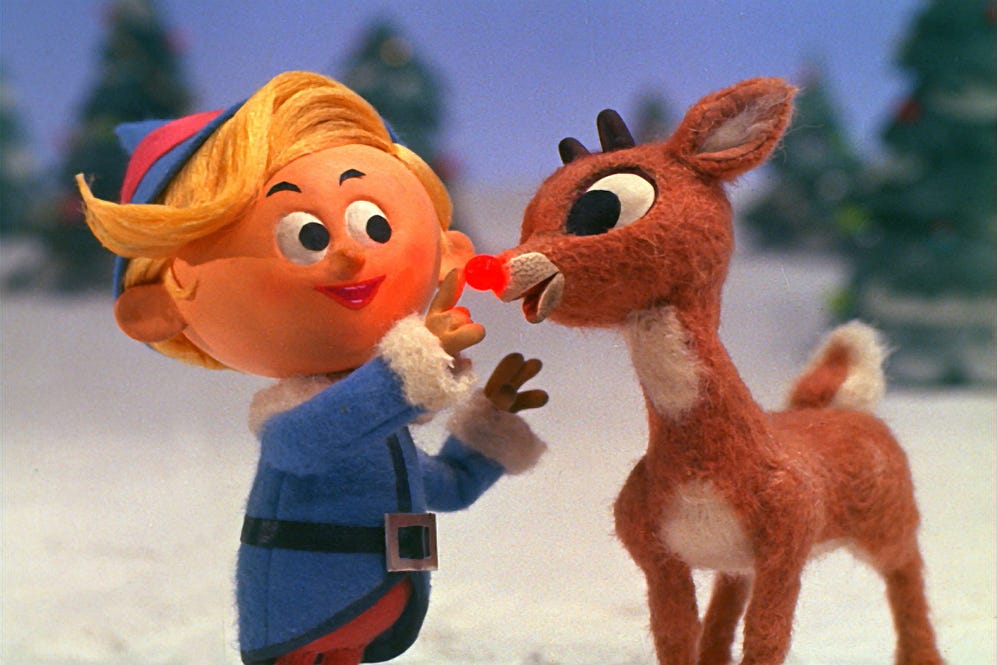
Hermey, though, is an elf who wants to become a dentist instead of a toymaker; Rudolph can’t really hide his bright, blinking nose and that makes him targeted by bullies. They are considered “unacceptable” by the groups they find themselves in — — not what they expect in an elf or reindeer. They don’t fit in, or won’t fit in. They won’t cooperate with what is expected. Rudolph tries to over his nose with mud. That’s not a permanent or acceptable fix for anyone.

When Rudolph and Hermey meet each other, they become besties! They have a lot of common experiences, in a way, commiserating over their differences. They reject societal norms! They are Rebels! They accept each other right away because they also want to be accepted! They go off into the world to do their own things.

They are all Abominable

Rudolph and Hermey aren’t safe in the world when they don’t play by the world’s rules. The Abominable Snowmonster is there to make them fear following their dreams. Noisy! Gnashing Teeth! Roaring! Chasing! GIANT! In a sense, as personified fear, he shows they will be unacceptable everywhere they go. He will relentlessly chase them down.

Who saves them from the Snowmonster? It isn’t Santa. Santa doesn’t even seem to know it exists, though I would say he is controlled by the fear himself.

Who HAS experienced that fear before — that fear of not being acceptable — and conquered it?

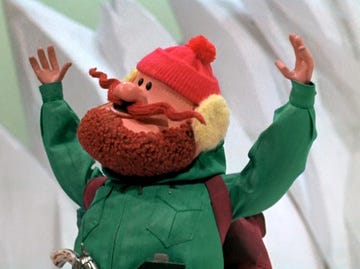
Yukon Cornelius.

Oh, he knows “Bumble”! He even reduces the scary words “abominable” and “monster” to rename him with a word for awkwardness. When we “bumble” through something, we bounce from one thing to another, without direction, we screw up, mess up, blunder, stumble. Bumble is a misfit too — and his name announces that he can’t “fit” either. Cornelius calls Bumble what he is — a socially awkward creature who is badly trying to fit in. He looks scary, and Yukon acknowledges that, but Yukon knows things about Bumble. He knows that Bumbles don’t like water and he knows they can bounce. He knows the strengths and weaknesses of Bumble. He sees through the scary part and sees the real Bumble, trying to survive alone. He will eventually save Bumble by giving him what he wants most: to be accepted with all his quirks.

Yukon Cornelius sees Hermey and Rudolph too. He sees them as who they are and who they want to be and immediately accepts them. He practices “radical acceptance” of everyone. Radical acceptance is acceptance BEYOND what you are comfortable with, what you’ve known, what is advantageous to you, or what might benefit you. You accept people for where and who they are. And you loudly support those you radically accept. Yukon is very loud. He is not afraid of anyone seeing who he’s with and who he supports.

The First Misfit

Long before they go to the island of Misfit Toys, we see that Yukon is already a MISFIT himself. He is a prospector obsessed with finding, not “silver and gold” as the snowman sings, as we are all led to believe, but a peppermint mine.

He doesn’t WANT what the rest of the prospectors — — or people want. He isn’t after money. He wants peppermint. Well that isn’t valuable, you might say. Why would a prospector be searching for peppermint? Prospecting is a hard life — — and would you go through the dangers of living in the wild, being outside of cities and companions, facing harsh weather, difficult, mountainous regions and digging through the earth — — just to find peppermint? The desire that makes Yukon different from ALL other prospectors is what makes Yukon a misfit. It seems to be a flaw. But I think it’s tied to his goals.

Santa has previously been characterized as judgmental: he knows if you’ve been bad or good. He has a list of naughty and nice people. He is a moral judge! If you are GOOD, you get blessings. If you are bad, you get JUNK. He is associated with worth and value, even commercial value, but also moral value.

Yukon, on the other hand, knows your strengths, allows those strengths to surface and guides you to use those strengths, even the ones others might dismiss. He is associated with seeking bliss, helping others, and he sees their innate value without judgment.

Yukon is set up to be a direct comparison to Santa.

Look at Yukon’s dog mushing team. This is radical acceptance in action! Whereas Santa’s sleigh has to be guided by “perfect” reindeer, Yukon’s sleigh is led by a mismatched group of sled dogs, that no one would believe would be good sled dogs: a St. Bernard, a dachshund, a sheltie, a beagle and a black poodle. We could think up a lot of reasons why this team of dogs wouldn’t work — -and yet, they work! Yukon believes in them, and they believe in themselves. They are all misfits but they love running and they run well together. They don’t know the proper commands (It takes them a while to understand “Mush” and “whoa” — “Stop” is what they have to hear to stop! Good luck teaching them Gee and Haw!) But in allowing them to be themselves, he demonstrates radical acceptance and love. He accepts the dogs for what they WANT to be, for who they know they ARE. And he lets them be that. And they show that they ARE good at what they love to do.

Yukon as the Better Santa

This is why I think Yukon contrasts so powerfully with Santa. They are similarly presented men — large, bearded, loud men with sleighs pulled by animals — but who act completely differently towards others. There are rules with Santa. There are not with Yukon.

Santa has to be convinced later into being accepting and giving . His acceptance of Rudolph comes when the reindeer can prove he can be of use NOT as a reindeer but as a beacon. Bumble, similarly, must be marketed as tall enough to put the Star on the Christmas tree. Thankfully, the presents from the island of Misfit Toys don’t have to prove themselves in order to be gifted at the end of the story to kids who will love them — but Santa must still be convinced to deliver them too. In fact, in 1964, with the original broadcast, Santa makes a promise to deliver them, but is never shown doing that, to which viewers complained that they wanted to see Santa keep his promise! In 1965, a new sequence was added to show Santa delivering the Misfit Toys to their new homes.

Even if you don’t understand the parallel set up of these two men as a kid, you GET the idea that Yukon accepts people and that Santa doesn’t. Yukon is the role model of this show, not Santa.

Yukon rescues, salvages, rehabilitates, transports, and teaches. He teaches Rudolph to value himself and to value others regardless of what kinds of expectations he may have, regardless of what they can do FOR him. Rudolph teaches Santa the same thing. I believe Yukon’s save of Bumble seals the lesson that no one is above acceptance.

When WE meet Yukon Cornelius
Growing up, seeing this show for the first time, and subsequent times, I think I saw myself as Rudolph, as many kids did — — someone who was not perfect, not wanted by other kids, not what adults thought I should be as a boy, but who had an important role to play in this “plot,” I hoped. I did not have a lot of positive male role models in my life who accepted me for who I was. I always felt like most boys and men were disappointed in me for one reason or another — I did not want to play hard, play sports; did not want to be mechanical; did not love the idea of the military as a proving ground for my manhood or patriotism. I did not know I was gay, and didn’t know I had ADHD. I was artsy and geeky. I was a misfit.

My parents did a great job to meet me where I was. Dad introduced me to Star Trek, comic books, science fiction. My mother read the Chronicles of Narnia to us in the hallway. These are enormous things! They also found and gave me for Christmas some very heady and scientific books on butterflies when I was interested in butterflies. I always got great gifts for Christmas — weird ones, but ones I cherished. My parents brought me things that transformed me for the rest of my life in good ways. They also were my first introduction to spirituality, and even though we eventually disagreed about some small things (that are kinda more important now) my faith began here. They gave me enough to grow my own faith and keep it strong, even as a gay man.

But my parents, like many people in the 70s and 80s, were still subject to the “rules” of society for gender. It was very hard for anyone not to be soaked in those rules. Guidelines for girls and boys and how they were supposed to act, what and who they should love, what they should do. We still have them. They are the basis for much pain and rejection even today.

Anti-Trans laws are directly influenced by previous theories about gender; anti-lgbtq legislation is also built on the backs of outdated gender theory. Gender is a cultural construct, and while many people are more aware of this, there are still many people who are afraid of people who don’t obey those gender rules — whether that is through gender expression or sexual orientation, or any other expression of gender and sexuality. 

We should know better now. 

But back in the 70s, these expectations were so much a part of our culture that I can’t honestly blame my parents for believing them. All the doctors, the newscasters, the psychologists, the media, not to mention all those in office. When your access to the truth is limited, you don’t get the truth, usually. 

My parents did what they could to guide. In many ways, they protected me from much of the consequences others might have wanted to give me, and in their own way, they were practicing radical acceptance — as radically as they could within our family.

We end up on the Island of Misfit Toys

These misfit toys in the movie were rejected only because they didn’t DO what was expected of them. They were still of value and still interesting (as we come to see in the movie). Moonracer, the winged lion, comes across as God protecting the misfits from others — -but unable to, himself, fix their situation. It takes Yukon with Rudolph and Hermey to help bridge the distance between these undervalued people and those who could help them find their home.

I think we unconsciously gravitate to those who accept us. Perhaps, while the kids were enjoying the animation, the adults were learning a lesson about which sled-musher to follow, about how to accept others.

Me, I was looking for a Yukon Cornelius to see my value and worth, as many of us do.

I eventually found a way to bring Yukon to me.
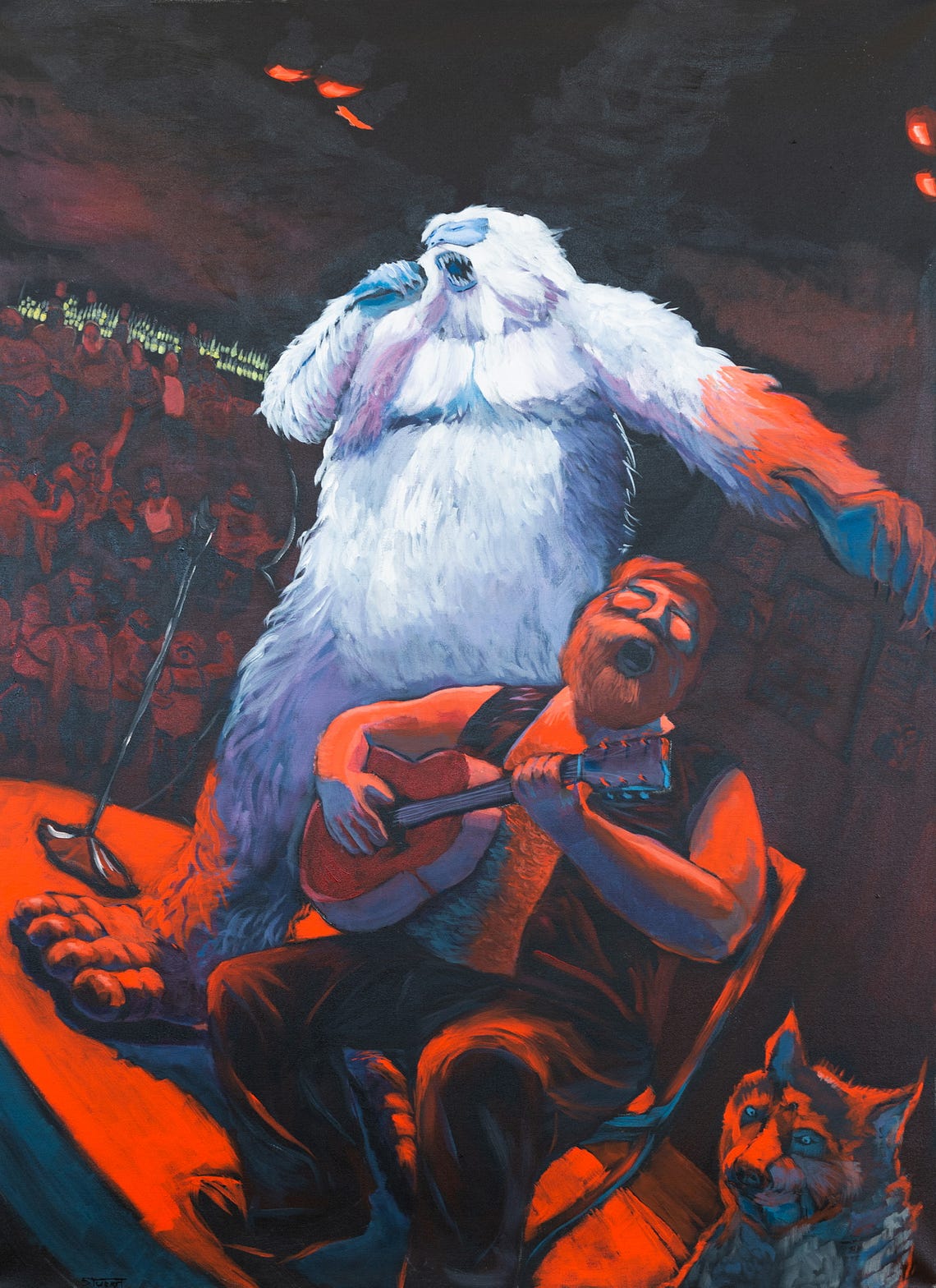
In 2019, I created a set of 10 paintings of Yukon Cornelius in the style of NC Wyeth — a style of boy’s adventure books popular in the early 20th Century, to explore what a gay hero might look like to me — the kind of gay hero I wish I could have had growing up. In 2022, I completed a show of about 50 paintings, acrylic and watercolor, with stories to go with them, titled, “The Further (Queer) Adventures of Yukon Cornelius,” where he went out to help other cryptids sometimes with his partner, Bumble. It gave me a gay hero that I would have loved to have read more about. We only got 10 min of Yukon Cornelius in “Rudolph” but it made me want to see what might happen if we had more time with him. Who else could he radically accept?

The Queer Connections

Yukon is the Santa we want to believe Santa is. Inclusive, accepting, encouraging, helpful, transformational. I think Romeo must have put this in here intentionally. As a writer, I can’t see this parallel as anything but intentional. Especially regarding the themes, and knowing Romeo made up the whole plot himself outside of Rudolph’s original rejection. I know you’ve probably come across a couple of articles that look at the gay themes in this show — -but wow, they certainly hit LGBTQ people strongly, whether or not they were intended to.

ALL people can identify with being rejected at one point in their lives for not being what other people thought they should be, which is why this movie has lasted for 59 years, being shown every year (I think it’s considered the longest running annual show on TV). It tapped into something universal. Rejection is HUGE for kids, and the fear of rejection is paralyzing. We are all, in some ways, a misfit.

But I do believe there is a specificity of rejection present here. Something queer kids know too well. When Donner is blamed for his son’s behavior, that Rudolph is not what his father wants him to be, and that this gets Rudolph banned from a place in society, that really hits so hard for queer people I think. To me there is a strong queer undertone for the KIND of rejection Rudolph goes through and the KIND of rejection that Hermey faces. They face shame for their different desires, their different aspirations, and their families are shamed too.

In this film, I believe Yukon Cornelius is a model for a better version of Santa. I think Romeo Muller wrote that on purpose, writing parallels to Santa into the DNA of Yukon Cornelius, in order to highlight their similarities and differences. I think he wanted us to rethink the way we “gift” others with our friendship and our acceptance. Are we here to judge them, to find out if they are naughty or nice, and then decide whether they are acceptable, or misfits?

No, I think we’re here to be more Yukon Cornelius. We are here to befriend, belove, rescue, support, transport, help, and accept people where they are, and for who they are. We all need a little more openness in our sleigh, to carry people, and not just our things, our job. We need to be able to detour away from our agendas at times and help out others with their agendas.

Perhaps today, Santa could learn some tips and could shed the “nice” and “naughty” criteria, allowing universal access to benefits and beneficence by practicing a little radical acceptance of his own.


Jerome Stueart (2007 Clarion Workshop) is an American and Canadian queer illustrator, writer, and professional tarot reader. His writing has appeared in F&SF, Tor.com, On Spec, Lightspeed, Strange Horizons, Geist, and elsewhere. He was a finalist for a 2020 World Fantasy Award in Short Fiction for “Postlude to the Afternoon of a Faun” (F&SF). His PhD in English (Texas Tech U) with specialties in Creative Writing put him forever in debt, but has allowed him to live and work as a teacher part-time for more than 25 years, running writing workshops in academia and through city programming, in schools, in churches and online. He also has a background in theatre, history, tourism, and marketing. He was the former Marketing Director of the Yukon Arts Centre in Whitehorse, Yukon. An emerging artist and illustrator in watercolor and acrylic, he lives now in Dayton, Ohio.

ALL the PARTS of Protect the Autumn Woods

To get you on the right path for “Protect the Autumn Woods” just choose the first block here on the left to start the story. And then you can just follow the link at the bottom of each of the chapters…. they will take you to the next chapter.

I have loaded the first 5 of them here with links, and will do that for the rest of them soon, but if you get to Chapter 0 The Autumn Woods, and you want to read straight through, you can do that from the first chapter.

Eventually, all of these will link to their chapters. Thank you for your patience as I put the autumn woods in order!

6. Badger Mastermind (Autumn Woods)

Gressler reminded them that Orcs were not dumb, but they had tendencies that could be taken advantage of.

Orcs, because of their size, and the size of their people in relation to every other creature, tended to believe that size and strength were all that mattered. Because they got what they wanted with size and strength.

So they to believe that they could conquer and overcome any group, no matter how many, because of their size, strength and stamina. Small things posed no threat to them, ever.

“How is that helping us?” The Beaver brothers asked. “We are small things.”

Gressler pointed out that along with their belief that they could win any strategy that favored strength and size, they tended to discount cleverness, trickery, intelligence. The Bix were taken by surprise, he reminded them. Bix are clever, and if they had known–as we know–that the orcs are coming, they could have prepared.

Other things to know about orcs: They had good eyes and ears. But that lead them to depend on them too much. They tended to trust what they saw and heard.

“Also, when in armies, orcs are often overworked by their commanders. It stems from the belief that orcs are strong and strength and stamina are the very nature of an orc. So they don’t give them breaks. This means they can be more exhausted than they will ever mention,” Gressler said.

He turned to a map of the Autumn Woods, a large detailed map where he had already marked where they were, according to Craek, the paths they were taking–and the ones they were avoiding.

“I believe,” Gressler said, “we can reroute them using natural barriers, distractions, and detours to move them quickly out of the woods.” He gave them all marking tools. “Now, let’s come to the map and see what we can do to guide them away.”

They would not be taken by surprise. They had the advantage. They just all had to come together and do it.

Go to Chapter 7


“Protect the Autumn Woods!” is an illustrated story by Jerome Stueart in 33 short flash fiction chapters. The story features D&D-inspired magic-using forest animals who fight to protect their homes. This story was at first a response to a prompt list created by Jenn Reese and Deva Fagan for an October Art Challenge in 2021. You can now read all 33 parts of the story, “Protect the Autumn Woods” with the search term, #AutumnWoods. “Protect the Autumn Woods!” Art Show at the Dayton Society of Artists (48 High Street, Dayton, OH) from November 1 — December 15 2024.

“Protect the Autumn Woods!” is adjacent to a larger show of amazing Dayton Artists, “Small, but Mighty.” Come see all of the art, any weekend, Friday 12-5, Saturday 12-5 to experience the art yourself.

5. Moth Mount (Autumn Woods)

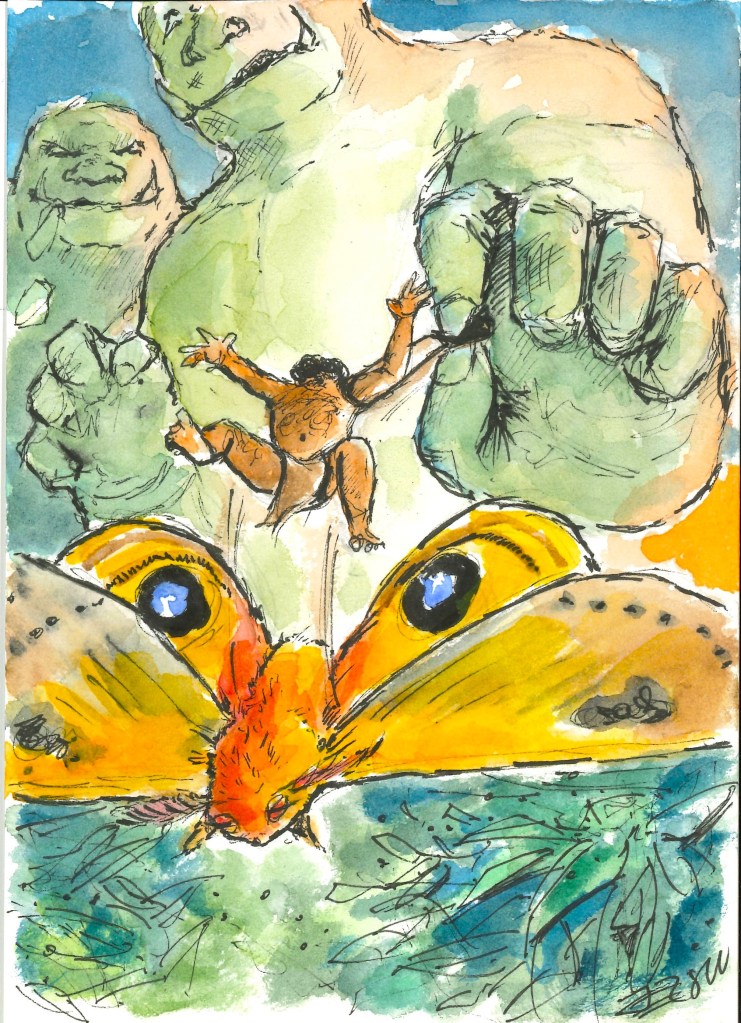
When Craek returned, and told them what he’d seen, everyone suddenly remembered the bix village massacre in Summer Woods many years ago.

“They were caught by surprise!”

A thriving group of little people of the forest, the bix were an important part of trade between the Summer Woods and outside villages of humans. You could find healing ointments, teas, remedies of all kinds, at a Bix Market. They could enchant acorns to guide you, put a protective leaf in a locket for you. The Bix were hard-working magical people living in harmony with the humans around them. The Summer Woods, always a delight to travel through, had been such a helpful place for humans and animals alike, partially because the Bix were there offering everyone the best that herbs and magic could devise. They enhanced the kingdoms around them.

This is how they were noticed by the Orcs. Everyone had heard a version of the story of the Maebon Massacre, or Bix Slaughter, or some other title. It was the kind of story that made good people think twice about being too kind, too open, too vulnerable. The bix didn’t make swords or weapons. They made medicines and remedies. Sometimes the story was told in a way to suggest, “See what happens when you get known for being nice.”

They were all killed and eaten. They say the orcs put their teas and medicines around what was left of their corpses. As if to say, heal thyself.

It reminded them of the horror that others could do. But it was so unthinkable that it became unthinkable— to think about it too much made people anxious and scared and paranoid. Orcs could turn up anywhere! In some ways, the story just couldn’t settle in a mind that believed that good things happen to good folks. Some variants of the story had to give the Bix some fault—outside of being noticed by Orcs. Others just said it was myth.

Nevertheless, the story drove them now into a frenzy. How do they protect themselves from this passing group of orcs? Why were they here in their woods? What did they want? Would the same fate await them as the bix of Summer Wood?

No.

They wouldn’t believe it.

They would fight and they would be clever and they would survive.


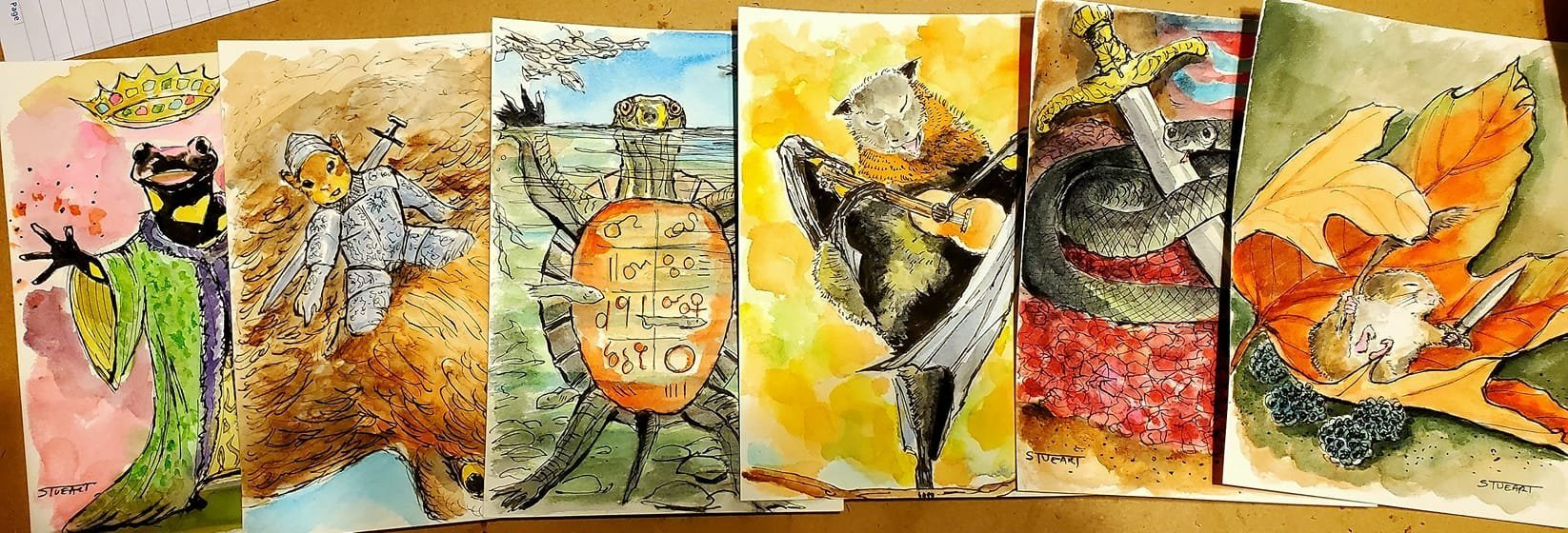
“Protect the Autumn Woods!” is an illustrated story by Jerome Stueart in 33 short flash fiction chapters. The story features D&D-inspired magic-using forest animals, all retired from dazzling adventurous lives, ready for peace and quiet in the midst of a spellbound forest, a woods with a very long autumn. When a mysterious troop of orcs, armed for battle, march into their woods, the heroes will do anything they can to keep the orcs away from their loved ones. Sometimes, though, the wards and tricks won’t work. Sometimes, you have to fight harder just to keep what you have.

This story was at first a response to a prompt list created by Jenn Reese and Deva Fagan for an October Art Challenge in 2021. Anyone who wanted to play along could draw pictures according to the prompts and post them on social media with the #autumnwoods hashtag for 31 days. I drew pictures and posted them. But I added D&D classes, and then a story happened. You can now read all 33 parts of the story, “Protect the Autumn Woods” with the search term, #AutumnWoods, or hear them all narrated to you on Substack as you go through the “Protect the Autumn Woods!” Art Show happening at the Dayton Society of Artists (48 High Street, Dayton, OH) from November 1 — December 15 2024.

A reception and opening happens this Friday, November 1st. “Protect the Autumn Woods!” is adjacent to a larger show of amazing Dayton Artists, “Small, but Mighty.” Come see all of the art, Friday, November 1st, or come back any weekend, Friday 12-5, Saturday 12-5 to experience the art yourself.

4. Beaver Crafters (Autumn Woods)

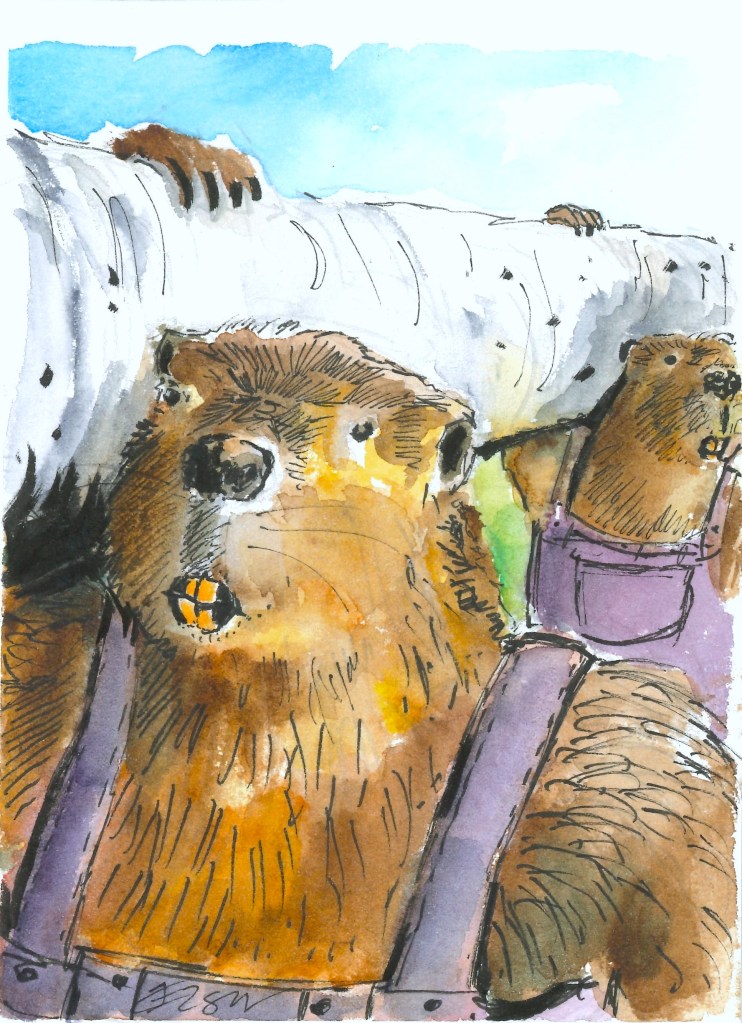
Kelsky and Big Slap had been the kind of brothers that didn’t need to say very much to each other, but they seemed to understand and communicate effectively anyway. A gesture, a nod, something anyone else would dismiss, was enough for them to cooperate on opposite sides of a river or stream.

Mama Beaver said they were born with the same mind. They’d laugh at that.

“I have half a mind to argue with you,” Kelsky would tell her.

“And I have the other half,” Big Slap would say. “But arguing with you is harder than Oak. I’m gonna go fell a softer tree.”

When they heard the call from Brother Fenzel, they had the same idea at the same time. Reroute the orcs. It was a simple as that. Everyone liked an easy path. You just got to make all the other paths too much trouble. It was like building a dam and guiding water.

And guiding a river, redirecting a stream, wasn’t that different from redirecting a troop of orcs, was it? They just needed to clear any path they wanted the orcs to take; and fill the rest with barriers, fallen trees, branches, things that wouldn’t look purposefully placed, but naturally fallen.

They needed the woods to be a suggestion of pathways.

Their suggestion.

They did not have time to fell as many trees as they needed. They would have to use what they already had. And what they had were their homes.

Kelsky grabbed both sides of a big sycamore atop his recent den addition and pulled, disturbing several other branches and logs.

“No,” his brother said, slapping the ground with his tail. “You need that.”

His brother smiled, his two teeth bright, “I’ll be getting it back, don’t worry, brother. It’s a temporary thing.”

“Well, we will need more logs than that.” He began dismantling the roof over his kitchen.

His brother huffed loudly, “There is plenty in this den. I overmade it anyway. You just keep your kitchen and we’ll use my den.”

“Won’t be enough, and you know it.” Big Slap kept pulling out logs from his kitchen.

Conversation was over. They both knew the other would not relent or change their mind. They were both right. It would take several well placed logs and branches to block the paths. Fitting that they would use their homes to save their homes.

Without a word, they spent the afternoon, pulling and dragging and scattering their home logs and branches into an effective set of barriers, placing them as if the wind had merely knocked them over and an open path never existed.

Go to Chapter 5


“Protect the Autumn Woods!” is an illustrated story by Jerome Stueart in 33 short flash fiction chapters. The story features D&D-inspired magic-using forest animals who fight to protect their homes. This story was at first a response to a prompt list created by Jenn Reese and Deva Fagan for an October Art Challenge in 2021. You can now read all 33 parts of the story, “Protect the Autumn Woods” with the search term, #AutumnWoods. “Protect the Autumn Woods!” Art Show at the Dayton Society of Artists (48 High Street, Dayton, OH) from November 1 — December 15 2024.

“Protect the Autumn Woods!” is adjacent to a larger show of amazing Dayton Artists, “Small, but Mighty.” Come see all of the art, any weekend, Friday 12-5, Saturday 12-5 to experience the art yourself.


3. Blue Jay Spy (Autumn Woods)

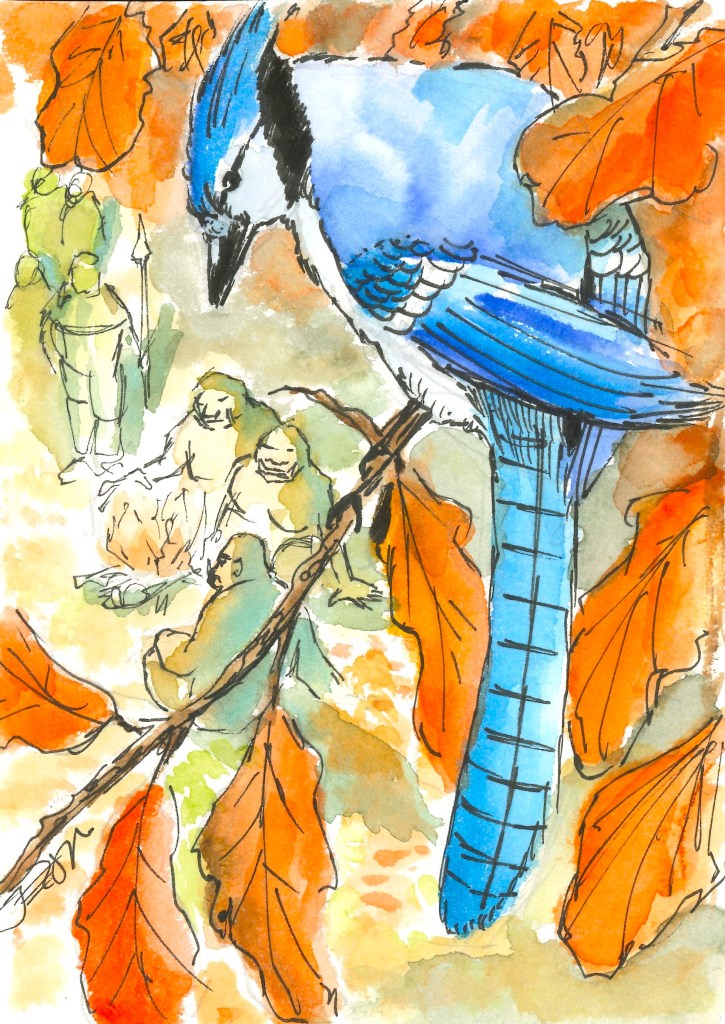
Craek collected rings. Gold inlay, brass, silver, it didn’t matter. If it shined in the sunlight, and was left out on a balcony, or next to a window, he would be pulled in.  He couldn’t resist those rings.  He had his ring collection stored high in an oak tree.

As a spy for Princess Kaera of Brightsun, Craek had helped stop the War of the Valley before it started by relaying the battle plans of the other two sides, had blabbed on the behaviors of three awful suitors seeking the hand of the Princess, and, less than 5 hours after the royal kidnapping, Craek found Little Prince Nessian.

He was given the highest honor of the King after that, as well as a small treasure of shiny, sparkling rings—but, of course, then the entire Kingdom not only knew of his bravery, but of his spying

So, that job was over.     

When he was ready, after training the next group of spies, he took his leave and retired to his nest of rings in the Autumn Woods. 

He was content to bring occasional news of the Outside Word to the group.  More and more, though, he stayed at home, mesmerized by his treasures.

“Promise me, Sir Craek of the BlabBlab, you won’t forget us as you travel from kingdom to kingdom.” 

He could not. Their love was the shiniest thing he’d ever had.

Tonight, though, Craek couldn’t forget the Princess.  Perched over an encampment of orcs, he saw the seven Brightson Ruby Rings around the neck of one of the orc soldiers.

They’d lit a fire, massacred several small rabbits from a local warren.  Now, the soldiers chewed without speaking, pulling the meat away from the spit with their tusks, . 

Continue reading

2. Weasel Cleric (Autumn Woods)

Brother Fenzel struggled in this wind to light the candles of the Passive Hours, the hours in the middle of the night when your fate was in the hands of the More Powerful.  The candles were a symbol of light, clarity, even in the darkness.  However, tonight the wind snuck through the branches and stones of the little shrine, making it harder for him to see that clarity, that light.  He had trusted his life to the care of Mundimila the Compassionate.  She protected the wanderer, the castaway, the hidden, the vulnerable, and so he honored her for her help in these vulnerable hours.  He was the attendant and cleric of her forest shrine here in the Autumn Woods.  But in this steady night breeze, even inside the shrine, the candles would not stay lit. His old hands trembled to light them again.

He’d been that kind of wanderer for many years, on lonely paths, mapping the world with his feet, pulled by wanderlust.  But then, one night, he’d heard Her singing and followed the sound.  She led him to the Church of the Starlit Branches, promised him something bigger than just his vagabond traveling.  Folks of the forest gave him food and shelter and friendship.  Many of them were displaced by war—smaller creatures, humans, Silvi, the Reconstructed, the Clodders who were just trying to settle again, anywhere.  He stayed, became a cleric, learned healing magic.  He found he wanted to help people. He served them for years and thought he always would.  But you don’t always get to stay where you want.

Continue reading

1. Black Cat General (Autumn Woods)

The Autumn Woods were peaceful.  But that didn’t stop retired General Astrati from his day-long perimeter walks.  Despite the widespread opinion that there was no need for such a constant search for danger and enemies, Astrati did it anyway.  He claimed it was good for his knees.  This allowed everyone to believe that he secretly took the walks to be alone.   But how could a soldier so easily retire after being vigilant most of his life?  You cannot turn it off.  It only made sense to him to offer his best skills to the group:  his watchfulness, his paranoia, his darksight, and his wariness.  Honestly, he was being a realist. Peace has to be protected.  Boundaries must be enforced.  They didn’t understand vigilance.

Astrati, they said, you get to be at peace too.

They’d all served their times, done their duties, been the advisors to Kings, been the mentors to magicians, the wise consultants for quests, the champions—the Generals.

This was years ago. 

Now, they had each moved to the Autumn Woods to have lasting peace in their older years, far from the cities, far from the villages and towns, deep in the safety of a thicket of bushes and trees with old roots that twisted and tangled through the hollows. 

They were entitled to rest, weren’t they? Let the Woods ward the strangers away, let the scary stories spread.  How can we be at peace, when we look for danger? 

Continue reading

0. The Autumn Woods (Autumn Woods story starts here)

Welcome to my illustrated story, “Protect the Autumn Woods.” Here you will find all the illustrations and their corresponding short chapters. Most of the chapters are less than a thousand words.

Once you read a chapter, you can click on the link below, or the right arrow to go to the next chapter.

If you are viewing the paintings at the Dayton Society of Artists from November 1-December 15, you can just read along with the paintings on the wall. They should go in order.


Prologue

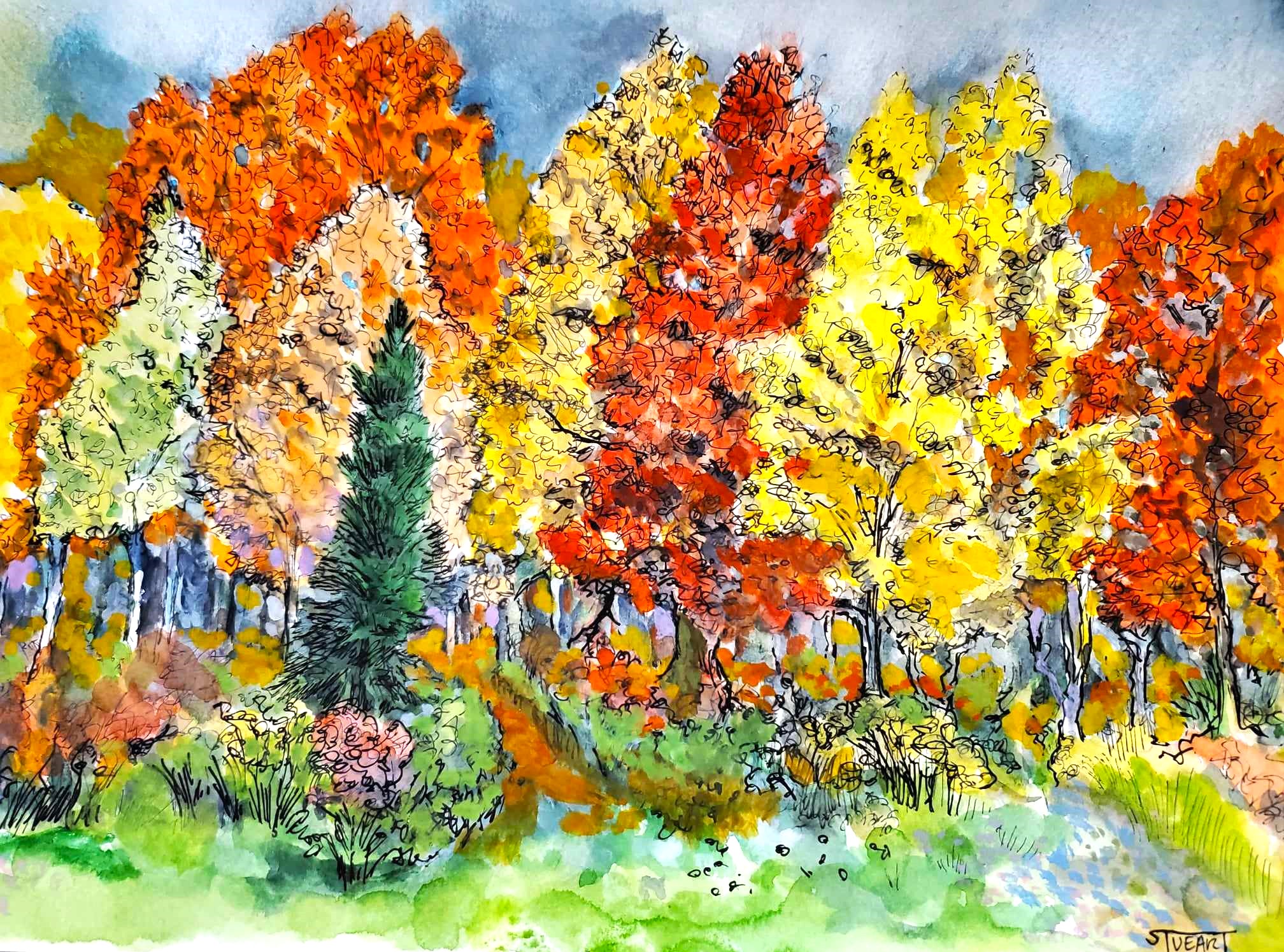
To outsiders, it seemed like fall came way too early to the Autumn Woods and stayed way too late.  The first trees to turn sang their first notes of autumn in spring. And the last of the trees’ colors stayed till the chill of winter, adding extra red and orange to the snow.  It was unnatural, some would say, for trees to linger through fall so long.  They could be right.  Leaves were almost always red and yellow and orange. Consensus decided the Autumn Woods were under a spell.  

Stories about the Autumn Woods, like the woods themselves, were a bit more colorful and lingered in the imagination longer than most stories. People said they were enchanted.  That their beauty was a lure.  That magicians and sorcerers lived in the woods, dangerous fighters and thieves and those who controlled the dead.

Others wondered if so many powerful people could live together peacefully. They’d quote the “Sole Witch Theory” of woodslore: that any woods purported to be dangerous or enchanted has only one powerful person at its center because, chances are, multiple powerful beings would not get along.

Though theories argued about who lived there, they agreed on one thing: that the paths through the Autumn Woods should only be used in emergencies, and that the magic there might be helpful and benign, but could turn against a nosy traveler. 

Best to leave these woods alone.  
              
In this way, the tales created a buffer between the Autumn Woods and the rest of the valleys, towns, and fortified cities that lay off in all directions.

Go through the Summer Woods if you want with its frequently-used, well-worn paths.

Take any of the paths that skirt around the Autumn Woods.

But unless you wanted to become one of the stories of the Autumn Woods, it would be best just to look, from a distance, at the bright yellow aspens, the boastful red and orange sugar maples, and see all the bursting, jovial trees and bushes as a curtain, holding a mystery from you, for your own good. 
              
Stay where you are now. On the edge of safety.


Go to Chapter 1


“Protect the Autumn Woods!” is an illustrated story by Jerome Stueart in 33 short flash fiction chapters. The story features D&D-inspired magic-using forest animals who fight to protect their homes. This story was at first a response to a prompt list created by Jenn Reese and Deva Fagan for an October Art Challenge in 2021. You can now read all 33 parts of the story, “Protect the Autumn Woods” with the search term, #AutumnWoods. “Protect the Autumn Woods!” Art Show at the Dayton Society of Artists (48 High Street, Dayton, OH) from November 1 — December 15 2024.

“Protect the Autumn Woods!” is adjacent to a larger show of amazing Dayton Artists, “Small, but Mighty.” Come see all of the art, any weekend, Friday 12-5, Saturday 12-5 to experience the art yourself.

Start your new Fantasy/ Scif/ Horror book on this Pisces New Moon

Whether you believe in astrology or not, it can’t hurt to START your BOOK NOW! It’s always a good time to start the thing you’ve been nervous about starting, or hesitant, or uncertain, or just didn’t have the reason to think this was the right time to start it. WELL, why not try this:

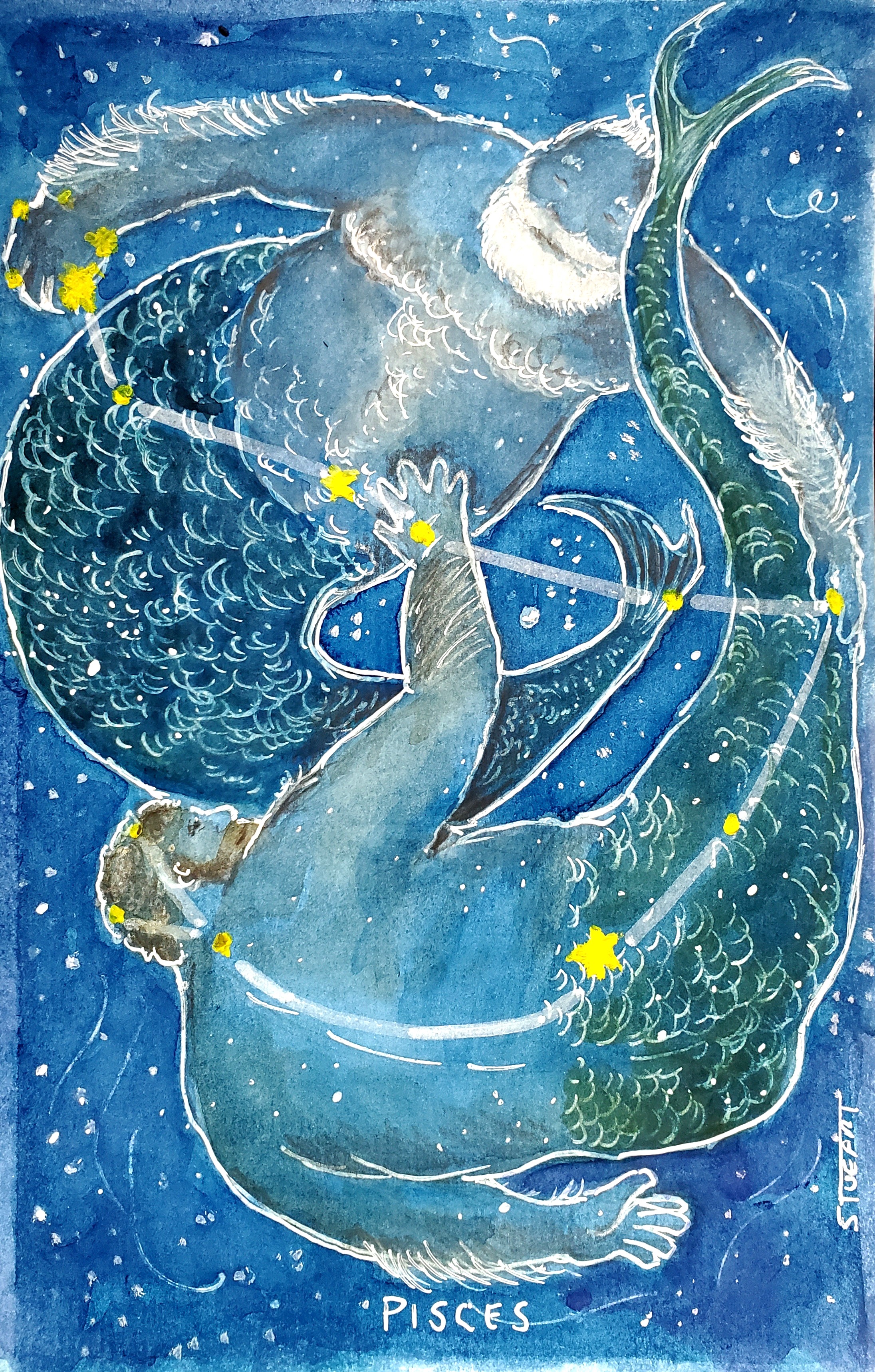
Feb 20, 2023 is a New Moon in Pisces wherever Pisces falls in your chart. It’s for wishing, dreaming big, tapping into your imagination and Fantasy—and it’s conjunct (connected right now with) Saturn, the planet of Get Your Workboots On, We’re Doing It. I think this might be a very helpful time for fantasy and scifi and horror writers to start that book you’ve wanted to write and make a plan to follow through. Saturn is there to help you, and keep pushing you, and getting all the distractions out of your way, and he will also ask you over and over again, “is this what you really want?” after a setback, after it gets hard, you will feel this urge to tap out—but I also think you will feel an urge to push through.

Let’s start a group of Piscean Writers who started their book projects (game project, art project, play, movie, etc) tomorrow–with a plan of action, a few words on a page, a brainstorm, etc… but something that begins it on Feb 20, 2023. Let’s see if that has any effect–test the waters of astrology, of Pisces–to see if that new Moon can help us set an intention that will help us achieve our goal. Now, this new Moon is good for starting lots of stuff connected to emotions, sleep, dreams, compassion, empathy, the arts, forgiveness, — and wherever Pisces is in your chart will give you a clue about what you might be starting. For more on that visit Cafe Astrology (with your birthday, birth time and birth city if you know it) and get your chart done and find out where Pisces is in your chart. It’s my 10H, so my house of career… I want an imaginative, fantasy career….

Maybe you do too….

Here is Octavia Butler’s written down intentions for her writing career:

Look at how specific she was! How powerful it is to write down your intentions and then focus on them.

Read those.

Now, write some intentions of your own for your future.

If you start your novel, short story, art project, etc tomorrow, Feb 20, 2023,— let me know in the comments and we can help each other stay on track for the next six months (at least—with the Full Moon in Pisces, sometime in August) and see what happens. Not saying you’ll get done with the project then—BUT—you may find yourself at a very fantastic pivotal spot in the project then.

Come be a Piscean New Moon Writer with me!