October 24:  Yukon Cornelius restores the Joy of Satyrs

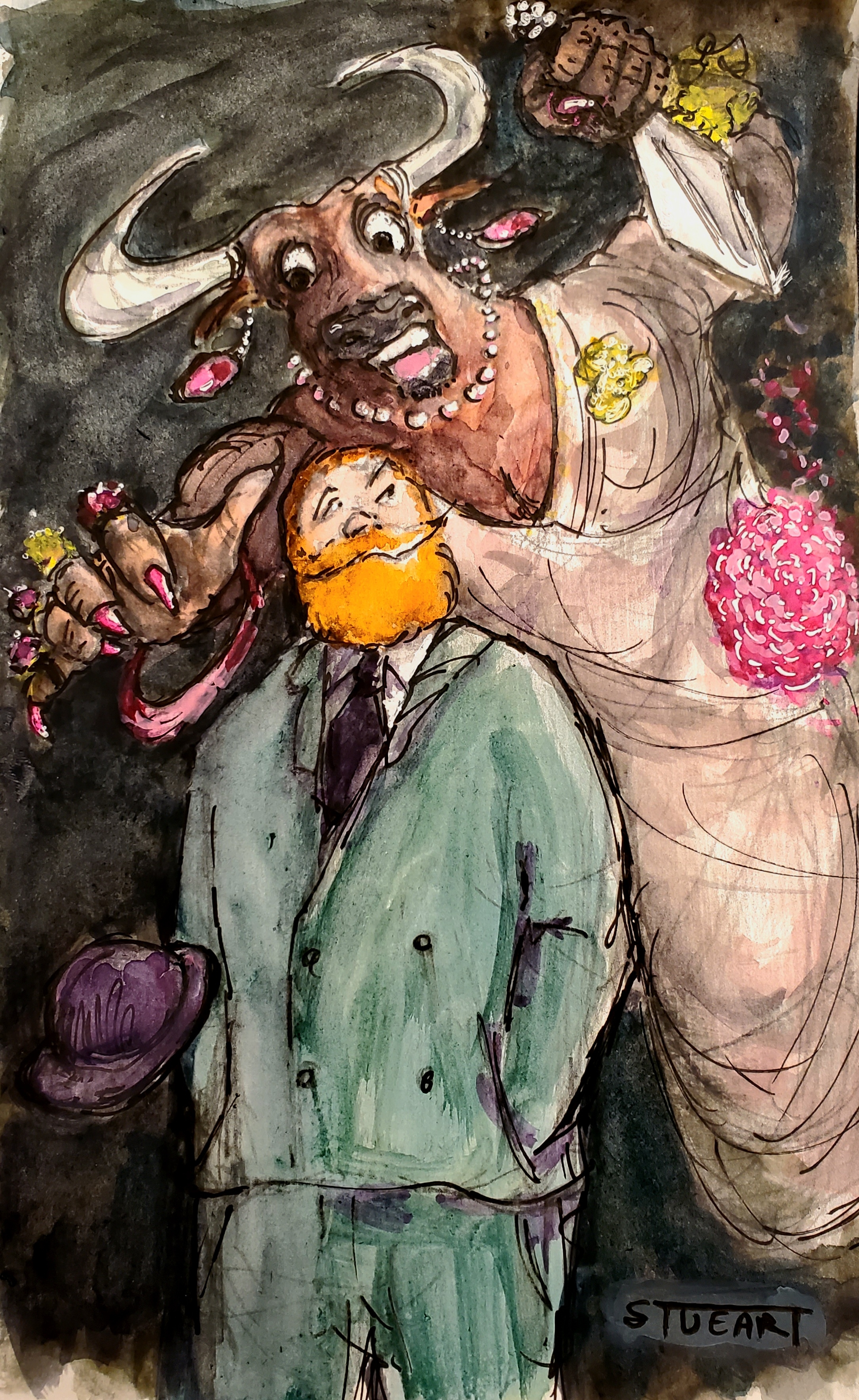
It is a truth universally acknowledged, that a man in possession of a rigid dogma must be in want of others to harass. It is also a fact that you can’t shout into a forest for every creature, animal, bird and insect to stop having sex. It is a forest. They will not listen to you. Nevertheless, some people try it. I watched with my satyr friends from the trees as a man in his thirties in a checked polyester shirt and brown slacks bent down, turned on an amplifier and squeaked the megaphone in his other hand to test that it was working. He stood up and faced the meadow, “Little DEVILS!” the megaphone shouted and squeaked. He bent down and adjusted the volume. He stood up and cleared his throat. “Little FORNicating devils! Good morning! I know you can hear me. I came here from a Holy Place to tell you that the Lord does NOT love you.” You can probably guess the rest. This went on for ten minutes, spewed almost in one continuous breath. He seemed to enjoy it too, as he gyrated his body whenever the word “sex-u-al” came up, like he was working a hula-hoop around his waist. He said all manner of nasty things about sex in general, about their sex definitely, and about their lustful ways. Apparently he did this three times a day, and had been doing it for the last three months.

“He’s honestly wearing us down, Yukon,” Cosmo said. Estevan confessed that he was starting to think the man spoke the truth. He didn’t know this man’s god very well. This is the first time he’d heard about it. But gods should be respected, and now, there was a god who didn’t want them to play in the meadow anymore. Art said, “They enjoy words like ‘lasciviousness’,” and all of them repeated the word the way the youth would say it, “and fornication. They quote a poem to us that describes us but they spit when they say it—“for they exchanged all manner of lusts with each other and lied down together.” They nodded. Art continued, “We love doing that! I exchange lust with Wendell the Tall and Dark, and Wendell the Tall and Dark exchanges lust with Cosmo, and sometimes two of us exchange lust with a third at the same time.” They were all very robust looking men with goat legs and horns, grinning about their passions. Estevan said, “But when they say it—it makes me feel I should be ashamed of myself.”

Had I ever heard of anything shaming the sexuality of a Satyr? I had not. Art said, “It’s what we enjoy. We have a lovely day of just having pleasure and playing our flutes and dancing and singing.” Cosmo said, touching my arm, “We lost two of our group a few weeks ago, Tadd and Flavian. One day, they just came into the meadow and said that they realized they had been going through a sexual phase for the last three hundred years and had now, that week, grown out of it. They were more mature now, and well, they didn’t want to stay in the forest with us anymore. They urged us to grow up, settle down, and to get meaningful work and contribute to society.” Where did they go, I asked. They said, “Corporate administration.”

They asked me what they should do. How could they get rid of these people? I told them, “I’m more concerned about the effects on you. It’s vile and toxic, but you should know that there is nothing wrong with your horny sexy ways. You should feel free to have as much sex as you want with each other in your meadow, in your forest, all day and all night. These people didn’t speak for their god. Love cannot enjoy hurting others. It can’t.” Outsiders had no right to take away what’s been giving the satyrs joy every day. I told them that these people are speaking from their fear and their lack of comfortability with their own bodies. And they want you to be as uncomfortable with your bodies. “They are intimidated by your freedom to express yourselves. They are jealous of your pure joy. I don’t see any real joy in them—except the pleasure they get from inflicting pain and ‘being right’ in their dogma, do you?” They shook their heads, agreeing.

Before they sunk into a funk, I told them. “But, I see so much joy in you. I don’t want you to lose that joy because of what someone else says. It doesn’t matter in whose authority they say they come in. Sexuality isn’t theirs to govern. It isn’t anyone’s to govern. As long as you make each other happy, and everything is consensual, you should be able to do what you like.” I knelt and drew a circle in the dirt and placed four rocks in it. “But you live in a place where people are often afraid of sexuality. A lot of humans right now are under similar situations—being harassed, even controlled, by the fears of others—fears about others’ bodies, their own bodies.” They could not understand why anyone would be afraid of their own body or the bodies of others. Afraid of pleasure. I said, “For them, it’s tied up in old ideas of shame, ownership, people as property, sexism, and a fear of the wrath of a loving god they were talking about. Unfortunately, you live in that place surrounded by that. We all live in that place.” They sighed. “But,” I pointed to my head, “They don’t live in this place.” I touched my heart. “They don’t live in this place. You can’t let them into those spaces, okay? No matter how loud they are. You can’t let them take over those spaces. You must remember the joy you have and not let anyone take it away.”

“What do we do with them? It’s hard to ignore them when they have a megaphone.” I told them to leave that to me. I had some friends that might help. I think they could change the situation. “Come see me in two weeks if things haven’t changed,” I said.

***

I needed an incentive for the evangelists to move, and I needed a disruption to push them to move. I also needed to stamp it with an authority they understood. I dressed up in my oldest out-of-fashion suit and found a leather-bound book that could look like a Bible from a distance. It was “Wind in the Willows,” but it would work. I went to Horace, a friendly, chatty ghost I knew. He let me borrow something he was attached to—a letter from his father—to take with me. I slipped that into the book. I found the church they were associated with. I walked in as a traveling evangelist and, with the right words, was accepted immediately. I told them dramatically why I had to come and see them. This vision I had received concerning them! It was so positive! How well they were doing! So God decided He would put his best people in the most needed place—downtown—to rail about Corporate Greed! He needed it loud! He needed his best humble servants! I slipped Horace and his letter under the cushion of the pew. Of course they weren’t going to be convinced right away. You have to synchronize messages from other places. After I left, Horace worked on them for a week, whispering to them about how greedy the corporations were, how He was upset about it, and started to win them over by correlating with my “vision.”

Finally, I contacted the poltergeist, Tammy, I met at GenCon. She was still hanging out with Ellen listening to old vinyl records and only slightly restless. I asked if she might visit this church. She asked Ellen and me, “Can I stay with them for a bit?” Ellen told her, “Yes! You can.” Tammy clung to me till we got there, met the pastor for a follow up visit,  and then she transferred herself to him.  She ramped up so much chaos at the church, each day, enough for them to believe that their god wanted them to move immediately –out of this possessed place. One night, during a service, all the hymnals floated out of their racks and opened above them, and the organ played something sinister. They ran out of the church and quickly positioned themselves downtown against The Beastly Greed of This Age. They were happy doing the work they did best. I went back to the church, now with its doors wide open but empty, retrieved and returned Horace’s letter. Tammy had moved with them. I hoped she would pace herself, give them some time to get comfy downtown before she started up again.

My satyr friends came to see me very soon afterwards, and invited me back to their recently reclaimed meadow and forest. I got a little carried away! But it was fun, and we all had a great time. Be good to yourselves, and be kind to others.

Tammy is watching you.

______________________

*not all faiths or all Christians are like this. You know specifically who I am talking about. And while our satyrs and Yukon love sex, we have folks and friends who are Ace (asexual) and are perfectly happy. None of these groups try to push their sexual values or ideas onto others or force behaviors or shame others for their differences. God bless you. May Tammy never bother you.

October 23:  Yukon Cornelius considers traditions with the Gryphon

Everyone thought she was part of Dragon Con—this 50 ft tall Gryphon that wandered into the Atlanta Marriott Atrium. Something animatronic. Something amazing. But definitely something there for a photoshoot. I found her surrounded by Jedis and Sith. I was on my way to get my Captain Kirk cosplay. Bumble, dressed as a Mugato, was waiting for me at a panel on the “Art of Charles Vess.” How did she even get into the conference center?  She was about to attack people with colored swords aimed at her. So, I did what I do in these situations: I ran up, waving my arms, and yelled louder than anyone else.

She saw me. I told all the Force-Users to back up slowly and exit farther into the connected hotel. I told them not to get security involved. But then I saw five security men stood staring at the Gryphon. I waved and yelled at them too.  She snatched my shirt with her beak and lifted me up as I told the security officers not to shoot.  And then she sat down and put me in between her front talons, and began to bellow, “I have searched for you!” she cried. “Across the Himalayas, the Caucasus, the Alps, the vast ocean, to find you here— finally— in your castle fortress!” She looked around the conference center at all the Jedis and Siths,  “Filled with your monks.” Her eagle eyes came back to me, resting between her paws. “You must help me.”

Her name was Mela. She had lost her mate several years ago, she said, and had relegated herself to a life alone, as was the way of Gryphons.  She had resisted searching for another.  She was content to fly above her mountains and sing her mourning songs in the hollowed aerie at the top of the craggy reach.  Until, that is, she wasn’t content.  “I can’t—I can’t stay alone,” she said. It happened to her over the years that she wanted to try again—with someone new. But then she would think about her traditions and about what made her a regal Gryphon and that this was part of her too—that she must live the rest of her life—which could be hundreds of years still–alone.  She sobbed. “I don’t know what will become of me if I break the very solemn oaths and vows I gave my mate, my mother, my father, myself. But I also don’t know what will become of me if I don’t.” She had taken up sculpting rock as a way to keep her mind off her loneliness. Now, in her aerie, were twenty three stone gryphons carved into the rock of the mountain, looking at her, watching her, and, she felt, waiting for her to die.

A crowd had gathered around us, a crowd Mela ignored very easily, but which I was very aware of. Hundreds on the main floor of the lobby at the base of the atrium sat on the floor in their costumes. Hundreds more were standing and watching us.  I looked around and I saw my beautiful Mugato, with his one rhinoceros horn directly above his eyes. He signed to me, Are you okay?  I nodded.

“It’s your decision,” I told her, touching her talon. “But which one can you live with for a hundred years?  Can you live with not being a perfect traditional Gryphon?”  She shook her head, “I don’t know. I’ve never been anything else.  I wouldn’t know how to be anything else?” I shook my head. “I wouldn’t know what to expect from a traditional gryphon—you get to tell me.  All I know is that I’m in awe of the first gryphon I’ve ever met, and she wants to be something different—or she wouldn’t be here.” Her eyes widened and watered. She said, “I’m different, yes. I’m a disgrace.”

I assured her she wasn’t. Then, a rebel fighter pilot stood up and told her about starting over at 53, leaving his job which was killing him, and the town his parents lived in, and starting a new life far away in Durango Colorado, in the mountains, working with horses. Two Spider-Women stood up, cradling each other’s hands, and told about meeting each other at Dragon Con years ago, and how it changed their whole lives. They realized they couldn’t be the people their parents wanted them to be anymore, or their churches—and that their relationship revealed to them who they were, and they liked that change. “But it hurt and it was scary,” they said. Others around them agreed. A Groot and an Incredible Hulk talked about moving across the country to be with each other. Princess Leia talked about divorce. Scarlet Witch took up pottery after her husband died, but she also joined a salsa dancing group because she needed both, and this upset her family.  A Wonder Woman from the Middle East said that coming to Dragon Con and wearing this costume was violating her traditions, her faith, her family.  “I couldn’t live under those restrictions any more,” she said. “But I kept the part of my traditions and my faith that I still believed in.”  Voice after voice, witness after witness, this sudden panel on Breaking Traditions had a thousand panelists and an audience of one.

I said to Mela, “Perhaps carving twenty three gryphons into your home walls was you trying to tell yourself to find someone. You were crafting the perfect mate.” She thought about that. “But what if I search the world,” she asked all of us, “and I don’t find another one like me?”

The Mugato I loved now stood next to her talons and took off his rhinoceros horn and his mask. And he was just the Abominable Snowmonster now, and he smiled at her. He pointed to me, in his way asking if he could join me inside the talons. “He’s with me,” I said to her.  She opened her talons. I said, “I live with him. We are mates.  He makes me happy.” I told her, taking Bumble’s big hand. “It doesn’t take an exact match to help with loneliness.” He sat behind me now his arms completely around my chest, his nearly 8-foot frame and thick body dwarfing my 5’10 ½ size, and I felt warm and safe inside his arms, the first of three nesting circles made up of his arms, her talons, and the circle of the souls of Dragon Con.  I winked up at her. “You might expand your search a bit.  Find someone who isn’t like you because you …. are becoming something new.”  She sighed, but it wasn’t a sad sigh, or a resigned sigh, but a resolved sigh. She looked around the atrium at the thousands of people listening. She looked back at me and Bumble. I said, “Tell me, Mela, have you been to Alexandria, Egypt?  There’s a big outdoor night club there now with a DJ about your size.”  She said, “My size?” I said, “Have you ever heard of — The Sphinx?”

October 21:  Yukon Cornelius delivers letters for the crew of the Flying Dutchman

I thought I had a big curse in my early twenties, after my mom died, and monsters came to find me. Everywhere I went, a new monster. They always found me. I figured the only way to get away from monsters was to go to the open sea, so I joined the Merchant Marines. Yeah that didn’t work. Do you know how many sea serpents there are? Long necked dinosaur sea life? And Leviathan? We “discovered” so many of these creatures that the crew felt like the ship was magical. Until a sea serpent came to talk to me, and then I was magical. I was a “monster whisperer”—and some of the crew liked it, and some of them were wary… what kinds of monsters would I bring to the ship that could endanger the crew? Since we ran commercial shipping in peacetime and wartime, sometimes in the thick of battle,  what would these monsters do? I attracted loose cannons—who might do anything to protect themselves. This wasn’t a good thing.

“I can’t control it,” I told my mates, my captain. It wasn’t like I could cover some beacon light with mud or a sheet. It was a curse I had no control over. I considered resigning from the Merchant Marines, but I was a good able seaman, and there was this other guy who attracted sea gulls, so they figured it wasn’t right to let us go for what came to find us. Simmons was just going to have to manage the gulls so they weren’t a problem, and me— I had to manage the “other things.”

Well, one of those was a ghost ship. One late afternoon, a time for storms to whip themselves up on the water, in the clouds and a time for ships to hunker down, or get out of the way, we spotted another ship in the storm. Some storms are unavoidable. The ship had old rigging and sails, and rumors passed among the crew that it was the Flying Dutchman, a fabled ghost ship from the 16th century when the Dutch and the East India Tea Co were the kings of shipping on the seas. The ship had a curse too—that they were never allowed to go home again, cursed always be adrift on the sea, never able to be with family or those they loved. And if another ship saw them, it spelled certain doom.

I asked, “If it’s certain doom, then how did you hear the stories? Wouldn’t everyone have died—so who’s coming back with the stories?” This caused my bunkmates to think. Someone said, “They.” Another nodded, “Yes, they.” Who is they? They didn’t know. “Survivors,” they agreed and that convinced them the stories were true. The ship looked in trouble and was flying a flag signifying that they needed assistance. “You don’t help the Flying Dutchman!” someone said when more of us  surrounded the Captain and the Mates. “Why?” I asked on the deck. “Why don’t you help them?” And I told them if it involved the whole ship being doomed then where’s the stories coming from?  I concluded, “Maybe others have seen them, but no one’s helped them.” One of the older men spoke up, “They will try to give you letters. Letters that they’ve written to family members who are already dead. If you take the letters, the ship you’re on will sink.” I held up my hand, “If the ship sank, then how do you know someone took the letters?” A long pause. Someone with a scratchy voice said, “I say we send Yukon out there to see them. He’s good with monsters.” They agreed. “And we put him in a tender. If the tender sinks, we go pick him up.” They agreed quickly. I asked, “What if this isn’t a monster– or a ghost ship and they need our help?”  They would send two tenders. Five other crewmates would be in a larger dinghy, but I had to stay in my little dinghy, and go on ahead, and they would wait for a signal that it was okay to approach closer.

I did not want to go out and meet a ghost ship. But if this meant that I was keeping the monsters away from my crew, then I was willing to do it. I told myself, just go see what they want.

I rowed the tender out on a sea becoming choppy. The other dinghy followed at a safe distance. The ship that was in distress slowed as I approached. They also glowed as I approached. I felt I could hear the gasps of the five men in their dinghy behind me. A luminescent seaman climbed the ladder down the side of the big ship, and in his hand he held a bag. I got closer and closer. “You asked for assistance! How can I help you?” I yelled out. They didn’t say anything, but the man held up the bag. The man glowed green. The bag was green, and the wind was swinging it back and forth. “Do you want me to take the bag?” The man nodded and held out the bag to drop it into my dinghy when I got closer. “Do you need me to come aboard?” I asked. He shook his head. The bag dropped from his hand—almost missing–into my dinghy with a thud. I thought I heard a whisper, Letters home. I looked at him, probably closer than any other person not on his ship had been to him, I guessed.  I thought I had a curse. These men could never see their families or loved ones again. They were forbidden. They had no idea that so much time had passed. The crew of the ghost ship lined the railing above us, watching. Hoping. I was overcome with empathy at their suffering, so much that my “curse” disappeared. I asked them, “Do you want me to deliver the letters for you?” The man nodded. I had a wild idea. I said, “I’m going to bring letters back to you,” I said. “Will you come back to this spot in two months?” They nodded and whispered, We will.

I rowed the tender back to the ship where the other five men had gotten aboard. They would not let me climb up. “He has the letters,” someone said. They talked about whether it was safe to bring me aboard. It was not. But it also wasn’t safe for me to stay in a tender in the approaching storm. “Throw the letters into the sea!” they yelled, “And we’ll pull you up.” I said I couldn’t do that. I made a promise. “But you also promised not to let any monsters hurt us. How do we know the letters won’t hurt us?” I called up. “They need us to deliver the letters.” And, I added, I knew that this gift I had would never kill me—because monsters needed me— so therefore, I knew the boat I was on wouldn’t sink. I was hoarse now and couldn’t speak any more and the storm was loud, and the sea was getting rougher. They decided they could not let me die. They hoisted me up. They all stared at the bag which was now just an old burlap bag. They wanted to open the bag. I kept it firmly shut. Not till we were safely on shore, I urged. I tied the bag even tighter with rope and put in a plastic bag to keep it water resistant.

Some monsters don’t start out as monsters. They are made monsters. These men did something to be rejected by the shore, but was it a just punishment, or overkill? Who decided that punishment? “They might say it in the letters!” they said. Yes, I said, but that’s for a family member to read.  When we got to shore, I had a few days. I took them to a museum, and we opened the bag in the presence of curators and historians. Handwritten letters, sealed, folded without envelope into the shape of an envelope. They agreed to use special scanning techniques to read the letters without opening them, and translate them from various languages, and also find the descendants of the recipients. “In two months, please” I said. They nodded, understanding how important it was, “In two months.”  

In two months, a storm sprang up exactly where we had been, and I sailed out to the Flying Dutchman with a bag of new letters from the great-great-great (to the 11th generation) grandchildren of the recipients, or cousins, or some relation. They hoisted the bag up eagerly and it again glowed green in their hands. I told them I could come back every two months. They all looked at me for a moment, stopping what they were doing, and smiled and nodded. Then turned and continued passing the letters to each other, each man who would hear for the first time a response from a relation. And if, as it happened in many cases, a relation could not be found, they  found someone who might be able to answer the lonely letters of outcast sailors that read, “We are still out here waiting to come home.”

October 20:  Yukon Cornelius boogies with the Boogeyman

The Boogeyman came into my room at 4am, “Are you awake?” I barely heard him scrape a chair across the room and sit in it. “Are you asleep?” One of my eyes opened halfway, I saw a white face and steampunk glasses surrounded by chaotic darkness. I closed them. He said, “I can wait until you are awake. No worries.” He crossed his hands in his lap. “No,” I said, rolling over, flipping on a lamp, and propping my head up on a pillow. I yawned. “If you want to talk,” I said. “I’ll listen.”  He seemed happy at that.  He jumped right in, “I feel like my calling has been hijacked.  People talk about me—my name is on the lips of every mother in the world, in multiple languages! Boogeyman, Boogeyman, Boogeyman.  But they say it to scare kids.  They’re always saying false things about me — twisting what I do. Tell me, Yukon, what have you heard about me? What’s my reputation?”

I told him, “You come get bad children. Disobedient children. Children who break rules.” It was early, I was having trouble thinking, “Children who don’t do what society expects them to do.” He sighed, “And so they are threatened with me.” He straightened his back. “I’ll come get them,” he said dramatically. “Look at me. Do I really look threatening?” He looked like the Child Catcher from the Chitty-Chitty Bang Bang movie.  I didn’t tell him that. “You are a little… dark,” I said.  He said, “There is a place for darkness, you know. It’s not scary. It’s just mysterious.  What have we done with mystery these days?”  

I began to answer that question before I knew it was rhetorical.

He said, “We’ve made it all disappear. Everything has an answer. Science, Science, Science or God, God, God.” I nodded, adding, “So, the Boogeyman is mystery.”

“Exactly,” he said. “Why couldn’t he be an intriguing mystery to find out more about instead of a punishment for bad behavior?“ 

“You have the grounds for a defamation suit,” I told him. He perked right up. “Can I sue every parent in the world?” I told him that wouldn’t be feasible. Too many defendants. And they’re all using your name the same way, and ignorant of the truth.  It wasn’t unique to him.  Monsters were often judged on appearance alone, whereas actual ‘monsters’—the kind who WILL hurt you—are freely accepted by society and sometimes had positions of power.  They looked like average people.  And this allowed them to do their monstrousness to others without fear of retribution. Hiddens, however, had some trait that others considered weird, creepy, different, unusual, fabulous, something that made a person who expects or experiences a very narrow conception of what is “normal” very uncomfortable. I told him if disliking groups of people based on misinformation were subject to trial, a helluva lot of people would be asking for compensation.

“You aren’t going to get parents to change their use of your name,” I said, reaching for a notebook on the nightstand and a pen. He asked, “Should I change it then? Go for something less scary, I guess.” I said, “No, don’t say that.  They are defining your name as scary. It doesn’t have to be. Also, you have name recognition which works in your favor.”  I wrote some things down. “You should lean into the darkness part, and market yourself straight to kids. They don’t have preconceived ideas till their parents tell them.” He was excited. I told him he needed to have a whole public relations overhaul. “Parents say you will ‘get’ children who misbehave— perhaps these are children fighting against authority, aHA!” I wrote that down. “You ‘get’ children who have bad behavior—or—kids who don’t meet the standards society expects of them. That’s a wider group of nonconformists. So there!” I looked up. “You need to market yourself as exactly the kind of thing parents say will ‘get’ the kids who don’t WANT to fit into society.  You ‘get’ them—you ‘understand’ them. They will want someone to understand them.  My dark friend,” I looked at his beautifully scary face, “You need a webpage. Do you have a webpage? Okay, we’ll get you one.”  I scribbled some more ideas down, and the number of a few people I knew who designed cheap webpages. Actually, I thought, this might be a way to go for more Hiddens than just him. “Aim for kids. This is a kid’s space. Imagine—,” I held up my hand to a giant webpage in front of us as if I were writing the copy on front page: ‘Do you like to learn about horror, about mystery, about other people who misbehaved in history, about the Taboo things you shouldn’t know? Come learn with the Boogeyman!’” I told him Kids will want to “be gotten by the Boogeyman.” And— it’s an educational site!  “They will come to you!”

He joined in, “Disobedient? Come to my website!” I said, “Tired of your parents making all the rules! Come to the Boogeyman!” He called out, “Love the darkness? The scary? The weird? You’ll be right at home at The Boogeyman! Let the boogeyman get you! Boogeyman, Boogeyman, Boogeyman!” Already, I could hear in his voice, he had freed his name from the way other people said it.  He had reclaimed something used against him. He was happy with his name.“

Okay, these are good to start with. I’ll call people I know, we will start this campaign of reclaiming your name!”  He clapped. “Thank you!” I told him it was the least I could do.  He would have to find things to teach and come up with lesson plans.  I got up and started to dress.  He said he would go home and write up all the dark things he knew.  I said, “One more thing. Do you boogie?” He looked confused. “Boogie? Dance? Do you know how to dance or do the boogie-woogie?” He said no. “Now is a good time to learn. We can add that to your portfolio of darkness—dance classes. It’ll be a twist on your name, another way to re-imagine what they think they know.  Hold on, I can show you some moves.” I stood up half-dressed and slid in my slippers in front of the window.  I found an appropriate song, one of Bumble’s favorites with a good beat, “Kids will love this because it’s ancient, and weird. You add moves to it and it’ll be even weirder.” He took my hand, and the darkness fanned out around him like it was taking a breath, and then we boogied in my bedroom at 5am.

October 19:  Yukon Cornelius (and Angela) help a Phoenix transition

You can’t recognize a phoenix until it is burning. A phoenix never knows if it will survive the burn.  In a year it forgets that it burns, that it’s a phoenix, so it doesn’t worry or anticipate it ever happening again. I’ve never radically transformed into anything or anyone, but I know folks who have.  And I’m not talking about Leonard.  I called Angela at short notice and she came to my house in three hours.  “I told work my mom was sick,” she said, getting out of the car.  “They let me have the week.”  She was 28, black, trans, working in student admissions in a college across the state, but now, she was here at my house, rubbing hand sanitizer into her palms. “What are you doing?” I asked. “You said this was a birth. I need clean hands.”

Just having someone to talk to who has transitioned in any way is a help to a phoenix. “It is not the trans experience, exactly,” Angela told me after I explained what was happening to my guest, that we didn’t know who or what they will become, “but I can understand someone needing to talk through radical change. I run a group for people in life transitions—any life transitions. I’ve found that all transitions have similar touchpoints.”

I introduced her to Caroline, who ran a pet store, a mother of grown sons, who’d come all the way from across the country.  “I felt drawn,” she said.  I told her that was the effect my mother passed down to me so that folks in need could find me. She also gave me the ability to see fire forming around Caroline already.  That’s how I knew what was happening.  I offered them both something to drink while they talked.  “How long have you felt like you weren’t the person you were supposed to be?” Angela asked. Caroline said, “Only in the last few months.”

Phoenixes incarnate as humans to have human experiences. But then part of themselves remember who and what they were and the tug becomes too strong.  “I find myself standing in the pet store after hours, in the dark, listening to everything around me, all the chattering, the barking, the fish tanks bubbling, as if I lived outside.” She looked at Angela. “And it feels right.”  She’d seen a psychiatrist; they gave her anti-depressants, anti-psychotics. She talked with a therapist. “I have dreams that I am flying. I’ve always had these dreams. But I can’t fly.” She looked at us. “Can I?”

Angela said, placing her hand on her chest, “I’m trans, and I counsel other trans men and women as they come into college. I also work with people in life transitions.  So,” she looked at me, “I don’t know if sharing my story will help your transition. But if I can tell you about my bridge, then it might help you cross yours.”

Angela told her story about her life before her transition, “Nothing reflected who I was back to me. But I knew. I knew who I was.”  She told us her story of telling her family, her friends.  “Ultimately I defined who I was,” Angela said. “It doesn’t matter what anyone thought they knew before. What I knew before mattered more. And so I became who I always was, and made the outside match my vision for myself.”  She paused.  “Caroline, what’s your vision for who you are?”

“I think…” she looked at both of us, “I think I’m beautiful.”  Angela said, “Oh hon, you’re beautiful now.” She shook her head, “No, beautiful like a bird– with red feathers and a long tail.” She paused, as if anticipating how we might think she was crazy.

I said, “That sounds wonderful.” She said, “You don’t think I’m crazy telling you I’m a bird.”  Angela looked at her, “Him? He sleeps with a Yeti. He doesn’t have anyone else’s definition of crazy.”  We laughed. Caroline said, “Wait, what?”  We laughed again. I said, “It’s okay.  I have a lot of experience with strange things.  I believe you.  In fact, I think I know what kind of bird you might be.”  While rare, sometimes the phoenix in its human form will turn back into a phoenix, finished for a time being others, and content to be itself, taking all that it learned from a former life, and bringing that into the new version of itself.

I told her about a phoenix. She was not scared. She was relieved. She needed space to talk, to think about what a transition might mean to her family, to her job, and she and Angela talked into the night. They stayed for three nights, and in that time, Caroline grew feathers, and one day she had a bird’s head. “I’m hideous!” she cried. Angela held her hand, “It’s not all going to come at once. You won’t be satisfied with how you look—but it’s part of the transition.” She cried for hours, “I can’t go back, can I?” Angela asked, “Do you want to?” She said, “No, I have to find out who I can be.”

The fire. I had almost forgotten about the fire part.  When she started to burn, she was startled. It happened during the early morning hours, before the sun had even risen. Angela and I rushed her out of the house. Angela stayed with her on the back patio. I fire-extinguished the guest bed.  When I got back to them, Caroline was saying, “I’m not afraid. I’m not afraid. I’m excited about who I’m going to be.” Angela and I stepped back as the light became too bright to look at, and a rush of wind, and then flying in front of us was a beautiful red feathered bird with a long tail—a phoenix.

“Caroline?” Angela asked. The phoenix looked at her, and when it spoke it sounded like fire roar, a rush of wind and flame. “I am Caroline and DeShawn and Xin-Yue and Rebecca and Lily and Hans.” Its wings flickered like fire, and its tail danced up and down, side to side. “Thank you, Angela. You made this transition so much easier for me. I did not have counsel like this before. It was sometimes very frightening. I was very alone. But I wasn’t frightened this time.” She looked at me. “Thank you, Yukon. If you are alive when I transition again, I will find you.  I must now go to Caroline’s family and tell them who I am.”  And with that, her great wings flapped and helped her rise into the air, as the morning sun had already done before her.

Angela said, “I know so many people who are phoenixes. Born out of fire. They may not change into a bird, but they are just as magnificent when they transition into who they are.”  She squeezed my hand, and we watched the phoenix move now like a slow comet, bright, blazing, back into the sky.

October 18:  Yukon Cornelius investigates a (suspected) Closet Monster

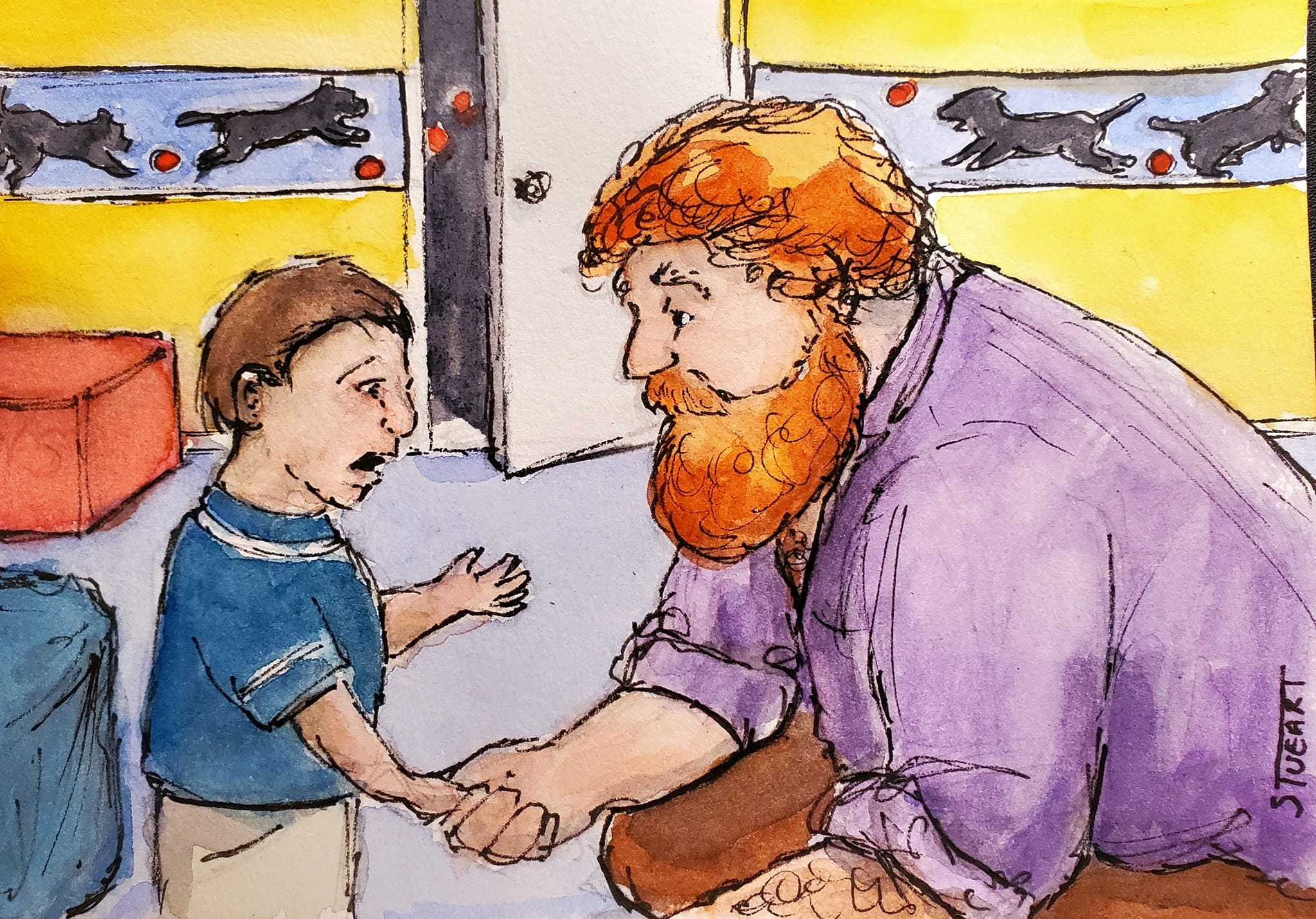
At the end of a tasty dinner hosted by my friends in their new home, their 8-year-old son, Felix, came down the stairs and hovered by his mother’s elbow. “What’s wrong, hun?” Mom asked. There was a monster in his closet. Everyone looked at me. “Okay. Sure. I’ll go check.” I couldn’t rule out something being pulled in because I was here. “If it is, I’ll deal with it,” I assured his mom. I followed Felix back upstairs. “It’s a beautiful new home you have,” I told him. “Do you like your big room?” He wouldn’t go in the door.

I flipped on the lights bright. The closet door was half open. “Okay,” I told him. “We don’t want to scare him.” He said, “I’m the one who’s scared.” I told him that sometimes the monster is scared too. “I mean, he’s got new people in his house and he doesn’t know you very well. How does he know you’re going to be kind to him? He doesn’t.” I knelt with him in the middle of the room, “But I’m not a monster.” Well, I said that we might not look like our version of a monster, but what would be a monster to a closet monster? He thought about that. “Do you knock on the door before you go in?” I asked. He did not. “Do you pop your head in there all of a sudden and start moving everything around?” He did. “Well, that could be surprising if that closet were your room.”

We looked at the closet across the room, which, I have to say, looked mighty comfy for a closet monster. I told him we should go check on the monster and see if he’s okay. I told him he might want to sit on the toy box. He did. I knocked on the door, even though it was open. “It’s a courtesy,” I said to Felix. “Hello. I’m Cornelius. This little boy is Felix and he’s moved into the room next to you.” Felix braced himself for any response. We waited. “We’d like to turn on the light if that’s okay?” I said. I didn’t hear anything. I looked at Felix. We both thought that a non-answer was an implicit yes. I turned on the light. Lots of dress shirts and sweaters and a couple of coats. Some shoes on the floor, and several unopened boxes. “We haven’t finished unpacking yet,” he said. He had managed to come to my side, still wary. I said, “What a lovely room you have,” to whomever might be in here. Just because I couldn’t see him didn’t mean he wasn’t there. I whispered to Felix, “You might put something colorful in here—like a small basket with plastic flowers.” He said, “But it’s dark in there? How can he see it?” Night vision, I said. They can see color. “And it’s a housewarming gift. You know how we all brought gifts tonight to you and your mom and dad?” He nodded. “That means, hey, we’re glad you’re here!” He was uncertain at that last sentiment. I also suggested him selecting a toy to put in there. “He could like toys, we don’t know. But the flowers and the toy says that you’re not going to hurt him. That you are welcoming him.” He nodded.

“How do we know he won’t hurt me?” he asked. I told him if the monster hurt him that his parents would hurt the monster back and the monster didn’t want trouble. “He actually wants a good person in the room. Someone he can trust. It would ruin everything for him if he hurt you.” I was, of course, saying this for the monster’s benefit too. I had to cover my bases. “He needs to feel safe with you,” I told Felix. “Oh, and they tend to like the door shut at night. They need to be in the dark. Just like you need that night light, they need to be all wrapped up in the dark to feel safe.” I asked Felix if he wanted to introduce himself while I was standing there. He was unsure. “You know, if you make a habit of telling him one interesting thing about yourself every day, he will get to know you.” But what if he talked back—Felix got scared again. I asked the monster if maybe, in a non-scary way, he could leave clues to the kind of monster he was and what he was like. “People tend to be afraid of things they can’t see so a voice out of the closet at first might be scary, but over time–,” and I looked at Felix, “Felix will feel more comfortable.” Felix asked, “Will he come into the room when I’m asleep? I don’t want that.” I told him that was a perfectly legitimate request, and I passed that on to whomever might be in the closet. “Anything else?” I asked. He thought. “No, that’s it.” I said we were going to turn off the light, and I did, and Felix said, “I’m glad you’re here!” suddenly into the dark, and I smiled at him and nodded, and then I shut the door.

Did I think there was a monster in his closet? asked his mom. “I can’t be 100% sure that there isn’t, but I set up some ground rules in case there is. I didn’t sense there would be trouble. But you call me if there is.”

I got a call a week later. His mother told me Felix had a ritual that he sat on the toy box every night and told the closet about his day. There were gifts that Felix left in the closet on the floor. He never got scared in his room again. “I have Magellan,” Felix told her, “and he makes sure I’m safe.” We laughed. “Oh, kids,” she said. She thanked me. I said, again, with emphasis, “Really, if anything else happens, anything at all, call me.” She laughed nervously.

Eight years pass and, whenever I am in the area, we have wonderful dinners and times together, and then, I get that call. She’s found a note from Felix that he and Magellan will be out adventuring and won’t be at dinner—having gone “through a portal in the closet!”—but he’ll “find something to eat along the way?!” He’s sixteen, I told her. He’ll be okay. Trust me. “He’ll probably be home by ten o’clock.”

I looked over at sixteen-year-old Felix who smiled at me and nodded, holding his plate ready, as Magellan the Blue, the four-armed swordsman, flipped hamburgers on the grill.


October 17:  Yukon Cornelius dreams a Daemon

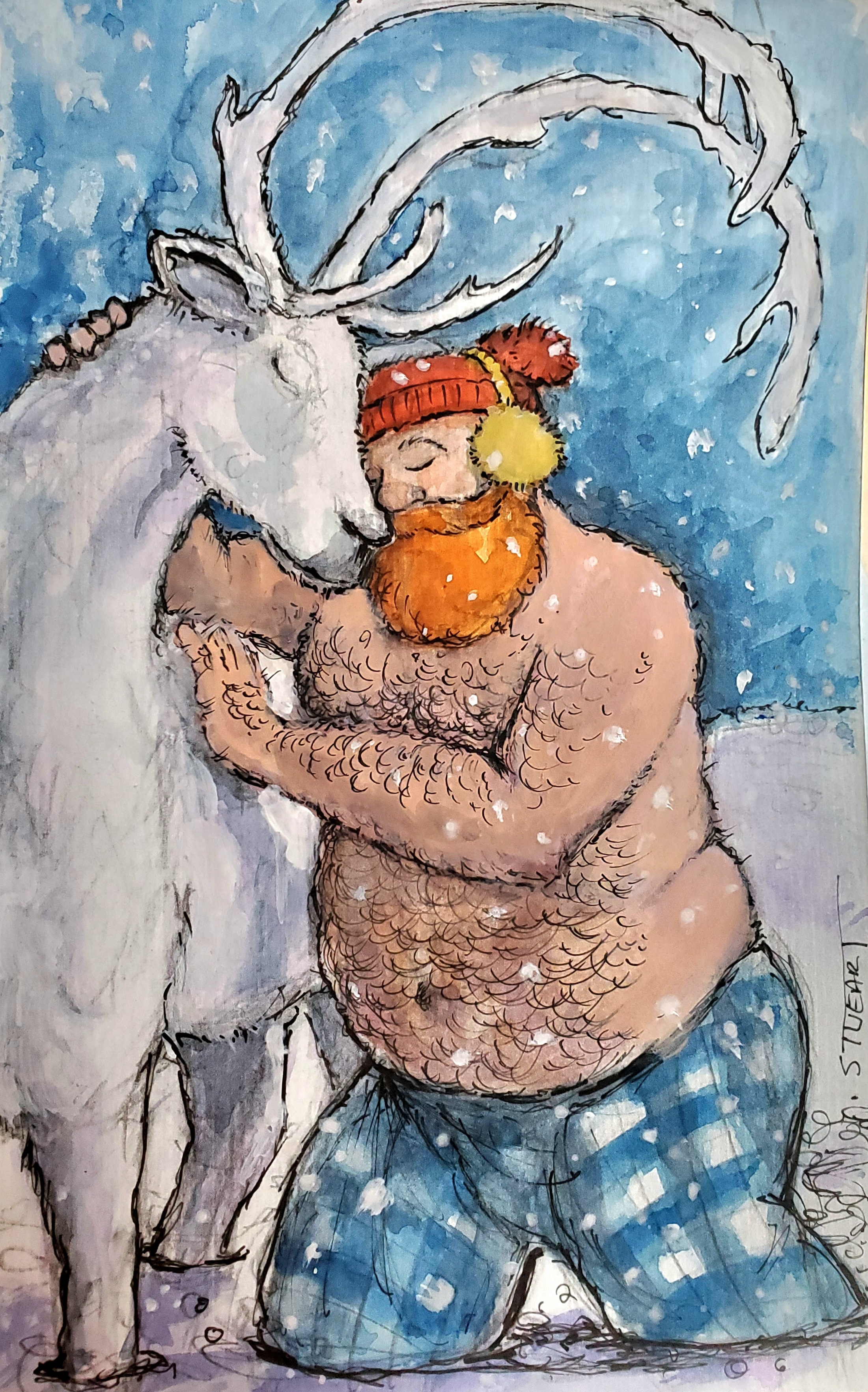
Three nights in a row I had intense, and wonderful, erotic dreams before I became lucid enough to realize that Infra himself was talking to me. We were in a Spanish villa in this dream.  There was a cool breeze, and he was pouring coffee at a table. We were naked and he gave me a mug of the best tasting sweet milky coffee. A dream, yes, but ask me if I could tell the difference. Everything tasted the same, the cushion on the chair felt like soft cotton, the mug hot, the coffee, the sex.  Infra leaned back, his wide shoulders catching the sunlight, said he wanted to thank me. “You could have just led with that.” He laughed, “And missed out on three exquisite nights with you? No, those three nights are part of the thank you.” Infra was a jinn—but as he would tell you, people called him many things over the centuries—including incubus, daemon, daimon and demon. “That last one,” he’d told me before, “that was the worst. We were blamed for rape, unwanted pregnancies, mental illness, depression, temptation, of turning people queer— all a misunderstanding of the word ‘daemon’. So many people left hurting in the wake. We were hated when we could have been helping.”

Now, in the dream, the breeze through the open archways of the villa brushed the back of my neck.  I turned to look at the balcony overlooking a cityscape. Infra said, “I did what you suggested. I found a good place to live, good people to help.” I was happy for him. “It’s an Assisted Living facility in Chillicothe, Ohio.” He sipped his coffee. “Vivid imaginations. Wise souls. So much joy there now. I feel a sense of self-worth that a thousand years of freedom roaming the world has never given me.”

He talked about the Elders, he called them. That he had given them all dreams and come to them to talk to them, long conversations sitting on the edge of beaches, standing on mountain peaks, laughing over a breakfast, and gentle, beautiful erotic dreams. “I have fallen in love with every one of them. I know all the names of their 456 grandchildren, and they are all adorable,” he beamed.  I told him that was wonderful. “However,” he said, “I’m running into a problem.” Many of them were religious and had conservative backgrounds — oh, I thought, the demon problem. He said, “No, it’s the erotic part— their dreams are so intense and wild and beautiful but they wake up sometimes with such guilt and shame. They’re embarrassed by their dreams and thoughts. Sometimes I erase the connections between their waking life and their dream life so that they aren’t haunted by their pleasures. But I hate to do that. I want them to remember. They want to remember.”  

He ate some blueberries and cream in a small glass bowl. “I’m sincerely in love, Yukon. With all 57 Elders. And they are in love with me too when they are in the dream. I look differently to each of them, of course. But this is my dilemma: many of them can’t handle thoughts of me in their waking life. Their children tell them that they should not be thinking these sexual thoughts at their age. They get laughed at by their families. They start feeling shamed.” I asked if they shared their experiences with each other—how did they react to that?  “Some of them have shared. Two of them, sweet ladies, share their dreams back and forth every morning, and become so happy for each other, so I left their connections clear.  But many of the women and men kept it to themselves. Several did confide in their nurses, asking about side effects of their medications—did it include intense erotic dreams? They were scoffed at.”  Listening to Infra talk about this took me back  to high school and no one wanted to admit that they had sexual thoughts. They wanted a sexual prowess reputation in the locker room, but they didn’t want to talk about actual sexual feelings. And if you were queer, you stayed quiet, or like some, they created a life they didn’t have—and tried to keep those two lives away from each other.

“Sometimes they beg me to remember. But what I remember is their shame and anxiety when they are awake.” I could tell he loved them. He wanted what was best for them.  I asked him if they were relieved or upset that they weren’t remembering their dreams anymore. “They’re upset at that too.”  I touched his big jinn arm. “Then let them remember.” He winced, and I could tell he was afraid of giving them too much to handle. “It’s more important that they have good, wonderful experiences than if they just have believable, expected ones. They have those all day.” I said that they would come up with their own solutions, maybe share their dreams only with safe people, form a therapy group in real life, wrestle together with this Jinn in their dreams and the incongruity of it all.  He should give them that choice. I said, “Maybe all of them—all 57 of them—will try to make their waking life more like their dreams.  Infra, they will all pull you closer.”  He hugged me in the dream so hard that I woke up in bed, and he was still there hugging me in bed. I smiled and pulled him closer.

October 16: Yukon Cornelius advocates for Gnomes

With clipboard in hand, and a gnome hiding under my beard, I “inspected” the large red maple behind the Carthage family house. “The kids affectionately call it Grandpa. It’s so old,” Mrs. Carthage said, standing beside me. “It’s beautiful in the Fall. But I want to remove it. With this free inspection, can you check the tree for disease, or danger, or rot?” I felt the gnome growling under my beard and I cleared my throat. I told her, Yes, I could do it today with supplies in my truck and went to get them. “It is not rotting!” Bombas Dreadnettle blasted under my beard. “And since when is old a reason to get rid of something?” Where would I even start with that? “Let’s just stick to the plan.” I opened up the truck and the other two gnomes jumped into my tool belt. “Are you guys ready?”

[  Two days ago, these three gnomes accosted me in my garden as I was struggling to get the weeds out and my shriveled carrots and potatoes to grow. “We need your help!” they cried. I knelt down to talk to them. “Our home is about to be cut down.” They said there were nearly sixty gnomes that would be displaced if the red maple were cut down. “We don’t know what to do.” I asked if they had thought to talk to the homeowners. “We didn’t think that was safe either. We would be telling them where we live!” I understood. “Do they have kind children?” Sometimes a kid could be a good advocate for a Hidden. “You be our advocate.” They leapt up and down, “You be our advocate! You be our advocate!” Okay, okay. I would see what I could do. One of them touched my hand, “We promise to help you with your garden. You are not that good with gardens,” they said sincerely. Ow. “You don’t have to.” Oh but they would! Gladly! “And bake you gnome berry bread!” Yes, they said, yes. Fresh berry bread, all I could eat, and garden help, If only I could save their home.  ]

I carried them over to the Red Maple, and we had privacy, though I kept looking behind me to see if she were there. I told her I would need an hour at least. I had to do some careful measurements and take samples. I pointed to Bombas, “Exact age! Go!” Moved to Filchbatter Thistlewaite, “I need the report of your team on the lateral extent of the roots! Go!” And finally, Xaltor Feroza, “I need the complete shelter records from your archives, and a current survey—no matter if it’s bird or bug or worm. Who’s living here? Go!” They had one hour for their teams. Gnomes don’t dig; they pass through earth and wood like air and I watched them phase into the tree. I went back to the truck and pulled out our Gnome Acclimation Box.

Later, when the gnomes had gathered far and wide and deep all the data I asked them to, I brought the Carthages out to the tree, now surrounded with ceramic garden gnomes. “Where did these come from?” Mrs. Carthage asked. I said, I needed a little help collecting data, and I brought in the specialists. Mr. Carthage made a weird face. I picked one up and told them that these ceramic gnomes could monitor the health of their tree—they had built in monitors. They thought that was clever, if kitschy. “So, about Grandpa. Your tree is the oldest tree for more than twenty blocks. It’s about 431 years old.” Mr. Carthage’s jaw dropped. I added, “…and it’s in very good health. Most of the trees of your neighborhood are relatively young—they’re tall, but they aren’t thick. Grandpa is doing the muscle work for cleaning out the carbon dioxide in your neighborhood.” She said, “One tree?” I nodded. “One old tree can do the work of 50 trees.” I might have been exaggerating, but we had a home to save. “Filtering your air quality. Grandpa cleans the air for everyone in your neighborhood. The young trees won’t be able to do the work it does if you remove it. Now, your roots,” I flipped to a map on my clipboard and circled in red the extent of the lateral root structure. It covered two blocks in any direction. “These roots are touching roots of trees on all these blocks. Roots communicate, share resources, and old trees teach younger trees how to adapt to change in the neighborhood.” They looked at each other. She said, “You’re saying our tree is teaching other trees?” I nodded. “Yes, I am. Now, your tree is also home to a number of –”

“Stop there,” Mr. Carthage was done. “Who are you really?” Too long of a pause, as I searched for what to say. Then a voice from around the tree spoke, “Well, shit!” The Carthages jumped backward. “Now everyone’s gonna have to move out—twenty families, lots of birds, squirrels, a possum…” He leaned his red-hatted head against the trunk, “Fuzzybuttons will be so upset.” I turned to the couple, and breathed, “You have a lovely community of gnomes in your red maple, Mr and Mrs. Carthage. They don’t know what to do to stop you from cutting down the tree. So they came to ask me to help them. They were afraid if they told you where they lived, you would you tear down the tree anyway.” Mrs. Carthage looked suddenly concerned as if she didn’t want to be known like that. I knelt down and brought Bombas up to eye level with the Carthages. “I may not know trees, but I know gnomes.” Mrs. Carthage smiled. “Gnomes are very good for a garden. They do a lot to encourage your flowers to grow strong,” and I pointed over to her blue phlox and her chrysanthemums. “They keep the soil loamy, and they don’t take from the environment. They are the best little hidden workers a garden could have and this is why your garden is so alive.” Bombas said, “Your phlox was lazy! But that was because the soil was weak. We fixed that.” Xaltor called up, “Tell her about the gardenias!” He looked at Mrs. Carthage, “Do you remember the gardenias?” She said, “They all died. I never knew why.” Bombas put his hat in his hand. “There were too many planted all together in the same place—and soil got moldy. We tried to save them, but we couldn’t. Frankly, there are some toxic things in your garden,” he said. He pointed a little gloved finger across the yard, “If you want to get rid of a tree—that Black Walnut over there is assailing your buttercups.” Mrs. Carthage reached out her hand, “Would you want to–,” and Bombas walked over to her across the bridge of my arm, “—I’d love to,” and off they went talking about Mrs. Carthage’s garden, and a trail of ten gnomes followed them. Mr. Carthage and I looked at each other. He smiled. “I think they’re going to be fine here,” he said. “She’s always wanted someone to talk to about gardening.”

October 15:  Yukon Cornelius helps a gold dragon relocate

Occasionally we all get lost. We think we know the way, we launch out, and we get turned around, and we lose the path we were on. That’s common.  Sometimes though, we never knew the way.

Solan was a young dragon when I first met her, bumping outside my window on a fall night. I welcome anything that comes to me. She was cold and tired and the size of a house cat.  She was my first dragon. Dragons aren’t common cryptids in the US or Canada. Lake serpents, yes. We have a lot of those. She told me she was searching for her home. I asked where she was from, and she thought, Solan. Her name? No, a place she was named for. I put her a soft pillow near the fire and sat down with her. I didn’t know what to feed her, but she said she liked pennies. She was obviously some sort of metal dragon. I raided my change jar and washed the pennies off and she ate them from a small bowl. She told me that she lived near here, but she didn’t want to. She’d been adopted as a pet, which is illegal. Her “family” had recently started to take her scales off. They said they were real gold. Every morning she’d awaken and find more scales taken. I was horrified. She’d heard them talking about declawing her, hoping her nails were solid gold. She slipped through a window screen, flown for several nights. She was looking for Solan, she believed to be her “real home”. I got out my laptop, and we sat down to look up lots of stuff.

Solan turned out to be a city in India. We looked up dragons in India. We discovered there weren’t a lot of dragons in India, only a few in mythologies (standard records of fact for cryptids and magical creatures). She knew she was a gold dragon, but that was it. “They restricted what I was allowed to read.”  So we looked up “gold dragons” online. Thank you, Internet, for having information inaccessible any other way for some folks. “But how do I find others like me?” That was harder. Dragons don’t have a Group Facebook page. That’s not the way Hidden creatures work. I’d never gone to look for a Hidden I didn’t already know —they’d usually find me. “I want to learn more about who and what I am.” I told her I would do my best to find some group of dragons for her. Until then she could stay here. She’d be safe here and have all the pennies she wanted.

“It says here I might like to eat gemstones. Do you have any of those?”  I said I would look. Who did I know who might know about dragons around here?  “I could be from China! They have gold dragons there. Is China near here?” If I were a flying dragon, I’d want to hide out in a place where people weren’t. Deserts, mountains, deep forests, caves. “Do I have to hoard treasure?” she asked. She was absorbing everything on the Internet. “I think you get to be the kind of dragon you want to be. I would not take any of that as rules on how to be a dragon, okay?” She needed dragon mentors, fast. “It says I might be able to produce fire!” She immediately lit up the pillow. I ran over, “Amazing! That’s awesome!” and stamped out the flame with my shoes. “I think you should practice aiming at the fireplace.” I went out to a forest to ask a friend who might know. I came back and she was crying. What happened? I asked her. “Do you know how many stories there are of slaying dragons? So many pictures. It’s everywhere. No wonder my family hurt me! Maybe I deserved it. Those stories have evil dragons—and I don’t know if I’m evil.” I went down to the burnt pillow and held her and said, “No, Solan, you did nothing wrong, you are nothing bad. You didn’t deserve to be treated badly. Dragons are like anything else—neither bad nor good. Certainly not inherently evil.” I took her cradled in my arms to a mirror, “Just look at you.” I said, “You are not evil. We’re going to find you a new family, okay?” She seemed comforted, “Are we going to China?” We were not.

But three days later, we did drive for about 5 hours till we came to a set of bluffs and cliffs near a river. Here was a group of magical creatures, not all of them dragons, but a few. My friend had sent birds to ask if we could meet up with this hidden enclave. I brought hiking and climbing gear because getting there was not easy. She flew up, resting ahead of me. “I think I want to change my name,” she said. Huffing and puffing I told her that sounded perfectly fine. “I hope they like me.” I assured her they would, and secretly hoped I was right. I was right. At the mouth of a cave near the bluffs, a much bigger dragon greeted us. He was winged, a deep green, with a kind, toothy smile, and I was humbled to meet him. “And I’m humbled to meet you,” he said. “Thank you for rescuing one of us and bringing her to safety. We are eager to meet her.”  I saw other Hiddens behind him, some of them very young like her.  I said, “Well, then, I am very pleased to introduce my friend, a gold dragon named Penny.”