 My friend and fellow Clarionite, Nick Wolven, posted this link to Edward Gorey’s beautiful, wrenching depiction of a novelist at work. I’d like to say this doesn’t often happen, but that part about wandering around doing everything else but writing—uh–that happens. Going to places or events to “improve the novel”, thinking that everyhing you attend and experience will aid the writing—uh—that happens. But it is funny. See how much this resonates with you:
And for Contrast: The Empire Goes Slack
In my blog entry/movie review “On Clones and The Clone Wars” I try to make the argument that the movie fails as an adult product–of which Star Wars had amassed millions of fans (not just sci-fi fans, but folks who grew up with the series as a defining part of their childhood, and a cultural reference)–but succeeds as a kid’s product, which is what it intended to do.
For more on the end of Star Wars fandom read this from the New York Times:
Let me once again reiterate that the audience for this film was kids. Unfortunately, the audience really ready for the film was made up of adults with much higher expectations (and a lot of pent up impatience from having two bad films precede this)–and frankly it matters more to them that Lucas pay attention to them, the loyalists, rather than pandering to a new set of toy-buying kids. Lucas blundered here, yes.
However, can you imagine a kid’s series on TV with a better universe to play with, better settings, better graphics (minus the marionette characters) ? Yep, those characters we loved have had the final bits of real character squeezed from their puppet forms…but perhaps Lucas is hoping that the kids will discover the Star Wars movies again. Maybe Clone Wars is a metaphorical giant hand with fingers pointing back to Episodes 1-6, even as another finger points to the Wal-mart toy shelves.
So, your kids might be benefiting from Lucas’ franchise and cleverness, while the jilted adults are smoldering in the back room.
On Clones and The Clone Wars
 I just returned from seeing The Clone Wars. It’s not going to revive the Star Wars franchise, but it’s a passing afternoon’s entertainment. Is The Clone Wars to Star Wars what Star Trek, The Animated Series is to Star Trek? Yes, in a way. And that’s not a bad thing.
The plot is simplified, two characters are added to appeal to younger audiences–one a young girl, who acts about 12, and two, a baby she must look after through the last half of the film. Target audience seems to be Babysitters who enjoy Star Wars. I think it’s odd why Lucas chose the main character of the film to be female and to have this stereotypically female task–safeguarding a baby. Star Wars seems to me to be very male-oriented: wars, “sword” fights, power struggles, technology, dark hoodies. This film seemed as if Disney took over scripting and added a young female lead and a horrible female villain to match her. I kept thinking “Snips” would break out in song. “I wanna be where the Jedis are….I wanna swing, wanna swing light sabers!”
What it does right: the settings are amazing and truly in the tradition of Lucas’s previous films–he often tries to do radically different settings–the vertical battle was stunning ; the action sequences are full of camera angles that are challenging and interesting;
What it lacks: Why did Lucas insist that the characters look like “marionettes”? These folks are worse than watching a Sims Youtube video. Expressionless, their eyes are either blinking or squinting or blank. I wish Pixar would have done this show….it might have even been funny.
There’s no tension. All the jedis can do amazing things. If the plot needs them to move from point A to point B, there’s no doubt they will make it. They just cut through a few droids, leap from one flying jet to another, tumble, roll and they are safe. It was a film of maneuvers without tension or fear. It’s funny. I actually felt fear during The Incredibles. Even though it was animated, there were rules set up–characters could die, things could go wrong.
This is then a plotting and character problem. The Jedis are plotted to do these things and those things they will do. It’s never a question that they won’t accomplish their mission, really. And with them animated, the characters don’t sweat, don’t umph, don’t act as if anything ever hurt. It’s the problem Superman writers faced when Supes could do anything. Kryptonite had to be written into every script, or his powers had to be limited–else there’s no audience identification. But, added with bad animation, there’s no feeling that these automatons even represent humans.
I did not identify with Snips. “Snips” was a bad character. She’s whiny, a twelve-year old brat whose animators make her float around and jump with ease. She’s constantly smarting off to her boss, Anakin, when she’s supposed to be a learner of a higher order of thought and power. Oh, she needs no physical training to be as powerful as Anakin. Never got that idea at all. She does everything she’s called to do–with complaint.
Anakin nor Obi Wan are fleshed out either. They are trapped in a kid’s plot and they must play their roles. Anakin is the unwilling mentor figure; Obi Wan the parental figure; Snips the bratty sidekick/trainee character. This is a long version of a Saturday Morning cartoon.
Which is to say that it finds the audience it needs on Sat. Morning. It is good for kids. It places them in a simplified, watered down version of the Star Wars universe–and if they have plots like this, the series will be entertaining for a target age of 5-14. So, in a way, it does exactly what it set out to do: advertise the new series coming to Sat. mornings; appeals to kids; continues the Star Wars universe in a way that doesn’t mess up Lucas’s vision. It is not more harmful to its original than Star Trek, the Animated Series was to Star Trek.
Is it for adults? Not really. The simplified plots, the flat characters, the watered down version of Star Wars will cause afficionados to run for the door. But then so did Episodes 2 and 3, and those were with real actors, sets, and expensive special effects. The Clone Wars, while a faded clone of the original films, achieves a level of entertainment for children. And that’s what it wanted.
Dream Jobs and Just Doing It: Star Trek Series
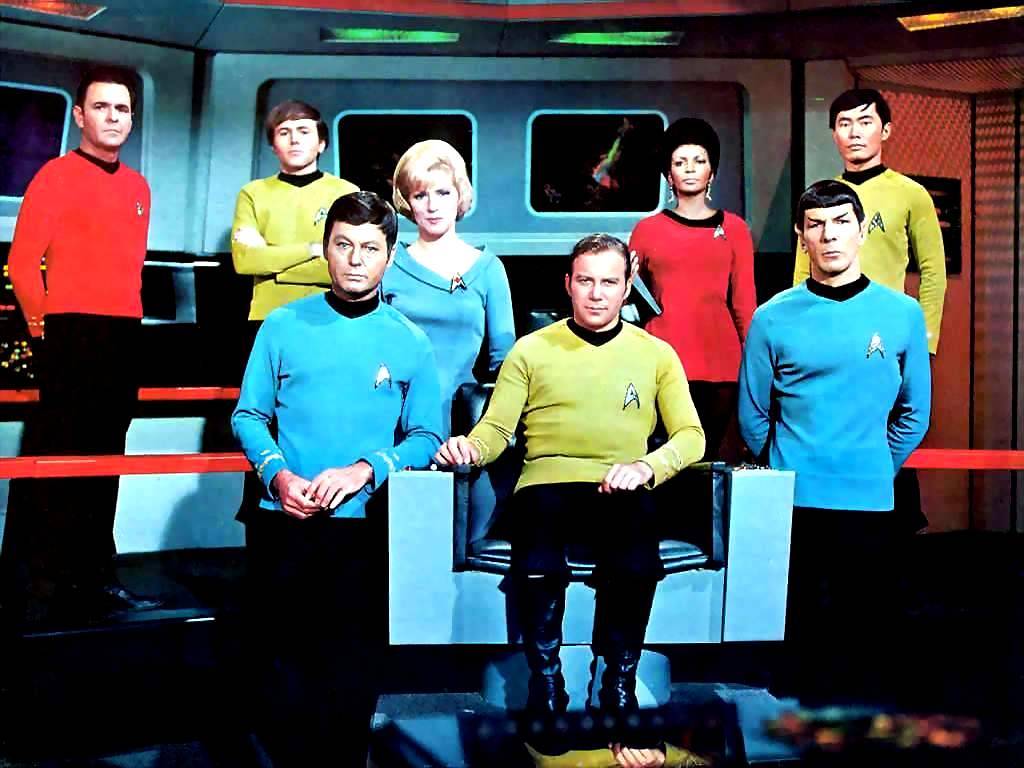
For the new Star Trek the Movie, see my posts: Star Trek: Movie Review and
New Star Trek Movie Trailer and the Power of Myth.
___________________
Okay. I’m not gonna be a self-help guru here, but I will tell you what happened to me.
I think my number one thing I’ve always wanted to do was to write for Star Trek. Or for some TV sci-fi series. I think I liked the idea of developing characters through adventures together, and writing with a team of people. And seeing that each episode became something that added to a whole. Maybe, too, I was disappointed by the squandered potential of Enterprise. I felt like Season One was underdeveloped; no one died at all and this was our first time into space…. The characters had potential but they were never utilized and the plots were dull. When the season finale came up, and the new season premiere completed it, I was sure that the problem was the writers–or the writers had been hemmed in by too many rules, I don’t know….
So, today I was complaining about how little time I have to write and that I’m working too much, and I told a colleague about my silly dream of writing for Star Trek, and she said, pulling out a notebook and a pen: Okay, let’s write for Star Trek.
The next two hours were a blast! We created a whole cast of new characters drawn from the Star Trek universe, and some from my own brain, and then created a series—what we do in season one, season two , season three. I had high hopes for the series—hehe. I learned that without a series going on, of course, selling a new series would be very difficult, and two, that Pocket Books really wants books with major characters who have appeared on the show–not your own. Who knows if one can write “similar” Federation type settings for books that are not Star Trek, but obviously borrowing the universe-structure. If anyone knows if publishers can’t stand ST-like books, let me know….but I may write this up as a novel pitch.
I have nothing to lose for trying. And that’s kind of what today proved to me. Laurie, my colleague, proved to me by pulling out the notebook and pen that sitting around and complaining does little good, and that it’s better when you just do it. If you want to write for Star Trek, do it. Create what you want. Perhaps with some positive energy, I can a) sell a TV series! or b) sell a book. Who knows? But I do know I’m several steps closer than I was. And I loved brainstorming with Laurie. It picked up my mood, and made me feel as if I were closer to my goals.
So, maybe don’t look at all the obstacles–just do it. You might as well have fun–and who knows–the product might be salable outside the frame you thought you wanted to work within. It was fun creating, and maybe that’s the whole point.
(I’ve just, of course, shown my complete geekness to the world….but multiple character arcs, episodic TV and science fiction are fun. Maybe I should just go ahead and create the Television Station that will run my show! Hey, Laurie—get out that notebook!)
The Fantasy of Beringia, except it’s true
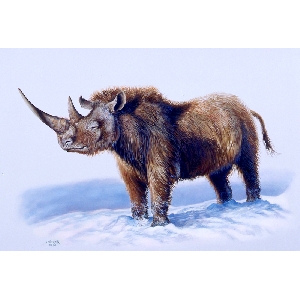
I work at the Beringia Centre, where we preserve Yukon history from 14,000-10,000 years ago. The great land mass of Beringia, situated in what is now the Bering Strait, connecting Siberia and Alaska, was our Atlantis–land that flourished for awhile and then sunk beneath the sea.
While it was here, it was a huge grassland bordered by glaciers and mountains, a refuge untouched by the Ice Age going on in northern North America, a place where plants and animals evolved and lived. And the animals, like the Woolly Rhino to the left, looked like something out of an ancient bestiary.
I think Beringia is a fantasy setting untapped. I would love to get a group of science fiction and fantasy writers to choose Beringia as a setting—scimitar cats, woolly mammoths, hunters crossing the land bridge, giant sloths and beavers, and the magic of the Gwich’in and T’lingit storytelling to go with it. It’s our living fantasy setting, or was.
Everything there is true, and the facts and science could aid a group of writers in developing storylines based on the science and setting of Beringia.
Perhaps one of our assignments in my after school sci-fi/fantasy writing program will be to go to the Beringia Centre and imagine it as a fantasy/sci-fi setting—research the science–develop a story. True, fantasy writers like to come up with settings that utilize wizards, dwarves, dragons, but these are northern European settings, northern European mythology, and Canadian writers have a treasure sitting beneath them.
We don’t have to live by Elves Alone.
Perhaps Beringia will inspire new writers to come up with their own mythology and characters based on this place–and break the European mold. Eh, it’s just an idea. Come visit and see the Fantasy that was really true. I dare Europe to find the bones of a dragon!
Fiction Can Change the World
It’s the subtlety of fiction that sneaks up on you and changes your mind. No one has to argue in front of a court of law, no one has to hit you over the head, or point to a passage of scripture. Fiction gives you a person. And you learn about this person, what it is to be black, white, female, male, gay, straight, Christian, atheist, hermaphroditic, Klu Klux Klan, the president, a beggar, a horse. And you can’t see the label as a label again—you’ve been talking with them all night. You’ve seen where they’ve lived, heard what they’ve thought, and fought with them through battles where you were both alone. Fiction appears harmless, but it’s the art that changes minds from the heart up.
Whitehorse: a Pullman City
 I’m in the Baked Café on First and Main, looking out the big wall of windows, watching all the Whitehorsians and their dogs. Phillip Pullman imagined an alternate reality in his set of books His Dark Materials, of which most people would recognize The Golden Compass. Everyone in this world has an animal companion. Some days, Whitehorse seems to take after that model. Every man and woman has his/her dog–mostly mutts, pound rescues, but some purebreds too. They walk these dogs down Main Street, tie them up at the different bike rack sculptures, let them spar with other dogs, eat with them, talk with them, live with them. You can’t find Susie without her two dogs–the Komondor giant dog that looks like a white sheepdog on growth hormones and the Bichon Frise, the Mini-Me to the first. Or Lily without her two huskies that she walks in the same way Uma Thurman might walk cougars, the leashes taut, pulling her. It’s beautiful to think that our companions complement–or even complete–us.
I have lived in other cities where there were dogs or cats, but never have I lived in a city where nearly every person had an animal companion like it is here. Phillip Pullman writes about your companion animal as your soul, certainly they reflect personality, certainly they too–like any companion–change the nature of our personality to not being just one person, but person with Merlin or Lucky or Danish or Peut Etre or Phish. Just like when you become a couple, the nature of your personality signature with other people changes. Some people are very different with their SO around. Some people are complemented by the other. Some people are more themselves alone.
Donna Harraway has a great book/pamphlet on these significant animal relationships called The Companion Species Manifesto, where she calls on us to think of our companions as unique non-humans in a symbiogenetic relationship with us. A unique couplehood where we each change the other.
My point: it’s not so hard to imagine Pullman’s animal companion utopia. I did it today. We see it everywhere. And those of us who live in the far north, peut etre, see it less as fantasy and more as commonplace–as we seem to be more familiar with familiars, and allowing ourselves to be mingled in with our companions, not fighting for our “me” but enjoying our “we.”
Living Rhizomatically
I was weeding a garden I share with friends, and was struck by how efficiently and effectively weeds live. I was in the carrots, a flimsy mass of ferny tops, trying to find the source of a weed tendril that I had in my fingers. I’d pulled some before–and they snapped off easily–but I’d never pulled up the root. I’d just yanked of an arm or link to the weed chain. It seemed that this particular weed gripped in several places, poking a very small root from mulitple tendrils. Like Bridge columns. It made pulling the tendrils ineffective–as I only removed a bridge link. Inevitably the weed grew back because the source was still there. Like a Hydra.
Carrots are pretty well single rooted, as far as I can tell, designed maybe to fatten the main root so they can be plucked—sorry, that’s a bit human-centered even for me. But my point is that the carrot can be pulled up easily–thank god it isn’t built like a weed where it would have to be harvested with a backhoe. Or you might never even find the tasty root.
Anyway, there’s a metaphor coming: I was talking with a friend about careers, how life seemed to alter our plans and that the best people seemed to be able to change careers easily. The most interesting people we knew were people with their root systems in multiple places–who developed multiple skills–so that when a main source of income was pulled up, they could still survive on another skill set.
Here in the Yukon, the system seems to favor living rhizomatically. There are world renowned lepidopterists living as business administrators, guitarists who are cooks, romance writers who are policy analysts. I’ve watched folks who have prepared for one career be able to jump into something else entirely when the soil was rich for the secondary career and not the first: immigration officers becoming film producers/directors.
Seems to me that focus can be great–can hone a person. Tiger Woods is not living rhizomatically. But then, not all of us, perhaps, have the time/skill/etc. to be Woods. More often than not, those who have focussed on one career have been flustered when that career isn’t producing, when those doors shut, or when forces gather to stop that career–bad bosses, coworkers, rivals, spouses. They may have no other skill sets to “fall back on”–so they doggedly pursue their career goal beyond logic, or they settle for something they have no skill at all, nor passion. They followed the advice of Jack Palance in “City Slickers”–find one thing you like to do and pursue it. And that’s a good philosophy, but I’m seeing that a great back up is having several passions, several skill sets. Like that weed, you are hard to pull up, hard to damage because there is no central root; any runner can sustain the weed. Therefore, any of a multiple skill set might sustain a person.
Learn French, puppetry, work with kids, volunteer in a nursing home, paint, read books on Tibet, listen to avant garde ethereal music—I don’t know, but finding multiple passions, unlike the one finger that sustained Palance, might sustain you.
Resources for SF/Fantasy Writing–Teen Writers
http://www.davidbarrkirtley.com/teenwriter/TeenResources.html
New Online Market: Beneath Ceaseless Skies
 Hey, here’s a new online, professional fantasy market. Here’s how they describe themselves and what they’re publishing in their own words:
Beneath Ceaseless Skies is a new online magazine dedicated to publishing the best in “literary adventure fantasy.”
We love traditional adventure fantasy, including classics from the 1930s pulp era and the new wave of fantasy from the 1970s post-Tolkien boom. But we also love how the recent influence of literary writing on fantasy short fiction has expanded and advanced the genre, allowing writers the freedom to use literary devices such as tight points-of-view, round characters, unreliable narrators, discontinuous narratives, and many others. This sophisticated level of craft has made fantasy short fiction more powerful than ever before.
We want stories that combine the best of both these styles—adventure fantasy plots in vivid secondary worlds, but written with a literary flair. Beneath Ceaseless Skies will feature exciting stories set in awe-inspiring places that are told with all the skill and impact of modern literary-influenced fantasy.
That’s what we mean by “literary adventure fantasy.” It could also be called “modern traditional fantasy” or “literary swords and sorcery.” There are many current short fiction markets that specialize in literary-style fantasy, and a hardy few that still publish adventure fantasy, but there is no magazine focusing on stories that combine both. Until now.
Beneath Ceaseless Skies will publish two stories per issue, with a new issue every two weeks. We will also maintain an online forum to update submitting writers and to encourage reader discussion of all things fantasy. We will use modern internet technology to target readers of fantasy short fiction as well as fans of traditional-style fantasy.
Okay, I know I’m not supposed to judge a book by its cover [art] but this is some nifty cover art by Mats Minnhagen [his website]. Here are the submissions guidelines. Good luck!
 Bear Witness