Peter learns to forgive himself.
A good meal can heal us.
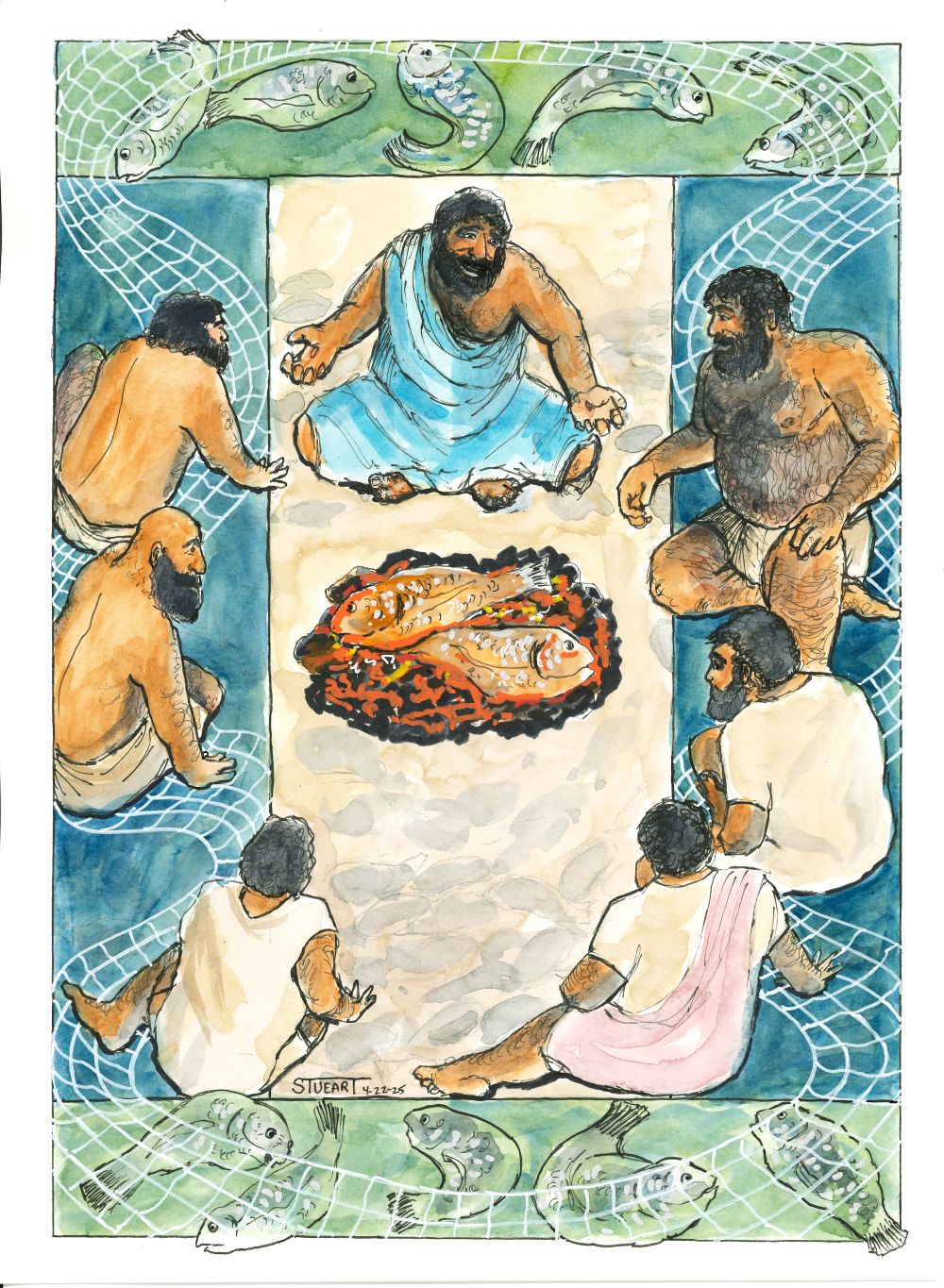
This is a depiction of a beautiful story (John 21) of Jesus, after he comes back from the dead, visiting his friends. It’s not unlike stories from friends I’ve talked to who have had someone pass recently. Stories of healing conversations with loved ones who have died. These stories have a similar theme, though maybe they didn’t see their friend quite so “in the flesh,” but the idea of a healing conversation still rings true and is common. We need to have old wounds resolved and healed after someone dies. Part of grieving is healing wounds that we might be keeping alive inside ourselves.
The bible story is — Jesus, after he comes back from the dead, appears to the fishermen-group of his disciples who have gone back to their old lives after Jesus died and are out on the Sea of Galilee fishing and having no luck. Jesus calls out to them from the shore asking the painful question, “How’s the fishing going?” They don’t know who he is. Granted it’s far away. They tell him that the fishing sucks. Thanks for asking! Jesus — not being a fisherman — then gives his opinion on what they should do to have better luck: “fish on the right side of the boat”.
Yeah. Sure, they thought. Like the right side of the boat will be any different than the left side. But nothing else has worked all day. So they do it and WHAM! there the fish are. This miracle is familiar! Jesus did this the first time they met him. Even though Jesus has just died, they figure this has to be Jesus again. Peter, who had been diving under the water as part of their fishing process, is naked, but grabs some shorts and dives into the water to swim to shore. (I learned that being naked as a fisherman wasn’t that uncommon considering the work and the need to keep clothes clean) The rest of the fishermen bring the boat to shore, after dragging an overloaded net full of fish into the boat.
Jesus already has fish, but he asks them to bring a few of their own and join him for breakfast on the beach. Of course everyone is happy. The person they love is alive again and sharing a meal with them. Who wouldn’t be? They don’t know how long he will be with them this time.
But Peter, even though he is HAPPY, is internally wounded, feeling pretty bad after having told people that he wasn’t associated with Jesus at all, no way, the night Jesus was arrested. And you know, I can’t blame him for thinking that after an arrest you might never see anyone again. Jesus was on a docket of crucifixions for Friday. Three at a time, keep them going, all day. I believe that crucifixion was such a common Roman punishment — not incarceration, just death — that everyone knew an arrest could be fatal to Peter or anyone the Romans decided was causing trouble.
Nevertheless, Peter had a hard time forgiving himself.
This breakfast was a forgiveness, a reconciliation, a healing for Peter. It wasn’t meant to call a truce or to confront Peter. It was to bring the poison out of Peter’s wound to the surface so it could be removed.
Jesus asks him, “Peter, do you love me?” and the first time must have seemed pretty casual and innocent. Peter probably answered yes and then got that pang of guilt you get when you realize, again, that you didn’t exactly say you loved him before — when it “counted”. I don’t think that Jesus wanted anyone else to be arrested. In one account of Jesus’ arrest, Peter cuts off a Roman soldier’s ear to protect Jesus. So, Peter did risk his life to be associated with Jesus. Romans would have arrested him for just that, and Jesus knew it. So Jesus heals the ear and then lets himself be arrested. So Jesus knows that Peter loves him and would defend him.
The problem is, Peter doesn’t believe that.
We are very selective about how we remember things. We can do the right thing 100 times, but be demoralized by doing one thing “wrong.” My memory will go over that moment a thousand times at night, for years, and never think of all those good moments when I did good. We can destroy ourselves, our wills, our souls, by ruminating on the past “wrongs” we’ve done. Jesus knows that.
So now that the guilt is coming up to the surface, Jesus repeats the question: “Do you love me, Peter?” But what Peter hears is: “Really? Are you serious? I don’t believe you love me because you lied about it before, and I know. Believe me, I know.”
Wracked with guilt, and trying to prove himself, Peter says again that he loves Jesus and doesn’t Jesus know that too? He does, Peter implies. He’s asking Jesus to hold BOTH of these ideas together in his mind — even though PETER CANNOT.
Peter is at war with himself. He can’t believe that he is any good to anyone after this one thing he’s done. He’s back to fishing because, well, he knows how to do that job fairly well. And maybe he believes he screwed up as a disciple. But he’s asking Jesus to help him balance those two ideas with him, even if he can’t do it himself.
There’s a deep conversation happening between Jesus and Peter that isn’t being shared with all the other fishermen. Jesus merely responds, twice, “then feed my sheep.” Jesus is instructing Peter how to SHOW that love he has for Jesus. Caring for others. Leading others. But he also wants Peter to let go of the guilt of “betraying” Jesus. In the cosmic comparison of things, betrayals of Peter and Judas look completely different. But not to Peter. Peter was willing to die for Jesus in the Garden of Gethsemane when he cuts off that Roman’s ear.
But Jesus doesn’t want Peter to die for him. He wants Peter to live for him.
And he can’t live for him if he’s held back by his own guilt.
So Jesus, offering more fish to Peter, I imagine, asks him a third time, “Do you love me, Peter?” By now, Peter must think that Jesus is exposing him and condemning him, and he cries out, “You know everything. You know I really love you.”
I really wish the writer of John’s Gospel had gone into more about Peter’s reaction and Jesus’ response. It feels like there’s an emotional beat missing after that because Jesus tells Peter to follow him and then tells Peter how he will die later in life (the very kind of death that Peter feared would happen to him when he was waiting in the courtyard for news of Jesus after he was arrested, when he was asked if he was associated with Jesus, the fear that made him lie.) This tells Peter that he won’t be afraid when the time comes for him to die. And that maybe it wasn’t the time for Peter to die that night when he lied.
Maybe, just maybe, his fear and his humanity was God’s will too.
Not to worry, Peter, Jesus seems to say, I already know that you love me till your dying breath. I’ve seen it. And you fearlessly die for me when the time is right. But hidden in there, I think, is an acknowledgment that the time for Peter to take that risk WASN’T the night of Jesus’ arrest — -so, neither from his brash sword-flashing, slashing an ear off of a Roman Guard, nor from boldly stating he was Jesus’ friend which also would have gotten him arrested. That wasn’t Peter’s destiny, and Jesus knew that. Jesus could heal the ear and save Peter from himself in the garden, but in some sense, he needed Peter to protect himself in the courtyard.
That truth. That’s the truth that Peter needed to accept. That preserving his life in the courtyard was not selfish — otherwise Peter would not be able to “feed my sheep” later. Peter is no good to Jesus dead. And it was good and proper for Peter to protect himself in the courtyard. And for the disciples to hide in the upper room after Jesus’ arrest. And for them to take precautions until Jesus had worked out this whole Resurrection thing.
But Peter doesn’t know it.
Peter will hold himself back, and hold Christ’s mission back, if he doesn’t accept his own humanity, and accept that his fear and self-preservation was also part of Jesus’ plan. Jesus KNOWS Peter loves him. He knows that now on the beach. He knew that when he predicted that Peter would lie, and he knew that when Peter actually lied to keep himself safe. He knew at that moment too. And I bet Jesus was relieved, even as Jesus was being tried and tortured, that Peter kept himself and others safe.
I know it.
So this “restoration of Peter” is for Peter to know that Jesus knew it. And for Peter to forgive himself. And for Peter to know that in the future he will get to do all the brave things he wants to do — and death will happen to him, later. But for now, Peter needs to lead others, teach others, and most important FEED others. Maybe even literally.
You have to be alive to feed others. This makes me think of all that is happening today here in the US. Many innocent people being arrested, detained, disappeared. Be careful how confront these forces against us. be smart. Sometimes self-preservation IS the right choice. Do not put yourselves in danger when faced with people who want to know who you are associated with, if you are here legally, know your rights. When the system is not fair or just, you don’t know what will happen or if your case will be heard. Do what it takes to protect others, hide them and yourself, and walk stealthily but powerfully through your day. We are living in the times of Andor (Star Wars: Andor) and navigating through a dangerous political landscape is difficult. There is nothing wrong with knowing when to speak out and when to not fight back, when to hide, when to stand out. There is bravery in lying and hiding others too. You are feeding them for another day.
Jesus is on a beach feeding his disciples, but he can’t stay. Peter must carry on that work. Peter, you know how to do this. You know how to catch fish and feed others. Keep feeding others the love and the truth and the joy and the forgiveness that you have been fed for three years. Keep protecting them. Keep being smart about when you speak and when you act. Jesus was not making martyrs; he was making reformers. Leaders, teachers, creators, lovers, compassionate protectors, caring people.
That is your beautiful destiny, Peter, for which Jesus wanted you to save yourself in the courtyard.
You are loved, Peter. You are loved. You are loved. And Jesus knew all along that you loved him, and still knows.
Now, finish up these fish, guys — they are mighty tasty!
_________________
About the art: I‘m proud of how this turned out. I created this for a friend for his upcoming sermon on “The Restoration of Peter”. Pastor Dave is a chaplain and a fisherman. He loves the stories of fish and fishermen in the Bible. So I did this with him in mind.
I even looked up the fish in the Sea of Galilee to come close to what they look like.
I also researched what fishermen might be wearing (if you click on the PDF of the whole issue of Jerusalem Perspective you can read the whole article, “What was Simon Peter wearing when he plunged into the sea?” by Mendel Nun.) So my depiction of Simon Peter, top right, was based on that article, not just my own joy at depicting male bodies.
As a gay artist of faith, I am drawn to the positive, and more accepting, earthy nature of of these male friendships, and so my depiction of bodies reflects that acceptance, and that biblical illustration, often confined these days to children’s sunday school literature, can be for adults as part of worship. Biblical illustration has been white-washed (Jesus wasn’t white, nor were the disciples) and “cleaned” of its earthiness because bodies weren’t shown (except in the case of the death of Christ) and that feels more like an American culture (or Victorian prudeness) that we’ve put on these stories. I think we need MORE illustration of these stories, emphasizing Christ’s compassion, in the adult spheres of the church — worship services, adult sunday school, art in the church itself. Please utilize the artists in your congregation! They are part of the body of Christ!
I’m experimenting here with more graphic design strategies for composition. It just made me happy to do it. It feels like storytelling.
This image is available for licensing. If you are interested, please contact me.
 Bear Witness