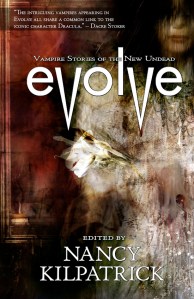
Evolve: Vampire Stories of the New Undead–all Canadian, all vampire, and evolved

Imagine this:  what would the future of vampires look like?  How would they evolve?  24 Canadian writers thought about this and came up with their ideas. Evolve: Vampire Stories of the New Undead is an all Canadian anthology–23 stories, one poem.  It’ll be launched at the World Horror Convention in Brighton England in March.  

Yep, I have a story in there, “How Magnificent is the Universal Donor.”  In my story, vampires have finally been pulled into positions of power in the medical field.  They save the world by stepping in to keep a terrible blood disease at bay, and they continue to keep the world safe.  But it’s not a perfect situation…some sacrifices occasionally have to be made for the good of the World.  They’re just not telling anyone.  Wouldn’t want to stain their new reputations as saviours.  

I’m thrilled to be a part of the collection.  

The collection is available for pre-order now.  A limited number of the anthologies have been packed into little wooden coffins and you can pre-purchase the coffin-encased anthology at this site.  You can also order the anthology by itself too, which will be available in March.  Can’t wait to be in England pushing these little coffins on our table—it’ll be an awesome visual.  As if we’ve made little gnome coffins.  

While I’m not normally a horror writer, I just played with the idea of getting to evolve vampires.  That was fun!  Hope you enjoy it.  

Evolve is published by Edge Books, Brian Hades Publisher, and edited by Nancy Kilpatrick.

Tesseracts 14 Submitters: Not to Worry

Eager to hear any news about Tesseracts 14?  

New Update:  The Table of Contents has been finalized and will, I hear, be revealed soon.  Brett and John are sending out emails right now.  That will take some time as I’m sure there were lots of submitters for this anthology.  But everyone should know everything in, at least, about a day or two, I’d guess.  Good luck everyone!  

_____________________________________

Everything below this is old news: dated January 9 2010.  

Brian Hades has posted this on the Tess 14 webpage:

WE ARE A BIT BEHIND 

With December holidays and more snow than one ever needs clogging up the works, we are about two weeks behind schedule. Please have patience as we catch up during the month of January. Thanks. – Brian Hades, publisher

This supersedes my other reports from SFC listserv.  Thanks Marcelle for those original tips.  I know folks were worried theirs were lost in the mail.  The snow has a way of swiping mail sometimes. Godspeed to the editors, and to us– good luck on your next projects–several deadlines approaching.  As for Tess 14, good luck to everyone!  Now back to snowfall, dogwalks and deadlines.

Rocketfuel Ignites Imaginations, the Yukon News story on my class


Photo by Ian Stewart for the Yukon News

My most excellent class of writers is the subject of a Yukon News article below.  These writers are an awesome group of imaginateurs.  I’m impressed, especially, with how they conducted themselves in an interview–thoughtful, insightful, well-read, interesting and interested in each other.  Love to start a book club with them!  

Article is by James Munson for the Yukon News.

_________________________________________

Zeb Berryman has some demons he’d like to share.

The 18-year-old scribe is an aficionado of the “dark side” in his literary circle, a dozen Whitehorse high school students known as Rocket Fuel.

“The darkness and violence is what makes it beautiful,” says Zeb, referring to one of his current anime reads.

Zeb’s comment elicits a few nods from his fellow science fiction enthusiasts sitting around the table in the FH Collins library.

These young adults have an encyclopedic knowledge of the fantasy genre, and can discuss the intricacies of alchemists, monsters, gods and goblins at length.

“It’s like literature discussion about a whole bunch of books you never get to hear literature discussions about,” says Jerome Stueart, a science fiction writer who started Rocket Fuel two years ago.

But more impressively, it’s their own literary creations they’re the most familiar with.

Ask any one of these students about their works, and it won’t be long before another interjects.

Franz Krabel, 12, tends to kill off his characters a lot, says Santana Berryman, Zeb’s 14-year-old sister.

Santana, for her part, has an obsession with the afterlife, says Stueart.

These writers know each other inside out.

Read the rest of the article

Treats, Beverages, and a bit of Fantasy, Shipyards Park, Fri. Dec 4

Students who are a part of Rocketfuel, the science fiction and fantasy writing group afterschool program–sponsored by the City of Whitehorse–will have a reading Friday night–TOMORROW–at Shipyards Park.  They’ll be reading from some of their current work.  There might actually be a story of Santa Claus meeting the Reaper…you never know.  

THE DETAILS:

Shipyards Park

Friday Dec 4, 7-9 pm.  

Treats, goodies, beverages like tea and coffee, and a bit of Fantasy to go home with and share with your season….

If you’re free tomorrow night, come by.  We’d love to have you.

The Thrill of Deadlines, and How to Meet Them Alive.

(Corrected: eliminated all the bad advice about the two week story)

That race to a deadline is fun and satisfying.  It’s a test to see if you can pull it off, get that story done and out by the time that clock strikes.  But you have to plan ahead, or else you’ll be turning in bad stuff, or stressed so much you miss the deadline.  

Douglas Adams loved deadlines too.  “I love deadlines.  I love the whooshing sound as they shoot past.”  

New Scientist says your heart attack risk rises six times normal at the approach of a stressful deadline.  

(But they also list sexual activity as a precursor to heart attack, and who wants to cut that out??)

My history has been spotty on deadlines.  I’ll admit, like Adams, I let them reluctantly whoosh past me, relieved at the amount of stress reduction they can have when they do leave—or when the professor gives you another day, or another hour—but this has not been good for me in the long run.  Always hoping that I’ll get an extension on a deadline has made me think that anyone will give an extension.  And this is not the case.  

I remember when I got my story in to an anthology Claude Lalumiere was editing at like 12:40, forty minutes past the deadline.  He said, no!  Holy cow.  I thought that he was a stickler, but I’ve learned this is standard practice.  Not everyone will give you an extension, and no one is obligated to.  There has to be a cutoff time.  Chaos can ensue.

And really, it’s bad form (Jerome!) to ask for extension on deadlines outside of real emergencies.  I’ve done that once in awhile, and I’m very happy for those who accommodate me.  But that puts them at risk.  An editor I know once had a rule about her deadlines: “Never tell the author the REAL deadline.”  She always told me a false deadline, in advance, knowing I would push it.  She actually had three false deadlines (one day I pushed through nearly all of them! eek).  But this was a magazine deadline, not a submission one.  

Submission deadlines are part of life.  They should be hard.  They make you plan better, and I think, increases the thrill without increasing bad stress if you aim accurately for the deadline.  

I can’t wake up two hours before a story deadline and think I’ll be able to pull off a winner: I’ve tried writing stories too close to the deadline, and I get bad stories.   But when I’ve had a story go through revision about six times and then I spot an anthology deadline, it really makes me polish well.  And a polished story, even if you send it in 17 minutes before midnight, still feels great!   

My heartfelt applause goes out to all those who made it by Tesseracts 14’s deadline, and the man who made it by the stroke of midnight!  WOO-HOO!  

How to plan ahead for deadlines.  Okay, I should preface this with the following disclaimer: I don’t write stories in two weeks, not normally.  And so I can’t tell anyone to write a story in two weeks.  A lot of my stories have been through lots of drafts, some over years, to figure out what the dang things are about.  But there are a few tips I have to think about when I’m writing towards a deadline.  

I go backwards from the last thing I have to do and count that as time I need.  So I save enough time for the spell-checking, the last minute editing, the spit-polishing.

I also try to save enough time for multiple drafts.  My worst writing comes out in the first draft, usually.  Bad, stinky writing.  So, you have to save time for yourself to redraft and rethink your story.  How long? I don’t know.  Sometimes, if I’m doing nothing but writing, a few days.  But this doesn’t count the thinking time in between a first draft and the multiple drafts that come after.  I’m working on a story right now that started life in 2002 as a 2500 word short story.   Then it had another incarnation in my dissertation as a 7000 word short story and now, in 2009, well, it’s getting another draft.  Not everything takes this long—but some of ’em do.

A week is only enough time for me to get an adrenaline draft—that first idea that you run on a pretend course to get to some conclusion.  Like a pace car.  But that isn’t time to see all the layers, the themes, etc.  It’s barely time to get the first draft out of your fingers.  

The ideas take longer:  you’ve been mulling over a cool idea, or have a vision of a great scene, so you’ve been jotting notes…this can take as long as it takes before it gels enough into a story.  Normally I won’t count this in the time I need.  If it hasn’t gelled, it’s not ready for a story.  

Your timeline will be different, but know where you are in the course of your writing, and what your normal speed to write your best story, in order to know how to plan for a deadline.  I remember a story not too long ago that I planned too short a time for….. and all I got was a nice first draft out of the story.  Yikes!  So, now I get to go back and give it work and it will shine!  

Thomas Jefferson had his deadlines too.   This quote from the Independence Visitor Center in Philadelphia:  “Thomas Jefferson wrote the rough draft of the Declaration in only a few days? He spent a period of two weeks refining it and even gave a copy to John Adams and Benjamin Franklin for their review.”  I’m no Thomas Jefferson, but I’m imagining he was under a tough deadline and had to get it right.  

Know your writing speed, and count backwards from the deadline.  Then you’ll be alive when you cross it.  Really, really alive!
Deadline Nov 30 for Tesseracts 14: Canadian Sci-fi and Fantasy Stories

from Woodleywonderworks on FlickrA reminder to all those thinking about submitting your short fiction (limit 7500 words) to Tesseracts 14, the latest in the series of anthologies featuring Canadian science fiction and fantasy.  It doesn’t have to be about Canada, or about the north.  Basically they are anthologies of Canadian writing.  (Okay, and a few stray Americans or other Nationalities who have immigrated to the fair shores of Canada)

Personally, Brian Hades, publisher of this series, would love to see greater representation of Canada in the anthology.  So, the Yukon needs to put out!  Haha.  Seriously, if you have fiction that strays just outside the everyday reality, consider submitting to Tesseracts 14.  Let’s wow Brian with Yukon writers!

More information at my previous post here:  Tesseracts 14 Open for Submissions

Realms of Fantasy re-opened and ready for your submissions

Shuttafly by Natassia A. Davis, from her Flickr pageIt’s official:  Realms of Fantasy is back, and expecting a ton of submissions.  I don’t think we should disappoint them.  

Note, Canadian authors: though you still have to submit hardcopy, if you supply your email, they will answer you via email.  They don’t want to work with IRCs and who does?  So, this saves us time too.  

Editorial guidelines from their link:

Editorial Guidelines

Realms of Fantasy, a bimonthly magazine, is a professional market for the best in fantastic short fiction. Stories should be no longer than 10,000 words, and can address any area in the realms of fantasy: heroic, contemporary, traditional, feminist, dark, light, and the ever-popular “unclassifiable.” What we do not want to see is standard SF (this means no alien worlds, no hard-edged technology, no FTL drives, etc.)  Additionally, ROF is not a market for poetry.  What we do want to see is the very best in the field–Realms of Fantasy is a highly competitive market.

For stories under 7,500 words, rates begin at 6 cents per word for new writers and move upward as a writer gains recognition. For stories over 7,500 words, the rates break at 7,500 to 4 cents a word. Thus, a 10,000-word story by a newcomer would pay $550. Again, for established writers, the rates will be proportionally higher.

All submissions must be typed in a 12 pt. serif font such as Courier or Times Roman, double-spaced, and accompanied by a self-addressed stamped envelope large enough to hold your manuscript.  Manuscripts not typed and double-spaced will not be considered.  Manuscripts without return postage will not be returned.  If you wish us to discard the ms. and reply only by letter, you need only enclose a letter-size (#10) envelope and mark your ms. DISPOSABLE.  Your name, address, email address and phone number should appear on the first page of the text, not on a cover sheet, as cover sheets can easily get separated from the rest of the ms.

International authors must still submit hardcopies of their stories but we will respond via email rather than regular mail, assuming that you do not require your ms. to be returned to you.  We do not accept multiple or simultaneous submissions.  Response time is ordinarily 8 to 12 weeks.  We regret that the majority of our responses must be in the form of pretyped letters.  This in no way reflects on your work, only on our time and work load.

Thank you for your interest in Realms of Fantasy, and we look forward to seeing your work in our pages.

Shawna McCarthy 
Editorial Address: Realms of Fantasy P.O. Box 527 Rumson, NJ 07760

Now, go give them what they want!  Good Yukon Stories, or stories from Yukon authors.  


Bondsmen, my story, up at Metazen: James Bond meets himselves

secret-agent2My story, “Bondsmen”, is up at Metazen.  The story–meant to be a comedy– is a bit surreal, having the latest James Bond (an actor beyond Daniel Craig) really stifled by all the things he has to do as James Bond—he just wants to be himself, dang-it, but he finds himself trapped in the character roles that have been played in the past by other actors….  This is a story of a man who wants to be an individual, not controlled by things he can and cannot do.  James Bond ends up quarreling with all the other actors who’ve ever played Bond–or rather, all the other versions of Bond.  It is meant to be parody, but also a way to think about living life suppressed, even when you’re a dangerous secret agent.  Does James Bond really get a choice to be anything else?

Metazen, ” is an online fiction zine that publishes short fiction and poetry by various authors. Metazen is a fly trap for metafiction, existentialism and  absurdism. It harbors all kinds of filth such as neurotic characters, obscure philosophies, love for inanimate objects and quests toward enlightenment. Metazen occasionally follows the real life, meta-fictional exploits of Frank.  Metazen is edited by Frank Hinton, Jessica Alchesse and Dylan Cohen.”

Enjoy the story!

Fantasy Magazine Interviews Me: Writing the Other

DSC_0360_255Fantasy Magazine, which published my short story,  “The Moon Over Tokyo Through Leaves in the Fall,” did a companion interview, which I thought was incredibly thoughtful.  When you write a story, you always hope for questions like this–that someone will ask what you meant when a character said this or that, or ask how you go about writing the story.  

And secretly too, you hope you don’t sound like a dork.  

I appreciate the interviewer, TJ McIntyre, and the work he put into the questions.  Thank you.  


An excerpt

There have been many controversies over the years relating to writing the “Other” or writing with a voice outside of one’s own natural experience. “The Moon Over Tokyo Through Leaves in the Fall” is written from the point of view of a modern Asian-American female. Did this create a challenge for you? What steps, if any, did you take to verify the authenticity of your voice in this piece? What tips do you have for other writers out there working on pieces where they are writing from the perspective of the “Other?”

Hmmm . . . This is a hard question for me because I think every character you write about is an “Other.” I do understand the argument, that writing something completely different from you is more challenging. But unless you are writing memoir, the characters have completely different childhoods, desires, relationships — all the characters, not just the POV one. So they all take a lot of work to understand and “get right,” so to speak.

But if someone wants to write a character which is “other” I wouldn’t stop them. Instead, I would encourage them to stretch themselves. I certainly don’t immediately identify with, or always find accurate to my experiences, the white, rural, college-educated, religious gay male characters I find. And I don’t always want to write that character. I would hate to stop someone else from writing them though.

So I think that’s my first tip: Feel free to be whoever you need to be for the story, without holding yourself hostage to criteria. Criteria can turn into stereotype. I remember once writing a poem about Theodore Roosevelt surviving the Amazon River. A fellow writer said that I had no albino catfish in the poem and that it was a weakness. If I didn’t mention them, I would be called on the authenticity of place. Even worse may be the authenticity of race or gender or sexual orientation — since we are multi-faceted people. I go back to my first statement: Everyone in your story that isn’t yourself is an “Other” . . . and you are required to be careful with all of them.

Saying that, though, I think writing a nasty, mean, selfish gay character might be an accurate representation of one particular person, and might make a funny character, but I would trust that character more in the hands of a gay man who knows the consequences of pushing a bad stereotype in a culture that seems to want to believe the stereotype, than in someone else’s hands. I tried hard to be sympathetic to both Matsui and Yumi equally — showing their flaws, their desires, and hopefully helping a reader side with both at different times.

So, not that you have to always treat your Other characters with kid gloves, but that you make everyone understandable and as authentic as a human being as you possibly can through research, and through infusing them with your own flaws/desires. I infused Yumi with some of my own doubts about my relevancy/impact on the world, my own relationship experiences, the sometimes clash of cultures I find with people older than me. The story doesn’t have my exact experiences, but the shades of feelings are right, the tone is right, the need to be loved and validated is right, I think.

Run the draft through a close set of writerly friends to check for bias. I did run this through Clarion 2007 in San Diego, past a rigorous group of fellow writers, half of them women, who had some questions about the way I wrote Yumi, and I followed their advice. Not that a character can’t make bad decisions, or have perceptible flaws, only that they should be unique, individually motivated and free from OBVIOUS bias.

Be open to learning what it’s like to be someone other than you. It’s really difficult to shed Jerome in order to take on Yumi or Matsui, but I try. Like an actor taking a role.

I think if we only wrote within our experience we’d really limit our stories, and ourselves. I remember once writing from the perspective of my brother, and I learned a lot about what it felt like to have to make some of his decisions. The story moved radically away from my brother’s actual deeds, but the writing process allowed me to feel empathy and understanding for him in a way I had never felt before writing about him.

The process allows a writer to “put themselves in someone else’s shoes” and that’s good, both for the writer — who learns something outside him/herself — and the reader — who doesn’t have to put up with a bunch of main characters who are sci-fi movie buffs. Viva l’Other!

______________________________________________

Read the whole interview on the Fantasy Magazine Website here.

Tesseracts 14: Canadian Sci-fi/Fantasy Anthology Open for Submissions

2508955112_7a2d3e3312

Canadian authors of science fiction and fantasy, get your stories ready.  Tesseracts 14, is open for business.


Tesseracts Fourteen:
OPEN FOR SUBMISSIONS (Sept. 1, 2009 – Nov. 30, 2009)


Submissions are now open (from September 1, 2009 to November 30, 2009) for volume 14 of the Tesseracts anthology. If you are a Canadian author and write speculative fiction, we want to see your stories, poetry, radio plays, flash fiction etc. [SEE GUIDELINES BELOW]

The editors for this antholgy are:

John Robert Colombo and Brett Alexander Savory.    


GUIDELINES 


  • This anthology is open to Canadians, landed immigrants, long-time residents, and expatriates.


  • Open to submissions in either English or French. (Francophone stories must be translated into English for publication if accepted.) Canadian authors who write in languages other than French or English are welcome to submit an English translation of their work, provided it otherwise falls within the parameters of this anthology. Please supply details of original publication for any submission that originally appeared in a language other than English.


  • Translation into English is the sole responsibility of the authors.


  • Genres: all the genres of imaginative literature, including but not limited to magic realism, science fiction, fantasy, dark fantasy, slipstream, supernatural horror, weird tales, alternate history, space opera, planetary adventure, surrealism, superheroes, mythic fantasy, etc.


  • The Tesseracts anthology series is open to both short fiction and poetry.


  • Payment is $20 for poetry, $50 for stories under 1,500 words, rising to a maximum of $100 for stories of over 5,000 words (longer stories are paid a slightly higher fee, but in order to exceed the word length limit of 7,500 words, the editors must judge a story to be of surpassing excellence.)


  • Deadline: 30 November 2009.


  • Do not query before submitting.


  • Email submissions: tess14@hadespublications.com


  • Emails MUST contain the word “submission” in the subject line, or they will be deleted automatically by the server. Please also include the story title in the subject line.


  • Submissions MUST come as an attachment: RTF is the only acceptable format.


  • Emails MUST contain a cover letter in the body of the email; for security reasons, email attachments with no cover letter will be deleted unread and unanswered.


  • Cover letter: include your name, the title of your story, your full contact information (address, phone, email), and a brief bio. Do not describe or summarize the story.


  • If your address is not within Canada, please indicate in the cover letter your status vis-à-vis Canada.


  • Reprints (stories having previously appeared in English in ANY format, print or electronic, including but not limited to any form of web publication) can be considered but will be a hard sell; reprints must come from a source not easily available in Canada. If your submission is a reprint, please supply full publication history of the story. If your story appeared previously, including but not limited to anywhere on the web, and you do not disclose this information to the editor upon submission, you will be disqualified from consideration.


  • Submission format: no strange formatting, colour fonts, changing fonts, borders, backgrounds, etc. Leave italics in italics, NOT underlined. Put your full contact information on the first page (name, address, email address, phone). No headers, no footers, no page numbering. DO NOT leave a blank line between paragraphs. Indent paragraphs. ALWAYS put a # to indicate scene breaks (a blank line is NOT enough).


  • ALWAYS include your full contact information (name/address/email/phone number) on the first page of the attached submission.


  • Rights: for original fiction, first World English publication, with a two-month exclusive from publication date; for all, non-exclusive anthology rights; all other rights remain with the author. (DO NOT INDICATE WHICH RIGHTS YOU ARE OFFERING; SUBMISSIONS MARKED WITH RESTRICTIVE RIGHTS WILL BE DELETED WITH NO REPLY.)


  • Spelling: please use Canadian spelling, as per the Canadian Oxford Dictionary.


  • Response time: initial responses (no / rewrite request / hold for further consideration) will be made within thirty days after the close of submissions. Final responses no later than 31 December 2009.


  • Submit up to three stories at the same time, butUNDER SEPARATE COVER (only one submission per email).


  • Simsubs are not encouraged but are acceptable. Should you receive a “rewrite request” or “hold for further consideration” response, please indicate immediately whether your story is under consideration anywhere else.