Yukon Cornelius is the Better Santa

You’ve seen the 1964 Rankin/Bass stop motion Christmas special, Rudolph the Red-Nosed Reindeer, written by Romeo Muller. It’s been aired on TV every year since it was first shown. You may have wondered, though, why Santa seems to be so MEAN-spirited in this movie (probably the only anti-Santa movie we show at Christmas time). There is a better Santa in this movie, though, hiding in plain sight.

CEO Santa Rules the North with a Manufacturer’s Mindset

Santa is the boss of toy-making and toy distribution, of all the elves and reindeer. When Rudolph is born, Santa blames Donner for having a “weird” son, and makes fun of Rudolph’s nose — — and of course, all of his “employees” do too. They’re just following Santa’s lead. His meanness and prejudice gets passed down to the reindeer. How can Santa himself be so narrow-minded!? This doesn’t feel like the Santa we know.

In a tale about manufacturing and production, this glowing reindeer and fabulous, dentist-oriented elf are merely flawed products. They are a version of an elf and reindeer who don’t do what those products should do. They are misfits like the toys they will meet later. The other elves, the other reindeer, do not want to accept them, as they have been taught to reject flawed toys.

Who do you think created the misfit toys? Those toys are typical manufacturing mistakes, tossed away. Losses. Victims of Quality Control. There is no love for a flawed product in a warehouse toy factory at the north pole. The elves must be VERY AWARE of their “mistakes”, even if they aren’t aware of the Island the misfit toys all eventually run to for safety.

I believe Santa is written this way on purpose — revealing the commercialized CEO Santa that’s kinda already there. Muller just reveals more of him because he has a doppleganger to compare Santa to. If Santa is the villain, and Rudolph is the hero of the story who has to grow and learn, then he needed a role-model for Rudolph to learn from, to really accept himself and others, since Santa won’t be modeling that.

This is the role given to the OTHER sleigh-driving big bearded man in the movie, Yukon Cornelius. I think this is done on purpose.

Yukon’s a character made up by writer, Romeo Muller, to expand the story beyond the original Robert May song. Muller doesn’t let this just be a song of Rudolph waiting till he’s useful to be discovered. That’s not fair to Rudolph. He creates someone better, a guide, a guru, a model to show Rudolph how to treat others, and himself, with radical acceptance and love.

Radical acceptance and love
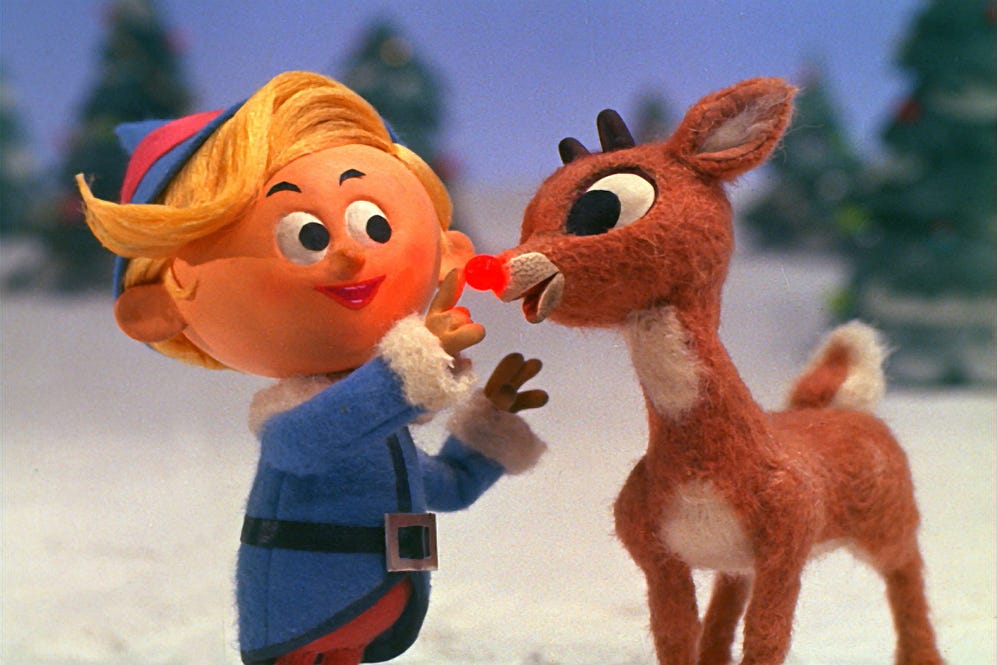
Members of a group, a society, a culture, may“naturally” accept people who reflect back to them the kind of group they want to be seen as. So they might accept those who are like “us”, those who stay within expectations of social and moral cultural systems. Those who stay within the lines our group has drawn.

Hermey, though, is an elf who wants to become a dentist instead of a toymaker; Rudolph can’t really hide his bright, blinking nose and that makes him targeted by bullies. They are considered “unacceptable” by the groups they find themselves in — — not what they expect in an elf or reindeer. They don’t fit in, or won’t fit in. They won’t cooperate with what is expected. Rudolph tries to over his nose with mud. That’s not a permanent or acceptable fix for anyone.

When Rudolph and Hermey meet each other, they become besties! They have a lot of common experiences, in a way, commiserating over their differences. They reject societal norms! They are Rebels! They accept each other right away because they also want to be accepted! They go off into the world to do their own things.

They are all Abominable

Rudolph and Hermey aren’t safe in the world when they don’t play by the world’s rules. The Abominable Snowmonster is there to make them fear following their dreams. Noisy! Gnashing Teeth! Roaring! Chasing! GIANT! In a sense, as personified fear, he shows they will be unacceptable everywhere they go. He will relentlessly chase them down.

Who saves them from the Snowmonster? It isn’t Santa. Santa doesn’t even seem to know it exists, though I would say he is controlled by the fear himself.

Who HAS experienced that fear before — that fear of not being acceptable — and conquered it?

Yukon Cornelius.

Oh, he knows “Bumble”! He even reduces the scary words “abominable” and “monster” to rename him with a word for awkwardness. When we “bumble” through something, we bounce from one thing to another, without direction, we screw up, mess up, blunder, stumble. Bumble is a misfit too — and his name announces that he can’t “fit” either. Cornelius calls Bumble what he is — a socially awkward creature who is badly trying to fit in. He looks scary, and Yukon acknowledges that, but Yukon knows things about Bumble. He knows that Bumbles don’t like water and he knows they can bounce. He knows the strengths and weaknesses of Bumble. He sees through the scary part and sees the real Bumble, trying to survive alone. He will eventually save Bumble by giving him what he wants most: to be accepted with all his quirks.

Yukon Cornelius sees Hermey and Rudolph too. He sees them as who they are and who they want to be and immediately accepts them. He practices “radical acceptance” of everyone. Radical acceptance is acceptance BEYOND what you are comfortable with, what you’ve known, what is advantageous to you, or what might benefit you. You accept people for where and who they are. And you loudly support those you radically accept. Yukon is very loud. He is not afraid of anyone seeing who he’s with and who he supports.

The First Misfit

Long before they go to the island of Misfit Toys, we see that Yukon is already a MISFIT himself. He is a prospector obsessed with finding, not “silver and gold” as the snowman sings, as we are all led to believe, but a peppermint mine.

He doesn’t WANT what the rest of the prospectors — — or people want. He isn’t after money. He wants peppermint. Well that isn’t valuable, you might say. Why would a prospector be searching for peppermint? Prospecting is a hard life — — and would you go through the dangers of living in the wild, being outside of cities and companions, facing harsh weather, difficult, mountainous regions and digging through the earth — — just to find peppermint? The desire that makes Yukon different from ALL other prospectors is what makes Yukon a misfit. It seems to be a flaw. But I think it’s tied to his goals.

Santa has previously been characterized as judgmental: he knows if you’ve been bad or good. He has a list of naughty and nice people. He is a moral judge! If you are GOOD, you get blessings. If you are bad, you get JUNK. He is associated with worth and value, even commercial value, but also moral value.

Yukon, on the other hand, knows your strengths, allows those strengths to surface and guides you to use those strengths, even the ones others might dismiss. He is associated with seeking bliss, helping others, and he sees their innate value without judgment.

Yukon is set up to be a direct comparison to Santa.

Look at Yukon’s dog mushing team. This is radical acceptance in action! Whereas Santa’s sleigh has to be guided by “perfect” reindeer, Yukon’s sleigh is led by a mismatched group of sled dogs, that no one would believe would be good sled dogs: a St. Bernard, a dachshund, a sheltie, a beagle and a black poodle. We could think up a lot of reasons why this team of dogs wouldn’t work — -and yet, they work! Yukon believes in them, and they believe in themselves. They are all misfits but they love running and they run well together. They don’t know the proper commands (It takes them a while to understand “Mush” and “whoa” — “Stop” is what they have to hear to stop! Good luck teaching them Gee and Haw!) But in allowing them to be themselves, he demonstrates radical acceptance and love. He accepts the dogs for what they WANT to be, for who they know they ARE. And he lets them be that. And they show that they ARE good at what they love to do.

Yukon as the Better Santa

This is why I think Yukon contrasts so powerfully with Santa. They are similarly presented men — large, bearded, loud men with sleighs pulled by animals — but who act completely differently towards others. There are rules with Santa. There are not with Yukon.

Santa has to be convinced later into being accepting and giving . His acceptance of Rudolph comes when the reindeer can prove he can be of use NOT as a reindeer but as a beacon. Bumble, similarly, must be marketed as tall enough to put the Star on the Christmas tree. Thankfully, the presents from the island of Misfit Toys don’t have to prove themselves in order to be gifted at the end of the story to kids who will love them — but Santa must still be convinced to deliver them too. In fact, in 1964, with the original broadcast, Santa makes a promise to deliver them, but is never shown doing that, to which viewers complained that they wanted to see Santa keep his promise! In 1965, a new sequence was added to show Santa delivering the Misfit Toys to their new homes.

Even if you don’t understand the parallel set up of these two men as a kid, you GET the idea that Yukon accepts people and that Santa doesn’t. Yukon is the role model of this show, not Santa.

Yukon rescues, salvages, rehabilitates, transports, and teaches. He teaches Rudolph to value himself and to value others regardless of what kinds of expectations he may have, regardless of what they can do FOR him. Rudolph teaches Santa the same thing. I believe Yukon’s save of Bumble seals the lesson that no one is above acceptance.

When WE meet Yukon Cornelius
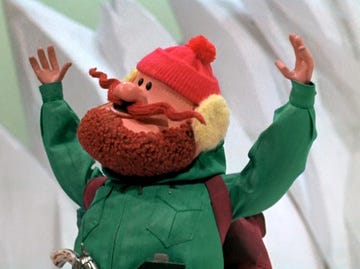
Growing up, seeing this show for the first time, and subsequent times, I think I saw myself as Rudolph, as many kids did — — someone who was not perfect, not wanted by other kids, not what adults thought I should be as a boy, but who had an important role to play in this “plot,” I hoped. I did not have a lot of positive male role models in my life who accepted me for who I was. I always felt like most boys and men were disappointed in me for one reason or another — I did not want to play hard, play sports; did not want to be mechanical; did not love the idea of the military as a proving ground for my manhood or patriotism. I did not know I was gay, and didn’t know I had ADHD. I was artsy and geeky. I was a misfit.

My parents did a great job to meet me where I was. Dad introduced me to Star Trek, comic books, science fiction. My mother read the Chronicles of Narnia to us in the hallway. These are enormous things! They also found and gave me for Christmas some very heady and scientific books on butterflies when I was interested in butterflies. I always got great gifts for Christmas — weird ones, but ones I cherished. My parents brought me things that transformed me for the rest of my life in good ways. They also were my first introduction to spirituality, and even though we eventually disagreed about some small things (that are kinda more important now) my faith began here. They gave me enough to grow my own faith and keep it strong, even as a gay man.

But my parents, like many people in the 70s and 80s, were still subject to the “rules” of society for gender. It was very hard for anyone not to be soaked in those rules. Guidelines for girls and boys and how they were supposed to act, what and who they should love, what they should do. We still have them. They are the basis for much pain and rejection even today.

Anti-Trans laws are directly influenced by previous theories about gender; anti-lgbtq legislation is also built on the backs of outdated gender theory. Gender is a cultural construct, and while many people are more aware of this, there are still many people who are afraid of people who don’t obey those gender rules — whether that is through gender expression or sexual orientation, or any other expression of gender and sexuality. 

We should know better now. 

But back in the 70s, these expectations were so much a part of our culture that I can’t honestly blame my parents for believing them. All the doctors, the newscasters, the psychologists, the media, not to mention all those in office. When your access to the truth is limited, you don’t get the truth, usually. 

My parents did what they could to guide. In many ways, they protected me from much of the consequences others might have wanted to give me, and in their own way, they were practicing radical acceptance — as radically as they could within our family.

We end up on the Island of Misfit Toys

These misfit toys in the movie were rejected only because they didn’t DO what was expected of them. They were still of value and still interesting (as we come to see in the movie). Moonracer, the winged lion, comes across as God protecting the misfits from others — -but unable to, himself, fix their situation. It takes Yukon with Rudolph and Hermey to help bridge the distance between these undervalued people and those who could help them find their home.

I think we unconsciously gravitate to those who accept us. Perhaps, while the kids were enjoying the animation, the adults were learning a lesson about which sled-musher to follow, about how to accept others.

Me, I was looking for a Yukon Cornelius to see my value and worth, as many of us do.

I eventually found a way to bring Yukon to me.
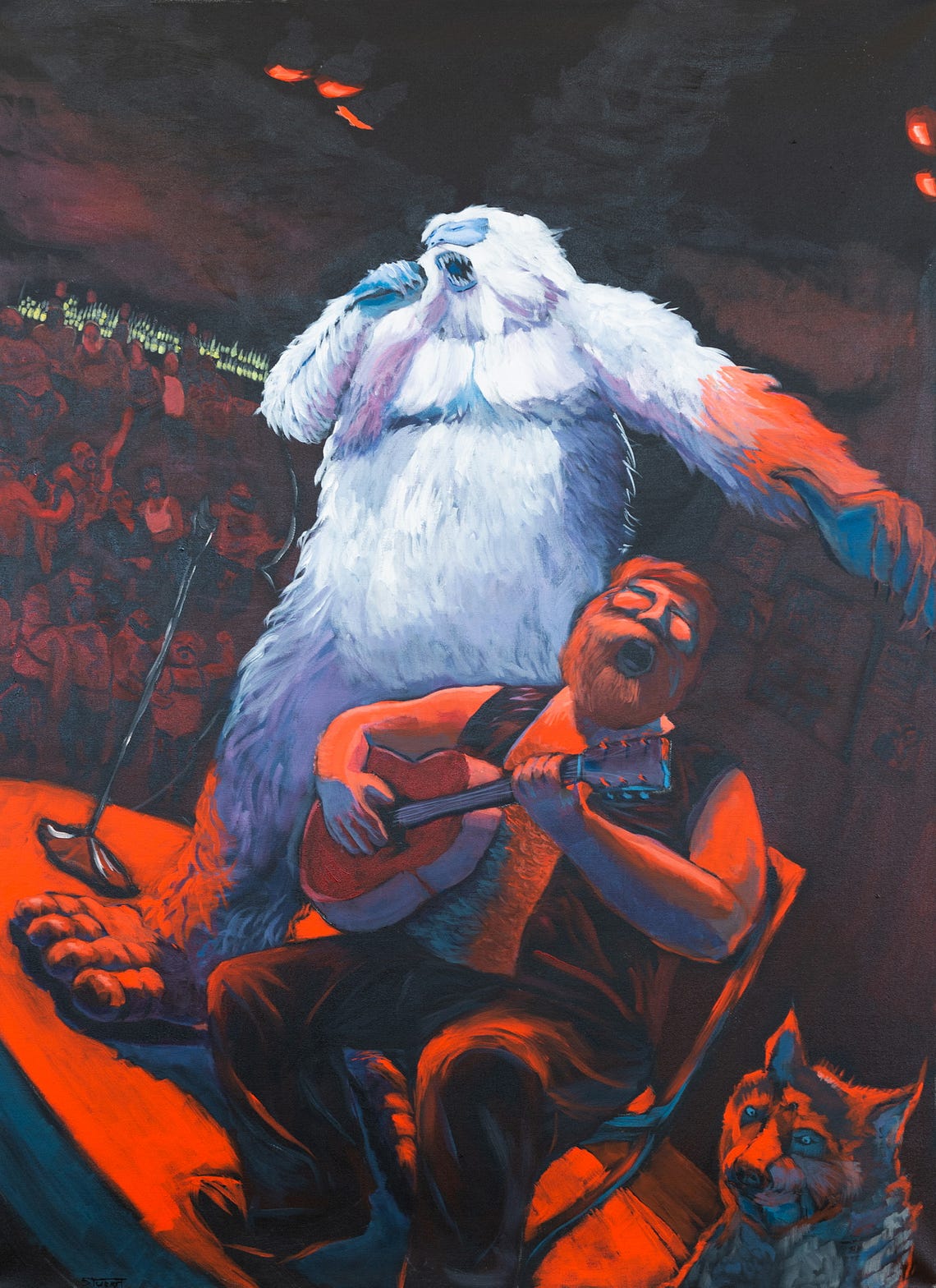
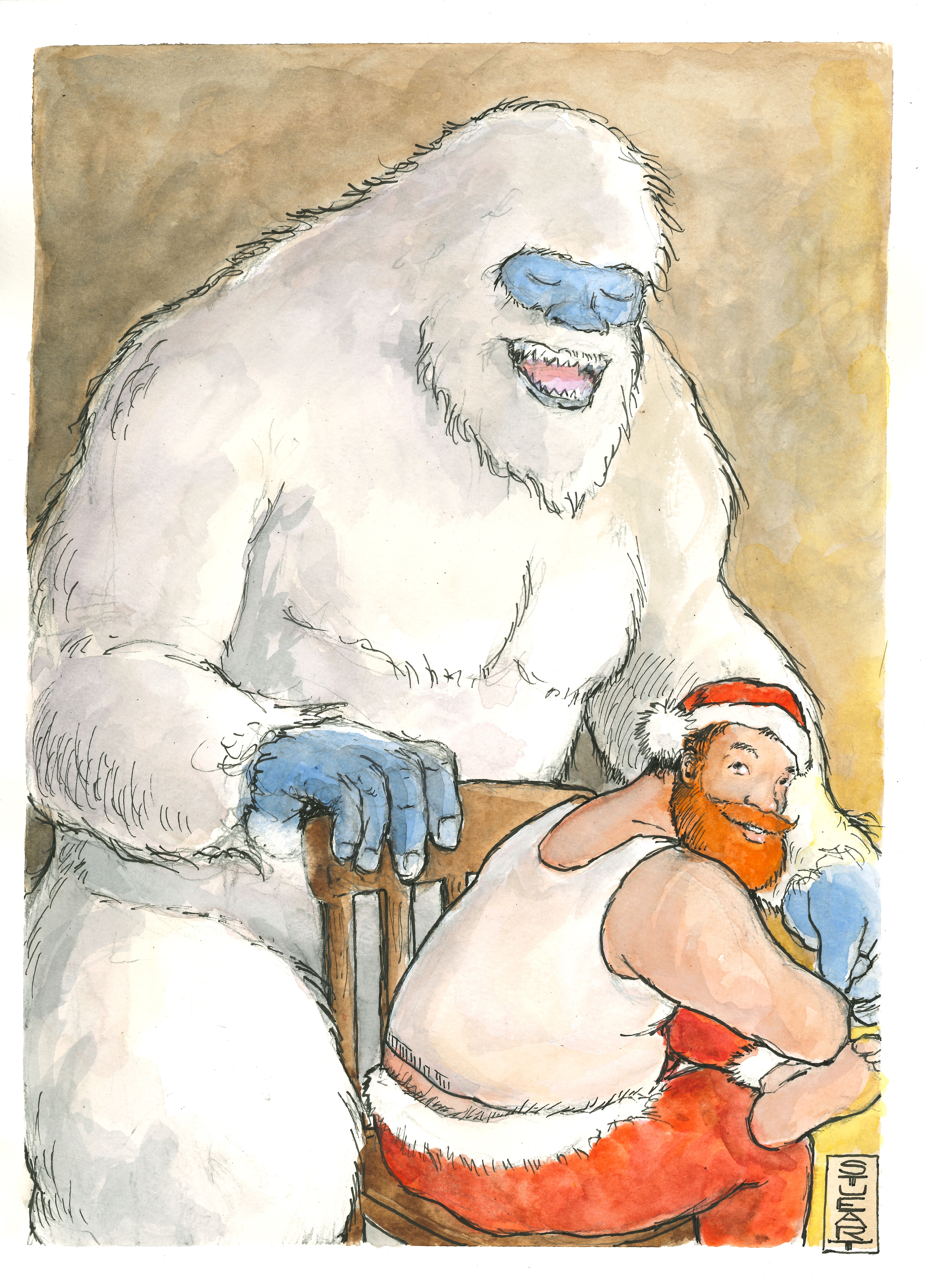
In 2019, I created a set of 10 paintings of Yukon Cornelius in the style of NC Wyeth — a style of boy’s adventure books popular in the early 20th Century, to explore what a gay hero might look like to me — the kind of gay hero I wish I could have had growing up. In 2022, I completed a show of about 50 paintings, acrylic and watercolor, with stories to go with them, titled, “The Further (Queer) Adventures of Yukon Cornelius,” where he went out to help other cryptids sometimes with his partner, Bumble. It gave me a gay hero that I would have loved to have read more about. We only got 10 min of Yukon Cornelius in “Rudolph” but it made me want to see what might happen if we had more time with him. Who else could he radically accept?

The Queer Connections

Yukon is the Santa we want to believe Santa is. Inclusive, accepting, encouraging, helpful, transformational. I think Romeo must have put this in here intentionally. As a writer, I can’t see this parallel as anything but intentional. Especially regarding the themes, and knowing Romeo made up the whole plot himself outside of Rudolph’s original rejection. I know you’ve probably come across a couple of articles that look at the gay themes in this show — -but wow, they certainly hit LGBTQ people strongly, whether or not they were intended to.

ALL people can identify with being rejected at one point in their lives for not being what other people thought they should be, which is why this movie has lasted for 59 years, being shown every year (I think it’s considered the longest running annual show on TV). It tapped into something universal. Rejection is HUGE for kids, and the fear of rejection is paralyzing. We are all, in some ways, a misfit.

But I do believe there is a specificity of rejection present here. Something queer kids know too well. When Donner is blamed for his son’s behavior, that Rudolph is not what his father wants him to be, and that this gets Rudolph banned from a place in society, that really hits so hard for queer people I think. To me there is a strong queer undertone for the KIND of rejection Rudolph goes through and the KIND of rejection that Hermey faces. They face shame for their different desires, their different aspirations, and their families are shamed too.

In this film, I believe Yukon Cornelius is a model for a better version of Santa. I think Romeo Muller wrote that on purpose, writing parallels to Santa into the DNA of Yukon Cornelius, in order to highlight their similarities and differences. I think he wanted us to rethink the way we “gift” others with our friendship and our acceptance. Are we here to judge them, to find out if they are naughty or nice, and then decide whether they are acceptable, or misfits?

No, I think we’re here to be more Yukon Cornelius. We are here to befriend, belove, rescue, support, transport, help, and accept people where they are, and for who they are. We all need a little more openness in our sleigh, to carry people, and not just our things, our job. We need to be able to detour away from our agendas at times and help out others with their agendas.

Perhaps today, Santa could learn some tips and could shed the “nice” and “naughty” criteria, allowing universal access to benefits and beneficence by practicing a little radical acceptance of his own.


Jerome Stueart (2007 Clarion Workshop) is an American and Canadian queer illustrator, writer, and professional tarot reader. His writing has appeared in F&SF, Tor.com, On Spec, Lightspeed, Strange Horizons, Geist, and elsewhere. He was a finalist for a 2020 World Fantasy Award in Short Fiction for “Postlude to the Afternoon of a Faun” (F&SF). His PhD in English (Texas Tech U) with specialties in Creative Writing put him forever in debt, but has allowed him to live and work as a teacher part-time for more than 25 years, running writing workshops in academia and through city programming, in schools, in churches and online. He also has a background in theatre, history, tourism, and marketing. He was the former Marketing Director of the Yukon Arts Centre in Whitehorse, Yukon. An emerging artist and illustrator in watercolor and acrylic, he lives now in Dayton, Ohio.
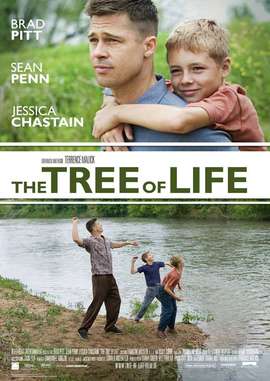

“Where were you?”: God and Grace in Terrence Malick’s The Tree of Life

It is a beautiful thing that the Yukon Film Society was able to bring us “Tree of Life” through their new Available Light Cinema incarnation at the Yukon Arts Centre once a month.  Even more amazing was the swiftness.  Whitehorse is not known as the place where new good films come quickly–but the YFS have almost bridged the gap between us and Seattle.  Tree of Life was handed the Palme D’Or in May, and we have it in September.  I’d say that was pretty darn fast. It shows again on Wednesday night, Sept 14 at the Yukon Arts Centre.

The Tree of Life is many things to many people.  The film doesn’t concern itself with a complicated, or even clear, narrative.  It has a simple one.  At the opening of the film, the death of brother/son sends the characters reeling.   What follows is a montage of scenes recalled from the mind of a surviving brother, now grown up (Sean Penn) as he tries to figure out what happened to “allow” this death in God’s great scheme of things.  The Tree of Life, for me, was a calling out, a plea, a requiem to God for our personal tragedies–asking many times of God, Where were you?  Why did you let this person die?  Was he a bad person?  The film is loosely tied together with scenes from a Texas childhood–a paradise of sorts–with a scary center, a frustrated musician father (Brad Pitt) who takes out his anger, at having to put away his music, on his three boys.

There’s a lot of whispering in this movie.  Be careful when you cough.  You’ll miss them.  Often the whispered pleas begin with “Father” or “Mother” or “You”— as the man, who speaks as the boy, tries to figure out whether he was more worthy of death than his brother.

God appears in this movie, but not as Christians typically think of him–he is a bit distant, but consistent with the book of Job.  There is the other “Where were you?” to consider:  the movie opens with an epigraph from Job, asking Job–in the voice of God–“where were you when I created the heavens and the earth?”  And there is stunning cinematography that takes a viewer from the beginnings of creation through to the moment the son is born.   Through this, the pleas and the questions cry out— “God, are you there?” plays over a volcanic planet being birthed.  The magnitude of the event of creation overshadows the magnitude of the personal tragedy.  It is almost as if Malick is answering for God: I was worried about much larger things.

But to make that the only statement Malick makes would be to miss his emphasis on the importance of love and forgiveness in the face of the cruelties of life and death.

Continue reading

The Other “Hijacked Airliner” Story: Whitehorse, Yukon 9/11

It was the only airplane to emit a hijacked signal on 9/11/2001.  It was heading to New York City, from Seoul, via Anchorage Alaska.  Fighter jets were scrambled.   A whole city, Whitehorse, was given 15 minutes warning that a hijacked plane was heading to their small airport, an airport just above the center of town.  Every school was evacuated, parents were told to pick up their kids, and a giant 747 escorted by jets whose missiles were locked on target came into view.

Max Fraser, local Whitehorse filmmaker, has put together one of the most intriguing “untold” stories of 9/11 in his documentary, Never Happen Here: the Whitehorse 9/11 story.  Only a few hours after four planes crashed into the World Trade Center towers, the Pentagon, and in Western Pennsylvania, Whitehorse is told that a hijacked plane is on its way to their city.  They have 15 minutes to get ready.

Imagine the panic, after watching everything happen in New York that day, hearing that it’s coming to your town in 15 minutes.  No one else got any warning that planes would be falling from the sky.  The morning of 9/11 was a surprise–there was no anticipation, no expectation.  While nothing can take away from the horror of 9/11 in the United States, or can compare to the tragedy of that event, Whitehorse’s story has an interesting angle no other story has.  It is because of the horror of 9/11 that Whitehorse had something to fear.  A disaster of 9/11 proportions was coming our way, only a few hours after we’d been shocked watching the panic and destruction hit New York City.   What would you do if you knew a 9/11 was coming to your city?

Continue reading

Characters with Something On Their Minds: the brilliant writing inside Deep Impact

Recently, I re-watched Deep Impact, one of two “asteroids-going-to-hit-Earth” movies that came out simultaneously (the other being, the poor-in-comparison, Armageddon).  Deep Impact builds slowly, and has amazingly drawn characters.  It’s worth it to watch just to pick up some tips on character development.  These are my thoughts after watching it.

1.  Every character in the movie has their own worries or concerns BEFORE their first scenes.  Jenny Lerner (Tea Leoni) wants to make a name for herself as a reporter and move up faster than the news organization’s corporate ladder will allow.  Leo Biederman (Elijah Wood) is falling in love.  Jenny’s mother (Vanessa Redgrave) is achingly going through the news of the marriage of her ex-husband to a younger woman; and the ex-husband has just married, and in the process, estranged his daughter.  Others are having babies, concerned about parties coming, or debts, or something.

It’s very easy for me as a writer to create characters who come into my scenes to do my bidding and then exit, stage left.  This makes them one-dimensional and cardboard–it also makes them a bit robotic, there to get my plot done for me.  BETTER are characters who have had something JUST happen to them when they come into your story, in other words, they are recovering from a cold, they are dealing with bills, parents passing, daycare that’s too expensive–something.  These scenes were really short, but they helped me care about the characters quicker because they had outside interests, outside agendas besides the imminent needs of the PLOT.

2.  They make CHOICES based on their previous problems or worries.  I was very surprised to see what kinds of choices they made, choices bound by the plot, yes, but could only have happened because of the natural cause-and-effect of the plot.  Someone chooses not to be saved; someone chooses to rescue someone else; someone kills themselves; each new choice brings about other choices–but choices that build on one another.

Sometimes writers (like me) create plots that are heavily structured because of what we want to see but we don’t quite take into consideration the kinds of choices  the characters would make—we make their choices from who they are in the beginning, not who they are BECOMING as the story progresses.  Events change us, and I was reminded that characters in the movies could not have made certain choices without having gone through the events in the movies. It’s a good thing to remember that the events of your story change your characters–and they do it gradually.

Change doesn’t happen because of one event, usually.  It happens because we are exposed again and again with events and choices.

Continue reading

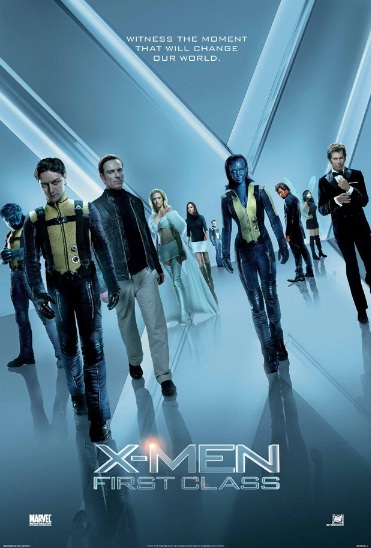
X-Men vs. X-Men: First Class

Okay, I just had to re-watch Brian Singer’s original X-Men (2000) after seeing X-Men: First Class.  I wanted to see how these two movies played off each other.  Call XM:FC what you want–origin story, prequel–it still has to be a good movie.  And I think Singer’s original X-Men is a much better movie than X-Men: First Class.  Here’s why.

1.  XM: So much more character development of several characters–Rogue, Wolverine, Magneto, Xavier, Jean Grey.  This movie takes time with its characters and keeps focus on Wolverine as the “schill” or the “new guy” who gets to experience all the Xavier School like we do, for the first time.  He operates “as us” so other characters tell him things we need to know.  Their world is well-developed already and intricate and we get the idea that it’s solid and has been this way for awhile, and has stuff that we haven’t seen yet.

XM:FC barely develops Eric as a tragic, one-note, revenge-minded character, and Charles as a privileged fop whose compassion comes because of his blindness to others hardships (though occasionally, his mind-link helps him “understand” your pain).  FC Xavier comes by his compassion too easily; original Xavier seems much kinder, empathetic, a person I’d admire.

None of the minor characters in XM:FC are even developed.  They barely get screen time except to fight.  Sure XM has its share of background/throwaway characters who simply run through a door, or make an ice rose, but we don’t need to know who they are.  They aren’t pivotal to the plot.  XM:FC characters are, and it’s a shame they are never really developed.

Continue reading

Mob Rules and the Art of the Team Movie— a review of X-Men: First Class

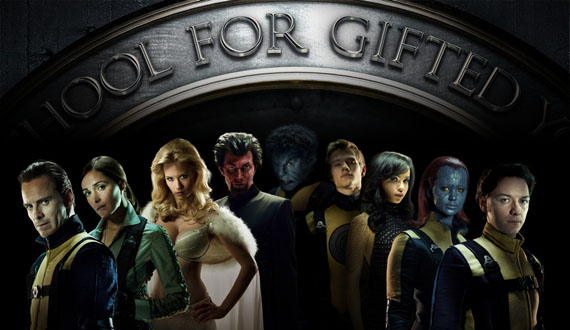
I saw X-Men: First Class last night.  It was a good, solid action movie with stunning special effects.  It moves and kept me interested.  It never had me on the edge of my seat.  It’s an origin story– it has to go through certain details to collect them all–but it doesn’t do it very interestingly, in my opinion.  It also has trouble with multiple characters, having a hard time giving them much development.  I thought the original X-Men did a better job at giving each character a moment.  While Wolverine, Rogue, Dr Jean Grey, et al have their moments to shine as characters pre-Xavier, we don’t have that in this movie.  Here, we barely know anything about Banshee, Beast, Raven, Angel, Darwin, Havoc.  They are more about what they can do than who they are–though they hint at something deeper.  In all, it’s a pretty good film, but not an amazing one.  Enjoy it as an action flick.

Continue reading

TRON: Legacy needs a CLU, gets a “journey without a goal”

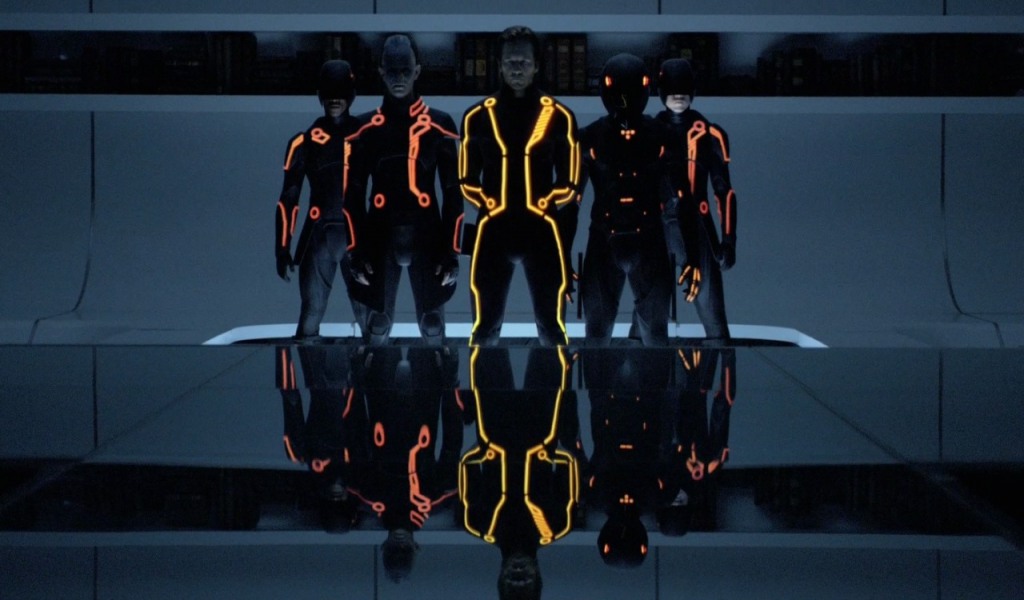
I wanted to like this movie.  I have such fond memories of the original TRON.  It was ahead of its time in many ways back then, and probably a little cheesy too…  It was wrapped up in religion a bit, which wasn’t bad— it gave programs a “culture,” a “faith.”  TRON: Legacy has kept up with the digital explosion in movies and taken it to grand heights, but it abandoned good writing and good characters along the way.  I found it hard not to roll my eyes, and even with such great visuals, found myself bored during the last quarter of the film.  How did they fumble such a beautiful opportunity?  I don’t know, but I have some ideas.  I offer these up for consideration.  I’m no Roger Ebert (but I’m a huge fan, Roger) but I think most critics have already agreed that the plot lacks something. The original TRON received 69% on the tomatometer from Rotten Tomatoes, the new Tron 49%.  Though, oddly the audience seems to like the second one more.  Critics agreed the light show and “glitter” are fun, and who can beat that soundtrack?  I loved the light show, the competitions, the music, but the plot is an epic fail.

Continue reading

Desperate Times Call For Desperate Magic: A Review of Harry Potter and the Deathly Hallows

Harry Potter and the Deathly Hallows, pt 1.  is a good film–a solid film, giving a good arc and screentime to all three of the main characters, and a host of others. There’s plenty of action, but this film also takes time to develop the story and the characters.  I stood in line at the Yukon Cinema for two hours to get in to the first showing (-10 C)–so my standards had to go up for how good this film had to be.  And I felt like, in the end, it was worth it.

You know the premise: Harry Potter and team are on the run from Voldemort.  Nowhere is safe.  Harry is out to find as many pieces of Voldemort’s soul as he can and destroy them.  We aren’t at Hogwarts anymore.  But the lessons, it seems, still go on–and the grades are worth more.

Some small spoilers follow—but nothing major.  Read later after you’ve seen the movie.  It’s just me talking about the really cool character arcs–but I do a bit of telling what characters do.

______

I was pleased at how much this film is about Hermoine.  The opening sequence has her erasing the memories of her from her parents’ minds, and also from every picture in the house.  She has, in effect, erased her existence in the Muggle world.  The film highlights the extreme displacement the kids feel by not being in Hogwarts, and you feel it too.  The camera shots from above the various geographies, rotate just slightly, giving you the feeling of being lost.  And these students are lost, very lost.  They are on the run, and no place is safe.  Hermoine guides them through past memories of her childhood, and the movie plays out as a backwards rendition of those memories she has erased.  Each place they disparate to, or jump to, is a place she alone remembers from her past.  When she is tortured in the film, we realize how much she has always been in potential danger at Hogwarts, especially because she is Muggle born.  While Draco Malfoy always carried the racism and bigotry into Hogwarts, because he was a child–he had no power to enforce that bigotry, and we assumed that it would be knocked out of him.  Hogwarts has obviously failed a few times to instill responsible and compassion in its students.  Voldemort carries this much farther.  On a purity spree, he is trying to subjugate the world of Muggles under wizardry control.  Hermoine represents muggles on the run, Muggles fighting back.  She even helps save another Muggle-born woman who has been stripped of her wand in a courtroom scene straight from the Inquisition.  We know that the imperative for the wizards getting back in control of Voldemort is to save mankind, not just themselves.  And we realize that the last six books were about Hogwarts, a school that taught morality and self-control to people who had great, destructive and constructive powers.  Hogwarts is what stands between wizards and witches taking over the world–young wizards’ and witches’ education is paramount to our safety.

Ron has a great arc as well, as his whole family is left fighting against Voldemort while he and Harry and Hermoine are trying to find the horcruxes.  Every day he listens to the radio to see if his family is okay.  And every day they don’t find a horcrux is another day that he isn’t doing something to stop the war.  He feels guilty that he’s “doing nothing” and doubly guilty because he gets to be with the woman he loves all the time.  This turns in him, and with the help of an evil horcrux which amplifies those feelings of betraying his family, it causes him to rage against his friends, and make a big decision.  It’s a huge move for a major character.  We know part of is the horcrux, but part of it stems from six books of Ron Weasley being seen as less than all of his siblings, and standing in the shadows of Harry Potter.  He now has to play the hero–and while he wants to so badly, there’s a fear that it’s always just “playing” and that this playing is actually taking away from a larger duty he owes his family back home.  His arc represents, to me at least, the wizarding families and the freedom they are likely to lose if Voldemort wins, and the sacrifices they make to keep people safe.

Harry, though frustrated as a leader, has a lot of moments to make good and bad decisions as he goes.  I like that he learns that his friends are doing the best they can.  They are counting on him to know what he’s doing–and sometimes he does and sometimes he’s just an 18 year old who is figuring things out as he goes.  I like that he’s learning to be a leader here under trying circumstances and there are moments in the film that he shows how good of a leader he can be.  We know the final film will explore even more of Harry’s character, and Dumbledore’s.  I wonder how much they’ll bring out the relationship between Grindewald and Dumbledore.  I’m very excited to see how Harry reaches what he has to reach in the next film.

Even though this film deviates from its normal Hogwarts school year–I was pleased to see that the way the earlier films marked the passing of time was kept in this one: holidays.  So even though you are on the run, Harry, you still mark time the same.

Deathly Hallows does have some overtones of Lord of the Rings, as Harry searches for multiple objects, so that he can destroy them.  The scene interrogating Creature about a locket gave me Gollum, Frodo, Samwise feelings all over the place.  And the dream sequences of seeing Voldemort closing in on various people acted like Sauron’s eye in reverse.

And then come to the middle of the film, I was surprised and charmed to find such a finely animated film inside.  When the story of the “Three Brothers” is read aloud by Hermoine, the film indulges in a beautiful moment of cinema.  I was entranced. The short segment is worth its own short film status–and I would definitely be interested in seeing a film like this made from the stories in Beetle the Bard.  If this was the director’s way of seeing if we’re interested in seeing that film–let me be the first to say, yes.

Overall, the film far exceeded my expectations, in that it brought out threads that resonated with the first six films, and managed to find humor in the darkest book of the HP series.  It also gave such meaty character building parts to Ron, Hermoine and Harry–just when you thought you knew them, now you see them grow again. This is the perfect culmination movie.

_______________

Kudos to the folks at the Yukon Cinemas for decorating the theatre, keeping peace, for filming the line, and asking us trivia questions for prizes.  Thank you for threatening any person who had cellphone nonsense during the movie with immediate expulsion.  Please do this for every movie!  🙂  I’m very proud of our how well Yukon Theatre did with the massive crowds, and regulating traffic.  And they were all dressed in Hogwarts robes!  Priceless.

Inception: the Idea trumps Character (movie review)

Help! My characters have no life. Oh wait, maybe they just need to wake up.

Inceptionis a solid movie, full of complications, a lot of thrill, and most importantly, some good ideas.  While it also has a couple of interesting characters in DiCaprio and Murphy, the rest of the cast fulfills their positions dutifully, easy to interchange and forget.   It’s a caper film–with the majority of the movie about the caper.  It uses a Matrix-like idea as a vehicle to achieve its goals.  The idea is central, the science fiction secondary; but like good science fiction–the idea is enough to carry the movie.

I liked the movie, enough to see it again if the time comes to rent it on DVD or if a friend wants to see it; but I found the inconsistencies in the premise took away from the caper.  How do they share freakin dreams!  Plug yourself in and something determines whose consciousness you’re going to share?  Doesn’t matter, the movie says— we’ll just tell you.  How do they determine who will dream and who will share?  Doesn’t matter, the movie says, watch what we can do with a special effect.

There’s enough infodump in the first twenty minutes to choke a horse, disguised as dialogue, interspersed with scenes of cities running amok and riots in the streets.  The riots are there to make sure the ideas go down easier.  “Just a spoonful of riot, makes the infodump go down…”  Take a note: this is NOT how to do an infodump.  We learn absolutely nothing about the characters in the first twenty minutes…only that a Molly means betrayal.   Nope, we need to explain the premise….

Now, once I got past that we were rushing through the “technical” issues to get to the action (I could almost hear the movie tell me–who cares about whether or not this makes sense? We’ve got a cool thing to show you), I enjoyed the movie.  But I didn’t really care about DiCaprio’s character– or empathize with his loss.  Normally Ellen Page is fantastic (LOVED JUNO!) but any actress could have pulled off that role, it required so little.  In some ways she, Michael Caine, and all the other actors are wasted to serve the idea….

Jeffery Overstreet has the same concerns in part one of his review of Inception.  And says them better.  It wasn’t so much a bad movie–as a rushed one, one that engaged your brain but not your heart–even when it was trying so desperately to do so.  And the ethics involved in changing someone’s mind so illegally made DiCaprio not a very sympathetic character.

Now, back to that idea.

The BEST thing about Inception, and why everyone should see it, is about how you put an idea into someone’s head.  The discussion about how you make someone believe that it was their original idea, as opposed to yours, is insightful–and will make everyone talk.  The whole work to get Cillian Murphy to think this is his own idea is downright fun.  And everyone in Marketing should see this.  Or maybe they shouldn’t!  (What might have been more interesting, but not as fun, would have been a philosophical film based on the premise–you know, in the same way that Sophie’s World merely used the least amount of plot to play with an idea.)

There is NO insight on dreaming in here.  Dreams, while they can be detailed, are murky and inconsistent.  They’re rarely realistic and may involve someone who looks like they are a walking shark carrying a tuba….  And as Overstreet admits too– other filmmakers have handled the surreality of dreaming SO much better.  That dreams can be invaded by someone–so casually–with no idea how to operate in someone else’s dream — is really lame.  As if the writer (and I like Christopher Nolan) just needed to get past some hurdles here…. to make a cool graphically conceived movie.  Also, the biggest clue that you’re in a dream is that you cannot read the same text twice.  It appears and changes as you’re reading it, rendering the opening premise illogical….

SPOILER:  And this is the third “dreamy” film–or film which contains reality based on your own thoughts–to include a suicidal woman.   What Dreams May Come, Solaris and this movie all have this as a premise…  that women can’t handle their own thoughts and will take their lives, causing their husbands, every one, to come rescue them.  And all three films end with that rescue leading to a kind of pseudo-paradise that the audience recognizes as delusion.  (What Dreams May Come is worthy of its own review.  A movie which ranks as one of my all time worst movies ever. But the ending delusion is supposed to be Heaven, so I can’t really argue with that.)

So, I found the movie a bit flat–even as the action was all revved up….  Caring about the characters, to me, was essential to enjoying the intensity of the film.  If I can’t care, then I can’t care about the intense situations you put the characters into.  Solaris made me care about the main two characters in their hyper-reality film; What Dreams May Come suffered from the same overblown concept with lack of character interest.   Inception forgets that narrative relies not just on amazingly cool logos, but on believable pathos too.

Is There No Wonder in Wonderland? A Review of Burton’s Alice in Wonderland

What do you want when you get down the rabbit hole?  Burton begs this question in his version of Alice in Wonderland.  Folks will probably enjoy the visuals–they are delightful to watch.  But in this age of CGI, there’s not as much fanfare left for special effects.  It’s coming down quickly to who tells a good story, and I want to examine Burton’s story here.

What I like about the story of Alice in Burton’s Wonderland is that we get a detailed look at Alice’s life before the rabbit hole–especially her cloying debutante-shuffling world, where so little was expected from women, and so much was expected from their cooperation.  I like the summer dance on the lawn, the hordes who like to watch when she’s proposed to.  I like Alice.  I liked that narrative so much that I was expecting more of it when we got to Wonderland and it wasn’t there, not immediately anyway.    When I realized that Wonderland was reflecting her own re-vision of a forced duty, then it got more interesting–but that time in Wonderland feels off.

Two things happened when she got into Wonderland.  I got confused, and Wonderland was reduced to a strip of land between two kingdoms.  The premise of this movie is that Alice has been here before.  In fact, she has recurring nightmares throughout her childhood and young adulthood, and yet nothing in Wonderland sparks her memory?  Even a memory of the dream?  I don’t buy it.  If I was haunted by something, I would start recognizing people and things.  She acts like she’s never even SEEN the place.  Why doesn’t anyone try to jar her memory when they pull out the Calendria?  (When we do see her previous journey in montages it looks vaguely like the same plot…and boring)

This plot seems very focused on the end of the movie.   It’s like one big long foreshadowing.  She has to fight the Jabberwocky–everyone tells her this.  All the beautiful weird dialogue of Lewis Carroll is gone, pared away to focus on an ending that’s so inevitable we might as well have just skipped to the end.  All the characters are focussed on Alice.  This is so unlike Carroll’s version where everyone was focussed on themselves.  Alice was merely observant.  Here she does only what we expect her to do; she goes through the motions of the Eat Me/Drink Me sequence, a moment with the Mad Hatter, a second with the Cheshire cat.  She’s not even curious anymore.  Where’s Alice–Carroll’s Alice?  

Wonderland really takes on the rivalry between Elizabeth and Mary, two queens that duked it out after Henry VIII died.  I didn’t buy the petty rivalry of sisters.  What’s there to fight over?  Two courts, fully intact.  The flashback involving the Jabberwocky smoking a White Queen party—well, there weren’t any consequences.  The White Queen had a new castle, attendants, and enough white to choke the Arctic.  I didn’t get the queens at all.  There’s no reason for them to be upset, and in fact, the White Queen seems devoid of any will to fight–she has to be saved.  Her court resembled the starchy-white English party Alice just left.  And we hated that.  

Remakes where characters revisit their original stories can be good.  Hook is an excellent version of the grown up Peter Pan visiting Never Never Land.  The script was brilliant.  Burton’s Wonderland has very little wonder left–even for the characters involved.  

Yes, Carroll’s original story is obtuse and playful–it isn’t easily figured out.  But Burton scrapped the multiplicity of places in Wonderland, the depth of odd characters, and Alice’s curiosity in favor of a plot.  If you’re going to put all your money on a plot, it better work.  This one is so muddly in the middle, I just waited for there to be a reason for Alice to do something….until we see her realize that everyone is telling her what to do–in both worlds, and then she goes and does something else.  But it’s not enough.  She hurries through the epilogue in the world’s longest/shortest “I need a moment to think.” 

I liked Burton’s rescuing of Alice’s real world experiences—though she doesn’t talk about them much in Wonderland any more.  I like the ending, I like the beginning, but her time in Wonderland plays like nobody wants to be distracted by wonder anymore–they want the big battle.  Carroll’s Wonderland was about the wandering, about the figuring things out, about the wonder— but this one had few choices for Alice, a lot of inevitably and no wonder.