Fantasy Magazine Interviews Me: Writing the Other

DSC_0360_255Fantasy Magazine, which published my short story,  “The Moon Over Tokyo Through Leaves in the Fall,” did a companion interview, which I thought was incredibly thoughtful.  When you write a story, you always hope for questions like this–that someone will ask what you meant when a character said this or that, or ask how you go about writing the story.  

And secretly too, you hope you don’t sound like a dork.  

I appreciate the interviewer, TJ McIntyre, and the work he put into the questions.  Thank you.  


An excerpt

There have been many controversies over the years relating to writing the “Other” or writing with a voice outside of one’s own natural experience. “The Moon Over Tokyo Through Leaves in the Fall” is written from the point of view of a modern Asian-American female. Did this create a challenge for you? What steps, if any, did you take to verify the authenticity of your voice in this piece? What tips do you have for other writers out there working on pieces where they are writing from the perspective of the “Other?”

Hmmm . . . This is a hard question for me because I think every character you write about is an “Other.” I do understand the argument, that writing something completely different from you is more challenging. But unless you are writing memoir, the characters have completely different childhoods, desires, relationships — all the characters, not just the POV one. So they all take a lot of work to understand and “get right,” so to speak.

But if someone wants to write a character which is “other” I wouldn’t stop them. Instead, I would encourage them to stretch themselves. I certainly don’t immediately identify with, or always find accurate to my experiences, the white, rural, college-educated, religious gay male characters I find. And I don’t always want to write that character. I would hate to stop someone else from writing them though.

So I think that’s my first tip: Feel free to be whoever you need to be for the story, without holding yourself hostage to criteria. Criteria can turn into stereotype. I remember once writing a poem about Theodore Roosevelt surviving the Amazon River. A fellow writer said that I had no albino catfish in the poem and that it was a weakness. If I didn’t mention them, I would be called on the authenticity of place. Even worse may be the authenticity of race or gender or sexual orientation — since we are multi-faceted people. I go back to my first statement: Everyone in your story that isn’t yourself is an “Other” . . . and you are required to be careful with all of them.

Saying that, though, I think writing a nasty, mean, selfish gay character might be an accurate representation of one particular person, and might make a funny character, but I would trust that character more in the hands of a gay man who knows the consequences of pushing a bad stereotype in a culture that seems to want to believe the stereotype, than in someone else’s hands. I tried hard to be sympathetic to both Matsui and Yumi equally — showing their flaws, their desires, and hopefully helping a reader side with both at different times.

So, not that you have to always treat your Other characters with kid gloves, but that you make everyone understandable and as authentic as a human being as you possibly can through research, and through infusing them with your own flaws/desires. I infused Yumi with some of my own doubts about my relevancy/impact on the world, my own relationship experiences, the sometimes clash of cultures I find with people older than me. The story doesn’t have my exact experiences, but the shades of feelings are right, the tone is right, the need to be loved and validated is right, I think.

Run the draft through a close set of writerly friends to check for bias. I did run this through Clarion 2007 in San Diego, past a rigorous group of fellow writers, half of them women, who had some questions about the way I wrote Yumi, and I followed their advice. Not that a character can’t make bad decisions, or have perceptible flaws, only that they should be unique, individually motivated and free from OBVIOUS bias.

Be open to learning what it’s like to be someone other than you. It’s really difficult to shed Jerome in order to take on Yumi or Matsui, but I try. Like an actor taking a role.

I think if we only wrote within our experience we’d really limit our stories, and ourselves. I remember once writing from the perspective of my brother, and I learned a lot about what it felt like to have to make some of his decisions. The story moved radically away from my brother’s actual deeds, but the writing process allowed me to feel empathy and understanding for him in a way I had never felt before writing about him.

The process allows a writer to “put themselves in someone else’s shoes” and that’s good, both for the writer — who learns something outside him/herself — and the reader — who doesn’t have to put up with a bunch of main characters who are sci-fi movie buffs. Viva l’Other!

______________________________________________

Read the whole interview on the Fantasy Magazine Website here.

Tesseracts 14: Canadian Sci-fi/Fantasy Anthology Open for Submissions

2508955112_7a2d3e3312

Canadian authors of science fiction and fantasy, get your stories ready.  Tesseracts 14, is open for business.


Tesseracts Fourteen:
OPEN FOR SUBMISSIONS (Sept. 1, 2009 – Nov. 30, 2009)


Submissions are now open (from September 1, 2009 to November 30, 2009) for volume 14 of the Tesseracts anthology. If you are a Canadian author and write speculative fiction, we want to see your stories, poetry, radio plays, flash fiction etc. [SEE GUIDELINES BELOW]

The editors for this antholgy are:

John Robert Colombo and Brett Alexander Savory.    


GUIDELINES 


  • This anthology is open to Canadians, landed immigrants, long-time residents, and expatriates.


  • Open to submissions in either English or French. (Francophone stories must be translated into English for publication if accepted.) Canadian authors who write in languages other than French or English are welcome to submit an English translation of their work, provided it otherwise falls within the parameters of this anthology. Please supply details of original publication for any submission that originally appeared in a language other than English.


  • Translation into English is the sole responsibility of the authors.


  • Genres: all the genres of imaginative literature, including but not limited to magic realism, science fiction, fantasy, dark fantasy, slipstream, supernatural horror, weird tales, alternate history, space opera, planetary adventure, surrealism, superheroes, mythic fantasy, etc.


  • The Tesseracts anthology series is open to both short fiction and poetry.


  • Payment is $20 for poetry, $50 for stories under 1,500 words, rising to a maximum of $100 for stories of over 5,000 words (longer stories are paid a slightly higher fee, but in order to exceed the word length limit of 7,500 words, the editors must judge a story to be of surpassing excellence.)


  • Deadline: 30 November 2009.


  • Do not query before submitting.


  • Email submissions: tess14@hadespublications.com


  • Emails MUST contain the word “submission” in the subject line, or they will be deleted automatically by the server. Please also include the story title in the subject line.


  • Submissions MUST come as an attachment: RTF is the only acceptable format.


  • Emails MUST contain a cover letter in the body of the email; for security reasons, email attachments with no cover letter will be deleted unread and unanswered.


  • Cover letter: include your name, the title of your story, your full contact information (address, phone, email), and a brief bio. Do not describe or summarize the story.


  • If your address is not within Canada, please indicate in the cover letter your status vis-à-vis Canada.


  • Reprints (stories having previously appeared in English in ANY format, print or electronic, including but not limited to any form of web publication) can be considered but will be a hard sell; reprints must come from a source not easily available in Canada. If your submission is a reprint, please supply full publication history of the story. If your story appeared previously, including but not limited to anywhere on the web, and you do not disclose this information to the editor upon submission, you will be disqualified from consideration.


  • Submission format: no strange formatting, colour fonts, changing fonts, borders, backgrounds, etc. Leave italics in italics, NOT underlined. Put your full contact information on the first page (name, address, email address, phone). No headers, no footers, no page numbering. DO NOT leave a blank line between paragraphs. Indent paragraphs. ALWAYS put a # to indicate scene breaks (a blank line is NOT enough).


  • ALWAYS include your full contact information (name/address/email/phone number) on the first page of the attached submission.


  • Rights: for original fiction, first World English publication, with a two-month exclusive from publication date; for all, non-exclusive anthology rights; all other rights remain with the author. (DO NOT INDICATE WHICH RIGHTS YOU ARE OFFERING; SUBMISSIONS MARKED WITH RESTRICTIVE RIGHTS WILL BE DELETED WITH NO REPLY.)


  • Spelling: please use Canadian spelling, as per the Canadian Oxford Dictionary.


  • Response time: initial responses (no / rewrite request / hold for further consideration) will be made within thirty days after the close of submissions. Final responses no later than 31 December 2009.


  • Submit up to three stories at the same time, butUNDER SEPARATE COVER (only one submission per email).


  • Simsubs are not encouraged but are acceptable. Should you receive a “rewrite request” or “hold for further consideration” response, please indicate immediately whether your story is under consideration anywhere else.


  • Two After-School Fantasy/Sci-fi Writing Classes for Teens: PC and FH

    Starting Sept 16 at FH and Oct 1 at PC, I will be offering science fiction and fantasy writing to interested secondary students.  

    The Little Girl and her Giant Crocodile, Mauro Lira
    The Little Girl and her Giant Crocodile, Mauro Lira

    Are you attending Vanier, FH or PC this year?  Do you like to read science fiction or fantasy, and do you like to write your own?  Come join a group of dedicated young fantasy/sci fi writers like yourself on Wednesdays at FH Collins, or on Thursdays at PC, after school.  Snacks will be provided for the hungry.  Bring your own notebook paper and pen.  A journal is best.  We’ll play some writing games and get you pulling stuff out of your imagination–and then writing stories.  

    After two successful years of running the first group–which last year landed at FH Collins–I’m starting a group up at PC.  If you think you’re interested or know someone who might be, get in contact with the Parks and Recreation folks at 668-8325 and register for either the FH or PC version.  Registration begins on Sept 8–one week from today.  Classes begin earlier at FH Collins—and their program is 13 weeks; PC, since we’re just starting out, has an 8 week run.  

    FH Collins begins: Sept 16

    PC begins: Oct 1

    Crocodiles will not be provided.  Please bring your own.

    Stories of Intergalactic and Fantastical Hoochies wanted for Anthology


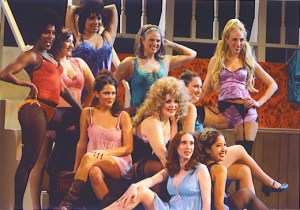
    Looks like the cast of Best Little Whorehouse in Texas
    Looks like the cast of Best Little Whorehouse in Texas

    Yep, you heard it right.  An anthology about the “World’s Oldest Profession” is looking for submissions.  Stories need to have a genre twist to them—science fiction, fantasy, something that makes them a bit different.  The anthology is “Ladies of Trade Town” and the Press is a good one.  


    For more info, go HERE   According to the Website:

    The stories selected for this anthology will build on that varied background to tell well-crafted tales of the women and men – and other sentient beings – who “ply the trade” in a variety of times and settings. I’m looking for original science fiction, fantasy, and related genre short stories that entertain and play to the imagination of the reader. Show me something I haven’t seen, read, or written. (For examples of that last, see “Lady Blaze” in Roby James’ Warrior Wisewoman 2  and the title cut of the filk CD that gives this volume its name.) Humor, characters of all orientations and gender-identities, and new writers all welcome.

    Despite the theme, I am *not* looking for porn, erotica, or gore-soaked horror. Absolutely no child abuse, incest, or non-consensual situations. Also not looking for poetry, fanfic or proselytizing either for or against the theme.Vekma

    STORY LENGTH:: between 3,000 – 10,000 words. Mostly looking for stories in the 5,000 – 6,000 word range, but I’d like to have a few stories on the upper and lower ends in the mix. The upper limit is firm for unsolicited stories.

    PAYMENT: $0.02 a word on acceptance of completed anthology manuscript by the Publisher, as an advance against pro-rata share of the royalties after earnout, plus one contributor copy.

    READING PERIOD: Opens January 5, 2010, closes June 9, 2010. Manuscripts received before or after this period will be discarded unread, unless prior arrangements have been made otherwise.

    Flash Me, for short short fiction–all Fantasy Issue, due August 31

    Flash Me Magazine’s All Fantasy Issue
    FLASH ME MAGAZINE will be doing another ALL FANTASY ISSUE October 31, 2009. All stories submitted for the fantasy issue must contain some element of fantasy and be 1,000 words or less. The submission deadline is August 31, 2009.

    Special guidelines apply, so please visit our website prior to submission. You can view the fantasy issue submission guidelines here.

    The deadline’s coming up, and we’re still searching for spectacular stories – maybe yours?? 

    Yvonne
    FMM Admin Assistant

    (thanks Specfic Markets)

    Preparing us for the Era of Displaced Peoples: District 9

    District-9-Wallpapers-Alien-Motherships-Guns-Helicopters-district-9-7039035-1920-1056District 9, Neill Blomkamp’s stunning directorial debut, is an intelligent science fiction movie, a disturbing Apartheid metaphor, but it might also be, unintentionally, a good look at the coming Global Diaspora and the problems of moving a whole nation of people inside another nation.  

    The film asks what a country does when they are inundated, suddenly, with refugees or displaced peoples.  Johannesburg has a huge mothership hovering over the city, malnourished aliens trapped inside, and the city must make a quick decision.  To help or not to help?  They help.  But the problem of fitting a nation within nation becomes more than what the people can handle–more than what they want.  Long term care.   The people on the ground don’t want a whole nation moving into their world–people so alien.  The government had no precedent for what to do.  I know that Blomkamp is aiming for an Apartheid metaphor, but the sins of Apartheid will become our sins if we don’t come up with a plan on what to do with displaced peoples in the coming decades.

    If Climate Change is occurring–whether man-made or not (the arguments shouldn’t stop precautionary measures)–Tuvalu, the island is sinking, and so are a number of other islands.  Their sinking isn’t the only problem.  The more water on the island, the more threat from disease, the more threat from storms, etc.  A very real scenario is that island populations will be forced to find other places to live–on the mainland.  That’s not a science fiction solution–that’s a practical prediction.  These migrations are not a bit of immigration for one country.  With the number of island nations we have in the world, this will be a LOT of immigration for every country.  

    How do you put American Samoa inside Kansas, let’s say?  A nation within a nation.  WIll there be sovereignty issues to think about?  Yes.  What control do Samoans have over their life if they are in Kansas?  Or the Japanese inside Mainland China, or more likely, Canada?  

    Climate change isn’t just about some places getting hotter or wetter; it is about changing the map entirely.

    District 9, then, plays as a fable of what NOT to do, what CAN happen if governments are unprepared to consider wider immigration revision, sovereignty issues, incorporating whole cultures within nations, relocation plans.  I believe in the next thirty years that this will be a reality—that we will look at the country we’re living in and find separate, but integrated, countries within them, that people who lived on islands will have to choose new homes, erect temporary governments.  They will need everyone’s help.  

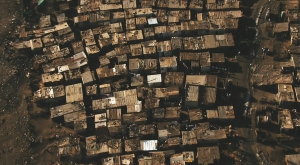
    We can’t make it look like the photo from District 9 above.  But we have to have infrastructure prepared for a global movement of people.  I wonder when countries like ours in North America, China, Russia, with large land mass, and whole sections with low population, will realize that they may become the destination of a nation.  Johannesburg in the movie was caught off guard.  We don’t have to be.  We can be ready for large scale movements of people, ready to know how to integrate cultures.  

    Canada has had some good prep already.  Known to be a country which allows new immigrants to keep their cultures intact, and a country that has been negotiating Land Claims and First Nation Sovereignty issues, they might start looking at ways they might use their plans for the Final Agreement on Land Claims to accommodate millions of new people looking for a home.  

    I know, it’s freaky to think about, but I don’t think it’s far down the road.  

    Immigration is about the resettlement of one or two families at a time, not whole cultures.  Refugees from Darfur come closer as a model.  Look at how that played out.  4 Million people were displaced in Sudan, and into Chad.  People escaping destruction.  They are still recovering, even as half of those people have returned home.  But what happens when it’s the whole nation and they can’t go back?  What do you do about their governments, their cultures, their possessions, integrating them into the workforce?  Can we wait to think about this?   Or will we have to build our own crudely-constructed District 9?  We are used to solving these problems by solving the political conflicts within a country—but water doesn’t recognize diplomacy.

    Realistic Science Fiction: District 9

    Scene-from-District-9-200-001This is an amazing film, both for what it sets out to do, and for what it accomplishes.  Taking the form of a documentary, it brings science fiction as close to real as I’ve ever seen it.  It is the documentary form, I think, that convinces a viewer that this is happening, or has happened.  

    The film is about what would happen if aliens came to Earth powerless and malnourished.  Human kindness would collide with our own aversion to aliens and suddenly you have camps where the aliens are kept.  It’s a brilliant stroke to make this set in South Africa and not New York or LA or London.  

    This film will surprise you at every moment.  I found myself, a film junkie, a sci-fi enthusiast, completely unprepared for where the movie would take me until it took me there.  The writing is superb.  You can’t find a traditional plot here anywhere.  

    Certainly we’ve come to an age where we can make special effects seem real—Peter Jackson, the producer and Neill Blomkamp, the director, have gone out of their way to make you see the special effects as realistically as possible.  Yes, the insectoid aliens are CGI, but there’s not a lot of special effects here that are obvious.  God bless ’em, effects are being smoothed into a film now.  

    This is not a mockumentary, whose job it is to make you laugh; it is filmed as a documentary to trick your brain into accepting its premise.  And it works.  I remember reading Dracula by Bram Stoker, as a kid.  And I hated the diary parts—but it is the story in letters that make that novel all the more horrifying because the author didn’t want it to seem like fiction.  They wanted you scared because these were actual letters.  It was more creepy to do it that way.  And this film, using documentary style–down to the archived tapes, the dates at the bottom, the steadycam moments–makes you think that someone pieced this together from twenty years of real footage.  Some of it is grainy, some of it is blurry.  

    If you want realistic science fiction, you blend the techniques and technology we have now with the strange and possible technology; you bring in recognizable cultural reactions (the Nigerians scamming the aliens), historical patterns of behavior (Nazi experimentation), all without winking at the audience.  Letting them react.  They will think it’s real–because you have torn away what they expect in a movie.  

    You expect a hero.  The main character is an idiot, really.  So, he’s not Bruce Willis.  He’s not super-intelligent, and rarely does the right thing.  But what an interesting character!   Again, if you are going for realistic science fiction, your main character may not be the best man or woman on the planet–but they are pivotal and they can learn.  A learning character is all you need.  

    The movie is brilliant on many levels.  It works as a science fiction thriller, yes.  But it also works as a metaphor for immigration, for refugees, and for the slums that are in South Africa.  Anytime a people are empowered over another people, stupid things happen to us.  The main character of the movie really is us–as we treat other people as alien.  That shift of power is the focus of the film, I think, and makes the most poignant statement.  Given the right circumstances, human kindness can become dispassionate, cold power.

    And what it takes to regain a sense of humanity, perhaps, is to lose it altogether.  But I won’t spoil any of the movie.  I’m so thrilled with the movie, I know that sci-fi junkies will love it and I know people who prefer realism and a smart script will love it.  

    I also know that if you have a passion for oppressed people in the world, and the injustice present in nations around the world who have subjugated another race, then you will also find the reflection of that, and the reflection, maybe, of hope.

    Steve Parker, Yukon Author, publishes Skrelsaga


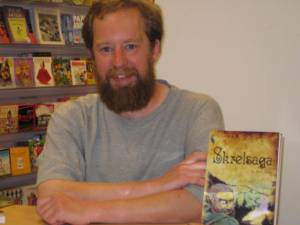
    Steve Parker looking pretty satisfied next to his book, Skrelsaga.  He lives to autograph!
    Steve Parker looking pretty satisfied next to his book, Skrelsaga. He lives to autograph!

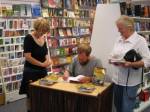
    Good friend and Fantasy writer, Steve Parker, known to many of you as the man who holds the downstairs desk at Mac’s Fireweed Bookstore–ordering your books, being pleasant, being Welsh–is the proud author of a new book, Skrelsaga, now available at Mac’s.  Here are a few photographs of his signing.  


    This is, I think, the first Fantasy novel published in the Yukon.  Yay, Steve!  

    More on the book in a review that will come later. For now, we celebrate the achievement!


    IMG_0425IMG_0434

    IMG_0435IMG_0440

    Science Fiction and Fantasy Writing–at FH Collins and PC


    Artist: C. Gerber
    Artist: C. Gerber

    Starting in the fall, I’m going to be doing the afterschool programs for teen writers at FH Collins (our second year!) and now, at Porter Creek.  It’s for science fiction and fantasy writers, and everyone’s welcome.  There is a fee.  We do serve food.  


    It’s through the City of Whitehorse.  You can contact Mia Lee at 668-8327 or mia.lee@whitehorse.ca to be a participant.  More information to come.  Programs will start up in late September or early October.  The guide comes out in two weeks so we’ll have more info then.

    Internet before Coffee? How does it affect your family?

    laptop and coffeeHey, I just read a great NYT article that I think will ring true in your family as well.  Read this:

    Coffee Can Wait.  Day’s First Stop is Online

    Excerpt:

    Karl and Dorsey Gude of East Lansing, Mich., can remember simpler mornings, not too long ago. They sat together and chatted as they ate breakfast. They read the newspaper and competed only with the television for the attention of their two teenage sons.

    That was so last century. Today, Mr. Gude wakes at around 6 a.m. to check his work e-mail and his Facebook and Twitter accounts. The two boys, Cole and Erik, start each morning with text messages, video games and Facebook.

    The new routine quickly became a source of conflict in the family, with Ms. Gude complaining that technology was eating into family time. But ultimately even she partially succumbed, cracking open her laptop after breakfast.”

    I’ve noticed that I’m online first thing.  I do manage to get coffee started and an english muffin in the toaster, but I’m there at the computer licketysplit.  

    How much of this is part of internet addiction–or communication addiction?  I don’t know.  

    Read this very funny, and poignant post in the same issue of the NYT today:

    I’ve Got Mail–by Verlyn Klinkenborg

    Excerpt

    I wish my memory worked differently. I’d like to be able to conjure up an accurate image of my consciousness from, say, 25 years ago. You know what 25 years means: No cellphones, no e-mail, no Internet, no social networking (except with an actual drink in hand), and only the most primitive of personal computers. What I want to answer is a single question: Was I as addicted to the future then as I seem to be now?”

    Care to share your experiences?  What were you like 25 years ago before all this technology gave us such instant access?

    For science fiction writers this should be a good exercise to think through.  Whenever you are designing the future, think about the implications of one change, and see the effects ripple through society and culture.  Life 25 years ago is very different from the way it is now.  And for every good piece of technology there are consequences.  It’s just an interesting thought problem that might be fun to fuel a writing exercise: what small change in the world could bring about major cultural changes?