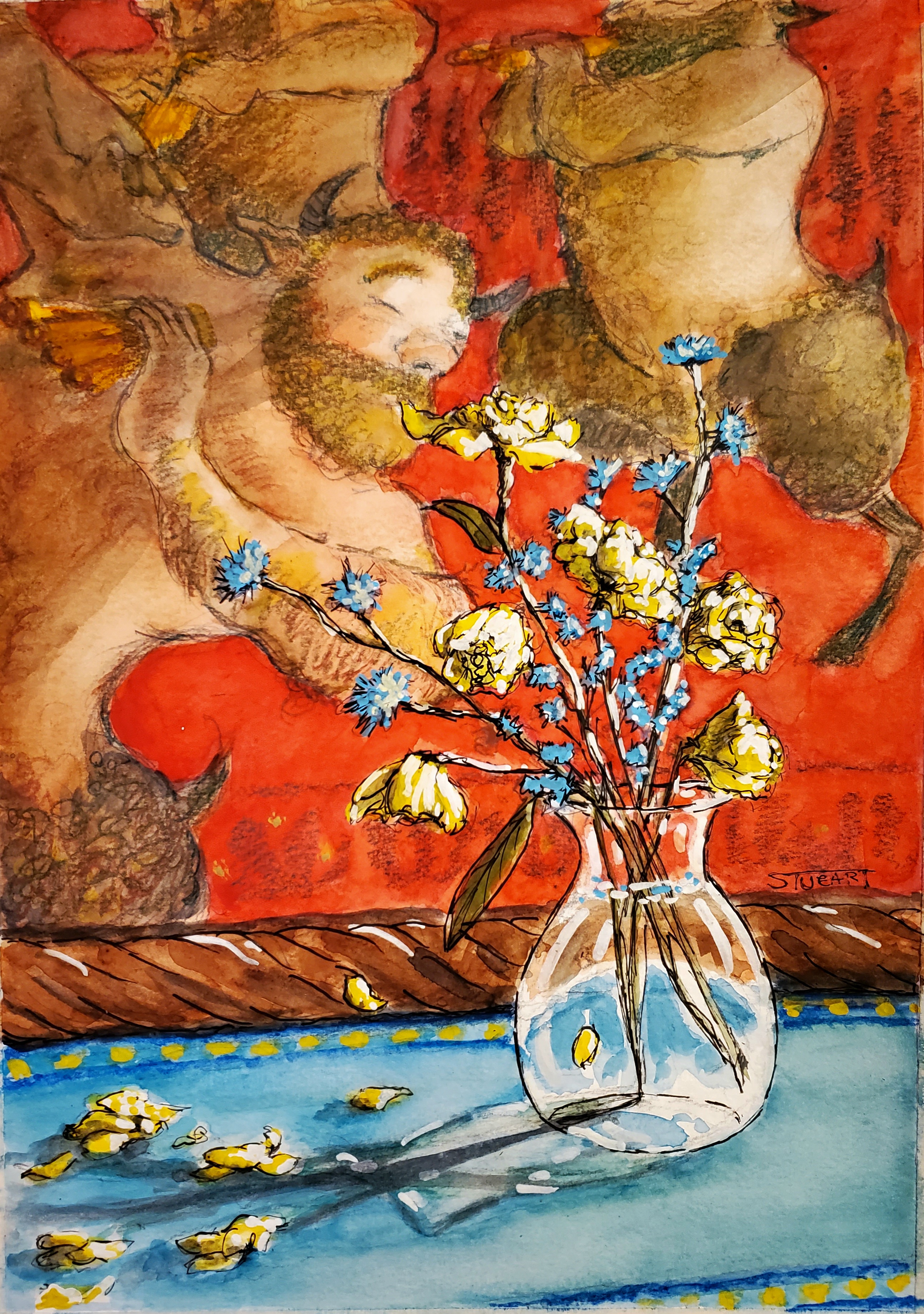
“Consider the Half-Life of Roses”

“Consider the Half-Life of Roses,” Jerome Stueart, (11 x 15) watercolor, watercolor pencil, mixed media on paper.

A satyr in a painting stops his play to smell the roses again before they are gone. My mother keeps dried roses in the kitchen window, and I know they still hold a beautiful smell. So much of the rose lingers after the rose dies. Roses have a long, long half-life. They don’t have to stay beautiful to hold a room spellbound. They give joy long after they can hold their blooms up, or keep their petals on. Old Roses are the most underestimated, and therefore give the most joy when we stop for a moment and smell them. “Oh, it’s still there.” Proving that their influence lasts so much longer than their lives. For years and years and years to come.

Hope you take time this week to enjoy everything around you.

Kuroshio Sea: a City Observed

 Jon Rawlinson has shot a beautiful video and placed it on Youtube for everyone.  It is spectacular.  It is the second largest aquarium tank in the world, the Kuroshio Sea, at the Okinawa Churaumi Aquarium in Japan.  The slow motion of the sea life, the black shapes of the people coming to observe this floating city, the music that perfectly matches the rhythm of the rays as they pulsate to the top.  I hope the Discovery channel or National Geographic picks this up as a commercial for a fund for Oceans.  It spurs a viewer to think more about the sea as a culture, a huge culture of life.  

Perhaps it’s what’s been missing when we see aquariums–we never get the grand scale.  But here, the camera moved back and just set to record—we see nearly five minutes of a city under glass under water, the schools of fish flying in formation, the slow galooting of the whale sharks as they pass.  It’s unforgettable.  

What I love too are those people, who are moving not in slow motion, but when they reach the edge of the tank they slow down and stop and we see scale, but we also see the dynamic inherent in saving the oceans:  People must be aware, people must see.  If it were just a video of the aquarium by itself, I think it would have less an impact on me.  It’s the people in the foreground that remind me of where we are, how small we are, and who is observing and why we are important to put in that picture.  

Thank you, Jon Rawlinson.  See his other work here.  I hope the Discovery Channel or the World Wildlife Fund or a new Oceans Fund calls you and asks you for the video.  Everyone should see this on a flat screen TV.  I’m sure it is stunning…