Rocketfuel Ignites Imaginations, the Yukon News story on my class


Photo by Ian Stewart for the Yukon News

My most excellent class of writers is the subject of a Yukon News article below.  These writers are an awesome group of imaginateurs.  I’m impressed, especially, with how they conducted themselves in an interview–thoughtful, insightful, well-read, interesting and interested in each other.  Love to start a book club with them!  

Article is by James Munson for the Yukon News.

_________________________________________

Zeb Berryman has some demons he’d like to share.

The 18-year-old scribe is an aficionado of the “dark side” in his literary circle, a dozen Whitehorse high school students known as Rocket Fuel.

“The darkness and violence is what makes it beautiful,” says Zeb, referring to one of his current anime reads.

Zeb’s comment elicits a few nods from his fellow science fiction enthusiasts sitting around the table in the FH Collins library.

These young adults have an encyclopedic knowledge of the fantasy genre, and can discuss the intricacies of alchemists, monsters, gods and goblins at length.

“It’s like literature discussion about a whole bunch of books you never get to hear literature discussions about,” says Jerome Stueart, a science fiction writer who started Rocket Fuel two years ago.

But more impressively, it’s their own literary creations they’re the most familiar with.

Ask any one of these students about their works, and it won’t be long before another interjects.

Franz Krabel, 12, tends to kill off his characters a lot, says Santana Berryman, Zeb’s 14-year-old sister.

Santana, for her part, has an obsession with the afterlife, says Stueart.

These writers know each other inside out.

Read the rest of the article

Fantasy-Filled Young Readers Give the Season Imagination

Rocketfuel, the youngest group of science fiction and fantasy writers in the Yukon, showcased their own writing (and art and music) Dec 4th at the Frank Slim’s Building at Shipyard’s Park.  It’s a nice venue with a roaring fireplace.  Makes it cozy.  Snacks were had, parents were entertained.  Must have been about twenty people there.  

About the readings–wow.  Okay, I know, I’m biased, but even I was blown away that night.  My boss, Mia Lee, was also amazed.  And the parents were too.  The writing was great, and fun.  We had readings about a day in the life of one of the heads of Cerberus, an alien abduction, a psychiatrist who knows a bit too much about Hell, an amulet that everyone wants, and other writings of imagination. 

Even the parents got to play when we brought out Justin Whitney’s patented Story Seeds, guaranteed to jump start a story, and starting playing the game around the room.  

I’d like to thank all those students in our Rocketfuel afterschool writing program–Franz, Hal, Santana, Zeb, Kylie, Erica, Kalyna, Renyka, Aubrey–and our emeritus writers Ashley, Bailey and Victoria.  We really do believe that writing contributes to the well-being of a young adult, and that fantasy and science fiction are part of our culture–a vivid part–that contributes to our cultural identity.  It can also change the way we see our world.  

Every culture holds dear a story that has supernatural elements in it, and this story defines and contributes to that culture.  Someone had to write about the dragon, Grendel and his mother, chomping on knights in the King’s Hall, or a Monkey to bring back the wisdom from the West, or captured a Djinn in a lamp, or brought a people across a sea split by the hand of God, and someone defined vampires, werewolves, ghosts and the Devil for a culture that enjoyed hearing the dark stories as much as the light ones….  Fiction even changed the way we celebrate Christmas. When our young writers write fantasy they are contributing to a long line of fantastical stories–to explain their world, even as they live in ours.  

The Young Author’s Conference understands this, and every summer, when the writers gather with our high schoolers, those writers read the works of our kids and at least half of them are fantasy and science fiction.  It’s important to develop a vivid and detailed imagination.  This is how adults solve problems—by imagining the solutions AND how to get there.  

Watch for the Yukon News article on Rocketfuel on Dec 23rd!  Woo-hoo!  

In January, TWO Rocketfuels start back up after school.  One at Porter Creek on Tuesdays and one at FH on Wednesdays.  If you think someone in your family might enjoy this, sign up through the Parks and Recreation, City of Whitehorse Leisure Guide or by calling Mia Lee at 668-8327.  

Treats, Beverages, and a bit of Fantasy, Shipyards Park, Fri. Dec 4

Students who are a part of Rocketfuel, the science fiction and fantasy writing group afterschool program–sponsored by the City of Whitehorse–will have a reading Friday night–TOMORROW–at Shipyards Park.  They’ll be reading from some of their current work.  There might actually be a story of Santa Claus meeting the Reaper…you never know.  

THE DETAILS:

Shipyards Park

Friday Dec 4, 7-9 pm.  

Treats, goodies, beverages like tea and coffee, and a bit of Fantasy to go home with and share with your season….

If you’re free tomorrow night, come by.  We’d love to have you.

The Thrill of Deadlines, and How to Meet Them Alive.

(Corrected: eliminated all the bad advice about the two week story)

That race to a deadline is fun and satisfying.  It’s a test to see if you can pull it off, get that story done and out by the time that clock strikes.  But you have to plan ahead, or else you’ll be turning in bad stuff, or stressed so much you miss the deadline.  

Douglas Adams loved deadlines too.  “I love deadlines.  I love the whooshing sound as they shoot past.”  

New Scientist says your heart attack risk rises six times normal at the approach of a stressful deadline.  

(But they also list sexual activity as a precursor to heart attack, and who wants to cut that out??)

My history has been spotty on deadlines.  I’ll admit, like Adams, I let them reluctantly whoosh past me, relieved at the amount of stress reduction they can have when they do leave—or when the professor gives you another day, or another hour—but this has not been good for me in the long run.  Always hoping that I’ll get an extension on a deadline has made me think that anyone will give an extension.  And this is not the case.  

I remember when I got my story in to an anthology Claude Lalumiere was editing at like 12:40, forty minutes past the deadline.  He said, no!  Holy cow.  I thought that he was a stickler, but I’ve learned this is standard practice.  Not everyone will give you an extension, and no one is obligated to.  There has to be a cutoff time.  Chaos can ensue.

And really, it’s bad form (Jerome!) to ask for extension on deadlines outside of real emergencies.  I’ve done that once in awhile, and I’m very happy for those who accommodate me.  But that puts them at risk.  An editor I know once had a rule about her deadlines: “Never tell the author the REAL deadline.”  She always told me a false deadline, in advance, knowing I would push it.  She actually had three false deadlines (one day I pushed through nearly all of them! eek).  But this was a magazine deadline, not a submission one.  

Submission deadlines are part of life.  They should be hard.  They make you plan better, and I think, increases the thrill without increasing bad stress if you aim accurately for the deadline.  

I can’t wake up two hours before a story deadline and think I’ll be able to pull off a winner: I’ve tried writing stories too close to the deadline, and I get bad stories.   But when I’ve had a story go through revision about six times and then I spot an anthology deadline, it really makes me polish well.  And a polished story, even if you send it in 17 minutes before midnight, still feels great!   

My heartfelt applause goes out to all those who made it by Tesseracts 14’s deadline, and the man who made it by the stroke of midnight!  WOO-HOO!  

How to plan ahead for deadlines.  Okay, I should preface this with the following disclaimer: I don’t write stories in two weeks, not normally.  And so I can’t tell anyone to write a story in two weeks.  A lot of my stories have been through lots of drafts, some over years, to figure out what the dang things are about.  But there are a few tips I have to think about when I’m writing towards a deadline.  

I go backwards from the last thing I have to do and count that as time I need.  So I save enough time for the spell-checking, the last minute editing, the spit-polishing.

I also try to save enough time for multiple drafts.  My worst writing comes out in the first draft, usually.  Bad, stinky writing.  So, you have to save time for yourself to redraft and rethink your story.  How long? I don’t know.  Sometimes, if I’m doing nothing but writing, a few days.  But this doesn’t count the thinking time in between a first draft and the multiple drafts that come after.  I’m working on a story right now that started life in 2002 as a 2500 word short story.   Then it had another incarnation in my dissertation as a 7000 word short story and now, in 2009, well, it’s getting another draft.  Not everything takes this long—but some of ’em do.

A week is only enough time for me to get an adrenaline draft—that first idea that you run on a pretend course to get to some conclusion.  Like a pace car.  But that isn’t time to see all the layers, the themes, etc.  It’s barely time to get the first draft out of your fingers.  

The ideas take longer:  you’ve been mulling over a cool idea, or have a vision of a great scene, so you’ve been jotting notes…this can take as long as it takes before it gels enough into a story.  Normally I won’t count this in the time I need.  If it hasn’t gelled, it’s not ready for a story.  

Your timeline will be different, but know where you are in the course of your writing, and what your normal speed to write your best story, in order to know how to plan for a deadline.  I remember a story not too long ago that I planned too short a time for….. and all I got was a nice first draft out of the story.  Yikes!  So, now I get to go back and give it work and it will shine!  

Thomas Jefferson had his deadlines too.   This quote from the Independence Visitor Center in Philadelphia:  “Thomas Jefferson wrote the rough draft of the Declaration in only a few days? He spent a period of two weeks refining it and even gave a copy to John Adams and Benjamin Franklin for their review.”  I’m no Thomas Jefferson, but I’m imagining he was under a tough deadline and had to get it right.  

Know your writing speed, and count backwards from the deadline.  Then you’ll be alive when you cross it.  Really, really alive!

Tesseracts 14: Canadian Sci-fi/Fantasy Anthology Open for Submissions

2508955112_7a2d3e3312

Canadian authors of science fiction and fantasy, get your stories ready.  Tesseracts 14, is open for business.


Tesseracts Fourteen:
OPEN FOR SUBMISSIONS (Sept. 1, 2009 – Nov. 30, 2009)


Submissions are now open (from September 1, 2009 to November 30, 2009) for volume 14 of the Tesseracts anthology. If you are a Canadian author and write speculative fiction, we want to see your stories, poetry, radio plays, flash fiction etc. [SEE GUIDELINES BELOW]

The editors for this antholgy are:

John Robert Colombo and Brett Alexander Savory.    


GUIDELINES 


  • This anthology is open to Canadians, landed immigrants, long-time residents, and expatriates.


  • Open to submissions in either English or French. (Francophone stories must be translated into English for publication if accepted.) Canadian authors who write in languages other than French or English are welcome to submit an English translation of their work, provided it otherwise falls within the parameters of this anthology. Please supply details of original publication for any submission that originally appeared in a language other than English.


  • Translation into English is the sole responsibility of the authors.


  • Genres: all the genres of imaginative literature, including but not limited to magic realism, science fiction, fantasy, dark fantasy, slipstream, supernatural horror, weird tales, alternate history, space opera, planetary adventure, surrealism, superheroes, mythic fantasy, etc.


  • The Tesseracts anthology series is open to both short fiction and poetry.


  • Payment is $20 for poetry, $50 for stories under 1,500 words, rising to a maximum of $100 for stories of over 5,000 words (longer stories are paid a slightly higher fee, but in order to exceed the word length limit of 7,500 words, the editors must judge a story to be of surpassing excellence.)


  • Deadline: 30 November 2009.


  • Do not query before submitting.


  • Email submissions: tess14@hadespublications.com


  • Emails MUST contain the word “submission” in the subject line, or they will be deleted automatically by the server. Please also include the story title in the subject line.


  • Submissions MUST come as an attachment: RTF is the only acceptable format.


  • Emails MUST contain a cover letter in the body of the email; for security reasons, email attachments with no cover letter will be deleted unread and unanswered.


  • Cover letter: include your name, the title of your story, your full contact information (address, phone, email), and a brief bio. Do not describe or summarize the story.


  • If your address is not within Canada, please indicate in the cover letter your status vis-à-vis Canada.


  • Reprints (stories having previously appeared in English in ANY format, print or electronic, including but not limited to any form of web publication) can be considered but will be a hard sell; reprints must come from a source not easily available in Canada. If your submission is a reprint, please supply full publication history of the story. If your story appeared previously, including but not limited to anywhere on the web, and you do not disclose this information to the editor upon submission, you will be disqualified from consideration.


  • Submission format: no strange formatting, colour fonts, changing fonts, borders, backgrounds, etc. Leave italics in italics, NOT underlined. Put your full contact information on the first page (name, address, email address, phone). No headers, no footers, no page numbering. DO NOT leave a blank line between paragraphs. Indent paragraphs. ALWAYS put a # to indicate scene breaks (a blank line is NOT enough).


  • ALWAYS include your full contact information (name/address/email/phone number) on the first page of the attached submission.


  • Rights: for original fiction, first World English publication, with a two-month exclusive from publication date; for all, non-exclusive anthology rights; all other rights remain with the author. (DO NOT INDICATE WHICH RIGHTS YOU ARE OFFERING; SUBMISSIONS MARKED WITH RESTRICTIVE RIGHTS WILL BE DELETED WITH NO REPLY.)


  • Spelling: please use Canadian spelling, as per the Canadian Oxford Dictionary.


  • Response time: initial responses (no / rewrite request / hold for further consideration) will be made within thirty days after the close of submissions. Final responses no later than 31 December 2009.


  • Submit up to three stories at the same time, butUNDER SEPARATE COVER (only one submission per email).


  • Simsubs are not encouraged but are acceptable. Should you receive a “rewrite request” or “hold for further consideration” response, please indicate immediately whether your story is under consideration anywhere else.


  • Two After-School Fantasy/Sci-fi Writing Classes for Teens: PC and FH

    Starting Sept 16 at FH and Oct 1 at PC, I will be offering science fiction and fantasy writing to interested secondary students.  

    The Little Girl and her Giant Crocodile, Mauro Lira
    The Little Girl and her Giant Crocodile, Mauro Lira

    Are you attending Vanier, FH or PC this year?  Do you like to read science fiction or fantasy, and do you like to write your own?  Come join a group of dedicated young fantasy/sci fi writers like yourself on Wednesdays at FH Collins, or on Thursdays at PC, after school.  Snacks will be provided for the hungry.  Bring your own notebook paper and pen.  A journal is best.  We’ll play some writing games and get you pulling stuff out of your imagination–and then writing stories.  

    After two successful years of running the first group–which last year landed at FH Collins–I’m starting a group up at PC.  If you think you’re interested or know someone who might be, get in contact with the Parks and Recreation folks at 668-8325 and register for either the FH or PC version.  Registration begins on Sept 8–one week from today.  Classes begin earlier at FH Collins—and their program is 13 weeks; PC, since we’re just starting out, has an 8 week run.  

    FH Collins begins: Sept 16

    PC begins: Oct 1

    Crocodiles will not be provided.  Please bring your own.

    Science Fiction and Fantasy Writing–at FH Collins and PC


    Artist: C. Gerber
    Artist: C. Gerber

    Starting in the fall, I’m going to be doing the afterschool programs for teen writers at FH Collins (our second year!) and now, at Porter Creek.  It’s for science fiction and fantasy writers, and everyone’s welcome.  There is a fee.  We do serve food.  


    It’s through the City of Whitehorse.  You can contact Mia Lee at 668-8327 or mia.lee@whitehorse.ca to be a participant.  More information to come.  Programs will start up in late September or early October.  The guide comes out in two weeks so we’ll have more info then.

    Internet before Coffee? How does it affect your family?

    laptop and coffeeHey, I just read a great NYT article that I think will ring true in your family as well.  Read this:

    Coffee Can Wait.  Day’s First Stop is Online

    Excerpt:

    Karl and Dorsey Gude of East Lansing, Mich., can remember simpler mornings, not too long ago. They sat together and chatted as they ate breakfast. They read the newspaper and competed only with the television for the attention of their two teenage sons.

    That was so last century. Today, Mr. Gude wakes at around 6 a.m. to check his work e-mail and his Facebook and Twitter accounts. The two boys, Cole and Erik, start each morning with text messages, video games and Facebook.

    The new routine quickly became a source of conflict in the family, with Ms. Gude complaining that technology was eating into family time. But ultimately even she partially succumbed, cracking open her laptop after breakfast.”

    I’ve noticed that I’m online first thing.  I do manage to get coffee started and an english muffin in the toaster, but I’m there at the computer licketysplit.  

    How much of this is part of internet addiction–or communication addiction?  I don’t know.  

    Read this very funny, and poignant post in the same issue of the NYT today:

    I’ve Got Mail–by Verlyn Klinkenborg

    Excerpt

    I wish my memory worked differently. I’d like to be able to conjure up an accurate image of my consciousness from, say, 25 years ago. You know what 25 years means: No cellphones, no e-mail, no Internet, no social networking (except with an actual drink in hand), and only the most primitive of personal computers. What I want to answer is a single question: Was I as addicted to the future then as I seem to be now?”

    Care to share your experiences?  What were you like 25 years ago before all this technology gave us such instant access?

    For science fiction writers this should be a good exercise to think through.  Whenever you are designing the future, think about the implications of one change, and see the effects ripple through society and culture.  Life 25 years ago is very different from the way it is now.  And for every good piece of technology there are consequences.  It’s just an interesting thought problem that might be fun to fuel a writing exercise: what small change in the world could bring about major cultural changes?

    Bringing Star Wars to the Research Station: Part I

    Part I:  A New Thought

    And now you will witness the full power of this        
             station….” General Tarkington, Star Wars: Episode   
             IV, A New Hope


    Bronwyn Goodwin shows the power of the X-Wing Fighter kite at KLRS
    Bronwyn Goodwin shows the power of the X-Wing Fighter kite at KLRS

    As a science fiction writer embedded now as a science writer at a northern research station, I thought my job was pretty clear: bring northern science to a larger audience through whatever means were at my disposal.  Blogs, Facebook, press releases, radio series.  But then I found out that a few people there had not seen Star Wars.   Suddenly, my best, natural personality came to the fore.  I had a new mission: Bring science fiction to scientists.


    While science fiction might be easily dismissed by those working in scientific fields, it is often the first place that the average person learns about scientific concepts like graviton waves, geodesic folds, Dyson spheres, and quantum mechanics.  It can also be a first introduction to Shakespeare, to history, to world cultures, and to understanding the alien—those different than us.  But it is also a huge asset when it comes to igniting the imagination about science and about the future.  In this way, fiction about science, or even science writing, aids the cause of science—by compelling the average person to both think about science now, and think about science as part of our future.

    Star Wars: a New Hope was aptly named.   In 1977, it transformed the movie industry, making possible special effects that matched our imaginations.  And it also introduced science fiction to the masses of non-science fiction readers—making science fiction mainstream.  Star Wars was nominated for 10 academy awards, and won six of them, including Best Musical Score.  Of course, everyone reading this knows this.  We grew up with Star Wars.

    But Bronwyn Goodwin, age 8, did not, and neither did her mother, Sian Goodwin, both raised at a Research Station.

    This is hardly to their disadvantage—imagine having brilliant scientists traipsing through your living room on their way to amazing science exploits, and having your dad be the pilot that takes them up to many of the highest peaks in North America.  But they missed what turned out to be a seminal cultural event in Western Culture.  Star Wars entered into our collective psyche in the eighties and has re-emerged in many forms—whether it’s Reagan’s Star Wars defense system, or the idea of being “turned to the dark side” as a reference for negative behavior.  The characters are well known to us—Han Solo, Luke Skywalker, Princess Leia, Chewbacca, R2-D2. 

    But there was a certain glee in bringing Star Wars to two people who had never been exposed to it.  And eventually, the audience at the research station grew…

    Continued in Part II….

    Interviewing Scientists for the Arctic Institute of North America


    Just down from my cabin, Kluane Lake
    Just down from my cabin, Kluane Lake

    My new gig. This summer, as part of the International Polar Year, the Arctic Institute of North America is embedding a journalist/communications specialist at the Kluane Lake Research Station to report on the tons of research being done this summer in the Yukon and beyond. That’s me.


    I feel privileged to have this opportunity. I came up in 2001 specifically to interview and talk to biologists, learn about the arctic from a firsthand point of view, in order to write a novel about a young college student trapped with arctic researchers on the tundra. While I am not on the tundra, and there are no talking polar bears around, this fulfills a dream and gives me an opportunity to research and understand the science behind the science fiction, and to write about real scientists hard at work in the Yukon.  It puts me in the middle of it too–which no amount of reading can quite convey.  Still, I’ll do my best to convey it to you.

    It may seem unusual to pick a science fiction author to be a science reporter, but in fact science fiction authors endeavor to make science ready for popular media, and we’re interested in the people involved in science research. I think there are times when some take the easy road of creating the “mad” scientist who will take the science to it’s nth degree–thereby accidentally villainizing science, instead of showing the complexity and adventure inside of real science.   But the more fiction writers handle the science both physically and communicationally, the better the writing and understanding for everyone.


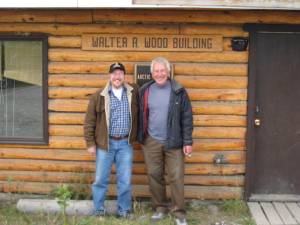
    Me and Andy Williams, Camp Manager and Head Pilot, Kluane Lake Research Station
    Me and Andy Williams, Camp Manager and Head Pilot, Kluane Lake Research Station

    Scientists do brave the wild to collect information that helps people understand our world. They are adventuresome, smart, crafty folks–and I hope to capture some of that in the blogs, podcasts, radio series, etc that comes out of this project. And perhaps, on the side, it will make my own writing about scientists more accurate.


    Watch here for more information on the new WordPress blog that will accompany this job. For now, just think of all the science going on in the Yukon and what you would like to know about it, or how you would like to interact with it….