October 20:  Yukon Cornelius boogies with the Boogeyman

The Boogeyman came into my room at 4am, “Are you awake?” I barely heard him scrape a chair across the room and sit in it. “Are you asleep?” One of my eyes opened halfway, I saw a white face and steampunk glasses surrounded by chaotic darkness. I closed them. He said, “I can wait until you are awake. No worries.” He crossed his hands in his lap. “No,” I said, rolling over, flipping on a lamp, and propping my head up on a pillow. I yawned. “If you want to talk,” I said. “I’ll listen.”  He seemed happy at that.  He jumped right in, “I feel like my calling has been hijacked.  People talk about me—my name is on the lips of every mother in the world, in multiple languages! Boogeyman, Boogeyman, Boogeyman.  But they say it to scare kids.  They’re always saying false things about me — twisting what I do. Tell me, Yukon, what have you heard about me? What’s my reputation?”

I told him, “You come get bad children. Disobedient children. Children who break rules.” It was early, I was having trouble thinking, “Children who don’t do what society expects them to do.” He sighed, “And so they are threatened with me.” He straightened his back. “I’ll come get them,” he said dramatically. “Look at me. Do I really look threatening?” He looked like the Child Catcher from the Chitty-Chitty Bang Bang movie.  I didn’t tell him that. “You are a little… dark,” I said.  He said, “There is a place for darkness, you know. It’s not scary. It’s just mysterious.  What have we done with mystery these days?”  

I began to answer that question before I knew it was rhetorical.

He said, “We’ve made it all disappear. Everything has an answer. Science, Science, Science or God, God, God.” I nodded, adding, “So, the Boogeyman is mystery.”

“Exactly,” he said. “Why couldn’t he be an intriguing mystery to find out more about instead of a punishment for bad behavior?“ 

“You have the grounds for a defamation suit,” I told him. He perked right up. “Can I sue every parent in the world?” I told him that wouldn’t be feasible. Too many defendants. And they’re all using your name the same way, and ignorant of the truth.  It wasn’t unique to him.  Monsters were often judged on appearance alone, whereas actual ‘monsters’—the kind who WILL hurt you—are freely accepted by society and sometimes had positions of power.  They looked like average people.  And this allowed them to do their monstrousness to others without fear of retribution. Hiddens, however, had some trait that others considered weird, creepy, different, unusual, fabulous, something that made a person who expects or experiences a very narrow conception of what is “normal” very uncomfortable. I told him if disliking groups of people based on misinformation were subject to trial, a helluva lot of people would be asking for compensation.

“You aren’t going to get parents to change their use of your name,” I said, reaching for a notebook on the nightstand and a pen. He asked, “Should I change it then? Go for something less scary, I guess.” I said, “No, don’t say that.  They are defining your name as scary. It doesn’t have to be. Also, you have name recognition which works in your favor.”  I wrote some things down. “You should lean into the darkness part, and market yourself straight to kids. They don’t have preconceived ideas till their parents tell them.” He was excited. I told him he needed to have a whole public relations overhaul. “Parents say you will ‘get’ children who misbehave— perhaps these are children fighting against authority, aHA!” I wrote that down. “You ‘get’ children who have bad behavior—or—kids who don’t meet the standards society expects of them. That’s a wider group of nonconformists. So there!” I looked up. “You need to market yourself as exactly the kind of thing parents say will ‘get’ the kids who don’t WANT to fit into society.  You ‘get’ them—you ‘understand’ them. They will want someone to understand them.  My dark friend,” I looked at his beautifully scary face, “You need a webpage. Do you have a webpage? Okay, we’ll get you one.”  I scribbled some more ideas down, and the number of a few people I knew who designed cheap webpages. Actually, I thought, this might be a way to go for more Hiddens than just him. “Aim for kids. This is a kid’s space. Imagine—,” I held up my hand to a giant webpage in front of us as if I were writing the copy on front page: ‘Do you like to learn about horror, about mystery, about other people who misbehaved in history, about the Taboo things you shouldn’t know? Come learn with the Boogeyman!’” I told him Kids will want to “be gotten by the Boogeyman.” And— it’s an educational site!  “They will come to you!”

He joined in, “Disobedient? Come to my website!” I said, “Tired of your parents making all the rules! Come to the Boogeyman!” He called out, “Love the darkness? The scary? The weird? You’ll be right at home at The Boogeyman! Let the boogeyman get you! Boogeyman, Boogeyman, Boogeyman!” Already, I could hear in his voice, he had freed his name from the way other people said it.  He had reclaimed something used against him. He was happy with his name.“

Okay, these are good to start with. I’ll call people I know, we will start this campaign of reclaiming your name!”  He clapped. “Thank you!” I told him it was the least I could do.  He would have to find things to teach and come up with lesson plans.  I got up and started to dress.  He said he would go home and write up all the dark things he knew.  I said, “One more thing. Do you boogie?” He looked confused. “Boogie? Dance? Do you know how to dance or do the boogie-woogie?” He said no. “Now is a good time to learn. We can add that to your portfolio of darkness—dance classes. It’ll be a twist on your name, another way to re-imagine what they think they know.  Hold on, I can show you some moves.” I stood up half-dressed and slid in my slippers in front of the window.  I found an appropriate song, one of Bumble’s favorites with a good beat, “Kids will love this because it’s ancient, and weird. You add moves to it and it’ll be even weirder.” He took my hand, and the darkness fanned out around him like it was taking a breath, and then we boogied in my bedroom at 5am.

October 19:  Yukon Cornelius (and Angela) help a Phoenix transition

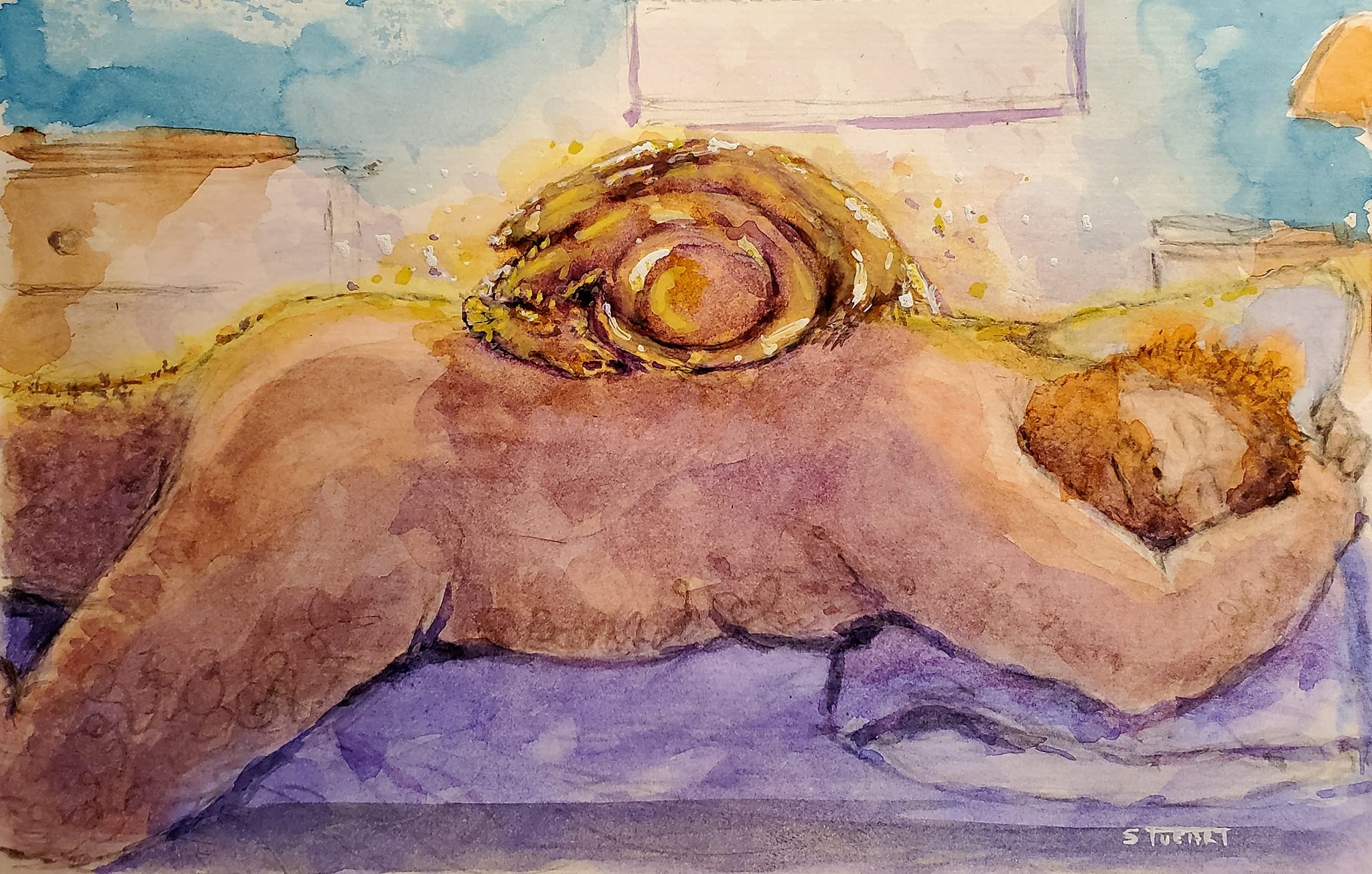
You can’t recognize a phoenix until it is burning. A phoenix never knows if it will survive the burn.  In a year it forgets that it burns, that it’s a phoenix, so it doesn’t worry or anticipate it ever happening again. I’ve never radically transformed into anything or anyone, but I know folks who have.  And I’m not talking about Leonard.  I called Angela at short notice and she came to my house in three hours.  “I told work my mom was sick,” she said, getting out of the car.  “They let me have the week.”  She was 28, black, trans, working in student admissions in a college across the state, but now, she was here at my house, rubbing hand sanitizer into her palms. “What are you doing?” I asked. “You said this was a birth. I need clean hands.”

Just having someone to talk to who has transitioned in any way is a help to a phoenix. “It is not the trans experience, exactly,” Angela told me after I explained what was happening to my guest, that we didn’t know who or what they will become, “but I can understand someone needing to talk through radical change. I run a group for people in life transitions—any life transitions. I’ve found that all transitions have similar touchpoints.”

I introduced her to Caroline, who ran a pet store, a mother of grown sons, who’d come all the way from across the country.  “I felt drawn,” she said.  I told her that was the effect my mother passed down to me so that folks in need could find me. She also gave me the ability to see fire forming around Caroline already.  That’s how I knew what was happening.  I offered them both something to drink while they talked.  “How long have you felt like you weren’t the person you were supposed to be?” Angela asked. Caroline said, “Only in the last few months.”

Phoenixes incarnate as humans to have human experiences. But then part of themselves remember who and what they were and the tug becomes too strong.  “I find myself standing in the pet store after hours, in the dark, listening to everything around me, all the chattering, the barking, the fish tanks bubbling, as if I lived outside.” She looked at Angela. “And it feels right.”  She’d seen a psychiatrist; they gave her anti-depressants, anti-psychotics. She talked with a therapist. “I have dreams that I am flying. I’ve always had these dreams. But I can’t fly.” She looked at us. “Can I?”

Angela said, placing her hand on her chest, “I’m trans, and I counsel other trans men and women as they come into college. I also work with people in life transitions.  So,” she looked at me, “I don’t know if sharing my story will help your transition. But if I can tell you about my bridge, then it might help you cross yours.”

Angela told her story about her life before her transition, “Nothing reflected who I was back to me. But I knew. I knew who I was.”  She told us her story of telling her family, her friends.  “Ultimately I defined who I was,” Angela said. “It doesn’t matter what anyone thought they knew before. What I knew before mattered more. And so I became who I always was, and made the outside match my vision for myself.”  She paused.  “Caroline, what’s your vision for who you are?”

“I think…” she looked at both of us, “I think I’m beautiful.”  Angela said, “Oh hon, you’re beautiful now.” She shook her head, “No, beautiful like a bird– with red feathers and a long tail.” She paused, as if anticipating how we might think she was crazy.

I said, “That sounds wonderful.” She said, “You don’t think I’m crazy telling you I’m a bird.”  Angela looked at her, “Him? He sleeps with a Yeti. He doesn’t have anyone else’s definition of crazy.”  We laughed. Caroline said, “Wait, what?”  We laughed again. I said, “It’s okay.  I have a lot of experience with strange things.  I believe you.  In fact, I think I know what kind of bird you might be.”  While rare, sometimes the phoenix in its human form will turn back into a phoenix, finished for a time being others, and content to be itself, taking all that it learned from a former life, and bringing that into the new version of itself.

I told her about a phoenix. She was not scared. She was relieved. She needed space to talk, to think about what a transition might mean to her family, to her job, and she and Angela talked into the night. They stayed for three nights, and in that time, Caroline grew feathers, and one day she had a bird’s head. “I’m hideous!” she cried. Angela held her hand, “It’s not all going to come at once. You won’t be satisfied with how you look—but it’s part of the transition.” She cried for hours, “I can’t go back, can I?” Angela asked, “Do you want to?” She said, “No, I have to find out who I can be.”

The fire. I had almost forgotten about the fire part.  When she started to burn, she was startled. It happened during the early morning hours, before the sun had even risen. Angela and I rushed her out of the house. Angela stayed with her on the back patio. I fire-extinguished the guest bed.  When I got back to them, Caroline was saying, “I’m not afraid. I’m not afraid. I’m excited about who I’m going to be.” Angela and I stepped back as the light became too bright to look at, and a rush of wind, and then flying in front of us was a beautiful red feathered bird with a long tail—a phoenix.

“Caroline?” Angela asked. The phoenix looked at her, and when it spoke it sounded like fire roar, a rush of wind and flame. “I am Caroline and DeShawn and Xin-Yue and Rebecca and Lily and Hans.” Its wings flickered like fire, and its tail danced up and down, side to side. “Thank you, Angela. You made this transition so much easier for me. I did not have counsel like this before. It was sometimes very frightening. I was very alone. But I wasn’t frightened this time.” She looked at me. “Thank you, Yukon. If you are alive when I transition again, I will find you.  I must now go to Caroline’s family and tell them who I am.”  And with that, her great wings flapped and helped her rise into the air, as the morning sun had already done before her.

Angela said, “I know so many people who are phoenixes. Born out of fire. They may not change into a bird, but they are just as magnificent when they transition into who they are.”  She squeezed my hand, and we watched the phoenix move now like a slow comet, bright, blazing, back into the sky.

October 18:  Yukon Cornelius investigates a (suspected) Closet Monster

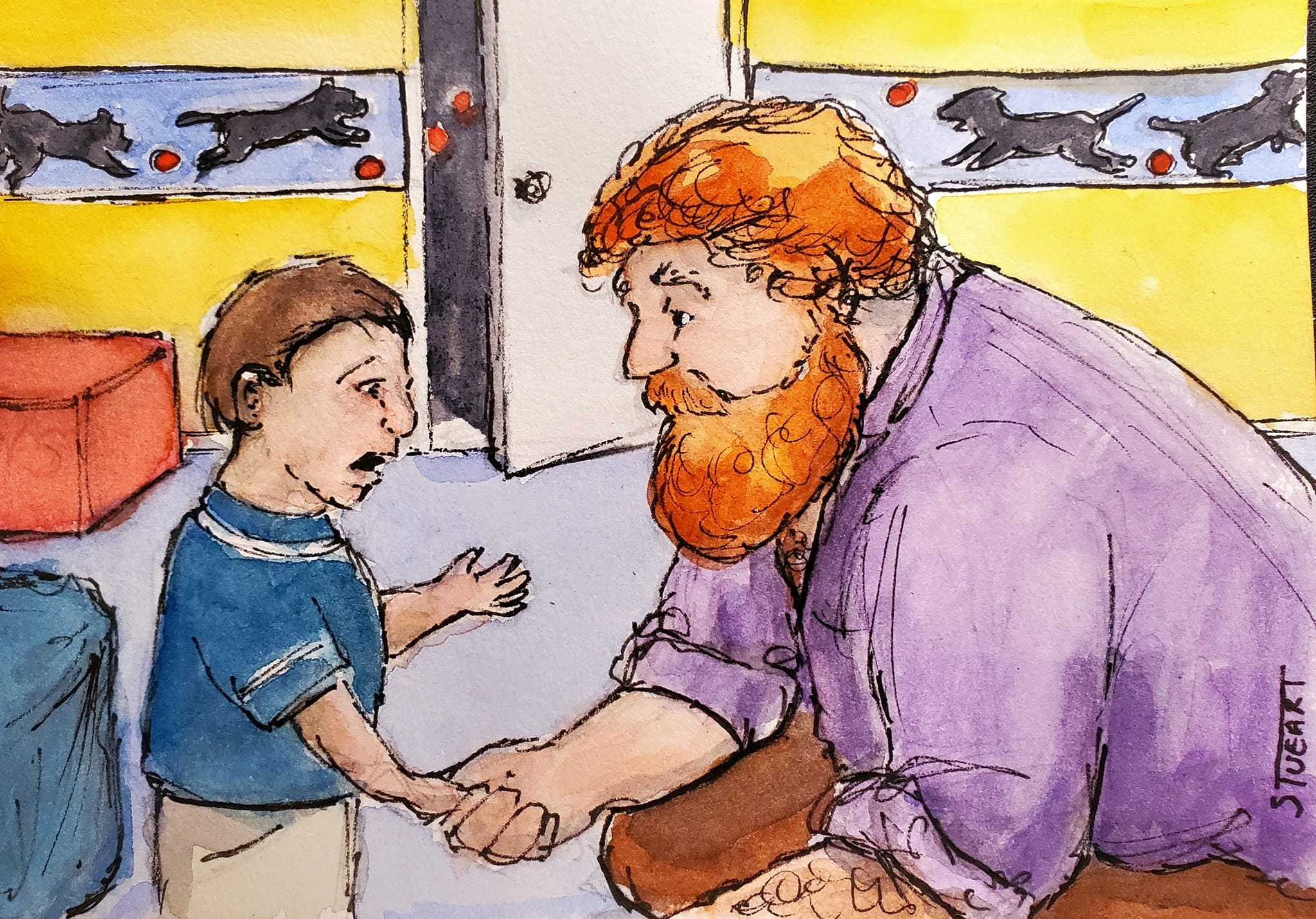
At the end of a tasty dinner hosted by my friends in their new home, their 8-year-old son, Felix, came down the stairs and hovered by his mother’s elbow. “What’s wrong, hun?” Mom asked. There was a monster in his closet. Everyone looked at me. “Okay. Sure. I’ll go check.” I couldn’t rule out something being pulled in because I was here. “If it is, I’ll deal with it,” I assured his mom. I followed Felix back upstairs. “It’s a beautiful new home you have,” I told him. “Do you like your big room?” He wouldn’t go in the door.

I flipped on the lights bright. The closet door was half open. “Okay,” I told him. “We don’t want to scare him.” He said, “I’m the one who’s scared.” I told him that sometimes the monster is scared too. “I mean, he’s got new people in his house and he doesn’t know you very well. How does he know you’re going to be kind to him? He doesn’t.” I knelt with him in the middle of the room, “But I’m not a monster.” Well, I said that we might not look like our version of a monster, but what would be a monster to a closet monster? He thought about that. “Do you knock on the door before you go in?” I asked. He did not. “Do you pop your head in there all of a sudden and start moving everything around?” He did. “Well, that could be surprising if that closet were your room.”

We looked at the closet across the room, which, I have to say, looked mighty comfy for a closet monster. I told him we should go check on the monster and see if he’s okay. I told him he might want to sit on the toy box. He did. I knocked on the door, even though it was open. “It’s a courtesy,” I said to Felix. “Hello. I’m Cornelius. This little boy is Felix and he’s moved into the room next to you.” Felix braced himself for any response. We waited. “We’d like to turn on the light if that’s okay?” I said. I didn’t hear anything. I looked at Felix. We both thought that a non-answer was an implicit yes. I turned on the light. Lots of dress shirts and sweaters and a couple of coats. Some shoes on the floor, and several unopened boxes. “We haven’t finished unpacking yet,” he said. He had managed to come to my side, still wary. I said, “What a lovely room you have,” to whomever might be in here. Just because I couldn’t see him didn’t mean he wasn’t there. I whispered to Felix, “You might put something colorful in here—like a small basket with plastic flowers.” He said, “But it’s dark in there? How can he see it?” Night vision, I said. They can see color. “And it’s a housewarming gift. You know how we all brought gifts tonight to you and your mom and dad?” He nodded. “That means, hey, we’re glad you’re here!” He was uncertain at that last sentiment. I also suggested him selecting a toy to put in there. “He could like toys, we don’t know. But the flowers and the toy says that you’re not going to hurt him. That you are welcoming him.” He nodded.

“How do we know he won’t hurt me?” he asked. I told him if the monster hurt him that his parents would hurt the monster back and the monster didn’t want trouble. “He actually wants a good person in the room. Someone he can trust. It would ruin everything for him if he hurt you.” I was, of course, saying this for the monster’s benefit too. I had to cover my bases. “He needs to feel safe with you,” I told Felix. “Oh, and they tend to like the door shut at night. They need to be in the dark. Just like you need that night light, they need to be all wrapped up in the dark to feel safe.” I asked Felix if he wanted to introduce himself while I was standing there. He was unsure. “You know, if you make a habit of telling him one interesting thing about yourself every day, he will get to know you.” But what if he talked back—Felix got scared again. I asked the monster if maybe, in a non-scary way, he could leave clues to the kind of monster he was and what he was like. “People tend to be afraid of things they can’t see so a voice out of the closet at first might be scary, but over time–,” and I looked at Felix, “Felix will feel more comfortable.” Felix asked, “Will he come into the room when I’m asleep? I don’t want that.” I told him that was a perfectly legitimate request, and I passed that on to whomever might be in the closet. “Anything else?” I asked. He thought. “No, that’s it.” I said we were going to turn off the light, and I did, and Felix said, “I’m glad you’re here!” suddenly into the dark, and I smiled at him and nodded, and then I shut the door.

Did I think there was a monster in his closet? asked his mom. “I can’t be 100% sure that there isn’t, but I set up some ground rules in case there is. I didn’t sense there would be trouble. But you call me if there is.”

I got a call a week later. His mother told me Felix had a ritual that he sat on the toy box every night and told the closet about his day. There were gifts that Felix left in the closet on the floor. He never got scared in his room again. “I have Magellan,” Felix told her, “and he makes sure I’m safe.” We laughed. “Oh, kids,” she said. She thanked me. I said, again, with emphasis, “Really, if anything else happens, anything at all, call me.” She laughed nervously.

Eight years pass and, whenever I am in the area, we have wonderful dinners and times together, and then, I get that call. She’s found a note from Felix that he and Magellan will be out adventuring and won’t be at dinner—having gone “through a portal in the closet!”—but he’ll “find something to eat along the way?!” He’s sixteen, I told her. He’ll be okay. Trust me. “He’ll probably be home by ten o’clock.”

I looked over at sixteen-year-old Felix who smiled at me and nodded, holding his plate ready, as Magellan the Blue, the four-armed swordsman, flipped hamburgers on the grill.


October 17:  Yukon Cornelius dreams a Daemon

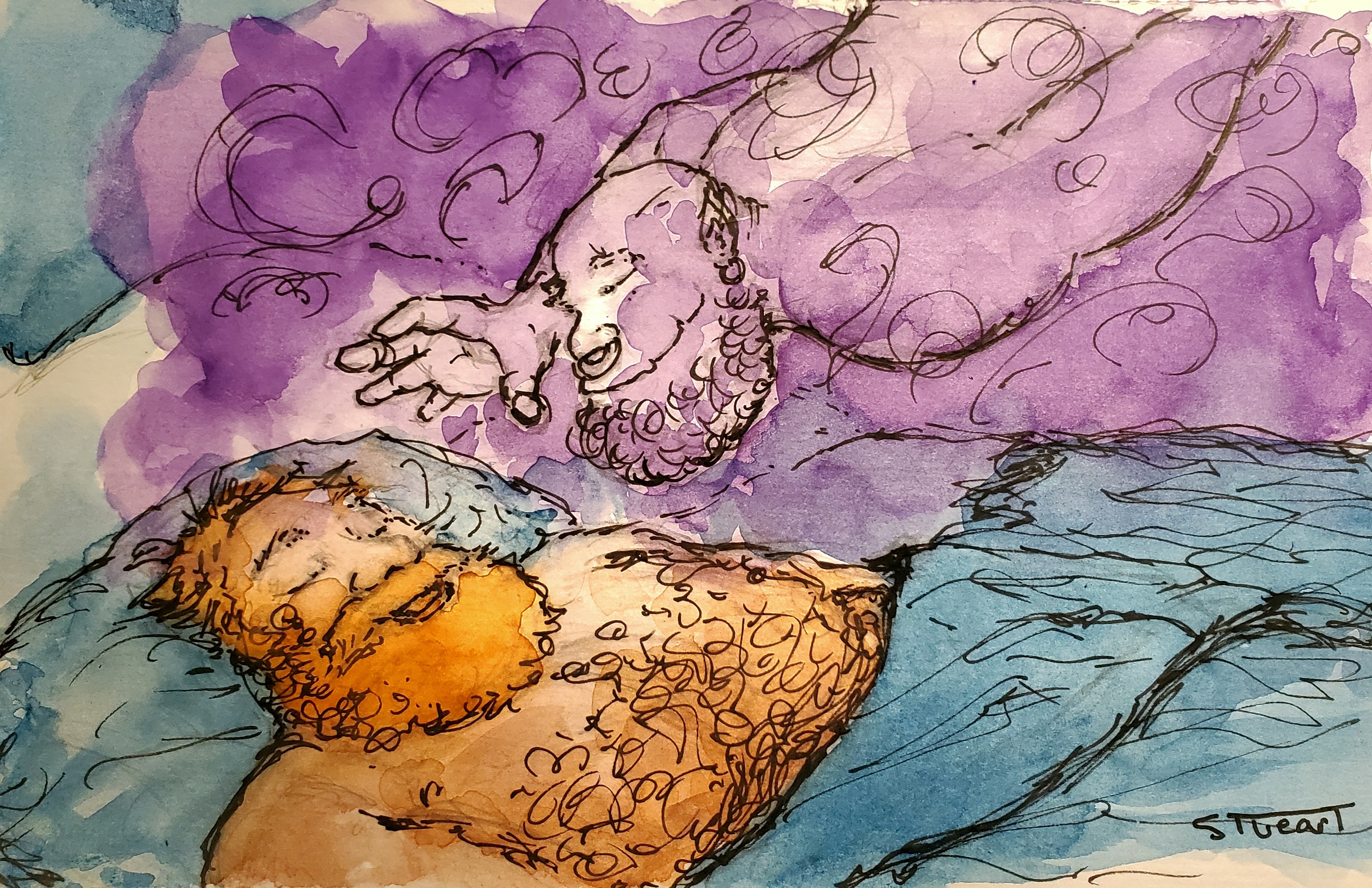
Three nights in a row I had intense, and wonderful, erotic dreams before I became lucid enough to realize that Infra himself was talking to me. We were in a Spanish villa in this dream.  There was a cool breeze, and he was pouring coffee at a table. We were naked and he gave me a mug of the best tasting sweet milky coffee. A dream, yes, but ask me if I could tell the difference. Everything tasted the same, the cushion on the chair felt like soft cotton, the mug hot, the coffee, the sex.  Infra leaned back, his wide shoulders catching the sunlight, said he wanted to thank me. “You could have just led with that.” He laughed, “And missed out on three exquisite nights with you? No, those three nights are part of the thank you.” Infra was a jinn—but as he would tell you, people called him many things over the centuries—including incubus, daemon, daimon and demon. “That last one,” he’d told me before, “that was the worst. We were blamed for rape, unwanted pregnancies, mental illness, depression, temptation, of turning people queer— all a misunderstanding of the word ‘daemon’. So many people left hurting in the wake. We were hated when we could have been helping.”

Now, in the dream, the breeze through the open archways of the villa brushed the back of my neck.  I turned to look at the balcony overlooking a cityscape. Infra said, “I did what you suggested. I found a good place to live, good people to help.” I was happy for him. “It’s an Assisted Living facility in Chillicothe, Ohio.” He sipped his coffee. “Vivid imaginations. Wise souls. So much joy there now. I feel a sense of self-worth that a thousand years of freedom roaming the world has never given me.”

He talked about the Elders, he called them. That he had given them all dreams and come to them to talk to them, long conversations sitting on the edge of beaches, standing on mountain peaks, laughing over a breakfast, and gentle, beautiful erotic dreams. “I have fallen in love with every one of them. I know all the names of their 456 grandchildren, and they are all adorable,” he beamed.  I told him that was wonderful. “However,” he said, “I’m running into a problem.” Many of them were religious and had conservative backgrounds — oh, I thought, the demon problem. He said, “No, it’s the erotic part— their dreams are so intense and wild and beautiful but they wake up sometimes with such guilt and shame. They’re embarrassed by their dreams and thoughts. Sometimes I erase the connections between their waking life and their dream life so that they aren’t haunted by their pleasures. But I hate to do that. I want them to remember. They want to remember.”  

He ate some blueberries and cream in a small glass bowl. “I’m sincerely in love, Yukon. With all 57 Elders. And they are in love with me too when they are in the dream. I look differently to each of them, of course. But this is my dilemma: many of them can’t handle thoughts of me in their waking life. Their children tell them that they should not be thinking these sexual thoughts at their age. They get laughed at by their families. They start feeling shamed.” I asked if they shared their experiences with each other—how did they react to that?  “Some of them have shared. Two of them, sweet ladies, share their dreams back and forth every morning, and become so happy for each other, so I left their connections clear.  But many of the women and men kept it to themselves. Several did confide in their nurses, asking about side effects of their medications—did it include intense erotic dreams? They were scoffed at.”  Listening to Infra talk about this took me back  to high school and no one wanted to admit that they had sexual thoughts. They wanted a sexual prowess reputation in the locker room, but they didn’t want to talk about actual sexual feelings. And if you were queer, you stayed quiet, or like some, they created a life they didn’t have—and tried to keep those two lives away from each other.

“Sometimes they beg me to remember. But what I remember is their shame and anxiety when they are awake.” I could tell he loved them. He wanted what was best for them.  I asked him if they were relieved or upset that they weren’t remembering their dreams anymore. “They’re upset at that too.”  I touched his big jinn arm. “Then let them remember.” He winced, and I could tell he was afraid of giving them too much to handle. “It’s more important that they have good, wonderful experiences than if they just have believable, expected ones. They have those all day.” I said that they would come up with their own solutions, maybe share their dreams only with safe people, form a therapy group in real life, wrestle together with this Jinn in their dreams and the incongruity of it all.  He should give them that choice. I said, “Maybe all of them—all 57 of them—will try to make their waking life more like their dreams.  Infra, they will all pull you closer.”  He hugged me in the dream so hard that I woke up in bed, and he was still there hugging me in bed. I smiled and pulled him closer.

October 16: Yukon Cornelius advocates for Gnomes

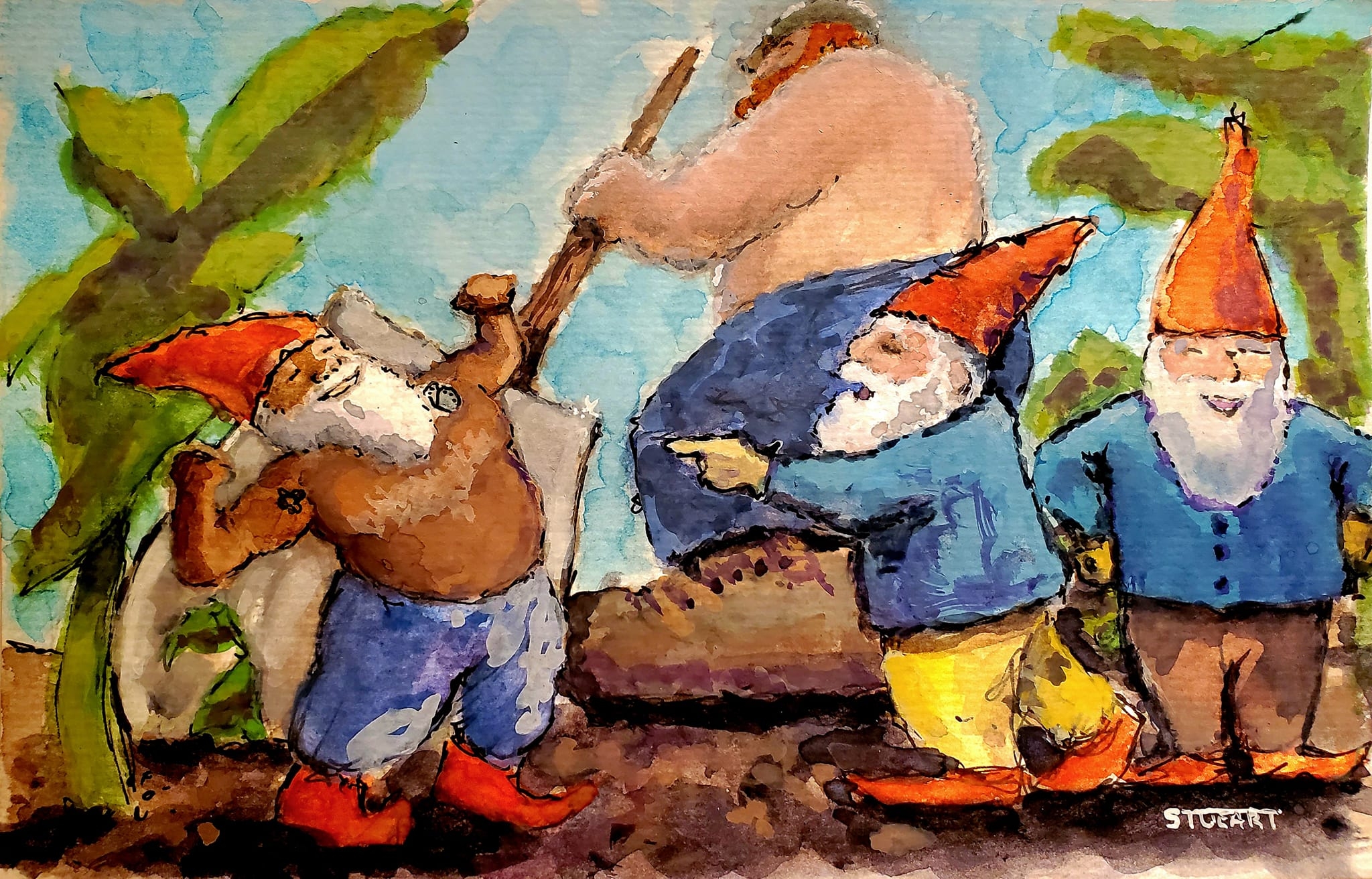
With clipboard in hand, and a gnome hiding under my beard, I “inspected” the large red maple behind the Carthage family house. “The kids affectionately call it Grandpa. It’s so old,” Mrs. Carthage said, standing beside me. “It’s beautiful in the Fall. But I want to remove it. With this free inspection, can you check the tree for disease, or danger, or rot?” I felt the gnome growling under my beard and I cleared my throat. I told her, Yes, I could do it today with supplies in my truck and went to get them. “It is not rotting!” Bombas Dreadnettle blasted under my beard. “And since when is old a reason to get rid of something?” Where would I even start with that? “Let’s just stick to the plan.” I opened up the truck and the other two gnomes jumped into my tool belt. “Are you guys ready?”

[  Two days ago, these three gnomes accosted me in my garden as I was struggling to get the weeds out and my shriveled carrots and potatoes to grow. “We need your help!” they cried. I knelt down to talk to them. “Our home is about to be cut down.” They said there were nearly sixty gnomes that would be displaced if the red maple were cut down. “We don’t know what to do.” I asked if they had thought to talk to the homeowners. “We didn’t think that was safe either. We would be telling them where we live!” I understood. “Do they have kind children?” Sometimes a kid could be a good advocate for a Hidden. “You be our advocate.” They leapt up and down, “You be our advocate! You be our advocate!” Okay, okay. I would see what I could do. One of them touched my hand, “We promise to help you with your garden. You are not that good with gardens,” they said sincerely. Ow. “You don’t have to.” Oh but they would! Gladly! “And bake you gnome berry bread!” Yes, they said, yes. Fresh berry bread, all I could eat, and garden help, If only I could save their home.  ]

I carried them over to the Red Maple, and we had privacy, though I kept looking behind me to see if she were there. I told her I would need an hour at least. I had to do some careful measurements and take samples. I pointed to Bombas, “Exact age! Go!” Moved to Filchbatter Thistlewaite, “I need the report of your team on the lateral extent of the roots! Go!” And finally, Xaltor Feroza, “I need the complete shelter records from your archives, and a current survey—no matter if it’s bird or bug or worm. Who’s living here? Go!” They had one hour for their teams. Gnomes don’t dig; they pass through earth and wood like air and I watched them phase into the tree. I went back to the truck and pulled out our Gnome Acclimation Box.

Later, when the gnomes had gathered far and wide and deep all the data I asked them to, I brought the Carthages out to the tree, now surrounded with ceramic garden gnomes. “Where did these come from?” Mrs. Carthage asked. I said, I needed a little help collecting data, and I brought in the specialists. Mr. Carthage made a weird face. I picked one up and told them that these ceramic gnomes could monitor the health of their tree—they had built in monitors. They thought that was clever, if kitschy. “So, about Grandpa. Your tree is the oldest tree for more than twenty blocks. It’s about 431 years old.” Mr. Carthage’s jaw dropped. I added, “…and it’s in very good health. Most of the trees of your neighborhood are relatively young—they’re tall, but they aren’t thick. Grandpa is doing the muscle work for cleaning out the carbon dioxide in your neighborhood.” She said, “One tree?” I nodded. “One old tree can do the work of 50 trees.” I might have been exaggerating, but we had a home to save. “Filtering your air quality. Grandpa cleans the air for everyone in your neighborhood. The young trees won’t be able to do the work it does if you remove it. Now, your roots,” I flipped to a map on my clipboard and circled in red the extent of the lateral root structure. It covered two blocks in any direction. “These roots are touching roots of trees on all these blocks. Roots communicate, share resources, and old trees teach younger trees how to adapt to change in the neighborhood.” They looked at each other. She said, “You’re saying our tree is teaching other trees?” I nodded. “Yes, I am. Now, your tree is also home to a number of –”

“Stop there,” Mr. Carthage was done. “Who are you really?” Too long of a pause, as I searched for what to say. Then a voice from around the tree spoke, “Well, shit!” The Carthages jumped backward. “Now everyone’s gonna have to move out—twenty families, lots of birds, squirrels, a possum…” He leaned his red-hatted head against the trunk, “Fuzzybuttons will be so upset.” I turned to the couple, and breathed, “You have a lovely community of gnomes in your red maple, Mr and Mrs. Carthage. They don’t know what to do to stop you from cutting down the tree. So they came to ask me to help them. They were afraid if they told you where they lived, you would you tear down the tree anyway.” Mrs. Carthage looked suddenly concerned as if she didn’t want to be known like that. I knelt down and brought Bombas up to eye level with the Carthages. “I may not know trees, but I know gnomes.” Mrs. Carthage smiled. “Gnomes are very good for a garden. They do a lot to encourage your flowers to grow strong,” and I pointed over to her blue phlox and her chrysanthemums. “They keep the soil loamy, and they don’t take from the environment. They are the best little hidden workers a garden could have and this is why your garden is so alive.” Bombas said, “Your phlox was lazy! But that was because the soil was weak. We fixed that.” Xaltor called up, “Tell her about the gardenias!” He looked at Mrs. Carthage, “Do you remember the gardenias?” She said, “They all died. I never knew why.” Bombas put his hat in his hand. “There were too many planted all together in the same place—and soil got moldy. We tried to save them, but we couldn’t. Frankly, there are some toxic things in your garden,” he said. He pointed a little gloved finger across the yard, “If you want to get rid of a tree—that Black Walnut over there is assailing your buttercups.” Mrs. Carthage reached out her hand, “Would you want to–,” and Bombas walked over to her across the bridge of my arm, “—I’d love to,” and off they went talking about Mrs. Carthage’s garden, and a trail of ten gnomes followed them. Mr. Carthage and I looked at each other. He smiled. “I think they’re going to be fine here,” he said. “She’s always wanted someone to talk to about gardening.”

October 15:  Yukon Cornelius helps a gold dragon relocate

Occasionally we all get lost. We think we know the way, we launch out, and we get turned around, and we lose the path we were on. That’s common.  Sometimes though, we never knew the way.

Solan was a young dragon when I first met her, bumping outside my window on a fall night. I welcome anything that comes to me. She was cold and tired and the size of a house cat.  She was my first dragon. Dragons aren’t common cryptids in the US or Canada. Lake serpents, yes. We have a lot of those. She told me she was searching for her home. I asked where she was from, and she thought, Solan. Her name? No, a place she was named for. I put her a soft pillow near the fire and sat down with her. I didn’t know what to feed her, but she said she liked pennies. She was obviously some sort of metal dragon. I raided my change jar and washed the pennies off and she ate them from a small bowl. She told me that she lived near here, but she didn’t want to. She’d been adopted as a pet, which is illegal. Her “family” had recently started to take her scales off. They said they were real gold. Every morning she’d awaken and find more scales taken. I was horrified. She’d heard them talking about declawing her, hoping her nails were solid gold. She slipped through a window screen, flown for several nights. She was looking for Solan, she believed to be her “real home”. I got out my laptop, and we sat down to look up lots of stuff.

Solan turned out to be a city in India. We looked up dragons in India. We discovered there weren’t a lot of dragons in India, only a few in mythologies (standard records of fact for cryptids and magical creatures). She knew she was a gold dragon, but that was it. “They restricted what I was allowed to read.”  So we looked up “gold dragons” online. Thank you, Internet, for having information inaccessible any other way for some folks. “But how do I find others like me?” That was harder. Dragons don’t have a Group Facebook page. That’s not the way Hidden creatures work. I’d never gone to look for a Hidden I didn’t already know —they’d usually find me. “I want to learn more about who and what I am.” I told her I would do my best to find some group of dragons for her. Until then she could stay here. She’d be safe here and have all the pennies she wanted.

“It says here I might like to eat gemstones. Do you have any of those?”  I said I would look. Who did I know who might know about dragons around here?  “I could be from China! They have gold dragons there. Is China near here?” If I were a flying dragon, I’d want to hide out in a place where people weren’t. Deserts, mountains, deep forests, caves. “Do I have to hoard treasure?” she asked. She was absorbing everything on the Internet. “I think you get to be the kind of dragon you want to be. I would not take any of that as rules on how to be a dragon, okay?” She needed dragon mentors, fast. “It says I might be able to produce fire!” She immediately lit up the pillow. I ran over, “Amazing! That’s awesome!” and stamped out the flame with my shoes. “I think you should practice aiming at the fireplace.” I went out to a forest to ask a friend who might know. I came back and she was crying. What happened? I asked her. “Do you know how many stories there are of slaying dragons? So many pictures. It’s everywhere. No wonder my family hurt me! Maybe I deserved it. Those stories have evil dragons—and I don’t know if I’m evil.” I went down to the burnt pillow and held her and said, “No, Solan, you did nothing wrong, you are nothing bad. You didn’t deserve to be treated badly. Dragons are like anything else—neither bad nor good. Certainly not inherently evil.” I took her cradled in my arms to a mirror, “Just look at you.” I said, “You are not evil. We’re going to find you a new family, okay?” She seemed comforted, “Are we going to China?” We were not.

But three days later, we did drive for about 5 hours till we came to a set of bluffs and cliffs near a river. Here was a group of magical creatures, not all of them dragons, but a few. My friend had sent birds to ask if we could meet up with this hidden enclave. I brought hiking and climbing gear because getting there was not easy. She flew up, resting ahead of me. “I think I want to change my name,” she said. Huffing and puffing I told her that sounded perfectly fine. “I hope they like me.” I assured her they would, and secretly hoped I was right. I was right. At the mouth of a cave near the bluffs, a much bigger dragon greeted us. He was winged, a deep green, with a kind, toothy smile, and I was humbled to meet him. “And I’m humbled to meet you,” he said. “Thank you for rescuing one of us and bringing her to safety. We are eager to meet her.”  I saw other Hiddens behind him, some of them very young like her.  I said, “Well, then, I am very pleased to introduce my friend, a gold dragon named Penny.”

October 14: Yukon Cornelius jams with the Hodag

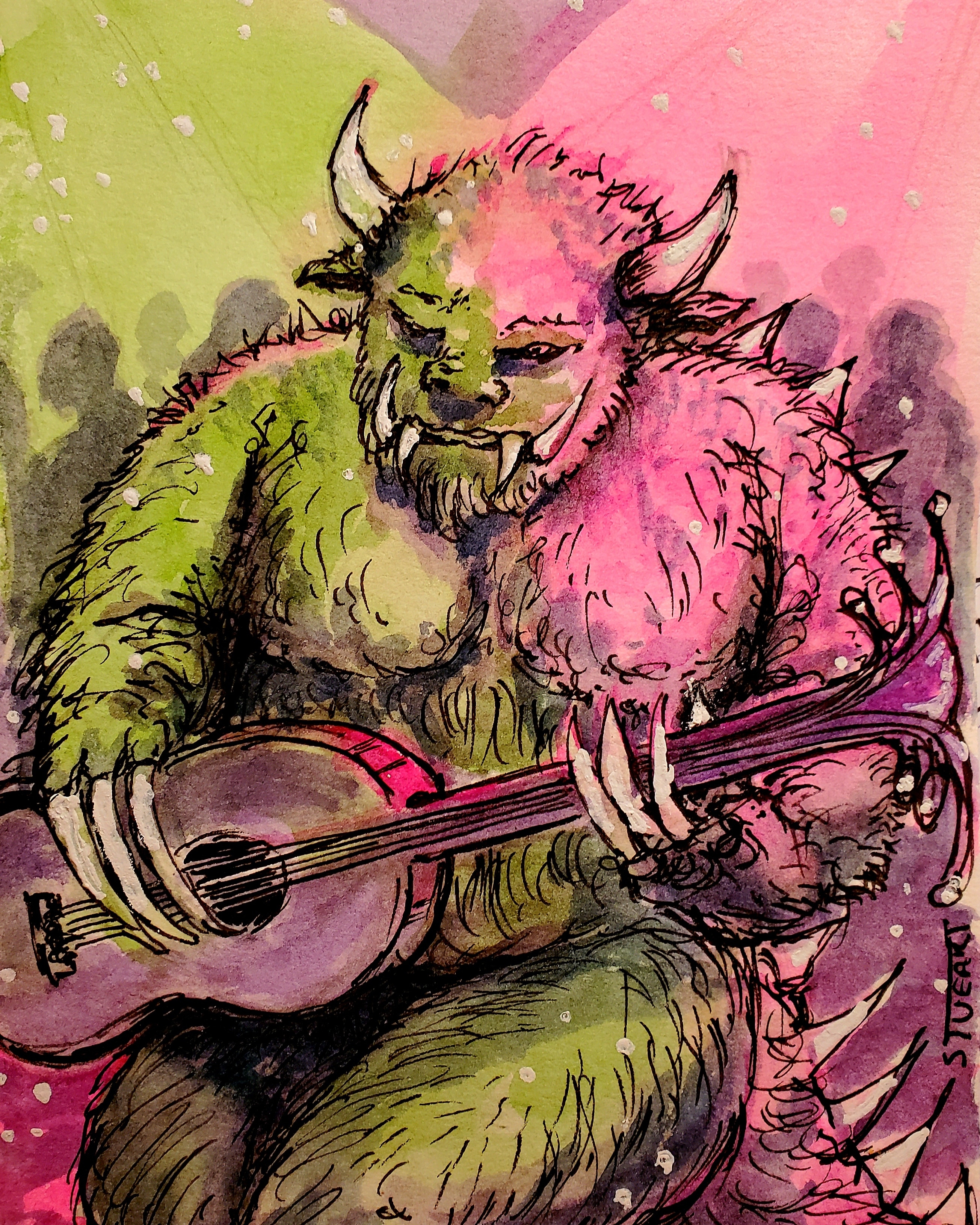
Thousands gather for the Hodag Country Festival, fans, vendors, bands. It’s noisy, lively, fun, a rich landscape of blending sounds. I’m just here to catch up with Berit. Most cryptids I visit usually find their encounters with people to be negative, rife with misunderstanding and prejudice, so they stay hidden as a protection against being killed.  I support those decisions because people are unpredictable. Safety and survival first. But then there’s Berit.  Resurrected from the ashes of hundreds of oxen, brought back as the avenging spirit of both the abused oxen and decimated forests, Berit is out to bring justice—and he aims to do that through music.  He is one of the most recognizable creatures I know. He’s the Hodag. The festival is named for him, the school mascot, with statues of him in front of the Chamber of Commerce.  It’s a very interesting way of being Cryptid.

He closes his set with “The Roots Remember (You Lousy SOBs)” and his voice is rough, and hoary. Lots of cheering. He comes over to my table, we hug, and I’m careful of his back spines. “How’s Bumble?” he asks, and is immediately swarmed by children with his CDs, asking for autographs. He gladly signs them as they touch his horns and giggle. I tell him Bumble’s good, would have loved to see him but he’s doing a mural. “Oh, I love his murals!” he says. Bumble and I did a circuit of concerts with Berit around the Great Lakes back in the day when we were doing gigs for food and travel money. Bumble can’t sing words, but he’s got a pitch perfect growl. I ask him how he’s doing, and he always interprets that as How is the Mission Going. “I think we’re getting through. We’ve passed some good forestry laws because we spoke at the legislative assembly.” I told him that was great, and he must be proud. He looked away, “It’s not enough. I get hopeful though.” He smiles and his tusks cross. “I’m up there calling them all out on their environmental inaction, and they cheer louder the angrier I get. They like it when the Hodag “gives ‘em what for” ––they always assume I’m talking to someone else.” He leans back on his stool, his tail giving him balance. “Am I just rearranging deck chairs on the Titanic?” I told him that these forests and animals will benefit. He asks, “How’s your work with all the rest of us Monsters? Are you working the government/law side—.” I shook my head, “More of the personal care side. I think the conversation about full acceptance and change is too hard right now.” He advises me to form a foundation or groups, “Friends of the Monsters!” he says. Get funding. “You can’t do this alone, Yuke.” I tell him I’ve formed some small groups who are helping out their local cryptids, but community organizing for something people are scared of and can’t see—that’s not easy. “Tell them all to come out! If they all came out, people would see that we’re everywhere—forests and swamps and downtown and suburbs—and hey, we haven’t hurt nobody.” He slaps the table. “We’d have numbers.” We have this conversation every time I come, and it frustrates me. He’s been out for more than a hundred years. They’ve been hidden forever. It’s taken him 50 years to gain this kind of popularity—a mass outing would frighten both sides. They are inching out into the light, but there’s a difference between the fighters and the wounded. They have no protections if they reveal themselves. Some find it hard enough just to survive. This city, his fame—I can’t tell him that maybe they let him perform because they don’t want him to choose another more violent way to do what he came to do. They let him have a stage, but they know they don’t have to listen. He says, “Ah, I shouldn’t tell you what to do. It’s not like I took up the ‘Love the Monsters’ cause myself.” I say, “It’s okay. You were commissioned with another job already.” He laughs in Avenging Spirit of Justice.

We catch up a bit more before someone tells him that he’s got five minutes. He looks at me. “Wanna play a song with me?” I wave him off, but I can tell he really wants to. It’s been years since I touched a guitar. He says, “Why don’t we play “The Moon in the Pines”—the love stuff?  They’re tired of hearing the angry stuff. They aren’t listening.” He’s already borrowed someone’s guitar for me, and there I go up on stage to jam. The lights are blue and white now, falling on us like the moon and we are the pines. Those intense orange eyes connect with mine, he smiles and looks genuinely happy. He sings right to me as I take up the harmony, and then we start the counterpoint melodies on the guitars, competing, blending, working together somehow with different notes, different paths. We each cover half the notes. It still creates the melody. I know the Hodag’s visibility helps people get ready for all the hidden ones, and he knows he can’t stop his mission to care for everyone individually. We both have good work to do, and a lot of it. We’re already working together. The chorus finds us both on the same notes, and we ease into it, the crowd joining us. “And they sway/ and the light with shadows play/ and the night becomes another way/ we speak about love.”

____________

October 13:  Yukon Cornelius is weird with the Abominable Snowmonster

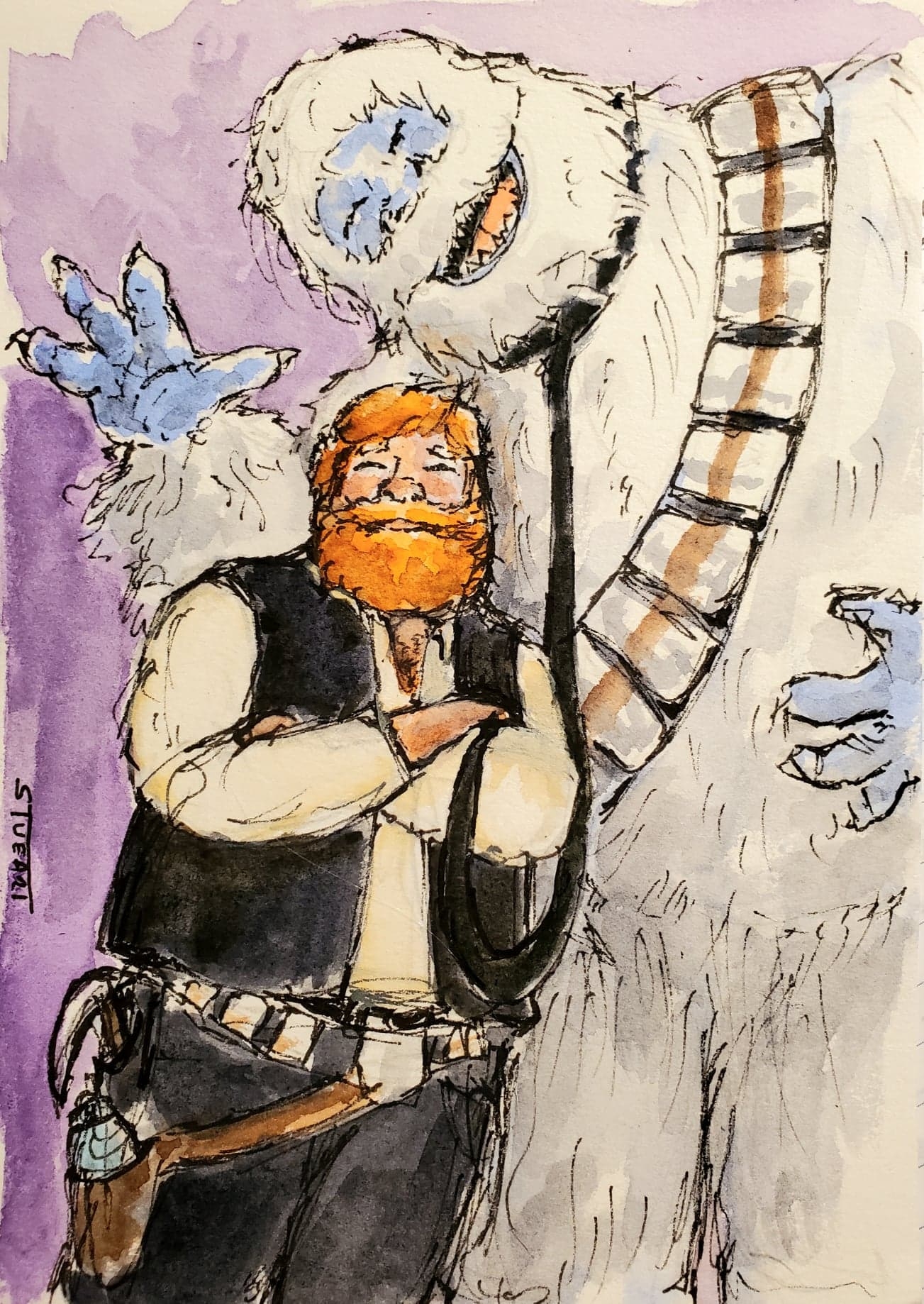
Yukon Cornelius and Bumble dressed as Han Solo and Chewbacca from Star Wars for a cosplay.

I help Bumble tonight with his costume—just one big sash/belt of ammo, I think, though I’ve never considered what Chewy wears, or ever seen him access this belt/sash thing.  All I know is that this one carries different flavors of Pop-Tarts.  His costume is simple—Chewy doesn’t wear much.  We throw in a leash to make it fun.  He helps me find my white shirt—it isn’t under the bed, in the closet, on the floor, in the laundry, and for a guy who doesn’t wear clothes, he is very observant about where I put mine.  He does a little roar that means, Come here.  He found it hung inside a suit jacket in the closet, hiding like a matched pair you assume must go together.

You have your casual acquaintances, friends, good friends, and then best friends, and then REALLY good friends (who might be lovers). Very few of them are the people who are “your weird.” You have to find them. They are the people you can truly be yourself around—manic craziness, stupid ideas, riffing off each other, laughing all night, even with your flaws they enjoy you. They will do any weird idea you suggest! And they are (this is the important part) Enthusiastic!! about your idea, and they get into it as much as you do. This is Bumble. He is my Weird. I met him in the Arctic when I was a prospector and I did not “get him,” but that didn’t deter him–he pursued me because he thought I was cute and funny. And one thing led to another, throw in a deer and some child dentist, we fell over a cliff, he BOUNCED, and then we started to “get” each other. We didn’t speak each other’s language, but we spoke each others’ Weird. Weird is a language that can bridge cultures. I learned to interpret his moans and roars and growls, and the gestural language he uses, and that wasn’t easy. But we both spoke the same dialect of Weird, and that made me love him.

And now, look at us: Yukon Solo and ChewBumble going to a Halloween Party. Look at the way he smiles when he puts on a costume. He just lights up! Stories are fun to share, but stories are even more fun to act out—to enter in a more physical way. We cosplay characters a lot—because he loves it, but also because inside a story is where I get to be with him in a vulnerable and open way, just letting the story take us over.  I think a story wants to take us over.  And when we give in to it, we discover things about ourselves. When we are doing that with a partner—by reading it to each other, by cosplaying, by role-playing, we discover each other in different ways.  He likes to go to Comic cons, Dragon Con, Gen Con—though, as always, we can’t stay long because I’m a freakin’ beacon for every supernatural thing out there, and crowds are not usually good for that (see the poltergeist that found us at GenCon and the anxiety-ridden griffin at Dragon Con). We have to be careful, but I found it worth the risk to see him “play” Fafhrd, or Sully, or a Balrog, or Obelix and be with him in that story. We LARP too sometimes.  If it’s a D&D campaign, everyone assumes he’ll be the barbarian, but he prefers to be the cleric and heal everyone.  We share so much Weird.  Bumble gets me.  So, I’m with him as often as I can be. He has his own life as a highly sought-after mural artist who works exclusively at night (that Arctic night vision he has!), and so we have to coordinate times we can be together.

Tonight, he buttons up my shirt tenderly, leans back to check me out, gives a thumbs up, insists on combing my hair when it won’t cooperate, licks it down. He is weird, but he’s my weird. I encourage you to go find your Weird. They are out there, waiting for you, searching for you, hoping for you. I hope Weird finds you, chases you, falls with you off a cliff and bounces back up with you. And I hope you hold onto Weird with everything you have.

____________

* Big Guy/Little Guy pairs we’ve been at Cons and parties and costume nights at the club. You may have seen us as:

Asterix and Obelix

Robin Hood and Little John

Inigo Montoya and Fezzik

Captain Kirk and the Mugato

Aang and Appa (from Avatar: The Last Airbender)

Yogi Bear and Boo-Boo

Gilgamesh and Enkidu

Gandalf and the Balrog

Beauty and the Beast

Fafhrd and the Grey Mouser

Laurel and Hardy

Mike and Sully (from Monsters, Inc.)

Thor and Hulk (from Thor: Ragnarok)

but, you know, Han Solo and Chewbacca is our favorite.

October 12:  Yukon Cornelius brings a Jack-O-Lantern to Dinner

*with recipe!

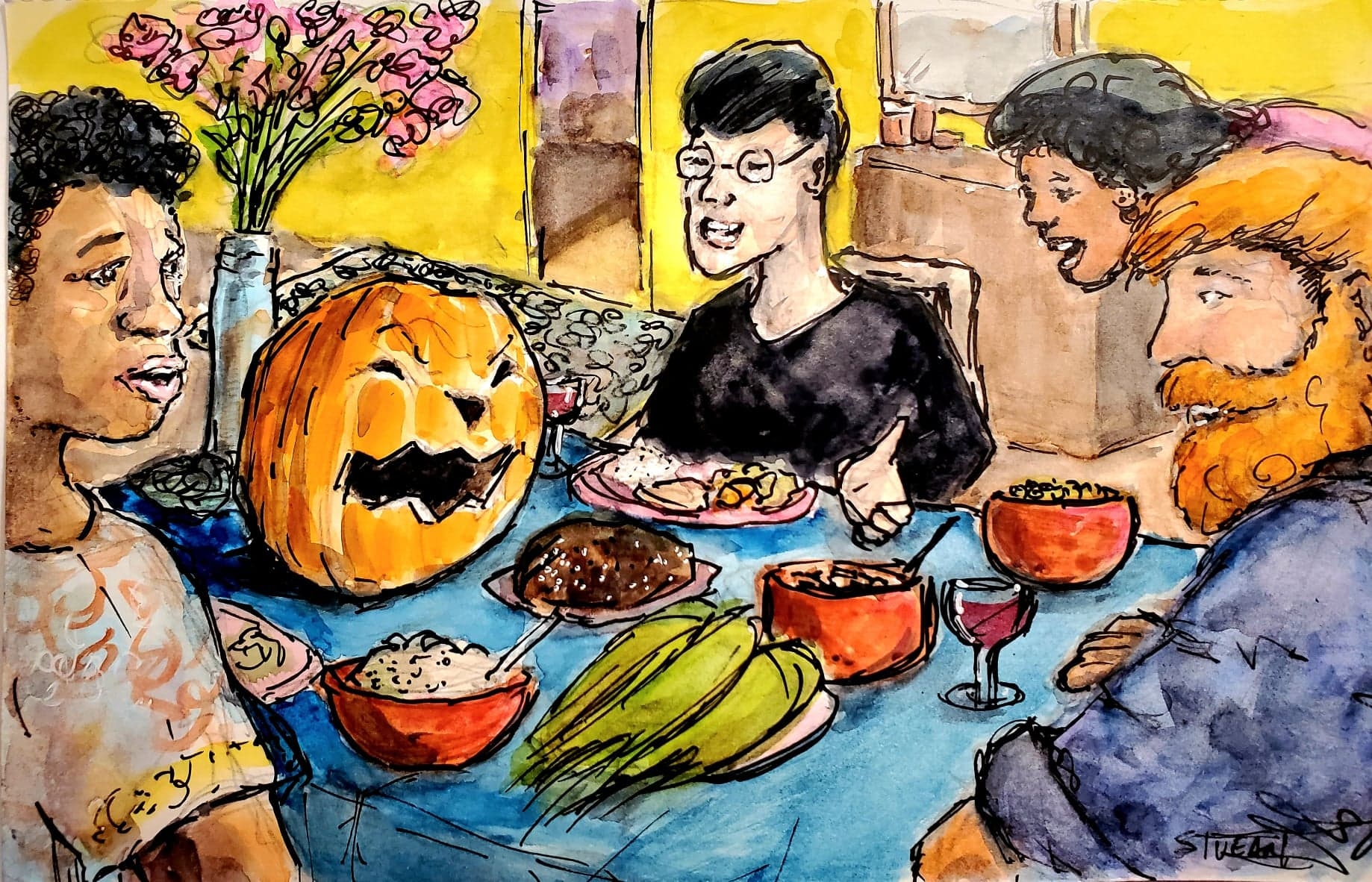
If Ulrich hadn’t thrown his head at me, I would have made him my Plus One tonight at dinner.  Now, it’ll have to be Plus Half.  When I got to Kate and Ashantu’s house, I set the Jack-o-Lantern on the table. “Everyone, meet Ulrich.” You can imagine their response as it just sat there. Ravenwood, a thin man in a black sweater, chuckled. “You can just say your Plus One bailed. It’s okay. No shame.” Ulrich wouldn’t say a thing. “He’s a little unhappy. This isn’t the way we had planned to come tonight.”  He had been loud and argumentative with me in the truck, threatened my life when his body showed up to claim him. For the last several times I’ve tried to visit him, he’d throw his head at me.  So, this time I picked it up. “I don’t want to go to a dinner!” He wasn’t really a people person.  He’d been bullied, hunted, shunned, wronged, even in death.  I also knew his body would eventually catch up to us.  An intervention was risky, but I thought a little warmth from people, a little conversation, some nice food smells would help him. Now he was an inanimate, stubborn, carved pumpkin.

They welcomed that pumpkin, even if he was going through a difficult period and didn’t want to talk. They fixed him a plate and put a very fat straw in the pureed carrot ginger soup and a straw in his wine. They included him in conversation, even if he didn’t answer. We all sat and talked about our lives with a Jack-O-Lantern and no one questioned my sanity. Ravenwood asked me, “So, how long have you two been friends?” Ulrich was silent. “It’s coming up on twenty years,” I said. They were surprised. “Ulrich saved my life.” I paused for a moment to see if he would tell the story. He didn’t.

So, I told them about how as a young man I was on shore between assignments—in my merchant marine years—and had met someone at a bar, as one does. But times being what they were, we were followed and harassed by a group of Angry Young Guys. “Ulrich showed up and did what he does best.” I leaned back in my chair to dramatically replay the scene, “He comes riding up on a horse, his head all aflame, scares them, and then he takes that flaming head and throws it at them! It streaks like a comet and hits one of them right in the chest. Boom! He lit up, tore off his shirt and ran screaming! Then Ulrich’s body, still on the horse, pulls out his sabre and holds it high in the air as his horse rears back!” I caught him looking at me. Did he remember that?  “They ran off. I had to convince my guy to stay. He was plenty rattled too. But you know, I believe they would have hurt us that night. Maybe killed us. And I,” I raised my glass of wine. “I owe my life to his penchant for throwing his head at people.” Ulrich’s mouth moved and his eyes got softer, “I don’t like people.” Kate, Ashantu and Ravenwood all looked at him as his whole face became animate. “Normally,” he added. He smiled a jagged smile. “I throw my head at everyone. He’s not special.” I looked at him. Rave asked, “Why don’t you like people?” Ulrich said flatly, “They’re monsters.” He looked quickly at them, “Normally.” He said, “I just don’t like to be bothered.” His pumpkin mouth stretched a little to grab the straw to the soup, sucking it down. He smiled. “Normally.” It felt like he was warming up. “My body is coming and will cut off your head,” he said to me. “SLICE!” he shouted. They all looked at me. “Did you know that Ulrich was in the Revolutionary War? Part of a cavalry.” That began a whole conversation where Ulrich was the center of attention, talking about the war, about his life. I buttered another roll. I may lose my head, but I still thought the risk was worth it. He was enjoying himself. After an hour of lively discussion about cannonballs and mercenaries, Kate eventually got up and brought out a pear tart with blue cheese. It looked delicious. There was a knock at the door. Ashantu opened it and a headless man in a cape and boots, brandishing a sabre, walked through. “At last!” Ulrich said, swiveling his whole pumpkin around. “Come my Body, and take what is ours!” We all stood up, backed away from the table. “Yes!” Ulrich said, spinning his head to look at us. “SLICE!” The body stepped up to the table, his sabre raised, and sliced five pieces of tart. “But first, I want a taste of that pear tart.” He smiled at Kate. His body put down the sabre, picked up the head and placed it back on his shoulders.  Then Ulrich Van Hesse, the Headless Horseman, my original Plus One, sat down for dessert.

***********************

Blue Cheese Pear Tart

a pie crust ((use your favorite pie crust recipe, or take 1 stick butter worked into (some) flour (Joey guesstimates it each time) then brought together with water))

3 pears, peeled and cored

some nice strong blue cheese

3 tablespoons of honey

Preheat oven to 450F.  Line a tart pan with the pie crust.  Slice the blue cheese medium thin (or crumble it) and line the bottom of the pie crust with it.  Slice the pears thin and arrange the slices in a circular fan.  Heat the honey and drizzle all over the pears.

Bake for 45 minutes until the crust is nicely browned and the pears are starting to color. The blue cheese should be bubbling in between the pear slices. Cool until it doesn’t burn your tongue.

*************************

October 11:  Yukon Cornelius tries to avoid the Black Dog of Death

Hiking the mountain trail on a summer night was beautiful, and still very warm. I sweated through my clothes. The moon lit up the sparse clouds. Few people hike at night.  But since I often get visited by strange creatures wherever I am, I try to stay away from crowds. This turned out to be a good idea. A black dog with big glowing red eyes now stood on the path ahead.  That was not a camper’s dog.  I needed to figure out which kind of ‘black dog’ this was before I just walked into it blindly. Folklore was full of reports of black dogs as apparitions of the dead, of the Devil, of doom, and they were often malevolent to travelers.  But those accounts were written in a superstitious age when death and disease and illness were attributed to Sin and other moral or religious laws.  So we gave Death a dog. A dog that warned us that Death was coming.

Perhaps this one wanted to talk.  Some might be friendly guardians.  Which was it?  Was it evil or protective? Was it the You’re Doomed kind or the You’re Safe Now kind?  Did it matter? Yes, I wanted to be aware of what I was walking into. I had a choice to keep going—but now it would be there.  Would it hurt me? How would it affect my hike, my safety?  Do I run from it, or walk toward it?  I needed to know which black dog it was ahead of time, but I didn’t know enough to make a good choice. I also couldn’t make a life out of avoiding unknown creatures.  That’s kinda inevitable for me.  So I took what I knew, just started walking again on the trail, and as I got closer and closer, I tried talking to it (sometimes a bad idea with black dogs). It didn’t move.  I told it I was going to walk around it, and I did.  And it stayed where it was.  If it needed me, it could always follow me, but I needed to keep walking. It trailed me. I was going to have to deal with it when I camped. Closer to sunrise, I found a good spot, next to a clear creek with a pool. I was hot, sweaty, and exhausted, and that creek would feel great. I set up a tent and then went for a dip just as the sky lightened. And ten minutes into relaxing in the water, it showed up again, crossing through the trees behind me. I decided to let it do what it was going to do. I wasn’t exactly in a place to run or defend myself.  Some black dogs are unavoidable. I kept my hands on the bank of the little pool to indicate that I wasn’t going to hurt it. (FYI, I am not immune to attacks by supernatural creatures.) Behind my head, I heard it run towards me. Harder and harder. I ducked down as it leapt over my head and dove into the water in front of me, splashing my face with a wave. I didn’t move. I was in shock and very wet. Then it bobbed in front of me, with its red glowing eyes, and I saw a green tennis ball in its mouth, and it pushed the ball onto my hand. “So that’s your game, Portent of Doom,” I said. I took the ball and threw it down the creek. She fetched it and came back, smiling, nuzzling me. We did this about twenty thousand times. I laughed a lot.  Maybe Death’s Dog needed to play.  Maybe I did.  Sometimes, the things we’re nervous about up ahead turn out to be surprisingly nice—even good for us.