Writing Faith Workshop begins, Feb 10, 5-8pm, Whitehorse United Church

  How do you write about your “faith”?  How do you describe the indescribable, the ineffable, the otherworldly? the grief or joy or miracle or peace or disappointment that you have because of your faith?  Everyone can argue about the value or lack of value in “religion”–and it’s an easy connect-the-dots to create your own pictures of what organized religion has done in the world.  It’s harder to write about personal faith or your personal interactions with religion–what keeps you going, what happened to you that you know no one would believe, about the anguish of trying to live in a real, faulty, fragile world, when others ask you to strive for peace, patience, happiness, even joy.

This writing workshop will explore how people write about these very personal experiences, or their thoughts about faith and religion and its very real presence in their lives, or the lives of those around them.  We’ve had students write about their relationships with their parents, their children, their grandchildren, experiences in nature, in confronting others who aren’t on the same page.  We have had students who are believers, non-believers, unsure, people of various faiths.  All faiths are welcome–come with what’s important to you, open to what is important to others. This isn’t a dogma class.  It’s not a class to teach you from the top down.  It’s for you to teach us from the ground up through your experiences, your writing.

Continue reading

My short piece in Geez Magazine #24, “Privilege” issue, on coming out

Ironically, my pastor at RBC suggested I write for Geez magazine.  I don’t think he imagined what piece I would eventually write for them.  But here it is, Issue #24, on “privilege”.  I wrote the fast version of my coming out at church.  I centered it on the idea of privilege–of the privileges I had as a single, white male Christian who had leadership potential and of the privileges I no longer had when I added “gay” to that mix.

The church has to change.  It has to.  It may not change from those fighting it on the outside, but it will have to incorporate change if it is to survive further.  It faces irrelevance, it postures with discrimination, it plays favorites, it values money.

Not all churches–no.  (When I say a statement like this I have to stop and say, Thank you, churches that are moving more towards inclusion, social justice, focusing on issues like poverty, the environment, civil rights.  You do exist, but I wouldn’t, yet, call you the “Church”–as the “Church” tends to be the monolithic Catholic Castle or the Evangelical Juggernaut.  One day, you will take on that mantle–you will be the “Church” and it will have a positive ring.  You will convince other churches that focusing on discrimination is not the answer.)

Anyway, there it is, in Geez #24.  If this brings you to Talking Dog, welcome.  There’s lots there, I hope, that will spark conversation.  If this entry leads you to Geez, welcome to Geez.  There’s lots there that will spark conversation as well.  It’s a valuable, important magazine carrying on “the” conversations we need to have happen.  It is intrepid, bold, and unflinching.

I would marry Geez magazine if it looked like a bear and loved me back.

*apologies to Kevin James, pictured, who is not gay.

The Guild’s Boston Marriage witty, fun, screamin’ good

Last Friday night I was banned from the Guild’s front row if I wear red and come to a comedy.  I couldn’t control myself.  The play is way too funny for me, and so I was laughing–and I plead my case to Artsnet.  Sometimes, laughing is uncontrollable. What is controllable, I’ll admit, is the color I’m wearing and where I sit.  But I was running late, and the front row has fantastic leg room.  I had no idea that I might be distracting to the actresses pulling off this coup of a play.  I certainly couldn’t tell; they were very professional at hiding their laughter.

Let me back up:
Photo by Cathie Archbould

Friday evening, through with a long string of shows at YAC, I got to go on a mini-vacation.  I went to Boston Marriage at the Guild.  You’d think you’d be “show”ed out, with all the cool things happening in Whitehorse, but Boston Marriage doesn’t feel as if you’ve gone to a show.  It feels like someone snuck you into someone else’s living room to watch.  And it’s refreshing and touching and funny.

The Guild, after a few plays where characters yell at each other, comes up with a love story, where the leads may bicker at each other a bit, but who resoundly care for each other at their heart–and their sniping isn’t just regular sniping.  It’s David Mamet sniping.  That’s like the Caviar of sniping.  Okay, for comparison, Albee’s Who’s Afraid of Virginia Woolf was hot salsa sniping. Sharp, angled, hook-like and a bit cruel.  Mamet’s language is so rich and perfect–it tastes way too expensive for your mouth (which is why hearing it from Katherine McCallum and Moira Sauer makes it even funnier–they know how to wrap their tongues around every word-morsel).

So I laughed, and laughed and laughed…(cringing) and couldn’t stop.  I was surprised that they didn’t stop the play to let me finish.  But they couldn’t–and when they went on, well, it compounded the laughter–and now I was laughing at new stuff, on top of the previous funny lines, and my laughter got worse.  I was very lucky I didn’t pass out, though I think Moira and Katherine both probably would have liked it if I lost just a teensy bit of oxgyen along the way.  Not that I ever covered up a line.  Not that I ever was so loud others couldn’t hear the jokes.  In fact, in FACT, others were laughing just as much as I was.  (But, they weren’t wearing red and they were sitting farther away–hence a more acceptable laughter.)  The whole room shook like puppies in Christmas box.

Continue reading

Dancing Bears on Main Street, Whitehorse: Sarah MacDougall, The Greatest Ones Alive

So, I’ve always wanted to be a bear.  Sarah MacDougall’s album, The Greatest Ones Alive, is being released at the Yukon Arts Centre on Saturday, Nov 12, and Erin and I decided to promote the album by being the dancing bears on the cover of her album.

Costumes rented, we danced up and down Main Street.  We had a great time.  Sarah MacDougall was there, and captured us in a video and put us dancing to her beautiful song, “Sometimes You Lose, Sometimes You Win.”

I already love her CD.  And I was already looking forward to seeing her live in concert.  Now I feel deeply honoured to be part of her VIDEO!!  And I get to be the bear I always wanted to be. I think I was born to be a mascot–what do you think??

Tickets are still available (667-8574, box office).

I would go on and on about a) her music, and b) the existential moment of being a bear, but I’ll let you watch the video instead.


Find Sarah MacDougall’s CD, The Greatest Ones Alive here.

Continue reading

Raven Ordering McDonald’s Drive-Thru: the Yukon has Smart Wildlife

Raven ordering McDonald's Drive-thru, photo by Jerome Stueart

Check out this photo taken yesterday, October 21, outside of the Whitehorse McDonald’s.  Ravens are getting so smart they’re ordering through the drive-thru. The Yukon has very smart wildlife. 

Of course, I’m not sure what this says about McDonald’s food considering what ravens eat. 

Check out this guy’s expression as he realizes what the raven is doing…

Hidden Histories: towards an LGBT history curriculum for California Schools

I was over on Talking Dog this afternoon and reading about how California teachers are having to come up with curriculum fast for a new law that requires them to teach LGBT history in schools.  I don’t think teachers have to overhaul everything—but I do think a quick version might be able to make things better for January.

So I devised Hidden Histories. 

Hidden Histories is based on the premise that lots of histories have been hidden over time—and that gay history, while the most completely submerged, is just one of many.  The curriculum asks that you start off the new year with a framework, but that you don’t have to change any of your curriculum.  The framework, and subsequently turning your students into little detectives, will bridge the interim for you.

The hardest thing facing California teachers, in regards to this law, is that most people, including myself, have never heard gay history.  So requiring teachers to teach it will be difficult unless you teach them gay history first—and provide them some ideas, lesson plans, curriculum. And giving them only till January to comply is hard… I think you should rather that the schools devise a Teacher training day in the spring, to come up with curriculum.

Anyway, over there at the other blog, I gave my ideas–and hopefully people will feel free to use them.

Best reason for this teaching LGBT stuff in classrooms:

“Within the typical secondary school curriculum, homosexuals do not exist. They are ‘nonpersons’ in the finest Stalinist sense. They have fought no battles, held no offices, explored nowhere, written no literature, built nothing, invented nothing and solved no equations. The lesson to the heterosexual student is abundantly clear: homosexuals do nothing of consequence. To the homosexual student, the message has even greater power: no one who has ever felt as you do has done anything worth mentioning.” -Gerald Unks, editor, The Gay Teen, p. 5.


Gross Heart: Much to Love about Mump and Smoot

Canadian clowns, Mump and Smoot (with Thug), were in Whitehorse tonight in a revival of their first show together, Something.  I was led to believe it was going to be scary, or disturbing--but these were not scary clowns.  While there are some grotesque moments, there’s a charming show beneath the grossness.  It stems from the deep friendship between characters Mump and Smoot, developed more than twenty years ago by John Turner and Micheal Kennard.

On stage, there is a sense that Mump, a bit rule-bound and dictatorial, is trying to be a mentor to Smoot, or a father-figure.  Smoot, on the other hand, is young, innocent, full of whim, silly even, more uncontrollable–like a child.  His voice even sounds a bit like Elmo from Sesame Street, though he can easily scowl at the audience and berate them just as much as Mump.  But the two clowns cry together, miss each other, play together, and are true friends–even if they play doctor and (unintentionally) hurt each other.  It’s not Laurel and Hardy I think of but Abbot and Costello.  Or even George and Gracie.

Our audience was completely charmed by these two–and I laughed through the whole thing—there’s really only a few moments that you can stop laughing.  Sometimes you are laughing at what the clowns are doing to other members of the audience.  The Audience serves as the fourth member of the show, and completely unpredictable.  John and Mike, afterwards in the talkback, referred to what the Audience does at their shows, as “gifts.”  They don’t know how the audience will react, but they take whatever the audience does and uses it in the show.  This is why the show is different every night.  Sure there are several “acts” they go through–but the audience determines paths they will take in the act.

Yes, there are some grotesque moments, but comedy and the grotesque have often gone together.  Abbot and Costello meet Frankenstein comes to mind as comedy exploring inside Horror.  We all still laugh–in fact fear makes us want to laugh all the more.  Movies that play with death, or that use a dead body as a running gag, or that find humor in zombies (see Sean of the Dead). Saturday Night Live’s spoof on Julia Child severing her own finger while doing a live cooking show–this is what they mean by grotesque, or even horror.  Mump and Smoot really don’t go beyond that barrier towards horror.  There is nothing so realistic that it makes you gag.  Thug, played by Candice, is perhaps the scariest of the three, and she doesn’t say a thing–which is why she’s kinda scary.  She’s completely unpredictable.

Continue reading

The Truth and the Narrative in Beauty: Compagnie Marie Chouinard’s “The Golden Mean”

To the slow, pounding, pulsing kettledrum, its waves of sound hitting the audience, the two sheen-fabric wrapped shapes on the stage slowly writhe and discard their stiff shimmering sheaths.  So begins Marie Chouinard’s The Golden Mean, restaged for another amazing tour.  I would have a hard time describing what happens.  It’s modern dance, but the performers are all wearing golden wigs, masks, and tassles that run down their legs, at first.  They resemble fauns.  But this isn’t Prelude to “the Afternoon of a Faun”—the music sounds a bit like a science fiction chorale, voices, drums, chorus, building, sustaining, crashing, wincing and dodging, always aching with long-note beauty.

There are maybe twelve dances in the 80 minutes, and each one provides a chance for the viewer, the audience, to participate by bringing their own meaning to the dance.  Perhaps this was intentional; perhaps not.

The dancers, part ballet-part something deeply, bodily organic–they tiptoe, launch, lurch across the stage, always flowing in rhythm to the music.  They are all lovely to watch.  For the first few numbers we feel as if we’re seeing the birth of a civilization, a whole society; toddlers walk across the stage, learn to laugh and cry together, have first few sleeps; ensemble pieces involving the whole company break up the solo, duo and trio dances.  I was most captivated by the two dancers who seemed to be acting out a first relationship—a man who dates the pliable woman, the one he fits into any shape he wants; he is aggressive, demanding, sexual, and she is passive, not quite even awake in the dance.  He discovers how wonderful it is to slide her hand down his face, his chest, his groin; and she starts to fight him, pushing away, and they twist each other back and forth, as she starts finding her own inner aggressor.  They have tortuous sex, or the dance version of it, always moving, stretching, twisting and flexing those dancers’ bodies.  I was captivated too by the narrative I was creating out of the dance–the story I gave that dance, that I’m even giving that dance now in this essay.

We can’t help it.  Human beings, when we see two or more humans interacting with another, we come up with a narrative, a voice over, maybe, but at least a set of actions, reactions, motivations, based on the expressions, the movements that we see in front of us.   Try it at your local mall.  Watch people for any length of time and you give them a narrative.  You can’t help it.

Continue reading

Picard Never Took a Text Message: Star Trek, Technology, and the Absence of Social Media in the Future

While Star Trek might have been the inspiration for the cellphone and the iPad and numerous other inventions, there is a noticeable lack of messaging, social media, or even constant chirps on the cells. The lack of computers running scheduling and communication on the Enterprise is interesting to note.
While the first Star Trek communicator, in its ST: TOS format, certainly looked like a cellphone and sort of acted like one–it actually worked like a CB.  Citizen Band Radio was open and easy to use–you picked up a small palm-sized black speaker, pressed a thumb button that turned a microphone on, and spoke the name of your party into it, and they answered back.  “Breaker One Nine, this is Foxtrot.  Are you listening?”  And Foxtrot would answer if he were listening.  On TV, nobody dials a number, nobody speaks into the Star Trek devices in a tone suggesting they are talking to a computer:  “Commander Riker,” Picard says–AS IF speaking TO Commander Riker, not accessing his number.  Even ST:TNG Picard and crew were using little more than CBs on their shirts to communicate with each other.  They would bang their chest, making it chirp, just like you would press the button in on the CB, and then announce who they wanted to talk to.  Officers would look up at the ceiling, as if that was where the sound was coming from, and announce that they were, indeed, coming quickly.  To say that it used name recognition software is ludicrous because no one ever spoke into their communicator like we do into our telephones when the “menu of choices” voice comes on to ask us to specify what we want.

Further, no one used their communicators for much more than a quick call.  They used the interstellar version of SKYPE in all versions of Star Trek.  For short calls they used this CB on their chests.  But the CB didn’t come with any apps, any cool devices, games, nor was there any social media.  People used the device simply.  Except for the Enterprise computer, each technological device seemed to have one simple function.  They had an episode on ST:TNG devoted to computer games–and it was the villain of the story–or at least the addictive brain-altering drug in the hands of villains.  Think about it, though.  No one in the 24th Century had a cellphone that took messages or that vibrated.  No one looked on their phones for scheduling.  (We’ll come back to those iPad things in a moment).  No one got a text message.  Computers did not command the social life of the crew, of any of the crew.  In ALL of its incarnations from 1964 to 2009 there is a HUGE lack of the presence of any social media, any social life that is facilitated by computers.

Continue reading

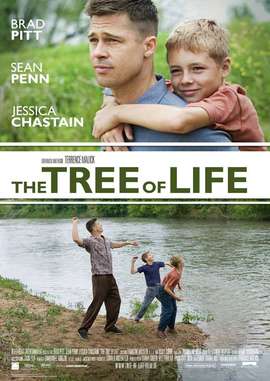
“Where were you?”: God and Grace in Terrence Malick’s The Tree of Life

It is a beautiful thing that the Yukon Film Society was able to bring us “Tree of Life” through their new Available Light Cinema incarnation at the Yukon Arts Centre once a month.  Even more amazing was the swiftness.  Whitehorse is not known as the place where new good films come quickly–but the YFS have almost bridged the gap between us and Seattle.  Tree of Life was handed the Palme D’Or in May, and we have it in September.  I’d say that was pretty darn fast. It shows again on Wednesday night, Sept 14 at the Yukon Arts Centre.

The Tree of Life is many things to many people.  The film doesn’t concern itself with a complicated, or even clear, narrative.  It has a simple one.  At the opening of the film, the death of brother/son sends the characters reeling.   What follows is a montage of scenes recalled from the mind of a surviving brother, now grown up (Sean Penn) as he tries to figure out what happened to “allow” this death in God’s great scheme of things.  The Tree of Life, for me, was a calling out, a plea, a requiem to God for our personal tragedies–asking many times of God, Where were you?  Why did you let this person die?  Was he a bad person?  The film is loosely tied together with scenes from a Texas childhood–a paradise of sorts–with a scary center, a frustrated musician father (Brad Pitt) who takes out his anger, at having to put away his music, on his three boys.

There’s a lot of whispering in this movie.  Be careful when you cough.  You’ll miss them.  Often the whispered pleas begin with “Father” or “Mother” or “You”— as the man, who speaks as the boy, tries to figure out whether he was more worthy of death than his brother.

God appears in this movie, but not as Christians typically think of him–he is a bit distant, but consistent with the book of Job.  There is the other “Where were you?” to consider:  the movie opens with an epigraph from Job, asking Job–in the voice of God–“where were you when I created the heavens and the earth?”  And there is stunning cinematography that takes a viewer from the beginnings of creation through to the moment the son is born.   Through this, the pleas and the questions cry out— “God, are you there?” plays over a volcanic planet being birthed.  The magnitude of the event of creation overshadows the magnitude of the personal tragedy.  It is almost as if Malick is answering for God: I was worried about much larger things.

But to make that the only statement Malick makes would be to miss his emphasis on the importance of love and forgiveness in the face of the cruelties of life and death.

Continue reading