The Wolfman: A Waning Version of the Original

The Wolfman,(2010) directed by Joe Johnston, starring Benicio Del Toro, is a remake of The Wolfman, (1941) directed by George Waggner, and starring Lon Chaney, Jr.  You know that.  My biggest question through the movie is WHY REMAKE IT?

The first half hour is a snoozer, merely a recap of the film you’ve already seen.  In fact, the writers so depend on you knowing the characters from the 1941 movie that hardly anyone is allowed screentime to develop as NEW characters.  Who is Lawrence Talbot in this version?  We don’t know.  He’s cast in such dark and moody lighting, such gothic teasery, that we don’t get a sense of Lawrence as a person.  They make the BIG SIN of Bad Movies–let the actors only talk about the Plot. So, every line, every snippet of dialogue is there to give us Backstory, Context, Tell Us Things We Should Know–but no one is allowed to actually talk about anything else.  No one asks anyone to pass the salt.  There’s no time.  We must talk, and talk quickly, about the plot.

To the movie’s credit there are three new twists thrown in:

* * *SPOILERS * * *

1.  Lawrence Talbot is an American Actor, starring in Hamlet in London. This is cool. I don’t mind there being some Shakespearian allusions in the movie!  Yay!  And Lawrence Talbot and Hamlet have some similarities— they’ve seen the truth about their fathers; they have seen their mothers ravaged by other men; they were gone for most of their adult life and are brought back for a funeral; they are in a quandary about what to do; their girlfriends think they are insane; they must kill their “fathers”.  Brilliant idea to show these similarities.  But where Shakespeare’s play develops characters, Johnston’s movie superimposes limp characters onto established patterns.  Not only is Del Toro’s Talbot hoping you think of Chaney’s Talbot, but he’s hoping you think of Hamlet–except Hamlet was clever, Hamlet PLAYED insane, Hamlet had a plan…  Talbot in this film has no plan.  He’s a victim of the werewolf, a victim of his Father, and ultimately a victim of the town.  The Comparison to Hamlet is an attempt to ride on Shakespeare’s coattails and give this film some depth it doesn’t earn.

IF they had started the movie on stage with Benicio Del Toro, playing Hamlet, going backstage to hear that his sister-in-law had written to him to come to the Family Manse, there’s been a murder–and he had to go back onstage—that would have been interesting.  It would have been SCENE.  We could have seen Talbot as an actor, as a person….  BEFORE he goes home to Goth House.

2.  Anthony Hopkins is HIMSELF a Werewolf. Cool.  In fact, I think both men are sexy as werewolves and the battle scene is beautifully done and fun to watch.  In fact, I’m sure that battle scene is worth the whole movie to some.  By making the dad a werewolf too, you add a great deal to the idea that Fathers make their Sons into monsters when they are monsters.  And I kind of liked this aspect of the movie.  It should add a depth to becoming a monster–abusive parents create abusive children, etc.  But that’s not really explored.  The Dad is completely heartless in that he’s finally decided to embrace his inner Werewolf and just kill at random.  He has no reason and no regret.  And so, we don’t care about him.  He’s one-dimensional and speaks from the script. And neither man can stop himself from killing once he’s a werewolf….  so why bother with morality at all?

3.  Lawrence Talbot was sent to a mental institution. VERY cool.  I like this.  It’s logical.  He sees his father kill his mother and goes a little bonkers.  And then they send him to America where those who are a little bonkers will fit in.  One scene.  That’s all the movie gives this beautiful, but underdeveloped, idea… so Talbot is dunked in icy water and given injections, and we get a flashback.  That’s it.  And, the second major transformation happens here…which is fun to watch.  But the addition of this backstory is sewn on with big thread and doesn’t really match the rest of the movie.  It isn’t utilized.

Some inconsistencies in this movie made this remake more confusing and tiresome.

A.  Why wasn’t Lawrence killed when he saw his father eating his mother? None of the other werewolves have stopped to save a child…. Lawrence should be dead, or he should have never seen that incident.

B.  Sometimes the moon comes through a cloud and changes you AT ONCE, and sometimes, you get to walk around outside or inside as a human being until you’ve finished your dialogue, and then you get to transform into the werewolf.  There’s no clear rule about transformation. Bad.

C.  What is the purpose of the Inspector or Gwen now? They are Wasted characters because they’re not given any screen time to really develop.  In 1941, Lawrence Talbot was a normal man, flirting with a beautiful girl, come back to run the estate of his family.  When he is bitten, that first “normal” life is taken from him.

Watch this here and see the development of character in a 1940’s way (and, wow, is Lon Chaney Jr. a hunk of a guy)

In 2010, Lawrence Talbot is already doom and gloom, and his bite is just further nightmare.  Nothing is normal in this new Talbot’s life.  The girl he’s flirting with now–that’s his dead brother’s fiance.  His father?  A werewolf who killed his own wife.  There ain’t a happy moment in this film–and therefore, without that happier beginning, there is no tragedy.

This was the HEART of the 1941 film. That a good man could be destroyed by a bite from a werewolf.  It has been ripped out of the chest of this story to make way for a kind of pre-ordained House of Usher doom….

So I come back to my first response:  WHY remake such a classic film?  To get neat special effects in and to get more gory.   There are some scary moments in the film, but twice we are blatantly tricked, making us feel like fools:  Samson the dog scare us at quiet moments.  (Oops!  Not a werewolf…shucks.  Gotcha anyway!)

There’s lots of killing, lots of killing, and it’s so random, that after awhile, it all becomes white noise.  Six people, ten people, there’s no challenge to the werewolf.  THEY ALL have silver bullets, but not one of them can shoot straight?  Yeah, right.

Bottom Line: Beautifully filmed and with stellar special effects, the Wolf Man gives us nothing else new and tarnishes what was good about the original. If you’re interested in seeing the classic, follow the Youtube connection above to see the whole film.

A Biologist’s Ecstasy: ‘Avatar’ Awakens Joy of Seeing the World Again

This essay over at the New York Times explains ‘Avatar‘ from a Biologist’s point of view.  Carol Kaesuk Yoon  is encouraging everyone who ever loved biology to go see Avatar purely for the wonder of seeing Life.  

Please excuse me if I seem a bit breathless, but the experience I had when I first saw the film (in 2-D, no less) shocked me. I felt as if someone had filmed my favorite dreams from those best nights of sleep where I wander and play through a landscape of familiar yet strange creatures, taking a swim and noticing dinosaurs paddling by, going out for a walk and spying several entirely new species of penguins, going sledding with giant tortoises. Less than the details of the movie, it was, I realized, the same feeling of elation, of wonder at life.

Perhaps that kind of potent joy is now the only way to fire up a vision of order in life. Many biologists of my generation (I will be 47 this month) were inspired to careers in science by the now quaint Time-Life series of illustrated books on animals or by the television program “Wild Kingdom,” rugged on-screen stuff for its time (“Now my assistant Jim will attempt to sedate the cheetah”). But maybe that isn’t enough anymore.

Maybe it takes a dreamlike ecstasy to break through to a world so jaded, to reach people who have seen David Attenborough here, there and everywhere, who have clicked — bored — past the Animal Planet channel hundreds of times without ever really seeing the animals. Maybe it takes a lizard that can glow like fire and hover like a helicopter and a staring troop of iridescent blue lemurs to wake us up. Maybe “Avatar” is what we need to bring our inner taxonomist back to life, to get us to really see.

Read the whole essay here.

If you are a science fiction/Fantasy writer, you’ll want to pay attention to the world-building done here.  Rarely have I seen world building done so well at the biological level, in a movie.  The plant and animal life here make sense together.  It’s not an anything goes style—if you check out the movie purely from that biological angle, you see a world that fits together well.  

And that’s something to take notes from.  


Avatar: A Second Chance to Get It Right

In my last post, I reacted to critics who were convinced there was a racist motif in play in Avatar.  But I’d like to talk about what Avatar is all about: Second Chances.

The movie is riddled with “seconds”— a twin who takes over for his brother when his brother is killed, a man who has his legs taken away from him getting a second chance at walking, Sully who has a second chance at being useful to the Na’vi, humankind getting a second chance to be at peace with a Planet.  

Cameron in his acceptance speech for the Golden Globes says as much:

“‘Avatar’ asks us to see that everything is connected, all human beings to each other, and us to the Earth. And if you have to go four and a half light years to another, made-up planet to appreciate this miracle of the world that we have right here, well, you know what, that’s the wonder of cinema right there, that’s the magic,” Cameron said.

I was moved by the essay on Sully that I read over at the Respectable Negro Tribe blog

Jake Sully is emasculated in a literal sense because of a combination of physical injury, financial inadequacy and family tragedy. Not only is Jake Sully a Marine who cannot walk or fight, but more tragically he knows that there is a cure for his injury, but cannot afford it. Further, Jake’s closest relative, his twin brother, has been killed in a meaningless act of violence that Jake could not prevent, and now Jake is now forced to step forward into a position that he does not feel he is smart enough to handle.

He gets that second shot, for his brother, for himself, and in a representative way, for humans.  When he is at the tree with the glowing strands, he asks the ancients to link up with him, look into his past.  He’s trying to warn Erya that his kind are bloodthirsty, and that they would destroy the planet if given the chance.  “We killed our Mother,” he tells the planet.  And the planet steps up to save itself.  

One wonders what our story would have been like if we would have had a more respectful way of listening to our planet.  Is Climate Change the consequences of not listening?  

This is the stronger message of Avatar.  Not who saves who, but of having a second chance to save things at all….

The Bishop’s Wife and the Inclusive God

One of my three favorite Christmas Movies and the last one I’ll blog about this season (I did the other two–It’s A Wonderful Life and The Snowman last year) is The Bishop’s Wife.  There was a remake in 1996, The Preacher’s Wife, with Denzel Washington and Whitney Houston, and it has its own merits.  But this post is about the original with Cary Grant, David Niven, and Loretta Young.

Grant plays an angel named Dudley who has come down to help out David Niven, the Bishop of the title.  The Bishop is seeking funding for a great cathedral he is building for God.  He’s run into a bit of a roadblock in the name of Mrs. Hamilton, a rich woman who won’t pony up her million unless her late husband is prominent in all the plans–making this more of a memorial than a cathedral.

What I like about this film–even though it is obvious that this film came after It’s a Wonderful Life and borrows a few tricks (and actors) from it–is that Cary Grant plays the angel as a very inclusive, open minded angel.  In fact, he seems to want to show us a God that is less condemning and more loving.

Dudley becomes good friends with an atheist professor–who finally, yes, does darken the church door, but it’s not because Dudley has prompted him.  In fact, Dudley seems to have fun turning the professor’s sherry into an endless bottle of sherry (recalling Christ’s miracle of the water into wine….”and good sherry at that!”).  Dudley also sees a palm reader, and instead of condemning her, he tries a little palm reading on the Bishop’s Wife.  Dudley knows Santa Claus and tells people.  In fact, Dudley seems to embrace all people where they are in belief, without sacrificing his angelic qualities.  And he’s not embarrassed by them.  He certainly doesn’t shun them.

Dudley even plays a bit devilish with the Bishop, by purposely dating the Bishop’s Wife to anger the Bishop into realizing what he’s got.  He basically gives the Bishop a choice–he can either represent the Bishop in these “important” funding meetings, or represent him with his wife.  Since the Bishop refuses to let the angel represent him at the meetings, naturally Dudley takes up with Loretta Young.  And they go out to the restaurants, and skate on the pond, and shop together…and the Bishop’s Wife loves it.  She blossoms.  She does not fall in love with Dudley.  In fact, Dudley almost plays the gay best friend here—almost a non-sexual male counterpart, who is nonetheless, doing all the romantic things that the Bishop should be doing, but isn’t.  The Bishop doesn’t see him as a threat, at first.  Until Dudley makes a pass….

Some great lines:  “No one expects him to be normal!  He’s a bishop,” says the maid.

“The only people who grow old are the ones who were old to begin with,” Dudley to the Bishop’s Wife.

And Dudley’s quote about mankind is really interesting and makes my point about his inclusiveness:  “We all come from our own little planets.  We’re all different.  That’s what makes life interesting.”  He loves the atheist professor, Santa, the palmist, the Bishop, the maid, everyone he meets–equally.  He thinks no more highly of the Bishop for being a bishop than he does the professor or the maid.  He has no judgment, no arrogance, no religiosity.  He is an angel outside of our religion.  And that may speak to a host of borders, boundaries, and restrictions that we put on our version of God.  And yet, Dudley’s fully believable as an angel of the God I know of.

It’s just unusual to see on screen–a lovable Christian man without all the harumph, all the damnation, all the trying-to-be-good.  He just is.  And that’s a bigger point than what David Niven learns.

If you get a chance, rent and watch The Bishop’s Wife.  It’s an under-appreciated Christmas Classic.

The Resonance of Flashforward for People of Faith

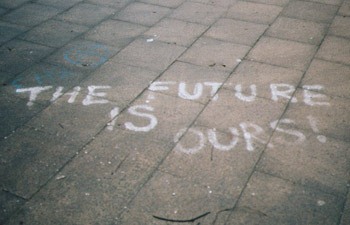
graph on the sidewalkThe ABC series, Flashforward, arguably one of the best written series in a long time, and the best using a science fiction concept, wrestles with a very old idea:  what if you knew the future?  The show expands it to ask: what if everyone knew the future? And by Episode 3:  What if everyone THOUGHT they knew the future?  This is not a new concept when you are dealing with people of faith.  Christians, specifically, have a vision of the future they hold on to.  Actually, they have two.

The first one is a concept of Heaven/Hell–that after they die, they will forever be installed in one of two polar extremes: a place of happiness vs. a place of sorrow–both eternal (also known as With God and Without God).  After that moment, there will only be a seamless future–one that never changes.  

This vision of the future does guide their/our actions to certain degree.  Some believe, still, that you have to hedge your bets.  Do a lot of good things to move your path towards Heaven, or ask forgiveness–quickly–and move yourself away from Hell.  This can also guide people’s actions towards you as they try to drag you to one path or the other–most often to Heaven by use of guilt, judgment or restriction.  Ah well, the path to Heaven, I guess is paved with good intentions too.

But really it’s the other vision of the future that is more worrisome for people of faith.  

Revelation was a book written based on John’s Flashforward.  In that vision he saw lots of stuff–lots of destruction, lots of wrath…it gets ugly.  And believers think they may have an escape route–the Rapture.  That miraculously they get to escape the major drama of the Earth’s end because they believed.  This is not unsubstantiated by the Bible, but it is questionable when it will happen. Trust me, I don’t want to argue pre-post-or mid-millenial tribulation/rapture.  And please–don’t discuss it in the comments!  

What I’d rather discuss is the idea that Christians may be creating the Tribulation themselves–or creating parts of it.

In Flashforward we are slowly beginning to believe that the main character, Agent Benford, is actually creating the bulletin-board he saw in his vision not because it has answers but because it was there.  In some ways, he may be creating his future, not actually solving the mystery of why everyone blacked out for two minutes.  We’ve already seen, in Episode 3, a man get hired to the position of airport security, not based on good qualifications, but because he saw himself in that future, and so did someone else.   

Many times I’ve watched Christians start to cringe if current events start to resemble events predicted in the Bible: the Anti-christ being a big icon to watch out for, as well as the Mark of the Beast, etc.  Credit cards, health cards, any kind of number that identifies you will no doubt bring a lot of fear–and have that implanted in a chip inside your hand or your forehead, and Christians will freak out.  (Hopefully lawmakers would NEVER pass an idea like that unless they want great opposition from Christians).  

I’ve lived through three people who were thought to be the Anti-Christ:  Ronald Reagan, Pope John Paul II and now, Barack Obama, for various reasons.  Often each one of them had a mystical kabbalistic criteria (their names added up to three sixes as Reagan’s does, or Obama’s “name” was spoken about in the Bible as paired with Lucifer–a complete stretch of the imagination) and a few of them have been “assassinated” and come back to life (Reagan and the Pope).  Each time I hear that someone new is the anti-christ, I cringe, thinking that people are gonna start believing all us Christians are loony.  And some of them, those that seem to be magnets for the news, deserve that label, not the airtime.

But then I wonder how often I too look at events with Revelation in the back of my mind.  At what point will events start coinciding so well that there’s a tipping point in even the most casual reader of the Bible–where people start to say–Hey, I’ve seen that before?  How often do we reject good things based on a false premise that THIS moment is part of Revelation, when obviously time just keeps rolling on?  


In Christian circles, we often thank God we don’t know the future–because if we did, it might take away from “who holds the future” and make it Fate, not choice.  But maybe that fits more squarely in Christian mythos–that our fates, our destinies, are already written.  I don’t think so, myself.  Everyone has choices.  But if you see a glimpse of your future, you won’t know if it is meant to be, or if you are being given a warning. We ask all the time for God to guide our lives, for us to make good choices, but we fear getting on the road to the wrong destiny.  As if the roads are already there and once on them, we’ll go 90 miles an hour.  

From Cassandra’s ignored warnings to Oedipus fighting against his fate to modern day futurists who tell us what will happen based on world economic events…one of our eyes is always on the future.  But will we let our concepts of the future influence today’s actions?  Will we allow small evidence to convince us that we are living in  “the end times” and then make irrational decisions?  Or will we make good decisions based on evidence in front of us and walk knowingly into the future, brave, but watchful, not reacting to everyone who says—the anti-christ is here, the anti-christ is there, etc.

What’s probably most disturbing is the Christian concept that they will be persecuted in the End Times.  And certainly every time someone critiques a Christian we hear echoes of this “end times” fear resurface.  That the critique means that the critic must be an enemy, and that Christians are being targeted.  This most resembles “making the future happen.”  By letting ourselves be irrational, afraid of debate, sensitive to criticism, and dogmatically judgmental–I think we will create the discrimination and persecution that will probably come.  But it happens because we’re being a$holes.  I mean, spread negativity long enough, represent bigotry, discrimination and narrow-mindedness long enough and folks will be distrustful.  Eventually, yes, being a Christian will be bad publicity.  But NOT because the enemy is bad, but because Christians are unloving, paranoid judges.  We will create the future we don’t want to happen.  Just like Benford is creating in Flashforward.  

Flashforward is a great show, allowing us to be thankful we DON’T know the future.  What a burden.  Hopefully it will teach us to treasure the moments we have, without being afraid of what’s coming–and make us watch out not to create the fates we want to avoid.  Let’s be good to each other out there.  We’re in this world together.

2012: The Last Movie Explosions and the End of an Era

Well, just saw a clip from the movie 2012, out in theatres in November.  After this movie, there will be no bigger explosions.  Hurray!   

I remember when Independence Day blew up the White House, and much of New York.  It was a cool special effect.  I remember when the Titanic split in two.  Wowzers!  But now, there’s not gonna be a special effect left to do using real places after 2012.  We’ll have seen the Eiffel Tower destroyed so many times, seen a realistic crumbling of the Rio Jesus, seen California being pushed into the sea, or dribbling into it as is the case here.

I mean, after that, the real end, when and if it does come, will seem like a rerun.  I bet when an earthquake hits California, one day, God forbid, but if it does, people will say “It looked just like 2012.”

Now, imagine filmmakers discussing options after 2012 comes out:  

“Well, there goes my next volcano film.  Can’t get more realistic than that!”

“And they just sunk Iowa into the ground.”

“We can’t redo the crumbling of the Statue of Liberty–we’ll be copying!”

“Exactly, boys.”  They’ll sigh.  Nod their heads.  “You know what this means?”

They’ll look around nervously.  

“We go back to plots and characters.  People won’t expect it.”

“What you mean is–they’ll yawn through another White House implosion.  No,” someone will shake his head, “we’ll go back to those all right—there’s nothing left to blow up, or blow up more realistically.  There’s nothing left but characters.  Damn.”

And this will be the END OF SPECIAL EFFECTS DRIVEN MOVIES.  Relief.  

It’s like the last ten years–post Jurassic Park–that directors have been like little boys with a new Chem Set and a set of bottles—what can we blow up?  Or Matthew Broderick and Ally Sheedy in Wargames, playing “Global Thermonuclear War.”   “What will we nuke first?” Broderick asks Sheedy.  “Las Vegas!  Seattle!” 

So many films destroying highways and bridges and houses and monuments…like Godzillas of the Green Screen.  Well, we’re all done with that!  Who can follow 2012?  The special effects people will be looking around for things to do and they’ll have to morph bodies on screen or something else….cause we’ve seen every conceivable iteration now.  Reality won’t be half as good! 

Either we move on now to plot/character driven movies whose special effects serve the moment, or this really is the end of the world….

God:  “Well, they’ve blown up everything they can on screen.  If I don’t cash in my chips, and call my peeps home, they’ll get bored…”

Flashforward: the Excellence that “Knowing” could have been

flashforward Watch Flashforward, Episode One

Robert Sawyer’s Flashforward has been made into an ABC miniseries. It is a masterpiece. I haven’t read the book, so I don’t know how faithful the series is to the original book, but the book won an Aurora Award.

The premise is that everyone blacks out at the same moment for 2 min and 17 seconds. In that time, they glimpse their futures. When they return to the present, mass chaos has already happened. Planes fell from the sky, cars crashed, trains derailed. People died, lots of people died. Everyone had blacked out, so no one was in control of all those vehicles.

The main characters, and there are several, include two FBI agents, a surgeon, a man who lost a daughter in Afghanistan, a doctor about to commit suicide, and several others. The series will be about them either trying to avoid their futures, or trying to get to them, depending on what they saw.

Oddly enough, the date they jump to, April 29, 2010, will be the season finale of the show–and at that moment you get to see if they reenact their futures or not.

Obviously, I don’t know how they can carry this through after that episode…BUT, I’m thoroughly pleased with watching till they get there. After this first episode I know that we have a great team of writers involved.

Now, this is what “Knowing” should have been. In my original review of “Knowing” I talked about how the movie, though predicting disasters, left very few for the main characters to experience, and I was troubled by the fact that it seemed the directors had determined that no one could change anything, so why bother.  That movie dripped with errant theology and left no doubt that everything was predetermined.  I don’t mind that fate or God may be a part of my life, but free-will is a human trait,and makes movies much more palatable.  To see someone struggle against their fate, to see them try.  It is what makes those who are given two weeks to live all the more heroic for skydiving or organizing a political rally.  How we react to what seems to be inevitable–THAT is interesting.

Already, I can tell that the show has set up five or six different beliefs about pre-determinism.  Some believe God gave them a gift, others that He gave them a punishment.  Some want to avoid the future, some to run to it.  For some it predicted a horrible mistake they will make.  

“Knowing” passed up all opportunities for real drama with real people, skidded ahead with bad dialogue and coincidence, to an ending which tried to justify the movie.  

Flashforward is like Mozart taking hold of the Salieri “Knowing” and actually making a great movie out of it.  Yes, I know, Knowing only had two hours…but still, this series is good solid writing.

1.  The characters are individuals, who walk onto the scene with their own problems, their own pasts.  They are well drawn and WHAT they do will determine the plot, not what others do.  Now that the big blackout is done, the characters guide the series.  They will push things forward accidentally or on purpose to meet up to April 29th.  They will determine their plots!

2.  Great dialogue, great stuff that isn’t about “the plot”— that Dimitri has to dance at his wedding to “Islands in the Stream.”  That the chief of the FBI has to lie about his vision because he’s embarrassed.  

3.  The plot starts with the action.  I can imagine this series beginning without the crash first.  But who would have waited the whole episode to have the blackout?  Nope, have the crash first, back up, and then take it slow.  Maybe this is just the difference between TV and reading….but I think starting as fast as you can into the action gets people involved with you.  I noticed in Robert’s book, first chapter, that he has a description of each character first…but within a page, he gets to the blackout.  He knows the blackout is a great hook, and that everything of importance happens afterwards.  

4.  I like the music in this series, already, the building, the back and forth between plots so quickly so that you know they are happening simultaneously–the music and this choice to flash around gives you a sense that everything is tied together.  In some sense it is like a trailer—when the trailer starts shuffling between images so fast that you get excited: all trailers seem to end this way these days.  The director took the music and that shuffling sequence to build suspense.  

I hope Robert Sawyer makes a huge amount of cash from this.  This is brilliant stuff.  And I’m glad to see a Canadian Science Fiction Writer land such an opportunity.  I hope they do more interviews with Robert Sawyer in the States.  

Well, I will keep watching the series.  I’ve already become a HUGE fan.

Realistic Science Fiction: District 9

Scene-from-District-9-200-001This is an amazing film, both for what it sets out to do, and for what it accomplishes.  Taking the form of a documentary, it brings science fiction as close to real as I’ve ever seen it.  It is the documentary form, I think, that convinces a viewer that this is happening, or has happened.  

The film is about what would happen if aliens came to Earth powerless and malnourished.  Human kindness would collide with our own aversion to aliens and suddenly you have camps where the aliens are kept.  It’s a brilliant stroke to make this set in South Africa and not New York or LA or London.  

This film will surprise you at every moment.  I found myself, a film junkie, a sci-fi enthusiast, completely unprepared for where the movie would take me until it took me there.  The writing is superb.  You can’t find a traditional plot here anywhere.  

Certainly we’ve come to an age where we can make special effects seem real—Peter Jackson, the producer and Neill Blomkamp, the director, have gone out of their way to make you see the special effects as realistically as possible.  Yes, the insectoid aliens are CGI, but there’s not a lot of special effects here that are obvious.  God bless ’em, effects are being smoothed into a film now.  

This is not a mockumentary, whose job it is to make you laugh; it is filmed as a documentary to trick your brain into accepting its premise.  And it works.  I remember reading Dracula by Bram Stoker, as a kid.  And I hated the diary parts—but it is the story in letters that make that novel all the more horrifying because the author didn’t want it to seem like fiction.  They wanted you scared because these were actual letters.  It was more creepy to do it that way.  And this film, using documentary style–down to the archived tapes, the dates at the bottom, the steadycam moments–makes you think that someone pieced this together from twenty years of real footage.  Some of it is grainy, some of it is blurry.  

If you want realistic science fiction, you blend the techniques and technology we have now with the strange and possible technology; you bring in recognizable cultural reactions (the Nigerians scamming the aliens), historical patterns of behavior (Nazi experimentation), all without winking at the audience.  Letting them react.  They will think it’s real–because you have torn away what they expect in a movie.  

You expect a hero.  The main character is an idiot, really.  So, he’s not Bruce Willis.  He’s not super-intelligent, and rarely does the right thing.  But what an interesting character!   Again, if you are going for realistic science fiction, your main character may not be the best man or woman on the planet–but they are pivotal and they can learn.  A learning character is all you need.  

The movie is brilliant on many levels.  It works as a science fiction thriller, yes.  But it also works as a metaphor for immigration, for refugees, and for the slums that are in South Africa.  Anytime a people are empowered over another people, stupid things happen to us.  The main character of the movie really is us–as we treat other people as alien.  That shift of power is the focus of the film, I think, and makes the most poignant statement.  Given the right circumstances, human kindness can become dispassionate, cold power.

And what it takes to regain a sense of humanity, perhaps, is to lose it altogether.  But I won’t spoil any of the movie.  I’m so thrilled with the movie, I know that sci-fi junkies will love it and I know people who prefer realism and a smart script will love it.  

I also know that if you have a passion for oppressed people in the world, and the injustice present in nations around the world who have subjugated another race, then you will also find the reflection of that, and the reflection, maybe, of hope.

PUSH is surprisingly good, an Indie film for Heroes watchers

3300601976_4c9f34aab4Imagine if Sophia Coppola, of Lost in Translation, had directed a sci-fi thriller and you can imagine the quirky,smart, place- layered PUSH, a movie now available on DVD.  

PUSH is set in Hong Kong, which is hugely in its favor, and allows the nature of Hong Kong to decide scene shots and plot development.  Hong Kong is more than a setting choice, though.  The director lets Hong Kong seep into this film, with a colorful multi-racial cast, while crowds crowd the scenes.  The movie is about people with psychic abilities running from the government, which wants to bottle and control them.  It’s like the X-Men without costumes or hero complexes.  They are truly ordinary people who are lost among the crowds of humans living in the cities.  Some can “push” a thought into your mind, some can move objects, some can see the future, some can sniff out the past, some can make you think one thing looks like another.  But there are only a limited number of things a psychic can be in this movie.  And having powers do not make them invincible.  

It’s a seek-and-find/chase movie, but the characters have strong motivations of their own.  I found the first three scenes a bit hard to follow at first.  Listen carefully to the opening credits of the film when Dakota Fanning narrates a huge info-dump.  This will set up the whole movie.  I usually HATE info-dumps, but in this case, you are hitting the ground running, and you need this info.  This is not an easy film to watch, but it is rewarding.  If you can make it past the first three or four scenes without turning it off because you have too many questions–then your questions will be answered as you go.

Characters who might have been cyphers in a bad movie, actually have pasts—which is nice.  I felt as if all the characters had met in a previous movie somewhere and so they knew each other, had past interactions.  They didn’t get scripted for this movie only…. and with any luck, there will be a PUSH 2.

There are clever moments in this movie, choices made by characters who are reacting to the choices of others.  It feels as if the characters are making up the plot as it happens instead of a heavy-handed writer.  The last third of the film is incredibly clever, one choice after the next, and it gave it a Heist-plot feel, where the Oceans Eleven crew are going to do a caper.  Yes, these are people who have superpowers but they are being followed and are in danger from other characters with better superpowers.  Superpowers in this film doesn’t equal wealth or control.  And that’s refreshing.  In Hong Kong there are no Reed Richards, super millionaires, who live off their powers, and these powered-people are not heroes, really.  They are trying to survive, and help each other.  

Now I want to get back to that directorial choice to set this in Hong Kong. In an online interview, McGuigan talks about Hong Kong, about heroes-genre films and what he wanted to do with that kind of film:

And then I thought about the whole genre aspect of it and, you know, we’re up against big movies because of The Dark Knights and I call it the Tin Man, but what’s it called? Iron Man? (laughs) You know, those were great movies and I thought to myself that the only reason I would do a film like this would be if I could do it the way I want to do it. An important part of my decision making was to have a strong point of view of how I was going to shoot it. Decision making, i.e., do I want to do this movie? And I said, this is the way I would want to do it which was all kind of handheld and use a place like Hong Kong to its full advantage. And, also, it’s the first time I’ve actually worked in a country or a city that I was actually in that country and that city. It’s like that film logic where you say, “Well, this looks like New York” and you’re in the middle of…it could be anywhere, in Scotland or something, just because it makes more sense financially, but it was actually great that they wanted to shoot it in Hong Kong.

…Usually what happens is that when you make a movie, you see a street scene and you walk and you see the street and you take a picture because you’re on location. And then you go, “Okay, we’ll put in our own people. We’ll take everybody off the street and we’ll populate it with our own people.” You can’t really do that inHong Kong. I mean, one, we can’t afford that amount of extras and two, it’s not as interesting. So, we basically had to let Hong Kong dictate how we worked which was nice and essentially how I like to work, but sometimes you don’t want people to muck with the camera, you don’t want people to look in the camera, so the idea was we had these hidden cameras and then what we would do is we would shoot a master shot and then we would punch in if we had to or felt we needed to, and then we would populate it with our people afterwards. So, it was a bit of both but for the big shots, and that’s why it looks quite an expensive movie because we were smart enough to use the location and we were fortunate enough to be able to use the location because we weren’t shooting Hong Kongfor New York. (laughs)

Doing it his way, he layers in slower scenes, develops character, layers it with music.  This film is visually beautiful, with fewer special-effects to carry the superpowers or carry the plot.  The plot, thank God, is carried by interesting characters.  Paul McGuigan is a smart director–creating an indie film out of the Heroes-genre.  While it’s been compared to Heroes and X-Men, Push limits itself to “reported” psychic phenomena, from a time before WW2 when there were experiments done with psychics, and follows a natural progression forward in governmental experimentation.  It also limits its story to the characters involved, though intimating a larger backdrop of plots and world organizations and other pushers, movers, shifters, etc.  But it was the crowded city streets, the alienness of Hong Kong for the American actors, the purposeful pitting of an Asian gang against the American government/ american powers, and the quirky indie film quality that kept pulling me back visually into this movie.  

It could have been Jumpers-rehash, or any number of bad government vs. heroes films, but McGuigan seemed to want to paint something different, something fresh.  I was surprised and pleased with Push and I think you will be too.  Go rent it.

Yes, Captain Kirk has a Character Arc

chris-pine-as-captain-kirkI don’t want anyone to miss this great discussion that Dave Wesley mentioned as a response to my earlier post.  He said that we ought to check out the discussion of character arcs in the new reboot of Star Trek

Frankly it’s a great discussion about writing.  Here’s KFM (Rogers) initial premise (SPOILERS):

“Captain James T. Kirk, the protagonist of the movie, does not have the development executive’s beloved “character arc.” He has no arc at all.

He starts as an arrogant sonovabitch, and becomes a slightly more motivated arrogant sonovabitch. He does not learn to sacrifice, he does not learn to work well with others — he takes over the goddam ship. He’s right all the time, he never doubts he’s right, and the only obstacle he occasionally faces is when other people aren’t sharp enough to see how frikkin’ awesome — and right — he is as quickly as they should.”

But read the responses and you’ll see a lot of varied ideas on character arcs.  Me, I think Kirk has a character arc.  (And I actually posted it on the responses to his post)–but in a nutshell:

Yes, he’s a sunovabitch through the whole movie, but he is a listless, aimless SOB at first, and he has to find purpose. He never thought his fighting, his rebelling, his go after the baddies ideas fit in well with tight-shirt Starfleet, ultra PC. And yet, it is a Kirk who transforms Starfleet.

Starfleet needs a person who thinks with his gut, and Kirk jumps into that role.  Both old Spock and Pike serve as catalysts to transform brawler Kirk into Captain Kirk.

I like Pike’s speech to him early in the movie:  “Have you ever felt you could be something more?”

I think this is one of the lines that resonates for the viewer.  Don’t we all wonder who we could be if we had the opportunity?  And the line from Spock’s past:  “You will always be a child of two worlds, fully capable of living in either one. “ And Spock has to make the decision where to be fully, and which side of himself to favor–Human or Vulcan.

The movie is about Destiny, and it screws around with time travel to ask the larger question about whether destiny is fixed or fixable.  I think the movie promotes fixable.

The whole discussion is worth reading, but here’s a great later post:

Both have arcs, and the arcs are definitely related because they are almost mirror images of each other. Even Kirk’s dead father is a mirror image of Spock’s dead mother.

Their arcs also cross each other when Kirk tries to gain control of the starship by picking a fight with Spock. Except this time, he doesn’t try to stage mutiny, but rather talks to Spock to get him to resign his post. Following this fight, Spock realizes that he has emotions and he can’t control them. At the end of the scene, Kirk realizes that if he is to be Captain, he has to stop being impulsive and Spock realizes that he can not be Captain with his spasms of rage, and that he will never be able to ignore his emotions.

The movie is good, but I think there’s a lot to discuss about how the movie moved towards good through the writing of characters we thought we already knew.  And character arc is important.  I don’t think that Abrams achieved his great story by NOT giving Kirk an arc–because Kirk is not static.  Kirk learns.  He learns how to adapt t0 and also transform Starfleet protocol to fit him–thereby creating the James T. Kirk of the TOS that we know, and the Starfleet that surrounds him.

In some ways, we learn a lot about how Kirk and Starfleet function with each other, and in spite of each other.