Star Trek: Playful, Exciting, Character-driven

spaceball-12947135322_30ab2b2c4fStar Trek has come a long way and just when you thought there were no surprises left, they show up.  I’ll admit, the last few Star Trek movies left me cold.  Nemesis bombed because the writer tried to copy too much from ST2 but without any of the heart.  Insurrection was a trite story line.  Abrams’ Star Trek reinvigorizes the franchise by giving us both old and new–it completely satisfies this Trekkie.

If you go, you will get a thrill ride, and you will also be reintroduced slowly to characters you thought you knew. Yes, everyone looks young and the sets look like Apple designed them, but that’s what it means to restart the series.  You will get your money’s worth from this movie.  Most people know these characters even if they aren’t fans–but they are reintroduced to us here in great detail.  And there’s lots in here for fans of the show–little touches that show that the writers know the whole series.

I’ll try to keep out all of the surprises.  But you already know that there is time travel involved, and it shows up at the very beginning.  And because of that, events are altered.  “Our destinies are not what they would have been,” says a young Spock.  This is okay.  Star Trek has thrived on the “might have been” storylines.  The Mirror Universe got a lot of play in nearly every incarnation of Star Trek; Tom Riker was a might-have-been Will Riker; Voyager had the two part episode “Year of Hell” and the Finale which changed and altered timelines.  Even ST: First Contact imagined a Borg-filled Earth.  So, it’s nothing illegal–it just gives the writers room to wiggle.  They got to play a little with the histories–legally –because a villain altered the timeline.

But that’s the premise.  The cool part of the movie is not what they changed, but what stayed the same.  We get to see some fine actors inhabit these characters and manage to put a bit of the former actor’s style into it.  You watch Chris Pine–slowly he becomes a bit of William Shatner; Quinto is a fantastic Spock.  I swear I can hear Kelley in this new McCoy!  Uhura shows her inner Nichols in a turbo-lift.  Sulu, Chekhov and Scotty all have their moments of channeling as well.  But the writers also let the actors play—play with these histories and parts.

The plot allows each character to be introduced separately. This is a brilliant maneuver.  instead of just dumping them all on the stage at once, we get to know each character in their context.  We meet Kirk and Spock as children, Uhura in a bar, McCoy on a shuttlecraft, Scotty in a Starfleet Outpost, Sulu as a pilot and in a fight, and Chekhov in a funny homage to ST4.

I wish Wolverine would have been this good.  This had just as much action as Wolvie, but ST had a unified plot, and well-developed characters we thought we knew completely.  In the same way Wolvie failed–by being a prequel with no surprises at all–Abrams managed to give us a bit of parallelism in the lives of these characters and the ones we already know.  And there are so many great and interesting surprises–what ifs–that are allowed to play out.

This is what revision should be.  The series was great, but Myth can revise a story and get to its essence, even if the details have somewhat changed.  I can accept both Roddenberry’s original and Abrams’ version–because this isn’t an arbitrary version.  It fits in with the timeline because Nero changed the timeline.  I’m cool with that.  Just as I’m cool with Janeway’s original arrival back on Earth, and “Yesterday’s Enterprise” (a fan favorite).

And J.J. Abrams, a big high-five to you and the writers from a long-time fan!  When I was seven, I took my photo with the wax figure of Mr. Spock, my dad on the other side of Spock.  I don’t have a costume–but I was once Spock at Halloween.  I don’t know Klingon, nor do I collect the series, or any of the paraphenalia, but I loved the stories, and I recognize Star Trek as American Mythos.  You’ve done a great job at bringing that to the surface.  Well done.  Do a sequel.
Wolverine: You can’t hurt him, so you can’t hurt us

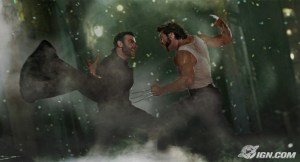
x-men-origins-wolverine-20090212020925195While Wolverine looked promising, it was a confusing mess of action with never a moment of tension. The problem was established early–in the credits–and this hindered us from caring about the characters.

If you make your characters indestructible, then you eliminate us from caring. It was the problem with Superman many years ago–he had no real vulnerability. So the writers rewrote him. Here with Wolverine and Sabertooth, they are given nearly immortal status at the beginning of the film. They don’t age slowly–they just don’t age once they hit their thirties. And they go through the Civil War, WW1, WW2, and the Vietnam War all in about ten minutes of screen time. They are always frontline, get shot at over and over, get hit, but never get hurt. There is no danger for these guys. None. That is established up front. So why would there be any tension in the film?

The film goes on to try and make Wolverine truly indestructible by giving him admantium bones. But since he was already invulnerable (yeah, he could get slightly bruised in a fight with his brother), the admantium claws gave him no discernible advantage. Ah, yes, in fights with Sabertooth, Sabe’s face was a bit more pained–but he was still walking tall after the fights. Spare me the argument that they can heal. 1) An ability to heal that quickly means there are no consequences. No consequences eliminate plot and choice–both essential to story. 2) Wolverine never healed that quickly in the comics. The point of Wolverine’s healing ability was to protect him in the long run, but he got beat up bad in the comics. Often, it would take him days and weeks to heal. And that’s good—it made him vulnerable, but gave him a slight advantage in the ICU. It made me care. But in this film, immediate healing meant that two shadows were boxing each other. I thought–so what?

The fights were scripted so that either Wolvie or his opponent should fall down so there could be a bit of dialogue, or a change of scene. If Sabertooth met up with any other character, that character was toast. It was just a matter of time. Because Sabertooth was established as indestructible.  Worse yet, I am now not sure what Sabertooth is really responsible for–since his main kill comes back to life.  The body count might have been high–but a viewer can’t care if the bodies spring back to life or never had much life to begin with.

Working against it too–the movie was a prequel. And if the survival of the main characters is the plot of a prequel, you’ve doomed yourself. The plot of a prequel needs to be another mystery–because their survival is assured. Here, we were told that we were going to learn the mystery of Wolverine’s origins–but there was no central goal for the main character, no puzzle to solve; just event after event happening to the main characters. No choices, no consequences, no mystery.

I was looking forward to Cyclops, to Gambit, Blob, etc. These characters were used more for the trailer than the movie. This movie had no arc, no plot, and characters who needed to wade through two hours of special effects to return them to X-Men 1, where they began.

Knowing: People Stuck in a Plot (a movie review)

knowing4Having just seen Knowing, the film starring Nicholas Cage as a man who’s been given a sheet of numbers predicting every accident that will happen, I’m having a hard time with Ebert’s review. Ebert gave it four stars. I would give it two.

It is a movie about whether events in life are random or predetermined and wants to be a movie about what you would do if you knew the end of the world was happening.

If you want to see the answer to that, go watch Deep Impact–a better film.

Knowing doesn’t uncover the “end of the world” plot until late in the movie. This movie is about  whether all events are preordained.  And should a coded sheet of these events fall into our hands–does it  indicate that higher forces are communicating with mankind–revealing these accidents?  But alas, it’s not to actually change them.  The list is stuck in a vault for fifty years. What’s the point of revealing numbers only to hide them away? Nicholas Cage would have us believe it is to give those numbers to his son, fifty years later. For what reason–there is no reason. Since Cage cannot do anything to affect or change the events, the paper communicates nothing but “proof” that someone knew what would happen.

Knowing is saddled with a predetermined plot too. The characters only talk about the plot; when they arrive in a scene, they say only what needs to be said to move the plot along, which I always find hard to believe.  When the sister enters the movie, her reason to be there is to tell us that Cage is estranged from the family, to establish that he is running from religion, to emphasize that the family is worried. The writers even realize that there is no real interaction in this scene because they have her tell Cage that he didn’t even ask “how are you? How’s your week been?” before telling her to leave. The characters know it is an awkward scene. All of the scenes are like this–leaping from plot point to plot point.

The revelation that the numbers are actually dates is so unnatural as to be funny.  It doesn’t happen because he actually strives to figure them out–he is drunk, it’s an “accident.” This plot is so much about determinism that it tries to get away with unbelievable coincidence. The author can always say–“Well, that was my point!” But that’s just bad writing. If you need coincidence that badly, then your characters are just puppets.

Cage is a morose father, drinking himself into a stupor every night. He’s supposed to be a MIT astrophysicist. Man, where did they get this classroom? That’s MIT?? It’s small. Only twenty students are there, most look around high school age. It’s supposedly his first lecture of the year–it’s completely philosophical, cosmological, lasts for ten minutes or less, with brilliant students who repeat back knowledge to the professor, and then our brilliant professor blanks when he’s talking about whether the world is random or not, and dismisses class. I never believed him as a professor. And I didn’t believe that was MIT, or any other university.

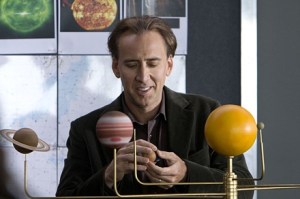
The worst foreshadowing happens here–when he takes up the models of planets and talks about them.

SPOILER: Cage is supposed to have worked on solar flares, was an expert in the field–but he doesn’t work on them now? He doesn’t mention this fact till the end of the film, when it becomes important. But one would suspect that the scientists who have already discovered that a major solar flare is coming would want to consult with the man who has solar flare knowledge.

This movie is full of Christian references to the inevitability of mankind’s destruction. You are sledgehammered over the head with it at times. Cage as prodigal son, makes the predictable return to his pastor/father. There’s even a convenient Christian message scrawled on a van in the last sequence–so that during watching destruction you might make a decision. The kids are taken in a “rapture” which makes angels look like a$$holes because they wouldn’t take Cage with them and save him too, or anyone else in those huge ships of theirs.

Take away the thin veil of science fiction and this is mere theology. Down to the “new adam and eve” and “tree of life” in the last frame… a very tired science fiction ending (we’ve seen it so much that On Spec and other sci-fi magazines reject all stories with “adam and eve” endings). Those people left behind are riotous and murderous, not many shown as kind; as destruction swoops down, you are made to think we are all sinners, murderous thieves. The writers have stacked the deck–giving us no choice on how to read the plot. Nobody really has a believable choice.  That may be honest theology, or philosophy–but it doesn’t make a good movie.

To Watch or not to Watch: a review of the Watchmen

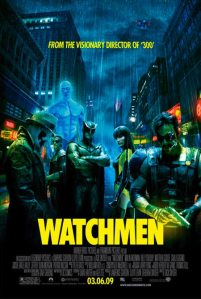
watchmen-poster-groupMy title refers not to whether or not you should watch the film, but about the dilemma of the characters–to watch over others or not.

You should see the film. It’s good to understand the gritty basics of superheroes and why they do what they do, and what kinds of mortals these heroes be.

I’ve bought the book, but I haven’t done more than skim it to see how close it comes to the movie.  I think the movie is faithful to the book.  But for those who haven’t read the book–like me–here’s the skinny on the movie:

The movie explores a history of superheroes in America–as if they really existed. The opening credits are brilliant.  All the moments of American history have as a background these groups of superheroes–mostly non-superpowered costumed vigilantes.  We won Vietnam, Nixon has won a third term as President, it is 1985.  We are in a cold war, but Andy Warhol is painting Night Owl not Marilyn Monroe.

Someone is killing off costumed superheroes who have retired.  Since an Act of Congress, superhero groups and persons have been outlawed or disbanded.  One of the superheroes has become a megamillionaire trying to create green energy; others have just retired without revealing who they were.  The threat of nuclear war is ever present.  One hero has superpowers, Dr. Manhattan, created in an accident (like all good heroes), and he is approaching godhood, barely concerned with humanity, but seeking to help find a way to help the world find an energy solution too.  He is the reason the Russians don’t attack–they are frightened of his nuclear abilities.

These heroes have mixed pasts.  They are more vigilantes, no longer asked to keep vigil.  There is no strong moral code guiding them.  Except for Night Owl, very few of them know what a moral code is.  For Rorschach, whose mask constantly changes shape–a fascinating thing to watch–humanity is disgusting, all the baser natures breeding and leaving nothing of value.  For him, he doesn’t care about humanity–they are all criminals waiting to happen.  When he searches the streets to find answers to who killed the Comedian (who dies in the first few minutes of both the film and the trailer), he beats people up to get his answers.

The movie is more complex than a whodunnit.  And this is what I love about the story.  It will complicate your ideas of justice.  And heroes.  And what responsibility is taken up when you take up a costume and “crimefighting,” and what kind of person needs to have that role, and what person doesn’t need to have it.

The movie shows us heroes who want to do something to help the world, but are filled so much with their own problems that they just don’t have the teamwork, the focus–they aren’t even on the same page.  You thought the Fantastic Four squabbled, but this is chaos.  It’s gritty real, though, at what a “real” group of heroes would be doing–all idealism, but with their own agendas.

If you liked Dark Knight, you will enjoy Watchmen.  It makes you think about vigilantism–what decisions you are allowed to make on behalf of others, and what decisions you shouldn’t make on behalf of others–even to keep them safe.

The movie is also visually stunning.  The sequences on Mars, the blue Dr. Manhattan, the fighting sequences–we’ve come a long way through the Matrix and out again.

The movie isn’t perfect.  I’ve never seen a worse Nixon–he looks plastic, as if he is wearing a mask himself; there are poor choices in music–Leonard Cohen singing “Hallelujah” during a sex scene; the sex scene itself seems a bit long.  But these are small things in a long movie that, overall, satisfies.

It has a lot of gratuitous violence–but I think the violence says a lot about these heroes.  They’ve become numb to it, to the choices they make regarding other people.  The world is something to clean up and guard.  Silk Sepctre II says that the law that disbanded superheroes was the best thing to ever happen to her–she never wanted to be a superhero.  Her mother, the first Silk Spectre, made her.  She hated the clothes. And the responsibility.

The end will keep you talking for weeks.  I promise you.  It is no easy ending and the movie leaves you wrestling with decisions.  Go see it.  Justice isn’t an easy topic.  Our conversation afterwards at Tim Horton’s involved youth who tag buildings with graffiti, but it could have been anything we were upset about.  To what ends does vigilantism aspire?  How far would you work outside of “the law” to get “justice”?  It sparks a lot of difficult conversations.  I’m sure I came across like an idiot–but i tend to let myself talk to see what I might say.  Cause only when I’ve said it, do I get to evaluate whether or not I believe it.

So, go see the movie and see what you start talking about afterwards.

The City of Ember: Clever Assignments For Everyone

Doon and Lina looking worriedThe City of Ember is a great fun family film, full of clever, unlockable mysteries. It comes with a map, all torn up and faded; it comes with a “ticking clock”–the fear that the city will wind up in the dark; and plenty of menacing obstacles. The ending leaves you wishing to be back in the more colorful Ember, but the movie enjoys itself and the city while it is there.

City of Ember is strongest when it is working within its world. Jeanne DuPrau is an excellent world-builder, trying to make a city buried beneath the earth believable. What would you do to make a nuclear bunker livable and expandable? The city is quirky and interesting and what I’d expect from a city slowly running down. Ramshackle, apartmental narrow English-looking cobblestone streets. No bad fumes down there–one would assume, with no cars–but then no oxygen either. True, the whole idea that the air and water are replenished–and yet not infected by radiation–is hard to swallow. But I’m willing to suspend my disbelief.

Opening sequence: I was getting ready for an infodump–but this is brilliantly constructed. If you’re gonna have to have an infodump, make it interesting. Tolkien does it with the history of the Ring in Lord of the Rings, and here, DuPrau talks about the Countdown box with the papers on how to Exit Ember. The directing on this scene focuses in on the hands of each successive mayor as they pass the box to each other in a line. So we set up our story’s inner problem, as soon as that line of succession is interrupted. Ember, like every other constructed engine, will fall apart. The city will go dark. The food will run out. And without the instructions, no one will escape. It’s up to two plucky teens to figure out how to escape.  It was a great way to start the movie/story.

I found the world so interesting–that unfortunately, I was disappointed when they escaped.  So let’s talk about the world of Ember.

High school graduation is not about living your dreams, but about getting an assignment to start working on keeping Ember going.  What a great idea!  Who needs years to find themselves?  Or following pursuits where there is no market?  (Where is the art down there?)  Lina wants to be a messenger; Doon wants to fix the engine, but on Assignment Day, they draw their jobs out of a hat (no more School Counselors with their aptitude tests!).  We start this movie with two people wanting something so badly, and they don’t get what they want!  Fantastic.

We see the city falling apart and the parents tell the kids not to worry about it.  This is the part that you feel resonating in today’s society.  There are several things we can do to make society work better and we better encourage our kids to work on them…or maybe we can do them.  Anyway, the city is falling apart–the kids join in the maintenance of Ember, but also want to fix Ember.

I was delighted by the cleverness of the plotting and worldbuilding in Ember, all the nooks and crannies we get to uncover.  In the movie, yes, we don’t get to spend enough time with Lina nor Doon’s past and their characters….so this is a plot-driven movie, as movies are wont to become.  But I still enjoy Lina and Doon.

Once their drive to exit Ember kicks in, though, they are consumed with that idea and we lose who they are.  They could be any two kids leaving the city.  It would have been nice to see more of heir characters shine through in their escapes–what they worry about, what they accidentally do.   But this is a MOVIE problem, not a story problem, likely.  The movie gadgets and Indiana-Jones style thrills take over to get the kids out of Ember.  And I liked the hidden “magic” inside the city–as if the city had been just a half-turn away from showing all its secrets.

Truly, I would have liked to have seen a whole movie about Ember BEFORE everything breaks down…but the plot moves them out of this nifty created world into, eventually, our own boring world with sunrises and prairies and mountains. Ahhh…landscapes.  They are nice.  But Lina and Doon, um, escaped the plot too, or forgot that they have no way of surviving on the surface.   The movie reminds me of a great carnival ride—a lot of action and joy and cleverness in the construction, and a sad sigh at the end when it’s over and the world has been “lost” and you have to exit the ride.  Not the sigh of characters you don’t want to leave–but the sigh that the cool part of the plot and story are gone.  For a discussion about movies that end with a “healed earth” as a trope, even when it’s looking more and more unlikely that the earth will just heal itself, click here.

I hear there are two sequels in books.  Both of them take place in a post-apocalyptic/new Earth in the US… but it is the idea of that buried, constructed city that sparks imagination.  If you’ve ever built a treehouse, ever put a sheet over tables and chairs as a fort in the living room, or marked up a cardboard moving box as a house–City of Ember appeals to you as the coolest underground fort can.  I hear that The Prophet of Yonwood is a prequel–and that will be cool to see how they built the city of Ember. I think DuPrau is hinting at some larger themes here and I like how she’s doing that.  We are all on Assignment Day–but we don’t have to draw ours out of a hat–but we need to pick them soon and get busy.

Rent the movie, enjoy the ride!  Or Read the Book, enjoy the characters!  Choose your assignment, fix the world!  That ought to cover it.

Repair-adise: The Myth of the Self-Cleaning Earth

3224040683_22edd9a60cOkay, I’ve seen the trope enough.  Yes, it is a hopeful image, but it perpetuates a myth.  End of movie: three or four people after post-apocalyptic disaster come out to “healed” Earth.  200 years in City of Ember.  700 years in Wall-E.

Gaia is a nice idea–that the Earth is bigger than us and will heal itself even from our damage.  However, it lessens any personal responsibility, and gives us some odd idea that humans, in the form that we know them, will be back one day after the Earth has gone through a cycle similar to a self-cleaning oven.

Oddly enough, the base idea is shared by those who don’t believe in Global Warming, or who don’t believe that Man is causing global warming–the idea that the Earth shifts in cold and hot and finds a balance and everything is returned to a state of Eden.

Here’s two things I know: The last Ice Age was a documented shift in the planet’s balance of hot and cold.  Those ice sheets lasted for more than 100,000 years, ending about 10,000 years ago.  The animal and plant life that we know from then have changed quite a bit over that span of time.  No more giant ground sloths, mammoths or neanderthals.  Even the steppe grasses are gone.  So,  it took the Earth 10,000 years to right itself–after some massive glaciation.  In other words, Global Warming may well indeed have been a natural shift, but Humanity will not survive a massive shift like that–certainly not in the way we are now. And likely, the Earth will come up with some radically new life forms–if it recovers at all.

The second idea here is that the Earth can take a beating from us.  No problem.  A) if it disposes of us, what have we learned?  and B)  We are capable of damaging an atmosphere irreparably.

Those Ice Ages, devastating as they were, still counted on an atmosphere.  If we hurt our atmosphere, isn’t it possible that we not just trigger an Ice Age, but stop it from fixing itself?  James Lovelock, the man who created the idea of Gaia–the earth that is an organism–was interviewed in New Scientist.

Do you think we will survive?

I’m an optimistic pessimist. I think it’s wrong to assume we’ll survive 2 °C of warming: there are already too many people on Earth. At 4 °C we could not survive with even one-tenth of our current population. The reason is we would not find enough food, unless we synthesised it. Because of this, the cull during this century is going to be huge, up to 90 per cent. The number of people remaining at the end of the century will probably be a billion or less. It has happened before: between the ice ages there were bottlenecks when there were only 2000 people left. It’s happening again.

I don’t think humans react fast enough or are clever enough to handle what’s coming up. Kyoto was 11 years ago. Virtually nothing’s been done except endless talk and meetings.

It’s a depressing outlook.

Not necessarily. I don’t think 9 billion is better than 1 billion. I see humans as rather like the first photosynthesisers, which when they first appeared on the planet caused enormous damage by releasing oxygen – a nasty, poisonous gas. It took a long time, but it turned out in the end to be of enormous benefit. I look on humans in much the same light. For the first time in its 3.5 billion years of existence, the planet has an intelligent, communicating species that can consider the whole system and even do things about it. They are not yet bright enough, they have still to evolve quite a way, but they could become a very positive contributor to planetary welfare.

How much biodiversity will be left after this climatic apocalypse?

We have the example of the Palaeocene-Eocene Thermal Maximum event 55 million years ago. About the same amount of CO2 was put into the atmosphere as we are putting in and temperatures rocketed by about 5 °C over about 20,000 years. The world became largely desert. The polar regions were tropical and most life on the planet had the time to move north and survive. When the planet cooled they moved back again. So there doesn’t have to be a massive extinction. It’s already moving: if you live in the countryside as I do you can see the changes, even in the UK.

He has a lot of optimism that despite all the damage we can do as a species, that the Earth will recover–even that perhaps these amazingly smart humans, in his opinion, the apex of creation, will figure out how to live in harmony with the Earth–eventually.

But it also might allow both a fatalism and a hedonism to develop–as if we can do nothing to hurt the Earth at all.  Lovelock was instrumental in getting the global CFC ban that led to saving the Ozone layer.   Perhaps there are still more things to do to stop the warming that’s happening–as he suggests in the article.   Certainly, we have to think short term.  Lovelock’s vision–is that after thousands and thousands of years–humanity will survive and learn.  Movies shorten that to a few hundred years, a slap on the hand for our negligent behavior instead of the mass extinction probably waiting for us.  They believe in Man rebooting after the Earth has rebooted itself.  Repair-adise.

All these movies have people waiting out the storm, walking into paradise, virtually unchanged.  Free of humanity for a mere 200 years, the planet heaves a rainbow sigh of relief, bushy gardens of plenty.  But with our weapons we can inflict planetary damage; Wall-E can never clean up all the trash and one plant can’t feed the multitudes–and there will be a long wait for the storm to be over.  And humans may not survive as humans.  There may be no humans to come back out after 55 million years….and if there are, will they remember what they did wrong?  We have to affect change.

Sure, we may not die, but we will all be changed.

Stardust Shines: Character Motivation-ism

stardustSometimes it’s simply about giving everyone something to want, something realistic, and then setting them on their paths.  Stardust, the Neil Gaiman-inspired movie, does a great job of giving characters real desires and then setting them at odds with each other.

If you are writing science fiction or fantasy, even well-developed characters function at half-power until they have a goal.  Once they have a goal–man, they zip!  This is one of my favorite things to watch, as objectively as I can, that moment in my heart and interest level when the character finds a goal.  It has to be something they want, not just an interesting goal that should be “universally interesting.”  They have to want it enough to maneuver through a tangly set of obstacles.

Stardust Plot summary: To woo Victoria, poor boy Tristan promises to get her the falling star they just saw.  When he goes to get the star, he discovers Yvaine, a woman, is the star that fell.  Three witches want to eat Yvaine’s heart to make them younger, and seven scheming princes want the throne–which can only be had if they can find the necklace, which happens to be with Yvaine.  So people want Yvaine for what she can give them: eternal life, long lasting beauty, a kingdom.  Tristan wants her to impress Victoria.

Really clear goals: Tristan wants to win the heart of Victoria. When he meets up with Yvaine (Claire Danes) he doesn’t suddenly switch goals.  He could have life immortal or even Claire Danes!  But no, he wants Victoria.  He promised to have her this star and that’s what he’ll do.  Yvaine won’t budge until she sees he has a Babylon Candle which could actually get her home—so she goes with Tristan on his way to Victoria because he promises to send her back home when he gets done showing off in front of his girl.

The pirates collect lightning, the witches want beauty, the princes want the kingdom and to kill each other.  When all their plots become melded into a single objective–from different angles–it revs up into high gear.

I enjoyed this movie.  I think it’s well designed.  The narrative is strong and is propelled by the desire lines of each character.  I love how all of them use similar means to get them to where they need to go: runes.  Not a map, not a prophecy, but unpredictable magic that you have to keep checking over and over again.

It helps that the scenery–meaning the place, the occupations, the “world- building” is interesting–but without desire, it is just scenery.  With desire, it becomes charming.  There are few memorable lines in the movie–this isn’t “Princess Bride”, though I believe the plots are just as good.  The comedy isn’t as strong–too many characters for you to memorize everything.  And this is its only fault, I think, that the characters may be well-motivated, extremely well-motivated, but rarely rise above stereotype–even with all the “cool stuff” around them.  They are stock characters with bling.

Tristan IS his want.  Other than his desire, he is a bit of a goof whose entire existence seems to be winning the heart of Victoria.  No mention of what his life was like before, or his relationship with his dad and having no mom.  Yvaine has a bit more character–she has been spending her life as a star watching us (we’re so entertaining to celestial beings) so she’s always wanted to have an adventure and fall in love.  But really we can’t imagine her life as a star.  Which is why she is so much more interesting on Earth (she’s got motivation and means).   The witches seem obsessive—and we wonder how they spent their time before the star fell.  Oh, you know, the last three hundred years….  The princes are fiendish, but they have no personalities outside of good/bad/opportunistic.  They want the kingdom–they only exist to push their plotline.

So, after all is said and done: character motivation, aka desire, is essential to move characters along, but without more character work–as in WHO these people are that make them different than their archetypal roles–desire becomes plot without managing to deepen character.  I imagine that Gaiman packed more into the novel, but on screen we may only have time for one choice: character desire vs. character development.

Ebert gave this 2  1/2 stars out of 4, saying that plotlines were convoluted and that the movie never rose to the level of “Princess Bride.”  I didn’t think the plotlines were convoluted, but only that the plotlines were so well charted that it left little room for characters to grow beyond the plot necessities–but that doesn’t mean it doesn’t satisfy like the best story–especially the fairytale kind of story it represents.   I would still give it 3 out of 4 stars—it’s a great movie.  Really.  And not making it to Princess Bride Status is not necessarily a fault.  It’s a clever romp through a well-developed world.  All the pieces are in place and they interact with each other well, and you can learn a lot about the power of character motivation, and the power of character too.  Even when character shines less than character desires.

Sita Sings the Blues: a great film we gotta see here

1sita-thumb-200x2312I just heard about this animated film that Ebert is raving about. Get this: an animated film based on the Indian epic, The Ramayana, with songs from 1930s singer Annette Hanshaw.

The Ramayana tells the story of a great betrayal by a husband and his mother on the husband’s wife. It is one of the oldest texts in India, and rife with magic, monkeys and religion. It was made to be a thriller–a very long thriller.

The movie though, is animated.

Here’s the trailer, without the Hanshaw.

The problem: Hanshaw’s estate won’t give Nina Paley, the creator of Sita Sings the Blues, the rights to use the songs, so no distributor will touch it. It can win tons of awards–and it has–check out this site. But it can’t be mass distributed. Update:  Here is Nina’s Distribution Plan since Ebert’s article!  Click there to find the movie…and where you’ll be able to see it.

I can’t wait to see this film. I wonder if we can get Yukon Film Society folks to bring it up. It seems to be showing at film festivals everywhere….

So, this is another outlet for fantasy writing: cartooning and reinterpreting world epics with lots of fantasy elements. And adding in some historical footage too. It’s remarkable. Listen to this. Here’s a nice mix of 1930s Singing, modern animation, and a world Epic:

There are no limits for fantasy writing. None. Okay, well, copyright….but really, no limits. 😉

The Wonderfulness of “It’s A Wonderful Life”

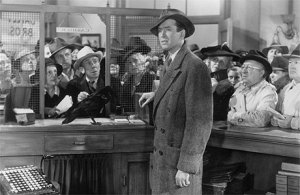
jamesstewart460This is my favorite Christmas movie.  So I’m a bit palled by recent articles that this is a dark film, or that George Bailey should never have been born.  Mainly, this is a response to a NYT article (and a short video commentary) about the “dark side” of “It’s a Wonderful Life.”  (But you can also see the seething condescension for Capra’s human vision in this article, “It’s a Wonderful Lie”)

Wonderful? Sorry, George, It’s a Pitiful Dreadful Life! by Wendell Jamieson revises, or attempts to revise the viewer’s reception of this movie, by making us concentrate on how miserable George’s life really was.

<“It’s a Wonderful Life” is a terrifying, asphyxiating story about growing up and relinquishing your dreams, of seeing your father driven to the grave before his time, of living among bitter, small-minded people. It is a story of being trapped, of compromising, of watching others move ahead and away, of becoming so filled with rage that you verbally abuse your children, their teacher and your oppressively perfect wife. It is also a nightmare account of an endless home renovation.>

While these are George’s circumstances, this not the point of the movie.  Coming out in 1946, this movie exemplifies the self-sacrifice that many Americans made during the war and the depression to get their families through.  Undoubtedly it was a paean to all those people who had sacrificed what they wanted for what was good for the country.  George Bailey still stands as an exemplary “citizen” who sacrifices his dreams–which if you look at them closely are founded on the idea of escape, and a small opinion of his small town–to care for the people of his town.  This film, for 1946, has a strong inclusive argument for immigrants.  Potter hates them; Bailey wants to give them a chance.  Certainly Capra’s viewers would have seen many immigrants in the 30s and 40s struggling with them in hard times.

The movie is also about the power of one man to fight against the greed and power of another man.  Bailey and Potter are two sides of this coin of power: Potter would rule Bedford Falls without George in his way.  But to do something great requires sacrifice.

Sadly, Jamieson doesn’t see the point of self-sacrifice.  I admire George for giving away his Honeymoon money to help the town stay afloat.  I admire Mary Bailey for all the reasons that Jamieson discounts her.  He calls her “oppressively perfect.”  I’m not sure WHO she’s oppressing.  She wants George to stay at home and raise a family, sure.  But she’s also willing to make the sacrifices and understands George’s need to help others.  She’s also the force that goes door to door to help raise funds for him.

Bedford Falls is not perfect—but it’s not stultifying.  Certainly it is better than Pottersville.  Jamieson disagrees:

Here’s the thing about Pottersville that struck me when I was 15: It looks like much more fun than stultifying Bedford Falls — the women are hot, the music swings, and the fun times go on all night. If anything, Pottersville captures just the type of excitement George had long been seeking

He later makes the point that Pottersville would have been a “resort town” and would have survived the latest crashes on Wall Street. Resort town?  Who’s he kidding.  No one looked happy or having “fun times.”  No one is happy in this version; not Mary, not Violet, not Bert or Ernie.  No one has a better life in the de-Georged version.  I saw bars and dance halls, triple X movie theatres, and people were in these places not because they were happy–they were there to drown themselves.  It wasn’t excitement.  I saw chaos.  Everyone was angry, bitter, frightened.
Jamieson catalogues George’s set of woes as if he is making a criminal case against God himself (or fate):

Soon enough, though, the darkness sets in. George’s brother, Harry (Todd Karns), almost drowns in a childhood accident; Mr. Gower, a pharmacist, nearly poisons a sick child; and then George, a head taller than everyone else, becomes the pathetic older sibling creepily hanging around Harry’s high school graduation party. That night George humiliates his future wife, Mary (Donna Reed), by forcing her to hide behind a bush naked, and the evening ends with his father’s sudden death.

Okay, I have never thought of the flirting scene with Mary as a humiliating moment with Mary, but merely of two kids who are teasing each other.  I don’t know what lens Jamieson sees this movie, but it is a twisted one–bringing out the dark elements and calling them the point.

I admire this film because it reminds us to think of others.  It is a lesson to the viewer who might be a George–that they DO count, that they have made a difference–and a template for those who might know a George on how to be a friend in times of need.  Everyone at the end sacrifices their small needs for George.  While Jamieson makes the case that George would still have been libel for the stolen money—no one in the film has accused anyone yet.  While the bank examiner has a warrant for George’s arrest–the policeman rips it in two a the party.  If they supply the $8000 back, then the money never went missing–especially if the bank examiner and the police are conspirators on forgetting the whole thing.

George Bailey is canonized in the hearts of Americans because he does good for others for the sake of doing good.  While, yes, his human rage at having been denied so many things gets the better of him at the beginning, it’s all the more to remind us how fragile our saints can be–that George is not a God nor a robot, but a man who makes the better choices each time.  Until, he can’t do them any more.

Writing a story, an author is told to torture his main character.  Good plots do this well–by taking away what our characters hold dear.  “Wonderful Life” just follows that pattern–taking away from George until he is laid bare on the night when his life could be destroyed.  His miracle is less a miracle than a vision.  It works so well as a device because despite the hocus-pocus of Becoming Pottersville, the idea is something we can actually envision for ourselves.  Each of us can imagine our own Pottersville in the wake of our disappearance–and this can reassure us in our darkest times.  I think we have all been on the bridge, looking at that swirling water.  We may need a Clarence to point out our worth, a human Clarence, which requires us to step up.  But in the end “It’s a Wonderful Life” is about the value of community–and for all George’s sacrifices he gained a community that loved him.  Don’t discount this.  In our heady, Me-oriented societies–we’re losing the idea of our community.  And when we get to the bridge, I’m afraid we won’t have a Clarence, and we won’t have the vision to see that we made any difference in the lives of others if we don’t practice self-sacrifice.  I’m not one to talk–having not done much—but I am one to watch and learn from George Bailey.