A Biologist’s Ecstasy: ‘Avatar’ Awakens Joy of Seeing the World Again

This essay over at the New York Times explains ‘Avatar‘ from a Biologist’s point of view.  Carol Kaesuk Yoon  is encouraging everyone who ever loved biology to go see Avatar purely for the wonder of seeing Life.  

Please excuse me if I seem a bit breathless, but the experience I had when I first saw the film (in 2-D, no less) shocked me. I felt as if someone had filmed my favorite dreams from those best nights of sleep where I wander and play through a landscape of familiar yet strange creatures, taking a swim and noticing dinosaurs paddling by, going out for a walk and spying several entirely new species of penguins, going sledding with giant tortoises. Less than the details of the movie, it was, I realized, the same feeling of elation, of wonder at life.

Perhaps that kind of potent joy is now the only way to fire up a vision of order in life. Many biologists of my generation (I will be 47 this month) were inspired to careers in science by the now quaint Time-Life series of illustrated books on animals or by the television program “Wild Kingdom,” rugged on-screen stuff for its time (“Now my assistant Jim will attempt to sedate the cheetah”). But maybe that isn’t enough anymore.

Maybe it takes a dreamlike ecstasy to break through to a world so jaded, to reach people who have seen David Attenborough here, there and everywhere, who have clicked — bored — past the Animal Planet channel hundreds of times without ever really seeing the animals. Maybe it takes a lizard that can glow like fire and hover like a helicopter and a staring troop of iridescent blue lemurs to wake us up. Maybe “Avatar” is what we need to bring our inner taxonomist back to life, to get us to really see.

Read the whole essay here.

If you are a science fiction/Fantasy writer, you’ll want to pay attention to the world-building done here.  Rarely have I seen world building done so well at the biological level, in a movie.  The plant and animal life here make sense together.  It’s not an anything goes style—if you check out the movie purely from that biological angle, you see a world that fits together well.  

And that’s something to take notes from.  


How to Read and Understand Science Fiction: Jo Walton’s Essay on Tor

Below is an excerpt and a link for the wonderful essay by Jo Walton on “SF Reading Protocols” or just how to understand Science Fiction and Fantasy when you’re reading it.   Her argument is that readers of Science Fiction actually read differently than other readers, and books in this genre require a different reading skillset.  

Genres are usually defined by their tropes—mysteries have murders and clues, romances have two people finding each other, etc. Science fiction doesn’t work well when you define it like that, because it’s not about robots and rocketships. Samuel Delany suggested that rather than try to define science fiction it’s more interesting to describe it, and of describing it more interesting to draw a broad circle around what everyone agrees is SF than to quibble about the edge conditions. (Though arguing over the borders of science fiction and fantasy is a neverending and fun exercise.) He then went on to say that one of the ways of approaching SF is to look at the way people read it—that those of us who read it have built up a set of skills for reading SF which let us enjoy it, where people who don’t have this approach to reading are left confused.

… My ex-husband once lent a friend Joe Haldeman’s The Forever War. The friend couldn’t get past chapter 2, because there was a tachyon drive mentioned, and the friend couldn’t figure out how that would work. All he wanted to talk about was the physics of tachyon drives, whereas we all know that the important thing about a tachyon drive is that it lets you go faster than light, and the important thing about the one in The Forever War is that the characters get relativistically out of sync with what’s happening on Earth because of it. The physics don’t matter—there are books about people doing physics and inventing things, and some of them are SF (The Dispossessed…) but The Forever War is about going away to fight aliens and coming back to find that home is alien, and the tachyon drive is absolutely essential to the story but the way it works—forget it, that’s not important.

This tachyon drive guy, who has stuck in my mind for years and years, got hung up on that detail because he didn’t know how to take in what was and what wasn’t important. How do I know it wasn’t important? The way it was signalled in the story. How did I learn how to recognise that? By reading half a ton of SF. How did I read half a ton of SF before I knew how to do it? I was twelve years old and used to a lot of stuff going over my head, I picked it up as I went along. That’s how we all did it. Why couldn’t this guy do that? He could have, but it would have been work, not fun…

Read More Here

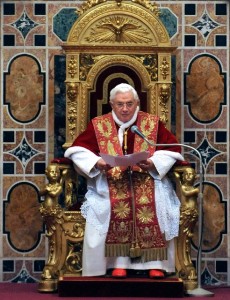
Pope Says Okay to believe in E.T., But Not In Gay Marriage

Well, the Vatican seems to be open to aliens.  I like that.  It’s heartwarming.  It’s progressive.  Though only speculative reasoning by the Vatican’s chief astronomer, the Pope threw open his arms to his “brother aliens.”    Fr. Jose Gabriel Funes is Chief Astronomer for the Vatican.  

The astronomer began the interview titled, “The Alien is my Brother,” by saying that, “Astronomy has a profound human value. It is a science that opens the heart and the mind. It helps us to put our lives, our hopes, our problems in the right perspective. In this regard, and here I speak as a priest and a Jesuit, it is an apostolic instrument that can bring us closer to God”, said Fr. Funes in the interview. 

And further on the subject of the aliens, the good astronomer had this to say:

Asked is he sees a contradiction between the Catholic faith and believing in aliens, he said, “I think there isn’t (a contradiction). Just as there is a multiplicity of creatures over the earth, so there could be other beings, even intelligent (beings), created by God. This is not in contradiction with our faith, because we cannot establish limits to God’s creative freedom. To say it with St. Francis, if we can consider some earthly creatures as ‘brothers’ or ‘sisters’, why could we not speak of a ‘brother alien’? He would also belong to the creation.”

Alas this brings up lots of interesting questions and contradictions in the Vatican’s positional stance on other issues closer to home.  This excellent post from the Guardian sums up the contradiction nicely.

That the Catholic church isn’t freaking out at the possibility of alien existence for one thing gives me hope that they might stop freaking out about other things that really do exist. Contraception, perhaps, or homosexuality. The Vatican might become open to the possibility of married priests, or female ones. And that would be super.

But, yeah, no.

E.T. ain’t heavy, he’s my brother.  But the gay couple, we won’t carry them.

They’re now a threat to Creation itself. (Step back, Climate Change!).  Says the Pope in his address to world diplomats–a plea for the environment and creation:

“Creatures differ from one another and can be protected, or endangered, in different ways, as we know from daily experience. One such attack comes from laws or proposals which, in the name of fighting discrimination, strike at the biological basis of the difference between the sexes,” he said.

“I am thinking, for example, of certain countries in Europe or North and South America,” he said.

Well, this speech, January 5 2010, came just after Mexico City declared gay marriage legal, and as Portugese Parliament was doing the same.  Hmm.  

I love that the Vatican embraces Aliens and what had been only science fiction before, but I hope they turn their attention to more immediate matters: the millions of gays and lesbians who want equality, and would like just a little of that love the church wants to dole out on Extraterrestrials they’ve never seen.  Irony seems a paltry word to describe this kind of injustice.  It’s cruelty inscribed in Jesus’ name.   This would make Jesus weep a second time.  

God is not science fiction, and probably aliens are not science fiction (I’ll give the Pope two points there).  Pope Benedict, gays aren’t monsters, gay marriage no threat to reproduction or creation in the world.  But the Church, unfortunately, is fast scripting themselves as Fantasy–out of touch with their own directives, mandates and missions, even their own Author.  Instead of walking away from the Church, I challenge people to go back in and help fix it.  Update it.  Teach it.  Vote out the bad policies.  Uncover God where He’s been shrouded.  Shake the dust off people’s shoulders who have been sitting there comatose for years.  Tell them there’s more than singing, more than preaching, more than baptizing, more than dinners and potlucks—there is a host of things to do work on, a host of people to reach out to, a host of folks in need.  

This plot is slumping.  Cut to the action again.  Bring in new characters, better dialogue.  

This novel idea, Christianity, has more potential, and could be a bestseller–could even change the world— but it’s gonna take a lot of work.

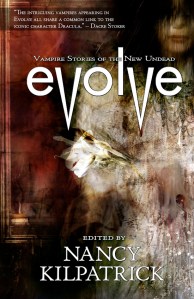
Evolve: Vampire Stories of the New Undead–all Canadian, all vampire, and evolved

Imagine this:  what would the future of vampires look like?  How would they evolve?  24 Canadian writers thought about this and came up with their ideas. Evolve: Vampire Stories of the New Undead is an all Canadian anthology–23 stories, one poem.  It’ll be launched at the World Horror Convention in Brighton England in March.  

Yep, I have a story in there, “How Magnificent is the Universal Donor.”  In my story, vampires have finally been pulled into positions of power in the medical field.  They save the world by stepping in to keep a terrible blood disease at bay, and they continue to keep the world safe.  But it’s not a perfect situation…some sacrifices occasionally have to be made for the good of the World.  They’re just not telling anyone.  Wouldn’t want to stain their new reputations as saviours.  

I’m thrilled to be a part of the collection.  

The collection is available for pre-order now.  A limited number of the anthologies have been packed into little wooden coffins and you can pre-purchase the coffin-encased anthology at this site.  You can also order the anthology by itself too, which will be available in March.  Can’t wait to be in England pushing these little coffins on our table—it’ll be an awesome visual.  As if we’ve made little gnome coffins.  

While I’m not normally a horror writer, I just played with the idea of getting to evolve vampires.  That was fun!  Hope you enjoy it.  

Evolve is published by Edge Books, Brian Hades Publisher, and edited by Nancy Kilpatrick.

Tesseracts 14 Submitters: Not to Worry

Eager to hear any news about Tesseracts 14?  

New Update:  The Table of Contents has been finalized and will, I hear, be revealed soon.  Brett and John are sending out emails right now.  That will take some time as I’m sure there were lots of submitters for this anthology.  But everyone should know everything in, at least, about a day or two, I’d guess.  Good luck everyone!  

_____________________________________

Everything below this is old news: dated January 9 2010.  

Brian Hades has posted this on the Tess 14 webpage:

WE ARE A BIT BEHIND 

With December holidays and more snow than one ever needs clogging up the works, we are about two weeks behind schedule. Please have patience as we catch up during the month of January. Thanks. – Brian Hades, publisher

This supersedes my other reports from SFC listserv.  Thanks Marcelle for those original tips.  I know folks were worried theirs were lost in the mail.  The snow has a way of swiping mail sometimes. Godspeed to the editors, and to us– good luck on your next projects–several deadlines approaching.  As for Tess 14, good luck to everyone!  Now back to snowfall, dogwalks and deadlines.

Rocketfuel Ignites Imaginations, the Yukon News story on my class


Photo by Ian Stewart for the Yukon News

My most excellent class of writers is the subject of a Yukon News article below.  These writers are an awesome group of imaginateurs.  I’m impressed, especially, with how they conducted themselves in an interview–thoughtful, insightful, well-read, interesting and interested in each other.  Love to start a book club with them!  

Article is by James Munson for the Yukon News.

_________________________________________

Zeb Berryman has some demons he’d like to share.

The 18-year-old scribe is an aficionado of the “dark side” in his literary circle, a dozen Whitehorse high school students known as Rocket Fuel.

“The darkness and violence is what makes it beautiful,” says Zeb, referring to one of his current anime reads.

Zeb’s comment elicits a few nods from his fellow science fiction enthusiasts sitting around the table in the FH Collins library.

These young adults have an encyclopedic knowledge of the fantasy genre, and can discuss the intricacies of alchemists, monsters, gods and goblins at length.

“It’s like literature discussion about a whole bunch of books you never get to hear literature discussions about,” says Jerome Stueart, a science fiction writer who started Rocket Fuel two years ago.

But more impressively, it’s their own literary creations they’re the most familiar with.

Ask any one of these students about their works, and it won’t be long before another interjects.

Franz Krabel, 12, tends to kill off his characters a lot, says Santana Berryman, Zeb’s 14-year-old sister.

Santana, for her part, has an obsession with the afterlife, says Stueart.

These writers know each other inside out.

Read the rest of the article

Fantasy-Filled Young Readers Give the Season Imagination

Rocketfuel, the youngest group of science fiction and fantasy writers in the Yukon, showcased their own writing (and art and music) Dec 4th at the Frank Slim’s Building at Shipyard’s Park.  It’s a nice venue with a roaring fireplace.  Makes it cozy.  Snacks were had, parents were entertained.  Must have been about twenty people there.  

About the readings–wow.  Okay, I know, I’m biased, but even I was blown away that night.  My boss, Mia Lee, was also amazed.  And the parents were too.  The writing was great, and fun.  We had readings about a day in the life of one of the heads of Cerberus, an alien abduction, a psychiatrist who knows a bit too much about Hell, an amulet that everyone wants, and other writings of imagination. 

Even the parents got to play when we brought out Justin Whitney’s patented Story Seeds, guaranteed to jump start a story, and starting playing the game around the room.  

I’d like to thank all those students in our Rocketfuel afterschool writing program–Franz, Hal, Santana, Zeb, Kylie, Erica, Kalyna, Renyka, Aubrey–and our emeritus writers Ashley, Bailey and Victoria.  We really do believe that writing contributes to the well-being of a young adult, and that fantasy and science fiction are part of our culture–a vivid part–that contributes to our cultural identity.  It can also change the way we see our world.  

Every culture holds dear a story that has supernatural elements in it, and this story defines and contributes to that culture.  Someone had to write about the dragon, Grendel and his mother, chomping on knights in the King’s Hall, or a Monkey to bring back the wisdom from the West, or captured a Djinn in a lamp, or brought a people across a sea split by the hand of God, and someone defined vampires, werewolves, ghosts and the Devil for a culture that enjoyed hearing the dark stories as much as the light ones….  Fiction even changed the way we celebrate Christmas. When our young writers write fantasy they are contributing to a long line of fantastical stories–to explain their world, even as they live in ours.  

The Young Author’s Conference understands this, and every summer, when the writers gather with our high schoolers, those writers read the works of our kids and at least half of them are fantasy and science fiction.  It’s important to develop a vivid and detailed imagination.  This is how adults solve problems—by imagining the solutions AND how to get there.  

Watch for the Yukon News article on Rocketfuel on Dec 23rd!  Woo-hoo!  

In January, TWO Rocketfuels start back up after school.  One at Porter Creek on Tuesdays and one at FH on Wednesdays.  If you think someone in your family might enjoy this, sign up through the Parks and Recreation, City of Whitehorse Leisure Guide or by calling Mia Lee at 668-8327.  

Treats, Beverages, and a bit of Fantasy, Shipyards Park, Fri. Dec 4

Students who are a part of Rocketfuel, the science fiction and fantasy writing group afterschool program–sponsored by the City of Whitehorse–will have a reading Friday night–TOMORROW–at Shipyards Park.  They’ll be reading from some of their current work.  There might actually be a story of Santa Claus meeting the Reaper…you never know.  

THE DETAILS:

Shipyards Park

Friday Dec 4, 7-9 pm.  

Treats, goodies, beverages like tea and coffee, and a bit of Fantasy to go home with and share with your season….

If you’re free tomorrow night, come by.  We’d love to have you.

The Thrill of Deadlines, and How to Meet Them Alive.

(Corrected: eliminated all the bad advice about the two week story)

That race to a deadline is fun and satisfying.  It’s a test to see if you can pull it off, get that story done and out by the time that clock strikes.  But you have to plan ahead, or else you’ll be turning in bad stuff, or stressed so much you miss the deadline.  

Douglas Adams loved deadlines too.  “I love deadlines.  I love the whooshing sound as they shoot past.”  

New Scientist says your heart attack risk rises six times normal at the approach of a stressful deadline.  

(But they also list sexual activity as a precursor to heart attack, and who wants to cut that out??)

My history has been spotty on deadlines.  I’ll admit, like Adams, I let them reluctantly whoosh past me, relieved at the amount of stress reduction they can have when they do leave—or when the professor gives you another day, or another hour—but this has not been good for me in the long run.  Always hoping that I’ll get an extension on a deadline has made me think that anyone will give an extension.  And this is not the case.  

I remember when I got my story in to an anthology Claude Lalumiere was editing at like 12:40, forty minutes past the deadline.  He said, no!  Holy cow.  I thought that he was a stickler, but I’ve learned this is standard practice.  Not everyone will give you an extension, and no one is obligated to.  There has to be a cutoff time.  Chaos can ensue.

And really, it’s bad form (Jerome!) to ask for extension on deadlines outside of real emergencies.  I’ve done that once in awhile, and I’m very happy for those who accommodate me.  But that puts them at risk.  An editor I know once had a rule about her deadlines: “Never tell the author the REAL deadline.”  She always told me a false deadline, in advance, knowing I would push it.  She actually had three false deadlines (one day I pushed through nearly all of them! eek).  But this was a magazine deadline, not a submission one.  

Submission deadlines are part of life.  They should be hard.  They make you plan better, and I think, increases the thrill without increasing bad stress if you aim accurately for the deadline.  

I can’t wake up two hours before a story deadline and think I’ll be able to pull off a winner: I’ve tried writing stories too close to the deadline, and I get bad stories.   But when I’ve had a story go through revision about six times and then I spot an anthology deadline, it really makes me polish well.  And a polished story, even if you send it in 17 minutes before midnight, still feels great!   

My heartfelt applause goes out to all those who made it by Tesseracts 14’s deadline, and the man who made it by the stroke of midnight!  WOO-HOO!  

How to plan ahead for deadlines.  Okay, I should preface this with the following disclaimer: I don’t write stories in two weeks, not normally.  And so I can’t tell anyone to write a story in two weeks.  A lot of my stories have been through lots of drafts, some over years, to figure out what the dang things are about.  But there are a few tips I have to think about when I’m writing towards a deadline.  

I go backwards from the last thing I have to do and count that as time I need.  So I save enough time for the spell-checking, the last minute editing, the spit-polishing.

I also try to save enough time for multiple drafts.  My worst writing comes out in the first draft, usually.  Bad, stinky writing.  So, you have to save time for yourself to redraft and rethink your story.  How long? I don’t know.  Sometimes, if I’m doing nothing but writing, a few days.  But this doesn’t count the thinking time in between a first draft and the multiple drafts that come after.  I’m working on a story right now that started life in 2002 as a 2500 word short story.   Then it had another incarnation in my dissertation as a 7000 word short story and now, in 2009, well, it’s getting another draft.  Not everything takes this long—but some of ’em do.

A week is only enough time for me to get an adrenaline draft—that first idea that you run on a pretend course to get to some conclusion.  Like a pace car.  But that isn’t time to see all the layers, the themes, etc.  It’s barely time to get the first draft out of your fingers.  

The ideas take longer:  you’ve been mulling over a cool idea, or have a vision of a great scene, so you’ve been jotting notes…this can take as long as it takes before it gels enough into a story.  Normally I won’t count this in the time I need.  If it hasn’t gelled, it’s not ready for a story.  

Your timeline will be different, but know where you are in the course of your writing, and what your normal speed to write your best story, in order to know how to plan for a deadline.  I remember a story not too long ago that I planned too short a time for….. and all I got was a nice first draft out of the story.  Yikes!  So, now I get to go back and give it work and it will shine!  

Thomas Jefferson had his deadlines too.   This quote from the Independence Visitor Center in Philadelphia:  “Thomas Jefferson wrote the rough draft of the Declaration in only a few days? He spent a period of two weeks refining it and even gave a copy to John Adams and Benjamin Franklin for their review.”  I’m no Thomas Jefferson, but I’m imagining he was under a tough deadline and had to get it right.  

Know your writing speed, and count backwards from the deadline.  Then you’ll be alive when you cross it.  Really, really alive!

Flash Mobs as Fantasy Writing: Some Tips from Mobs

Who doesn’t love a flash mob suddenly breaking out and dancing?  Below are many examples of the Flash Mob, some of my favorites.  I wonder if they could be called Fantasy Writing, in a sense.  A collaborative work that changes the reality of those watching into a fantasy version of reality.  It’s more honestly described as theatre—probably Guerilla Theatre,  and certainly it is based on “musical reality” where tough gangsters in Guys and Dolls dance, or thugs in West Side Story snap their fingers.  But I think the Flash Mob which has really gained popularity has a more recent common ancestor.

A film called, The Fisher King, starring Robin Williams and Jeff Bridges.  In that film, there’s a sequence where all the walking people in Grand Central Station suddenly turn into dancers.  It’s the essence of Flash Mob–to create a dream sequence.  It’s such a stunning moment that I often see it in mash-ups of film retrospectives.  And the fact that modern flash mob dance sequences take place in large public spaces–like Grand Central–nods, at least a little to “The Fisher King.”

Here’s the Fisher King sequence, and then following it a selection of some of the most entertaining Fantasy moments you’ll find, this side of Reality.  Following that is a short selection of tips I think Fantasy writers can pick up from Flash Mobs.

Fisher King dance at Grand Central Station

Michael Jackson tribute in Stockholm

Oprah and Black-Eyed Peas

Frozen Grand Central Station (the opposite of Fisher King)

And for more of Improv Everywhere–they do musicals in grocery stores and much much more!

What tips can Fantasy Writers pick up from Flash Mobs

1.  They know what their audience expects, and they do the unexpected.  Grand central is supposed to be busy and chaotic–but not when it’s choreographed or frozen in place.  Fantasy writing wants to both fulfill desires and offer something new.   If you have a dwarf, an elf, a ring….uh….we know what might happen, we know what could happen, and we may not wait for anything surprising TO happen.  Shrek and Princess Bride play off expectations.  They successfully surprise and entertain their readers—but they are parodies.  Creating completely surprising fantasy realms–with new creatures, new settings, no medieval setting–can also surprise a reader and make him or her want to read.

2.  Flash Mobs bring joy to their watchers, or a sense of wonder, by giving the mundane new life.  Subway commutes, catching a train, buying groceries–now that’s a list of first dates I wanna go on!  But if you give the mundane a new sense of wonder you can re-vitalize something that was boring.  Wish they’d do that with filling out registration for car insurance….  Fantasy writing can take the ordinary and make it amazing.  Look at how exciting a compass got in The Golden Compass (yep, an alethiometer!), or CS Lewis transforming a game of hide and seek in an old mansion on a rainy day, or tornadoes in Kansas….  Find a way to take something ordinary, an object, an action, and give it new meaning, new wonder.  Honestly, I want reality to be a little more like fantasy, a little more like a flash mob.

3.  Flash Mobs are Choreographed.  They look spontaneous!  But in reality, a lot of effort was put in to make them look effortless.  Same in writing.  In writing, you guide the reader’s experience.  It requires you to be more calculating and choreagraphical than maybe you’re used to, but that’s what an interesting plot is.  Imagine if the dancers in these sequences had done boring moves…  Plot is choreography–telling your reader where to move, and what to watch….

4.  But everyday flashmobbing would become boring.  If you saw this happen all the time, you’d start to think this was reality, and ignore it.  It’s the unusual nature of a flashmob–the sudden coming together of people doing the same thing–that makes it unique.  It has to stay unusual to escape being usual.  What does that mean for fantasy writers?  That we should only create one thing— nope, but variation is important.  If you only do one kind of thing, dragons, let’s say, then your reader may eventually become bored with what you’re doing–even your interesting fantasy might become mundane.  Imagine ten more books of Harry Potter.  HP had to have a story arc that encompassed a certain number of books.  Plan that arc, and then, it’s over.  Else you get a Wheel of Time that keeps on spinning.

Good fantasy writing changes reality—and ripples into your reality forever altering it.  

Okay, I could be analyzing too much.  Enjoy the damn flashmobs and stop thinking of writing….  Oh, look, over there, it’s a whole collection of random werewolves doing Bollywood!  Made you look.