Writing Classes at Yukon College–Get Your Novels Out

Hey, Novelists!

For some of you Nanowrimo was a great experience–but what next??  Or some of you have an old novel kicking around in your closet.  Dust it off, get it ready.

I’m teaching two courses at Yukon College in the Winter, both of them are Fiction Writing Workshops.  You can read more about them if you click on Writing Classes up on the Menu Bar.

In brief:  Monday night is for novels that are more realistic–they don’t have magic, or time travel, or science fiction, or monsters in them.  They are set in this world, working with people as we know them.  They can be set in the past.

If you have at least 3/4 of a novel manuscript through a first draft, you are welcome to join the course.  If you don’t have that much done, that’s okay to join too, as long as you know that a majority of people will be working on novels, and that class time discussion will be focussed on longer story arcs.  People with novels are required to workshop 3 chapters over the course of the semester, comment on other people’s chapters, and with a group, present one novel to the class, one of the ones that we will be reading (we have three on the schedule), and  turning in to the class a synopsis of your novel.

The practical side is that in April you will need one synopsis and the first three chapters of your novel ready to show editors who are coming to the Yukon!!  Don’t pass up this opportunity. BIG name people are coming to look for manuscripts and help people move towards publication.  They will take our class to the next level, much farther than most could take you.  They will also take you to that next level if you AREN’T a part of the class–the Editor’s Weekend is a Yukon Wide event… (oh, it won’t be named Editor’s Weekend…I just made that up….).

Tuesday nights are for those novelists with a speculative element in their novel.  There are different considerations when you are working with speculative elements and you will want people who are familiar with those elements.  The rest of the class will be VERY similar to the Monday night group–all that’s different is that we will be working with texts that are outside of realism, even just slightly.

The courses are 16 weeks long, are the cheapest prices in any college in North America (dare anyone to beat $150 per course), and I think you will get more bang for your buck.  Workshops are good to use to get a good opinion of what to look at more closely.  Only come if you are ready to receive the opinions of 15 other readers, and to consider their thoughts on your work.

Come and Join us for a good workshop experience!  CRWR 241: Fiction Writing Workshop (Mondays–realism; Tuesdays–Speculative) Starts Jan 5 at Yukon College!
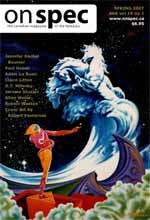
Hearing me read my story in On Spec [online]

os_spr07Hey, you can hear me reading from my science fiction story, “Why the Poets were Banned from the City” online at On Spec: Follow this link here.

It originally appeared in the Spring 2007 issue that you see on the left. What I loved about the cover art by Robert Pasternak is that it is a wave of white horses, exactly how Whitehorse was named (for the rapids and their uncanny resemblance to white horses). It was a nice piece of synchronicity for me as a writer.

The piece is only 5 minutes long, but you can read the rest in the Spring 2007 back issue.

Much gratitude to Diane Walton and Colin Lynch of On Spec for asking me to do it. And for a great friend who helped me record it. Thanks!

On Spec is dedicated to publishing Canadian Speculative Fiction and is always looking for more. Hop around on their website this holiday and see what they’ve got.

Yukon 2058, the radio series, starts Dec. 8

Well, it’s official. Yukon 2058, my newest radio series premieres Dec. 8th on CBC. They’ll play it in the mornings, in the afternoons and have it available on their website for 24hrs. If you miss it, you can go to their CBC North website.

What is it? It’s a story about a man who is working for CBC in 2058. By then, CBC is small. Only a few employees. Our hero, Michael, is wondering if he’s making a difference in the north. And he’s tempted by the offer of a job to go down south. But to get the job at CBC in Toronto–he’ll need three big stories. Can he get them? In a world where everyone can interview anyone at any time by patching into their earbud, news stories travel faster than they can get finished happening. Reporters tumble over each other to get scoops. But CBC North doesn’t work in scoops–they play by other rules.

Come to 2058. You’ll find trade wars over the Northwest Passage, mammoth hunting in Vuntut National Park, the creation of West Canada, a growing population, Holland America trains everywhere on magnetic rails, and kids you know all grown up and become important in the Yukon. Come find out what may happen to you in 50 years, what may happen in the Yukon. It’s not all bad in the future–it’s just different, and the future starts Dec. 8th. Or at least my version. Hope you enjoy it!

Shine Anthology, and Dreaming of a Better World

In another post I talked about thinking positive about the future.  I linked to an anthology, SHINE, open to writers, that wants to make the world a better place in the future–a vision of how we WILL get it right eventually.  How  decisions we make technologically, politically, personally will solve–or begin to solve–global crises we face right now.  For years, scientists have been cast as Dr. Frankensteins in movies–playing God with forces we don’t understand–and rarely are they those who solve the problem.  If they do arch heroically at the end, it’s often to put back what went wrong, the Hamlets of a technological Denmark gone rotten.

When doing the radio series, Yukon 2058, I was sitting with Lil from Lil’s Diner and we were talking about Angel’s Nest, the future home for the homeless teens in our area, a cause Lil’s Diner has taken a personal investment in, literally.  For Halloween, the employees at the diner donated all wages made that day to Angel’s Nest and they kept the diner open most of the night to host a fund drive party.  We sat and talked about what teens need in this town, and I realized that science fiction could be used to describe what we want in the world–not just to warn people, not just a good story, but planting seeds in the minds of those who might be able to help us make those changes.  SF can be used to help people envision.

Who wants to walk into a post-apocalyptic future?  Why not place things in the future we need to see–and once seen, that we can create for real.  So, via radio, I created a youth center, the kind I would love to see the town create in the old Canadian Tire building.  And I put it on the air, and inside my vision for the future.

So, if you have ideas about what kinds of positive strides the world could make in the future–ways of solving crises in the world– allow me to suggest some positive outlets for you, outlets where your vision could inspire the vision of others who can make it happen:

1)  CBC North is going to want to interview you for your vision of the Yukon–a place that will be much changed in the next 50 years.  Imagine the future, and then talk about it on the radio.

2)  SHINE anthology, edited by Jetse de Vries, is open to writers this next spring who want to write optimistic science fiction.  This doesn’t mean that utopia comes without dramatic tension or story, only that it includes a positive vision of the world of the future.  If you want to write up your idea as story, read these guidelines.  This is going to be a great opportunity for writers and thinkers, since anthologies, collecting these positive views of science, will likely have a great distribution and put you in pages populated by well-known, world-class thinktankers/writers.  (If only there could be a weekend to gather engineers, scientists and science fiction writers to pool ideas…)

3) the 24hr Playwriting competition, held here in Whitehorse by Nakai Theatre in April, might be another place to launch a positive future in the Yukon, as local plays are funded, produced and showcased through the Homegrown Theatre Festival in the Yukon, in order to get them ready for possible Canadian distribution.

4) Write directly to the Governmental groups that might help implement your idea: help them see what impact your idea–all consequences considered–might have on the Yukon.  Write for funding to research it through the Northern Research Institute

5)  Don’t forget other Canadian science fiction magazines: On Spec needs you!  And loves you.  And wants to promote Canadian voices.

I think if a people down south, my fellow Americans, can be inspired to change by electing Barack Obama as President, then anything is possible.  I think we are being called on to help make that change ourselves, first by envisioning and then by doing.  I think science fiction writers inspire change.

Else why would the first American space shuttle be named Enterprise

Egalité at the World Fantasy Convention, a report

img_7941I have returned from Calgary where I attended the World Fantasy Convention, a yearly gathering of editors, publishers, writers of Fantasy literature. There were three of us from Whitehorse–Marcelle Dubé, Claire Eamer and me–forming a Contingency.

The convention for me was divided into four parts: the seminars, the networking, the readings and the dealer’s room.

The Seminars: The theme was Mystery in Fantasy Literature, with some seminars on how to put mystery elements into your fantasy fiction, or the best Fantasy novels of the last 20 years, etc. You can go and hear editors and publishers and writers speak about their writing strategies and their interests. Important was putting names and faces together in the editing and publishing world and getting an idea of what each editor might enjoy seeing in fantasy fiction, and how they might be to work with as editors and publishers. I also learned a lot about which authors were considered the best in the field, and how to catch up on authors I’d missed out on.

Networking: This is actually a lot of fun. Catching people for dinner, or talking with them in the convention suites after programming/seminars were over. You meet a lot of people you could never meet otherwise and this is for them–and you–to put names and faces together. I was able to hand out a few cards (ones that I’d made on my computer an hour before I left on the Air North plane), and meet a lot of people one on one who are exciting, interesting folks–fellow writers, and the aforementioned editors and publishers. You’d be surprised to learn, I’m sure, that I’m not a good schmoozer. I couldn’t last the many hours it requires. However, as the picture implies, we all got nametags and were encouraged to sit in the autograph room as equals–this is actually a very nice egalitarian maneuver. We’ve been hearing and talking to editors and publishers as they are movers, shakers, and opinion-makers–and then for two hours, we are all on the same level together. Nope, no one came up to have me sign anything. But it was nice–to feel like a writer, someone who COULD give autographs at any moment.

The readings: though I didn’t go to very many, I did enjoy the ones I went to. Mostly they were friends that I knew. Here you can hear about books you haven’t bought yet.

The dealer’s room: where books are sold. Ah, the joy of the dealer’s room. Lots of books. And I got to do an interview with Edge Books Website for a podcast. I even signed some books for them: Tesseracts Nine and Eleven. Edge Books and Hades Publications are fantastic people.

I’d like to do it again. But one of the biggest lessons I learned there was that you could be a well-known name despite publishing very much. If you send stuff out to be published, and are rejected, your name will still be more recognizable than if you had never submitted at all.

So, courage–even without publication–is rewarded with recognition. And recognition in a small cadre of people is worth its weight in gold.

(picture: l-r, Catherine Cheek, Derek Kunsken, me, Peter Atwood—Catherine and Peter were fellow Clarionites–and thanks to Liza Trombi of LOCUS for the pic!  Thanks, Liza!)

Living Rhizomatically

I was weeding a garden I share with friends, and was struck by how efficiently and effectively weeds live. I was in the carrots, a flimsy mass of ferny tops, trying to find the source of a weed tendril that I had in my fingers. I’d pulled some before–and they snapped off easily–but I’d never pulled up the root. I’d just yanked of an arm or link to the weed chain. It seemed that this particular weed gripped in several places, poking a very small root from mulitple tendrils. Like Bridge columns. It made pulling the tendrils ineffective–as I only removed a bridge link. Inevitably the weed grew back because the source was still there. Like a Hydra.

Carrots are pretty well single rooted, as far as I can tell, designed maybe to fatten the main root so they can be plucked—sorry, that’s a bit human-centered even for me. But my point is that the carrot can be pulled up easily–thank god it isn’t built like a weed where it would have to be harvested with a backhoe. Or you might never even find the tasty root.

Anyway, there’s a metaphor coming: I was talking with a friend about careers, how life seemed to alter our plans and that the best people seemed to be able to change careers easily. The most interesting people we knew were people with their root systems in multiple places–who developed multiple skills–so that when a main source of income was pulled up, they could still survive on another skill set.

Here in the Yukon, the system seems to favor living rhizomatically. There are world renowned lepidopterists living as business administrators, guitarists who are cooks, romance writers who are policy analysts. I’ve watched folks who have prepared for one career be able to jump into something else entirely when the soil was rich for the secondary career and not the first: immigration officers becoming film producers/directors.

Seems to me that focus can be great–can hone a person. Tiger Woods is not living rhizomatically. But then, not all of us, perhaps, have the time/skill/etc. to be Woods. More often than not, those who have focussed on one career have been flustered when that career isn’t producing, when those doors shut, or when forces gather to stop that career–bad bosses, coworkers, rivals, spouses. They may have no other skill sets to “fall back on”–so they doggedly pursue their career goal beyond logic, or they settle for something they have no skill at all, nor passion. They followed the advice of Jack Palance in “City Slickers”–find one thing you like to do and pursue it. And that’s a good philosophy, but I’m seeing that a great back up is having several passions, several skill sets. Like that weed, you are hard to pull up, hard to damage because there is no central root; any runner can sustain the weed. Therefore, any of a multiple skill set might sustain a person.

Learn French, puppetry, work with kids, volunteer in a nursing home, paint, read books on Tibet, listen to avant garde ethereal music—I don’t know, but finding multiple passions, unlike the one finger that sustained Palance, might sustain you.