Bear Witness to Your Body: a 31-day Writing and Art-Making Journey to Body Positivity

We are given myths and distortions about our bodies, our sexuality, our desires from many places: our society, our religion, our parents, our significant relationships, our experiences.  These are messages and myths we then “embody” and take with us. Our bodies “don’t belong, don’t fit in, take up too much space.” Chairs are not big enough, clothes are not affordably made to fit us, airplane seats, theatre seats cannot contain us. We are continuously asked to control and contort our bodies. Or perhaps our face is not what others want to see, or our hairstyle, our fashion—not acceptable. We are too short, too thin, to ungainly, too much– and while we try to fit in, we “fail” to hide ourselves enough. What is an acceptable body in public?  In private? What’s acceptable sexual behavior?  How has an unspoken need for acceptance shaped our ideas of our body? How do we begin to own, respect, and love our bodies again?

We are already given plenty of ways to think about our body–but we need to see those body image messages, confront them, and replace them with true, accurate concepts of body image through our own study.

***

Often, it takes a lot of work to reshape, re-craft our physical expectations and embrace our unique bodies, genders, sexual expressions. We must change our eyes, our perceptions, our beliefs. One way to re-vision our bodies again is through art-making– painting, sculpting, music, dance, writing, photography, etc. I wrote about this in my essay, “A Fat Lot of Good That Did: How an Art Studio Transformed My Eyes,” originally published in Fat & Queer: an anthology of Queer and Trans Bodies and Lives (eds. Morales, Grimm, Ferentini. Jessica Kingsley Publishers, 2021). I learned a lot about my body and myself through art-making, through photography, and later through daily watercolor art. That daily practice also improved my art making skills, and my body acceptance, tremendously.

This class will take inspiration from Classical Art to contemporary art, from Bouguereau to Boudoir.  Daily, you will be invited to create art with a pen, a brush, a camera, with writing, or song, or dance, to understand the body you have better, to understand others better, and possibly to understand ourselves better. 

Based on the concept of thirty day art challenges to improve skills, you will receive email prompts, from October 1-31, with links that lead to our Discord channel—with a piece of classic or contemporary art and a short reading and prompt, asking you to think about the art, or the story surrounding the art, and inviting you to choose a way to creatively express your response to the prompt—through making art, photography, or writing (or dance, song, etc.).  When you are finished with this month, you will have 31 expressions that you created that are in direct response to your personal exploration of bodies.  You do not have to use yourself as a model.  You do not have to share anything private that you are not ready to share. 

Continue reading
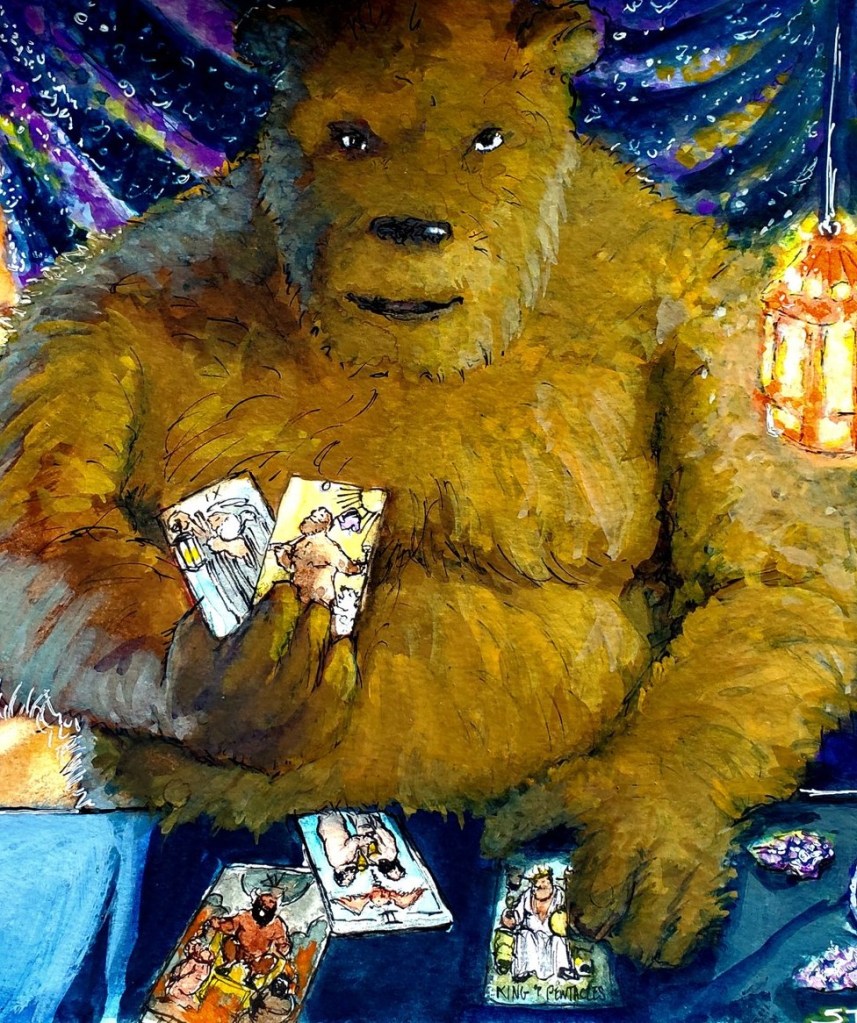
7 Ways Tarot Can Inspire and Revive Your Writing

Grab your favorite deck and join us in two weeks! Or, if you don’t own a deck, bring your questions, story blockages, character conundrums and we will do the spreads for you!

Tarot Decks have been used to guide seekers for hundreds of years. Why couldn’t they be used to guide writers? We write about lives, about choices, about being human. With 78 cards, there is, at the very least, a lovely randomization to the process, but at its most potent, tarot cards have wisdom in them to guide you along your writerly way too.

I’d like to show you ways you can get insight on stories, and how you can get insight into YOU as a writer.

Maybe you are stuck on a chapter and you can’t get through: Why am I stuck in Chapter 7? What is happening in my head that makes me stop here and not move on?

Maybe you are having trouble with creating complexity in your characters— there are spreads that will give you some beautiful complexity to characters you don’t want to have too flat or simple.

Continue reading

Jesus in Science Fiction

I started teaching a course that looks at the character of Jesus when he shows up in SJombsfcience Fiction.  Currently the course is only 6 weeks long and only taught at the UDLLI, the University of Dayton’s Lifelong Learning Centre for Senior Adults.  We are using the following short stories and novels in the course, and I will be placing the blogposts of the course over on Wrestling With Gods website because it’s become a great place to talk about religion and faith as it appears in science fiction and fantasy.

What happens to Biblical Jesus when the narrative is continued into the future?  Is it subverted?  Are writers appropriating Christianity to rewrite it and rob the narrative of its miracle, or do they instead seek to expand the notion of Jesus to its infinite possibility?  How does Jesus fare in science fiction and what can we learn about faith when science fiction writers write about him?  We look first at the life of Jesus in the Gospels to ground us in the ur-text, try to gather the importance of him as a character and iconic figure in history, culture and religion.  How is Jesus relevant in the future?  Then we look at how authors extrapolate the future of faith, or seek to tweak history, just a bit, to get the savior they want, and perhaps we can better see what kind of culture we are in the face of our chosen Saviour.

Come follow along over on the Wrestling with Gods site.  Already the class has been exciting as these students know a lot about religion, specifically Judaism and Christianity (UD is a Catholic institution) and many retired professors attend these classes for fun (they also can be quite mischievous).

The works we’re going to explore, and I will detail in blogposts are these:

To get us oriented on Jesus the character in the Bible:

Jesus: the Face of God    Jay Parini

“The Man”     Ray Bradbury from The Illustrated Man

“Mecha-Jesus”     Derwin Mak from Wrestling With Gods

“So Loved”           Matt Hughes from Wrestling With Gods

“The Rescuer”      Arthur Porges

“The Traveler”          Richard Matheson

“The Real Thing”       Carolyn Ives Gilman

 “Let’s Go to Golgotha!”      Garry Kilworth

“The Gospel According to Gamaliel Crucis”   Michael Bishop (a longer work I may not use)

“Jesus Christ in Texas” W.E.B Dubois  (which isn’t exactly Science Fiction, but may prove useful in this study)

Then two novels:

Behold the Man, Michael Moorcock, 

Jesus on Mars   Philip Jose Farmer

 If we have time, “Farewell to the Master,” Harry Bates—Which becomes The Day the Earth Stood Still.  This would be delightful to show to students in a longer class.  To read the short story and then watch both films.  

I can also see adding these works to the syllabus for a longer class:

The Man Who Died         DH Lawrence

Jesus Christ, Animator   Ken MacLeod

All Star Superman       Grant Morrison

Jesus Christs                AJ Langguth

Only Begotten Daughter     James Morrow

If you have suggestions on stories, poems, or novels to add to this list, let me know. Specifically we are NOT covering characters who merely have a “savior-esque” quality to them, or those that have a martyr motif.  I want to look at places where characters are for all intents and purposes supposed to BE Jesus.


Writing Classes at Yukon College–Get Your Novels Out

Hey, Novelists!

For some of you Nanowrimo was a great experience–but what next??  Or some of you have an old novel kicking around in your closet.  Dust it off, get it ready.

I’m teaching two courses at Yukon College in the Winter, both of them are Fiction Writing Workshops.  You can read more about them if you click on Writing Classes up on the Menu Bar.

In brief:  Monday night is for novels that are more realistic–they don’t have magic, or time travel, or science fiction, or monsters in them.  They are set in this world, working with people as we know them.  They can be set in the past.

If you have at least 3/4 of a novel manuscript through a first draft, you are welcome to join the course.  If you don’t have that much done, that’s okay to join too, as long as you know that a majority of people will be working on novels, and that class time discussion will be focussed on longer story arcs.  People with novels are required to workshop 3 chapters over the course of the semester, comment on other people’s chapters, and with a group, present one novel to the class, one of the ones that we will be reading (we have three on the schedule), and  turning in to the class a synopsis of your novel.

The practical side is that in April you will need one synopsis and the first three chapters of your novel ready to show editors who are coming to the Yukon!!  Don’t pass up this opportunity. BIG name people are coming to look for manuscripts and help people move towards publication.  They will take our class to the next level, much farther than most could take you.  They will also take you to that next level if you AREN’T a part of the class–the Editor’s Weekend is a Yukon Wide event… (oh, it won’t be named Editor’s Weekend…I just made that up….).

Tuesday nights are for those novelists with a speculative element in their novel.  There are different considerations when you are working with speculative elements and you will want people who are familiar with those elements.  The rest of the class will be VERY similar to the Monday night group–all that’s different is that we will be working with texts that are outside of realism, even just slightly.

The courses are 16 weeks long, are the cheapest prices in any college in North America (dare anyone to beat $150 per course), and I think you will get more bang for your buck.  Workshops are good to use to get a good opinion of what to look at more closely.  Only come if you are ready to receive the opinions of 15 other readers, and to consider their thoughts on your work.

Come and Join us for a good workshop experience!  CRWR 241: Fiction Writing Workshop (Mondays–realism; Tuesdays–Speculative) Starts Jan 5 at Yukon College!