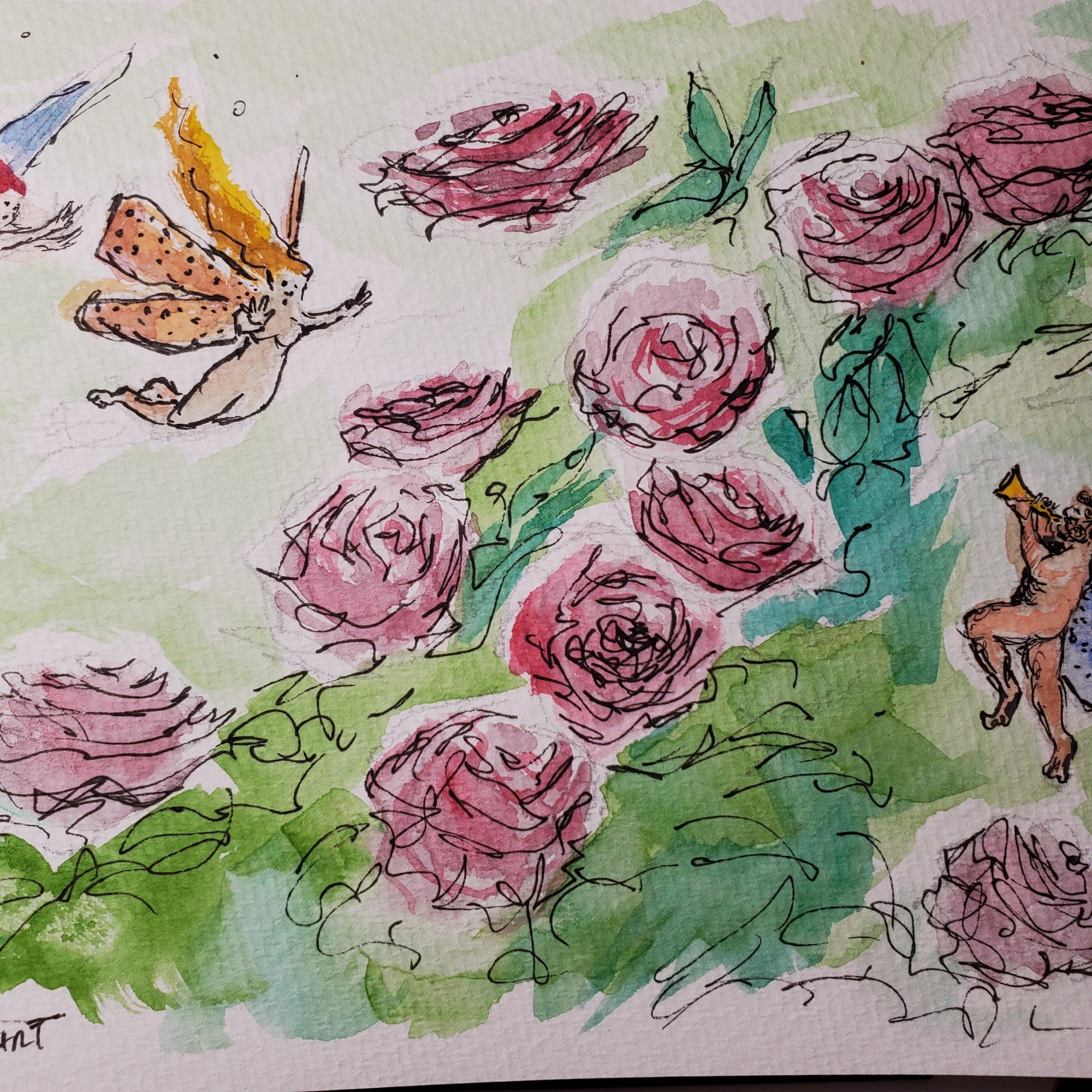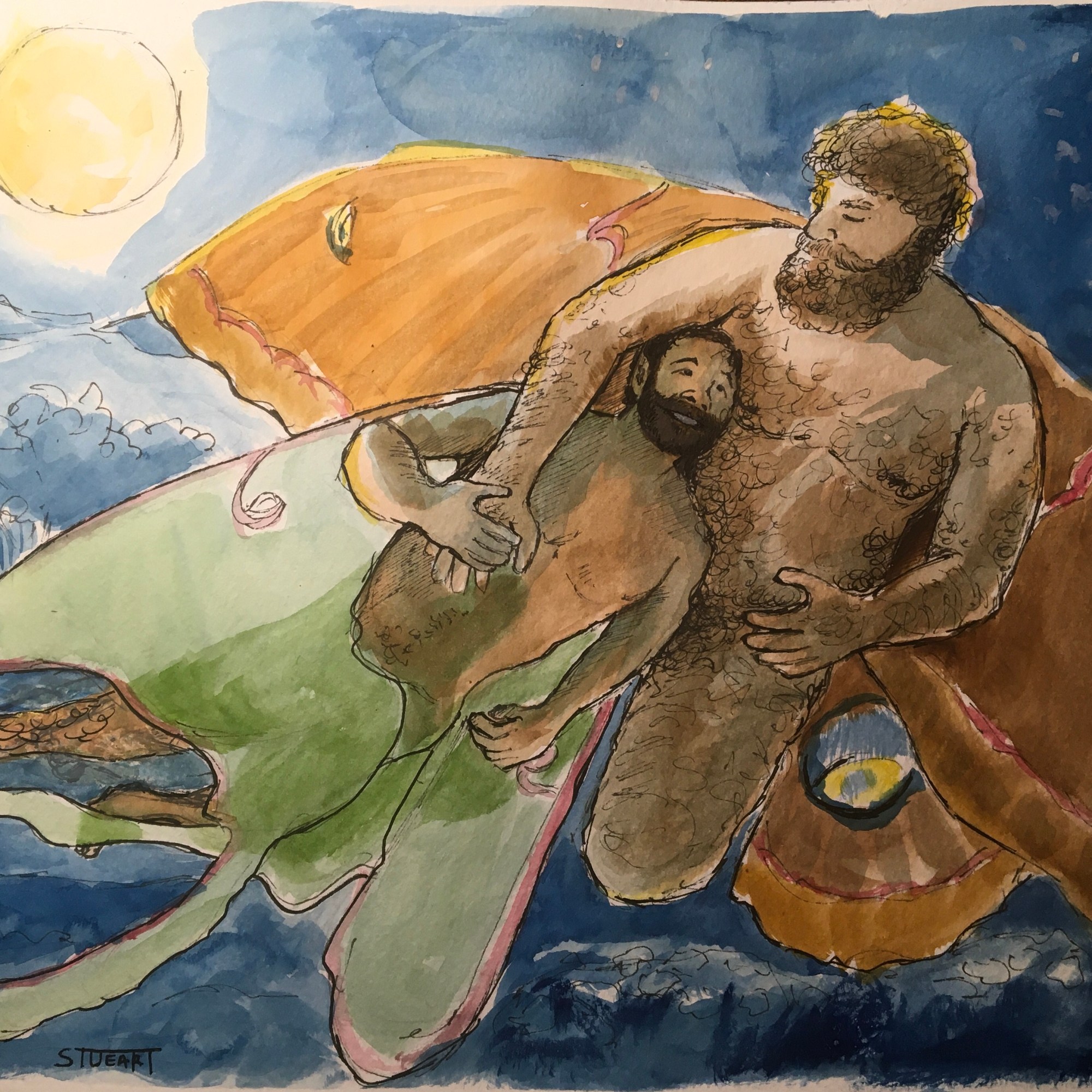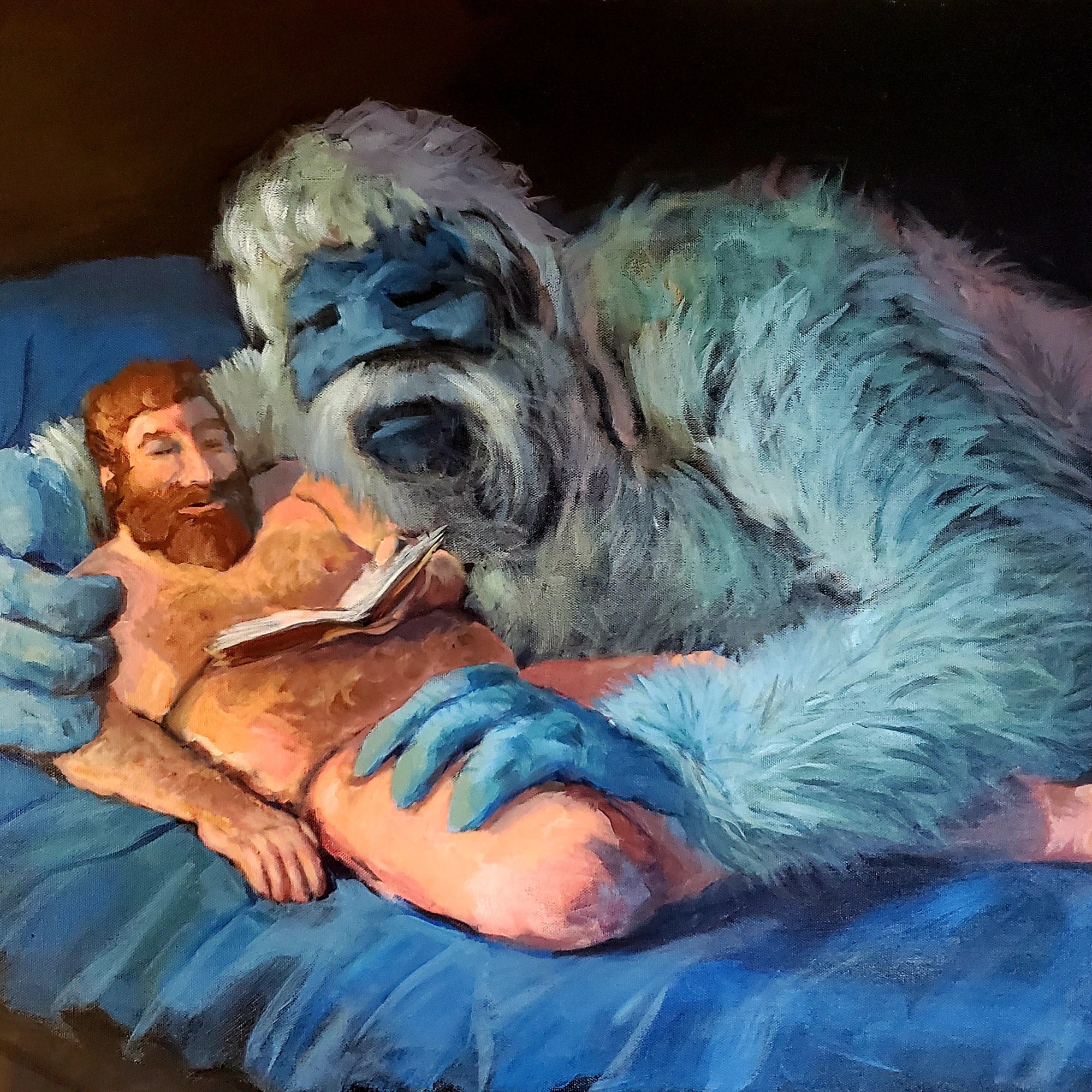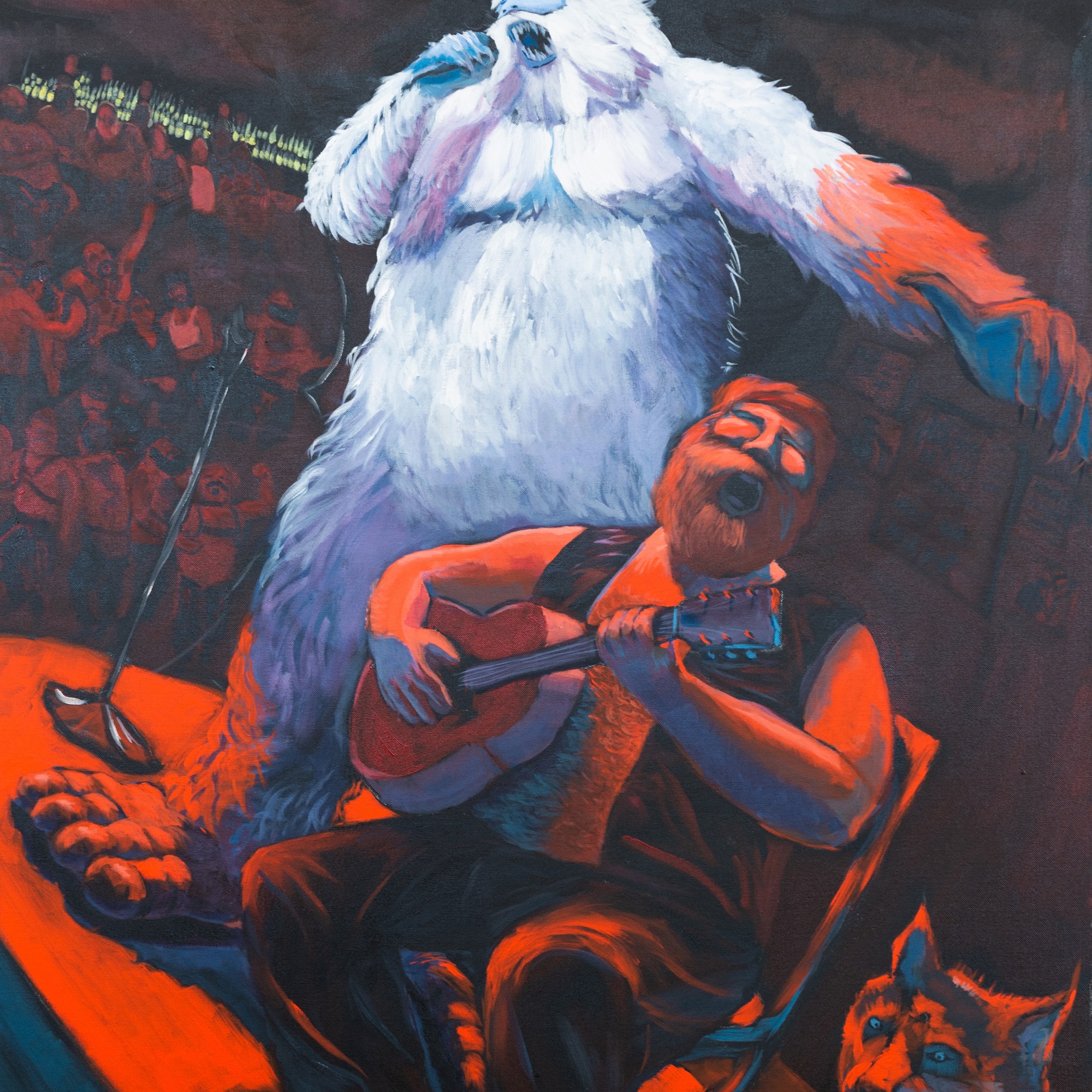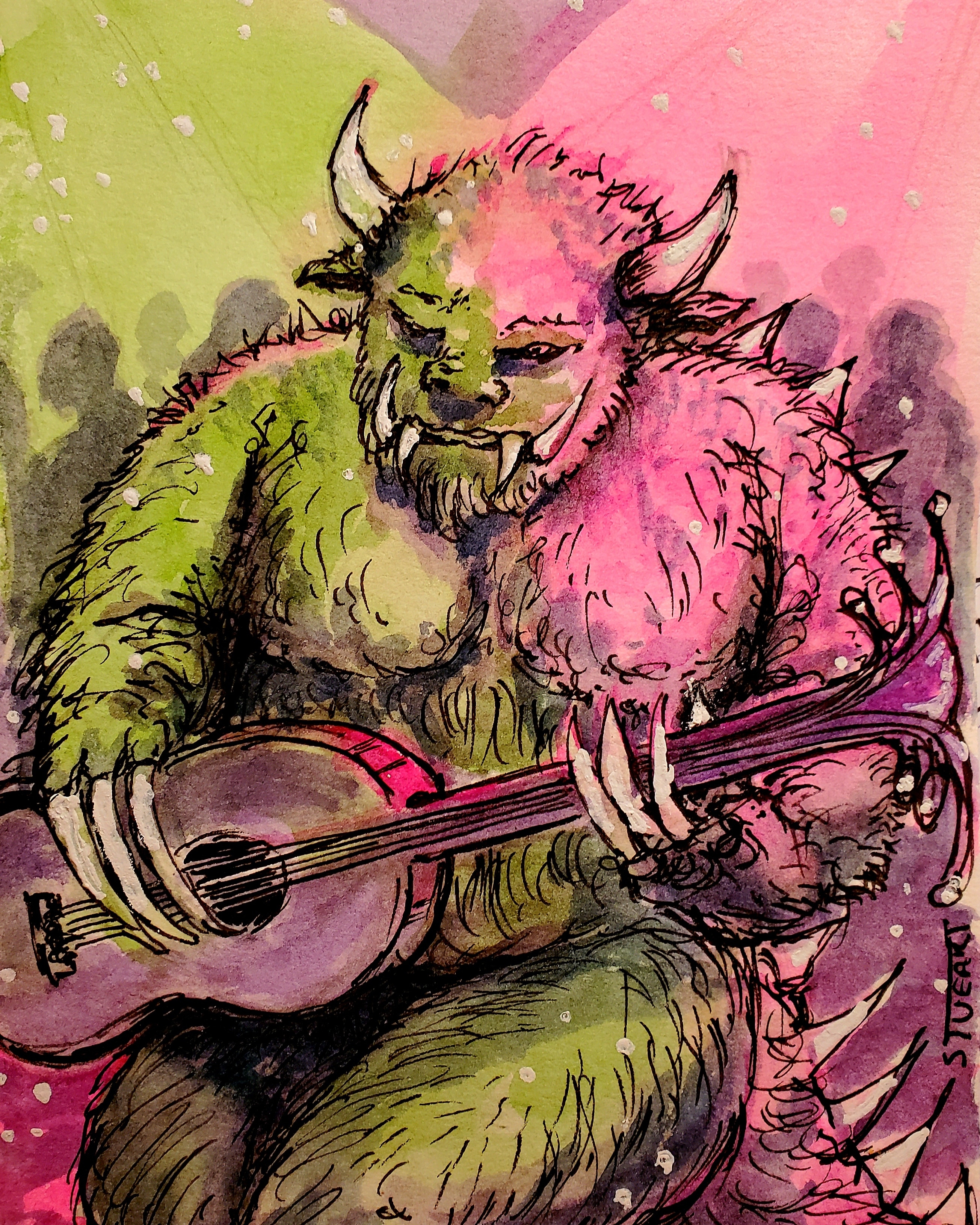
October 14: Yukon Cornelius jams with the Hodag

Thousands gather for the Hodag Country Festival, fans, vendors, bands. It’s noisy, lively, fun, a rich landscape of blending sounds. I’m just here to catch up with Berit. Most cryptids I visit usually find their encounters with people to be negative, rife with misunderstanding and prejudice, so they stay hidden as a protection against being killed.  I support those decisions because people are unpredictable. Safety and survival first. But then there’s Berit.  Resurrected from the ashes of hundreds of oxen, brought back as the avenging spirit of both the abused oxen and decimated forests, Berit is out to bring justice—and he aims to do that through music.  He is one of the most recognizable creatures I know. He’s the Hodag. The festival is named for him, the school mascot, with statues of him in front of the Chamber of Commerce.  It’s a very interesting way of being Cryptid.

He closes his set with “The Roots Remember (You Lousy SOBs)” and his voice is rough, and hoary. Lots of cheering. He comes over to my table, we hug, and I’m careful of his back spines. “How’s Bumble?” he asks, and is immediately swarmed by children with his CDs, asking for autographs. He gladly signs them as they touch his horns and giggle. I tell him Bumble’s good, would have loved to see him but he’s doing a mural. “Oh, I love his murals!” he says. Bumble and I did a circuit of concerts with Berit around the Great Lakes back in the day when we were doing gigs for food and travel money. Bumble can’t sing words, but he’s got a pitch perfect growl. I ask him how he’s doing, and he always interprets that as How is the Mission Going. “I think we’re getting through. We’ve passed some good forestry laws because we spoke at the legislative assembly.” I told him that was great, and he must be proud. He looked away, “It’s not enough. I get hopeful though.” He smiles and his tusks cross. “I’m up there calling them all out on their environmental inaction, and they cheer louder the angrier I get. They like it when the Hodag “gives ‘em what for” ––they always assume I’m talking to someone else.” He leans back on his stool, his tail giving him balance. “Am I just rearranging deck chairs on the Titanic?” I told him that these forests and animals will benefit. He asks, “How’s your work with all the rest of us Monsters? Are you working the government/law side—.” I shook my head, “More of the personal care side. I think the conversation about full acceptance and change is too hard right now.” He advises me to form a foundation or groups, “Friends of the Monsters!” he says. Get funding. “You can’t do this alone, Yuke.” I tell him I’ve formed some small groups who are helping out their local cryptids, but community organizing for something people are scared of and can’t see—that’s not easy. “Tell them all to come out! If they all came out, people would see that we’re everywhere—forests and swamps and downtown and suburbs—and hey, we haven’t hurt nobody.” He slaps the table. “We’d have numbers.” We have this conversation every time I come, and it frustrates me. He’s been out for more than a hundred years. They’ve been hidden forever. It’s taken him 50 years to gain this kind of popularity—a mass outing would frighten both sides. They are inching out into the light, but there’s a difference between the fighters and the wounded. They have no protections if they reveal themselves. Some find it hard enough just to survive. This city, his fame—I can’t tell him that maybe they let him perform because they don’t want him to choose another more violent way to do what he came to do. They let him have a stage, but they know they don’t have to listen. He says, “Ah, I shouldn’t tell you what to do. It’s not like I took up the ‘Love the Monsters’ cause myself.” I say, “It’s okay. You were commissioned with another job already.” He laughs in Avenging Spirit of Justice.

We catch up a bit more before someone tells him that he’s got five minutes. He looks at me. “Wanna play a song with me?” I wave him off, but I can tell he really wants to. It’s been years since I touched a guitar. He says, “Why don’t we play “The Moon in the Pines”—the love stuff?  They’re tired of hearing the angry stuff. They aren’t listening.” He’s already borrowed someone’s guitar for me, and there I go up on stage to jam. The lights are blue and white now, falling on us like the moon and we are the pines. Those intense orange eyes connect with mine, he smiles and looks genuinely happy. He sings right to me as I take up the harmony, and then we start the counterpoint melodies on the guitars, competing, blending, working together somehow with different notes, different paths. We each cover half the notes. It still creates the melody. I know the Hodag’s visibility helps people get ready for all the hidden ones, and he knows he can’t stop his mission to care for everyone individually. We both have good work to do, and a lot of it. We’re already working together. The chorus finds us both on the same notes, and we ease into it, the crowd joining us. “And they sway/ and the light with shadows play/ and the night becomes another way/ we speak about love.”

____________
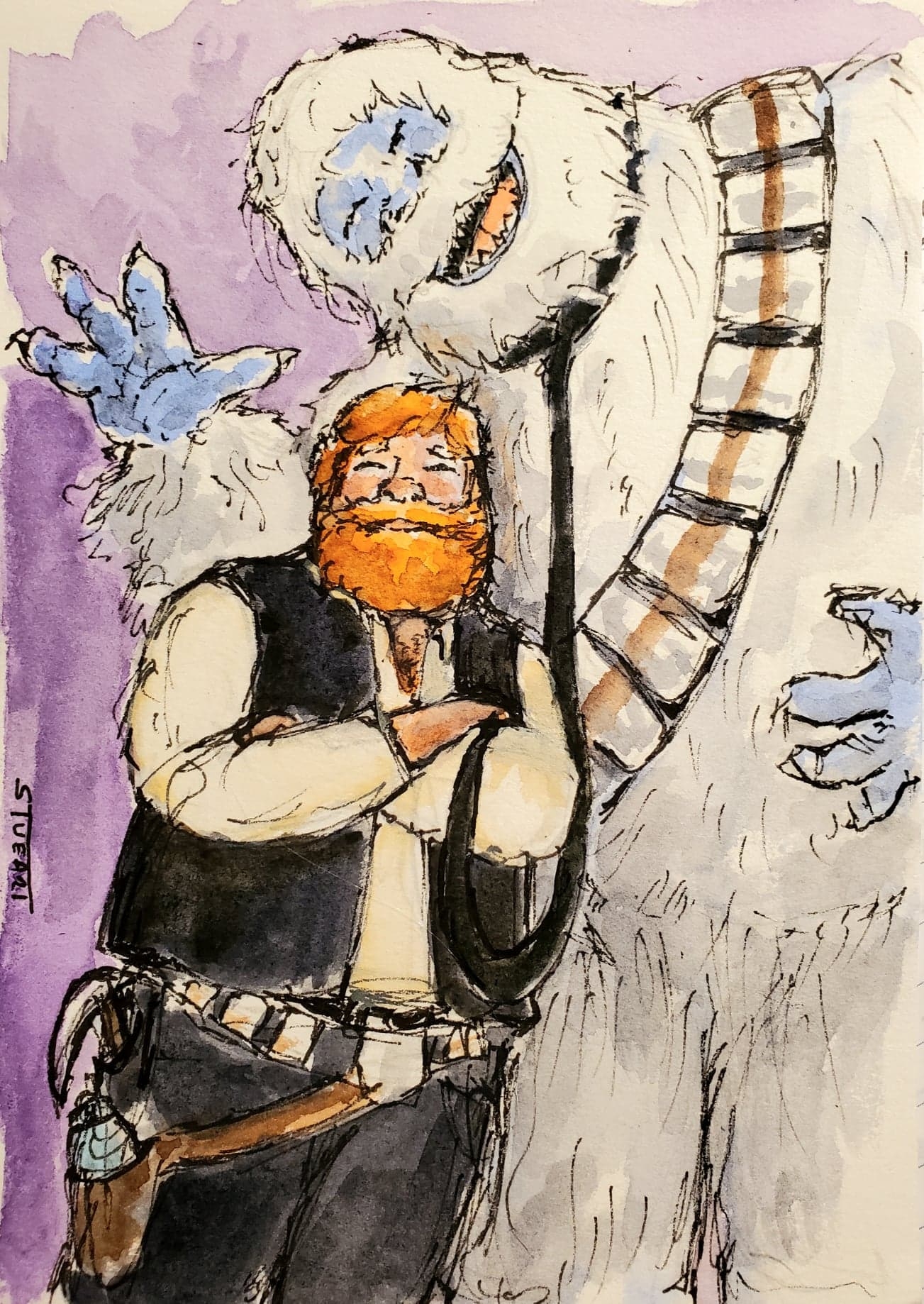
October 13:  Yukon Cornelius is weird with the Abominable Snowmonster

Yukon Cornelius and Bumble dressed as Han Solo and Chewbacca from Star Wars for a cosplay.

I help Bumble tonight with his costume—just one big sash/belt of ammo, I think, though I’ve never considered what Chewy wears, or ever seen him access this belt/sash thing.  All I know is that this one carries different flavors of Pop-Tarts.  His costume is simple—Chewy doesn’t wear much.  We throw in a leash to make it fun.  He helps me find my white shirt—it isn’t under the bed, in the closet, on the floor, in the laundry, and for a guy who doesn’t wear clothes, he is very observant about where I put mine.  He does a little roar that means, Come here.  He found it hung inside a suit jacket in the closet, hiding like a matched pair you assume must go together.

You have your casual acquaintances, friends, good friends, and then best friends, and then REALLY good friends (who might be lovers). Very few of them are the people who are “your weird.” You have to find them. They are the people you can truly be yourself around—manic craziness, stupid ideas, riffing off each other, laughing all night, even with your flaws they enjoy you. They will do any weird idea you suggest! And they are (this is the important part) Enthusiastic!! about your idea, and they get into it as much as you do. This is Bumble. He is my Weird. I met him in the Arctic when I was a prospector and I did not “get him,” but that didn’t deter him–he pursued me because he thought I was cute and funny. And one thing led to another, throw in a deer and some child dentist, we fell over a cliff, he BOUNCED, and then we started to “get” each other. We didn’t speak each other’s language, but we spoke each others’ Weird. Weird is a language that can bridge cultures. I learned to interpret his moans and roars and growls, and the gestural language he uses, and that wasn’t easy. But we both spoke the same dialect of Weird, and that made me love him.

And now, look at us: Yukon Solo and ChewBumble going to a Halloween Party. Look at the way he smiles when he puts on a costume. He just lights up! Stories are fun to share, but stories are even more fun to act out—to enter in a more physical way. We cosplay characters a lot—because he loves it, but also because inside a story is where I get to be with him in a vulnerable and open way, just letting the story take us over.  I think a story wants to take us over.  And when we give in to it, we discover things about ourselves. When we are doing that with a partner—by reading it to each other, by cosplaying, by role-playing, we discover each other in different ways.  He likes to go to Comic cons, Dragon Con, Gen Con—though, as always, we can’t stay long because I’m a freakin’ beacon for every supernatural thing out there, and crowds are not usually good for that (see the poltergeist that found us at GenCon and the anxiety-ridden griffin at Dragon Con). We have to be careful, but I found it worth the risk to see him “play” Fafhrd, or Sully, or a Balrog, or Obelix and be with him in that story. We LARP too sometimes.  If it’s a D&D campaign, everyone assumes he’ll be the barbarian, but he prefers to be the cleric and heal everyone.  We share so much Weird.  Bumble gets me.  So, I’m with him as often as I can be. He has his own life as a highly sought-after mural artist who works exclusively at night (that Arctic night vision he has!), and so we have to coordinate times we can be together.

Tonight, he buttons up my shirt tenderly, leans back to check me out, gives a thumbs up, insists on combing my hair when it won’t cooperate, licks it down. He is weird, but he’s my weird. I encourage you to go find your Weird. They are out there, waiting for you, searching for you, hoping for you. I hope Weird finds you, chases you, falls with you off a cliff and bounces back up with you. And I hope you hold onto Weird with everything you have.

____________

* Big Guy/Little Guy pairs we’ve been at Cons and parties and costume nights at the club. You may have seen us as:

Asterix and Obelix

Robin Hood and Little John

Inigo Montoya and Fezzik

Captain Kirk and the Mugato

Aang and Appa (from Avatar: The Last Airbender)

Yogi Bear and Boo-Boo

Gilgamesh and Enkidu

Gandalf and the Balrog

Beauty and the Beast

Fafhrd and the Grey Mouser

Laurel and Hardy

Mike and Sully (from Monsters, Inc.)

Thor and Hulk (from Thor: Ragnarok)

but, you know, Han Solo and Chewbacca is our favorite.

October 12:  Yukon Cornelius brings a Jack-O-Lantern to Dinner

*with recipe!

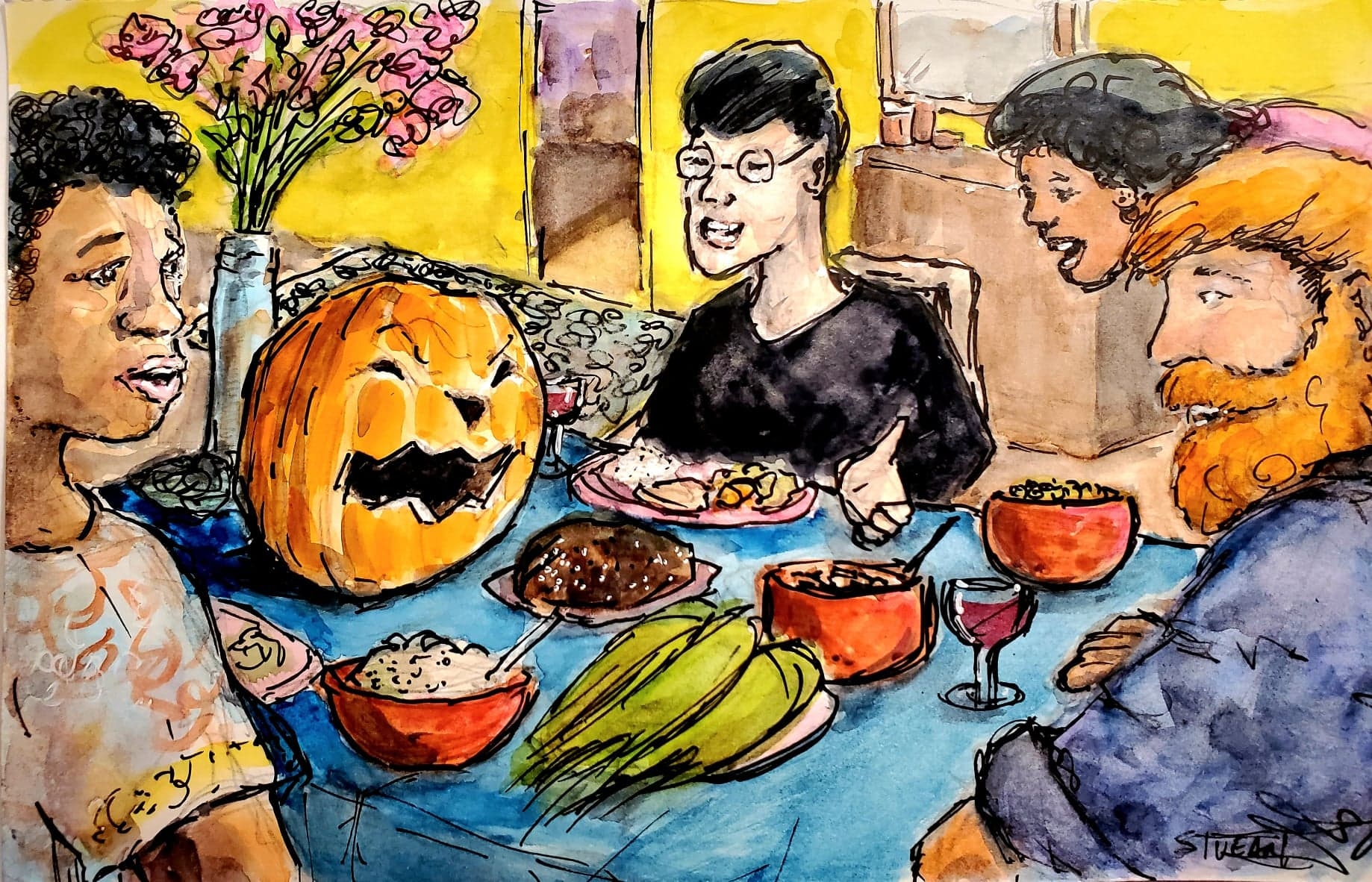
If Ulrich hadn’t thrown his head at me, I would have made him my Plus One tonight at dinner.  Now, it’ll have to be Plus Half.  When I got to Kate and Ashantu’s house, I set the Jack-o-Lantern on the table. “Everyone, meet Ulrich.” You can imagine their response as it just sat there. Ravenwood, a thin man in a black sweater, chuckled. “You can just say your Plus One bailed. It’s okay. No shame.” Ulrich wouldn’t say a thing. “He’s a little unhappy. This isn’t the way we had planned to come tonight.”  He had been loud and argumentative with me in the truck, threatened my life when his body showed up to claim him. For the last several times I’ve tried to visit him, he’d throw his head at me.  So, this time I picked it up. “I don’t want to go to a dinner!” He wasn’t really a people person.  He’d been bullied, hunted, shunned, wronged, even in death.  I also knew his body would eventually catch up to us.  An intervention was risky, but I thought a little warmth from people, a little conversation, some nice food smells would help him. Now he was an inanimate, stubborn, carved pumpkin.

They welcomed that pumpkin, even if he was going through a difficult period and didn’t want to talk. They fixed him a plate and put a very fat straw in the pureed carrot ginger soup and a straw in his wine. They included him in conversation, even if he didn’t answer. We all sat and talked about our lives with a Jack-O-Lantern and no one questioned my sanity. Ravenwood asked me, “So, how long have you two been friends?” Ulrich was silent. “It’s coming up on twenty years,” I said. They were surprised. “Ulrich saved my life.” I paused for a moment to see if he would tell the story. He didn’t.

So, I told them about how as a young man I was on shore between assignments—in my merchant marine years—and had met someone at a bar, as one does. But times being what they were, we were followed and harassed by a group of Angry Young Guys. “Ulrich showed up and did what he does best.” I leaned back in my chair to dramatically replay the scene, “He comes riding up on a horse, his head all aflame, scares them, and then he takes that flaming head and throws it at them! It streaks like a comet and hits one of them right in the chest. Boom! He lit up, tore off his shirt and ran screaming! Then Ulrich’s body, still on the horse, pulls out his sabre and holds it high in the air as his horse rears back!” I caught him looking at me. Did he remember that?  “They ran off. I had to convince my guy to stay. He was plenty rattled too. But you know, I believe they would have hurt us that night. Maybe killed us. And I,” I raised my glass of wine. “I owe my life to his penchant for throwing his head at people.” Ulrich’s mouth moved and his eyes got softer, “I don’t like people.” Kate, Ashantu and Ravenwood all looked at him as his whole face became animate. “Normally,” he added. He smiled a jagged smile. “I throw my head at everyone. He’s not special.” I looked at him. Rave asked, “Why don’t you like people?” Ulrich said flatly, “They’re monsters.” He looked quickly at them, “Normally.” He said, “I just don’t like to be bothered.” His pumpkin mouth stretched a little to grab the straw to the soup, sucking it down. He smiled. “Normally.” It felt like he was warming up. “My body is coming and will cut off your head,” he said to me. “SLICE!” he shouted. They all looked at me. “Did you know that Ulrich was in the Revolutionary War? Part of a cavalry.” That began a whole conversation where Ulrich was the center of attention, talking about the war, about his life. I buttered another roll. I may lose my head, but I still thought the risk was worth it. He was enjoying himself. After an hour of lively discussion about cannonballs and mercenaries, Kate eventually got up and brought out a pear tart with blue cheese. It looked delicious. There was a knock at the door. Ashantu opened it and a headless man in a cape and boots, brandishing a sabre, walked through. “At last!” Ulrich said, swiveling his whole pumpkin around. “Come my Body, and take what is ours!” We all stood up, backed away from the table. “Yes!” Ulrich said, spinning his head to look at us. “SLICE!” The body stepped up to the table, his sabre raised, and sliced five pieces of tart. “But first, I want a taste of that pear tart.” He smiled at Kate. His body put down the sabre, picked up the head and placed it back on his shoulders.  Then Ulrich Van Hesse, the Headless Horseman, my original Plus One, sat down for dessert.

***********************

Blue Cheese Pear Tart

a pie crust ((use your favorite pie crust recipe, or take 1 stick butter worked into (some) flour (Joey guesstimates it each time) then brought together with water))

3 pears, peeled and cored

some nice strong blue cheese

3 tablespoons of honey

Preheat oven to 450F.  Line a tart pan with the pie crust.  Slice the blue cheese medium thin (or crumble it) and line the bottom of the pie crust with it.  Slice the pears thin and arrange the slices in a circular fan.  Heat the honey and drizzle all over the pears.

Bake for 45 minutes until the crust is nicely browned and the pears are starting to color. The blue cheese should be bubbling in between the pear slices. Cool until it doesn’t burn your tongue.

*************************

October 11:  Yukon Cornelius tries to avoid the Black Dog of Death

Hiking the mountain trail on a summer night was beautiful, and still very warm. I sweated through my clothes. The moon lit up the sparse clouds. Few people hike at night.  But since I often get visited by strange creatures wherever I am, I try to stay away from crowds. This turned out to be a good idea. A black dog with big glowing red eyes now stood on the path ahead.  That was not a camper’s dog.  I needed to figure out which kind of ‘black dog’ this was before I just walked into it blindly. Folklore was full of reports of black dogs as apparitions of the dead, of the Devil, of doom, and they were often malevolent to travelers.  But those accounts were written in a superstitious age when death and disease and illness were attributed to Sin and other moral or religious laws.  So we gave Death a dog. A dog that warned us that Death was coming.

Perhaps this one wanted to talk.  Some might be friendly guardians.  Which was it?  Was it evil or protective? Was it the You’re Doomed kind or the You’re Safe Now kind?  Did it matter? Yes, I wanted to be aware of what I was walking into. I had a choice to keep going—but now it would be there.  Would it hurt me? How would it affect my hike, my safety?  Do I run from it, or walk toward it?  I needed to know which black dog it was ahead of time, but I didn’t know enough to make a good choice. I also couldn’t make a life out of avoiding unknown creatures.  That’s kinda inevitable for me.  So I took what I knew, just started walking again on the trail, and as I got closer and closer, I tried talking to it (sometimes a bad idea with black dogs). It didn’t move.  I told it I was going to walk around it, and I did.  And it stayed where it was.  If it needed me, it could always follow me, but I needed to keep walking. It trailed me. I was going to have to deal with it when I camped. Closer to sunrise, I found a good spot, next to a clear creek with a pool. I was hot, sweaty, and exhausted, and that creek would feel great. I set up a tent and then went for a dip just as the sky lightened. And ten minutes into relaxing in the water, it showed up again, crossing through the trees behind me. I decided to let it do what it was going to do. I wasn’t exactly in a place to run or defend myself.  Some black dogs are unavoidable. I kept my hands on the bank of the little pool to indicate that I wasn’t going to hurt it. (FYI, I am not immune to attacks by supernatural creatures.) Behind my head, I heard it run towards me. Harder and harder. I ducked down as it leapt over my head and dove into the water in front of me, splashing my face with a wave. I didn’t move. I was in shock and very wet. Then it bobbed in front of me, with its red glowing eyes, and I saw a green tennis ball in its mouth, and it pushed the ball onto my hand. “So that’s your game, Portent of Doom,” I said. I took the ball and threw it down the creek. She fetched it and came back, smiling, nuzzling me. We did this about twenty thousand times. I laughed a lot.  Maybe Death’s Dog needed to play.  Maybe I did.  Sometimes, the things we’re nervous about up ahead turn out to be surprisingly nice—even good for us.

October 10:  Yukon Cornelius sits with a Banshee

For two weeks, her wail was impossible to miss. “She’ll be quiet soon. She’ll go on for another night or so, and then it’s all quiet,” the bartender told me. When I told him I intended to find her, he grabbed my arm. “You might die. You just have to let them cry their peace.”  

Some called her the Widow of the Hollow, said she’d lost seven children a hundred years ago. Others said she was from the Civil War, and the town had lost all of its young men. “Grief like that can turn you into a banshee,” someone said. “How much grief does it take?” I asked, knowing there was no way a person had turned into a banshee. That’s not the way you get them. “Losing your children—I imagine that could turn you into a banshee,” said a young woman. An older man raised his hand, “I’ve lost all three and I haven’t turned into one yet.” No one said anything. I said, “I’m so sorry. That must have been very hard.” He drank from his pint, not meeting anyone’s eyes, “Death happens. It’s not anything to wail for weeks about.  People have to move on.” Other faces nodded in agreement but didn’t speak. He said, “Some of us need sleep. Go find her and maybe she’ll shut up.”  Someone else said, “If she’s cried for hundreds of years, having a little talk with this guy isn’t going to stop her.” I drank down the rest of my beer, “I didn’t say I was going to stop her.”  I put my beer down, and some money on the counter. “I’m going to listen to her.  That’s what you do when someone is upset.” The bartender called out just before the door shut, “That’s what bars are for.” More laughter.

Moonlight turned the gravestones into the crooked teeth of a wide-open mouth. She sat heavy on a white marble bench in the graveyard.  When she howled, though, she rose like a veil in a strong wind, all twisting with pain. Her lament echoed off the stone mausoleums. I didn’t want to scare her. I asked if I could sit with her, and she didn’t stop her keening. But she looked at me and moved back a bit to give me room, I think. So I sat with her. Every new cry was fresh pain. It had no rhythm or music or predictability. She focused on me. I looked her in the eye for some of it, and then I looked down at my hands. Grief is hard to look at in the eye. Even if you are ready for it. I was not going to be afraid of it, but it can be heavy. She knew. I stayed silent for the first hour. She filled the trees with her sadness. I cried with her some—as she could pull the grief I needed to express out of me. I told her what I, a visitor, knew about the people who had died recently. I thanked her for grieving for each person. Her ability to cry for others, even strangers, was something few people did. Even in small towns, like this one, where they “know each other well”— I knew she could teach them a lot.

Then beneath the trees, we saw someone else approaching. It was the old man from the bar. He hesitated when we turned. “I can–,” he called out, “I can take over for a bit.” In a moment, standing next to me, he confided, “I rushed my wife when we lost our last one. I thought it was for the best that we both stop crying. I wanted for her, for us, to be happy again. She wasn’t ready.” He broke down and I held him while the banshee poured out his pain. He stayed with her after I left.

Later I heard the old man brought her to the bar in the middle of the night, where he sat with her, surrounded by others. Oh, good, I thought. That’s what bars are for.

Great Queer Fantasy and Science Fiction

I moderated a “Queering Fantasy” panel at the virtual 2020 World Fantasy convention that looked at the connection between adding queer characters and queering the fantasy tropes themselves.

How do you queer Fantasy and Fantasy tropes? Is it dropping in a queer character into an otherwise fantastical plot? Slipping in a positive queer romance? Or is it dismantling, changing, altering, and questioning the tropes that have been present in Fantasy for decades? Is it queering the way power is distributed in a society, or queering character goals and story endings? Does it touch how we build a Fantasy economy, a government, a landscape, a culture? We would say it includes all these things. Queer characters invite complete queer make-overs of Fantasy tropes. We’re here to discuss that– discussing the contributions of LGBTQIAA2S+ authors to the field; we want to give you plenty to look at and consider. Heck, we might, at the end, even compose multiple queer “I want” Disney songs for the Fantasy stories we want to create or see created–ya never know. Whether you’re an activist or an ally, we welcome you.

We had a great time–and if you went to WFC2020 and didn’t see it, it is recorded. We could have talked another hour on these themes. Part of our takeaway for guests to that panel was a list of great queer fantasy and science fiction. We placed it in the Session Pages section of WFC 2020’s online presence at Crowdcast. We had originally just been thinking of fantasy, and then it expanded to include SF and then horror, steampunk, etc…. but here is the list (with a few more edits by me).

Caveats: This is NOT a list of every queer story out there–by no means–but was a list that four panelists Corry L. Lee, Cheryl Morgan, S. Qiouyi Lu and I could come up with over a couple of days to hand to people when they got done with the panel.

It’s intended to be a starter list–a recommended reading list. These are books we’ve read and recommended. It is limited by our personal reading. It will have holes (not enough of us read YA and MG) and S. didn’t get a chance to put aer complete list with ours, but I hope ae does and then I will add aers to the rest.

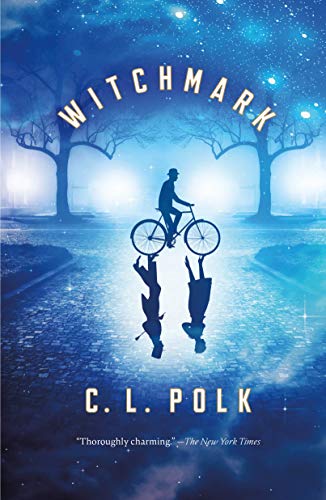
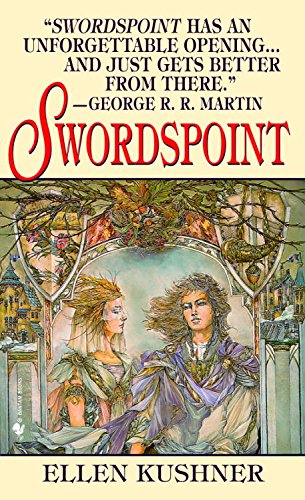
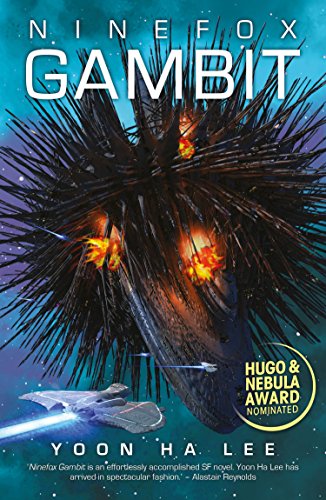
I chose representative covers with complete randomness, not as any statement.

There are many great reading lists for queer books–this one is ours.

So, from the “Queering Fantasy” panel at the 2020 World Fantasy Convention, a list of their recommended reading:

Great Queer Fantasy and Science Fiction

Feel free to circulate and add your own–or let me know! Let it grow, let it grow, let it grow!

Recommendations by Corry L. Lee, Cheryl Morgan, Jerome Stueart, and S. Qiouyi Lu

Key: SF = Science Fiction, F = Fantasy, YA = Young Adult, MG = Middle Grade, H = Horror, SP = Steampunk, SH = Superheroes, GN = Graphic Novel SS = short story collection

Adult:

  • Ninefox Gambit – Yoon Ha Lee (SF)
  • The City We Became – N.K. Jemisin (F/contemporary)
  • The Perfect Assassin – K.A. Doore (F)
  • Raven Tower – Ann Leckie (F)
  • Ancillary Justice – Ann Leckie (SF)
  • A Memory Called Empire – Arkady Martine (SF)
  • The Future of Another Timeline – Annalee Newitz (SF, Alt Hist)
  • Weave the Lightning – Corry L. Lee (F, novel)
  • Dhalgren — Samuel R. Delany (SF, novel)
  • Stars in my Pocket Like Grains of Sand — Samuel R. Delany (SF, novel)
  • The Affair of the Mysterious Letter – Alexis Hall (F)
  • Will Do Magic for Small Change – Andrea Hairston (F/contemporary)
  • Silver in the Wood & The Drowned Country – Emily Tesh (F, novellas)
  • The Seep – Chana Porter (SF, novella)
  • Swordspoint – Ellen Kushner (F, novel and the whole Riverside series)
  • The Outremer Series – Chaz Brenchley (F, 6 novels in US, 3 fat novels in UK)
Continue reading

Original Art Available on Squarespace

I have put my available original artwork on Squarespace. All my watercolors of fairies in the garden, Gardens of the Mythbegotten, and all the Yukon Cornelius paintings as well as my more controversial paintings of police action in Columbus.

You can follow the link to Squarespace here.

Remember too, that if you want any of these images on magnets, buttons, aprons, pillows, journals, that you can follow my link to Redbubble here.

Family and Community in ZZ Claybourne’s “The Air in My House Tastes Like Sugar” (GigaNotoSaurus, March, 2020)

Y’all, I read this awesome story, and I want to tell you about it. It’s about a mother and daughter who are witches, tired of having to move from town to town to hide their identities. They finally say, no, and decide to push back on all the rumors, fake stories, and prejudice so they can stay in community with the town. They’re happy there, to an extent, but negative rumors about witches and children and ovens are spreading in the city about them, so they have to take action. Mother takes her daughter into town to confront those rumors head on! And she is not someone to be messed with. Does she use witchcraft to get her way? She does not. She uses reason.

Along the way, she discovers a bigger secret hiding in the town, and must be the witch the town needs in order to survive.

I loved this story for many reasons.

Yes, it has a trope I love—family. I’m a sucker for brothers and sisters, fathers and sons, mothers and daughters, mothers and sons, any combo of family. So I’m already biased going in. Family for me comes with its own stakes already in place. In nearly every family story there is a question of “how do we keep the family unit intact?” How do we survive together? The characters are not just strangers, or friends, or a D&D Party (all good groups!), but have shared history together that an author can explore, and a familiarity with each other that can really aid a story. I think Zig Zag Claybourne uses all these positives to his favor in this story.

Continue reading

“Postlude to the Afternoon of a Faun” is finalist for Eugie Foster Memorial Award

Very happy and honored to tell you that my novelette, “Postlude to the Afternoon of a Faun” originally published in The Magazine of Fantasy and Science Fiction (Mar/Apr 2019) is a finalist for the 2020 Eugie Foster Memorial Award!

The Eugie Foster Memorial Award for Short Fiction (or Eugie Award) celebrates the best in innovative fiction. This annual award is presented at Dragon Con, the nation’s largest fan-run convention. Starting with the 2020, we will add a video presentation of the award online, along with a reading of a section of each finalist.


The Eugie Award honors stories that are irreplaceable, that inspire, enlighten, and entertain. We will be looking for stories that are beautiful, thoughtful, and passionate, and change us and the field. The recipient is a story that is unique and will become essential to speculative fiction readers.

—from the Eugie Award website http://www.eugiefoster.com/eugieaward

You can learn on the website what a wonderful writer and person Eugie Foster was, and about her legacy. I’m deeply honored to be on a list recognized by those associated with her.

Four other writers are also featured with their stories:

A Civilization Dreams of Absolutely Nothing” by Thoraiya Dyer (Analog Science Fiction and Fact)

For He Can Creep” by Siobhan Carroll (Tor.com)

The House Wins in the End” by L Chan (The Dark)

Love in the Time of Immuno-Sharing” by Andy Dudak (Analog Science Fiction and Fact)

http://www.eugiefoster.com/eugieaward

I’ve had a wonderful two days just telling people that I became a finalist and receiving so much positive feedback. I kinda feel that being a finalist with all these cool authors and stories is its own reward! It’s really filled my soul with love in this very tumultuous time.

There are still many changes to make in the world. We will make them! Today, it was nice to feel loved.

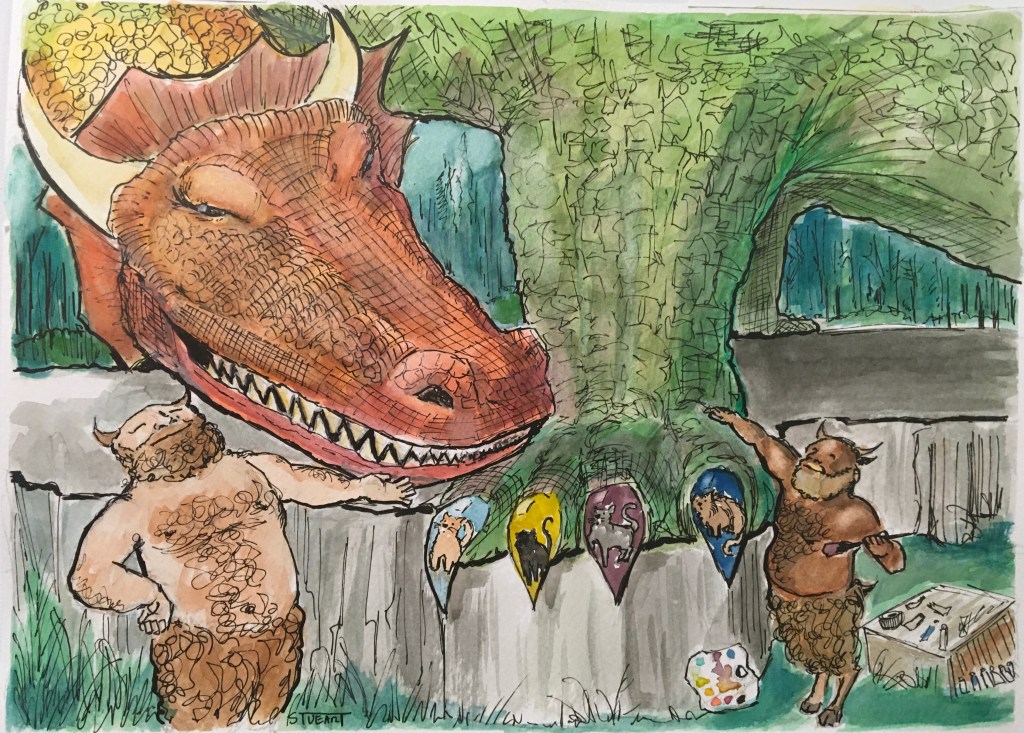
PS. Yes that is my illustration for the story. It was something created way after the story was accepted and in print… but it was fun to doodle.

Awards Eligibility Post, 2019

I only published one thing this year, 2019, but it was a big publication for me. “Postlude to the Afternoon of a Faun” was a novelette (8000 words) published in the Magazine of Fantasy and Science Fiction in the March/April 2019 issue and is eligible for Canadian and American writing awards. It is Fantasy. It’s about the power of music, music mentoring, about the courage to go on after loss, and features jazz-playing fauns. The character is queer and disabled. He stays queer and disabled and alive through the whole story.

Below you’ll find a link to the whole story here online, or you can read an excerpt from it.

*I am a Canadian and American writer, holding dual citizenship.

Thank you for visiting my 2019 year round up page, and I hope you enjoy my story.

Excerpt:

________________

Postlude to the Afternoon of a Faun

Mr. Dance couldn’t keep his eyes off Eric’s clarinet. From the moment the young football player opened the black case and revealed the instrument, Mr. Dance knew that what he thought had been broken– as his legs were– or lost–as he felt–had instead been hidden for a hundred years.

Continue reading