October 12:  Yukon Cornelius brings a Jack-O-Lantern to Dinner

*with recipe!

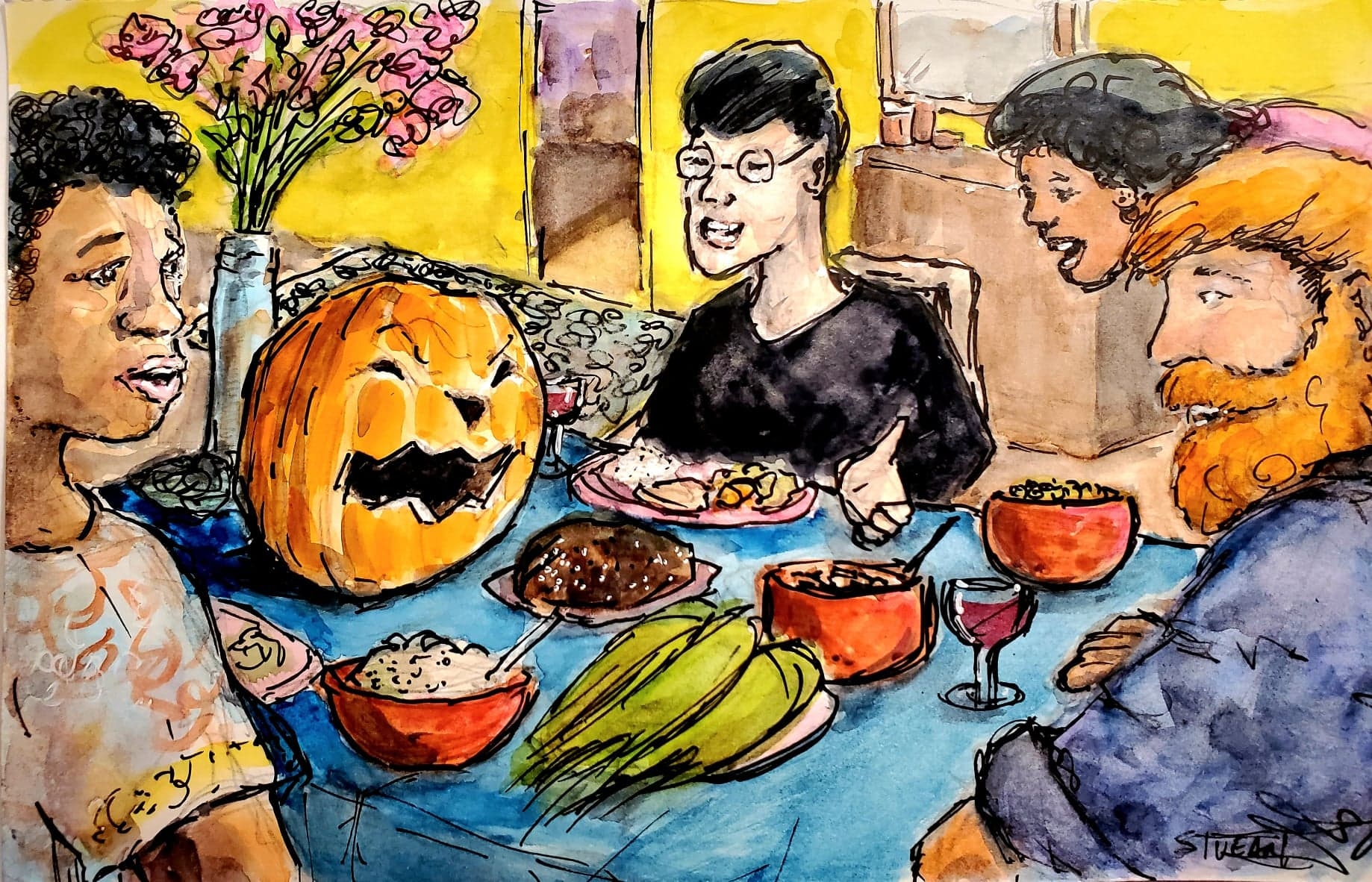
If Ulrich hadn’t thrown his head at me, I would have made him my Plus One tonight at dinner.  Now, it’ll have to be Plus Half.  When I got to Kate and Ashantu’s house, I set the Jack-o-Lantern on the table. “Everyone, meet Ulrich.” You can imagine their response as it just sat there. Ravenwood, a thin man in a black sweater, chuckled. “You can just say your Plus One bailed. It’s okay. No shame.” Ulrich wouldn’t say a thing. “He’s a little unhappy. This isn’t the way we had planned to come tonight.”  He had been loud and argumentative with me in the truck, threatened my life when his body showed up to claim him. For the last several times I’ve tried to visit him, he’d throw his head at me.  So, this time I picked it up. “I don’t want to go to a dinner!” He wasn’t really a people person.  He’d been bullied, hunted, shunned, wronged, even in death.  I also knew his body would eventually catch up to us.  An intervention was risky, but I thought a little warmth from people, a little conversation, some nice food smells would help him. Now he was an inanimate, stubborn, carved pumpkin.

They welcomed that pumpkin, even if he was going through a difficult period and didn’t want to talk. They fixed him a plate and put a very fat straw in the pureed carrot ginger soup and a straw in his wine. They included him in conversation, even if he didn’t answer. We all sat and talked about our lives with a Jack-O-Lantern and no one questioned my sanity. Ravenwood asked me, “So, how long have you two been friends?” Ulrich was silent. “It’s coming up on twenty years,” I said. They were surprised. “Ulrich saved my life.” I paused for a moment to see if he would tell the story. He didn’t.

So, I told them about how as a young man I was on shore between assignments—in my merchant marine years—and had met someone at a bar, as one does. But times being what they were, we were followed and harassed by a group of Angry Young Guys. “Ulrich showed up and did what he does best.” I leaned back in my chair to dramatically replay the scene, “He comes riding up on a horse, his head all aflame, scares them, and then he takes that flaming head and throws it at them! It streaks like a comet and hits one of them right in the chest. Boom! He lit up, tore off his shirt and ran screaming! Then Ulrich’s body, still on the horse, pulls out his sabre and holds it high in the air as his horse rears back!” I caught him looking at me. Did he remember that?  “They ran off. I had to convince my guy to stay. He was plenty rattled too. But you know, I believe they would have hurt us that night. Maybe killed us. And I,” I raised my glass of wine. “I owe my life to his penchant for throwing his head at people.” Ulrich’s mouth moved and his eyes got softer, “I don’t like people.” Kate, Ashantu and Ravenwood all looked at him as his whole face became animate. “Normally,” he added. He smiled a jagged smile. “I throw my head at everyone. He’s not special.” I looked at him. Rave asked, “Why don’t you like people?” Ulrich said flatly, “They’re monsters.” He looked quickly at them, “Normally.” He said, “I just don’t like to be bothered.” His pumpkin mouth stretched a little to grab the straw to the soup, sucking it down. He smiled. “Normally.” It felt like he was warming up. “My body is coming and will cut off your head,” he said to me. “SLICE!” he shouted. They all looked at me. “Did you know that Ulrich was in the Revolutionary War? Part of a cavalry.” That began a whole conversation where Ulrich was the center of attention, talking about the war, about his life. I buttered another roll. I may lose my head, but I still thought the risk was worth it. He was enjoying himself. After an hour of lively discussion about cannonballs and mercenaries, Kate eventually got up and brought out a pear tart with blue cheese. It looked delicious. There was a knock at the door. Ashantu opened it and a headless man in a cape and boots, brandishing a sabre, walked through. “At last!” Ulrich said, swiveling his whole pumpkin around. “Come my Body, and take what is ours!” We all stood up, backed away from the table. “Yes!” Ulrich said, spinning his head to look at us. “SLICE!” The body stepped up to the table, his sabre raised, and sliced five pieces of tart. “But first, I want a taste of that pear tart.” He smiled at Kate. His body put down the sabre, picked up the head and placed it back on his shoulders.  Then Ulrich Van Hesse, the Headless Horseman, my original Plus One, sat down for dessert.

***********************

Blue Cheese Pear Tart

a pie crust ((use your favorite pie crust recipe, or take 1 stick butter worked into (some) flour (Joey guesstimates it each time) then brought together with water))

3 pears, peeled and cored

some nice strong blue cheese

3 tablespoons of honey

Preheat oven to 450F.  Line a tart pan with the pie crust.  Slice the blue cheese medium thin (or crumble it) and line the bottom of the pie crust with it.  Slice the pears thin and arrange the slices in a circular fan.  Heat the honey and drizzle all over the pears.

Bake for 45 minutes until the crust is nicely browned and the pears are starting to color. The blue cheese should be bubbling in between the pear slices. Cool until it doesn’t burn your tongue.

*************************

October 11:  Yukon Cornelius tries to avoid the Black Dog of Death

Hiking the mountain trail on a summer night was beautiful, and still very warm. I sweated through my clothes. The moon lit up the sparse clouds. Few people hike at night.  But since I often get visited by strange creatures wherever I am, I try to stay away from crowds. This turned out to be a good idea. A black dog with big glowing red eyes now stood on the path ahead.  That was not a camper’s dog.  I needed to figure out which kind of ‘black dog’ this was before I just walked into it blindly. Folklore was full of reports of black dogs as apparitions of the dead, of the Devil, of doom, and they were often malevolent to travelers.  But those accounts were written in a superstitious age when death and disease and illness were attributed to Sin and other moral or religious laws.  So we gave Death a dog. A dog that warned us that Death was coming.

Perhaps this one wanted to talk.  Some might be friendly guardians.  Which was it?  Was it evil or protective? Was it the You’re Doomed kind or the You’re Safe Now kind?  Did it matter? Yes, I wanted to be aware of what I was walking into. I had a choice to keep going—but now it would be there.  Would it hurt me? How would it affect my hike, my safety?  Do I run from it, or walk toward it?  I needed to know which black dog it was ahead of time, but I didn’t know enough to make a good choice. I also couldn’t make a life out of avoiding unknown creatures.  That’s kinda inevitable for me.  So I took what I knew, just started walking again on the trail, and as I got closer and closer, I tried talking to it (sometimes a bad idea with black dogs). It didn’t move.  I told it I was going to walk around it, and I did.  And it stayed where it was.  If it needed me, it could always follow me, but I needed to keep walking. It trailed me. I was going to have to deal with it when I camped. Closer to sunrise, I found a good spot, next to a clear creek with a pool. I was hot, sweaty, and exhausted, and that creek would feel great. I set up a tent and then went for a dip just as the sky lightened. And ten minutes into relaxing in the water, it showed up again, crossing through the trees behind me. I decided to let it do what it was going to do. I wasn’t exactly in a place to run or defend myself.  Some black dogs are unavoidable. I kept my hands on the bank of the little pool to indicate that I wasn’t going to hurt it. (FYI, I am not immune to attacks by supernatural creatures.) Behind my head, I heard it run towards me. Harder and harder. I ducked down as it leapt over my head and dove into the water in front of me, splashing my face with a wave. I didn’t move. I was in shock and very wet. Then it bobbed in front of me, with its red glowing eyes, and I saw a green tennis ball in its mouth, and it pushed the ball onto my hand. “So that’s your game, Portent of Doom,” I said. I took the ball and threw it down the creek. She fetched it and came back, smiling, nuzzling me. We did this about twenty thousand times. I laughed a lot.  Maybe Death’s Dog needed to play.  Maybe I did.  Sometimes, the things we’re nervous about up ahead turn out to be surprisingly nice—even good for us.

October 10:  Yukon Cornelius sits with a Banshee

For two weeks, her wail was impossible to miss. “She’ll be quiet soon. She’ll go on for another night or so, and then it’s all quiet,” the bartender told me. When I told him I intended to find her, he grabbed my arm. “You might die. You just have to let them cry their peace.”  

Some called her the Widow of the Hollow, said she’d lost seven children a hundred years ago. Others said she was from the Civil War, and the town had lost all of its young men. “Grief like that can turn you into a banshee,” someone said. “How much grief does it take?” I asked, knowing there was no way a person had turned into a banshee. That’s not the way you get them. “Losing your children—I imagine that could turn you into a banshee,” said a young woman. An older man raised his hand, “I’ve lost all three and I haven’t turned into one yet.” No one said anything. I said, “I’m so sorry. That must have been very hard.” He drank from his pint, not meeting anyone’s eyes, “Death happens. It’s not anything to wail for weeks about.  People have to move on.” Other faces nodded in agreement but didn’t speak. He said, “Some of us need sleep. Go find her and maybe she’ll shut up.”  Someone else said, “If she’s cried for hundreds of years, having a little talk with this guy isn’t going to stop her.” I drank down the rest of my beer, “I didn’t say I was going to stop her.”  I put my beer down, and some money on the counter. “I’m going to listen to her.  That’s what you do when someone is upset.” The bartender called out just before the door shut, “That’s what bars are for.” More laughter.

Moonlight turned the gravestones into the crooked teeth of a wide-open mouth. She sat heavy on a white marble bench in the graveyard.  When she howled, though, she rose like a veil in a strong wind, all twisting with pain. Her lament echoed off the stone mausoleums. I didn’t want to scare her. I asked if I could sit with her, and she didn’t stop her keening. But she looked at me and moved back a bit to give me room, I think. So I sat with her. Every new cry was fresh pain. It had no rhythm or music or predictability. She focused on me. I looked her in the eye for some of it, and then I looked down at my hands. Grief is hard to look at in the eye. Even if you are ready for it. I was not going to be afraid of it, but it can be heavy. She knew. I stayed silent for the first hour. She filled the trees with her sadness. I cried with her some—as she could pull the grief I needed to express out of me. I told her what I, a visitor, knew about the people who had died recently. I thanked her for grieving for each person. Her ability to cry for others, even strangers, was something few people did. Even in small towns, like this one, where they “know each other well”— I knew she could teach them a lot.

Then beneath the trees, we saw someone else approaching. It was the old man from the bar. He hesitated when we turned. “I can–,” he called out, “I can take over for a bit.” In a moment, standing next to me, he confided, “I rushed my wife when we lost our last one. I thought it was for the best that we both stop crying. I wanted for her, for us, to be happy again. She wasn’t ready.” He broke down and I held him while the banshee poured out his pain. He stayed with her after I left.

Later I heard the old man brought her to the bar in the middle of the night, where he sat with her, surrounded by others. Oh, good, I thought. That’s what bars are for.

Family and Community in ZZ Claybourne’s “The Air in My House Tastes Like Sugar” (GigaNotoSaurus, March, 2020)

Y’all, I read this awesome story, and I want to tell you about it. It’s about a mother and daughter who are witches, tired of having to move from town to town to hide their identities. They finally say, no, and decide to push back on all the rumors, fake stories, and prejudice so they can stay in community with the town. They’re happy there, to an extent, but negative rumors about witches and children and ovens are spreading in the city about them, so they have to take action. Mother takes her daughter into town to confront those rumors head on! And she is not someone to be messed with. Does she use witchcraft to get her way? She does not. She uses reason.

Along the way, she discovers a bigger secret hiding in the town, and must be the witch the town needs in order to survive.

I loved this story for many reasons.

Yes, it has a trope I love—family. I’m a sucker for brothers and sisters, fathers and sons, mothers and daughters, mothers and sons, any combo of family. So I’m already biased going in. Family for me comes with its own stakes already in place. In nearly every family story there is a question of “how do we keep the family unit intact?” How do we survive together? The characters are not just strangers, or friends, or a D&D Party (all good groups!), but have shared history together that an author can explore, and a familiarity with each other that can really aid a story. I think Zig Zag Claybourne uses all these positives to his favor in this story.

Continue reading

Back in the Saddle, and the Horse Didn’t Buck

IMG_4592Well, it’s been awhile since I pumped out some fiction.  I’ve been working on a longer novella, hit and miss, for ages, based on my own experiences on Long Island in 2004, and on a longer novel full of fun things.   But I just looked at my “written work” section and discovered that I had a good six fiction publications in 2010, but what have I done for you lately?  Not a darn thing sold since 2010–and that means not a darn fiction thing written, really.  I have sold some nice short pieces to GEEZ, and I’m glad.  But for fiction, it’s been awhile.

So, I’m thrilled that I got a story done for the Tesseracts 17 deadline (tonight at midnight).  Sent it off yesterday.  Hope they like it.  But I’m chomping at the bit to get more done.  So, I’ll see if I can’t pull off another story or two in March.  I have a lot of started stories that lost their way….or which got derailed by work or life or both.

I tell you it was GREAT to get back into writing fiction.  I wanted to write stories with werewolves, time travelers, Kings, ghosts–things you just don’t get to see everyday.  And I’ve been reading Graham Greene’s The Quiet American.  If Graham Greene wrote about magical creatures…. anyway, glad I’m back into the swing of things, and hope I can keep this up.

Proud that other Yukoners, including my two minions, Santana and Zeb, also found the deadline for Tess 17 to be an adequate kick-your-butt deadline for writing.  YAY.  Now, let’s see if I can do it without a deadline.

I also purchased an e-book for .99.  I have to say it was great reading.  Good ideas, and helped push me along.  It’s called 2k to 10K: Writing Faster, Writing Better and Writing More of What You Love, by Rachel Aaron.   One idea of hers, to sketch out a scene before you write it saved me a lot of time.  And made the scene crystallize more.  I’ve always been a huge note-taker–but her ideas were about making those notes more efficient and more usable for the final writing.  Working out scene problems ahead of time–before you sit down–saves time when you sit down.

Anyway, nothing but praise for that book, for Tesseracts 17, and for writing again.  Good to be back in the saddle.

My Year of Canadian Reading: what stories are you made of?

As I’m approaching an inevitable embrace of Canada (oh, sweet mystery of life at last I’ve found you!) I’m aware that I have very little knowledge of the Canadian literary tradition.   A poor citizen is one who does not know his country’s stories. It is how we speak to one another–a cultural physiography and language that connects Canadians together.  How can I become a citizen without learning this cultural language?   I thought a more creative way would be for Yukoners to suggest Canadian books that meant something to them–then it would be more personal.

So I went on CBC with Dave White and we came up with a plan for book suggestions–a reading list of sorts–so that I could become more literate about Canada.  We are getting great results, but please call in to Dave and suggest more books.  I’d like to build a canon, of sorts, of Yukon-suggested Canadian literature.  Right now I’m looking mostly for fiction, poetry and drama—but creative nonfiction would be appropriate too.  I built a blog to read and discuss this literature.  It’s called “A Year of Canadian Reading” and you can follow the link to see what I’m reading, what I’m up to, and what I thought about books you suggested.  Follow along if you like.  Read them with me.  I want to get an idea about Canada from its literature.  I want to understand you through your stories.

I don’t have any intention of stopping reading after the Year is over—but an actual year is a start.  I’ve read some Canadian Literature–Mordecai Richler, Al Purdy, Tomson Highway, Alistair MacLeod, Alice Munro, Margaret Atwood and Michael Ondaatje (as well as some great science fiction and fantasy).  But I’m aiming for a deeper understanding of Canada through breadth and depth of your suggestions.

Let me know if you want to play.  Follow these links if you want to:  SUGGEST A BOOK FOR ME, or find out WHAT I’M GOING TO READ.

Flash Fiction Challenge: Inhuman

INHUMAN:  Absolute Xpress, owned by Edge Books (the makers and owners of the Tesseracts series of science fiction and fantasy anthologies), have announced their fourth flash fiction challenge:  1000 words on what humans are like from a non-earth based, non-human perspective.  The title of the anthology is called “Inhuman” and details are here

In their words:

The Theme: InHuman

There are other beings out there. Demons, fae, aliens, robots and more. Creatures that have been watching us for a long time. They know us. For this challenge, write from the point of view of something “Inhuman”; an exterior point of view that is able to see what it really means to be Human.

You now have 6 weeks to answer this challenge. Flex your fingers and get typing. This challenge closes on May 15th at Midnight Pacific Standard Time (PST). For more details on how to submit check out the Flash Fiction Challenge page.

So what are we really looking for?

We want you to write from the point of view of a sentient, intelligent life form (no earth-based animals please (pets, birds, fish, etc.)). Perhaps they have been impacted by humanity, or visa versa. Or maybe they’ve been watching us from a distance. The big thing is that who ever these beings are, they have an insight into what it means to be human. This perspective is the key thing to highlight in your stories. It doesn’t have to be profound but these inhuman persons should notice something about what makes humanity human.


1000 words, one week left.  You can do it.

Toronto Launch of Evolve: the all-Canadian Vampire anthology, April 9-10

Coming up, Evolve: Vampire Stories of the New Undead will be launched in Toronto at Ad Astra, the science fiction convention there.  It happens April 9-10 in two separate events: one is a the Canadian Launch on Friday night, 7pm at the World’s Biggest Bookstore.  And the other is a reading on Saturday at Toronto Don Valley Hotel and Suites which is hosting Ad Astra.  

You can read more about it here.

What is Evolve?  Evolve is really 24 authors tackling the premise–what would happen if Vampires evolved? What would the new versions look like?  When you have a history of Vampires that takes you from the ghoulish looking Nosferatu to the sexy, sparkling Edward, then you already have an evolution of vampires from their horrific beastial state–where being bitten was a life sentence–to teen girls hoping and praying they’ll be bitten by Edward…  Where have we come to?  What have vampires already become?  And where will they evolve next?

As Nancy tells me, this is the first ever all Canadian effort to tackle contemporary vampire stories–and I think we have an exciting premise.  If anyone is wondering if Vampires have lost their direction post-Meyers, here’s 24 things to think about for future reference.  

Evolve: Vampire Stories of the New Undead includes writing from Kelley Armstrong, Tanya Huff, Claude Lalumière, Mary E. Choo, Sandra Kasturi, Bradley Somer, Kevin Cockle, Rebecca Bradley, Heather Clitheroe, Colleen Anderson, Sandra Wickham, Rhea Rose, Ronald Hore, Bev Vincent, Jennifer Greylyn, Steve Vernon, Michael Skeet, Kevin Nunn, Victoria Fisher, Rio Youers, Gemma Files, Natasha Beaulieu, Claude Bolduc, and Jerome Stueart.

If you’re in Toronto and want to stop by the World’s Largest Bookstore, or by Ad Astra for the readings, you’ll enjoy it.  

Bondsmen, my story, up at Metazen: James Bond meets himselves

secret-agent2My story, “Bondsmen”, is up at Metazen.  The story–meant to be a comedy– is a bit surreal, having the latest James Bond (an actor beyond Daniel Craig) really stifled by all the things he has to do as James Bond—he just wants to be himself, dang-it, but he finds himself trapped in the character roles that have been played in the past by other actors….  This is a story of a man who wants to be an individual, not controlled by things he can and cannot do.  James Bond ends up quarreling with all the other actors who’ve ever played Bond–or rather, all the other versions of Bond.  It is meant to be parody, but also a way to think about living life suppressed, even when you’re a dangerous secret agent.  Does James Bond really get a choice to be anything else?

Metazen, ” is an online fiction zine that publishes short fiction and poetry by various authors. Metazen is a fly trap for metafiction, existentialism and  absurdism. It harbors all kinds of filth such as neurotic characters, obscure philosophies, love for inanimate objects and quests toward enlightenment. Metazen occasionally follows the real life, meta-fictional exploits of Frank.  Metazen is edited by Frank Hinton, Jessica Alchesse and Dylan Cohen.”

Enjoy the story!

Wolverine: You can’t hurt him, so you can’t hurt us

x-men-origins-wolverine-20090212020925195While Wolverine looked promising, it was a confusing mess of action with never a moment of tension. The problem was established early–in the credits–and this hindered us from caring about the characters.

If you make your characters indestructible, then you eliminate us from caring. It was the problem with Superman many years ago–he had no real vulnerability. So the writers rewrote him. Here with Wolverine and Sabertooth, they are given nearly immortal status at the beginning of the film. They don’t age slowly–they just don’t age once they hit their thirties. And they go through the Civil War, WW1, WW2, and the Vietnam War all in about ten minutes of screen time. They are always frontline, get shot at over and over, get hit, but never get hurt. There is no danger for these guys. None. That is established up front. So why would there be any tension in the film?

The film goes on to try and make Wolverine truly indestructible by giving him admantium bones. But since he was already invulnerable (yeah, he could get slightly bruised in a fight with his brother), the admantium claws gave him no discernible advantage. Ah, yes, in fights with Sabertooth, Sabe’s face was a bit more pained–but he was still walking tall after the fights. Spare me the argument that they can heal. 1) An ability to heal that quickly means there are no consequences. No consequences eliminate plot and choice–both essential to story. 2) Wolverine never healed that quickly in the comics. The point of Wolverine’s healing ability was to protect him in the long run, but he got beat up bad in the comics. Often, it would take him days and weeks to heal. And that’s good—it made him vulnerable, but gave him a slight advantage in the ICU. It made me care. But in this film, immediate healing meant that two shadows were boxing each other. I thought–so what?

The fights were scripted so that either Wolvie or his opponent should fall down so there could be a bit of dialogue, or a change of scene. If Sabertooth met up with any other character, that character was toast. It was just a matter of time. Because Sabertooth was established as indestructible.  Worse yet, I am now not sure what Sabertooth is really responsible for–since his main kill comes back to life.  The body count might have been high–but a viewer can’t care if the bodies spring back to life or never had much life to begin with.

Working against it too–the movie was a prequel. And if the survival of the main characters is the plot of a prequel, you’ve doomed yourself. The plot of a prequel needs to be another mystery–because their survival is assured. Here, we were told that we were going to learn the mystery of Wolverine’s origins–but there was no central goal for the main character, no puzzle to solve; just event after event happening to the main characters. No choices, no consequences, no mystery.

I was looking forward to Cyclops, to Gambit, Blob, etc. These characters were used more for the trailer than the movie. This movie had no arc, no plot, and characters who needed to wade through two hours of special effects to return them to X-Men 1, where they began.