Yukon Cornelius is the Better Santa

You’ve seen the 1964 Rankin/Bass stop motion Christmas special, Rudolph the Red-Nosed Reindeer, written by Romeo Muller. It’s been aired on TV every year since it was first shown. You may have wondered, though, why Santa seems to be so MEAN-spirited in this movie (probably the only anti-Santa movie we show at Christmas time). There is a better Santa in this movie, though, hiding in plain sight.

CEO Santa Rules the North with a Manufacturer’s Mindset

Santa is the boss of toy-making and toy distribution, of all the elves and reindeer. When Rudolph is born, Santa blames Donner for having a “weird” son, and makes fun of Rudolph’s nose — — and of course, all of his “employees” do too. They’re just following Santa’s lead. His meanness and prejudice gets passed down to the reindeer. How can Santa himself be so narrow-minded!? This doesn’t feel like the Santa we know.

In a tale about manufacturing and production, this glowing reindeer and fabulous, dentist-oriented elf are merely flawed products. They are a version of an elf and reindeer who don’t do what those products should do. They are misfits like the toys they will meet later. The other elves, the other reindeer, do not want to accept them, as they have been taught to reject flawed toys.

Who do you think created the misfit toys? Those toys are typical manufacturing mistakes, tossed away. Losses. Victims of Quality Control. There is no love for a flawed product in a warehouse toy factory at the north pole. The elves must be VERY AWARE of their “mistakes”, even if they aren’t aware of the Island the misfit toys all eventually run to for safety.

I believe Santa is written this way on purpose — revealing the commercialized CEO Santa that’s kinda already there. Muller just reveals more of him because he has a doppleganger to compare Santa to. If Santa is the villain, and Rudolph is the hero of the story who has to grow and learn, then he needed a role-model for Rudolph to learn from, to really accept himself and others, since Santa won’t be modeling that.

This is the role given to the OTHER sleigh-driving big bearded man in the movie, Yukon Cornelius. I think this is done on purpose.

Yukon’s a character made up by writer, Romeo Muller, to expand the story beyond the original Robert May song. Muller doesn’t let this just be a song of Rudolph waiting till he’s useful to be discovered. That’s not fair to Rudolph. He creates someone better, a guide, a guru, a model to show Rudolph how to treat others, and himself, with radical acceptance and love.

Radical acceptance and love
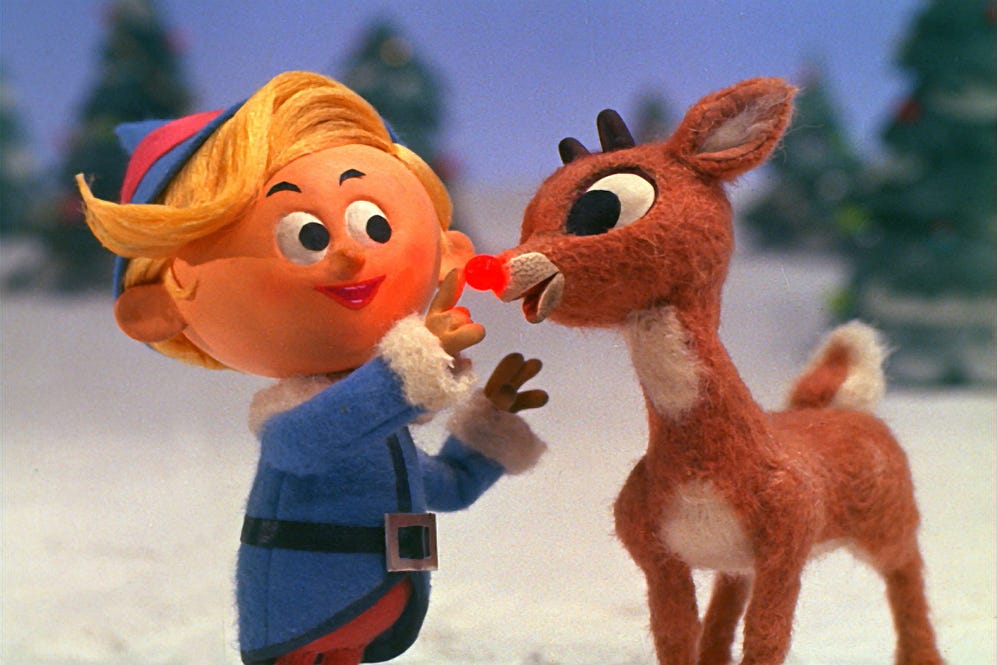
Members of a group, a society, a culture, may“naturally” accept people who reflect back to them the kind of group they want to be seen as. So they might accept those who are like “us”, those who stay within expectations of social and moral cultural systems. Those who stay within the lines our group has drawn.

Hermey, though, is an elf who wants to become a dentist instead of a toymaker; Rudolph can’t really hide his bright, blinking nose and that makes him targeted by bullies. They are considered “unacceptable” by the groups they find themselves in — — not what they expect in an elf or reindeer. They don’t fit in, or won’t fit in. They won’t cooperate with what is expected. Rudolph tries to over his nose with mud. That’s not a permanent or acceptable fix for anyone.

When Rudolph and Hermey meet each other, they become besties! They have a lot of common experiences, in a way, commiserating over their differences. They reject societal norms! They are Rebels! They accept each other right away because they also want to be accepted! They go off into the world to do their own things.

They are all Abominable

Rudolph and Hermey aren’t safe in the world when they don’t play by the world’s rules. The Abominable Snowmonster is there to make them fear following their dreams. Noisy! Gnashing Teeth! Roaring! Chasing! GIANT! In a sense, as personified fear, he shows they will be unacceptable everywhere they go. He will relentlessly chase them down.

Who saves them from the Snowmonster? It isn’t Santa. Santa doesn’t even seem to know it exists, though I would say he is controlled by the fear himself.

Who HAS experienced that fear before — that fear of not being acceptable — and conquered it?

Yukon Cornelius.

Oh, he knows “Bumble”! He even reduces the scary words “abominable” and “monster” to rename him with a word for awkwardness. When we “bumble” through something, we bounce from one thing to another, without direction, we screw up, mess up, blunder, stumble. Bumble is a misfit too — and his name announces that he can’t “fit” either. Cornelius calls Bumble what he is — a socially awkward creature who is badly trying to fit in. He looks scary, and Yukon acknowledges that, but Yukon knows things about Bumble. He knows that Bumbles don’t like water and he knows they can bounce. He knows the strengths and weaknesses of Bumble. He sees through the scary part and sees the real Bumble, trying to survive alone. He will eventually save Bumble by giving him what he wants most: to be accepted with all his quirks.

Yukon Cornelius sees Hermey and Rudolph too. He sees them as who they are and who they want to be and immediately accepts them. He practices “radical acceptance” of everyone. Radical acceptance is acceptance BEYOND what you are comfortable with, what you’ve known, what is advantageous to you, or what might benefit you. You accept people for where and who they are. And you loudly support those you radically accept. Yukon is very loud. He is not afraid of anyone seeing who he’s with and who he supports.

The First Misfit

Long before they go to the island of Misfit Toys, we see that Yukon is already a MISFIT himself. He is a prospector obsessed with finding, not “silver and gold” as the snowman sings, as we are all led to believe, but a peppermint mine.

He doesn’t WANT what the rest of the prospectors — — or people want. He isn’t after money. He wants peppermint. Well that isn’t valuable, you might say. Why would a prospector be searching for peppermint? Prospecting is a hard life — — and would you go through the dangers of living in the wild, being outside of cities and companions, facing harsh weather, difficult, mountainous regions and digging through the earth — — just to find peppermint? The desire that makes Yukon different from ALL other prospectors is what makes Yukon a misfit. It seems to be a flaw. But I think it’s tied to his goals.

Santa has previously been characterized as judgmental: he knows if you’ve been bad or good. He has a list of naughty and nice people. He is a moral judge! If you are GOOD, you get blessings. If you are bad, you get JUNK. He is associated with worth and value, even commercial value, but also moral value.

Yukon, on the other hand, knows your strengths, allows those strengths to surface and guides you to use those strengths, even the ones others might dismiss. He is associated with seeking bliss, helping others, and he sees their innate value without judgment.

Yukon is set up to be a direct comparison to Santa.

Look at Yukon’s dog mushing team. This is radical acceptance in action! Whereas Santa’s sleigh has to be guided by “perfect” reindeer, Yukon’s sleigh is led by a mismatched group of sled dogs, that no one would believe would be good sled dogs: a St. Bernard, a dachshund, a sheltie, a beagle and a black poodle. We could think up a lot of reasons why this team of dogs wouldn’t work — -and yet, they work! Yukon believes in them, and they believe in themselves. They are all misfits but they love running and they run well together. They don’t know the proper commands (It takes them a while to understand “Mush” and “whoa” — “Stop” is what they have to hear to stop! Good luck teaching them Gee and Haw!) But in allowing them to be themselves, he demonstrates radical acceptance and love. He accepts the dogs for what they WANT to be, for who they know they ARE. And he lets them be that. And they show that they ARE good at what they love to do.

Yukon as the Better Santa

This is why I think Yukon contrasts so powerfully with Santa. They are similarly presented men — large, bearded, loud men with sleighs pulled by animals — but who act completely differently towards others. There are rules with Santa. There are not with Yukon.

Santa has to be convinced later into being accepting and giving . His acceptance of Rudolph comes when the reindeer can prove he can be of use NOT as a reindeer but as a beacon. Bumble, similarly, must be marketed as tall enough to put the Star on the Christmas tree. Thankfully, the presents from the island of Misfit Toys don’t have to prove themselves in order to be gifted at the end of the story to kids who will love them — but Santa must still be convinced to deliver them too. In fact, in 1964, with the original broadcast, Santa makes a promise to deliver them, but is never shown doing that, to which viewers complained that they wanted to see Santa keep his promise! In 1965, a new sequence was added to show Santa delivering the Misfit Toys to their new homes.

Even if you don’t understand the parallel set up of these two men as a kid, you GET the idea that Yukon accepts people and that Santa doesn’t. Yukon is the role model of this show, not Santa.

Yukon rescues, salvages, rehabilitates, transports, and teaches. He teaches Rudolph to value himself and to value others regardless of what kinds of expectations he may have, regardless of what they can do FOR him. Rudolph teaches Santa the same thing. I believe Yukon’s save of Bumble seals the lesson that no one is above acceptance.

When WE meet Yukon Cornelius

Growing up, seeing this show for the first time, and subsequent times, I think I saw myself as Rudolph, as many kids did — — someone who was not perfect, not wanted by other kids, not what adults thought I should be as a boy, but who had an important role to play in this “plot,” I hoped. I did not have a lot of positive male role models in my life who accepted me for who I was. I always felt like most boys and men were disappointed in me for one reason or another — I did not want to play hard, play sports; did not want to be mechanical; did not love the idea of the military as a proving ground for my manhood or patriotism. I did not know I was gay, and didn’t know I had ADHD. I was artsy and geeky. I was a misfit.

My parents did a great job to meet me where I was. Dad introduced me to Star Trek, comic books, science fiction. My mother read the Chronicles of Narnia to us in the hallway. These are enormous things! They also found and gave me for Christmas some very heady and scientific books on butterflies when I was interested in butterflies. I always got great gifts for Christmas — weird ones, but ones I cherished. My parents brought me things that transformed me for the rest of my life in good ways. They also were my first introduction to spirituality, and even though we eventually disagreed about some small things (that are kinda more important now) my faith began here. They gave me enough to grow my own faith and keep it strong, even as a gay man.

But my parents, like many people in the 70s and 80s, were still subject to the “rules” of society for gender. It was very hard for anyone not to be soaked in those rules. Guidelines for girls and boys and how they were supposed to act, what and who they should love, what they should do. We still have them. They are the basis for much pain and rejection even today.

Anti-Trans laws are directly influenced by previous theories about gender; anti-lgbtq legislation is also built on the backs of outdated gender theory. Gender is a cultural construct, and while many people are more aware of this, there are still many people who are afraid of people who don’t obey those gender rules — whether that is through gender expression or sexual orientation, or any other expression of gender and sexuality. 

We should know better now. 

But back in the 70s, these expectations were so much a part of our culture that I can’t honestly blame my parents for believing them. All the doctors, the newscasters, the psychologists, the media, not to mention all those in office. When your access to the truth is limited, you don’t get the truth, usually. 

My parents did what they could to guide. In many ways, they protected me from much of the consequences others might have wanted to give me, and in their own way, they were practicing radical acceptance — as radically as they could within our family.

We end up on the Island of Misfit Toys

These misfit toys in the movie were rejected only because they didn’t DO what was expected of them. They were still of value and still interesting (as we come to see in the movie). Moonracer, the winged lion, comes across as God protecting the misfits from others — -but unable to, himself, fix their situation. It takes Yukon with Rudolph and Hermey to help bridge the distance between these undervalued people and those who could help them find their home.

I think we unconsciously gravitate to those who accept us. Perhaps, while the kids were enjoying the animation, the adults were learning a lesson about which sled-musher to follow, about how to accept others.

Me, I was looking for a Yukon Cornelius to see my value and worth, as many of us do.

I eventually found a way to bring Yukon to me.
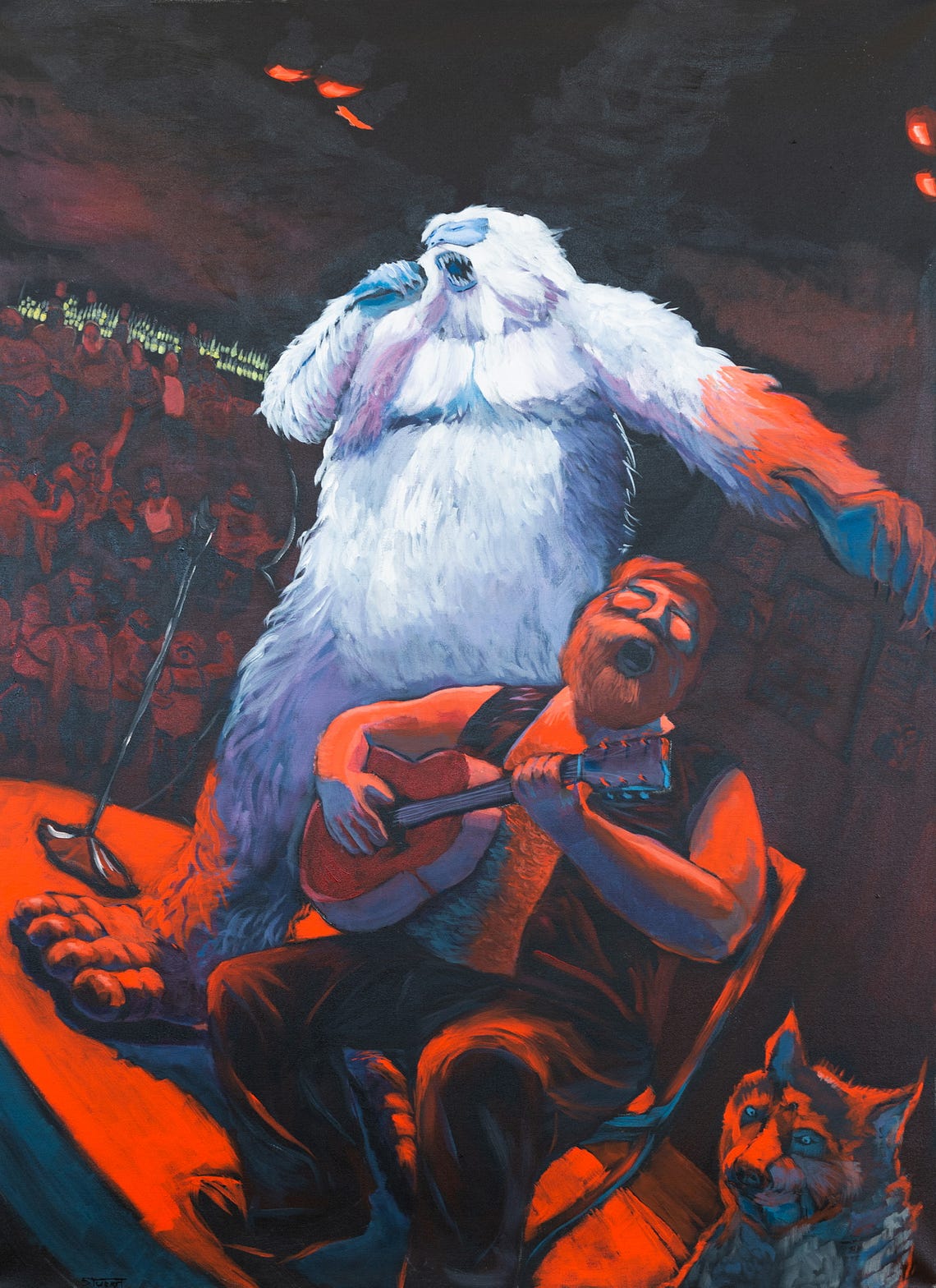
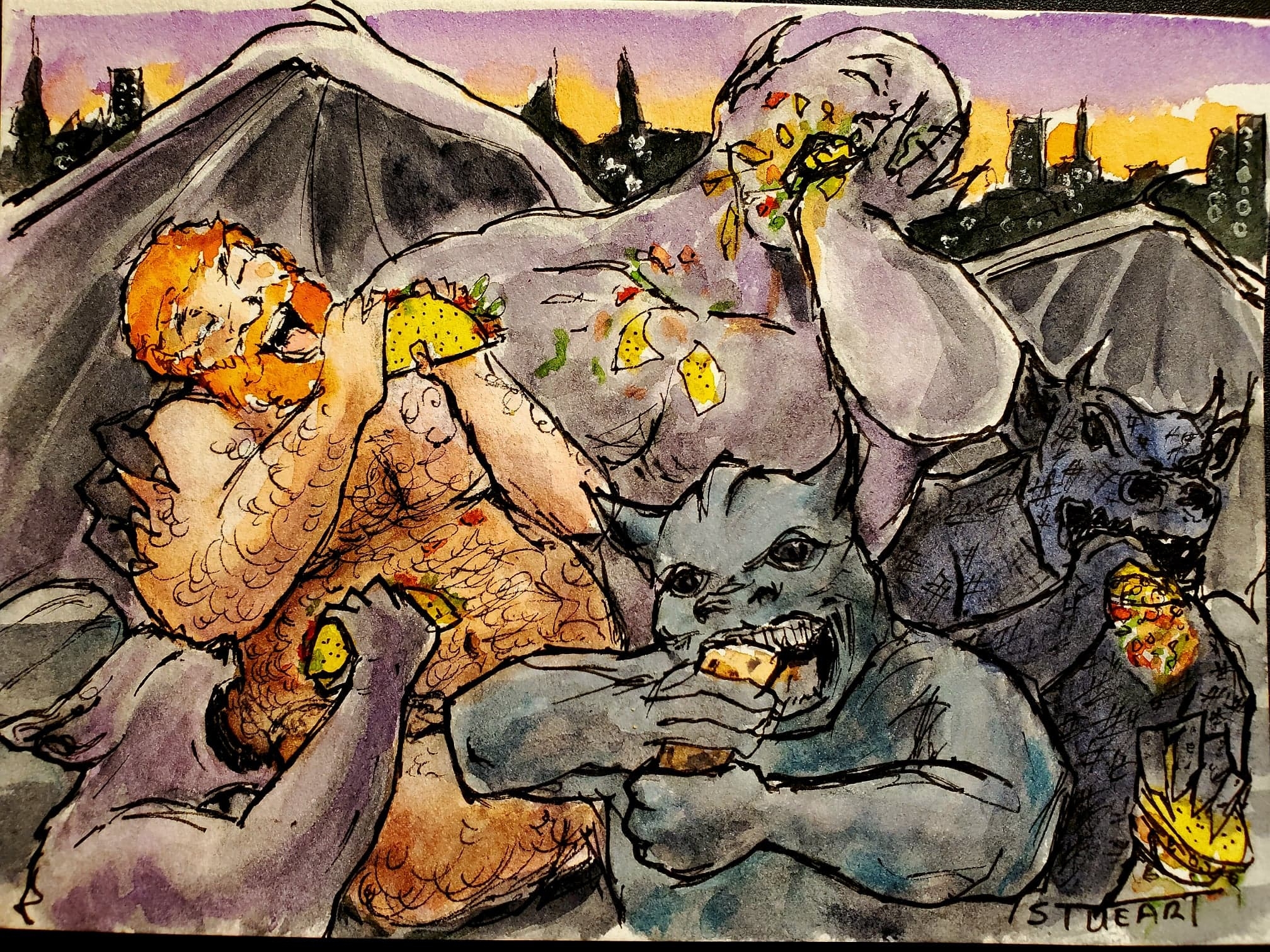
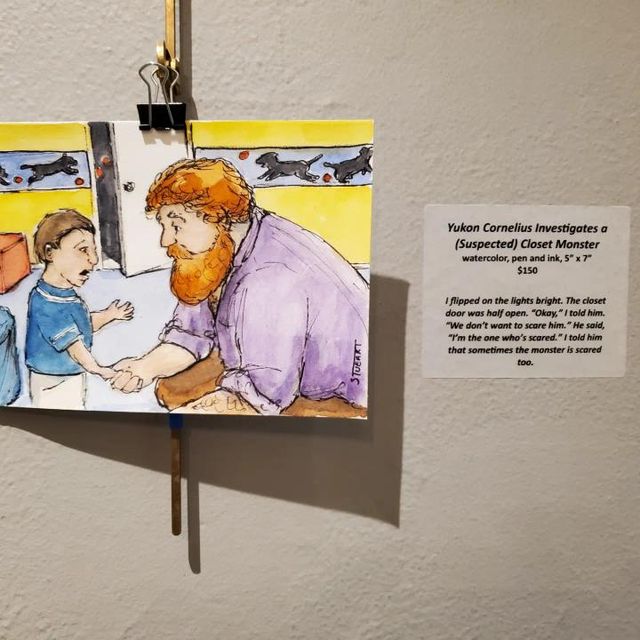
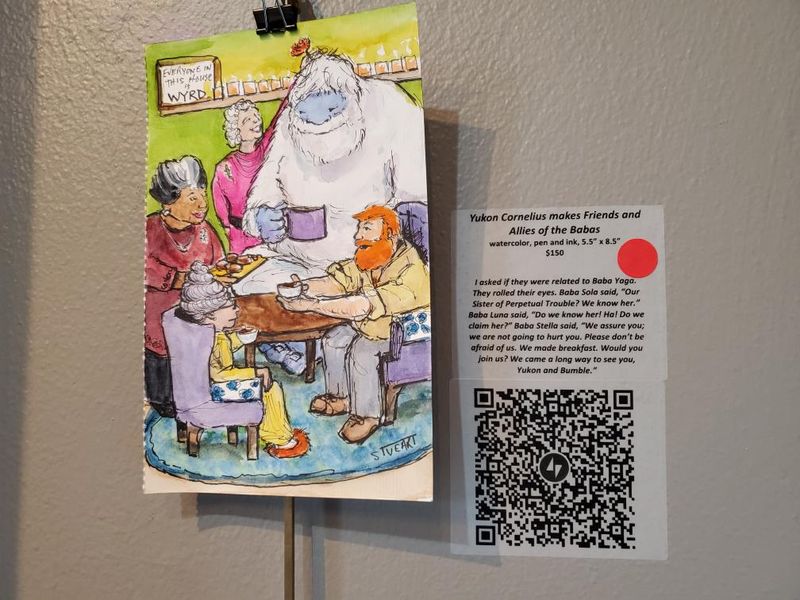
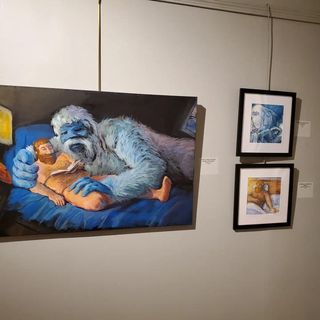
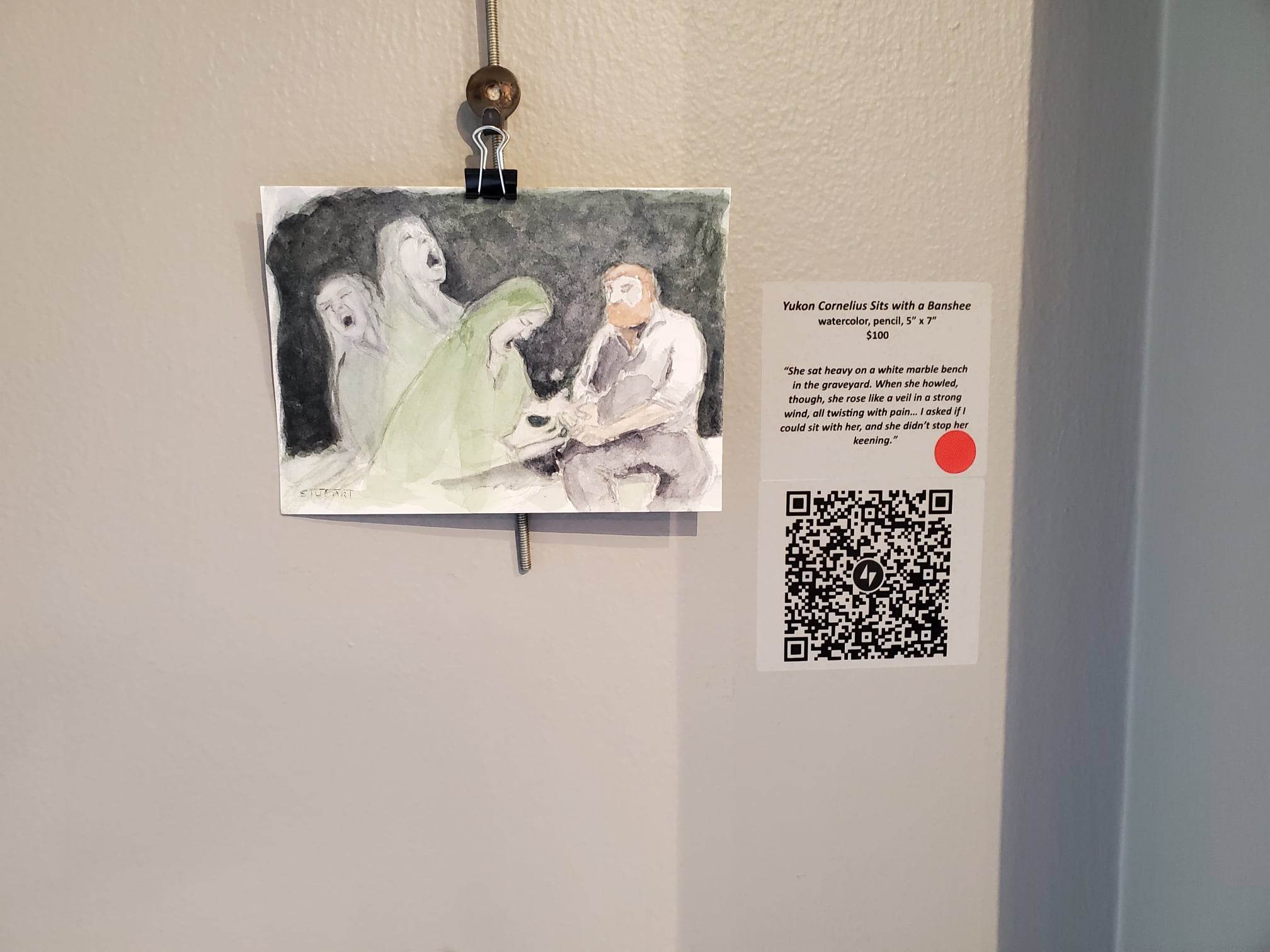
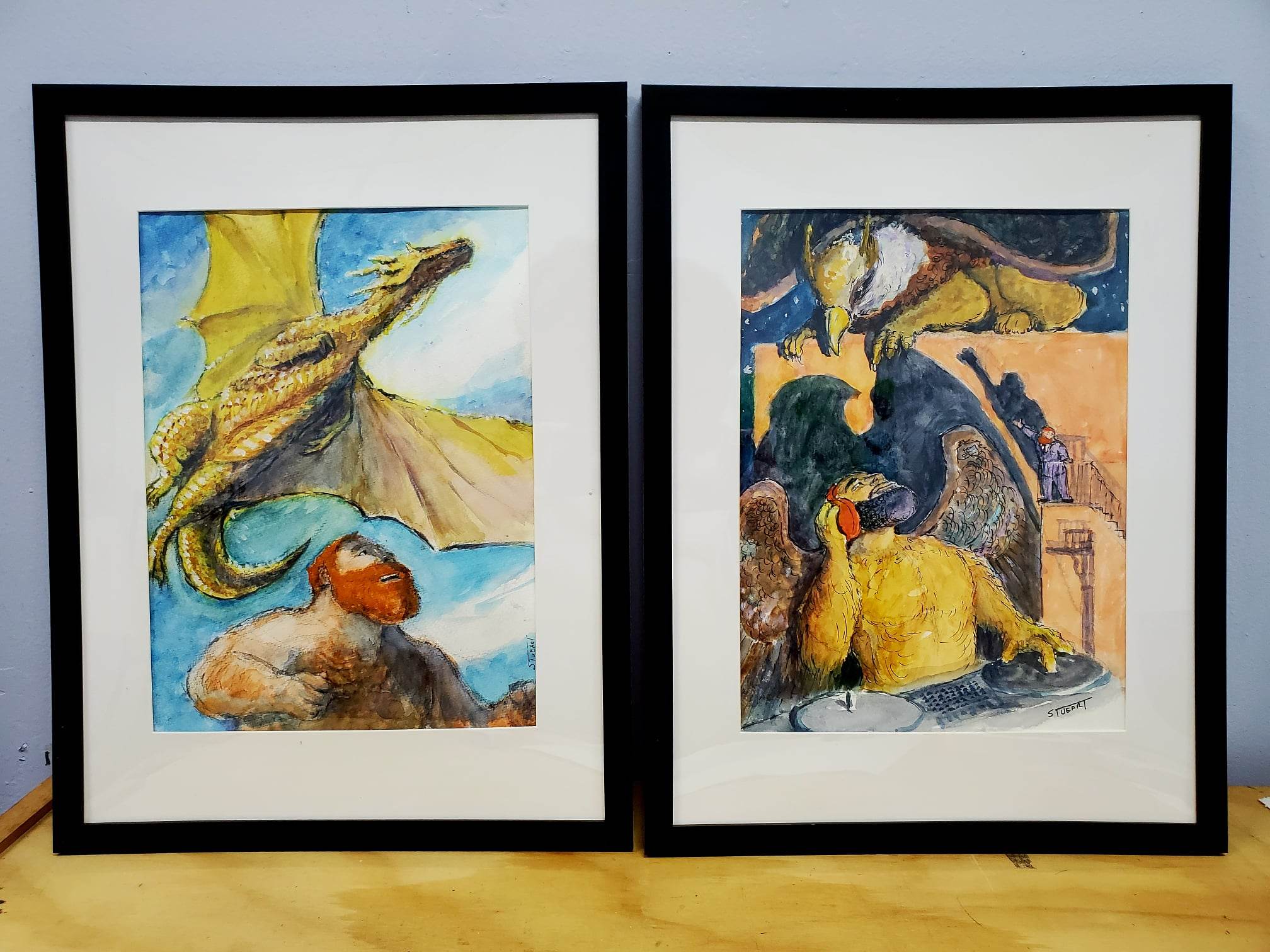
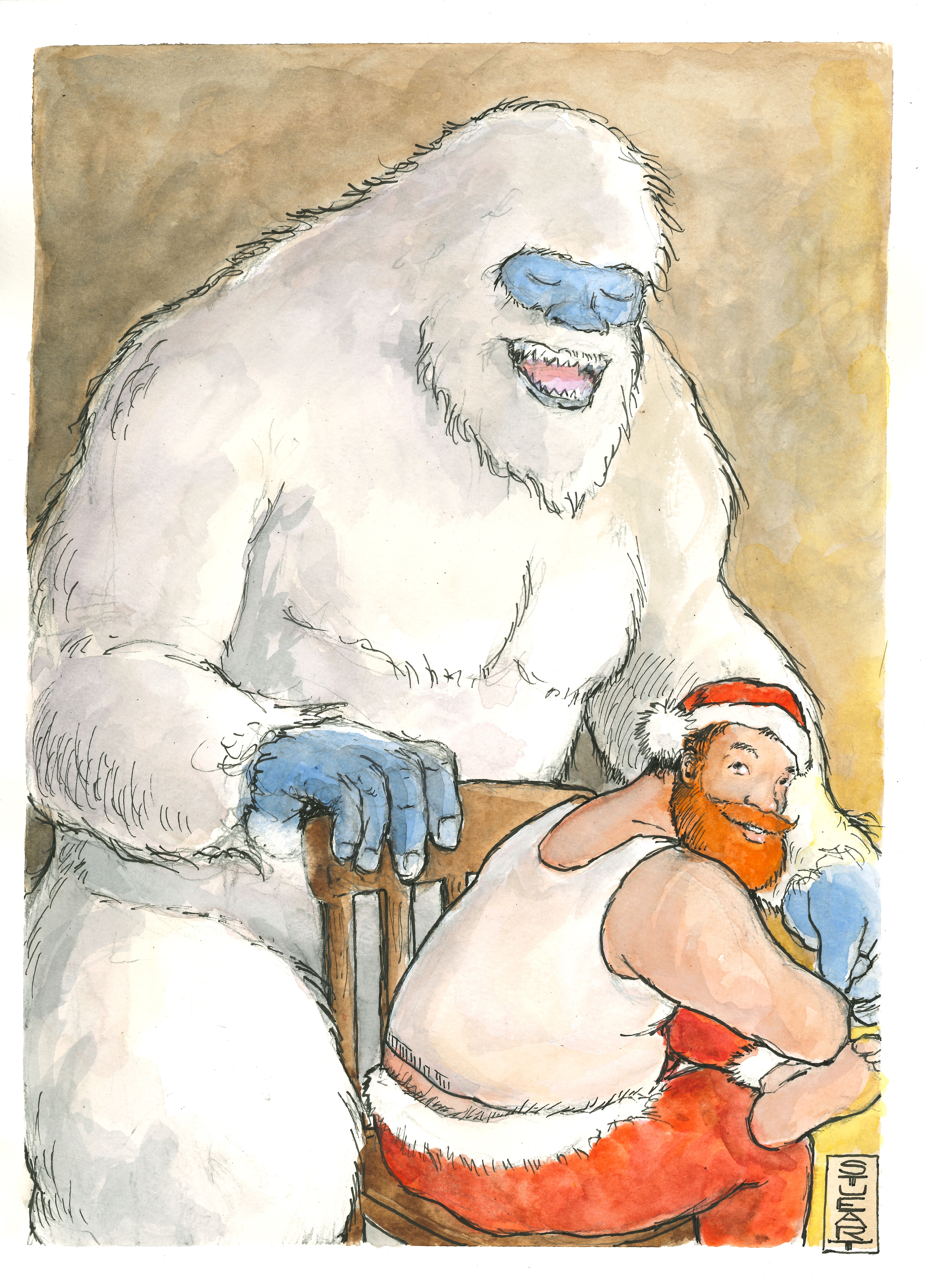
In 2019, I created a set of 10 paintings of Yukon Cornelius in the style of NC Wyeth — a style of boy’s adventure books popular in the early 20th Century, to explore what a gay hero might look like to me — the kind of gay hero I wish I could have had growing up. In 2022, I completed a show of about 50 paintings, acrylic and watercolor, with stories to go with them, titled, “The Further (Queer) Adventures of Yukon Cornelius,” where he went out to help other cryptids sometimes with his partner, Bumble. It gave me a gay hero that I would have loved to have read more about. We only got 10 min of Yukon Cornelius in “Rudolph” but it made me want to see what might happen if we had more time with him. Who else could he radically accept?

The Queer Connections

Yukon is the Santa we want to believe Santa is. Inclusive, accepting, encouraging, helpful, transformational. I think Romeo must have put this in here intentionally. As a writer, I can’t see this parallel as anything but intentional. Especially regarding the themes, and knowing Romeo made up the whole plot himself outside of Rudolph’s original rejection. I know you’ve probably come across a couple of articles that look at the gay themes in this show — -but wow, they certainly hit LGBTQ people strongly, whether or not they were intended to.

ALL people can identify with being rejected at one point in their lives for not being what other people thought they should be, which is why this movie has lasted for 59 years, being shown every year (I think it’s considered the longest running annual show on TV). It tapped into something universal. Rejection is HUGE for kids, and the fear of rejection is paralyzing. We are all, in some ways, a misfit.

But I do believe there is a specificity of rejection present here. Something queer kids know too well. When Donner is blamed for his son’s behavior, that Rudolph is not what his father wants him to be, and that this gets Rudolph banned from a place in society, that really hits so hard for queer people I think. To me there is a strong queer undertone for the KIND of rejection Rudolph goes through and the KIND of rejection that Hermey faces. They face shame for their different desires, their different aspirations, and their families are shamed too.

In this film, I believe Yukon Cornelius is a model for a better version of Santa. I think Romeo Muller wrote that on purpose, writing parallels to Santa into the DNA of Yukon Cornelius, in order to highlight their similarities and differences. I think he wanted us to rethink the way we “gift” others with our friendship and our acceptance. Are we here to judge them, to find out if they are naughty or nice, and then decide whether they are acceptable, or misfits?

No, I think we’re here to be more Yukon Cornelius. We are here to befriend, belove, rescue, support, transport, help, and accept people where they are, and for who they are. We all need a little more openness in our sleigh, to carry people, and not just our things, our job. We need to be able to detour away from our agendas at times and help out others with their agendas.

Perhaps today, Santa could learn some tips and could shed the “nice” and “naughty” criteria, allowing universal access to benefits and beneficence by practicing a little radical acceptance of his own.


Jerome Stueart (2007 Clarion Workshop) is an American and Canadian queer illustrator, writer, and professional tarot reader. His writing has appeared in F&SF, Tor.com, On Spec, Lightspeed, Strange Horizons, Geist, and elsewhere. He was a finalist for a 2020 World Fantasy Award in Short Fiction for “Postlude to the Afternoon of a Faun” (F&SF). His PhD in English (Texas Tech U) with specialties in Creative Writing put him forever in debt, but has allowed him to live and work as a teacher part-time for more than 25 years, running writing workshops in academia and through city programming, in schools, in churches and online. He also has a background in theatre, history, tourism, and marketing. He was the former Marketing Director of the Yukon Arts Centre in Whitehorse, Yukon. An emerging artist and illustrator in watercolor and acrylic, he lives now in Dayton, Ohio.

A Fat Lot of Good That Did: How an Art Studio Opened My Eyes

Jerome Stueart

(a previous version of this essay originally appeared in Fat & Queer: An Anthology of Queer and Trans Bodies and Lives, ed. Morales, Grimm, Ferentini. Jessica Kingsley Publishers, 2021.)

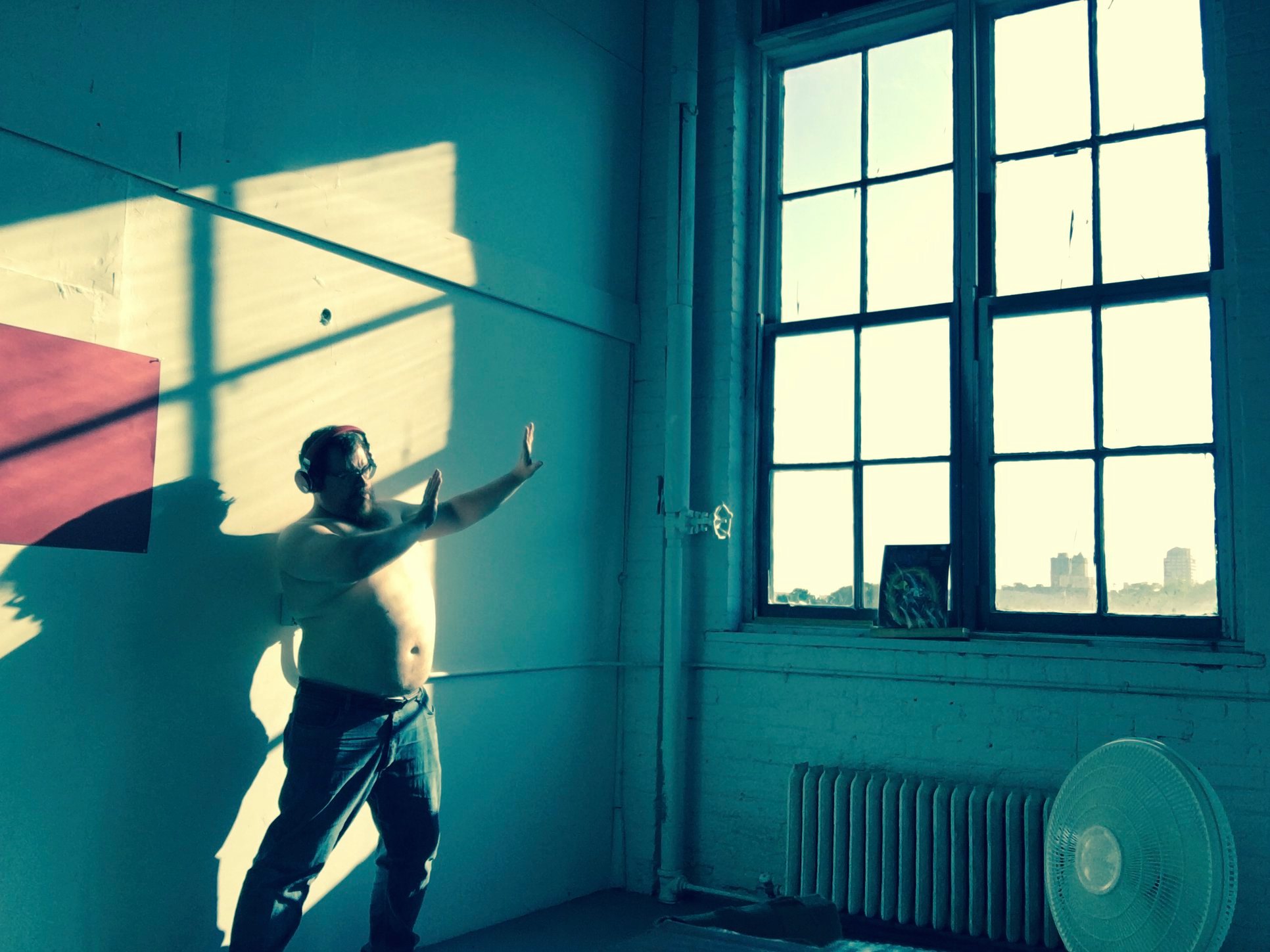
I had a little art studio for one year. A place for all my paints, my canvases, my artistic dreams. A place to be alone, to create masterpieces, to rock out to music, to be myself, to grow and learn.

Then, a year later, the art studio was completely erased, as if it had never been there.

All the walls were taken down; the room became a much larger gallery. You couldn’t find it if you didn’t know where it had been. If you didn’t know my window, you couldn’t see any fingerprint of where I had been.

While the studio was there, that brief year, it changed my life. It gave me a better understanding of my body — something I had never really seen before. It gave me back my sexuality — something taken from me by evangelical churches. It let me see myself as a work of Art — something I never would have believed.


While I struggled to create art, the studio worked on creating me.

For decades, Front Street Studios in Dayton, OH, had used an old Singer Sewing Machine factory as living space for artists. A set of imposing red brick buildings, some two story, some three, with giant fifteen foot windows, sat next to a very active set of railroad tracks, with a river not far away. Over a few decades, the old factory had gone to seed, become unlivable, a place for drug deals and fire hazards. A few years before I got there, it was taken over by new management. The new owners cleaned it up, bought out whoever was still there, and turned it into studio spaces for artists, with open studios twice a month where people from Dayton could come through, wine in hand, and visit your studio and buy your Art. The new owners brought in live bands outside, sold burgers and hot dogs on those open studio days. You’d never have known the place was abandoned and trashed just a few years before.

Continue reading

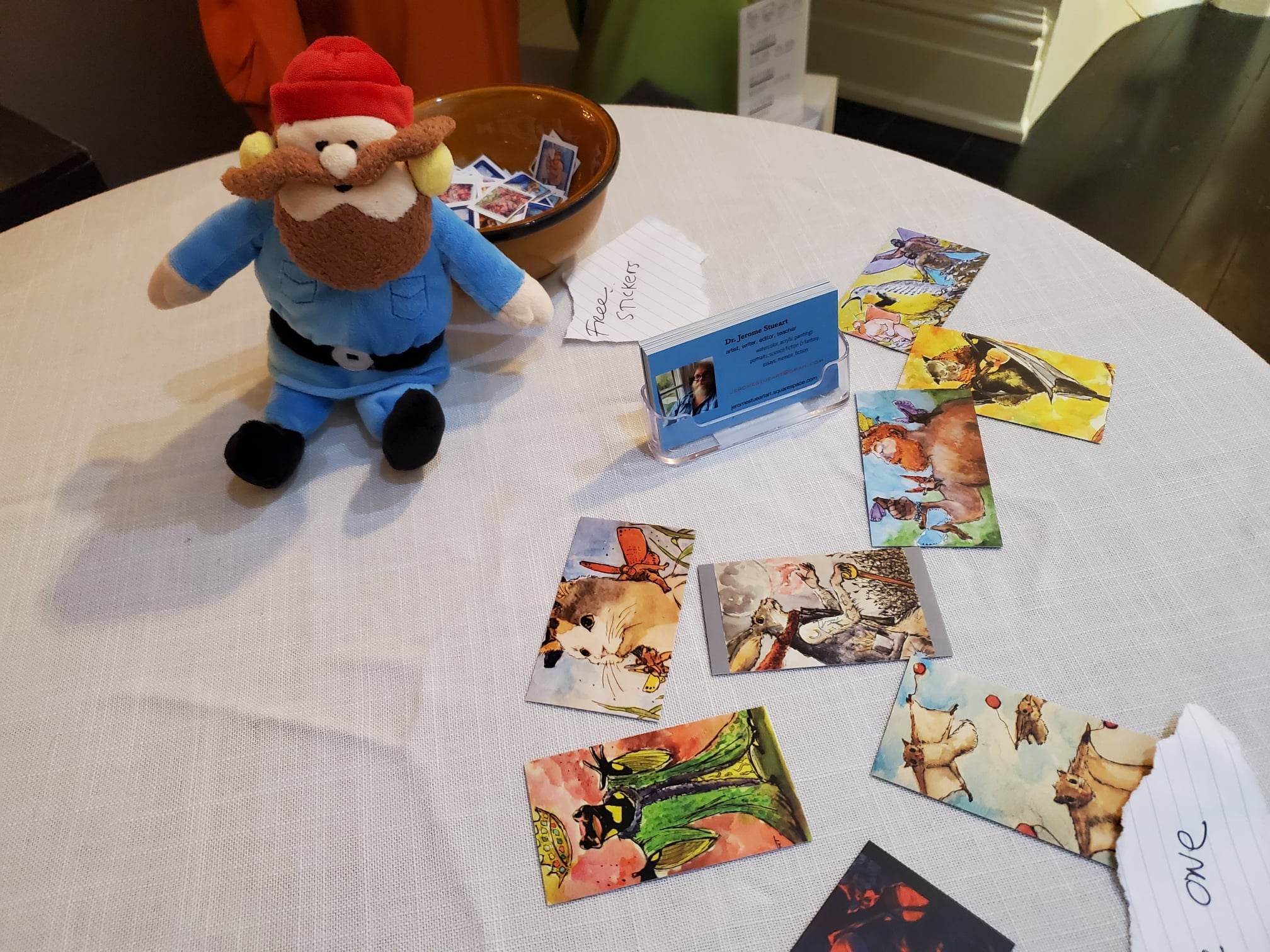
Greeting Card SETS for SALE: Fairies and Yukon Cornelius


Would you like to purchase a set of greeting cards made up of designs from the “Yukon Cornelius” series or my “Hairy Fairies in the Garden” series?

I sold these 5 for $20 at the show, allowing people to mix and match. Now I’ve made sets of them for you to buy and lowered the price.

I have 5 sets of 10 different cards (with envelopes) for purchase below. You order them through me. One set of 10 is $35, 2 sets are $60 ($30 a piece), 3 sets and above are $28 a piece (saving $21!)

Cards are 4.13″ x 5.83″ | 16pt paper thickness. I will use a rigid envelope to mail them in, or if multiple sets then a cushioned envelope. Allow 3 weeks for delivery.


EMAIL ME:


Specify which set or sets you’d like to buy, then use Paypal or Zelle or Venmo at that same address to pay for the cards. Please add $5 for shipping and handling if in the US, $10 if anywhere else. All prices are in USD.
______________________________________________________________


YUKON CORNELIUS SET 1: 10 cards and envelopes, $40.

Yukon Cornelius SET 2: 10 cards and envelopes = $40


GET READY FOR SPRING WITH THESE HAIRY FAIRY SETS OF CARDS!

FAIRIES SET 1: 10 Cards and envelopes = $40

FAIRIES SET 2

FAIRIES SET 3

Thank you for your continued interest in my work, and I hope you enjoy these sets of cards!

The Solo Art Show, “The Further (Queer) Adventures of Yukon Cornelius” was fun—and successful!

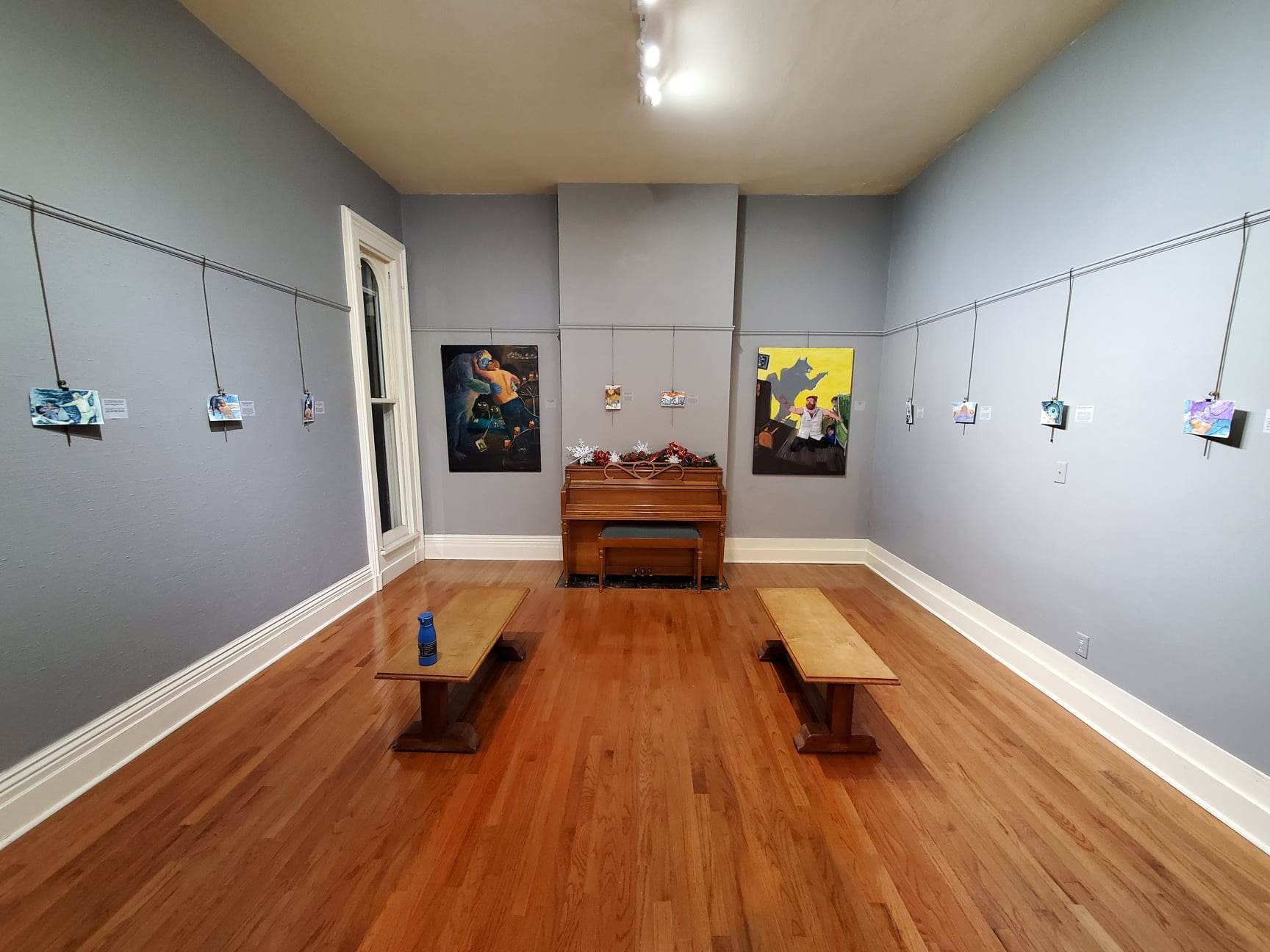
We had a great time putting on the show for you, December 15-18, at the Dayton Society of Artists. We put up 50+ paintings, some of which you can see here below, we had refreshments (thank you Donna for banana bread and pumpkin bread) and I gave an artist talk (that has been recorded so I can use it as a video). We sold 16 paintings from the show, and 91 art cards! WOW. Thank you, Dayton! Thank you for everyone who came out and enjoyed the show. I heard many people say they would buy a book of this show and I want to do that too! So I’m looking into possibilities.

I swear people came to the show, but I didn’t carry a camera with me to take pictures…. I was chatting with them and being a host. The pics look a little empty but actually I think 50-70 people saw the show over the four days.

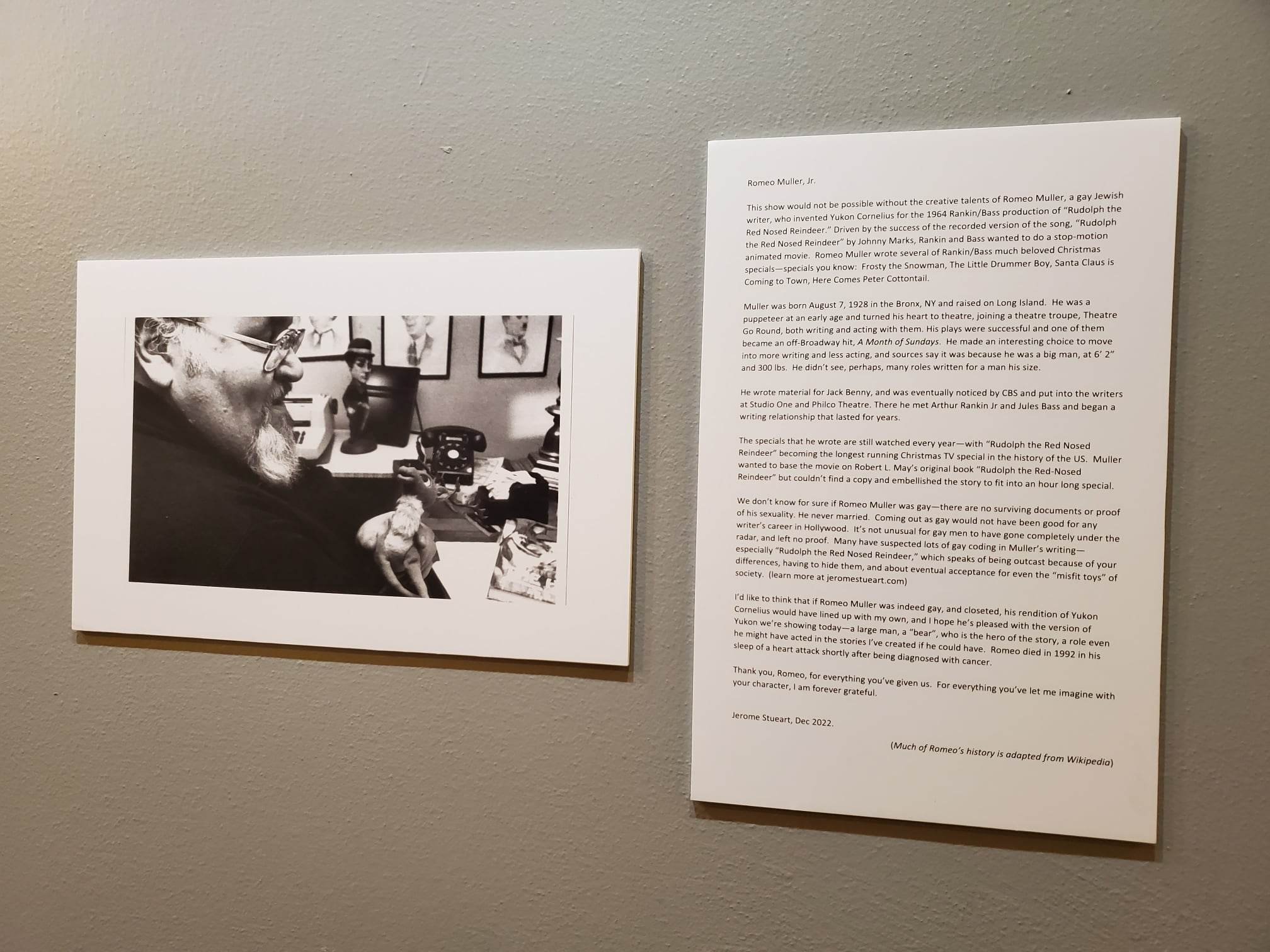
We also made a Dedication wall to Romeo Muller who created the character, Yukon Cornelius, and wrote the TV show script, “Rudolph the Red Nosed Reindeer” from the Robert L May poem/story. Without him, the show that I created wouldn’t have been the same–or it would have had different touchstones. What I created on top of his character— a whole queer life for Yukon— went far beyond the character as written. I barely referenced the show in a vague way…. but I know the character touched many people and being able to bring out, perhaps, some of the nuances of the original script from a gay, Jewish writer. I’m hoping that he liked the version of Yukon I crafted. We transformed the character but I believe some of the seeds were already there.

Thanks, Dayton Society of Artists, for helping me put on this show! If you ever want to chat with me about renting the DSA gallery and what that experience is like, let me know. I will tell you!

November 29:  Friends come over to chat with us in our bedroom

Someone is a visitor; someone else is visited.

Understanding that Yukon and Bumble’s bedroom is their former living room, you can see why they might also entertain friends and guests there. Anyone with a studio apartment might know what I’m talking about too, as your bedroom is the living room and kitchen too.  But doesn’t this remind you of when you were living with your folks?  When I was a teen, having friends over meant having them in my bedroom. It was the only place with privacy, and it felt too formal to meet “in the parlor” (I never had one of those anyway!) or in the living room. We wanted to be able to talk to each other, laugh, look at my Stuff (comics, art, computer). Okay, technically I had no friends in high school, and no one came over to see me, but YOU all did, right?  My brothers and sister had them—and they all met in their bedrooms.  And from watching TV, I know this is what kids do—they live in their bedrooms with their friends.
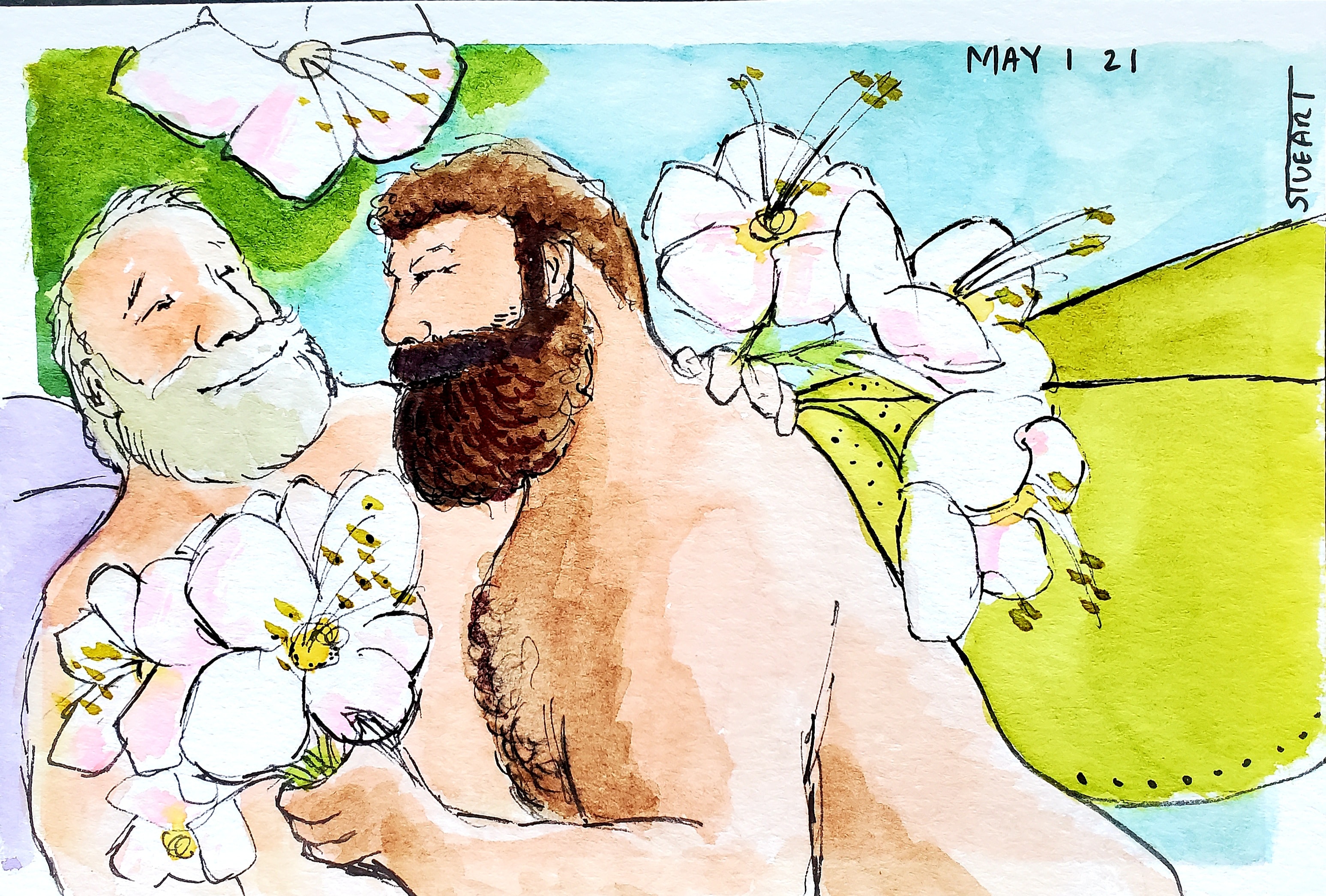
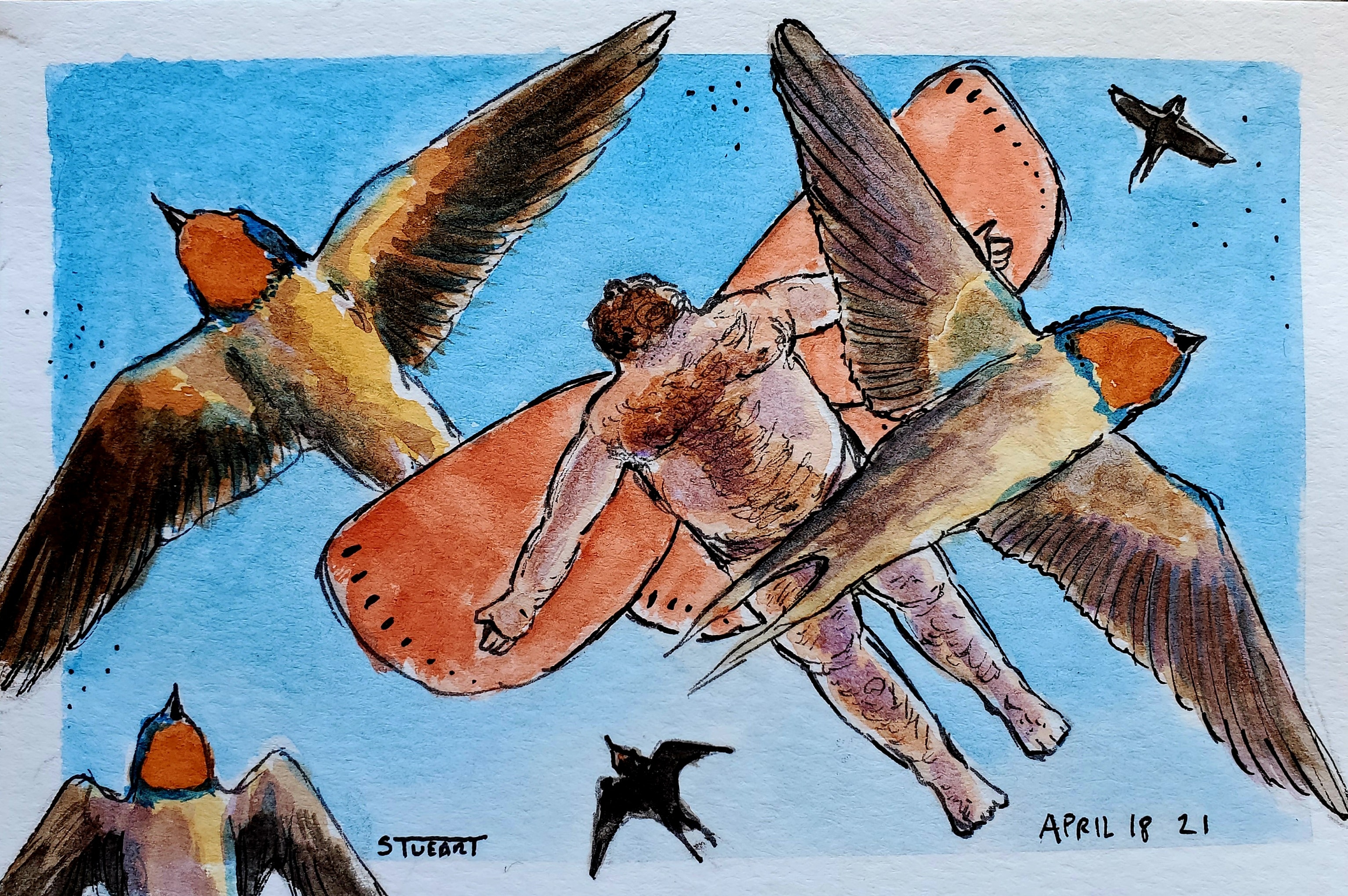
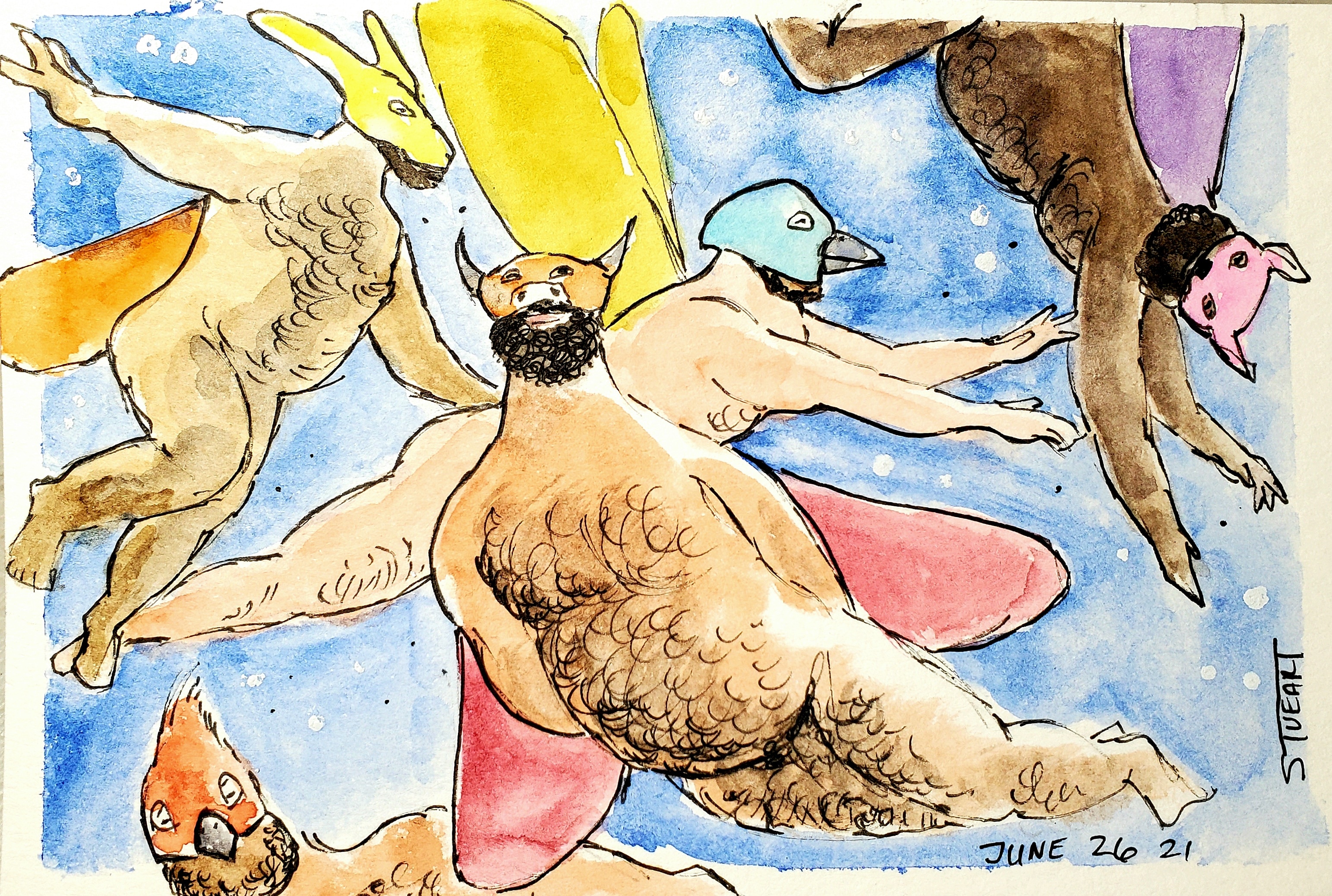
Here is a hairy fairy seated comfortably in the garden-gloved hand of Yukon. (As you might remember, there were a few ginger-bearded fairies with red butterfly wings in my fairy paintings from last year). He’s come over to chat.  If you also recall, these fairies are in a special place that doesn’t connect well to the rest of the world, and they were also afraid that they might get lost if they ever left their own protected garden.  But sometimes it takes a brave soul to try— and be the explorer, see what is out there, and then attempt to get back. Sort of a Fairy’s Hero’s Journey!

Who said there were only two stories in the world: someone comes to town, someone leaves town? (I know Cory Doctorow has a novel by that name!) Someone gets a visitor, someone is a visitor. While I may not have had many visitors growing up or later–I have been a visitor many times. Let me tell you how much joy there is in visiting someone at their home. (I miss it. COVID sucks. )

I am so grateful to have been invited into so many homes, so many living rooms, given coffee or water or tea or pop, or food, and had great conversation for hours.  I know the most amazing people! I always felt welcome.  I always felt loved.  I feel very blessed to know good people. I like being able to see people in their “natural habitat.” LOL.  We don’t get to decorate the outside world much–or put in it what we would enjoy–but a home, and a bedroom especially, is very reflective of the individuals who live there.  (I’ve barely tapped what is actually IN Yukon’s and Bumble’s bedroom/living room besides a HUGE bed, some chairs, dresser, and some paintings done by Bumble.  I didn’t see much of Yukon in there…  I need to talk to them about being a bit more even-handed in the way they decorate!)  You can tell a lot about a person by what they have in their living room–and what they have in their bedroom? Are they different things?  Since the bedroom is usually more private–what do we have in there for decor?  As a teen, of course, your bedroom always reflected you–posters of your favorite movies, crushes, heroes, musicians.

What is in your bedroom that reflects you?  (I move so much and live with so many people that lately I have not had a bedroom that reflects me as much..,)  When I had a bedroom, I did have paintings that I made in it. I also had paintings by other people.  I also have a special “chest” of what I think of as sacred pieces— little things that have meant a lot to me over the years that I collected in one place… gifts others have given to me, or little things that remind me of them. I keep them all in a special little chest I picked up in a Tuesday Morning once.  It is made, I think, for a young girl and it has written on it DREAMS, ADVENTURE, with clouds and maps and things in purple and pink and cream—but I liked it! lol.  This chest though, meant that I could make my Room MOBILE. I could always put my “things” in my new room, wherever I was, and make it feel like me for whatever time I was there.

I hope this fairy has a great time visiting Yukon and Bumble and that they can show him how to get back “home” so he doesn’t have to think of visiting others as the consolation for never having a home again.  I would love for him to tell the others that it’s possible–if they want–to leave and come back again.

I hope one day to have a home where people come and visit me, so that I can return the favor of being the guest, the visitor, in so many other places.  I hope to see you all again soon.  I also hope YOU have visitors who come to you and give you joy. I hope you are visitors to others to bring your joy to them.  I hope you entertain and are entertained this holiday season. I hope you know what it is to be the guest, to be the host, and to savor both those opportunities to know other people.  Love generously. Befriend hugely. Spread love and joy.  We need to spread something good this year.

November 28:  Just what kinds of possibilities are we letting into the bedroom?

Our bedrooms are private vaults–we keep our secrets in here. We only show them to people we trust. We don’t let just anyone in. Safe to be ourselves in our room, we relax knowing we are in a private sanctum. This room is locked tight, we think. Except… that balcony… that window.

“What is happening in this painting, Jerome??”

Why is it that, in movies, supernatural entities all seem to have a key to every balcony door and bedroom window? The strange things enter in through windows of the bedroom–whether it is Dracula at the balcony of Mina’s bedroom, or Frankenstein entering through the balcony to kill Victor’s wife, or George Hamilton’s Dracula in the 70s alighting on Susan St. James’ balcony saying with a sly smile as the breeze pushes the curtains away, “With you, never a quickie. Always a longie.” It is the beating on the bedroom window of the gnarly tree in Poltergeist, the giant vulture who brings a cage every night to the balcony of Andromeda to carry her away to see Calibos in Clash of the Titans, The Snowman coming to take James on a magical flight to the Arctic, Romeo climbing up to see Juliet, Aladdin alighting on Jasmine’s balcony, Salem Lot’s child at the window, Phantom of the Opera, Peter Pan, Wynken, Blynken, and Nod.

The bedroom, inaccessible? Every rogue, bandit, and monster knows how to get into an upstairs window! These three moth men have no trouble. Maybe Yukon left it open because it was hot. It makes sense that horror movies capitalize on bedroom windows–the only way into our security from the outside. But erotic and romantic stories also play with balconies–as the passage into the forbidden room, the access to the Lover that bypasses the guards, the parents, the doors. Romantic fantasies quiver on the possibility of love working hard to find us, especially when we’ve failed to find love before. Fantasies use them as launchpads and gateways to the mysterious and wondrous waiting just outside. “I can show you the world…”

Are we frightened or intrigued by these access points? Something has gotten in and sees us–sees the private things we hide! Oh my. Just what kinds of things are we letting in to our bedrooms?

Our thoughts are the real access points–the other window into our rooms, our sleep –and those we can control, sometimes.

***

I’ve had a lot of bad dreams and scary moments in my bedrooms. Being a sensitive, imaginative kid, I experienced my share of nighttime paralysis where I would see things in my room that would frighten me–still frighten me. Heads rising up the wall, children coming in and out of the closet, covers being pulled off by invisible hands. I’ve heard voices in my room fly down from the ceiling and whip past my ear telling me I was not safe. It looked like a fortress, didn’t it? Who let these things in?

However, I’ve also had some good dreams of someone coming to take me on journeys, flights, or back up to the Enterprise to live my new life. I’ve imagined lovers, or werewolves that just need a place to stay until the hunting party leaves the forest, or angels watching over me, or fun dreams of wandering through castles, or dogs that I know from the past finding me. Some of us pray in our bedrooms, allowing a safe protective spirit of God or Spirit to enter and comfort us. We want to have good things in our dreams, our thoughts, our hopes! We want to imagine the positive possibilities. We want to have choices about what gets in–what gets access–who sees us–what gets barred.

***

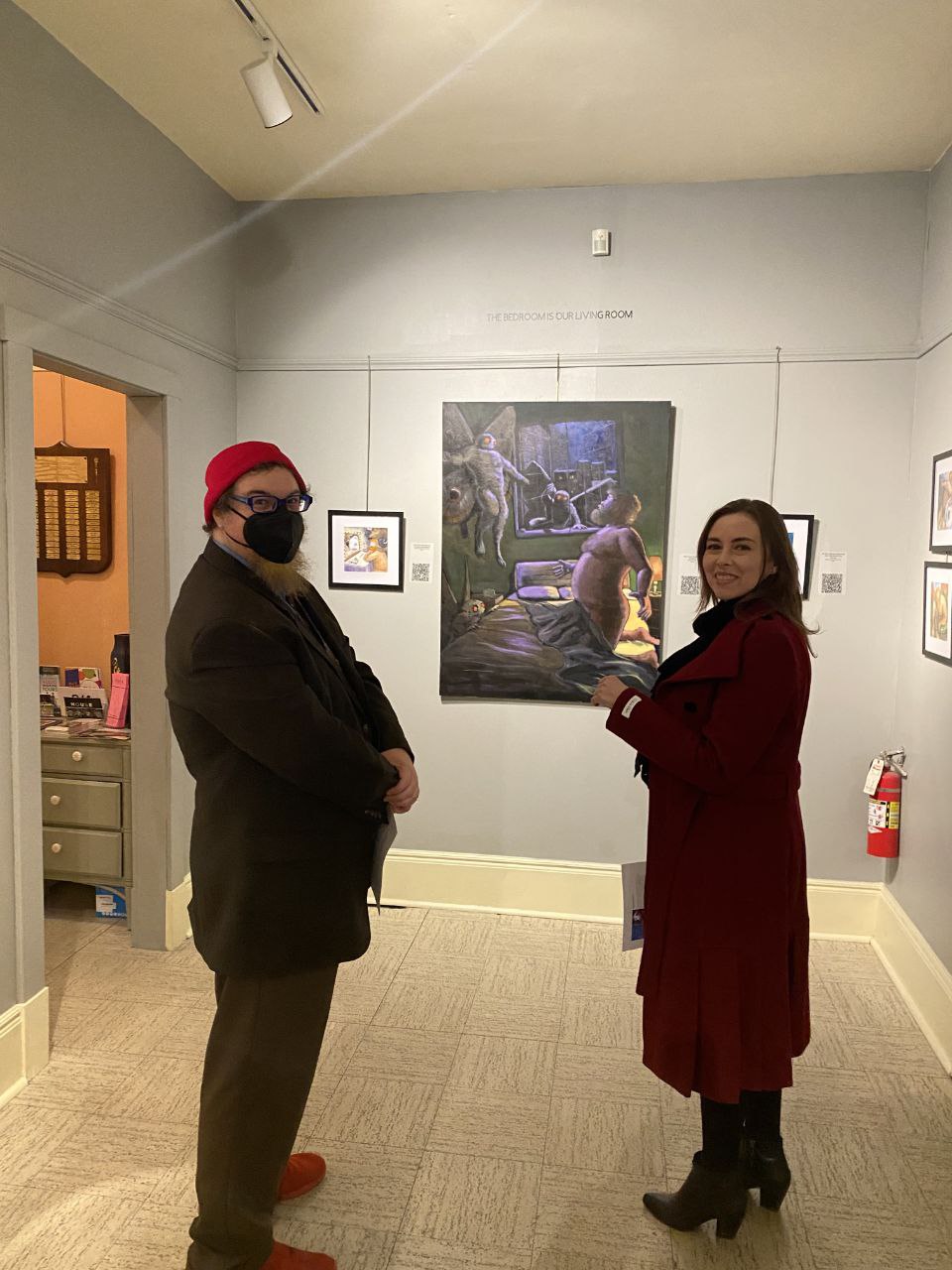
This was my second painting in the Yukon series, back in art school. The surprise on Yukon’s face! The three moth men coming in through the window to scare him?? to cuddle with him?? I got a lot of kidding by my fellow artists about the magically-supported sheets up against his legs. I swear I just didn’t get the folds right, and now it looks like something else is holding them up. How much fun it was to create this painting!–kind of a taboo for me to break. A giant naked man. My first. I still get asked if this is my body. Why do people want to know? That’s a very private question! I think they want to know because they assume I’m making the private public and that I want public question about what should be unknown. They think they’ve seen something private from my bedroom. They think I’ve given them access to a private fantasy! HAHA, they say! I’ve let them in. Any question is okay now….

Well, mothmen coming in my window, hmm; it is a nicer thought than the fears I used to have about things in my bedroom. I used to be afraid to go to sleep because of recurring nightmares. But I’ve gotten into the habit of thinking of awesome things happening–or reading happier, cozier, fantasy books before bed, or watching something light and fun before I sleep. I fill my room with fantasy and imagination before I sleep. I laugh.

Our dream life and our fantasy life need to crowd out our Fear life. If we have to think about the future in the face of the unknown, let it be warm, inviting, magical and mystical things that mean us no harm. The fantasies (or horrors) we allow into our minds color the way we experience the world–as a place of hope or harm around every corner. They can give us good sleep or no sleep. I choose to believe that there is hope around the corner because I want to open up my window to the fantasies and the magic and be vulnerable to the possibility of joy.

May good thoughts and good fantasies fill your minds and rooms this holiday season!

____________________________

This is part of the “The Bedroom is Our Living Room,” as part of “The Further (Queer) Adventures of Yukon Cornelius” series of paintings I did, reimagining the prospector from the Christmas special as a gay man whose whole life is helping “Hiddens” (or as other people put it, Monsters) as they adapt to life in a world of often fearful humans. My way of talking about queer issues and queer life.

November 30:  We take care of each other in the bedroom

When I was a sick kid, I would stay in bed and my mom would put a plastic cup of 7-up and a wrapped stack of saltines by my bedside. She would often come in, sit beside me, and take a cool wet cloth and press it to my forehead.  That cool damp cloth absorbed all the heat. That sensation lasted much longer than is physically possible from a wet cloth because her presence was really doing all the absorbing. 

The bedroom can be the place of recovery. Studies show that sleep heals. Getting enough sleep is important to proper brain function, but also helps the body do its work while we are busy dreaming.  But in case of a greater illness, the bedroom is where we gather our strength among all our sacred and familiar objects.  Many of us have spent quite a long time in our bedrooms feeling sick, especially these last few years.  Except, with COVID, it was difficult to be able to tend to each other because it was highly contagious.

During the plague in the Dark Ages, people who tended the sick, or stayed with those who were dying, would catch it and bring it back with them. They didn’t know how it was spread.  Our very acts of compassion and community were being attacked. Still–(though not the plague)–my mom would stay with me through the flu or strep throat or whatever else knocks a kid off his feet. She endangered herself in order to care for me.  I don’t remember if she ever caught the flu from us. I don’t think so. But she didn’t know she wouldn’t.   

No one likes being sick. Some of us don’t like to bother the people near us with our sickness either–we choose to bear it alone so that no one has to be endangered because of us.  Deep down, though, we want someone with us–someone who doesn’t mind us at our worst, or helpless, or dependent.  These are traits that are so strongly hated in America today that we are embarrassed by our need and desire for each other.  But we ache with needing each other too.

I remember every person who stayed with me when I was sick.  I have forgotten a LOT of things… but I remember Dave in the ER when they couldn’t find a good vein and poked me three or four times in each elbow and on both hands and how I cried.  I remember my mother standing beside the dentist when I had three wisdom teeth removed. I remember Doug who sat most of the night with me as I dealt with kidney stones in the ER of Whitehorse Hospital. I remember the first doctor who gave me lots of morphine when I had my first kidney stones. Thank you thank you. I have a skill at making them. (I should sell them!)  My Dean of Student Services followed the ambulance when I had a panic attack (which we thought was a heart attack) in college. He was there when they told me to breathe in a paper bag after all of that drama and fuss. My heart remembered these people staying with me when I was hurt.  

It seems like such a small thing, doesn’t it? To sit with someone. To be with someone.  Not to entertain them, but just to endure with them the space of time that hurts.  That time counts.  It means everything.  Maybe we don’t feel abandoned. Maybe we feel protected. Maybe we feel safe.  But that presence beside us when we sleep binds our injuries, holds our bodies together, so they can heal.  

The bedroom is a place of healing. And caregiving. And love expressed through easing each other’s pain.  We hate when it happens, but it does open up a way to love each other that no other moment offers. It does not embarrass us to see each other dependent or make us hate them.  Instead, it makes us value each other more, and each other’s health more. For a fortnight, we become a sentry, guarding each other, fighting off the illness together, till stealthy health comes sneaking back through the gates again. 

November 27: We are sometimes by ourselves and sometimes lonely and in our bedroom

Not every moment in our bedrooms is filled with Joy ™ or Love ™ or Companionship ™. Those we love and care about could be far away from us for a while. I know that Yukon and Bumble both have, sometimes, long assignments apart from each other. This can turn into a lot of long-distance conversations over a laptop or phone, lots of pizza, soft drinks, feelings of loneliness. How do we cope with missing someone—or not having someone?

Here are ways I’ve found helpful to keep long distance relationships going—and they can fluctuate between being together and enjoying being apart. I find if I balance those two things, it helps both of us. We need other ways to be happy outside of the relationship (that took me a long time to understand). These are just my suggestions—and I’m sure others have great ideas too. These may not work for everyone.

How to be TOGETHER, even apart:

JITSI/ZOOM/SKYPE/FACETIME: at least once a week, we try to meet in realtime on a video to talk to each other.

When we can’t or don’t have the time for ZOOM/SKYPE/JITSI, we use Telegram to send pictures, and write notes and send Voice Messages. We find Voice Messages to be the most effective way to communicate back and forth—you get to hear the full idea of your partner and then respond. We find that if it’s more than 6 min it looks scary—so we try to break it into parts; also if it does get above 6 min, we say “12 min message coming, all good stuff” so that no one thinks there’s a hard discussion hidden in there.  We often share really deep stuff in voice messages—because they are like mini essays. And this encourages the other partner to share too. We also sometimes tell each other collaborative stories (because we both love scifi and fantasy)—that are just plain funny, or sometimes titillating. Sharing in a collaborative story can be very bonding.

If we have to have a hard discussion we NEVER use voice messages anymore… it’s too easy to rant, or to get longwinded or to misunderstand and then be 12 min behind the problem moment. ALWAYS CALL if there’s a disagreement… so you can talk it out together.

We watch movies or TV shows together—but apart. So we time when we’re going to watch a show we both like—and then we watch it together separately (not on a share program, but just both hit PLAY on Netflix etc at the same time) and then we send each other Voice Messages to discuss it!  We did this with Andor and House of the Dragon.

We try to hear each other’s voice or see each other’s short video message (Telegram has 1 minute video messages) every day. Seeing a face, a smile, and hearing a voice can do wonders.

We send each other articles that we think the other would love (but NOT articles that “prove our point”—that doesn’t seem to be good.)

We send photos about our day. We share messages about our agendas for the day. Mundane, yes, but relationships are built on mundane stuff too.

We try to get to see each other physically at least once every 3 weeks—but we know that’s not always possible for everyone. We live 6 hours from each other. We have gone as long as 2 months without being together physically. It’s doable. But it takes a lot more screen time and message time.

We rarely use email—and he doesn’t have social media, so facebook and Instagram, etc are not on the table. So you may use these too to stay in touch with your partner.

How to ENJOY Being APART:
I date myself when I’m alone. It’s like self-care—but with LOVE and INTENTION to make me happy.

I save good movies that I like and my partner isn’t into for times when we’re apart.  I’m a big Marvel fan and Disney fan, so Disney + is a feel-good channel for me. Also Netflix and HBO Max. We both love Indie films so I save those for when we’re together… but Moon Knight and She-Hulk and the Guardians of the Galaxy Christmas Special are for moments by myself. I watch all my Tarot and Astrology and HOW TO ART videos when I’m alone.

I listen to my music. Sometimes loudly.

I work on pet projects. I have art and writing to get done. I do that when we’re not able to be together. (But I also do some of it when we are together, if I’m going to be with him for more than a couple of days.) I get to stay in my studio for 7-10 hours a day!! It’s fun!

I see Museum Exhibits, go to Coffeeshops, walk in the park—do things that I LOVE doing alone. I sometimes send him pictures of it afterwards, but I try to value my alone time too.

I buy foods that I love. I give myself little gifts of food—usually involving chocolate!

I buy myself little gifts online or in stores, when I’m in a store. Just something I know I will use or love. Like new paints (if I can afford them) or erasers!I read when I’m by myself. I love being able to be involved in a book. Deep and undisturbed. I may only be able to do this apart from my partner.

I call other people—my mom, birthmom, friends, or write them—or I arrange to have coffee with them or hang out with them. My partner can’t fulfill all my desires for company and conversation and friends are awesome. Having time with other people keeps us from also being “lonely.”

Church and clubs—if you have a social group outside of your relationship, it can help strengthen your resiliency when the two of you are apart. I always feel better knowing when my partner is visiting friends, his family, or is part of a group that is meeting. Then I know he is happy.It took me a long time to realize that happiness WITHOUT your partner is not just okay, it is good, and needed.

We may not always get rid of the lonely feelings we have when our partner is not with us—that’s okay. That’s natural. That’s love too. But we can minimize them when they become uncomfortable.  We are fully rounded people with outside interests and ways of getting joy enhances our time together— two people ADDING to each other from all the outside things we do, not just our shared experiences.

Don’t worry, Yukon! Bumble will be back before you know it! Eat your pizza and hang out with the satyrs!

November 22:  We read to each other in the Bedroom

Reading books in the bedroom, with someone you love–either separately, with separate books, or together with the same book is a wonderful strange feeling of being together and being in completely different worlds or sharing a world and leaving this one behind.  You can be engrossed, fascinated, spellbound by a book, and it can also shield you from the outside world for awhile. We probably all learned that as kids.

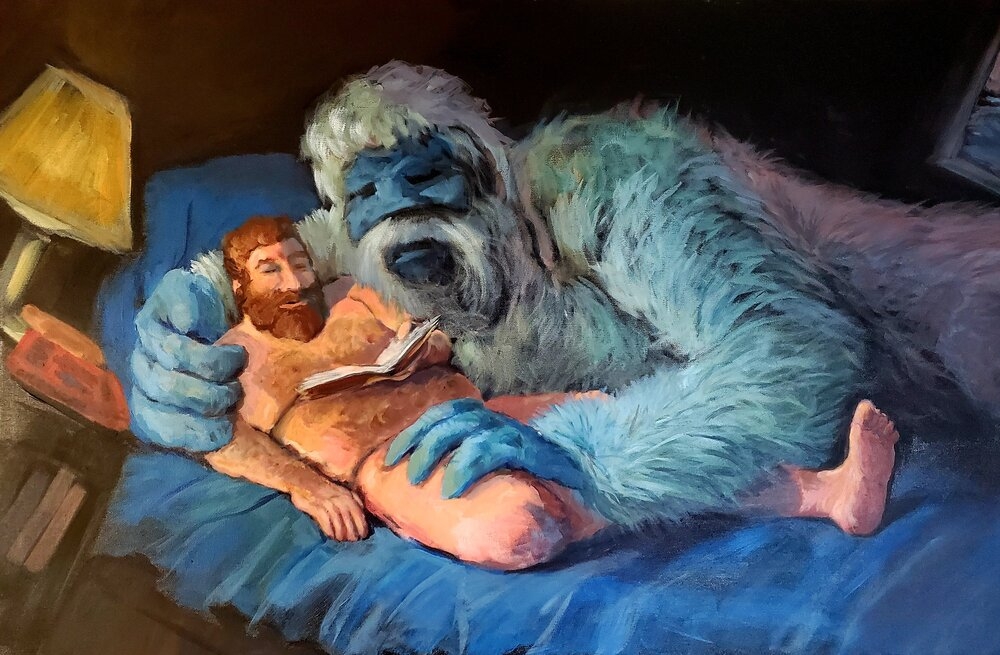
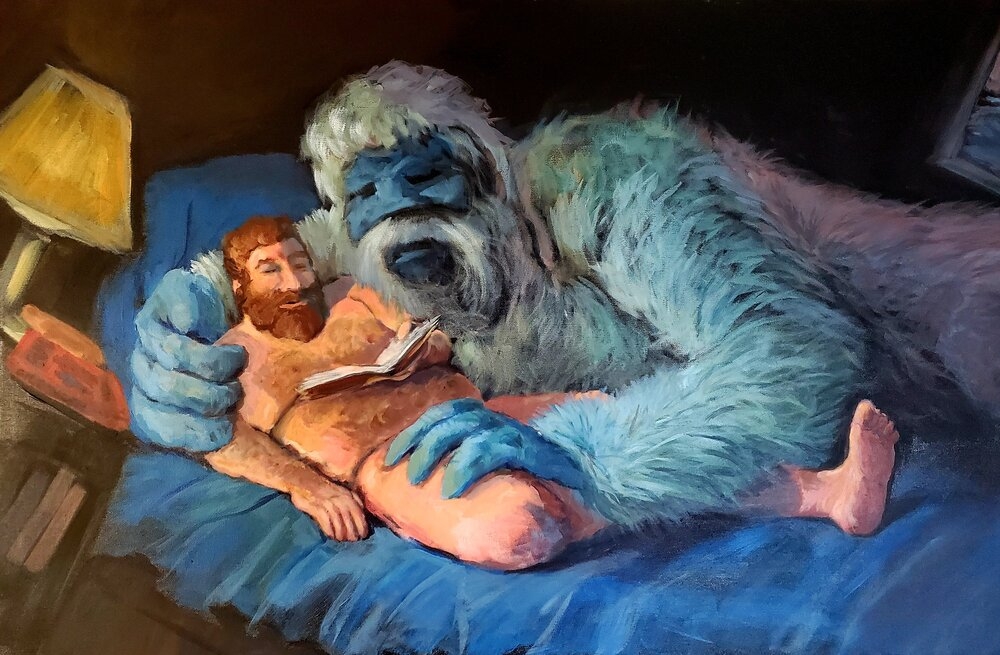
“Yukon and Bumble Reading in Bed” is an acrylic painting I painted in April or May of 2020, at the beginning of the pandemic.  It was one of the last big paintings I painted for several years (certainly the last I would complete –at that time–in the unfinished Yukon Cornelius set). My goal for the original set of Yukon paintings had been 10 acrylic paintings, sized 36″ x 48″!  But here I am, switching to one slightly smaller at 24″ x 36″—on my way, in late 2020 and early 2021, to the tiny 4″ x 5″ postcards I used when I created my fairy garden.  There was just no room for big grand things in a house you are sharing with two others, no money for resupplying paints, but also, suddenly, in a world that seemed to be chaotic, our immediate worlds got smaller, more confined.  I felt the need to go very small…and the need to complete something in a day.  I needed to be pulled in to a fairy garden.  Like one is pulled into a book.

Gardens are not so different than books—both are curated spaces, carefully cultivated, designed even, to produce feelings in someone, to create moments.  Both pull the viewer/reader in, engross them, fascinate them, and keep out the outside world–through boundaries, rules, thematic arrangements for aesthetic reasons.  Books talk about events, people, things and are similar to the real world but in different configurations–fictions; gardens have plants and flowers in different configurations than you’d see in the real world, while keeping the wildness outside the garden. They too are fictions.

Perhaps then, reading is a garden we create in our minds to keep out the wild world. The anagram of “reading” are the words “I, Garden” (or iGarden, if you’re Apple!). We get lost in the carefully planned garden of a book, forgetting what lies outside around us, and we are happy to stay there safe within HUGE walls of dramatic plot and cool characters that block out the rest of the world.  

Look at Bumble in that painting.  He is HUGE, probably 14 feet or more.  As you’ve probably noticed in my paintings of Yukon and Bumble, there is no consistency of size for Bumble. I say Bumble is 10 feet to Yukon’s 6 feet… but the Snowmonster’s body seems to change size with every picture.  However, the Bumble from the Star Wars cosplay painting is about 10 feet. And sometimes, in other paintings, it looks like he’s just 8 feet tall;  his size changes to the needs of my painting and the scene I’m trying to convey.  Just like my paintings moved from very, very large to very, very small to reflect my move from giant, loud, bold feelings to the collapsed, tighter, confined spaces of a small fairy garden in a pandemic–Bumble here reflects my need for peace and safety. He grew like a wall.

There’s a shift in this painting from the others.  All my first paintings of Yukon have him Encountering the Wild, his arms thrown back in wonder and surprise at these amazing “monsters”–a werewolf, a sea dragon, moth men, the Loveland Frogs, or the boisterous Eagle Bar on stage singing with Bumble!  They are loud!  Dramatic!  But here–at the beginning of the pandemic– is a different visual theme, away from large encounters and wonder—to the bedroom—into the arms of Bumble–to reading quietly–to a soft lit room that seems to be presented from multiple perspectives at once, as if the edges are still touching chaos but the center is safe…  we are confined (look at Bumble’s hands almost locking Yukon in place) but protected, in this welcome, warm, loving, plush space of peace.

In 2020, I needed to be in Bumble’s arms, reading a book in peace.  So Bumble was the size I needed him to be– large enough to be a wall, to surround Yukon with his arms, and let him escape the world. Reading can be an act of preservation, of protection. Reading to each other is a heroic act— like the Fellowship of the Ring resting in Rivendell, Mole and Rat at Badger’s House, Mary Lennox in her Secret Garden, Enola Holmes at her brother Sherlock’s house, the House Madrigal…oh look, you came with me to these places. We are there together. Safe for awhile.

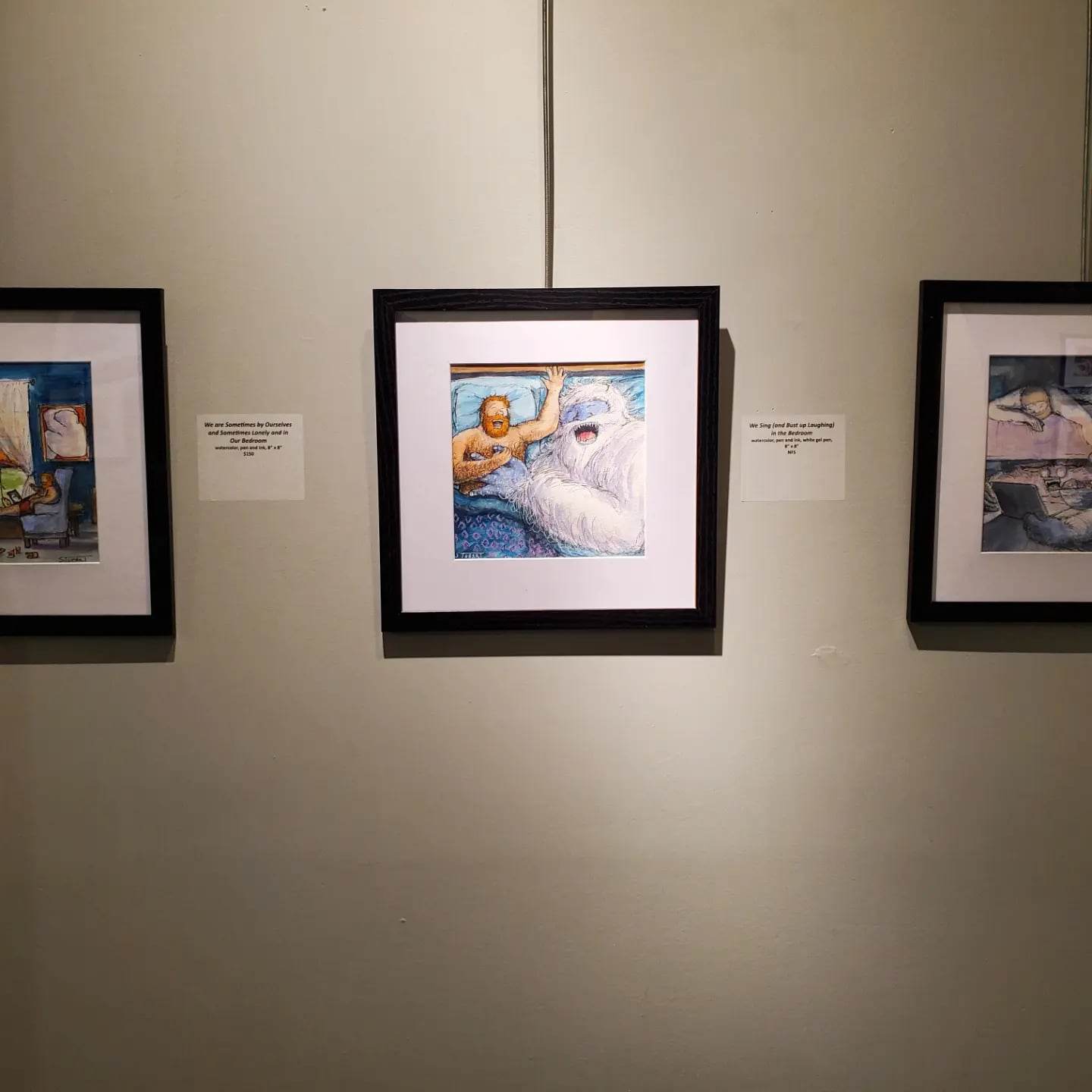
November 21:  We Sing (and Bust up Laughing) in the Bedroom

I had best hits of the 80s playing when I drew this (“I was dreaming when i wrote this…”) so I was singing hard in my studio… and I pray everyone else in adjoining studios was okay with that!  But I know the lyrics to hundreds of 80s songs… embedded in my core memory forever. Not useless data. Valuable data. Shared experience  data.  You know old folks homes for Gen Xers are gonna be filled with the best music.  Nobody will come in there on weekends to play “a bicycle built for two”–they’ll bring in a cover band and play Journey, “Someday love will find you, BREAK those chains that BIND you!” And all us old Xers will be rockin’ out and singing along.

Do you sing in the bedroom? If you have a partner, do they sing in the bedroom?  Do you sing together in the bedroom sometimes? (I count the shower as the bedroom in some houses!)  Then do you  bust up laughing because it’s so wonderful and funny?  70’s-80s songs, Broadway, Disney and church hymns…. that’s my on-call repertoire. Some Irish ballads… folk songs… and okay, Dan Fogelberg and the Beatles can be pulled up when necessary.  Currently, songs from Nathaniel Rateliff, Rag & Bone Man, Taylor Swift, and Adele run through my head–because they got me through the pandemic by dropping albums into our difficult times like rocks into a still lake. (And now—Sam Smith and Kim Petras’ “Unholy” is so damn catchy, I’ve been playing that over and over while I work on the big King O the Cats painting)  Anyway!  When I have had someone who likes to sing, it’s fun to sing with them. (Some cute guy I know enjoys singing in the car!  And it’s nice to blend with him down the curvy road.)

Where do songs come from inside us? Are they stored with feelings? I don’t think they are in a bin called “music” in our brain because if someone asked me what I know by heart I couldn’t tell you… that file is empty… but let me have a feeling, and wow, I get songs with lyrics that match that feeling flood my brain.  If I hear three notes outside from a windchime–I can sing a whole song in full. Or turn on the car radio and all my notes are there.

There are songs appropriate for every feeling we’ve felt and I thank musicians for cataloguing those experiences and feelings so well.  When I have to clean, I turn on the music to get me happy enough not to mind the cleaning.  When I am sad, I turn on music to purge the sadness, to reflect in it, to bleed it out.  Music puts us on a collective train of a feeling–and the lyrics and our lives merge in the windows of the shared landscape passing by. By the end of the song, we know the singer has “felt” our experience, and we theirs, our shared music of the moment

In the bedroom, we have a chance for many duets. Yeah, our voices aren’t perfect all the time. (But I bet opera baritone Bryn Terfel’s morning voice can be froggy hilarious too!)  But I love my partner’s voice. I love singing with him. I love laughing about how we know all the lyrics, or- or- or- or… stay with me… how I memorized the lyrics ALL wrong… and those can be really funny too.  Music allows us to share feelings– in a way like no other. We are full-throated blasting the Joy of our “Summer of 69” or we are harmonizing and synching in the sadness of our “Mercy Street” together.  It puts us, for a moment, on the same page as our partner.  And they know, even when they can’t express their feelings in words yet, that yeah, we “feel” their music too.