Janelle Monáe and Science Fiction: Metropolis, Freedom, and the Other

I like finding science fiction in odd places.   Janelle Monáe is a genius.  Think if the Archies had been a ska band with a funk lead singer.  But she’s more than that.  She’s also a brilliant storyteller.  Her “Many Moons” reimagines the beginnings of science fiction cinema, Metropolis.  She gives the silent film Metropolis the soundtrack it needed.  For Janelle, Metropolis is about many androids now…and there are comments on slave auctions, blaxploitation, and the lack of freedom–for anyone.  For women, for minorities, for humans in a world overcome by technology.  There is no fear of androids in “Many Moons”—but even I would think that at the corners of the movie Monae makes, there is jealousy at the perfection of the androids, and even a bit of jealousy when Cindy Mayweather erupts in a spasm of freedom, or is it a spasm of realization that she is not free…. all I know is that she breaks loose and begins to dance, dance so high, that she short circuits.  But the crowd is in ecstasy with her.

Monae has certainly looked here at humanity as commodity.  She’s done it with brass.  And artistry.  She’s even mixed in a bit of Sesame Street.

I like finding science fiction in odd places.  And this small film is beautiful.    It’s got solid worldbuilding where she’s imagined, in one scene, the state of society.  The characters all have the hint of well-developed backstories; they have desires, weaknesses, past confrontations.  Cindy Mayweather grows as an android/character.  Her growth, perhaps, comes from her realizations–of the names that keep her as Other.  The names are not androidish—they are names leveled at minorities.  Check out the Cybernetic Chantdown after the break.

Continue reading

The Nudge, The Monument, and The Fan Base: thoughts about the endurance of writers

Roger Ebert responded recently to an article by Cynthia Ozick written in the New Republic.  So goes my reading.  I get my Ozick from Ebert, but that’s ’cause I’m reading where Ebert is writing.  I don’t have a subscription to the New Republic (but, alas, I should).  Anyway, he quotes from her a lengthy passage about writers no one reads anymore.

Death disports with writers more cruelly than with the rest of humankind,” Cynthia Ozick wrote in a recent issue of The New Republic.

“The grave can hardly make more mute those who were voiceless when alive–dust to dust, muteness to muteness. But the silence that dogs the established writer’s noisy obituary, with its boisterous shock and busy regret, is more profound than any other.

“Oblivion comes more cuttingly to the writer whose presence has been felt, argued over, championed, disparaged–the writer who is seen to be what Lionel Trilling calls a Figure. Lionel Trilling?
“Consider: who at this hour (apart from some professorial specialist currying his “field”) is reading Mary McCarthy, James T. Farrell, John Berryman, Allan Bloom, Irving Howe, Alfred Kazin, Edmund Wilson, Anne Sexton, Alice Adams, Robert Lowell, Grace Paley, Owen Barfield, Stanley Elkin, Robert Penn Warren, Norman Mailer, Leslie Fiedler, R.P. Blackmur, Paul Goodman, Susan Sontag, Lillian Hellman, John Crowe Ransom, Stephen Spender, Daniel Fuchs, Hugh Kenner, Seymour Krim, J.F. Powers, Allen Ginsberg, Philip Rahv, Jack Richardson, John Auerbach, Harvey Swados–or Trilling himself?”

Ebert goes on to talk about whether he’s read these authors, and he’s read all but two.  Ozick goes on to ask the question of whose writing will endure?  I’m not sure that’s the question to ask.  After the Library of Alexandria debacle, who can say anything will endure?  But can we say that we affected the minds of those who lived?  Yes.

Ozick determines that Saul Bellow will endure, most because of the Adventures of Augie March, a book I know few of my friends will have read.  I haven’t read it, and I should.  But it did affect a whole generation.  Ebert makes a comment about Hemingway, that we will know him for The Sun Also Rises and his stories, but little else (he’s quoting and agreeing with another friend).  And true, Old Man and the Sea, though the Pulitzer winner, isn’t the book that endures.  It’s his first book of stories, I think, and The Sun Also Rises that continue to be read.

The Fan Base

I will say that in Science Fiction and Fantasy they have developed the concept of the FAN BASE.  And this actually keeps writing, and writers, alive.  JRR Tolkien will endure for a very long time.  So will Stephen R. Donaldson, Isaac Asimov, Ray Bradbury, etc.  The classics of Science Fiction are still being read by the fan base, by those who love science fiction and fantasy.  They are suggesting them to their friends.  They are voracious readers and they claim, quite knowledgeably, that you can’t know science fiction and fantasy without reading this set of writers, or that book, and at the conventions these writers are celebrated.  Even ComicCon has such a large science fiction and fantasy base that these 30,000 people will all know a large set of names, not just the celebrities of the moment, but the masters and grandmasters of the genre.

It could be that you might dismiss the FAN BASE as those who feed on pulp, but I would argue that they know what they like, and they are assisting in the endurance of writers and writing and that cultivating a fan base is not a bad idea.  Further, these “genre writers” are introducing them to many of the great works of literature, by quoting from, giving allusions to, works by other authors.  Many of our first introductions to literature–Shakespeare even–was in a comic book, or in a science fiction novel.  I’m not going to give too much more a spirited defense to the importance of Fantastic Literature, or say too much longer that, before Hemingway, authors had their science fiction novels and their literary novels and no one thought of the books differently: London, James, Twain, Poe, Hawthorne, all had a novel where time travel or science fiction played a large role.  Anyway, I have a larger point to make. Still, hold onto the idea that developing a fan base is important–because a fan base has been enthused by your writing, has been affected by your writing, and seeks to market you to their friends.

Continue reading

“…his cultivation of genuine menace…”: a review of “One Nation Under Gods” at Portal

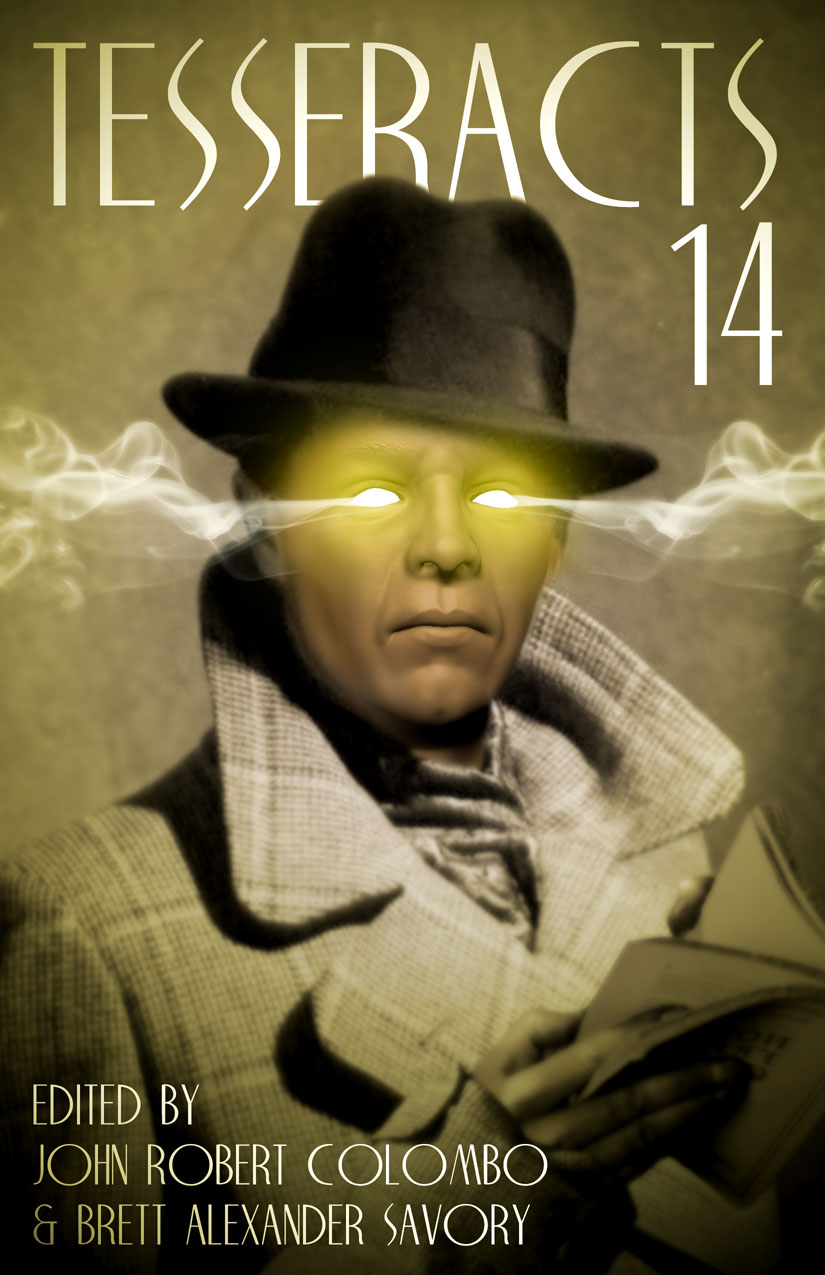
Val Grimm, over at the Portal, gave me a good review for my short story, “One Nation Under Gods”!  Thanks, Val.  I’m always thrilled that there are people who will review short fiction, and anthologies.  Thank you, Val!  Val reviews the whole anthology, Tesseracts 14, story by story.  Here is his review of mine:

The author of “One Nation Under Gods”, Jerome Stueart, emigrated to Yukon from the States in 2007, and his former citizenship is evident in the themes and content of his story. I’m not biased in its favor because of my nationality, nor simply because its dark vision seems in concord with my fears. This story succeeds, in my eyes, because of his detailed worldbuilding, the realistic relationship between the narrator and his sister, and his cultivation of genuine menace, an evocation of the way people can be treated as things. In the world of this story (which in outlook and some tropes puts me a bit in mind of Steve Darnall and Alex Ross’ 1997 comic Uncle Sam) concepts like Freedom and Patriot are incarnate as deities, administered by priests and priestesses, and the Statue of Liberty herself is known to walk abroad. The history of the gods is the history of the country, and its people are required to memorize that catechism or pay with their lives in particularly grotesque ways; if a child fails the standardized test which is a mandated rite of passage, he or she is transformed into a public object, anything from a soda shop to a garbage can. Stueart skillfully incorporates the conflict between individuality and vested religious and political powers; the way those powers can intertwine and what that merging means; the clash between idealism or perception cultivated through propaganda and reality, between history as the study of people in power versus the study of the people’s past; and the transformation of people into instruments, people into numbers.—Val Grimm at the Portal.

The Future of the Yukon (maybe): Radio Series “Yukon 2058”

We hear a lot about the future of New York, of San Francisco, of England.  Ever wondered what the NORTH would look like in 50 years? What would be happening, what kinds of trends here in the Yukon?  What kinds of possibilities?  Is it all going to be dark from climate change, or will we adapt as we go? I think it’s going to be a good Future if we can take better care of the Now.

Three years ago I created a five part series called “Yukon 2058” for the 50th anniversary of CBC.  They wanted something that celebrated their first 50 years, so I offered them a look at the next 50 years.  My theme was to eventually come back to why CBC is important, why local programming trumps National programming, why having a large staff in a small place like the Yukon is important.  I tried weave my opinions about what is good about CBC, and what is bad about the trends happening to CBC, into a narrative.  Yukon 2058 is the result.  5 parts.  The narrative of a CBC reporter wondering what his future will be, trying to find where he belongs in a rapidly competitive market.

You can go to the Radio Series page and look under YUKON 2058.

________________________________________________________________________

*image is Joyce Majiski’s “Racing Uphill.”  See more of her work on her website.

What if you knew the Internet would be gone next week?

I was thinking about how much I live a web-life–the articles I read online from newspapers I subscribe to online, the contact I keep with people online, the deals I make online, the shopping I do, the uploading, the downloading.  We already have virtual lives.  We don’t need Second Life to show us how to be an avatar; we are already avatars in our own online worlds.

But what if by next week you knew there would be no more Internet? No more Facebook.  No more Amazon.  No more NY Times on the web.  No more getting your news there.  No more Youtube.  No more buying on iTunes.  No more Skype.  No more sharing lives this way.  No more information.  No more wikipedia to answer questions, or health sites to give you info.  You were restricted to the former ways of staying in contact with others, the former ways of looking up info, the former ways of living.  Welcome to LudLife.  You would still have a computer–it just wouldn’t be connected to a network.  You would still have a phone, but not a smart one.  There would be no texting.  You would have to talk.

If you knew this internet shutdown would happen on March 31st, what would you do between now and then?

Continue reading

Mac’s Fireweed, Noon, Saturday, signing with me and Dave Strachan

Thanks everyone for coming out and being a part of our signing at Mac’s Fireweed!  Two anthologies I’m a part of: Tesseracts 14 and Inhuman, and Dave Strachan, who has the lead story in Inhuman, was signing too!  The Fantasy/Science Fiction community in Whitehorse is doing great!  More and more of our group are stretching their talents and skills, and turning out great stories and sending them off to publishers!  So happy that this is happening in Whitehorse!  The Yukon is building a presence in Canadian Science Fiction and Fantasy.  Oh YEAH!

Tesseracts 14 and Inhuman are both published by Hades Publications and Edge Science Fiction and Fantasy Publishing (for Inhuman, through their imprint Absolute XPress).

Here’s photos of us at Mac’s Fireweed, Saturday March 12.  See if you can recognize all the campadres who helped make it a great event…


Moose, Cranberry, and the Everlasting Dinner Party: The Boreal Gourmet, cookbook, by Michele Genest

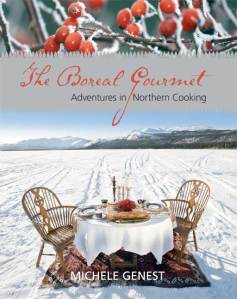
You’ve already seen the wonderful wildberry sourdough muffins recipe which I so tantalized you with (permission granted by Miche).  Now experience what cooks and connoisseurs are talking about in The Boreal Gourmet: Adventures in Northern Cooking by Michele Genest.  The book is more than a cookbook–it is a memoir of the cooking experience, the preparation, the friends, the mistakes, the surprises, and what might be an everlasting dinner party from recipe to recipe.

The Boreal Gourmet is a unique cookbook, with recipes that utilize all the cool things you’ll find walking around or rooted to the ground in the Yukon, but it is also a bit of Yukonalia.  It is a portrait of people living, and cooking, and eating and enjoying life, in the north.  From Geist’s review of the book:

I’ve always felt the best cook­books are the ones you open with the inten­tion of a quick browse but find your­self read­ing cover to cover and com­ing out the other end feel­ing like you’ve attended an inspir­ing din­ner party hosted by the author — with­out leav­ing the com­fort of your arm­chair. Michele Genest’s The Boreal Gourmet: Adventures in Northern Cooking (Harbour) is just this sort of cookbook. The nar­ra­tive that accom­pa­nies the inven­tive recipes oscil­lates from bush sur­vival advice to per­sonal mem­oir to his­tor­i­cal anec­dote (Klondike hope­fuls brought sour­dough starter buried in a sack of flour with them over the Chilkoot Pass) and is sim­ply a lovely read. The recipes them­selves range from the more gour­mdet — Arctic Char Poached in White Wine, Gin and Juniper Berries — to the less gourmet — Moose Lake Lasagna in a Pot (com­plete with tips on how to cook it in the backwoods) — and are com­ple­mented by Laurel Parry’s endear­ing hand-drawn illustrations.

Continue reading

Wildberry Sourdough Muffins recipe from The Boreal Gourmet, by Michele Genest

Breakfast-eaters, snackers, hangers-out:  it’s time to reclaim the muffin from the fast-food joints and even from the groovy independent cafes.

_____________________________________

Like the picture?  Get more recipes like the one below from our very own Yukon Boreal Gourmet, Michele Genest.  Her book, the Boreal Gourmet, just got a nice, nice, tasty review from GEIST.

_____________________________________

Muffins should not be as big as your head, as my friend LP observes. When I was a child a muffin was a 6-bite morsel available in the glass case in the cafeteria or on the counter at the greasy spoon. Now it is an epic that requires a whole morning to consume, and you have to mount an expedition to find the nuts and berries inside. So here are two recipes for muffins of sensible size that feature wild northern berries, are easy to make, low on fat and sugar and bursting with healthy grains. They are similar but not the same.

Low Bush Cranberry Bran Muffins

On a blazing blue day last week I climbed the clay cliffs above Whitehorse and picked a pint of low bush cranberries before breakfast. I came back home with cold fingers and an appetite and whipped up these bran muffins, based on a recipe from that brilliant standby, Joy of Cooking, but tweaked here and there. I’m really pleased with them; they remind me of my grandmother’s bran muffins, for which the recipe is lost (my mother and my aunt have searched their files in vain) and which I’ve been trying to replicate for a long time. Let us sing their praises: light, moist, not too sweet, branny but not too branny and featuring the nice tart bite of low bush cranberries.

Dry Ingredients

1 cup (240 ml) all-purpose flour

1 cup (240 ml) whole wheat flour

1 cup (240 ml) bran

2 Tbsp. (30 ml) sugar

1 tsp. (5 ml) baking soda

¼ tsp. (1.2 ml) salt

Continue reading

Clarion 2011 taking Applications: Science Fiction and Fantasy Writing Workshop

Announcing the 2011 Clarion Science Fiction and Fantasy Writers’ Workshop  @ UC San Diego

June 26 to August 6, 2011

Clarion is widely recognized as a premier training ground for aspiring writers of fantasy and science fiction short stories.

The 2011 writers in residence are

Nina Kiriki Hoffman    John Scalzi

Elizabeth Bear                David Anthony Durham

John Kessel                     Kij Johnson


Since its inception in 1968, Clarion has been known as the “boot camp” for writers of speculative fiction. Each year 18-20 students, ranging in age from late teens to those in mid-career, are selected from applicants who have the potential for highly successful writing careers. Students are expected to write several new short stories during the six-week workshop, and to give and receive constructive criticism. Instructors and students reside together in campus apartments throughout the intensive six-week program.

The application period for the 2011 workshop is December 1 – March 1. Applicants must submit two short stories with their application. Scholarships are available. Additional information can be found at http://clarion.ucsd.edu.

See my Page on CLARION 2011 for more info on what a Clarion can do for you.

Personally, I have to say that the chance to work with Kij Johnson would be enough to make me put on a disguise and go again, though, like Narnia, former Clarion grads can’t go home again….  Kij’s story, “26 Monkeys, Also the Abyss” won the World Fantasy award and was on the final ballot for both the Nebula and the Hugo.  It’s an AMAZING story and just the kind of story I hope to write when I grow up.

What is Realms of Fantasy looking for?

The Clarion Foundation (parent of Clarion Science Fiction and Fantasy Workshop) has a wonderful blog.  Douglas Cohen, an editor from Realms of Fantasy, recently wrote a guest post there talking about the view from Realms of Fantasy, from its long run in the industry, including its two recent revivals with new publishers.  There is some great insight here for those who are submitting stories and poems (yes, they have started publishing poems).  Here’s just a snippet, but the rest you can read on the Clarion blog.

1)     Fantasy is a broad genre, and it’s yet to stop expanding.  In addition to writers, editors are playing a crucial role in defining what fantasy is.  I’ve read a number of stories in our pages that I consider science fiction.  Obviously Shawna felt otherwise, or at least saw enough fantasy-related elements to justify publishing these tales in RoF.  Too often, I hear about authors rejecting themselves from certain markets because their stories are “not a good fit.”  Now, if you’re writing a hard science fiction piece in the vein of Gregory Benford or Isaac Asimov, it’s true that your story most likely isn’t right for us.  But if there is an element that could be considered fantastical in your sf story, who knows?  We just might buy it.  Did you know John Joseph Adam’s recent dystopian sf reprint anthology has a story from RoF in there?  Did you know we published a story with robots that were clearly inspired by Transformers?  Did you know we had a story about molecule memory that was reprinted in Rich Horton’s Science Fiction, Best of the Year, 2008?  I could go on.  The point—and this is something to keep in mind for all markets—is that it’s not your job to reject your stories for our magazines.  It sounds like a basic thing, but too often I see authors—including experienced ones—overanalyzing their prospective writing markets.  This is not a phenomenon unique to RoF.  It’s good to know your markets, because that might help you land a sale sooner rather than later.  But don’t be the editor for them.  I can’t stress this enough.  When in doubt, submit.  Let us decide what’s right for the magazine.  The worst that happens is that we say no.  To borrow (and probably mangle) a phrase from John W. Campbell: “How dare you reject your story for my magazine?”

2)     Shawna and I have different tastes.  Yes, there is definite overlap, and these similarities (and the differences for that matter) are why we work well together.  But I hear too many authors saying things like, “Realms of Fantasy is not a market for sword & sorcery.”  Ahem.  I love sword & sorcery.  I also unquestionably enjoy this sub-genre more than Shawna does, meaning I’m likelier to enjoy an S&S tale than she is.  But since I’ve been with the magazine, we’re publishing more in this area than we ever have before.  Not an overwhelming amount, but definitely more.  The point is that magazines change over time.  Too many people stop reading a certain venue for whatever reason, and five or ten years later, when they’re telling you their problems with this magazine, what they’re saying is no longer relevant.  Again, I see this happen with experienced writers too, so I feel I should mention it here.  So not only should you never reject yourself, but it’s also a terrible idea letting others do your market research for you.  Sharing ideas is fine, but make sure your friends are up to date on what they’re saying.  If the information is coming secondhand, make sure it’s coming from a reliable source.

There are eight more points Mr. Cohen makes–equally insightful. It behooves you (I like ‘behooves’) to run over there and check them out.  Happy submitting.

Mr. Cohen also makes a strong point about Clarion graduates supplying the magazine with quality stuff.  See that top name on the February cover of Realms of Fantasy—Desirina Boskovich?  One of my Clarion buddies.  Awesome, Desirina!