Bringing Star Wars to the Research Station: Part I

Part I:  A New Thought

And now you will witness the full power of this        
         station….” General Tarkington, Star Wars: Episode   
         IV, A New Hope


Bronwyn Goodwin shows the power of the X-Wing Fighter kite at KLRS

As a science fiction writer embedded now as a science writer at a northern research station, I thought my job was pretty clear: bring northern science to a larger audience through whatever means were at my disposal.  Blogs, Facebook, press releases, radio series.  But then I found out that a few people there had not seen Star Wars.   Suddenly, my best, natural personality came to the fore.  I had a new mission: Bring science fiction to scientists.


While science fiction might be easily dismissed by those working in scientific fields, it is often the first place that the average person learns about scientific concepts like graviton waves, geodesic folds, Dyson spheres, and quantum mechanics.  It can also be a first introduction to Shakespeare, to history, to world cultures, and to understanding the alien—those different than us.  But it is also a huge asset when it comes to igniting the imagination about science and about the future.  In this way, fiction about science, or even science writing, aids the cause of science—by compelling the average person to both think about science now, and think about science as part of our future.

Star Wars: a New Hope was aptly named.   In 1977, it transformed the movie industry, making possible special effects that matched our imaginations.  And it also introduced science fiction to the masses of non-science fiction readers—making science fiction mainstream.  Star Wars was nominated for 10 academy awards, and won six of them, including Best Musical Score.  Of course, everyone reading this knows this.  We grew up with Star Wars.

But Bronwyn Goodwin, age 8, did not, and neither did her mother, Sian Goodwin, both raised at a Research Station.

This is hardly to their disadvantage—imagine having brilliant scientists traipsing through your living room on their way to amazing science exploits, and having your dad be the pilot that takes them up to many of the highest peaks in North America.  But they missed what turned out to be a seminal cultural event in Western Culture.  Star Wars entered into our collective psyche in the eighties and has re-emerged in many forms—whether it’s Reagan’s Star Wars defense system, or the idea of being “turned to the dark side” as a reference for negative behavior.  The characters are well known to us—Han Solo, Luke Skywalker, Princess Leia, Chewbacca, R2-D2. 

But there was a certain glee in bringing Star Wars to two people who had never been exposed to it.  And eventually, the audience at the research station grew…

Continued in Part II….

PUSH is surprisingly good, an Indie film for Heroes watchers

3300601976_4c9f34aab4Imagine if Sophia Coppola, of Lost in Translation, had directed a sci-fi thriller and you can imagine the quirky,smart, place- layered PUSH, a movie now available on DVD.  

PUSH is set in Hong Kong, which is hugely in its favor, and allows the nature of Hong Kong to decide scene shots and plot development.  Hong Kong is more than a setting choice, though.  The director lets Hong Kong seep into this film, with a colorful multi-racial cast, while crowds crowd the scenes.  The movie is about people with psychic abilities running from the government, which wants to bottle and control them.  It’s like the X-Men without costumes or hero complexes.  They are truly ordinary people who are lost among the crowds of humans living in the cities.  Some can “push” a thought into your mind, some can move objects, some can see the future, some can sniff out the past, some can make you think one thing looks like another.  But there are only a limited number of things a psychic can be in this movie.  And having powers do not make them invincible.  

It’s a seek-and-find/chase movie, but the characters have strong motivations of their own.  I found the first three scenes a bit hard to follow at first.  Listen carefully to the opening credits of the film when Dakota Fanning narrates a huge info-dump.  This will set up the whole movie.  I usually HATE info-dumps, but in this case, you are hitting the ground running, and you need this info.  This is not an easy film to watch, but it is rewarding.  If you can make it past the first three or four scenes without turning it off because you have too many questions–then your questions will be answered as you go.

Characters who might have been cyphers in a bad movie, actually have pasts—which is nice.  I felt as if all the characters had met in a previous movie somewhere and so they knew each other, had past interactions.  They didn’t get scripted for this movie only…. and with any luck, there will be a PUSH 2.

There are clever moments in this movie, choices made by characters who are reacting to the choices of others.  It feels as if the characters are making up the plot as it happens instead of a heavy-handed writer.  The last third of the film is incredibly clever, one choice after the next, and it gave it a Heist-plot feel, where the Oceans Eleven crew are going to do a caper.  Yes, these are people who have superpowers but they are being followed and are in danger from other characters with better superpowers.  Superpowers in this film doesn’t equal wealth or control.  And that’s refreshing.  In Hong Kong there are no Reed Richards, super millionaires, who live off their powers, and these powered-people are not heroes, really.  They are trying to survive, and help each other.  

Now I want to get back to that directorial choice to set this in Hong Kong. In an online interview, McGuigan talks about Hong Kong, about heroes-genre films and what he wanted to do with that kind of film:

And then I thought about the whole genre aspect of it and, you know, we’re up against big movies because of The Dark Knights and I call it the Tin Man, but what’s it called? Iron Man? (laughs) You know, those were great movies and I thought to myself that the only reason I would do a film like this would be if I could do it the way I want to do it. An important part of my decision making was to have a strong point of view of how I was going to shoot it. Decision making, i.e., do I want to do this movie? And I said, this is the way I would want to do it which was all kind of handheld and use a place like Hong Kong to its full advantage. And, also, it’s the first time I’ve actually worked in a country or a city that I was actually in that country and that city. It’s like that film logic where you say, “Well, this looks like New York” and you’re in the middle of…it could be anywhere, in Scotland or something, just because it makes more sense financially, but it was actually great that they wanted to shoot it in Hong Kong.

…Usually what happens is that when you make a movie, you see a street scene and you walk and you see the street and you take a picture because you’re on location. And then you go, “Okay, we’ll put in our own people. We’ll take everybody off the street and we’ll populate it with our own people.” You can’t really do that inHong Kong. I mean, one, we can’t afford that amount of extras and two, it’s not as interesting. So, we basically had to let Hong Kong dictate how we worked which was nice and essentially how I like to work, but sometimes you don’t want people to muck with the camera, you don’t want people to look in the camera, so the idea was we had these hidden cameras and then what we would do is we would shoot a master shot and then we would punch in if we had to or felt we needed to, and then we would populate it with our people afterwards. So, it was a bit of both but for the big shots, and that’s why it looks quite an expensive movie because we were smart enough to use the location and we were fortunate enough to be able to use the location because we weren’t shooting Hong Kongfor New York. (laughs)

Doing it his way, he layers in slower scenes, develops character, layers it with music.  This film is visually beautiful, with fewer special-effects to carry the superpowers or carry the plot.  The plot, thank God, is carried by interesting characters.  Paul McGuigan is a smart director–creating an indie film out of the Heroes-genre.  While it’s been compared to Heroes and X-Men, Push limits itself to “reported” psychic phenomena, from a time before WW2 when there were experiments done with psychics, and follows a natural progression forward in governmental experimentation.  It also limits its story to the characters involved, though intimating a larger backdrop of plots and world organizations and other pushers, movers, shifters, etc.  But it was the crowded city streets, the alienness of Hong Kong for the American actors, the purposeful pitting of an Asian gang against the American government/ american powers, and the quirky indie film quality that kept pulling me back visually into this movie.  

It could have been Jumpers-rehash, or any number of bad government vs. heroes films, but McGuigan seemed to want to paint something different, something fresh.  I was surprised and pleased with Push and I think you will be too.  Go rent it.

Kuroshio Sea: a City Observed

 Jon Rawlinson has shot a beautiful video and placed it on Youtube for everyone.  It is spectacular.  It is the second largest aquarium tank in the world, the Kuroshio Sea, at the Okinawa Churaumi Aquarium in Japan.  The slow motion of the sea life, the black shapes of the people coming to observe this floating city, the music that perfectly matches the rhythm of the rays as they pulsate to the top.  I hope the Discovery channel or National Geographic picks this up as a commercial for a fund for Oceans.  It spurs a viewer to think more about the sea as a culture, a huge culture of life.  

Perhaps it’s what’s been missing when we see aquariums–we never get the grand scale.  But here, the camera moved back and just set to record—we see nearly five minutes of a city under glass under water, the schools of fish flying in formation, the slow galooting of the whale sharks as they pass.  It’s unforgettable.  

What I love too are those people, who are moving not in slow motion, but when they reach the edge of the tank they slow down and stop and we see scale, but we also see the dynamic inherent in saving the oceans:  People must be aware, people must see.  If it were just a video of the aquarium by itself, I think it would have less an impact on me.  It’s the people in the foreground that remind me of where we are, how small we are, and who is observing and why we are important to put in that picture.  

Thank you, Jon Rawlinson.  See his other work here.  I hope the Discovery Channel or the World Wildlife Fund or a new Oceans Fund calls you and asks you for the video.  Everyone should see this on a flat screen TV.  I’m sure it is stunning…

Shine Anthology Extends Deadline: spin positive, change the world

Incredible Art by Kater Cheek

Shine Anthology, edited by Jetse de Vries, has extended their deadline for submissions of positive, near future science fiction to August 1st.  You got less than a month.  Just a reminder--SHINE guidelines, SHINE expectations, and some fine essays:

Why I Can’t Write a Near Future, Optimistic SF Story–this one is a brilliant essay and really calls into question the nature of science fiction.  Have we been feeding off science to create doomsday scenarios and don’t-touch-this theologies?  These are great excuses about why people CAN’T write positive science fiction, but in the end, we should.

Optimistic Literature and SF Around the World:  5 parts just as the title suggests. Great reading.  Nice job, Jetse.  I wish these were published in a book, too, but then they wouldn’t be so graciously free!  Thanks!


So AUGUST 1st:  Get WRITING.  Create the World.  You have three weeks.  

Interviewing Scientists for the Arctic Institute of North America


Just down from my cabin, Kluane Lake

My new gig. This summer, as part of the International Polar Year, the Arctic Institute of North America is embedding a journalist/communications specialist at the Kluane Lake Research Station to report on the tons of research being done this summer in the Yukon and beyond. That’s me.


I feel privileged to have this opportunity. I came up in 2001 specifically to interview and talk to biologists, learn about the arctic from a firsthand point of view, in order to write a novel about a young college student trapped with arctic researchers on the tundra. While I am not on the tundra, and there are no talking polar bears around, this fulfills a dream and gives me an opportunity to research and understand the science behind the science fiction, and to write about real scientists hard at work in the Yukon.  It puts me in the middle of it too–which no amount of reading can quite convey.  Still, I’ll do my best to convey it to you.

It may seem unusual to pick a science fiction author to be a science reporter, but in fact science fiction authors endeavor to make science ready for popular media, and we’re interested in the people involved in science research. I think there are times when some take the easy road of creating the “mad” scientist who will take the science to it’s nth degree–thereby accidentally villainizing science, instead of showing the complexity and adventure inside of real science.   But the more fiction writers handle the science both physically and communicationally, the better the writing and understanding for everyone.


Me and Andy Williams, Camp Manager and Head Pilot, Kluane Lake Research Station

Scientists do brave the wild to collect information that helps people understand our world. They are adventuresome, smart, crafty folks–and I hope to capture some of that in the blogs, podcasts, radio series, etc that comes out of this project. And perhaps, on the side, it will make my own writing about scientists more accurate.


Watch here for more information on the new WordPress blog that will accompany this job. For now, just think of all the science going on in the Yukon and what you would like to know about it, or how you would like to interact with it….

Yes, Captain Kirk has a Character Arc

chris-pine-as-captain-kirkI don’t want anyone to miss this great discussion that Dave Wesley mentioned as a response to my earlier post.  He said that we ought to check out the discussion of character arcs in the new reboot of Star Trek

Frankly it’s a great discussion about writing.  Here’s KFM (Rogers) initial premise (SPOILERS):

“Captain James T. Kirk, the protagonist of the movie, does not have the development executive’s beloved “character arc.” He has no arc at all.

He starts as an arrogant sonovabitch, and becomes a slightly more motivated arrogant sonovabitch. He does not learn to sacrifice, he does not learn to work well with others — he takes over the goddam ship. He’s right all the time, he never doubts he’s right, and the only obstacle he occasionally faces is when other people aren’t sharp enough to see how frikkin’ awesome — and right — he is as quickly as they should.”

But read the responses and you’ll see a lot of varied ideas on character arcs.  Me, I think Kirk has a character arc.  (And I actually posted it on the responses to his post)–but in a nutshell:

Yes, he’s a sunovabitch through the whole movie, but he is a listless, aimless SOB at first, and he has to find purpose. He never thought his fighting, his rebelling, his go after the baddies ideas fit in well with tight-shirt Starfleet, ultra PC. And yet, it is a Kirk who transforms Starfleet.

Starfleet needs a person who thinks with his gut, and Kirk jumps into that role.  Both old Spock and Pike serve as catalysts to transform brawler Kirk into Captain Kirk.

I like Pike’s speech to him early in the movie:  “Have you ever felt you could be something more?”

I think this is one of the lines that resonates for the viewer.  Don’t we all wonder who we could be if we had the opportunity?  And the line from Spock’s past:  “You will always be a child of two worlds, fully capable of living in either one. “ And Spock has to make the decision where to be fully, and which side of himself to favor–Human or Vulcan.

The movie is about Destiny, and it screws around with time travel to ask the larger question about whether destiny is fixed or fixable.  I think the movie promotes fixable.

The whole discussion is worth reading, but here’s a great later post:

Both have arcs, and the arcs are definitely related because they are almost mirror images of each other. Even Kirk’s dead father is a mirror image of Spock’s dead mother.

Their arcs also cross each other when Kirk tries to gain control of the starship by picking a fight with Spock. Except this time, he doesn’t try to stage mutiny, but rather talks to Spock to get him to resign his post. Following this fight, Spock realizes that he has emotions and he can’t control them. At the end of the scene, Kirk realizes that if he is to be Captain, he has to stop being impulsive and Spock realizes that he can not be Captain with his spasms of rage, and that he will never be able to ignore his emotions.

The movie is good, but I think there’s a lot to discuss about how the movie moved towards good through the writing of characters we thought we already knew.  And character arc is important.  I don’t think that Abrams achieved his great story by NOT giving Kirk an arc–because Kirk is not static.  Kirk learns.  He learns how to adapt t0 and also transform Starfleet protocol to fit him–thereby creating the James T. Kirk of the TOS that we know, and the Starfleet that surrounds him.

In some ways, we learn a lot about how Kirk and Starfleet function with each other, and in spite of each other.

Star Trek: Playful, Exciting, Character-driven

spaceball-12947135322_30ab2b2c4fStar Trek has come a long way and just when you thought there were no surprises left, they show up.  I’ll admit, the last few Star Trek movies left me cold.  Nemesis bombed because the writer tried to copy too much from ST2 but without any of the heart.  Insurrection was a trite story line.  Abrams’ Star Trek reinvigorizes the franchise by giving us both old and new–it completely satisfies this Trekkie.

If you go, you will get a thrill ride, and you will also be reintroduced slowly to characters you thought you knew. Yes, everyone looks young and the sets look like Apple designed them, but that’s what it means to restart the series.  You will get your money’s worth from this movie.  Most people know these characters even if they aren’t fans–but they are reintroduced to us here in great detail.  And there’s lots in here for fans of the show–little touches that show that the writers know the whole series.

I’ll try to keep out all of the surprises.  But you already know that there is time travel involved, and it shows up at the very beginning.  And because of that, events are altered.  “Our destinies are not what they would have been,” says a young Spock.  This is okay.  Star Trek has thrived on the “might have been” storylines.  The Mirror Universe got a lot of play in nearly every incarnation of Star Trek; Tom Riker was a might-have-been Will Riker; Voyager had the two part episode “Year of Hell” and the Finale which changed and altered timelines.  Even ST: First Contact imagined a Borg-filled Earth.  So, it’s nothing illegal–it just gives the writers room to wiggle.  They got to play a little with the histories–legally –because a villain altered the timeline.

But that’s the premise.  The cool part of the movie is not what they changed, but what stayed the same.  We get to see some fine actors inhabit these characters and manage to put a bit of the former actor’s style into it.  You watch Chris Pine–slowly he becomes a bit of William Shatner; Quinto is a fantastic Spock.  I swear I can hear Kelley in this new McCoy!  Uhura shows her inner Nichols in a turbo-lift.  Sulu, Chekhov and Scotty all have their moments of channeling as well.  But the writers also let the actors play—play with these histories and parts.

The plot allows each character to be introduced separately. This is a brilliant maneuver.  instead of just dumping them all on the stage at once, we get to know each character in their context.  We meet Kirk and Spock as children, Uhura in a bar, McCoy on a shuttlecraft, Scotty in a Starfleet Outpost, Sulu as a pilot and in a fight, and Chekhov in a funny homage to ST4.

I wish Wolverine would have been this good.  This had just as much action as Wolvie, but ST had a unified plot, and well-developed characters we thought we knew completely.  In the same way Wolvie failed–by being a prequel with no surprises at all–Abrams managed to give us a bit of parallelism in the lives of these characters and the ones we already know.  And there are so many great and interesting surprises–what ifs–that are allowed to play out.

This is what revision should be.  The series was great, but Myth can revise a story and get to its essence, even if the details have somewhat changed.  I can accept both Roddenberry’s original and Abrams’ version–because this isn’t an arbitrary version.  It fits in with the timeline because Nero changed the timeline.  I’m cool with that.  Just as I’m cool with Janeway’s original arrival back on Earth, and “Yesterday’s Enterprise” (a fan favorite).

And J.J. Abrams, a big high-five to you and the writers from a long-time fan!  When I was seven, I took my photo with the wax figure of Mr. Spock, my dad on the other side of Spock.  I don’t have a costume–but I was once Spock at Halloween.  I don’t know Klingon, nor do I collect the series, or any of the paraphenalia, but I loved the stories, and I recognize Star Trek as American Mythos.  You’ve done a great job at bringing that to the surface.  Well done.  Do a sequel.

Wolverine: You can’t hurt him, so you can’t hurt us

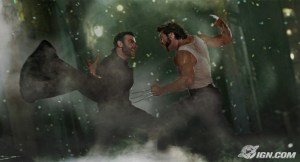
x-men-origins-wolverine-20090212020925195While Wolverine looked promising, it was a confusing mess of action with never a moment of tension. The problem was established early–in the credits–and this hindered us from caring about the characters.

If you make your characters indestructible, then you eliminate us from caring. It was the problem with Superman many years ago–he had no real vulnerability. So the writers rewrote him. Here with Wolverine and Sabertooth, they are given nearly immortal status at the beginning of the film. They don’t age slowly–they just don’t age once they hit their thirties. And they go through the Civil War, WW1, WW2, and the Vietnam War all in about ten minutes of screen time. They are always frontline, get shot at over and over, get hit, but never get hurt. There is no danger for these guys. None. That is established up front. So why would there be any tension in the film?

The film goes on to try and make Wolverine truly indestructible by giving him admantium bones. But since he was already invulnerable (yeah, he could get slightly bruised in a fight with his brother), the admantium claws gave him no discernible advantage. Ah, yes, in fights with Sabertooth, Sabe’s face was a bit more pained–but he was still walking tall after the fights. Spare me the argument that they can heal. 1) An ability to heal that quickly means there are no consequences. No consequences eliminate plot and choice–both essential to story. 2) Wolverine never healed that quickly in the comics. The point of Wolverine’s healing ability was to protect him in the long run, but he got beat up bad in the comics. Often, it would take him days and weeks to heal. And that’s good—it made him vulnerable, but gave him a slight advantage in the ICU. It made me care. But in this film, immediate healing meant that two shadows were boxing each other. I thought–so what?

The fights were scripted so that either Wolvie or his opponent should fall down so there could be a bit of dialogue, or a change of scene. If Sabertooth met up with any other character, that character was toast. It was just a matter of time. Because Sabertooth was established as indestructible.  Worse yet, I am now not sure what Sabertooth is really responsible for–since his main kill comes back to life.  The body count might have been high–but a viewer can’t care if the bodies spring back to life or never had much life to begin with.

Working against it too–the movie was a prequel. And if the survival of the main characters is the plot of a prequel, you’ve doomed yourself. The plot of a prequel needs to be another mystery–because their survival is assured. Here, we were told that we were going to learn the mystery of Wolverine’s origins–but there was no central goal for the main character, no puzzle to solve; just event after event happening to the main characters. No choices, no consequences, no mystery.

I was looking forward to Cyclops, to Gambit, Blob, etc. These characters were used more for the trailer than the movie. This movie had no arc, no plot, and characters who needed to wade through two hours of special effects to return them to X-Men 1, where they began.

Yukon Writers Festival: Reading, 7pm, Beringia Centre

Everyone, come hear the six Yukon Writers Festival writers read on Wednesday night at 7pm at the Beringia Centre for FREE. Part of Live Words: Yukon Writers Festival and the Young Authors Conference, these six writers will be teaching young adults to write at FH Collins–and this presentation is free and open to the public.

I’ve been asked to be the MC for the evening. As I have nothing funny to say, and you can’t be a good MC without funny material–I need six words from readers of my blog–one per person please–the first six– that I have to fit into my opening short speech. And if I get all six, I should win some sort of prize. Nothing that I couldn’t say in public please–so I won’t accept vulgar expressions.

It’s fun. And if you come, you get to see if I can fit them all in.