Muslim Punk Rock, or What Fiction Can Do

23moth_muslimThis just in from the New York Times. Michael Muhammad Knight wrote a book about Muslim-Americans forming a punk band in Buffalo New York. From the article by Christopher Maag, “Young Muslims Build a Subculture on an Underground Book“:

Five years ago, young Muslims across the United States began reading and passing along a blurry, photocopied novel called “The Taqwacores,” about imaginary punk rock Muslims in Buffalo.

“This book helped me create my identity,” said Naina Syed, 14, a high school freshman in Coventry, Conn.

A Muslim born in Pakistan, Naina said she spent hours on the phone listening to her older sister read the novel to her. “When I finally read the book for myself,” she said, “it was an amazing experience.”

The novel is “The Catcher in the Rye” for young Muslims, said Carl W. Ernst, a professor of Islamic studies at the University of North Carolina at Chapel Hill. Springing from the imagination of Michael Muhammad Knight, it inspired disaffected young Muslims in the United States to form real Muslim punk bands and build their own subculture.

As a writer, the article is fascinating to me. Fiction has the power to give method and ideas to real people, helping to create reality. Now Stephanie Meyer’s Twilight isn’t gonna make vampires out of anyone–but it might make teenage girls want a chaste boyfriend. But Taqwacores imagined a reality for alienated Muslim teens in the States, a way to cope, a way to establish a new identity, a counter culture. The book empowers people. Through fiction.

Countless movies have played on the idea that a writer could create reality through writing about it–they are mostly comedies. But the concept, I think, is a powerful one. What if –instead of reflecting culture–we created it? What if we consciously created something that was not there before–something that could happen–so that it inspires others to create it?

Science Fiction often does this in reverse. Create something that we DON’T want around and then destroy it. And thank God we got rid of “it.” I think the Shine Anthology is seeking to help us imagine some creative solutions–and I still encourage you to submit. But I want to keep harping on the idea that you, as writers, can change the world. Michael M. Knight did. (I love that his name is the same as the hero from Knight Rider, the 80s TV show (with recent makeover)).

Go create something you want to see that doesn’t exist right now. Like Knight, create a subculture for disenfranchised teens. Or create the ultimate youth center in your town and inspire someone to imagine the real one. Or show oppressed people in power, how a family operates using green technology in their house, believable, doable, possible things. And then I hope your novel is photocopied and passed around and around and around. The world.

It’s a Wonderful Life, Captain Picard

270px-st-tng_tapestrySeeing that it’s Christmas, and I’m going through a midlife crisis, I thought I would further comment on the magic of “It’s a Wonderful Life.” That magic: the Re-vision of a person’s life has been played out on a number of TV shows. That 70’s Show undid a kiss, Moonlighting a meeting, etc. Each show played off the idea that life could be revised differently, playing to our many regrets. All of us have wondered from time to time how life might have been different if we’d chosen another option.

Here’s Star Trek’s version of the Capra classic, and whether you are a Sci fi fan or not, or a Trekkie, the message in this episode is broad enough to speak about the human condition.

In “Tapestry,” Captain Picard is killed on an away mission. His artificial heart is damaged and it fails him. He meets up with Q as an afterlife. Q is the Trek Universe’s answer to God–an amoral, irresponsible, uncompassionate God. Omnipotence with no ethics. Clarence with no caring. Q offers to change one aspect of Picard’s life, and he uncovers a pivotal moment when Picard loses his real heart in a fight with badass aliens, when he was a young officer. Picard never realizes that the moment is pivotal. Q transports him back in time to play out that moment when he was stabbed. Q forces him to either accept death, or find a way not to get stabbed and see what his life would have been like with a real heart instead of an artificial one.

Picard replays the days leading up to the argument, to the fight, to the stabbing, to avoid violence. To do this, he has to stop his friends from defending their honor, and in doing so, loses his friends–but gains his life. Q transports him back to the future–or to the present. Picard finds that he has a completely different life. A life void of risk, completely safe. And by playing it safe, Picard has become a Lt. Astrophysics analyst, who transports data back and forth to senior officers.

If you want the whole episode, go to Youtube and begin here.

But I think the end has the meat of the message. Watch here.

The difference here is not that Picard is pivotal in the lives of others. Undoubtedly he was. But that our risks bring about a person who can lead. Our risks, or lack of them, define us. George Bailey’s sacrifices define him. Picard’s daring defines him. What defines you?

For another take on this idea, here’s a heartwarming video by Garth Brooks called “Standing Outside the Fire.” Pardon me mixing Star Trek and country music, but the themes are nice together.

The Wonderfulness of “It’s A Wonderful Life”

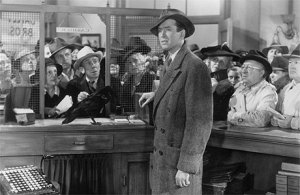
jamesstewart460This is my favorite Christmas movie.  So I’m a bit palled by recent articles that this is a dark film, or that George Bailey should never have been born.  Mainly, this is a response to a NYT article (and a short video commentary) about the “dark side” of “It’s a Wonderful Life.”  (But you can also see the seething condescension for Capra’s human vision in this article, “It’s a Wonderful Lie”)

Wonderful? Sorry, George, It’s a Pitiful Dreadful Life! by Wendell Jamieson revises, or attempts to revise the viewer’s reception of this movie, by making us concentrate on how miserable George’s life really was.

<“It’s a Wonderful Life” is a terrifying, asphyxiating story about growing up and relinquishing your dreams, of seeing your father driven to the grave before his time, of living among bitter, small-minded people. It is a story of being trapped, of compromising, of watching others move ahead and away, of becoming so filled with rage that you verbally abuse your children, their teacher and your oppressively perfect wife. It is also a nightmare account of an endless home renovation.>

While these are George’s circumstances, this not the point of the movie.  Coming out in 1946, this movie exemplifies the self-sacrifice that many Americans made during the war and the depression to get their families through.  Undoubtedly it was a paean to all those people who had sacrificed what they wanted for what was good for the country.  George Bailey still stands as an exemplary “citizen” who sacrifices his dreams–which if you look at them closely are founded on the idea of escape, and a small opinion of his small town–to care for the people of his town.  This film, for 1946, has a strong inclusive argument for immigrants.  Potter hates them; Bailey wants to give them a chance.  Certainly Capra’s viewers would have seen many immigrants in the 30s and 40s struggling with them in hard times.

The movie is also about the power of one man to fight against the greed and power of another man.  Bailey and Potter are two sides of this coin of power: Potter would rule Bedford Falls without George in his way.  But to do something great requires sacrifice.

Sadly, Jamieson doesn’t see the point of self-sacrifice.  I admire George for giving away his Honeymoon money to help the town stay afloat.  I admire Mary Bailey for all the reasons that Jamieson discounts her.  He calls her “oppressively perfect.”  I’m not sure WHO she’s oppressing.  She wants George to stay at home and raise a family, sure.  But she’s also willing to make the sacrifices and understands George’s need to help others.  She’s also the force that goes door to door to help raise funds for him.

Bedford Falls is not perfect—but it’s not stultifying.  Certainly it is better than Pottersville.  Jamieson disagrees:

Here’s the thing about Pottersville that struck me when I was 15: It looks like much more fun than stultifying Bedford Falls — the women are hot, the music swings, and the fun times go on all night. If anything, Pottersville captures just the type of excitement George had long been seeking

He later makes the point that Pottersville would have been a “resort town” and would have survived the latest crashes on Wall Street. Resort town?  Who’s he kidding.  No one looked happy or having “fun times.”  No one is happy in this version; not Mary, not Violet, not Bert or Ernie.  No one has a better life in the de-Georged version.  I saw bars and dance halls, triple X movie theatres, and people were in these places not because they were happy–they were there to drown themselves.  It wasn’t excitement.  I saw chaos.  Everyone was angry, bitter, frightened.
Jamieson catalogues George’s set of woes as if he is making a criminal case against God himself (or fate):

Soon enough, though, the darkness sets in. George’s brother, Harry (Todd Karns), almost drowns in a childhood accident; Mr. Gower, a pharmacist, nearly poisons a sick child; and then George, a head taller than everyone else, becomes the pathetic older sibling creepily hanging around Harry’s high school graduation party. That night George humiliates his future wife, Mary (Donna Reed), by forcing her to hide behind a bush naked, and the evening ends with his father’s sudden death.

Okay, I have never thought of the flirting scene with Mary as a humiliating moment with Mary, but merely of two kids who are teasing each other.  I don’t know what lens Jamieson sees this movie, but it is a twisted one–bringing out the dark elements and calling them the point.

I admire this film because it reminds us to think of others.  It is a lesson to the viewer who might be a George–that they DO count, that they have made a difference–and a template for those who might know a George on how to be a friend in times of need.  Everyone at the end sacrifices their small needs for George.  While Jamieson makes the case that George would still have been libel for the stolen money—no one in the film has accused anyone yet.  While the bank examiner has a warrant for George’s arrest–the policeman rips it in two a the party.  If they supply the $8000 back, then the money never went missing–especially if the bank examiner and the police are conspirators on forgetting the whole thing.

George Bailey is canonized in the hearts of Americans because he does good for others for the sake of doing good.  While, yes, his human rage at having been denied so many things gets the better of him at the beginning, it’s all the more to remind us how fragile our saints can be–that George is not a God nor a robot, but a man who makes the better choices each time.  Until, he can’t do them any more.

Writing a story, an author is told to torture his main character.  Good plots do this well–by taking away what our characters hold dear.  “Wonderful Life” just follows that pattern–taking away from George until he is laid bare on the night when his life could be destroyed.  His miracle is less a miracle than a vision.  It works so well as a device because despite the hocus-pocus of Becoming Pottersville, the idea is something we can actually envision for ourselves.  Each of us can imagine our own Pottersville in the wake of our disappearance–and this can reassure us in our darkest times.  I think we have all been on the bridge, looking at that swirling water.  We may need a Clarence to point out our worth, a human Clarence, which requires us to step up.  But in the end “It’s a Wonderful Life” is about the value of community–and for all George’s sacrifices he gained a community that loved him.  Don’t discount this.  In our heady, Me-oriented societies–we’re losing the idea of our community.  And when we get to the bridge, I’m afraid we won’t have a Clarence, and we won’t have the vision to see that we made any difference in the lives of others if we don’t practice self-sacrifice.  I’m not one to talk–having not done much—but I am one to watch and learn from George Bailey.

How Science Fiction has influenced Space exploration: video

s124e009982_lThe European Space Agency has a wonderful educational video (which you can hear in any language you like) that tracks the inspiration of science fiction on space exploration. Going back to Jules Verne, the ESA makes the case that inspiration pushes science. “A lot of space scientists are actually science fiction writers.” And vice versa: Working scientists become sci fi writers, and help Science make the Leap. Let’s not underestimate inspiration–without it, people don’t think of launching rockets into space, and sometimes a writer can shake out a problem that science faces by making those leaps–but don’t take my word for it. Watch the video. It’s really good and only 6 minutes long. Here’s the link.

Or if you can’t reach that link–here’s the address:

http://www.esa.int/SPECIALS/Space_In_Bytes/SEMNJ0STGOF_0.html

If you are a teacher, on the right at the website you’ll see lesson plans to go with the video. Inspire your students to write science fiction that will inspire scientists, or inspire your future scientists to read science fiction. We’ll all benefit from the cross pollination of ideas.

(I found this link on http://www.planet-x.com. Thanks!)

Clarion 2009 open for submission Jan 2-Mar 1

Announcing the

2009 Clarion Science Fiction and Fantasy Writers’ Workshop

@ UC San Diego

June 28 to August 8, 2009

The Clarion Workshop is widely recognized as the premier training ground for aspiring writers of fantasy and science fiction short stories. Many graduates have become well-known writers, and a large number have won major awards. Instructors are among the most respected writers and editors working in the field today. The 2009 writers in residence are Holly Black, Larissa Lai, Robert Crais, Kim Stanley Robinson, Elizabeth Hand, and Paul Park. The six-week workshop is held on the beautiful beachside campus of the University of California at San Diego .

Since its inception in 1968, Clarion has been known as the “boot camp” for writers of speculative fiction. Each year 18-20 students, ranging in age from late teens to those in mid-career, are selected from applicants who have the potential for highly successful writing careers. Students are expected to write several new short stories during the six-week workshop, and to give and receive constructive criticism. Instructors and students reside together in campus apartments throughout the intensive six-week program.

The application period for the 2009 workshop is January 2 – March 1. Applicants must submit two short stories with their application. Scholarships are available. Additional information can be found here.

For my testimonial, click on Clarion Page above.

Hearing me read my story in On Spec [online]

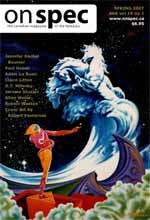
os_spr07Hey, you can hear me reading from my science fiction story, “Why the Poets were Banned from the City” online at On Spec: Follow this link here.

It originally appeared in the Spring 2007 issue that you see on the left. What I loved about the cover art by Robert Pasternak is that it is a wave of white horses, exactly how Whitehorse was named (for the rapids and their uncanny resemblance to white horses). It was a nice piece of synchronicity for me as a writer.

The piece is only 5 minutes long, but you can read the rest in the Spring 2007 back issue.

Much gratitude to Diane Walton and Colin Lynch of On Spec for asking me to do it. And for a great friend who helped me record it. Thanks!

On Spec is dedicated to publishing Canadian Speculative Fiction and is always looking for more. Hop around on their website this holiday and see what they’ve got.

Jon Stewart on Canadian Politics

Jon Stewart sees beautiful PLOT  up here in Canada –Yes, kids, Canadian Politics can be unpredictable! fun! full of intrigue!!  I’m learning more about Canada in this political showdown than ever before.  And if you watch Stewart, you’ll learn a bit about what his audience knows about Canada.  Apparently they don’t understand the whole GG Connection thing either!

Why You Should Subscribe to New Scientist, and why you have to put it down

phpthumbScience Fiction writers have a strange relationship to science. To write compelling science fiction, I think a writer has to do some research. Where would Crichton’s Jurassic Park have been without Chaos theory and real-life paleontologists? And you want your ideas to be ahead of the game, so get yourself some subscriptions.

I know, we are poor bastards and we can’t afford very much–certainly not expensive subscriptions.

I don’t think I could get more (Big) bang for my buck than through New Scientist. You can too.

1. It’s weekly. Meaning that when science is advancing, New Scientist doesn’t have to wait two months to come out with an issue. Discover is a monthly, and it’s a nice mag. But it can’t compete with 65-75 pages a week chock full of insightful articles.

2. It’s got short blurbs and longer indepth articles, and these can be read–some of them–online. Let me give you a sample of what’s out right now:

Why the Universe may be teeming with Aliens

Are Daughters-in-Law to blame for Menopause?

A healthy planet? Top 10 articles on the Environment in 2008

The glass universe: where astronomy meets art

Creationists Declare War on the Brain

These are the longer in-depth articles, yes, but the magazine is FULL of shorter articles. Shorter articles stimulate creativity in a way that is beneficial for a creative writer. You want a magazine that has plenty of short articles on broad topics–a whole mess of ’em.

3. It covers a lot of areas: space, environment, sex, health, physics and math, tech articles…. that’s good. Coming out once a week, it allows the magazine to be current on several areas. It allows you to cross-pollinate ideas.

4. It’s cheap. Yep, it’s from Britain, but it’s 36 bucks for 6 months or 24 issues. You can sign up online here for a subscription. Or you can browse the website first. With a subscription you get the magazine delivered to your door in uninterrupted service, and you get online access to back issues 24hrs a day. It’s cheap and it comes to you. If I had to have just one subscription to a science magazine, I would keep this one.

Writers of science fiction should certainly start with the stimulation that comes from reading science magazines–BUT, and this is where it gets interesting, I think they shouldn’t be bogged down in the details. If you are predicting the future, look how fast the present changes. I just did a radio piece talking about dark energy–which is about to be out of fashion, passé, even illusory–but in twenty years?? In fifty years?? It may be all the rage.

Science fiction writers need to be able to extrapolate from data, yes, but they also need to be able to make the Leap. Leaps are about prediction beyond what can be extrapolated. Go someplace wild with the information. Don’t be afraid to be wrong in twenty years, or in two weeks. Make it believable. But not predictable by any physics grad student. Combine fields, combine theories, and then move beyond them. Sure, it’s not real. But that’s the point of writing fiction–to be brave enough to make the leaps that science isn’t allowed to without hard fact.

If science fiction actually does lead the way in technology and science–then we’ve got to lead by going beyond what the best scientists can predict, and certainly past what the public can imagine. That’s our job–to help people imagine a believable, but still surprising and entertaining, future. That’s where your stimulated brain comes in handy……

You can start seeing that future by picking up a New Scientist issue, but you can’t create it till you’ve put the issue down.

Leaving America is All Here

Okay, I uploaded the rest of Leaving America.  All seven episodes are there.  Some of you heard this in a 5 episode run–don’t know what they (Toronto) cut, but they went from Seven 6.5 min episodes to Five 5 min episodes.  Here are the original versions where you even get to hear me do a bad Tiki Chorus at the Ft. Nelson hotel….forgive me.  I was having too much fun.

The 4000 mile road-trip journey is full of immigrants, storms, wild and woolly Oz, screaming Heads, funny interviews, a little history, a little death, a lot of song, and many hidden science fiction references–especially in the music.  After all, immigration is about being an alien who finds a home.

And that’s pure science fiction.

I want to thank everyone who allowed me to talk with them along the way, my family, my friends, CBC and Arnold Hedstrom for funding it and giving me complete creative freedom, the great musicians whose music runs through this.  And to all the listeners who liked it and told me about it.  Thanks for liking my story.

Enjoy.

Leaving America Is Up

Hey folks, just placed the first three episodes of Leaving America, my radio series about my immigration journey, up on the site–as its own page.  I’m sorry you have to click on two separate pages–but I’m not as familiar with WordPress as I’d like to be.  Still, I’m very happy that the files are up somewhere.

Hope you enjoy them.  I will put up a page for Yukon 2058 as soon as the series is done on CBC.  They will not be putting them online, so I can place them here for those who missed episodes.

Thanks for your encouragement and kind words.

Jerome