What a difference the right church makes, eh? For queer and trans people, the right church can be a matter of life and death.
I grew up believing that you look for churches within the denomination you were raised in, and pretty much, if you stayed within those safe theological walls, you’d have a good experience, one that you were used to. Familiar. Like Church Branding. Stick with the Brand Name and you’d have the quality and taste you were looking for. If you grow up in “the church,” that concept is so ingrained in you. More than the brand of jeans you buy, your favorite burger place, the make of your car, even the teams you root for. None of those choices would affect the next ten thousand years of your happy eternal life. You will stick to your brand pretty strongly.
An “off-brand” church is an unknown path. I was raised to believe that Baptists (somehow) hold the Truth about Everything Spiritual and that Presbyterians were slightly off–like 10 degrees off to port. I know this is ludicrous, but follow the bouncing logic here…
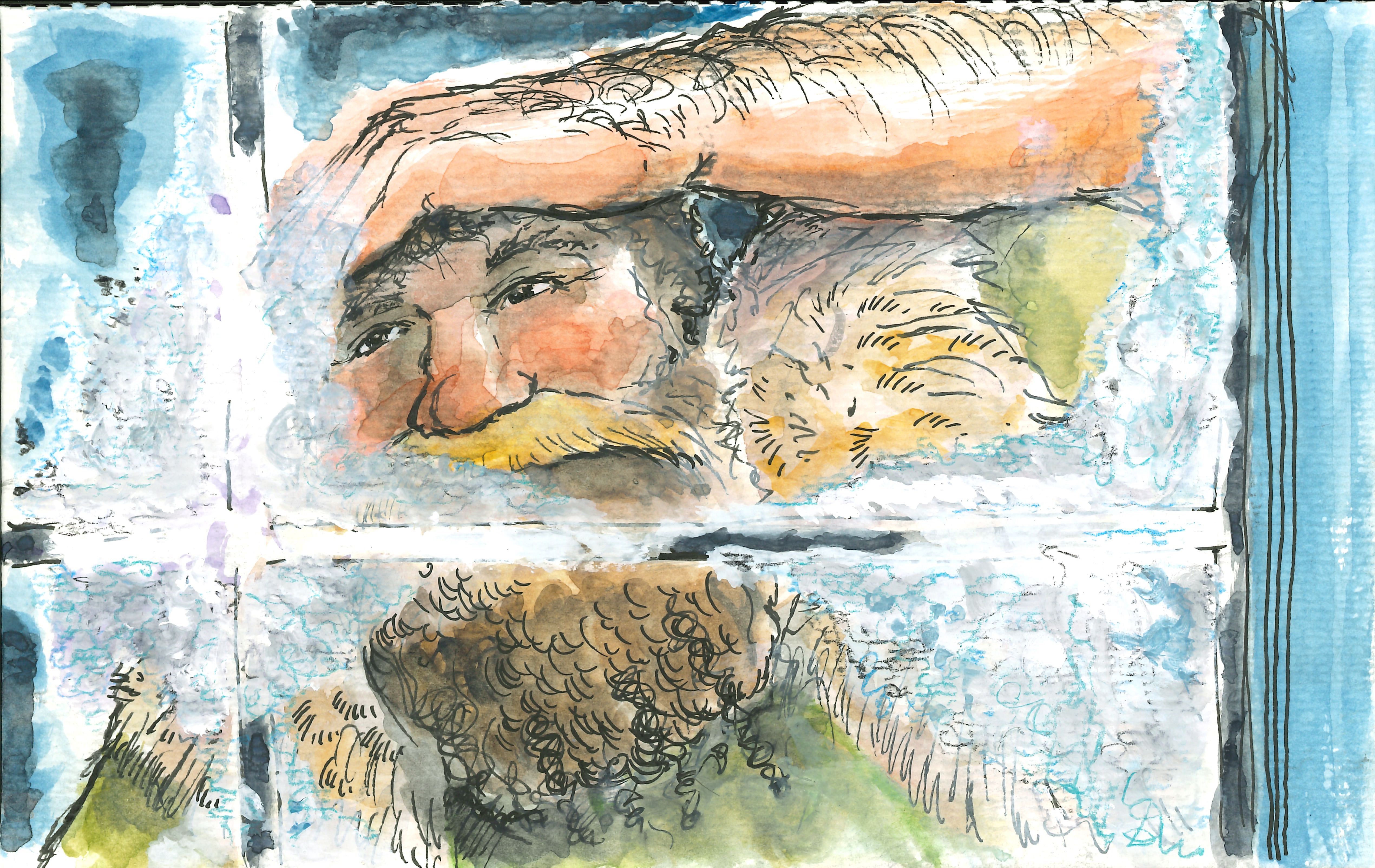
My Birthmother, Laurie, as a spiritualist on stage, listening to the dead who are trying to give her messages to relay to those in the audience. Part of the illustrations for the essay.
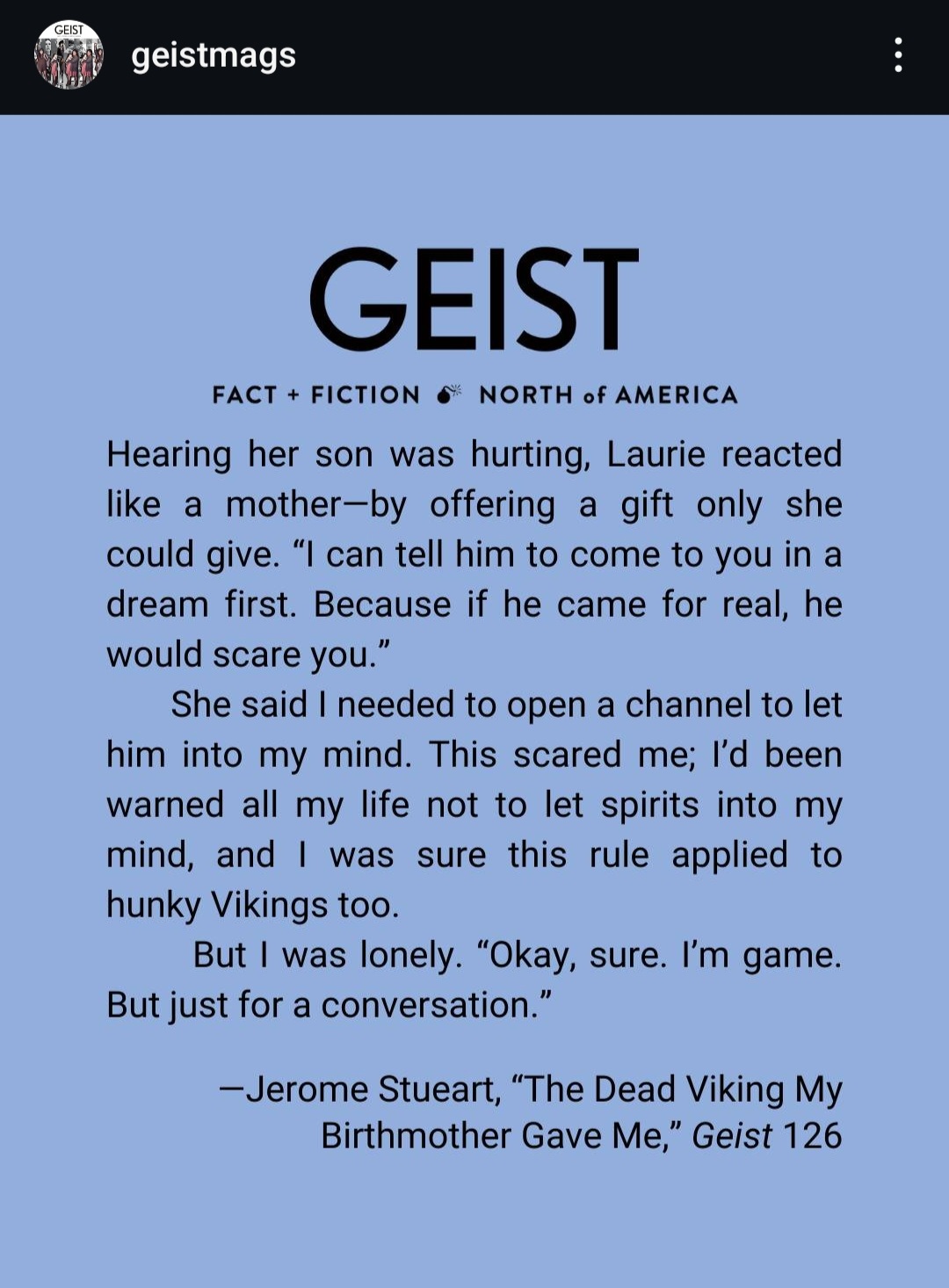
My essay, “The Dead Viking My Birthmother Gave Me,” is up over at GEIST Magazine online. It’s an essay about adoption, being queer, being lonely in the Yukon during Winter, and spiritual differences between a birthmother and son that include what one might do with a hunky centuries-old Viking spirit guide, and it’s all true from what I can remember.
Some of the illustrations that were published in the article that I did weren’t able to be put in the online version because of technical difficulties, so here they are:
At the end of January, I found my painting, “The Gulf of Empathy,” going viral, quite by accident. I want to tell you a little about what I learned through going viral — and for what “going viral,” I think, means for the larger moment in time.
After the painting went viral, seen by hundreds of thousands, maybe millions, of people around the world, I knew this moment was bigger than me, and the outpouring of love and support I received as an artist was as much a testament to Bishop Budde, speaking truth in the face of malevolent power. Her words that day spoke to millions of people.
Her message was profound — and we need to hear more of this side of Christianity, rather than the hate-filled rhetoric of exclusion, racism, sexism, and violence that seems to be what the evangelical side of Christianity, the ones who get to voice the “Christian response” in the media, offers. The one that’s also been promoted to Trump’s Office of Faith, which will be searching for “anti-Christian bias” in the United States. But whose Christianity, which bias?
The rest of the world — the people I heard from — felt more promising. They are full of empathy and compassion, and I got the emails and responses to prove it. From everywhere.
The world is with you, Bishop Budde, and with those who stand up for the marginalized, the unprotected, and who stand up to tyranny and megalomaniacs and oligarchs. People around the globe understand, on an international diplomacy level, on a war-mongering level, that everyone is in danger with Trump and Elon Musk in power. And they find hope in reminding him, and us, what the role of a leader should be.
This is why, I think, a little painting went viral.
“The Gulf of Empathy,” is an 11 x 15 watercolor and mixed media painting based on how I felt about the real-life moment Bishop Mariann Edgar Budde delivered her sermon at the inauguration. In the painting, I show the Bishop standing with hundreds of people, her arms outstretched to protect them, as Donald Trump, his administration and the billionaires stand on the other side of a great gulf, which I call “the Gulf of Empathy,” a play on the Gulf of Mexico, something he purposefully refuses to acknowledge as well. It is another great gulf that he has trouble bridging.
Hey friends, and new friends, I just wanted to take a moment and say thank you. Thank you for sharing my work, “The Gulf of Empathy” to all your friends and on your pages and in your groups, all around the world. I am overwhelmed with gratitude at your kindness.
Many of you have asked for prints, and I am doing some due diligence to make sure everything is in place to sell prints. Right now, my image is under review at RedBubble. If and when it is approved, I will let you know.
I wanted first to make sure that a) I reached out to Bishop Budde and ask her thoughts and permission on any likeness of her, and b) that part of the proceeds goes to organizations that help defend LGBTQ and Immigrant communities. The overwhelming popularity of this image should be used to help as many people as possible.
I have been stuck at home the last few days with a bad chest cold, in and out of sleep. The way this painting zoomed around the world caught me a bit off guard, as no one expects to go viral, but if it had to happen, I am very happy that it happened this way.
I know that it’s the power of Bishop Mariann Edgar Budde’s words during the inauguration that is the real power that compels us to share this work. It certainly was the impetus behind me creating the painting and sharing it first with you. At a time when we needed someone to speak out, Bishop Budde was there–and spoke so eloquently and so simply about the need for Mercy and Empathy.
People need reassurance and they need hope that their lives will be protected, their rights upheld, and that they can continue to be who they are without having to hide themselves, or produce documents, or live in fear of being found out, or have their health care, food assistance, or jobs taken away.
Her words were prophetic, as we found out by the end of the day that the most vulnerable people in the country would be targeted with a flurry of executive orders.
It was her speech that went viral that day, that kept playing again and again to drown out each executive order. I hope that keeps happening and we amplify the people who are helping us. There’s a lot of bad in the news these days, but following Mr. Rogers’ advice, I’m “looking for the helpers”. What they are doing are much more important–and we can be inspired daily by the kinds of people who stand up and use their opportunities, platforms, microphones, keyboards, webpages to speak FOR good, to make sure that the Joy is not all taken by those who want to steal it. It is not about hiding our eyes from the bad, but it is about looking for those who are fighting back, and amplifying that instead of amplifying the hateful rhetoric that already has a bunch of platforms. Crowd that out with Kindness and Mercy. I’m going to look for the people helping us.
They want you to be exhausted and sad and defeated and give up.
Keep dancing (as Dan Savage reminded us) and keep creating beautiful things that remind us of what it is to be kind, merciful, generous.
One of the oldest stories in the world is the story of a woman who tells her husband, the ruler of the nation, one story after the next about mercy and kindness, reminding him to be merciful and what it means to be kind and generous, and eventually it has an effect on him and, perhaps, those who read or heard the stories later. Scheherazade did this for One Thousand and One Nights, though, so we have our work cut out for us. Inspire others with your stories and your creations and keep looking and amplifying voices and tactics and plans that successfully protect others. Do what you can where you are to stop hate in its tracks.
We are not defeated. We are “stronger together” (as Dayton, Ohio taught me) and we will push back, and keep our hopes protected.
Thank you again for sharing one queer artist’s work and for amplifying the words of empathy, mercy, compassion around the world.
As a last note: Please help me in giving proper attribution to my work wherever you see it. Some images I’ve seen do not have attribution, or others are taking credit, and some just have my name spelled incorrectly. I know my last name has a funny spelling, but it has an “ear” in it. Thank you to everyone who has reached out to ask if this work is mine, and for those who have helped correct attribution mistakes. Artists deeply appreciate your efforts. We can only grow an audience with our names and our works.
Yours,
Jerome Stueart
PS. I will be answering all your thoughtful letters and messages as fast as I can, thank you. You have been very kind to me. I should be back in good health early next week, I hope!
“The Gulf of Empathy,” (11 x 15) watercolor, mixed media on paper.*
Protect others. Speak Out. Use your art and voice when you can.
Thank you, Bishop Mariann Edgar Budde, for taking that opportunity to simply ask for mercy. Your words reverberated around the world and spoke to every heart, and especially strengthened mine and others’ hearts in queer communities and queer ally communities.
We pray every heart will hear the call to mercy.
For more about this painting and how and why it was made, read this essay
*due to requests and responses to this image, prints are available through Squarespace/ FinerWorks
Yes, it’s remarkably well-produced and edited. It’s funny, and it’s poignant, deeply moving at times.
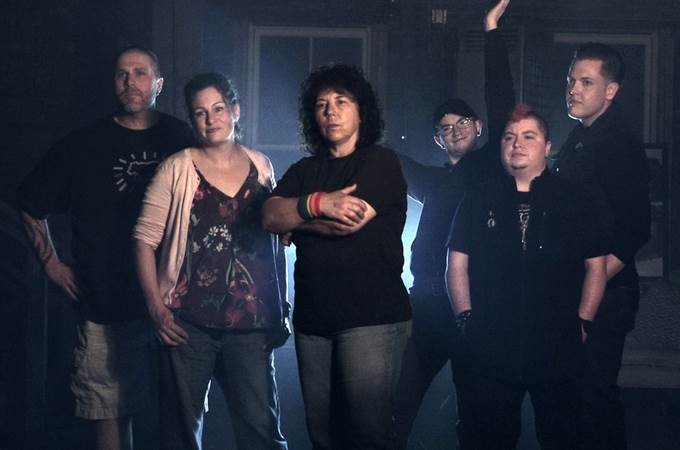
The Stonewall Columbus Queer Ghost Hunters accomplishes these things because it’s doing everything so differently than other ghost hunter shows.
They aren’t reacting to a disturbance or a sighting. The ghost hunters don’t (so far) go to a place because they’ve been called by folks disturbed by ghost activity. They are seeking out where they believe queers would have gone in cities and rural areas. Theatres, prisons, convents.
The goal is not to get the ghost on tape, or to prove that ghosts exist. The show takes as a premise that ghosts exist. Their goal: to provide a safe space for queer ghosts to talk about what it was like living queer in different moments of history.
They’re looking for QUEER ghosts specifically. Their focus drives their narrative. They are looking to bring a safe community to a group of queers who can’t move out of their places to find other queers. ( It’s not like ghosts can pack up and go to San Francisco or Greenwich Village.) The show’s aim is to chat amiably with queer ghosts who may not have had anyone to talk to in their lives about being queer.
All of the ghost hunters fall on the Queer spectrum: genderfluid, lesbian, bisexual, gay, transgendered, pansexual, even a bear. 🙂 This is about diversity in the cast as well as diversity in the ghosts, but they are talking about LGBT issues.
This is MORE than just ghost hunting: it is an examination of the history of LGBT people and, in some ways, how people lived, hid, coped with being queer in different places. In that, it is a reflection–and a chance–for people to talk about what it is to live as queer in any time.
I would like to see Martin Luther King Jr.’s “Letter from a Birmingham Jail” (1963) added to all new Bibles.
I don’t propose this lightly. Three times in the Bible, in three different places, listeners (and they wouldn’t have been readers) are exhorted not to add to, or take away, from specific books. One is about Revelation, one is specifically to the Israelites in Deuteronomy to listen to the law, and the other is in Proverbs: “Every word of God is true….do not add to his words, lest you be proved a liar.” I think it’s safe to say that I won’t propose adding any new words of God to the Bible. I’m advocating something less radical. If we can have letters from Paul, we can have letters from Martin.
I started teaching a course that looks at the character of Jesus when he shows up in Science Fiction. Currently the course is only 6 weeks long and only taught at the UDLLI, the University of Dayton’s Lifelong Learning Centre for Senior Adults. We are using the following short stories and novels in the course, and I will be placing the blogposts of the course over on Wrestling With Gods website because it’s become a great place to talk about religion and faith as it appears in science fiction and fantasy.
What happens to Biblical Jesus when the narrative is continued into the future? Is it subverted? Are writers appropriating Christianity to rewrite it and rob the narrative of its miracle, or do they instead seek to expand the notion of Jesus to its infinite possibility? How does Jesus fare in science fiction and what can we learn about faith when science fiction writers write about him? We look first at the life of Jesus in the Gospels to ground us in the ur-text, try to gather the importance of him as a character and iconic figure in history, culture and religion. How is Jesus relevant in the future? Then we look at how authors extrapolate the future of faith, or seek to tweak history, just a bit, to get the savior they want, and perhaps we can better see what kind of culture we are in the face of our chosen Saviour.
Come follow along over on the Wrestling with Gods site. Already the class has been exciting as these students know a lot about religion, specifically Judaism and Christianity (UD is a Catholic institution) and many retired professors attend these classes for fun (they also can be quite mischievous).
The works we’re going to explore, and I will detail in blogposts are these:
To get us oriented on Jesus the character in the Bible:
Jesus: the Face of God Jay Parini
“The Man” Ray Bradbury from The Illustrated Man
“Mecha-Jesus” Derwin Mak from Wrestling With Gods
“So Loved” Matt Hughes from Wrestling With Gods
“The Rescuer” Arthur Porges
“The Traveler” Richard Matheson
“The Real Thing” Carolyn Ives Gilman
“Let’s Go to Golgotha!” Garry Kilworth
“The Gospel According to Gamaliel Crucis” Michael Bishop (a longer work I may not use)
“Jesus Christ in Texas” W.E.B Dubois (which isn’t exactly Science Fiction, but may prove useful in this study)
Then two novels:
Behold the Man, Michael Moorcock,
Jesus on Mars Philip Jose Farmer
If we have time, “Farewell to the Master,” Harry Bates—Which becomes The Day the Earth Stood Still. This would be delightful to show to students in a longer class. To read the short story and then watch both films.
I can also see adding these works to the syllabus for a longer class:
The Man Who Died DH Lawrence
Jesus Christ, Animator Ken MacLeod
All Star Superman Grant Morrison
Jesus Christs AJ Langguth
Only Begotten Daughter James Morrow
If you have suggestions on stories, poems, or novels to add to this list, let me know. Specifically we are NOT covering characters who merely have a “savior-esque” quality to them, or those that have a martyr motif. I want to look at places where characters are for all intents and purposes supposed to BE Jesus.
Writing the Spiritual Journey (UDLLI on the U of Dayton Campus)
Excited to be able to offer this workshop to the University of Dayton’s Lifelong Learning Institute on the River Campus. 6 Weeks and registration information link is below.
_____________________________
How do you describe the indescribable without sounding preachy or crazy? What if you’ve had bad experiences with faith? Speak it honestly anyway. We need all voices to chart the faith journey. Open to all faiths and believers and seekers, this workshop will use readings and memoir writing exercises in both in-class and take-home assignments. Readings feature Annie Dillard, Langston Hughes, Anne Lamott, Kathleen Norris, Mark Doty, John Updike, Elie Wiesel and others. You will give fellow writers feedback in class and will become better equipped to edit your own writing by the end of the workshop.
6 Mondays, January 12 – February 23 (No seminar on January 19)
9:30–11:30 a.m. at River Campus
Seminar Limit: 16
Recommended text: A number of readings in PDF format will be available before the first seminar meeting. These will also be printed out and available as a packet.
Jerome Stueart earned his Ph.D. in creative writing from Texas Tech University and has been teaching writing workshops for more than 20 years. He is a 1996 recipient of the Milton Fellowship (now sponsored by the journal Image), designed to foster excellence in writing for Christians. His writing has been published in Geist, Geez Magazine, Joyland and many other journals, anthologies, newspapers and magazines. He is the co-editor of Tesseracts 18: Wrestling with Gods, an anthology of faith-inspired science fiction and fantasy. His first book about religion in an altered-history America, One Nation Under Gods, is forthcoming from ChiZine Publications (November 2015); his collection of short stories follows in 2016.
As a science fiction/fantasy writer, I just want to remind folks that we aren’t all alike, and we don’t live in just one bubble. My blog has always been about the experience of being a science fiction/fantasy writer and not just reflecting the genre/writing parts—but about my whole experience of being a Yukoner, of having a faith, of being gay–AND being a science fiction/fantasy writer. So this is part of it.
The Queer Story Archives came up to Whitehorse–Lulu from OnMyPlanet.ca–in July 2013, recording stories of Yukon Queers, and we recorded this right before I was to leave for Dayton, Ohio. I think it’s turning into a positive story so I’m sharing it. Ultimately I’m suggesting that including gay people can save a rapidly diminishing Church population. To do that, I tell my story. Some of you have heard it–either through the Yukon News, or through DNTO. Both sources were good but heavily edited. This is me telling it in less than ten minutes. It feels better in my own words, complete.
We grow from hard times in our lives and this was a good growth for me. Eventually, I’ve come to retain and re-establish many friendships from the first church. I hope my story still helps others. I’m placing this over on Talking Dog too.





 I would like to see Martin Luther King Jr.’s “Letter from a Birmingham Jail” (1963) added to all new Bibles.
 cience Fiction. Currently the course is only 6 weeks long and only taught at the UDLLI, the University of Dayton’s Lifelong Learning Centre for Senior Adults. We are using the following short stories and novels in the course, and I will be placing the blogposts of the course over on
 Bear Witness