Writing Advice from J.K. Rowling

I came across this nugget of writing advice from JK Rowling in an article from the Toronto Star. It’s simple, but important.

Of the “universal appeal” of her books, Rowling said, “I’ve been asked that question a lot. I’ve always found it very difficult to answer. I feel there’s an expectation that I should know what the magical formula was, but in truth I wrote what I liked reading.

“I wrote about characters I was deeply interested in.”

And that is probably the most profound writing advice you’ll get–the part we forget sometimes. Have you ever been writing along on some short story for a contest, a journal, even working on a novel, but you don’t really care about the characters? In fact, you would find them boring if you met them in real life? Or tiresome, or annoying, or bland, or one-sided, or pitiful.

It matters to your readers if you care about your characters. Sometimes, like scribbling gods, we are interested in our Plots–how we can mess up the quiet lives of our characters, or how interesting we can make their situations—but the characters may not matter as much because they are being propelled by the plot. They are riding shotgun to the plot that’s really driving. They can react, white-knuckle the door, scream, maybe even fling the door wide, but they don’t get to drive, and partly because they just aren’t as interesting as the cool plot we’ve given the keys to.

I read that article and interview with Rowling and I left thinking about my own stories, and how many of those characters–on the stories I was working on–were those I wasn’t “deeply interested” in? You could say that for short stories you only have to be mildly attracted to them–it’s a 10 page affair after all. But a novel, you might say–or even a Potter series–you’d have to be interested in the character. Yet, I think we all want memorable characters to follow as we read. As we write. In short stories and in long ones, and in series. Because if we’re interested, then readers will be too.

Time to revamp some of my characters–the ones I’m not currently deeply interested in–and find out how I make them more interesting on the page–so that even in a small story, the characters linger in a big way.

Realms of Fantasy Folds: Is it Past Time to Save A ‘Zine?

Very ,very sad to announce that Realms of Fantasy is folding.

The news broke yesterday.

Realms of Fantasy has been with us for fifteen years and “was coming up on its 100th issue,” Cleveland said. “We were excited about the special Halloween issue we’d been planning, which would have been our first.” The staff is obviously harried by the news, and that it’s become public so quickly. Cleveland had been hoping to tell the authors and artists the news before it broke publicly.

Realms of Fantasy has been one of the anchors of the Fantasy short story publishing industry.  As a print magazine, Realms was billed as “the largest magazine in the world devoted to Fantasy”.  It was part of the big four anchor magazines of the industry (the others being Asimov’s, Fantasy and Science Fiction and Analog) partly built on the venue–a large glossy magazine (not a small pulp), its reputation for helping careers begin, the high distribution from subscription, and the amount it paid for stories. Editor Shawna McCarthy was recognized as one of the best editors in the business (and she will be here in the Yukon in April!–I hope!!).  Will all venues and markets go web-only?  Is that an answer to part of it–or is it about advertising, and since you’d have to have advertising either way, are closings inevitable?

With Fantasy and Science Fiction going bimonthly, Realms‘ closing narrows the market for writers of short FSF considerably.  If this is the beginning of the economic crisis, recession, depression, etc., then this isn’t a good sign.  Two out of four of the big anchor markets down or downsized?   I’m assuming Realms thought of all options–bimonthly, web-only zine, etc.— so I’m not gonna try to come up with suggestions for fixes…

However, now is the time to save a ‘zine.  If the economic crisis is just going to get worse, is there a way to help ‘zines as fans and writers?  Can we donate money? Tell us.  Can we help support in other ways?  Tell us.  Can we ask universities to adopt a Zine for a short period of time?  I was never one to subscribe much–mostly because I moved around every couple of years, and my subscriptions had a hard time finding me, and because I was often broke.  When I could I bought from the newsstand.  But if I can help by choosing three zines to subscribe to in order to save them from oblivion–let me know.  I should have been doing that all along.  However, if I thought it was balanced on my subscription, I would have done it earlier.  And I suspect many writers would feel the same way—that if people needed to borrow from us, they could.

Is there a way to stop the closing of Realms of Fantasy?  Is there a way to stop the decline in markets and venues and places to read great science fiction/fantasy?

The City of Ember: Clever Assignments For Everyone

Doon and Lina looking worriedThe City of Ember is a great fun family film, full of clever, unlockable mysteries. It comes with a map, all torn up and faded; it comes with a “ticking clock”–the fear that the city will wind up in the dark; and plenty of menacing obstacles. The ending leaves you wishing to be back in the more colorful Ember, but the movie enjoys itself and the city while it is there.

City of Ember is strongest when it is working within its world. Jeanne DuPrau is an excellent world-builder, trying to make a city buried beneath the earth believable. What would you do to make a nuclear bunker livable and expandable? The city is quirky and interesting and what I’d expect from a city slowly running down. Ramshackle, apartmental narrow English-looking cobblestone streets. No bad fumes down there–one would assume, with no cars–but then no oxygen either. True, the whole idea that the air and water are replenished–and yet not infected by radiation–is hard to swallow. But I’m willing to suspend my disbelief.

Opening sequence: I was getting ready for an infodump–but this is brilliantly constructed. If you’re gonna have to have an infodump, make it interesting. Tolkien does it with the history of the Ring in Lord of the Rings, and here, DuPrau talks about the Countdown box with the papers on how to Exit Ember. The directing on this scene focuses in on the hands of each successive mayor as they pass the box to each other in a line. So we set up our story’s inner problem, as soon as that line of succession is interrupted. Ember, like every other constructed engine, will fall apart. The city will go dark. The food will run out. And without the instructions, no one will escape. It’s up to two plucky teens to figure out how to escape.  It was a great way to start the movie/story.

I found the world so interesting–that unfortunately, I was disappointed when they escaped.  So let’s talk about the world of Ember.

High school graduation is not about living your dreams, but about getting an assignment to start working on keeping Ember going.  What a great idea!  Who needs years to find themselves?  Or following pursuits where there is no market?  (Where is the art down there?)  Lina wants to be a messenger; Doon wants to fix the engine, but on Assignment Day, they draw their jobs out of a hat (no more School Counselors with their aptitude tests!).  We start this movie with two people wanting something so badly, and they don’t get what they want!  Fantastic.

We see the city falling apart and the parents tell the kids not to worry about it.  This is the part that you feel resonating in today’s society.  There are several things we can do to make society work better and we better encourage our kids to work on them…or maybe we can do them.  Anyway, the city is falling apart–the kids join in the maintenance of Ember, but also want to fix Ember.

I was delighted by the cleverness of the plotting and worldbuilding in Ember, all the nooks and crannies we get to uncover.  In the movie, yes, we don’t get to spend enough time with Lina nor Doon’s past and their characters….so this is a plot-driven movie, as movies are wont to become.  But I still enjoy Lina and Doon.

Once their drive to exit Ember kicks in, though, they are consumed with that idea and we lose who they are.  They could be any two kids leaving the city.  It would have been nice to see more of heir characters shine through in their escapes–what they worry about, what they accidentally do.   But this is a MOVIE problem, not a story problem, likely.  The movie gadgets and Indiana-Jones style thrills take over to get the kids out of Ember.  And I liked the hidden “magic” inside the city–as if the city had been just a half-turn away from showing all its secrets.

Truly, I would have liked to have seen a whole movie about Ember BEFORE everything breaks down…but the plot moves them out of this nifty created world into, eventually, our own boring world with sunrises and prairies and mountains. Ahhh…landscapes.  They are nice.  But Lina and Doon, um, escaped the plot too, or forgot that they have no way of surviving on the surface.   The movie reminds me of a great carnival ride—a lot of action and joy and cleverness in the construction, and a sad sigh at the end when it’s over and the world has been “lost” and you have to exit the ride.  Not the sigh of characters you don’t want to leave–but the sigh that the cool part of the plot and story are gone.  For a discussion about movies that end with a “healed earth” as a trope, even when it’s looking more and more unlikely that the earth will just heal itself, click here.

I hear there are two sequels in books.  Both of them take place in a post-apocalyptic/new Earth in the US… but it is the idea of that buried, constructed city that sparks imagination.  If you’ve ever built a treehouse, ever put a sheet over tables and chairs as a fort in the living room, or marked up a cardboard moving box as a house–City of Ember appeals to you as the coolest underground fort can.  I hear that The Prophet of Yonwood is a prequel–and that will be cool to see how they built the city of Ember. I think DuPrau is hinting at some larger themes here and I like how she’s doing that.  We are all on Assignment Day–but we don’t have to draw ours out of a hat–but we need to pick them soon and get busy.

Rent the movie, enjoy the ride!  Or Read the Book, enjoy the characters!  Choose your assignment, fix the world!  That ought to cover it.

Repair-adise: The Myth of the Self-Cleaning Earth

3224040683_22edd9a60cOkay, I’ve seen the trope enough.  Yes, it is a hopeful image, but it perpetuates a myth.  End of movie: three or four people after post-apocalyptic disaster come out to “healed” Earth.  200 years in City of Ember.  700 years in Wall-E.

Gaia is a nice idea–that the Earth is bigger than us and will heal itself even from our damage.  However, it lessens any personal responsibility, and gives us some odd idea that humans, in the form that we know them, will be back one day after the Earth has gone through a cycle similar to a self-cleaning oven.

Oddly enough, the base idea is shared by those who don’t believe in Global Warming, or who don’t believe that Man is causing global warming–the idea that the Earth shifts in cold and hot and finds a balance and everything is returned to a state of Eden.

Here’s two things I know: The last Ice Age was a documented shift in the planet’s balance of hot and cold.  Those ice sheets lasted for more than 100,000 years, ending about 10,000 years ago.  The animal and plant life that we know from then have changed quite a bit over that span of time.  No more giant ground sloths, mammoths or neanderthals.  Even the steppe grasses are gone.  So,  it took the Earth 10,000 years to right itself–after some massive glaciation.  In other words, Global Warming may well indeed have been a natural shift, but Humanity will not survive a massive shift like that–certainly not in the way we are now. And likely, the Earth will come up with some radically new life forms–if it recovers at all.

The second idea here is that the Earth can take a beating from us.  No problem.  A) if it disposes of us, what have we learned?  and B)  We are capable of damaging an atmosphere irreparably.

Those Ice Ages, devastating as they were, still counted on an atmosphere.  If we hurt our atmosphere, isn’t it possible that we not just trigger an Ice Age, but stop it from fixing itself?  James Lovelock, the man who created the idea of Gaia–the earth that is an organism–was interviewed in New Scientist.

Do you think we will survive?

I’m an optimistic pessimist. I think it’s wrong to assume we’ll survive 2 °C of warming: there are already too many people on Earth. At 4 °C we could not survive with even one-tenth of our current population. The reason is we would not find enough food, unless we synthesised it. Because of this, the cull during this century is going to be huge, up to 90 per cent. The number of people remaining at the end of the century will probably be a billion or less. It has happened before: between the ice ages there were bottlenecks when there were only 2000 people left. It’s happening again.

I don’t think humans react fast enough or are clever enough to handle what’s coming up. Kyoto was 11 years ago. Virtually nothing’s been done except endless talk and meetings.

It’s a depressing outlook.

Not necessarily. I don’t think 9 billion is better than 1 billion. I see humans as rather like the first photosynthesisers, which when they first appeared on the planet caused enormous damage by releasing oxygen – a nasty, poisonous gas. It took a long time, but it turned out in the end to be of enormous benefit. I look on humans in much the same light. For the first time in its 3.5 billion years of existence, the planet has an intelligent, communicating species that can consider the whole system and even do things about it. They are not yet bright enough, they have still to evolve quite a way, but they could become a very positive contributor to planetary welfare.

How much biodiversity will be left after this climatic apocalypse?

We have the example of the Palaeocene-Eocene Thermal Maximum event 55 million years ago. About the same amount of CO2 was put into the atmosphere as we are putting in and temperatures rocketed by about 5 °C over about 20,000 years. The world became largely desert. The polar regions were tropical and most life on the planet had the time to move north and survive. When the planet cooled they moved back again. So there doesn’t have to be a massive extinction. It’s already moving: if you live in the countryside as I do you can see the changes, even in the UK.

He has a lot of optimism that despite all the damage we can do as a species, that the Earth will recover–even that perhaps these amazingly smart humans, in his opinion, the apex of creation, will figure out how to live in harmony with the Earth–eventually.

But it also might allow both a fatalism and a hedonism to develop–as if we can do nothing to hurt the Earth at all.  Lovelock was instrumental in getting the global CFC ban that led to saving the Ozone layer.   Perhaps there are still more things to do to stop the warming that’s happening–as he suggests in the article.   Certainly, we have to think short term.  Lovelock’s vision–is that after thousands and thousands of years–humanity will survive and learn.  Movies shorten that to a few hundred years, a slap on the hand for our negligent behavior instead of the mass extinction probably waiting for us.  They believe in Man rebooting after the Earth has rebooted itself.  Repair-adise.

All these movies have people waiting out the storm, walking into paradise, virtually unchanged.  Free of humanity for a mere 200 years, the planet heaves a rainbow sigh of relief, bushy gardens of plenty.  But with our weapons we can inflict planetary damage; Wall-E can never clean up all the trash and one plant can’t feed the multitudes–and there will be a long wait for the storm to be over.  And humans may not survive as humans.  There may be no humans to come back out after 55 million years….and if there are, will they remember what they did wrong?  We have to affect change.

Sure, we may not die, but we will all be changed.

Inaugural Poem: Take Out Your Pencils. Begin.

I just finished watching the Inaugural Events on TV. Many things to talk about, but I want to use the words of the Inaugural Poet, Elizabeth Alexander, as a call to writers, and a call to Americans, to face the challenges we face in the world today.

Her poem, Praise Song for the Day, was Whitmanesque in its description of everyday people doing their jobs, but when she came to the Teacher telling the students to take out their pencils and begin, it stirred me. It reflected Obama’s call to action, and I heard it as a writer.

In Canada, I feel a bit outside of history as an American. As if America has gone on without me. It was my choice to leave America and work and live in the Yukon. I don’t regret that choice as much as I seek to know what my role is now. If anything, the Inauguration of Barack Obama called out the American part of me to work hard for freedom and justice. But here I am, in another country, and not so skilled at building bridges or repairing roads or even close enough to move towards changing policies. But I am a writer, an American writer. And there is much you can do with a pencil.

Alexander’s poem reminded me that we are all at the beginning of a test. A fiscal test, an international test, a test of our ideals and the strength of our nation. Wherever we are, we have that test before us–and now is the time to bring out our pencils and begin writing.

On this Inauguration Day, let us all take out our pencils and write the future. Write new policies, new ideas, to “meld imagination with a common purpose” as Pres. Obama said, and change what needs to be changed with a pencil and an eraser. Because with pencils, erasers are standard issue–we make mistakes, but we can correct them. Still, we have to write. Write to inspire. Write to correct. Write to change. To remind. To call out. Envision. Direct. Encourage. Explain. Record. Unite. Obama said to the nations that would oppose America–“We will outlast you.” And writing can outlast a thousand nations, even as it forges them.

Yes, I can build a bridge, repair a road, strengthen infrastructure–even from outside the United States. Writing has no borders.

Writers, go forge. “Take out your pencils. Begin.”

Yukon Fantasy/Science Fiction Writer Profiles: Marcelle Dubé

Marcelle DubéThe Yukon is home to more than just one science fiction/fantasy writer. In fact, there’s quite a few, so I’d like to profile them. These will be based on my experiences with them, not just interviews, though I’ve linked and excerpted sections of an interview Marcelle did with Joanna Lilley in What’s Up Yukon.

I first met Marcelle during the first Yukon Writer’s Conference in 2002. She was instrumental in bringing up Canadian sci-fi guru, Robert Sawyer, and for co-organizing a writer’s conference here that would do any university proud. We had six major writers, across genres, editors and agents, each giving multiple seminars. It was a three day event, complete with contests, one-on-one sessions with editors and agents, and food. I remember how shocked I was that this major operation was run by two people. Marcelle was stuffing bags full of free On Spec magazines, pens and pads of paper, in the Westmark when I ran into her for the first time. She didn’t seem like she was running amok–so I had no idea that she didn’t have a staff of twenty with her somewhere in the hotel.

We became friends, writing colleagues. She was part of the growing science fiction/fantasy community here in Whitehorse. And she wanted to provide writers here with the same advantages that writers down south would have. Not to mention, i think, that she wanted to bring up some people that she wanted to meet too!

Marcelle describes her work in this interview with Joanna Lilley:

I always like a plucky heroine who finds herself in a situation and needs her brains and her courage to get herself out.

Her stories often have well-conceived, elaborate cultures. I remember one of my favorite stories of hers, “Jhyoti“, that concerned how women prepared the dead for burial. Vividly detailed, well written, the story ended up in Challenging Destiny. Richard Horton, of Locus, recalls her story and two others (out of 14) in his end of the year review of Challenging Destiny:

From #25 I really enjoyed a rather traditional story — but very well done — by Marcelle Dubé: “Jhyoti”. The heroine is a low-caste woman trying to make it in the Academy. Doing some research, she finds evidence of terrible abuse and murder of a low-caste woman by a higher-caste person — can she risk her career, and disappoint her patrons, by investigating this? There are no surprises here, but it was quite satisfying.

Marcelle also got her work published in Julie Czerneda’s anthology of Polar Science called Polaris. She is just starting to sell, like me, and she has an excellent critical eye for story. I value her critique on my work. She attended World Fantasy with me and Claire Eamer (another writer you will get to meet on this blog soon) and made several more contacts. I suspect we’ll be hearing a lot more from Marcelle in short stories to come. She has attended a Master Class workshop in the short story from Dean Wesley Smith on the Oregon Coast, and will be attending another this year.

But Marcelle is not satisfied with just growing her own career. She wants to help all of us. This generosity of spirit has made her invaluable to the writing community. Since 2002, she has helped host two other conferences, that I can think of, and one coming up in 2009. She and Barb Dunlop invite writers, editors and agents that span every genre–romance, literary, mystery, science fiction–so that everyone gets helped up here. Because of these conferences I have met more science fiction writers than I ever did in Texas (cause none of them came to Lubbock, Texas ) and all the writer’s conferences were done by AWP or MLA or SWPCA and had hundreds or thousands of attendees, which meant that authors, agents and editors were swarmed by people, who had much higher clearance than some refugee from Texas Tech. (I met Ray Bradbury in Lubbock–which is another story.)

Because of Marcelle and Barb–and the moneys granted to them by the Advanced Artist Awards and other Yukon agencies for the growth of the Arts–I was able to meet, dine with, and learn from Robert Sawyer, Matt Hughes, Candas Jane Dorsey, Terrence Green, and editor, Diane Walton of On Spec–as well as authors, agents and editors in othe genres. Yes, in the Yukon. Taking classes from Terrence Green moved my story “Lemmings in the Third Year” to publishable quality and his suggestions on places to send it helped it get published quickly in Tesseracts Nine.

See, we are never alone as writers. We are always beholden on the community around us to lift us up, connect us, encourage us, critique us, kick our asses. I’m glad Marcelle is up here; she’s a great colleague and friend and I hope to see more of her unique vision in all the fantasy and science fiction magazines. I also hope, for the Yukon’s sake, she and Barb continue to organize these conferences which bring the world of Publishing to the Yukon.

See you all in April for the 2009 Yukon Writer’s Conference!

Year’s Best Fantasy and Horror Ceases, Hope in the Comments

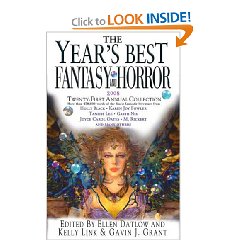
Year's Best Fantasy and HorrorLCRW announced the end of an era. The Anthology that praised the best in Horror and Fantasy published every year has ceased after 21 volumes. Year’s Best Fantasy and Horror collected two genres together, ones that complemented each other. It was good to have the cross-pollination. There’s much sadness in the Fantasy and Horror worlds, yes, but there seems to be glimmers of hope in the Comments section which has turned into a Who’s Who of Fantasy and Horror. In these comments, Ellen Datlow reveals that she has a new publisher for the Horror side of the anthology and Kathryn Cramer, publisher of Year’s Best Fantasy, reveals they have switched publishers. It’s the “narrowly dodged the bullet” reference that Cramer makes that causes me to think that the YBF&H closing might have been a publisher decision to cut costs in the rapidly diminishing American economy* (Ellen Datlow comments below that it was a combination of things, but most importantly it was an agreed-upon decision between the editors and publisher, not a sole publisher decision. My apologies for jumping to conclusions.).

Editors and authors alike send condolences in the nearly 100 comments that follow the announcement. The anthology was a huge part of the community–a way to celebrate and honor stories that represented what was happening in that community. Award shows can be fleeting celebrations–anthologies preserve and mark the year. I felt like a family gathering in the comments for a funeral or a wake. I look forward to seeing what new incarnations will arise from these decisions. And if there is a wake for the Anthology, I hope it is a big, raucous one for all the good they have done for the community!

To purchase a copy of the last volume of work, celebrating the best of 2007, follow the links above.

Diversify, or How to Get the Most from Your Writing Degree

APTOPIX Turkey DolphinariumI confessed to a fellow writer that I had nine jobs in the Yukon, and that it was still sometimes make or break at the beginning of each month.  I was living by cobbling together jobs, which isn’t necessarily bad. In my case, I might not get to do everything I want at first–but learning to diversify has helped me survive.

I’d always thought I would rather live by the phrase: I’m a ________ who also writes. Fill in the blank with astronaut, beekeeper, mechanic, sumo wrestler, whatever you like. This is where my money would come from–then I would carve out writing time. Or, another option was: I married a _______ and I write. Fill in the blank with astronaut, beekeeper, fire swallower, accountant, President, Estate owner, whatever you want. [On second thought, hold off on the fire swallower] Either way, money would come into my house steadily. I like paying my bills, really. 😀 But these options come with their own heartaches, as I’ve been reminded of by a good friend who struggles with the full time job and not having time for art. I would say it’s a choice–this art or security–but I want to believe we don’t have to make that choice.

Some say “the lean and hungry look” is a good one for writers–makes you write more, and more brilliantly. But lack of security makes me frightened, cranky, and depressed, and angry at myself for not planning better, or getting marketable skills. My brain panics and I make endless lists on how I can make money—that’s not what I would call “creative writing”–it is Fear.  You don’t get paid from writing for months, so it’s never fast money. So, the answer I came up with –if I couldn’t get a big job that paid well–was to diversify.

Here’s my version of diversification to make ends meet: I teach one college class on novel writing, teach cartooning in the schools through Yukon Arts Edventures, teach an after school program for teens through the City of Whitehorse on writing science fiction and fantasy, write articles for Yukon: North of Ordinary, sometimes for What’s Up Yukon, work as an on-call interpreter for the Beringia Centre, am doing an Oral History project for a friend, perform vaudeville in the summer, write radio series for CBC. In the works: I have auditioned for some short movies as an actor, may be working on an ad campaign, am auditioning to sing in a Big Band and am trying to teach online, and teach through teleconference, in the summer.

Even with all these small jobs, I’m still doing what I love:

Of my  jobs, most of them can be connected to narrative in some way. I write articles on topics that both interest me, and might be used for later stories; I teach about writing or literature; the radio series lets me both write, perform and produce; cartooning in the schools has expanded my understanding of narrative. The performance jobs–including Beringia as an interpreter–are still about words, communication, entertainment, teaching. So, in reality, I haven’t strayed too far from my writing, or my degrees.

And–working outside my field has improved my writing by showing me different styles of writing: a more informative style (articles and Beringia) and comedic (vaudeville and comic strip), for example–and by giving me new subjects to write about–like mammoths and scimitar cats and Yukon history and fifth graders. Also, it’s given me several editors–newspaper, magazine, online editors.

My friend, Arlin McFarlane, is a professional at diversifying. Actor, producer, director, B & B owner, acting teacher, English teacher, creator of Burning Away the Winter Blues and other creative events in Whitehorse, Arlin calls it repackaging yourself for every new job–the money I make she calls “ribbons of income.” It’s what we do to survive as Creators. I’d say that diversifying is more than a survival technique, it is a way of expanding your understanding of your skills. What CAN you do? A host of things. They may not pay much at first, but they keep you creating.

Write anyway:

I had to give writing its own place in my job line up too.  If I didn’t, then job number 10 or 11 could sweep away the writing.  Until you find a sustaining job –that also gives you time and support to create–diversify to keep your name out there, your skills fresh, and your money coming in.   If a Walrus can play a saxophone to make a living, you can discover new ways to make your bucket of fish too.

PS. While I was writing this, the phone company called to remind me my bill is overdue. Sigh. Ars longa, bills brevis.


Stardust Shines: Character Motivation-ism

stardustSometimes it’s simply about giving everyone something to want, something realistic, and then setting them on their paths.  Stardust, the Neil Gaiman-inspired movie, does a great job of giving characters real desires and then setting them at odds with each other.

If you are writing science fiction or fantasy, even well-developed characters function at half-power until they have a goal.  Once they have a goal–man, they zip!  This is one of my favorite things to watch, as objectively as I can, that moment in my heart and interest level when the character finds a goal.  It has to be something they want, not just an interesting goal that should be “universally interesting.”  They have to want it enough to maneuver through a tangly set of obstacles.

Stardust Plot summary: To woo Victoria, poor boy Tristan promises to get her the falling star they just saw.  When he goes to get the star, he discovers Yvaine, a woman, is the star that fell.  Three witches want to eat Yvaine’s heart to make them younger, and seven scheming princes want the throne–which can only be had if they can find the necklace, which happens to be with Yvaine.  So people want Yvaine for what she can give them: eternal life, long lasting beauty, a kingdom.  Tristan wants her to impress Victoria.

Really clear goals: Tristan wants to win the heart of Victoria. When he meets up with Yvaine (Claire Danes) he doesn’t suddenly switch goals.  He could have life immortal or even Claire Danes!  But no, he wants Victoria.  He promised to have her this star and that’s what he’ll do.  Yvaine won’t budge until she sees he has a Babylon Candle which could actually get her home—so she goes with Tristan on his way to Victoria because he promises to send her back home when he gets done showing off in front of his girl.

The pirates collect lightning, the witches want beauty, the princes want the kingdom and to kill each other.  When all their plots become melded into a single objective–from different angles–it revs up into high gear.

I enjoyed this movie.  I think it’s well designed.  The narrative is strong and is propelled by the desire lines of each character.  I love how all of them use similar means to get them to where they need to go: runes.  Not a map, not a prophecy, but unpredictable magic that you have to keep checking over and over again.

It helps that the scenery–meaning the place, the occupations, the “world- building” is interesting–but without desire, it is just scenery.  With desire, it becomes charming.  There are few memorable lines in the movie–this isn’t “Princess Bride”, though I believe the plots are just as good.  The comedy isn’t as strong–too many characters for you to memorize everything.  And this is its only fault, I think, that the characters may be well-motivated, extremely well-motivated, but rarely rise above stereotype–even with all the “cool stuff” around them.  They are stock characters with bling.

Tristan IS his want.  Other than his desire, he is a bit of a goof whose entire existence seems to be winning the heart of Victoria.  No mention of what his life was like before, or his relationship with his dad and having no mom.  Yvaine has a bit more character–she has been spending her life as a star watching us (we’re so entertaining to celestial beings) so she’s always wanted to have an adventure and fall in love.  But really we can’t imagine her life as a star.  Which is why she is so much more interesting on Earth (she’s got motivation and means).   The witches seem obsessive—and we wonder how they spent their time before the star fell.  Oh, you know, the last three hundred years….  The princes are fiendish, but they have no personalities outside of good/bad/opportunistic.  They want the kingdom–they only exist to push their plotline.

So, after all is said and done: character motivation, aka desire, is essential to move characters along, but without more character work–as in WHO these people are that make them different than their archetypal roles–desire becomes plot without managing to deepen character.  I imagine that Gaiman packed more into the novel, but on screen we may only have time for one choice: character desire vs. character development.

Ebert gave this 2  1/2 stars out of 4, saying that plotlines were convoluted and that the movie never rose to the level of “Princess Bride.”  I didn’t think the plotlines were convoluted, but only that the plotlines were so well charted that it left little room for characters to grow beyond the plot necessities–but that doesn’t mean it doesn’t satisfy like the best story–especially the fairytale kind of story it represents.   I would still give it 3 out of 4 stars—it’s a great movie.  Really.  And not making it to Princess Bride Status is not necessarily a fault.  It’s a clever romp through a well-developed world.  All the pieces are in place and they interact with each other well, and you can learn a lot about the power of character motivation, and the power of character too.  Even when character shines less than character desires.