There Are Stories You’ve Never Heard, Brilliantly Told: a review of The River

I went Saturday night to The River, a Nakai production, with Michael Greyeyes directing a play written by David Skelton, Judith Rudakoff and Joseph Tisiga.  To be frank, I wasn’t sure if I was interested in what I thought would be a sermon on homelessness.  I just didn’t want the guilt.  (And yes, I’m ashamed I actually said that—but I’m human and honest, and homelessness seems so much larger than I can comprehend–and I don’t know how to react “properly” or have any effect on the problem.  I suspect avoiding the issue is part of that problem–and yet, it’s the easiest thing to do.)

But local playwright David Skelton co-wrote the play, and I’m a huge fan of David and Nakai.  So I went.

I was blown away.   It wasn’t a sermon.  It wasn’t a guilt trip.  It was eye-opening, and it was riveting, and it was brilliant.  

For more of my review of The River at What’s Up Yukon

In a nutshell, brilliant writing, directing and acting take you into the vulnerable world of the homeless in Whitehorse.  Inspired by first person stories, collected by the writers through interviews over several years, that interviewing technique gives this play a realistic quality you won’t find in stories about homeless people.  You want to catch this play fast.  It’s here for a limited time, limited seating.  You won’t be disappointed.  I predict a long life for this play, and many, many performances across Canada.

(For more stunning photos of The River by photographer Richard Legner, visit this page.)

The Future of the Yukon (maybe): Radio Series “Yukon 2058”

We hear a lot about the future of New York, of San Francisco, of England.  Ever wondered what the NORTH would look like in 50 years? What would be happening, what kinds of trends here in the Yukon?  What kinds of possibilities?  Is it all going to be dark from climate change, or will we adapt as we go? I think it’s going to be a good Future if we can take better care of the Now.

Three years ago I created a five part series called “Yukon 2058” for the 50th anniversary of CBC.  They wanted something that celebrated their first 50 years, so I offered them a look at the next 50 years.  My theme was to eventually come back to why CBC is important, why local programming trumps National programming, why having a large staff in a small place like the Yukon is important.  I tried weave my opinions about what is good about CBC, and what is bad about the trends happening to CBC, into a narrative.  Yukon 2058 is the result.  5 parts.  The narrative of a CBC reporter wondering what his future will be, trying to find where he belongs in a rapidly competitive market.

You can go to the Radio Series page and look under YUKON 2058.

________________________________________________________________________

*image is Joyce Majiski’s “Racing Uphill.”  See more of her work on her website.

Mac’s Fireweed, Noon, Saturday, signing with me and Dave Strachan

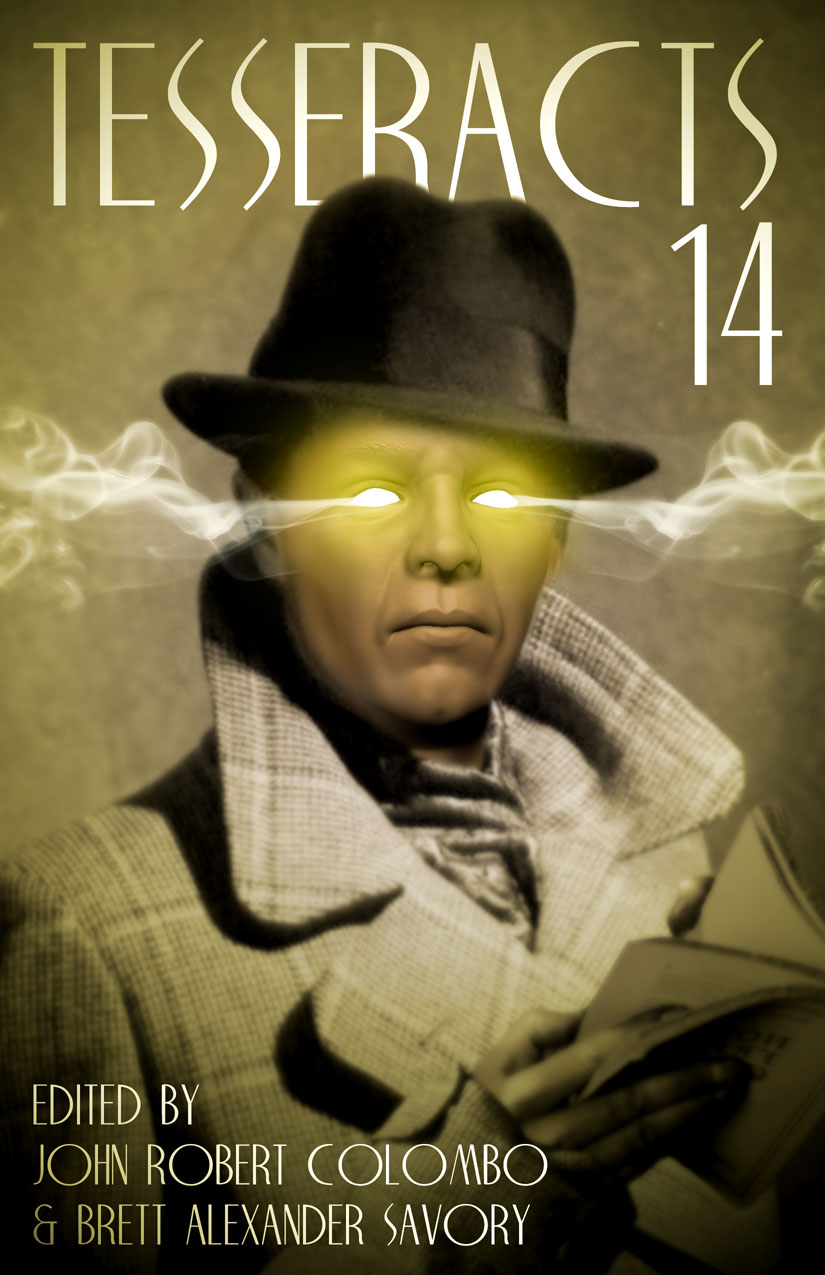
Thanks everyone for coming out and being a part of our signing at Mac’s Fireweed!  Two anthologies I’m a part of: Tesseracts 14 and Inhuman, and Dave Strachan, who has the lead story in Inhuman, was signing too!  The Fantasy/Science Fiction community in Whitehorse is doing great!  More and more of our group are stretching their talents and skills, and turning out great stories and sending them off to publishers!  So happy that this is happening in Whitehorse!  The Yukon is building a presence in Canadian Science Fiction and Fantasy.  Oh YEAH!

Tesseracts 14 and Inhuman are both published by Hades Publications and Edge Science Fiction and Fantasy Publishing (for Inhuman, through their imprint Absolute XPress).

Here’s photos of us at Mac’s Fireweed, Saturday March 12.  See if you can recognize all the campadres who helped make it a great event…


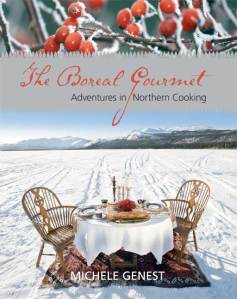
Moose, Cranberry, and the Everlasting Dinner Party: The Boreal Gourmet, cookbook, by Michele Genest

You’ve already seen the wonderful wildberry sourdough muffins recipe which I so tantalized you with (permission granted by Miche).  Now experience what cooks and connoisseurs are talking about in The Boreal Gourmet: Adventures in Northern Cooking by Michele Genest.  The book is more than a cookbook–it is a memoir of the cooking experience, the preparation, the friends, the mistakes, the surprises, and what might be an everlasting dinner party from recipe to recipe.

The Boreal Gourmet is a unique cookbook, with recipes that utilize all the cool things you’ll find walking around or rooted to the ground in the Yukon, but it is also a bit of Yukonalia.  It is a portrait of people living, and cooking, and eating and enjoying life, in the north.  From Geist’s review of the book:

I’ve always felt the best cook­books are the ones you open with the inten­tion of a quick browse but find your­self read­ing cover to cover and com­ing out the other end feel­ing like you’ve attended an inspir­ing din­ner party hosted by the author — with­out leav­ing the com­fort of your arm­chair. Michele Genest’s The Boreal Gourmet: Adventures in Northern Cooking (Harbour) is just this sort of cookbook. The nar­ra­tive that accom­pa­nies the inven­tive recipes oscil­lates from bush sur­vival advice to per­sonal mem­oir to his­tor­i­cal anec­dote (Klondike hope­fuls brought sour­dough starter buried in a sack of flour with them over the Chilkoot Pass) and is sim­ply a lovely read. The recipes them­selves range from the more gour­mdet — Arctic Char Poached in White Wine, Gin and Juniper Berries — to the less gourmet — Moose Lake Lasagna in a Pot (com­plete with tips on how to cook it in the backwoods) — and are com­ple­mented by Laurel Parry’s endear­ing hand-drawn illustrations.

Continue reading

Wildberry Sourdough Muffins recipe from The Boreal Gourmet, by Michele Genest

Breakfast-eaters, snackers, hangers-out:  it’s time to reclaim the muffin from the fast-food joints and even from the groovy independent cafes.

_____________________________________

Like the picture?  Get more recipes like the one below from our very own Yukon Boreal Gourmet, Michele Genest.  Her book, the Boreal Gourmet, just got a nice, nice, tasty review from GEIST.

_____________________________________

Muffins should not be as big as your head, as my friend LP observes. When I was a child a muffin was a 6-bite morsel available in the glass case in the cafeteria or on the counter at the greasy spoon. Now it is an epic that requires a whole morning to consume, and you have to mount an expedition to find the nuts and berries inside. So here are two recipes for muffins of sensible size that feature wild northern berries, are easy to make, low on fat and sugar and bursting with healthy grains. They are similar but not the same.

Low Bush Cranberry Bran Muffins

On a blazing blue day last week I climbed the clay cliffs above Whitehorse and picked a pint of low bush cranberries before breakfast. I came back home with cold fingers and an appetite and whipped up these bran muffins, based on a recipe from that brilliant standby, Joy of Cooking, but tweaked here and there. I’m really pleased with them; they remind me of my grandmother’s bran muffins, for which the recipe is lost (my mother and my aunt have searched their files in vain) and which I’ve been trying to replicate for a long time. Let us sing their praises: light, moist, not too sweet, branny but not too branny and featuring the nice tart bite of low bush cranberries.

Dry Ingredients

1 cup (240 ml) all-purpose flour

1 cup (240 ml) whole wheat flour

1 cup (240 ml) bran

2 Tbsp. (30 ml) sugar

1 tsp. (5 ml) baking soda

¼ tsp. (1.2 ml) salt

Continue reading

My Year of Canadian Reading: what stories are you made of?

As I’m approaching an inevitable embrace of Canada (oh, sweet mystery of life at last I’ve found you!) I’m aware that I have very little knowledge of the Canadian literary tradition.   A poor citizen is one who does not know his country’s stories. It is how we speak to one another–a cultural physiography and language that connects Canadians together.  How can I become a citizen without learning this cultural language?   I thought a more creative way would be for Yukoners to suggest Canadian books that meant something to them–then it would be more personal.

So I went on CBC with Dave White and we came up with a plan for book suggestions–a reading list of sorts–so that I could become more literate about Canada.  We are getting great results, but please call in to Dave and suggest more books.  I’d like to build a canon, of sorts, of Yukon-suggested Canadian literature.  Right now I’m looking mostly for fiction, poetry and drama—but creative nonfiction would be appropriate too.  I built a blog to read and discuss this literature.  It’s called “A Year of Canadian Reading” and you can follow the link to see what I’m reading, what I’m up to, and what I thought about books you suggested.  Follow along if you like.  Read them with me.  I want to get an idea about Canada from its literature.  I want to understand you through your stories.

I don’t have any intention of stopping reading after the Year is over—but an actual year is a start.  I’ve read some Canadian Literature–Mordecai Richler, Al Purdy, Tomson Highway, Alistair MacLeod, Alice Munro, Margaret Atwood and Michael Ondaatje (as well as some great science fiction and fantasy).  But I’m aiming for a deeper understanding of Canada through breadth and depth of your suggestions.

Let me know if you want to play.  Follow these links if you want to:  SUGGEST A BOOK FOR ME, or find out WHAT I’M GOING TO READ.

I Claudius, I Gertrude, I Polonius, I Hamlet: the humanity and unity of Bhaneja’s Hamlet {solo}

I just returned from a brilliant rendition of Shakespeare’s Hamlet at the Yukon Arts Centre.  One man, Raoul Bhaneja, did the whole play–or an edited version of the whole play–but he did every part, not just Hamlet’s soliloquies.  He had a box of light and an edge of darkness that he ran around making us believe he was seven or eight or ten people.  It was, in a word, stunning.  You might think that it will become boring–one man doing everything–and yet, every character received the same high quality attention.  I can’t imagine the inner-acting work that went on to understand every character, embody every person.  “I wanted to give everyone their chance,” Bhaneja said during the Q & A after the show.

It is a two hour show, and Bhaneja says about 15,000 words (from his own estimation).  He nuances characters with a gesture–Rosencrantz, his arm in the air; Guildentstern, leaning on one knee; Gertrude with her hand over her chest; Polonius stooped; Horatio a bit rigid and formal; Ophelia shy and uncertain.  His voice takes on multiple voices–a Sybil of sorts–but whose accents define the boundaries of the characters well enough for you to imagine, and I kept doing this, as if there were really six or seven people on stage and they were just being revealed to you one at a time as they spoke, as if they just came through the haze to speak.

Because Bhaneja edited the work, the transitions might be a bit altered, transitions from scene to scene.  But when I watched him end one scene with Hamlet and then start the next scene with Claudius I was struck by the statement it made about their characters.  Having one man portray both Claudius and Hamlet and crossfade into them gives the viewer this chance to see the two men as more similar, more equal, two sides of the same coin.  It’s easy to delineate the characters when they are played by separate actors, but when one man does them, it actually makes you think about how similar they all are.

Continue reading

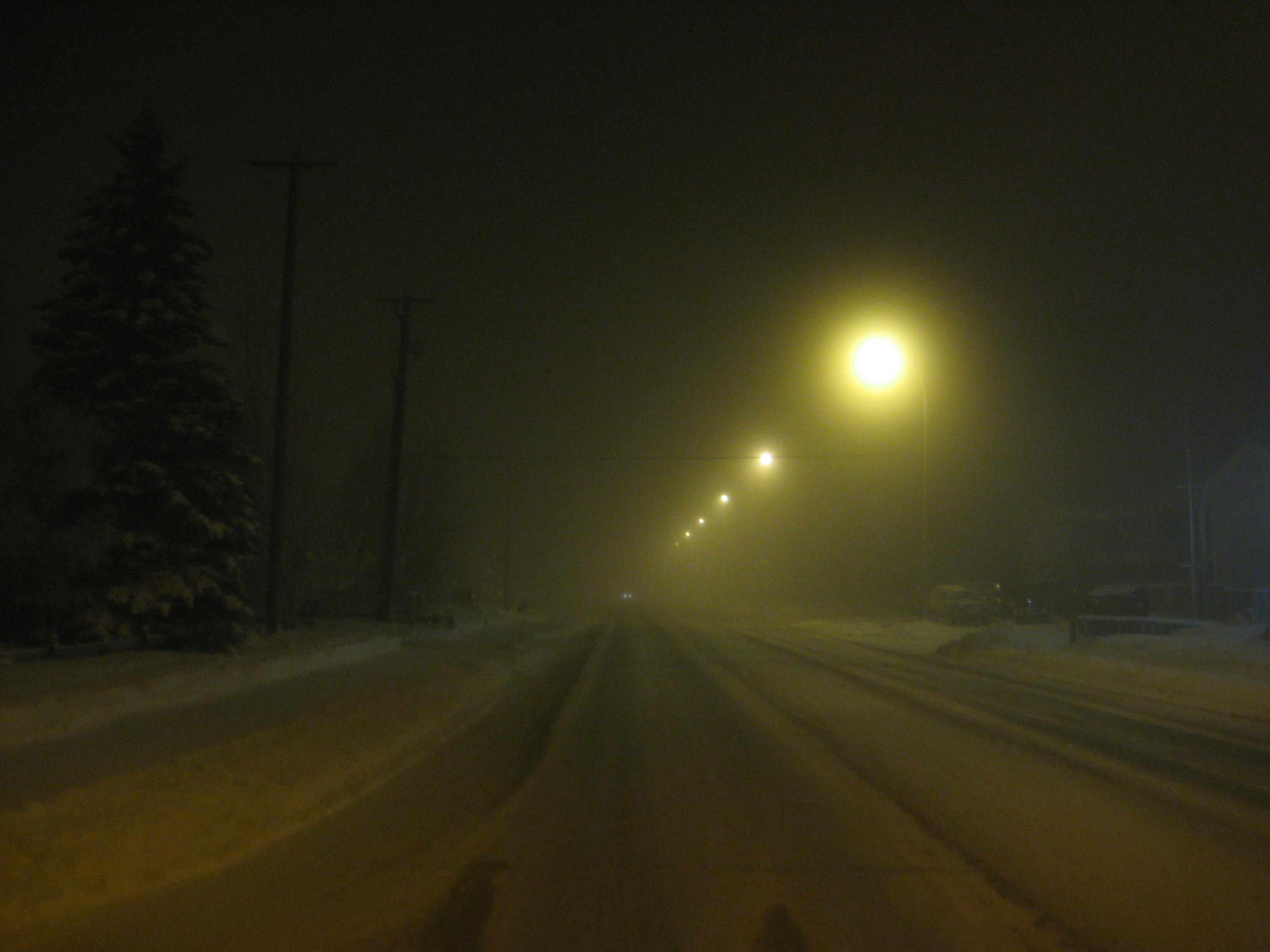
Whitehorse, curtained in icefog and woodsmoke, revealed in shrouded segments

Just a reality of living in the north, these -40 nights, where the icefog and the woodsmoke turned back on the streets mingle together to hide the city.  It’s mysterious and lovely.  Dangerous to drive in.  I couldn’t see the next segment until it was revealed.  People crossed second street without tapping the crossing light button and I could barely make out their dark forms merging back in with the night.  It was like there was a wall at the back of every backdrop setting— here’s Main Street with nothing beyond it but a white wall, and now the Library and now the Bridge.  Like curtains being opened one after the other, presenting our town in segments.  It certainly robs the city of continuity, or of flow, but it really makes you think of the city in sections—as if Main street were all by itself, or the Bridge, somewhere in England, instead of Canada, the fog so thick you couldn’t tell where it was placed in the geography.

I wished I’d had my camera the whole time, but it was hard enough driving your truck through the fog.  It groaned and squeaked as if it were thirty years old instead of five.  My friend says she won’t drive after it dips below -35C.  “Everything on your car breaks.”  And I saw, like an ambulance for vehicles, five or six tow trucks dragging perfectly good-looking cars and SUVs–just reminding me that even good cars in bad weather can break.  The air is filled with particles–mostly smoke because the smoke from homes hits a certain layer of air and bounces back.  You can see that everyone’s smoke flatlines at about 100 feet, going sideways, and coming back down, like we’re attacking ourselves.  Certainly Riverdale has been warned about woodsmoke pollution….but at -40, who’s listening?  (And -40 is where all temperature worlds, both those who live in Fahrenheit and those who live in Celsius, meet)

It’s interesting to think of the city all divided up into parts, separate sections outside of their context.  Like the world ends at the end of the street.  In some ways it was like speeding through the countryside of Texas and seeing each section as if it were its own small town strung together like pearls on a string heading towards the big city.

I saw Raoul Bhaneja’s one man version of Hamlet tonight, so I’m really enjoying language.  Makes me want to read, or see, Shakespeare more often.  Also makes me think of transitions–from one street to the next–from one scene to the next–my whole town was in crossfades.

Baked Café: Purveyors of Fine Coffees, Good Foods, and Perfect Days

A perfect day, and I’ve had them before, almost always contains a visit to Baked Café.  Some days I just come to sit on the black couches and look out the windows at Whitehorse going by.  Sometimes I bring a book to read.  Sometimes I plan official meetings there.  Other times I arrange to meet my friends.  Often, I run into them there unexpectedly.  Baked Café is a community hub, so naturally it’s a great venue for meeting.  There’s a lot of ambience in the wide room, and a lot of ambient noise so that you can speak frankly without being overheard.  Music on the radio.  People standing around talking.  It’s comfortable, and often crowded, but not in a jam-packed way, but more like having your best friends all over at your place, happy.  It’s probably the largest coffeeshop that Whitehorse has.

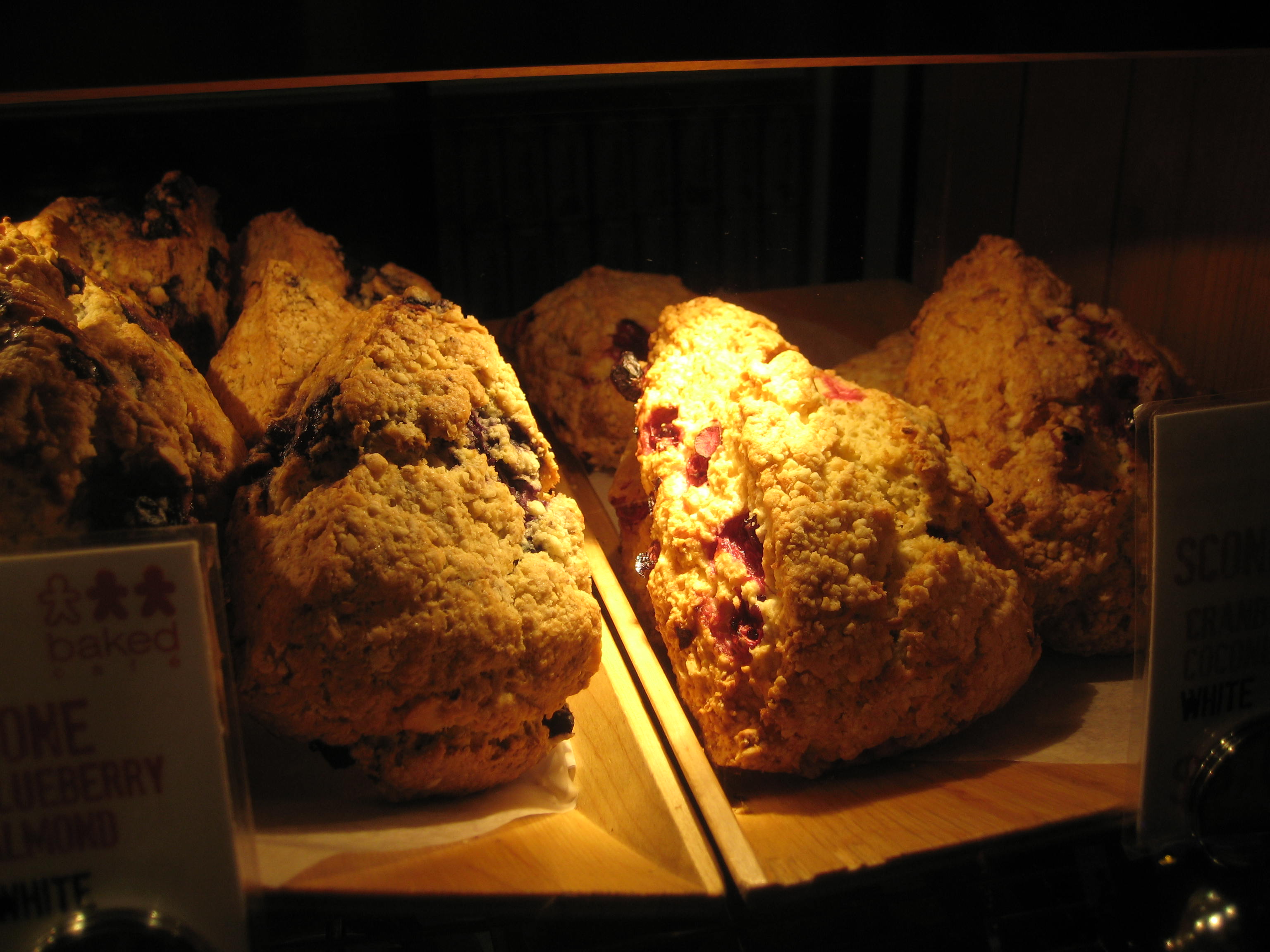
At the corner of First and Main, Baked Café serves a large range of specialty coffees and teas, cold drinks, as well as a wide repetoire of scones and pastries.  You cannot pass up a scone that is bigger than your hand.  It is a meal.  Cranberry Coconut, Cranberry Chocolate Chip, Blueberry Almond or Raspberry Walnut–they each come in three kinds: white, wheat and spelt.  Awesome soups–my favorites are any of their hearty chowders and their Tomato Basil with or without chicken.  They also serve sandwiches, beef pies, quiches, wraps, salads, cookies, and in the summer, several flavors of gelato. There is something for everyone.  It is a hot tourist spot in the summer, and just a hop away from the Whitehorse Trolley across the street.  Kids love it.  And it’s close to everything on Main Street–a place to begin your perfect day of shopping and touring around.  It’s a block away from the Museum, down the street from the Westmark, next to the river and the Whitepass Yukon Railway building.

Continue reading

Writing Your Faith: Workshop offered in January at the United Church

Olya telling me the Russian Faith and Light Movement StoryWhat is Faith to you?  How do you think about it?  How do you put it into words–to tell someone else what it means to you?  Does it only appear when you are going through struggles?  Is it constant like gravity?  I like this photograph by Grigory Kravchenko.  The woman looks up, but it looks as if she’s giving God a good talking to.  Faith seems to take place over coffee, and in a gritty real-world setting.

Starting January 21st (it was the 14th, but we canceled the first class due to extreme temps, -38C), the Whitehorse United Church and I have teamed up to offer a class in Writing Your Faith.  How do we put into words what is ineffable?

We’ll be looking at a lot of writers who have done just that.   Some you will find more effective for your style of writing than others.

While the majority of works that we look at will be of the Christian variety, they will not be texts that marginalize you.   They will be authors who struggle with the same kinds of questions that most people do when they are talking about a greater being in the world and how they interact with that being.  We’re not reading the selections to pick up content—it’s not an evangelical endeavor.  What we’re doing is looking at how people talk about their Faith, whatever their Faith might be.  So we’re picking up tips.  And those tips are good to use whether you are writing about yourself as a Christian or Muslim or Buddhist or Jewish or Agnostic.

Continue reading