Palin Eyes Role in New Star Trek Series

Fresh from her announcement that she’s accepting a position on Fox comes bigger leaked news.  Former governor Sarah Palin is in negotiations for a lead role on a new Star Trek series, tentatively titled Star Trek: Reckoning, going into production this fall, ready to be aired on both Paramount and Fox in the Fall of 2011.  

If she accepts, Palin would play Captain Nalia Fergus of the USS Steadfast, one of the ships convinced of an upcoming battle which the Federation won’t take seriously.  Unlike past series, this series concentrates on multiple ships and the Federation–so some political intrigue.  Palin, of course, has to be a “rogue” captain! [I love it!]  

The series takes place after Voyager, with an expansive Federation, a bit more difficult to govern, a bit too relaxed.  The title, Reckoning, refers to an Armageddon-like disaster predicted by the D’mi, a culture that sees dreams as predictions of the future.  They’ve had a collective, planet-wide dream that involves the whole Federation, but very few are listening.  The show is about their attempts to convince the Federation to do something about an impending attack that could destroy multiple sectors.  In the premiere and first season, they are able to convince three ships, who will work tirelessly through the series to undermine the current administration, all while trying to create alliances with other ships through deception, manipulation and controlling the media.

The President of the Federation, a very powerfully-minded, but peaceful, Betazed, is unphased by a dreaming culture predicting doom.  Fergus, believing D’mi predictions, forms an underground alliance with two other ships (writers are arguing over names like the USS Sun Tzu, USS Pearl Harbor, and the USS Buchanan) to protect Section 001, Earth.  This show will be about a bit of infighting in the Federation.  

“They’ve done it before,” says one of the writers.  “The TNG episode, Conspiracy, the Maquis, and the Dominion, and even the threats of Species 8472–but these were mostly alien attacks, people posing as humans.  The Maquis sequence really opened up the door to talking about multiple sides within the Federation–or even political parties,” say writers who want to remain anonymous till Paramount’s April announcement. 

Still they’re excited about the series.  And about these rogue captains.  “They really distrust the President.  He’s too peaceful.  He can read their minds–which they hate.  He’s a negotiator, a diplomat, at a time when they feel like war is coming. The constant question on the table will be–are the D’mi’s dreams really accurate, do they have a political agenda, and at what moment do you take matters into your own hands?”  

One of them quipped, “It’s kind of like writing a series in the Mirror Universe, except this one is bad.”

The coolest thing is that Fergus’ first officer is Commander Nuuk, a walking, talking polar bear from some ice planet.  Earth apparently dropped off its Arctic species on this planet (yeah, climate change wiped them out on Earth) and they mixed with the indigenous life there–very similar–so you get a polar bear.  Fergus used to hunt bears.  Nuuk doesn’t know that, so this is going to be a source of tension, as she doesn’t want to admit it, but thinks of him as a trophy first officer.  She’s gonna have a D’mi onboard too–who has these waking dreams–who’s living in both reality and fantasy all the time, but can’t tell the difference.  

These are three ships full of conservatives.  I do think that a ship of conservatives gives the writers what they’ve always waited for–the ability to write in closeted gay characters.  There won’t be much open romantic intrigue because everyone’s uptight, not wanting to be revealed.  

Palin has expressed interest, according to one former aide in Alaska.  “She likes the character.  It’s so much like her–bold, aggressive hunting woman, now commanding a starship of conservatives, who move with her every command.  They fight for Earth, and they seek to protect the planet from its own bad judgment.”  

Palin is reportedly brushing up on Federation policies, which like Kirk, she will ignore and bend at will, and she’s learning Klingon–just in case.  She does have some concerns.  She’s asked to be written in as a mother, with small children on board the ship.  She wants to be assured of a four year gig (no death in season two).  She also wants to have her own ghost writer write in folksy things she would normally say, but now in a command-sort of way.”  

Paramount and Fox want to give her as much latitude as possible.  “We’ve never been able to pick up this demographic.  Usually we just get intelligent, science-oriented, techno geeks with a liberal, compassionate viewpoint.  We have the potential to scoop Red State America–the O’Reilly viewers,” says one assistant producer.  “We wouldn’t just have a fan base–we’d have an electorate!” 

McCain, a trekkie since William Shatner was a child, has said he’d always wondered how the Earth in Star Trek ever resolved pluralistic ideas.  “Never made sense to me why everyone agreed on Earth.  What happened to pluralism?”  And he has a point.  How did this series eliminate differences of opinions?  Where did the all Israeli ship go?  Or the Chinese ships?  Where were the rivals to get spaceships into space?   Did they sabotage each other?  Surely there was more fighting before we conquered space.  This series, McCain indicates, will “bring back the lipstick in realistic.”  No one knows exactly what he means.  

It does bring up interesting possibilities for the writers.  Could they keep the Star Trek fan base intact–those rooting for the Federation?  But those fans just might like a quirky, folksy rogue captain–plucky enough to cause a conservative revolution.  

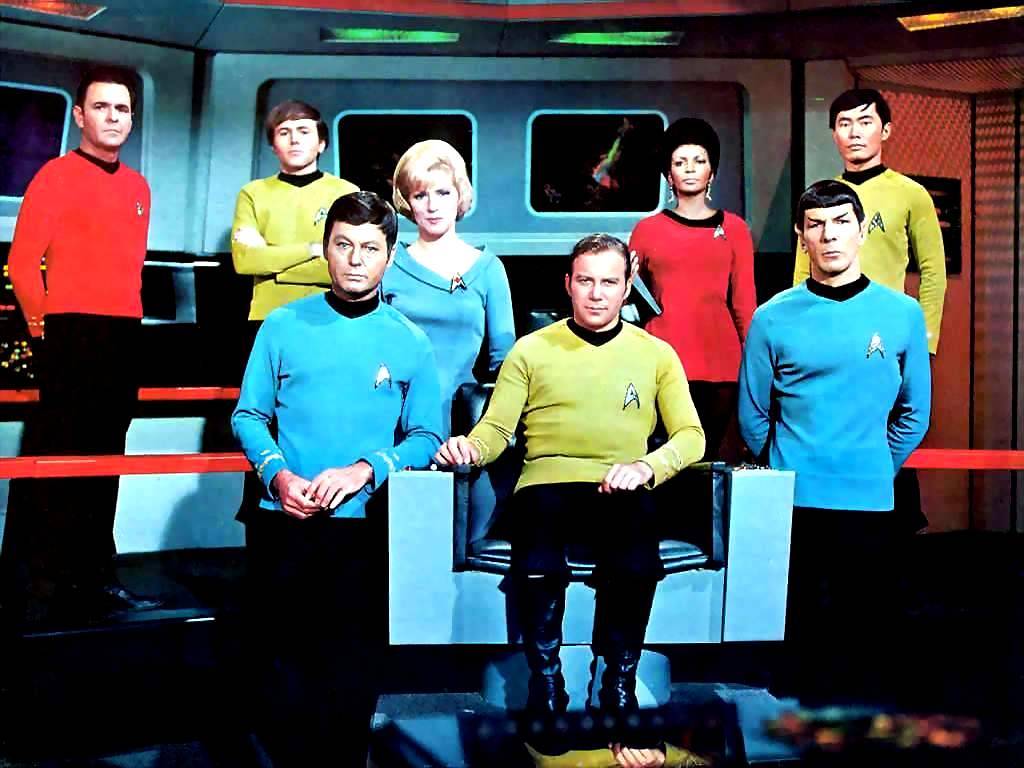
Palin as Captain of her own ship?  What do you think?  She does wear red well.


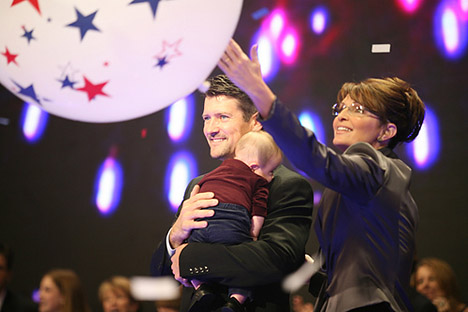
 Shatner giving Palin the baton, the formal written permission to be as “rogue as she wants to be.”

____________________________

(this is, of course, a parody.  A wink to Sarah Palin.)


For more on the new Star Trek Series, don’t miss these entries:  Gingrich as D’mi, and Palin citing Star Trek to promote Gun Rights  and Red State America Wants Their Star Trek

Yes, Captain Kirk has a Character Arc

chris-pine-as-captain-kirkI don’t want anyone to miss this great discussion that Dave Wesley mentioned as a response to my earlier post.  He said that we ought to check out the discussion of character arcs in the new reboot of Star Trek

Frankly it’s a great discussion about writing.  Here’s KFM (Rogers) initial premise (SPOILERS):

“Captain James T. Kirk, the protagonist of the movie, does not have the development executive’s beloved “character arc.” He has no arc at all.

He starts as an arrogant sonovabitch, and becomes a slightly more motivated arrogant sonovabitch. He does not learn to sacrifice, he does not learn to work well with others — he takes over the goddam ship. He’s right all the time, he never doubts he’s right, and the only obstacle he occasionally faces is when other people aren’t sharp enough to see how frikkin’ awesome — and right — he is as quickly as they should.”

But read the responses and you’ll see a lot of varied ideas on character arcs.  Me, I think Kirk has a character arc.  (And I actually posted it on the responses to his post)–but in a nutshell:

Yes, he’s a sunovabitch through the whole movie, but he is a listless, aimless SOB at first, and he has to find purpose. He never thought his fighting, his rebelling, his go after the baddies ideas fit in well with tight-shirt Starfleet, ultra PC. And yet, it is a Kirk who transforms Starfleet.

Starfleet needs a person who thinks with his gut, and Kirk jumps into that role.  Both old Spock and Pike serve as catalysts to transform brawler Kirk into Captain Kirk.

I like Pike’s speech to him early in the movie:  “Have you ever felt you could be something more?”

I think this is one of the lines that resonates for the viewer.  Don’t we all wonder who we could be if we had the opportunity?  And the line from Spock’s past:  “You will always be a child of two worlds, fully capable of living in either one. “ And Spock has to make the decision where to be fully, and which side of himself to favor–Human or Vulcan.

The movie is about Destiny, and it screws around with time travel to ask the larger question about whether destiny is fixed or fixable.  I think the movie promotes fixable.

The whole discussion is worth reading, but here’s a great later post:

Both have arcs, and the arcs are definitely related because they are almost mirror images of each other. Even Kirk’s dead father is a mirror image of Spock’s dead mother.

Their arcs also cross each other when Kirk tries to gain control of the starship by picking a fight with Spock. Except this time, he doesn’t try to stage mutiny, but rather talks to Spock to get him to resign his post. Following this fight, Spock realizes that he has emotions and he can’t control them. At the end of the scene, Kirk realizes that if he is to be Captain, he has to stop being impulsive and Spock realizes that he can not be Captain with his spasms of rage, and that he will never be able to ignore his emotions.

The movie is good, but I think there’s a lot to discuss about how the movie moved towards good through the writing of characters we thought we already knew.  And character arc is important.  I don’t think that Abrams achieved his great story by NOT giving Kirk an arc–because Kirk is not static.  Kirk learns.  He learns how to adapt t0 and also transform Starfleet protocol to fit him–thereby creating the James T. Kirk of the TOS that we know, and the Starfleet that surrounds him.

In some ways, we learn a lot about how Kirk and Starfleet function with each other, and in spite of each other.

Star Trek: Playful, Exciting, Character-driven

spaceball-12947135322_30ab2b2c4fStar Trek has come a long way and just when you thought there were no surprises left, they show up.  I’ll admit, the last few Star Trek movies left me cold.  Nemesis bombed because the writer tried to copy too much from ST2 but without any of the heart.  Insurrection was a trite story line.  Abrams’ Star Trek reinvigorizes the franchise by giving us both old and new–it completely satisfies this Trekkie.

If you go, you will get a thrill ride, and you will also be reintroduced slowly to characters you thought you knew. Yes, everyone looks young and the sets look like Apple designed them, but that’s what it means to restart the series.  You will get your money’s worth from this movie.  Most people know these characters even if they aren’t fans–but they are reintroduced to us here in great detail.  And there’s lots in here for fans of the show–little touches that show that the writers know the whole series.

I’ll try to keep out all of the surprises.  But you already know that there is time travel involved, and it shows up at the very beginning.  And because of that, events are altered.  “Our destinies are not what they would have been,” says a young Spock.  This is okay.  Star Trek has thrived on the “might have been” storylines.  The Mirror Universe got a lot of play in nearly every incarnation of Star Trek; Tom Riker was a might-have-been Will Riker; Voyager had the two part episode “Year of Hell” and the Finale which changed and altered timelines.  Even ST: First Contact imagined a Borg-filled Earth.  So, it’s nothing illegal–it just gives the writers room to wiggle.  They got to play a little with the histories–legally –because a villain altered the timeline.

But that’s the premise.  The cool part of the movie is not what they changed, but what stayed the same.  We get to see some fine actors inhabit these characters and manage to put a bit of the former actor’s style into it.  You watch Chris Pine–slowly he becomes a bit of William Shatner; Quinto is a fantastic Spock.  I swear I can hear Kelley in this new McCoy!  Uhura shows her inner Nichols in a turbo-lift.  Sulu, Chekhov and Scotty all have their moments of channeling as well.  But the writers also let the actors play—play with these histories and parts.

The plot allows each character to be introduced separately. This is a brilliant maneuver.  instead of just dumping them all on the stage at once, we get to know each character in their context.  We meet Kirk and Spock as children, Uhura in a bar, McCoy on a shuttlecraft, Scotty in a Starfleet Outpost, Sulu as a pilot and in a fight, and Chekhov in a funny homage to ST4.

I wish Wolverine would have been this good.  This had just as much action as Wolvie, but ST had a unified plot, and well-developed characters we thought we knew completely.  In the same way Wolvie failed–by being a prequel with no surprises at all–Abrams managed to give us a bit of parallelism in the lives of these characters and the ones we already know.  And there are so many great and interesting surprises–what ifs–that are allowed to play out.

This is what revision should be.  The series was great, but Myth can revise a story and get to its essence, even if the details have somewhat changed.  I can accept both Roddenberry’s original and Abrams’ version–because this isn’t an arbitrary version.  It fits in with the timeline because Nero changed the timeline.  I’m cool with that.  Just as I’m cool with Janeway’s original arrival back on Earth, and “Yesterday’s Enterprise” (a fan favorite).

And J.J. Abrams, a big high-five to you and the writers from a long-time fan!  When I was seven, I took my photo with the wax figure of Mr. Spock, my dad on the other side of Spock.  I don’t have a costume–but I was once Spock at Halloween.  I don’t know Klingon, nor do I collect the series, or any of the paraphenalia, but I loved the stories, and I recognize Star Trek as American Mythos.  You’ve done a great job at bringing that to the surface.  Well done.  Do a sequel.

What Will You Do with this Symbiont You’ve Been Given?

jadzia_dax-002Recently saw a rerun of Deep Space Nine where Jadzia Dax is reviewing a possible Trill initiate. Just to clarify: Trills have the opportunity to join with a symbiotic species which will live through many hosts. Imagine a worm that lives off you, but also provides you with the lifetimes of all its previous hosts and the knowledge it’s accumulated. There are millions of Trills, but only a few thousand of these symbiants, so there’s quite a competition for them. It’s an honor to be joined. The host’s personality and the symbiant’s personality alters when they are joined, and they become a new person. “The two become one.” But because the symbiant has lived such a long time, its personality is pretty strong as an influence, and Trills try to choose for a host a pretty strong personality who has defined themselves before joining—not someone who has no personality or desires–someone who offers nothing to the symbiant, nor to society, but who just wants to live off the symbiant (ironic).

In “Playing God” in Season Two, Jadzia finds herself reviewing a potential host. The problem is that he is eager to get the nod from her, but not to add much to a symbiant’s life. He has no passions, no plans for his life. He is living his father’s dream–not his own.

I thought about this. Here was a man who was not doing anything with his life. He was hoping that the symbiant would give him a life….

How many times do we do that in a relationship? We cancel out ourselves to make sure there is room for someone else. We stop living because we want to be “joined” with someone. We’d do anything to be “joined” including becoming what they want…. and yet we forget that we could add to the mix too.

People are fascinating. We are attracted to them because they are fascinating. Even the most “serving” personality has thoughts and dreams that happen to no one else. We all can hear the death knell on a relationship when one person tries to eliminate what makes them “them” in order to get “joined.” And we all hear wedding bells when two strong interesting individuals get together–as two strong people, bringing something to the relationship.

So, what will you do with this life you have been given? And what will you contribute to your joining? How will you contribute to the world? What are your passions? Do this, find this, before you get “joined”—-you will contribute a lot to your joining–whether it’s a marriage, a workplace, a family, a faith.

Hmmm. We forget that sometimes–we Christians. God is not here to hollow out his creation and make them clones of Jesus. He needs something to work with. That’s why you gotta be the best Trill you can be as a host for such a cool symbiant. (Oh my, I’ve surely crossed a line—Jesus as Symbiant….) But I think it works. I’ve met too many Christian young adults who are empty vessels–no personality–save worry about not doing the right thing—who are hiding who they are and I think they get this message from well-meaning folks and colleges. Hey, good men and women, God doesn’t want “you” to be a robot, a device that he manipulates, downloads His thoughts and desires—he enjoys a cool person to talk with, to “join” with.

Give him one. The more interesting, the better.

It’s a Wonderful Life, Captain Picard

270px-st-tng_tapestrySeeing that it’s Christmas, and I’m going through a midlife crisis, I thought I would further comment on the magic of “It’s a Wonderful Life.” That magic: the Re-vision of a person’s life has been played out on a number of TV shows. That 70’s Show undid a kiss, Moonlighting a meeting, etc. Each show played off the idea that life could be revised differently, playing to our many regrets. All of us have wondered from time to time how life might have been different if we’d chosen another option.

Here’s Star Trek’s version of the Capra classic, and whether you are a Sci fi fan or not, or a Trekkie, the message in this episode is broad enough to speak about the human condition.

In “Tapestry,” Captain Picard is killed on an away mission. His artificial heart is damaged and it fails him. He meets up with Q as an afterlife. Q is the Trek Universe’s answer to God–an amoral, irresponsible, uncompassionate God. Omnipotence with no ethics. Clarence with no caring. Q offers to change one aspect of Picard’s life, and he uncovers a pivotal moment when Picard loses his real heart in a fight with badass aliens, when he was a young officer. Picard never realizes that the moment is pivotal. Q transports him back in time to play out that moment when he was stabbed. Q forces him to either accept death, or find a way not to get stabbed and see what his life would have been like with a real heart instead of an artificial one.

Picard replays the days leading up to the argument, to the fight, to the stabbing, to avoid violence. To do this, he has to stop his friends from defending their honor, and in doing so, loses his friends–but gains his life. Q transports him back to the future–or to the present. Picard finds that he has a completely different life. A life void of risk, completely safe. And by playing it safe, Picard has become a Lt. Astrophysics analyst, who transports data back and forth to senior officers.

If you want the whole episode, go to Youtube and begin here.

But I think the end has the meat of the message. Watch here.

The difference here is not that Picard is pivotal in the lives of others. Undoubtedly he was. But that our risks bring about a person who can lead. Our risks, or lack of them, define us. George Bailey’s sacrifices define him. Picard’s daring defines him. What defines you?

For another take on this idea, here’s a heartwarming video by Garth Brooks called “Standing Outside the Fire.” Pardon me mixing Star Trek and country music, but the themes are nice together.

New Star Trek movie and the Power of Myth

What I love about what seems to be Abrams’ vision is that he is turning this story into myth. He’s taken Kirk and made him into a man who is dissatisfied with his current state and yearning for a destiny, and taken Spock and made him into a conflicted man who must choose between two paths. While Abrams will no doubt rewrite some of the canon, by escaping the usual players (Shatner, Nimoy–though Nimoy does have a role in the film, Nichols, Takei), he allows these “characters” to be interpreted much like –and on the scale of–Shakespeare. Now hold with me. I ain’t saying that Roddenberry’s original show was Shakespearean, or certainly that the original episodes were on par with the Bard, only that the design of archetypal characters was hidden there all along.

Kirk as a man who leads with his gut; Spock a man who thinks with his brain; McCoy a man who decides with his heart. All three of them make up the primary triad of most every episode where a concept or idea must be batted around between these three polarities—does the gut, the brain or the heart win out?

Abrams looks as if he has captured that archetypal quality in at least the main two characters. I’m hoping McCoy is fleshed out a bit (he should have been quite a bit older than Kirk).

When Peter Jackson remade King Kong, he turned it into myth, and I loved that movie. Myth is where you know the basic gist of what will happen–what has to happen–the Empire State building throws its shadow on the whole film–which makes Kong into a tragic figure, lurching towards that building no matter what. But it gives Jackson a chance to play with the inbetween scenes–which he does.

Now Abrams is getting a chance to interpret character, much as an actor like Branaugh or Gibson or Olivier interprets Hamlet. By gutting the Nimoy from Spock, and the Shatner from Kirk, we’re left with the essence of the character—these two torn, universal, archetypal men. And I think you will see that Star Trek will move–as it has always been moving–into American Myth.

Yep, America has myths–just as profound as the Greek ones. We’re starting to see those myths coalesce. You can tell a myth–it keeps being referred to, being reinterpreted, having something new to say, becomes universal. In my opinion, American myths include: The Wizard of Oz, Batman, Superman, Star Wars, Star Trek, King Kong, Spiderman. Nearly all of them started as Art in one way or another. The Oz books got the promotion into mythos when Judy Garland put on the red slippers–but all the reincarnations of that story have mythologized it. Certainly, though, the books were illustrated and this helped.

There are other broader myths too: the cowboy, Western expansion, the American Dream–but in the fictional ones I mentioned, America gets stories. They get strong characters that can be played and played again.

I am glad that Star Trek is entering the realm of Myth, even as we come closer to the days of space exploration. I look forward to Abrams’ rendering of the characters–not the show–of the ways these men and women represent the American story, and how they keep reflecting us back to ourselves in the mirror of Science Fiction and Myth.

Dream Jobs and Just Doing It: Star Trek Series

For the new Star Trek the Movie, see my posts: Star Trek: Movie Review and

New Star Trek Movie Trailer and the Power of Myth.

___________________

Okay. I’m not gonna be a self-help guru here, but I will tell you what happened to me.

I think my number one thing I’ve always wanted to do was to write for Star Trek. Or for some TV sci-fi series. I think I liked the idea of developing characters through adventures together, and writing with a team of people. And seeing that each episode became something that added to a whole. Maybe, too, I was disappointed by the squandered potential of Enterprise. I felt like Season One was underdeveloped; no one died at all and this was our first time into space…. The characters had potential but they were never utilized and the plots were dull. When the season finale came up, and the new season premiere completed it, I was sure that the problem was the writers–or the writers had been hemmed in by too many rules, I don’t know….

So, today I was complaining about how little time I have to write and that I’m working too much, and I told a colleague about my silly dream of writing for Star Trek, and she said, pulling out a notebook and a pen: Okay, let’s write for Star Trek.

The next two hours were a blast! We created a whole cast of new characters drawn from the Star Trek universe, and some from my own brain, and then created a series—what we do in season one, season two , season three. I had high hopes for the series—hehe. I learned that without a series going on, of course, selling a new series would be very difficult, and two, that Pocket Books really wants books with major characters who have appeared on the show–not your own. Who knows if one can write “similar” Federation type settings for books that are not Star Trek, but obviously borrowing the universe-structure. If anyone knows if publishers can’t stand ST-like books, let me know….but I may write this up as a novel pitch.

I have nothing to lose for trying. And that’s kind of what today proved to me. Laurie, my colleague, proved to me by pulling out the notebook and pen that sitting around and complaining does little good, and that it’s better when you just do it. If you want to write for Star Trek, do it. Create what you want. Perhaps with some positive energy, I can a) sell a TV series! or b) sell a book. Who knows? But I do know I’m several steps closer than I was. And I loved brainstorming with Laurie. It picked up my mood, and made me feel as if I were closer to my goals.

So, maybe don’t look at all the obstacles–just do it. You might as well have fun–and who knows–the product might be salable outside the frame you thought you wanted to work within. It was fun creating, and maybe that’s the whole point.

(I’ve just, of course, shown my complete geekness to the world….but multiple character arcs, episodic TV and science fiction are fun. Maybe I should just go ahead and create the Television Station that will run my show! Hey, Laurie—get out that notebook!)