Gays Will Save the Church: my story in Queer Story Archives

As a science fiction/fantasy writer, I just want to remind folks that we aren’t all alike, and we don’t live in just one bubble. My blog has always been about the experience of being a science fiction/fantasy writer and not just reflecting the genre/writing parts—but about my whole experience of being a Yukoner, of having a faith, of being gay–AND being a science fiction/fantasy writer. So this is part of it.

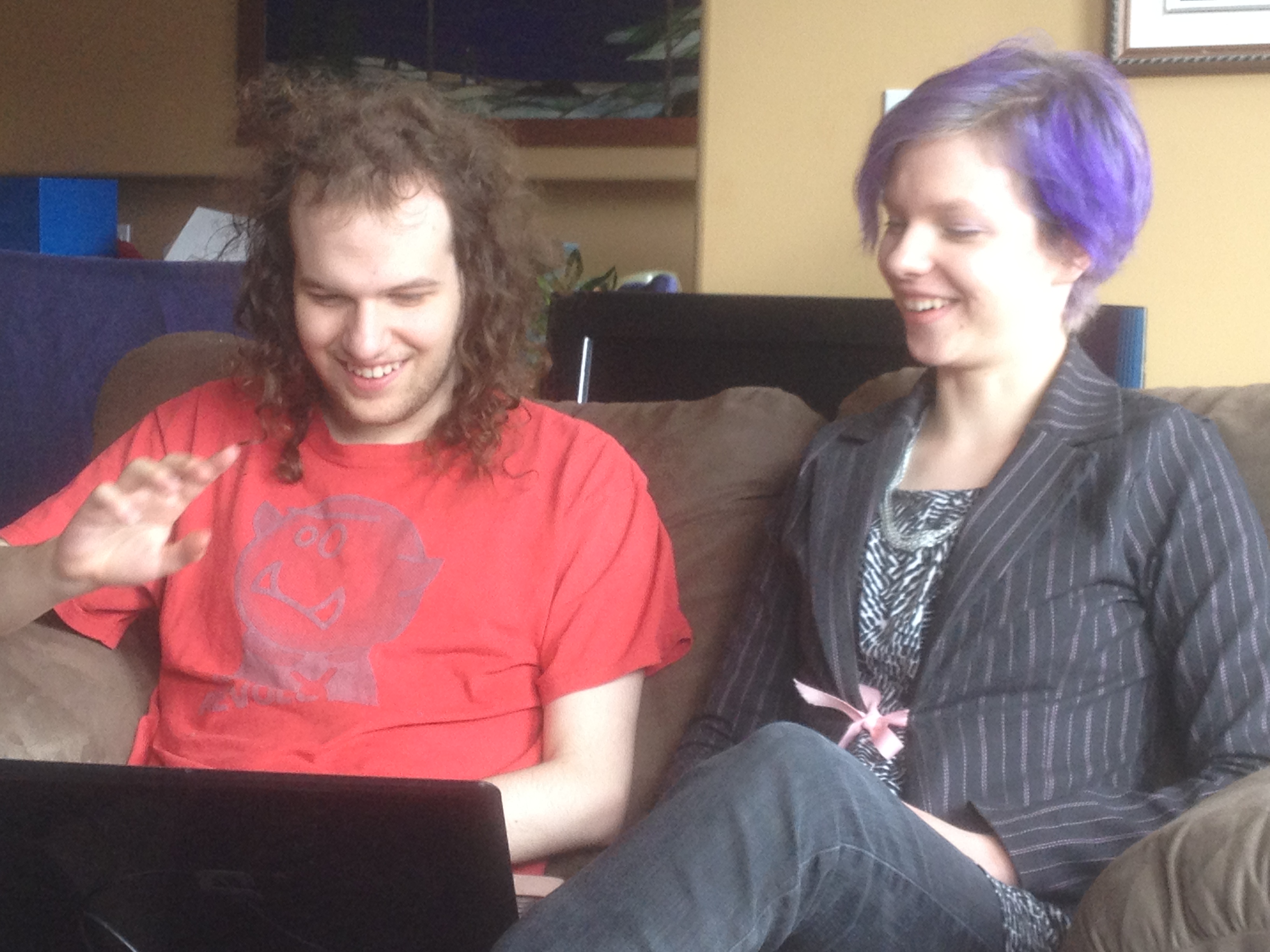
The Queer Story Archives came up to Whitehorse–Lulu from OnMyPlanet.ca–in July 2013, recording stories of Yukon Queers, and we recorded this right before I was to leave for Dayton, Ohio. I think it’s turning into a positive story so I’m sharing it. Ultimately I’m suggesting that including gay people can save a rapidly diminishing Church population. To do that, I tell my story. Some of you have heard it–either through the Yukon News, or through DNTO. Both sources were good but heavily edited. This is me telling it in less than ten minutes. It feels better in my own words, complete.

We grow from hard times in our lives and this was a good growth for me. Eventually, I’ve come to retain and re-establish many friendships from the first church. I hope my story still helps others. I’m placing this over on Talking Dog too.

Depicting the Divine in Epic Fantasy via Tor.com

From Brian Stavely comes a thoughtful post on depicting the divine in Fantasy over on Tor.com.  I’ve included a short beginning here, but read the whole thing at this link to the whole article. Essentially Stavely counts off the ways one can describe a god in epic fantasy fiction–and there are five options.  I was thinking through his list, and it’s good, but I think there are at least three more ways to depict a god in epic fantasy, and I humbly offer them up:

Option 6: Use other people’s understanding of the god as description.  They might not all be alike, but the confluence, the overlap of them, will give a mosaic feel to your god.  It will also create character development for the characters who have seen/or believe in this god, as we tend to see what we desire in our gods.  A god’s description in the mouth of one character as a “god of vengeance” is a very different character than someone who calls him “a god of protection.”  May be same god.

Option 7: Use tales of the deeds of a god to describe him or her.  Actually what a god does says more about him than his/her description.  And again, people have tales. If you can gather up the tales of a god, you can capture a character description that readers can fill in as they go.  Then if and when the god shows up in your text, it may already have a pretty firm description in the mind of the reader, based on what it has done in the world.  God is rarely described in the Bible, but his deeds let you know exactly what kind of God he is.

Option 8: Every culture uses Art to talk about its gods.  Can you pull together images of the divine from a culture’s art?  That will help form a picture in a reader’s mind through the cultural depictions of the gods, telling you a hell of a lot about the culture, as well as the god.  Michaelangelo’s God touching Adam who seems curly headed and benevolent, and other depictions of God as a fiery, anger-filled rage monster.

___________________________________

Depicting the Divine in Epic Fantasy

by Brian Stavely

There’s a striking moment near the end of the twenty-first canto of Dante’s Inferno, one that almost all readers tend to remember, when the demon Barbariccia “avea del cul fatto trombetta.” It’s hard to put it delicately: he turns his ass into a trumpet. Not the kind of thing you expect out of a writer recording the steps his salvation, but the image stays with you.

Likewise, readers of the Divine Comedy remember Ugolino, who, for the sin of eating his sons, is forever frozen to his neck in ice, gnawing on the brains of Archbishop Ruggieri. In fact, Dante has no trouble at all depicting sinners in the various postures of their suffering, and for seven centuries readers have kept turning the pages. Corporal violence sells. Electronic Arts even has an eponymously titled video game in which Dante looks less like a poet and more like a Muay Thai Knight Templar. The EA people are no fools—they understand that there’s a ready market for brain eating and ass trumpets.

When it comes to the celestial realm of heaven, however, Dante runs into trouble.

READ MORE HERE.

Thanks, Brian and Tor.com!!

Hopefully these suggestions help YOU when writing about Faith in your Fantasy or Science Fiction.  Let me know what you think.  And don’t forget, you can write about Faith in Fantasy and Science Fiction for the Tesseracts 18: Wrestling with Gods anthology, open for submissions right now over at http://www.tesseracts18.com!

Writing Faith Writing Workshop starts tonight

Jerome-WritingFaith(web)

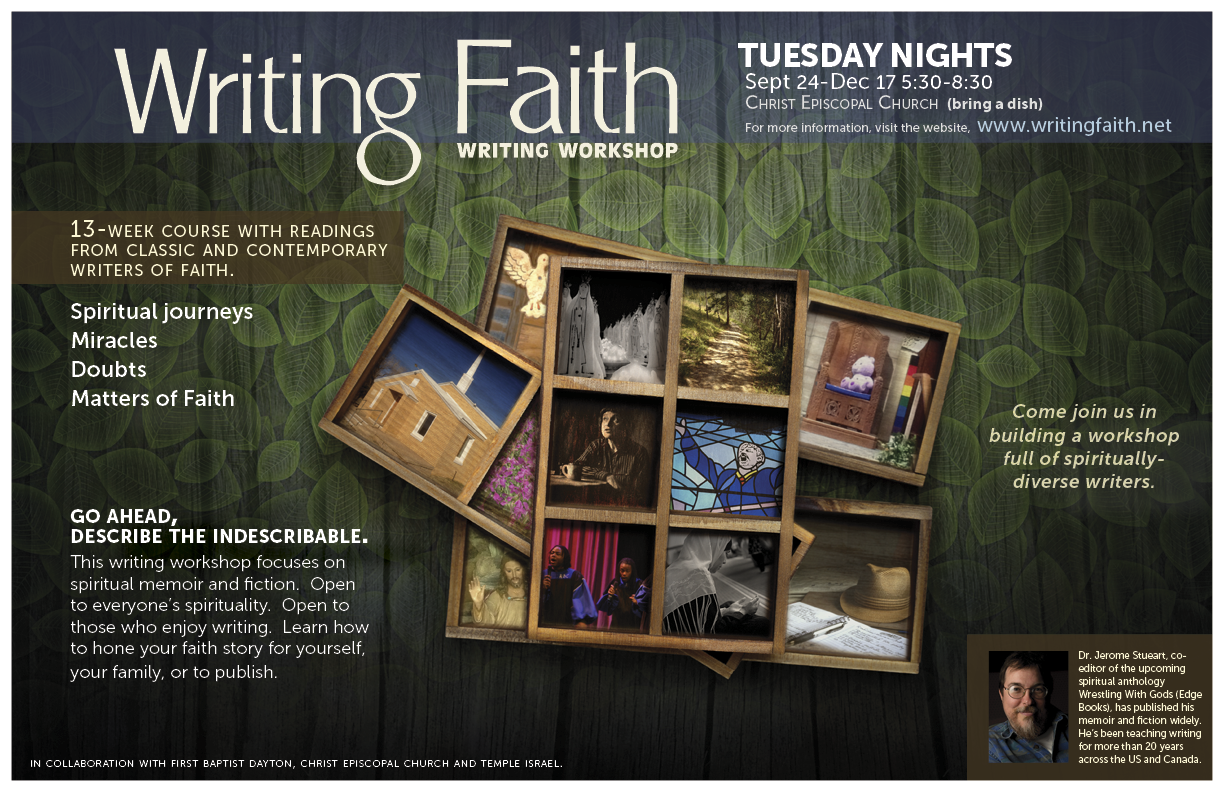
If you’re in Ohio, there’s a new workshop of Writing Faith starting up at Christ Episcopal Church in downtown Dayton.  A collaboration with First Baptist Dayton and Temple Israel, the workshop is going to be 13 weeks, Tuesdays, 5:30-8:30.

The workshop is designed to teach you how to write about Faith–a tricky subject to begin with–but with a long history.  Come explore your faith and learn techniques found in Annie Dillard, Langston Hughes, Donald Miller, Thomas Merton, Andre Dubus, John Updike, Frederika Mathews-Green, Kathleen Norris and others.  While the core may be Jewish and Christian based, there will be readings from other faiths.  We hope to create a lasting workshop of multi-faith writers who will continue to write and workshop together.

Follow us on www.writingfaith.net where I’ll be posting short articles about “How to Write about Faith” as we go.

Jerome in the Yukon Writers Festival

20130422-154228.jpg

A really nice article by Dan Davidson appeared in the Whitehorse Star on Friday, April 19. Alistair Maitland did the photo. I appreciate them both. I think this Festival will be a lot of fun. It’s always good to get to teach Yukon high school students as part of the Young Authors Conference as well.

The Festival starts with a big reading at the Kwanlin Dun Cultural Centre Tuesday night at 7pm. The Young Authors Conference is held the next two days after that in FH Collins Library and then we head off Friday to Haines Junction for a reading.

Organizer Sara Davidson has done a great job at gathering diverse writers together. Yukoner Dennis Allen, as well as Drew Hayden Taylor and Carrie Mac and Beverley Brenna.

If you can, come and enjoy the readings with us.

Back in the Saddle, and the Horse Didn’t Buck

IMG_4592Well, it’s been awhile since I pumped out some fiction.  I’ve been working on a longer novella, hit and miss, for ages, based on my own experiences on Long Island in 2004, and on a longer novel full of fun things.   But I just looked at my “written work” section and discovered that I had a good six fiction publications in 2010, but what have I done for you lately?  Not a darn thing sold since 2010–and that means not a darn fiction thing written, really.  I have sold some nice short pieces to GEEZ, and I’m glad.  But for fiction, it’s been awhile.

So, I’m thrilled that I got a story done for the Tesseracts 17 deadline (tonight at midnight).  Sent it off yesterday.  Hope they like it.  But I’m chomping at the bit to get more done.  So, I’ll see if I can’t pull off another story or two in March.  I have a lot of started stories that lost their way….or which got derailed by work or life or both.

I tell you it was GREAT to get back into writing fiction.  I wanted to write stories with werewolves, time travelers, Kings, ghosts–things you just don’t get to see everyday.  And I’ve been reading Graham Greene’s The Quiet American.  If Graham Greene wrote about magical creatures…. anyway, glad I’m back into the swing of things, and hope I can keep this up.

Proud that other Yukoners, including my two minions, Santana and Zeb, also found the deadline for Tess 17 to be an adequate kick-your-butt deadline for writing.  YAY.  Now, let’s see if I can do it without a deadline.

I also purchased an e-book for .99.  I have to say it was great reading.  Good ideas, and helped push me along.  It’s called 2k to 10K: Writing Faster, Writing Better and Writing More of What You Love, by Rachel Aaron.   One idea of hers, to sketch out a scene before you write it saved me a lot of time.  And made the scene crystallize more.  I’ve always been a huge note-taker–but her ideas were about making those notes more efficient and more usable for the final writing.  Working out scene problems ahead of time–before you sit down–saves time when you sit down.

Anyway, nothing but praise for that book, for Tesseracts 17, and for writing again.  Good to be back in the saddle.

Young Fantasy/Sci-fi Writers Write like the Dickens (or the Gaiman) in a Write-a-Thon

You might recognize these two intrepid writers if you live in Whitehorse!  Zeb and Santana Berryman have great talent.  I’ve been privileged to have been working with them now for five years!  And they keep surprising me.

I met them first when I offered a Saturday science fiction/fantasy creative writing class in October 2007.  They were teens…in fact, I think Santana was eleven? Incredibly well-read in science fiction and fantasy, and horror and manga, etc., this brother and sister went on to spin some novels of their own.  Both of them write a novel every September in the three-day novel contest, as well as the November Novel writing month, and short stories, their own novels, and a novella with me.

Now they’ve decided to spur on their shorter works by joining up with the Write-A-Thon happening through Clarion Science Fiction and Fantasy Writing Workshop.  First link there will take you to the Write-A-Thon page–where YOU can help these writers by spurring them on!  They are using their writing drive to help Clarion with their Fundraising drive.  Folks can click on the “Support a Writer” and will be taken to this page.  There, they can click on the different teams–and Zeb and Santana are hiding in the Team Bears Discover Fire–click on show members.

Or you can go directly to Zeb Berryman’s page here.

Or to Santana Berryman’s page here.

You can spur them on in their writing–as well as lead them to win an iPad–by pledging a bit of money per word or per story or per whatever their writing is divided into.  It doesn’t have to be more than a dollar a story!  And that money goes to develop scholarships for writers to come to Clarion for the summer.

Every year the workshop invites about 18 writers to come join them and gives them real science fiction and fantasy writers working in the field to be their mentors.  Those writers get individualized attention for six weeks!  Six weeks, a different writer every week.

If you want to hear my testimonial about Clarion, and this page on Clarion, I am an alumni and can testify how great it is for propelling a writer forward.

These two writers are going to be great!  I have every confidence in them.  I believe one day, they too might enjoy Clarion.  We three are raising money for that possibility–or the possibility for someone to recieve a scholarship for Clarion some year.

Look for them on that webpage–and then look for them soon in a bookstore!

Bless You, Ray Bradbury

I was sad to hear of the passing of Ray Bradbury, a giant in my life.  He was 91, so he lived a good long life, and he gave us amazing writing like Something Wicked This Way Comes and Fahrenheit 451.  But I will always remember him for his collections of short stories, The Illustrated Man, Martian Chronicles, R is for Rocket, S is for Space, Medicine for Melancholy, and others.  They fueled my imagination–as I’m sure they did many people.  But I can truthfully say that Ray Bradbury–with his lyrical writing, his vivid description and interesting stories–shaped me as a writer. I heard he was one of those bridge writers–the ones that transcended genre.  But that didn’t matter.  What mattered was that he took me places, expanded my imagination, urged me to tell stories.

We met once.

I was in Lubbock, working, I think, on my last year at a degree at Wayland Baptist University.  It was 1992.  Ray was speaking at a Young Author’s conference, but also as a public speaker.  I was there to meet my hero.  I brought a copy of Martian Chronicles with me, and the picture of him in the paper.

He talked about his time working for the Smithsonian, designing famous garages of inventors; his work on the Moby Dick screenplay for John Huston.  He didn’t talk much about making science fiction…  but I was rapt nonetheless.  This man had produced so much.  His imagination was so vivid.

Afterwards, there was of course a line up to get signatures. Ray sat behind a small table, and I worked my way up to him.  While I was still a couple of people away, a woman came out of nowhere and jumped the line–with a stack of ten books, all open to the front page.  These she plunked down in front of Ray, saying “These won’t take you but a minute.”  Then she grabbed him by the shoulders and turned him sideways so her daughter could snap a picture.  I think Ray was a bit miffed–a whole line of people trailed out in front of him.

After quickly signing all her books, while she babbled, he turned back to the line with a huge amount of graciousness for our patience.  When I got up there, I put my newspaper and book in front of him, and said, “You’re the reason I started writing.”

He looked up.  “Are you sending stuff out?”

“Well, I’m trying to…I mean…” I stammered.  I wasn’t a very confident writer in 1992, with no sales to my name, but thirty bad stories completed and sitting around somewhere.

“You have to send them out.  Send one out a week.  That’s what I did.  I wrote one story a week–started on Sunday and mailed it on Saturday.  I did this for years.  That way I had 52 stories in the mail and some of them had to sell!”

He laughed.  He shook my hand.  I assured him I would do that. I didn’t keep that promise.  I went on to college, studied writing, but never writing one story a week–until I got to Clarion Writing Workshop and had to write one story a week–(I got five out of six weeks!)

That day back in 1992 I felt blessed by Ray Bradbury.  My hero took time with me, gave me advice.  Perhaps he was fueled by the woman who had taken the time he wanted to give us–maybe he felt an extra special need to be encouraging to me.  I don’t know, but I’ll never forget it.

Bless you, Ray Bradbury.  Bless you for blessing me that day.  And bless you for all the wonderful stories and novels and essays you left us.  And how you crafted magic out of an ordinary day.

Which do you want? Love or Power: Wagner’s Der Ring des Nibelungen

I was living with my folks the last time I saw the Ring Cycle on PBS in the US.  I made my parents endure several hours of it before they said, enough!  After all I had hi-jacked the TV for several nights.  And I was in the middle of Siegfried, and well, maybe…..  actually my mother came to me and said, “Are you really enjoying this?” with a hint that she’d probably prefer something else.  And actually, then, without the absence of distraction–I was inside the living room of an active six person house with dog–I don’t remember much of the Ring Cycle at all.  I do remember telling my mom that we could change the channel.

I know, high recommendation eh?  But it was a small tv, on a fuzzy station, in a mad house of six people and dog— it wasn’t the Yukon Arts Centre, with its HD and surround sound.  It’s giant screen.  And it wasn’t hunky Bryn Terfel, the Wotan of this Ring Cycle.  I’m unabashedly crushing on Bryn Terfel.

Needless to say, I am looking forward to going through my first RING CYCLE in its entirety!  As a fully realized, aware, culturally-interested adult (without a dog).  I want the t-shirt that says I got through it.  I may ask Triple J’s to make some!

Anyway, a FREE movie begins the cycle–it’s Wagner’s Dream: the Making of the Ring Cycle at 7pm on Saturday, May 12.

________________________

Because we are offering the Ring Cycle and because I’m kind of the defacto host of these Met Opera’s, I needed to know more about it–so I looked up the story.  It’s freakin’ amazing!

It might sound familiar: A ring forged that will let the wearer rule the world, dwarves fighting for the ring, dragons that guard it, doomed lovers— seems like Wagner’s Ring Cycle might be  The Lord of the Rings with music.  It’s not true.

Though there is a strong case that Wagner and Tolkien both got their source material from the same places–German and Norse mythology and sagas–what they crafted is very different.  And with all proper credit to Tolkien, Wagner’s opera has just as much amazing storytelling as the tale of hobbits and wizards.

Tolkien’s Trilogy of books starts off with a prelude book, The Hobbit, just as Wagner’s trilogy of operas starts off with Das Rheingold.

Continue reading

Writing Faith Workshop begins, Feb 10, 5-8pm, Whitehorse United Church

  How do you write about your “faith”?  How do you describe the indescribable, the ineffable, the otherworldly? the grief or joy or miracle or peace or disappointment that you have because of your faith?  Everyone can argue about the value or lack of value in “religion”–and it’s an easy connect-the-dots to create your own pictures of what organized religion has done in the world.  It’s harder to write about personal faith or your personal interactions with religion–what keeps you going, what happened to you that you know no one would believe, about the anguish of trying to live in a real, faulty, fragile world, when others ask you to strive for peace, patience, happiness, even joy.

This writing workshop will explore how people write about these very personal experiences, or their thoughts about faith and religion and its very real presence in their lives, or the lives of those around them.  We’ve had students write about their relationships with their parents, their children, their grandchildren, experiences in nature, in confronting others who aren’t on the same page.  We have had students who are believers, non-believers, unsure, people of various faiths.  All faiths are welcome–come with what’s important to you, open to what is important to others. This isn’t a dogma class.  It’s not a class to teach you from the top down.  It’s for you to teach us from the ground up through your experiences, your writing.

Continue reading

Characters with Something On Their Minds: the brilliant writing inside Deep Impact

Recently, I re-watched Deep Impact, one of two “asteroids-going-to-hit-Earth” movies that came out simultaneously (the other being, the poor-in-comparison, Armageddon).  Deep Impact builds slowly, and has amazingly drawn characters.  It’s worth it to watch just to pick up some tips on character development.  These are my thoughts after watching it.

1.  Every character in the movie has their own worries or concerns BEFORE their first scenes.  Jenny Lerner (Tea Leoni) wants to make a name for herself as a reporter and move up faster than the news organization’s corporate ladder will allow.  Leo Biederman (Elijah Wood) is falling in love.  Jenny’s mother (Vanessa Redgrave) is achingly going through the news of the marriage of her ex-husband to a younger woman; and the ex-husband has just married, and in the process, estranged his daughter.  Others are having babies, concerned about parties coming, or debts, or something.

It’s very easy for me as a writer to create characters who come into my scenes to do my bidding and then exit, stage left.  This makes them one-dimensional and cardboard–it also makes them a bit robotic, there to get my plot done for me.  BETTER are characters who have had something JUST happen to them when they come into your story, in other words, they are recovering from a cold, they are dealing with bills, parents passing, daycare that’s too expensive–something.  These scenes were really short, but they helped me care about the characters quicker because they had outside interests, outside agendas besides the imminent needs of the PLOT.

2.  They make CHOICES based on their previous problems or worries.  I was very surprised to see what kinds of choices they made, choices bound by the plot, yes, but could only have happened because of the natural cause-and-effect of the plot.  Someone chooses not to be saved; someone chooses to rescue someone else; someone kills themselves; each new choice brings about other choices–but choices that build on one another.

Sometimes writers (like me) create plots that are heavily structured because of what we want to see but we don’t quite take into consideration the kinds of choices  the characters would make—we make their choices from who they are in the beginning, not who they are BECOMING as the story progresses.  Events change us, and I was reminded that characters in the movies could not have made certain choices without having gone through the events in the movies. It’s a good thing to remember that the events of your story change your characters–and they do it gradually.

Change doesn’t happen because of one event, usually.  It happens because we are exposed again and again with events and choices.

Continue reading