Kudos to the kids of MAD (Music Art Drama) for their Haunted House this year, with its, yes, SCIENCE FICTION theme. I won’t give anything away, but it’s a lot of fun.
I didn’t know what to expect, but I was pleasantly shocked. I really enjoyed the opening number with their rendition of “Science Fiction/Double Feature” and the old movie posters and clips through that number! Brought back a lot of good memories.
My advice is not to come too early because you’ll be sitting for a bit. Come closer to the times they let people in: 1:00 and 2:30 on Halloween.
You have a hard choice–whether to go through the line and into the haunted house, or sit and watch some cute homemade films from the kids. I say, stay and enjoy the films at first; the haunted house will be there, so you don’t need to be in line up front.
I won’t tell you what’s in the rooms, but they’ve done a good job at recreating some of the frights of space travel that have been highly “documented” in science fiction…and playing them for all their worth in front of people.
I just want to tell the kids: You got me back for scaring you. The rooms are excellent. I left wanting more rooms. There’s some nice originality in these scenes. I love the Observatory! But it was the room with the synchronized bodies in it that freaked me out…. The use of the scrim on the stairs was a nice, scary touch, too. What the MAD kids seem to know is that it doesn’t matter if you show all the details…they leave a lot un-shown, and that’s what frightens you.
Five Dollars will get you a good scare! Go out and support these high schoolers from MAD. They’ve done an awesome job.
And thank you, Jeff and Mary, for thinking of Science Fiction when you think of scary…
If you’re like me, you harvested a lot of vegetables this Fall. Gardening in the Yukon is amazing! With long hours of sunlight, a crop of vegetables can be yours in 10 weeks. But then you have a huge harvest. You can’t possibly eat them all in a few weeks. Outside of freezing, how do you store vegetables? Can someone store vegetables all winter and keep them as fresh as if they were still in the ground? Well, I know a way. Bruce Pedersen, local chiropractor, has been using a method that keeps tons of vegetables from his garden fresh all winter long. Try his method and see if it works for you.
1. For carrots, beets, turnips: get a large paint bucket and place an ordinary kitchen trash bag inside the bucket as a liner. Don’t use the drawstring, get the ones with those flaps you have to tie with.
2. Pull up your vegetables from the ground. Don’t wash them. Just shake the dirt off. Don’t wipe or try to clean them. “When people scrub a vegetable clean, they damage the skin and then they have to eat it right away or it will rot faster,” Dr. Pedersen says. So, don’t clean these.
3. Right at the truck, he had a cutting board and a knife. Take the knife and cut off the greens, slicing just at the top of the carrot, or beet. For carrots and beets, you only make one cut–to take off the greens. With beets, you leave on the long root if it has one. For turnips, you’re going to make two cuts: one to clear off the greens, and the second to cut off the roots, so it’s a round ball.
4. These headless carrots all go in the trash-bag lined bucket, all on top of each other. Don’t worry if you get dirt in there. Be careful putting them in the bucket. If they’re long and break off on impact, then you have to dispose of them (eat them right there!) They’ll rot if they go in the bucket broken.
This bucket actually needs more carrots in it first.
5. Fill the bucket till it’s 3/4 full or 4/5. Then shake the bucket a bit to settle the carrots. Then take ordinary peat moss and fill the bucket with peat moss till it is full.
6. Then take the trashbag flaps and nearly cover the peat moss, leaving a hole showing the peat that’s about the size of a tennis ball. “This is to help the peat moss breathe. You don’t want it all completely covered–but you don’t want more than a small hole either.” You’ll tape down the bag in place.
7. Store the buckets of vegetables in your garage over the winter, or a cool, dry place. Not a freezing place. And not in your house where it will be too warm. Maybe an entryway, or a back porch.
8. Over the winter, just dig out your carrots, beets, turnips, etc. from the buckets when you need them.
9. For potatoes, put the bunch of potatoes in a large styrofoam cooler, the kind you get at Canadian Tire. Fill that with peat moss too. Cover with a trashbag, stretched out over the top, taped down in places, but with enough space in other places to let the peat moss breathe. And just dig up a potato when you need it.
Why peat moss? Peat is a moisture regulator. It seems to draw in the extra moisture from the newly harvested vegetables and then gives it back to the vegetables when they get dry. It seems also to slow the decay of the vegetables, almost holding them in a stasis for a longer period of time. Sand doesn’t regulate moisture and is a lot messier to work with. Also you need more sand to cover the vegetables because it will sink down to the bottom. The peat mostly rests on top as a barrier to the cold dry air.
Bruce Pedersen has done this for several years and has had fresh vegetables all winter long. Hopefully, the method will work for you too.
If you found this information helpful, please consider donating just .99 cents. It keeps us writers fed.
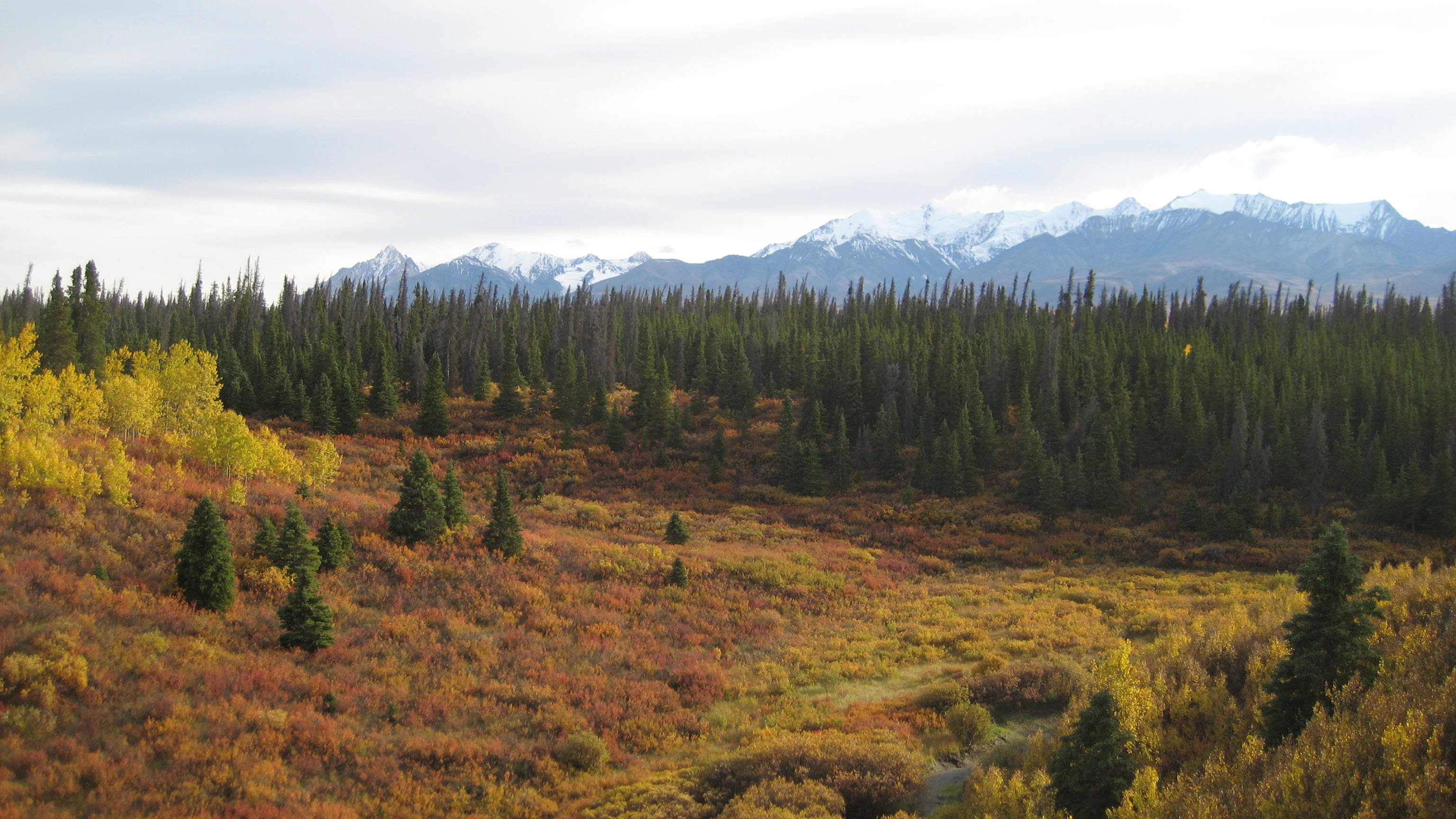
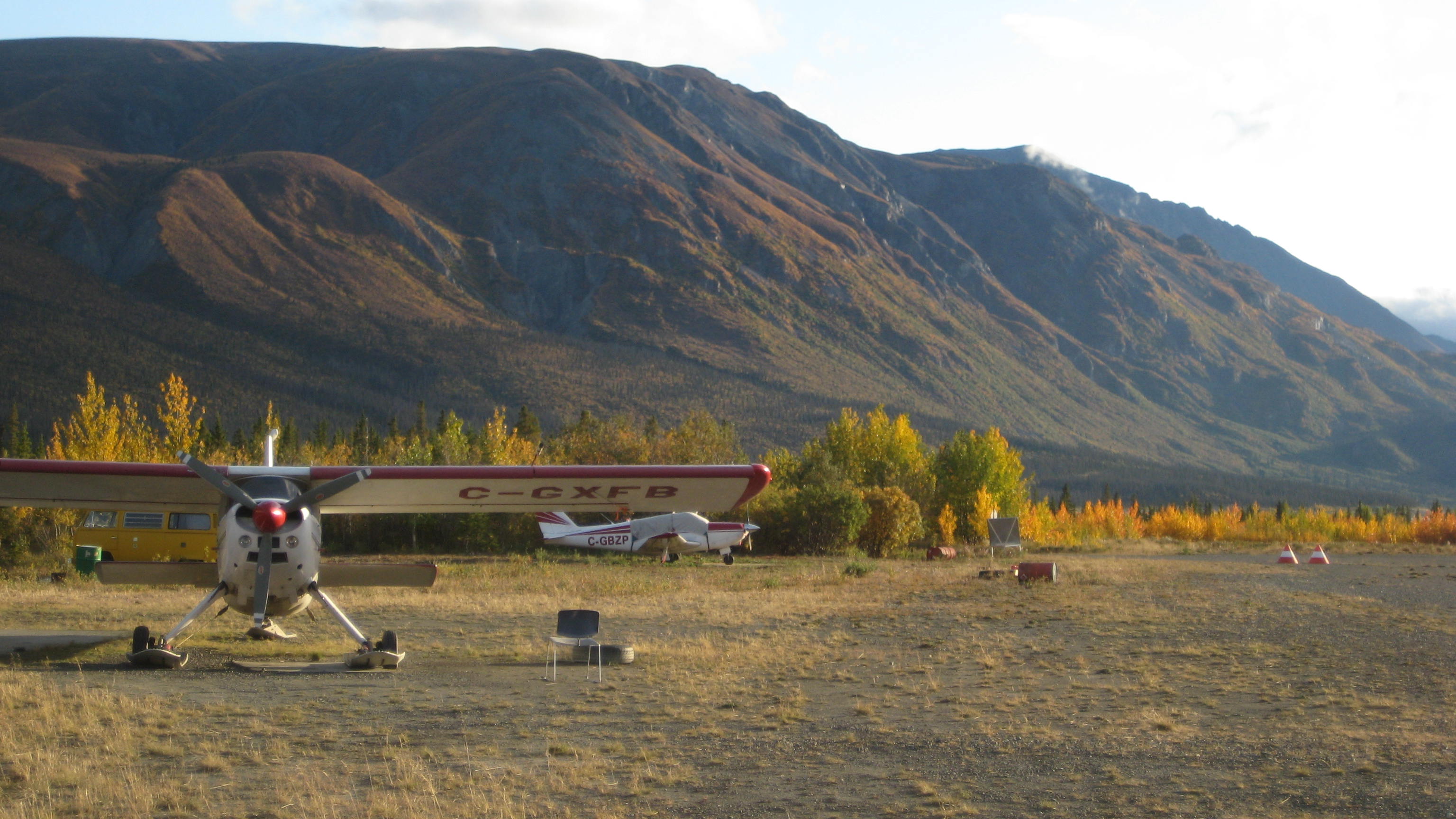
I had the chance of a lifetime this summer to work out at Kluane Lake. The drive from Haines Junction to Kluane Lake has to be one of the most beautiful drives ever, but it really glows in the fall. Holy Cow. I took 92 pictures and movies. This was my drive to work every week. Today it looked like everything had turned to gold in the Yukon.
Me looking adventurous and small.
At the airport at the Kluane Lake Research Station.
The fall is brief here, but it sings. Go outside and see the music.
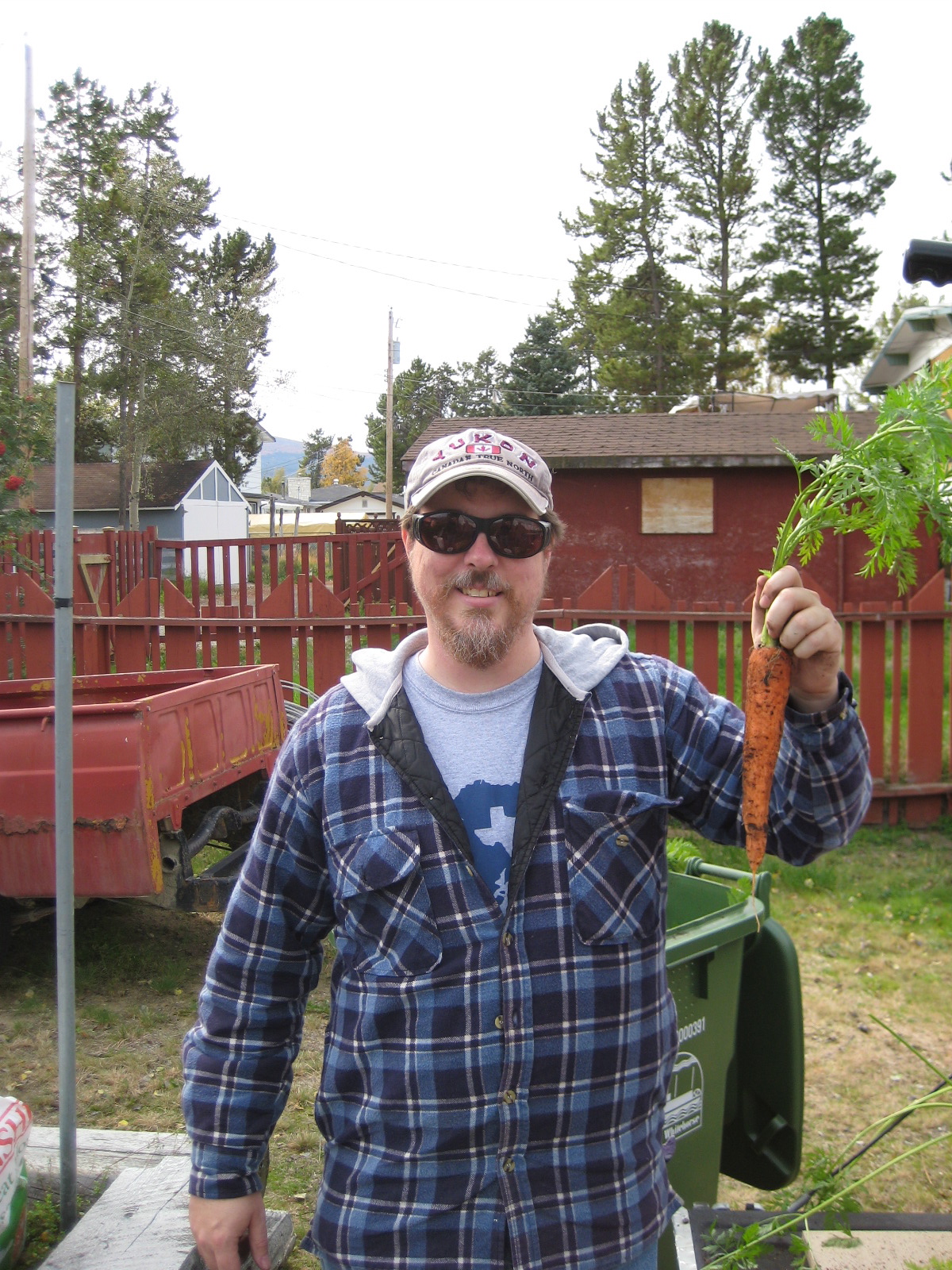
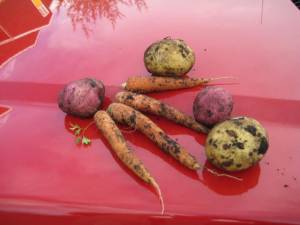
Had a great crop this year, and it’s not done. We just started harvesting. Wow. The vegetables are big. So I decided to showcase the vegetables next to objects you’d recognize….my pen, a bottle of T-3s, my truck.
The one next to the bottle made me think about the difference between something that comes out of the ground and something that comes out of a bottle. I like ’em both, but I think if I had more fresh garden vegetables that soon I wouldn’t need anything else.
The garden was a work of art this year. I am so proud of the labor that went into it, into weeding, into caring for it. The carrots are big and sweet, the potatoes rich. And the greens they grow so high…
Yes, the Greens They Grow So High
I learned a lot from growing the garden. The patience. The time involved on your hands and knees rooting out the chickweed. Sweating in the Yukon sun. These are mini-accomplishments, like trophies. And it’s a nice thing to do in the Yukon on these long summer days inside a quick and dirty summer–10 weeks, maybe. We had so much sun this summer. If you were thinking about leaving the Yukon after the last three summers, this summer wooed you back.
Harvest on a Red Truck
I’m gonna fix a sheep stew tomorrow–fresh Dall Sheep that was walking around last week (I did not shoot it, but I did help cut it up)–and fresh vegetables. A lot of work went into that stew and I’ll remember the two guys who trekked across the mountains in gale-force winds and rain to get this sheep to my kitchen. And I’ll remember the hours I spent in the garden waiting for the vegetables to get big enough to leave the garden and enter my kitchen.
And I’ll say to myself—hey, this cures whatever ails me–this summer stew.
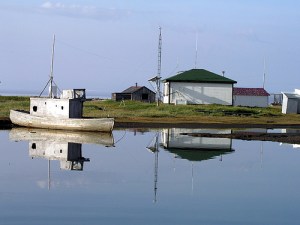
Herschel Island, a quiet pond, an old fishing boat, the old Canadian Signal Corps building--amazing photo by incredible photographer Hank Moorlag
Meagan Grabowski didn’t know she was coming up with a catch phrase, but a visit to Herschel Island for a couple of weeks, and she was a one-woman neologist. “It started at Pika Camp,” a remote camp for researchers a few kilometres away from the Kluane Lake Research Station. “We were coming up with an Inuvialuktan to English to Yorkshire dictionary…for fun…and the Yorkshire term for ‘it’s very cold’ turned out to be ‘positively Baltic.'” But when she was up for two weeks studying biomass on Herschel Island, and it got really, really cold, she slipped on the ‘baltic’ and said the weather was “positively Beaufort.” Meaning, it doesn’t get colder than that….the wet wind off the Beaufort Sea…beats everything.
Meagan was up there as part of International Polar Year, with a team of researchers, Scott Gilbert, Charlie and Alice Krebs, Don Reed, and others, all looking at Herschel Island as an ecosystem, finding out what made it tick, and how that information could be transferred, and compared, to other northern islands and our own Yukon high alpine tundra areas.
Meagan Grabowski is daughter to well-known taxidermist Tony Grabowski and you can hear more of her adventures up on Herschel Island, as well as how any young Yukoner can spend a summer in a such a positively Beaufort place. The last of my two radio shows this summer, coming Tuesday at 7:50am.
We’re hoping the weather stays warm for a long time, but in case it drops to -40 this winter, feel free to put “positively Beaufort” into circulation.
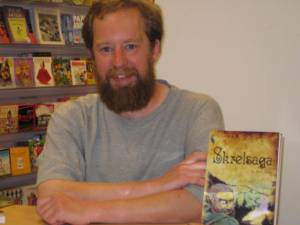
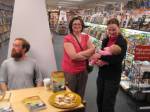
Steve Parker looking pretty satisfied next to his book, Skrelsaga. He lives to autograph!
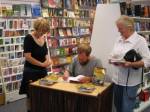
Good friend and Fantasy writer, Steve Parker, known to many of you as the man who holds the downstairs desk at Mac’s Fireweed Bookstore–ordering your books, being pleasant, being Welsh–is the proud author of a new book, Skrelsaga, now available at Mac’s. Here are a few photographs of his signing.
This is, I think, the first Fantasy novel published in the Yukon. Yay, Steve!
More on the book in a review that will come later. For now, we celebrate the achievement!
Starting in the fall, I’m going to be doing the afterschool programs for teen writers at FH Collins (our second year!) and now, at Porter Creek. It’s for science fiction and fantasy writers, and everyone’s welcome. There is a fee. We do serve food.
It’s through the City of Whitehorse. You can contact Mia Lee at 668-8327 or mia.lee@whitehorse.ca to be a participant. More information to come. Programs will start up in late September or early October. The guide comes out in two weeks so we’ll have more info then.
Everyone, come hear the six Yukon Writers Festival writers read on Wednesday night at 7pm at the Beringia Centre for FREE. Part of Live Words: Yukon Writers Festival and the Young Authors Conference, these six writers will be teaching young adults to write at FH Collins–and this presentation is free and open to the public.
I’ve been asked to be the MC for the evening. As I have nothing funny to say, and you can’t be a good MC without funny material–I need six words from readers of my blog–one per person please–the first six– that I have to fit into my opening short speech. And if I get all six, I should win some sort of prize. Nothing that I couldn’t say in public please–so I won’t accept vulgar expressions.
It’s fun. And if you come, you get to see if I can fit them all in.
In conjunction with the Young Authors Conference, Live Words brings five authors up to the Yukon, and this year they are offering a few more appearances in Whitehorse and the communities for readings and workshops. Yay! I applaud Joyce Sward and other organizers for their efforts to bring these writers to the community.
Schedule as follows:
LIVE WORDS
YUKON WRITERS’ FESTIVAL: Tues Apr 28 – Fri May 8
with writers:
Shelley Hrdlitschka, Celia McBride, Arthur Slade, Shyam Selvadurai, Candace Savage, Kenneth T. Williams
WHITEHORSE EVENTS
Reading: Kenneth T. Williams, Tues Apr 28, 7 pm, Blue Feather Youth Centre, free
Reading & Reception: Guest writers, Wed Apr 29, 7 pm, Beringia Centre, free Young Authors’ Conference: Thurs Apr 30 & Fri May 1, 8:45 – 3:15, FH Collins
Lecture: Bird Brains: Inside the Lives of Ravens and Crows, Candace Savage & Sun May 3, 7:30 pm, Beringia Centre, free
Writing Workshop: Shyam Selvadurai, Mon May 4, 7 – 9 pm, Whitehorse Public Library. 667-5239 to register (limited space), free.
COMMUNITY EVENTS
Readings & Music: Guest writers & music, Sat May 2, 7 pm, St. Elias Convention Centre, Haines Junction, $10 adults, $5 students, children 12 & under/seniors free.
Readings: Shyam Selvadurai -Tues May 5, 7 pm, Teslin Library; Wed May 6, 7 pm, Carcross Library; Thurs May 7, 7 pm; Carmacks Library; Fri May 8, 11am, Faro Library, free
Lecture: Bird Brains: Inside the Lives of Ravens and Crows, Candace Savage, Mon May 4, 7:30 pm, Northern Lights Centre, Watson Lake, free
 Kudos to the kids of MAD (Music Art Drama) for their Haunted House this year, with its, yes, SCIENCE FICTION theme. I won’t give anything away, but it’s a lot of fun.










 Bear Witness