October 10:  Yukon Cornelius sits with a Banshee

For two weeks, her wail was impossible to miss. “She’ll be quiet soon. She’ll go on for another night or so, and then it’s all quiet,” the bartender told me. When I told him I intended to find her, he grabbed my arm. “You might die. You just have to let them cry their peace.”  

Some called her the Widow of the Hollow, said she’d lost seven children a hundred years ago. Others said she was from the Civil War, and the town had lost all of its young men. “Grief like that can turn you into a banshee,” someone said. “How much grief does it take?” I asked, knowing there was no way a person had turned into a banshee. That’s not the way you get them. “Losing your children—I imagine that could turn you into a banshee,” said a young woman. An older man raised his hand, “I’ve lost all three and I haven’t turned into one yet.” No one said anything. I said, “I’m so sorry. That must have been very hard.” He drank from his pint, not meeting anyone’s eyes, “Death happens. It’s not anything to wail for weeks about.  People have to move on.” Other faces nodded in agreement but didn’t speak. He said, “Some of us need sleep. Go find her and maybe she’ll shut up.”  Someone else said, “If she’s cried for hundreds of years, having a little talk with this guy isn’t going to stop her.” I drank down the rest of my beer, “I didn’t say I was going to stop her.”  I put my beer down, and some money on the counter. “I’m going to listen to her.  That’s what you do when someone is upset.” The bartender called out just before the door shut, “That’s what bars are for.” More laughter.

Moonlight turned the gravestones into the crooked teeth of a wide-open mouth. She sat heavy on a white marble bench in the graveyard.  When she howled, though, she rose like a veil in a strong wind, all twisting with pain. Her lament echoed off the stone mausoleums. I didn’t want to scare her. I asked if I could sit with her, and she didn’t stop her keening. But she looked at me and moved back a bit to give me room, I think. So I sat with her. Every new cry was fresh pain. It had no rhythm or music or predictability. She focused on me. I looked her in the eye for some of it, and then I looked down at my hands. Grief is hard to look at in the eye. Even if you are ready for it. I was not going to be afraid of it, but it can be heavy. She knew. I stayed silent for the first hour. She filled the trees with her sadness. I cried with her some—as she could pull the grief I needed to express out of me. I told her what I, a visitor, knew about the people who had died recently. I thanked her for grieving for each person. Her ability to cry for others, even strangers, was something few people did. Even in small towns, like this one, where they “know each other well”— I knew she could teach them a lot.

Then beneath the trees, we saw someone else approaching. It was the old man from the bar. He hesitated when we turned. “I can–,” he called out, “I can take over for a bit.” In a moment, standing next to me, he confided, “I rushed my wife when we lost our last one. I thought it was for the best that we both stop crying. I wanted for her, for us, to be happy again. She wasn’t ready.” He broke down and I held him while the banshee poured out his pain. He stayed with her after I left.

Later I heard the old man brought her to the bar in the middle of the night, where he sat with her, surrounded by others. Oh, good, I thought. That’s what bars are for.

October 9:  Yukon Cornelius takes a Werewolf to Pup Obedience Training

We are frightened to lean too far into wildness. Get embarrassed. Cause a scandal. Or, like tonight, become Leonard on top of a heifer, ripping it to pieces.

I waited for him on the other side of the electric fence. Afterwards, he held his face in his bloody werewolf hands and sat in the pasture. “You were supposed to be here to stop me!” I tried to comfort him. I told him, “I know some people who are exploring their animal sides in a safe space. You don’t have other people and you don’t have a safe space. I think those are crucial for you to live a happy balanced life as a werewolf.”  

“But I don’t want to be a werewolf at all,” he said. I told him it would be okay.

After he cleaned all the blood off, I drove this big guy to an old home bought by the local LGBT chapter and two leather groups, and there I introduced him to Pup Obedience Training. He was behind a door, so he didn’t shock anyone at first. In the room, about twelve human pups chased a ball, wrestled each other, or sat contentedly at their handler’s side. “These people are just playing like dogs.” No, I told him. They are forgetting that they are human for a moment. A pup is in “pupspace” for hours and they are free to leave behind human worries. He thought that sounded strange when all he wanted to do was be human now. “They explore a headspace so often that they can switch back and forth and control it better. You have to get a ‘wolfspace’ happening when you are human, so that when you are forced to be the wolf, you’re in control.” Think of it like a fire drill, I told him. You practice it enough and during the fire, you don’t have to be controlled by the fire. “Most of these pups just want the mental freedom to be a dog and play when they want to.” He nodded and agreed to try it for a month. “As a rancher, I can’t keep eating my own herd.”  

I encouraged him to meet everyone tonight. Very slowly, we opened the door and he inched into the light. Everyone turned and looked at Leonard, the giant werewolf, and….the pups bounded over to investigate, followed by appreciative handlers. He was surrounded by encouragement and admiration. They probably thought he was a furry in a very expensive fursuit, but you know, no one ran from him. “You’ll need a collar and a harness and a pup name,” I told him. He hugged me. “I’m sorry if I expected you to save me. I’m so needy,” he said. I told him being needy isn’t a bad thing; it lets someone know how to help. “It’s a positive thing?” he asked.  And that’s how a werewolf became a pup named Needy.

October 8: Yukon Cornelius sees a Leviathan

Michael was a kid that most people saw and tried not to see at the same time. He was 10, dressed in a purple shirt and khaki shorts, talking exuberantly to anyone who would listen about the waves the boat was making, his electric hope of seeing whales, the colors of the ocean he could name. “Have you seen a whale?” he asked me after designating me a friendly listener. I told him I had. I had seen many whales. I used to work on a ship, I told him, as a merchant marine. I’d seen many deep-sea creatures. “Why are you on the whale-watching tour then—did you miss the ocean?”  I laughed. Yes, I missed the ocean. I told him I was here to see a friend. “I’m here to see a whale,” he said. “Up close. I want to really see him—and I want him to see me.”  I told him I’m sure that any whale who got to be seen by him was a lucky whale, and would be very happy. “I love whales,” he said, “I love a lot of things.” He named off several animals he loved, dramatically, said their names more loudly than folks around us wanted, I could tell, and then he hugged himself, as if he were trying to hug all the animals he loved at once. I said to him, “We’re about to see something much bigger than a whale.” “What’s bigger than a whale?” he laughed. I said, “Leviathan.” LEVIATHAN! WHAT’S THAT?

I looked around at everyone staring at us. I told Michael how the Leviathan spends many years sleeping on the bottom of the ocean, and how the barnacles collect on it because it doesn’t move for so long, and the anemone make their homes on it, and then it stirs, like an earthquake, and moves to another location, taking them all with it.  A man behind us, who had been listening, said, “That’s a demonic creature mentioned in the Bible that will destroy humankind.” He quoted several verses, ‘proving’ the Leviathan was evil. I told Michael that there were many things that people made up stories about. “It’s really sad when people don’t understand the real you,” I told him.

He heard me, and his eyes got wide, searching my face, maybe for recognition. Then, right beneath me in the water, suddenly there was a giant eye. Other people saw it. They were pointing, excited. Michael gasped, and it took him a second to realize what he was seeing. He waved with both hands, jumping up and down. “Oh Mister Leviathan, I see you. I SEE YOU. Do you see ME?”  I teared up next to Michael at how badly he wanted to be seen—by anyone, by anything. Just like my friend here, coming here to be seen, not as something evil, but for what he truly was: Magnificent. I waved at him, “Hello old friend,” I said. He blinked at all of us. Michael waved, shouting “I LOVE YOU WITH ALL MY HEART!” I told Michael, “He heard you. He saw you.”  Then Michael hugged the railing, and then me, and then, finally, himself.

(inspired by a true story told to us by Jason Alspaugh)

October 7: Yukon Cornelius brings the Tacos to the Gargoyles

I bring the tacos because they can’t go through the drive-thru to get them. We do this ritual every week in the summer. At sunset, when they shed their stony shells and can breathe and move again, I get to the roof of the cathedral (I know the priest) and there they are, waiting! They take the bags from me, kindly, and dive in to unwrap the treasures. From this height you can see so much of the city below, and it is beautiful.  Scarfing down tacos and laughing with your friends on a roof– I wish everyone could do that.

You know, one thing most people don’t know about gargoyles is that they are philosophers—and very spiritual–they spend all this time gazing over the city, thinking about the life beneath them. They say, “Doesn’t everyone watch the life below them?” They come up with radical ideas. “Gargoyles are above the Pope!” “Above all the priests and cardinals!” “If God were in the sky, we would be closer to God, mathematically,” and they laugh. “They would see us first!” (Crunch! go the tacos). 

Sometimes they wonder, in a philosophical way, why there is so little joy in the world. And it makes them sad to see the daytime world, a place they can’t experience, not make people happier. They discuss how we hurt each other, how joy is kept away from us, made restricted, or expensive, or impossible to experience. They sigh and stop eating, becoming still like stone. I hold up a taco. “We do not value the taco enough in this world and the joy it brings!” They holler and hoot and roll over, “You do not!” and stuff more tacos into their mouths, and taco shells, tomatoes, lettuce, cheese, cover their bodies. I believe gargoyles are angels (smeared in taco sauce) watching over us without the capacity to help, and this steals their joy. They are hoping for us, I know, rooting for us, in their silence. On these nights, I stay with them all night in a warm gargoyle cuddle, loving, laughing, telling them stories of people who *do* find joy, while we watch the stars float by and catch the Moon looking down on us from the top of a space cathedral somewhere, smiling at us in all our joy.

October 6: Yukon Cornelius negotiates with Ghosts at his nieces prom

After the chaos, the screams, and a hundred prom kids running through purple and pink lights, and after a little persuasion, I convinced the ghosts of the 1913 flood to come down to the floor to talk to me, to us. They descended from the ceiling of my niece’s high school gym through the cardboard stars hanging on fishing line, carrying their own river haze with them, until they all dangled just above the floor. One of the spectral women looked around the gym. “The water was up to the ceiling of the house. We were all asleep. It was so fast. The water.”  One of the kids said that the flood had killed over 900 people in several states. “We were dancing around the barn just the night before.” She looked at the faces of the kids in bright prom dresses and tuxedos. “Like you.” She looked back at me, and the room just stayed quiet for minutes. Kids held each other. No one moved. The ghosts floated in ripples… like they were in water. “It was right here,” she said, moving her hand across us all, as if the gym had been a barn, a field, a house. “I’m so sorry,” I told them. They stared at us. They were waiting for me to tell them what to do now, now that their whole world had ended in a night, a night that they seemed trapped inside forever. I didn’t know what to tell them. I looked at all the faces of the kids, some of them drying their eyes from their own fear. They’d expected to have the best night of their lives. Now they were talking to ghosts—ghosts who had been their age when they died. I didn’t think I would have the right words to comfort her—after so much time, but I tried. I looked at her, “Well, you’re here with us tonight.  Do you want to— do you want to dance with us?  We could all dance with you.” Some of the kids nodded. She stared at me in a hundred years of pain and loss, her face blank. “Yes,” she said, and she drifted down those last few inches, settling like a rock at the bottom of a lake, and her toes touched the dance floor for the first time.

October 5: Yukon Cornelius teaches a Skunk Ape about Beard Oil

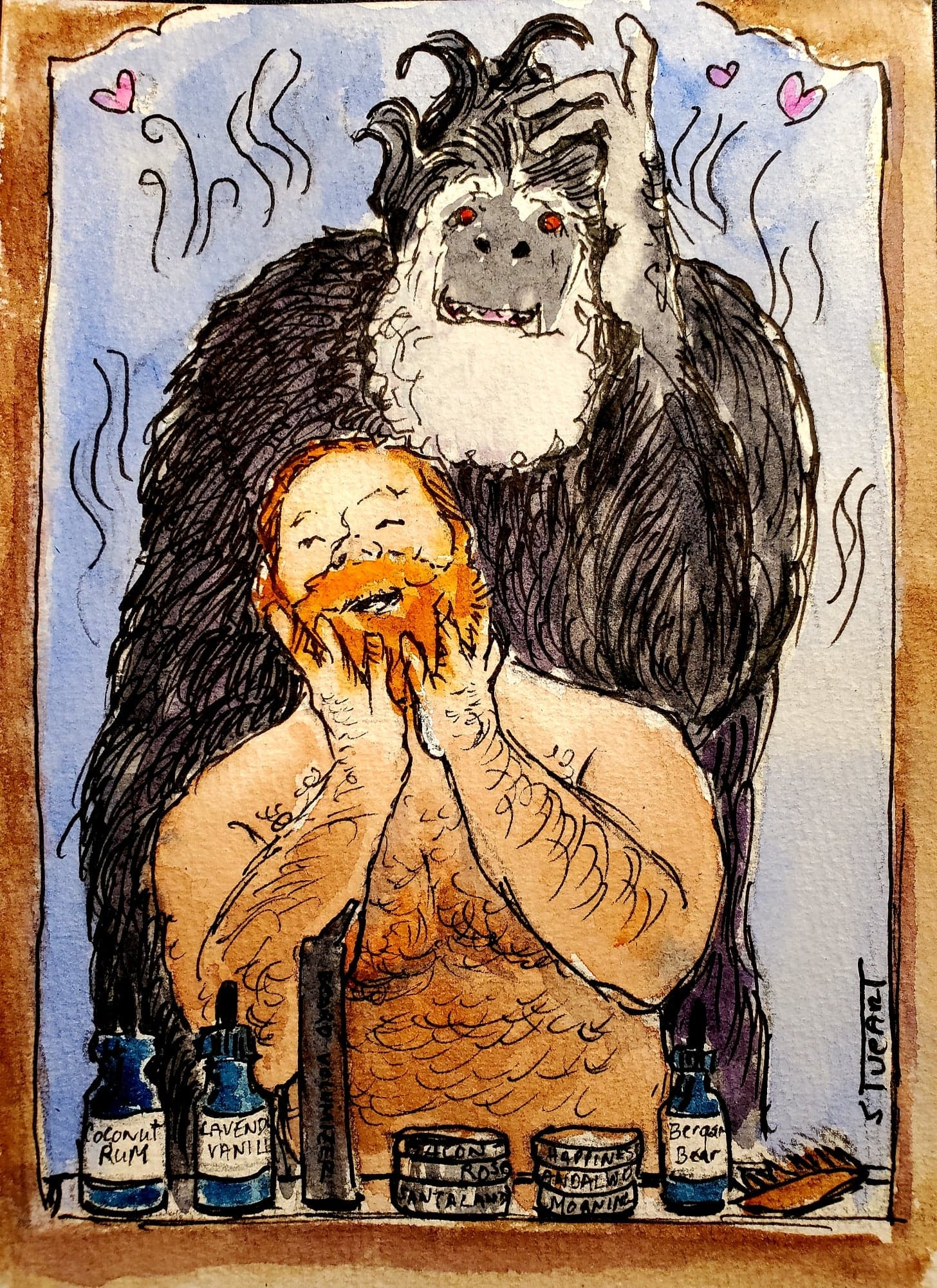
When he said, ‘surprise them” and “spice things up,’ of course I led him to the beard oil. All three of them liked strong scents, but lately he just felt like something was missing in the kissing. So, all those small animals he killed was his way of trying to improve his smell, but, of course, the neighborhood couldn’t tolerate any eventual assault on their pets. I introduced him to all the scents I had in stock. He sampled patchouli, Happiness (a citrus blend), Rose, Lavender and Vanilla, Daddy (a version of Smoke and Leather), Dusk (a spicy musk) and Bergamot Bear (green tea and elderberries). He liked them all. And eventually decided to rub some of all of them in different areas. He said his mates would then get to rediscover him in stages all over his body. I smiled at his thoughtfulness. Finally, like a good friend and his first hairdresser would, i suggested some hair gel which he used to turn his hair into waves of black meringue. When he was finished, I gave him a variety pack of scents in a small bag.  ‘They’re gonna love you, ‘ I told him. He grinned, and walked out into the night, his fur radiating a whole summer of desire.


October 4: Yukon Cornelius feeds a Unicorn


Contrary to popular belief, unicorns are not hung up about your sexual status.  I know we’ve been taught that only people who are sexually “pure”…a “virgin” … can get near them. That’s a bunch of hogswaller. Unicorns, like any magical creature, want to feel safe with you. They detect kindness, not virginity. Some old religious dudes who were frightened of the powers of women and sex decided they would make this unicorn a judge of the goodness of people based on their own stringent rules about sex and the body. They quarantined this beauty behind a fence of abstinence to keep the joy of your own body away from you. Look at me in this moment. She doesn’t care about whom I’ve loved, or slept with, or played with, or enjoyed… she just wants fresh mangoes. And she will make Ugly Mouth and Happy Eyes and come right to you just to have them. She will be your best friend because you gave her something she loved, not because you denied yourself something you would love.

October 3: Yukon Cornelius reads to the Monster Under the Bed

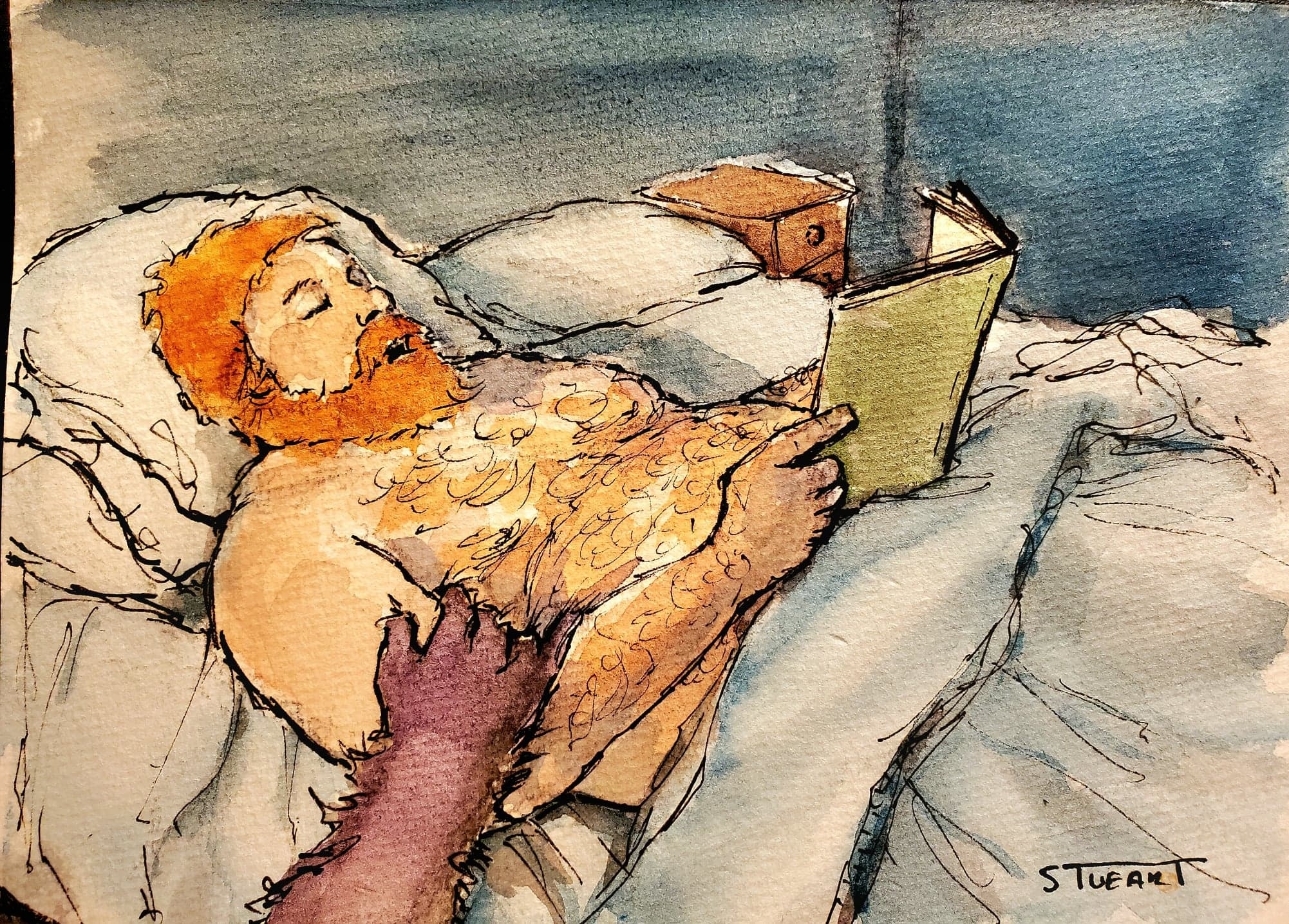
Sometimes we just want to connect to someone, reach out and touch them.  We are so afraid of being rejected, though, of making someone scared of us. We crawl back into our hiding places and lay low. Tonight I pull out The Wind in the Willows by Kenneth Grahame, one of my favorite books. It’s about reaching out in your isolation. And I give it a good read out loud—not trying to pressure him, but give him the space and comfort of a voice to know I’m here, and I’m not afraid of him.  No one should be afraid to reach out when they are lonely. And slowly, as I read about Mole and Rat and Badger who meet and become friends, that hand that just wanted to say, I am here, I am always here, stays on my arm till I finish a chapter and then slips back down as I turn off the light.

October 2: Yukon Cornelius face-paints Vampires

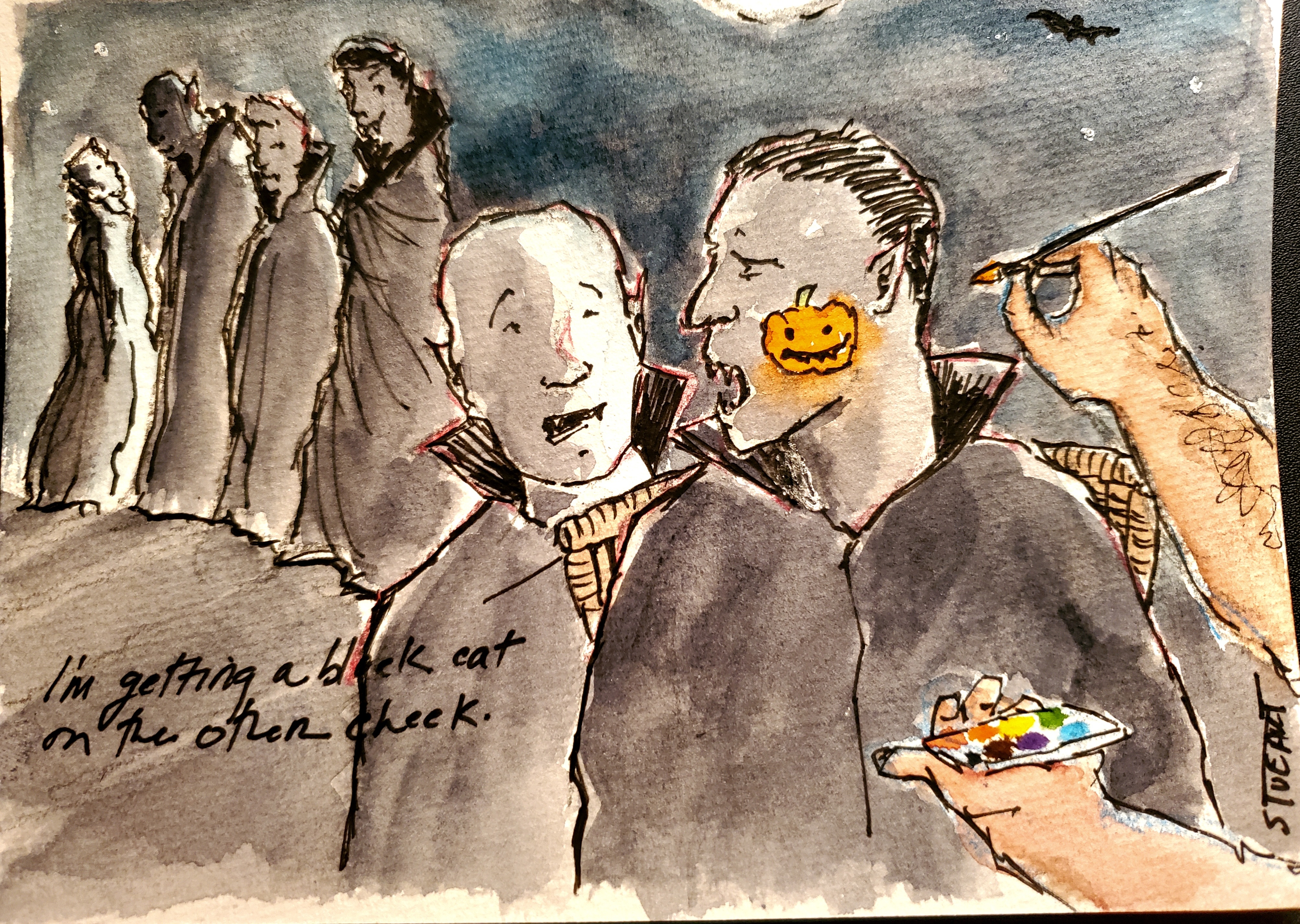
Well what was I going to do? Disappoint a whole nest of Vampires? So I got out my facepaints (I keep a set in the glove compartment of the truck) and set up a little booth. I mean, they’d all been through Halloween for centuries and not one of them had gotten their face painted? You should have seen their excited pale faces lean up to my brush and hear them say, “Oh, I want a Luna moth.”


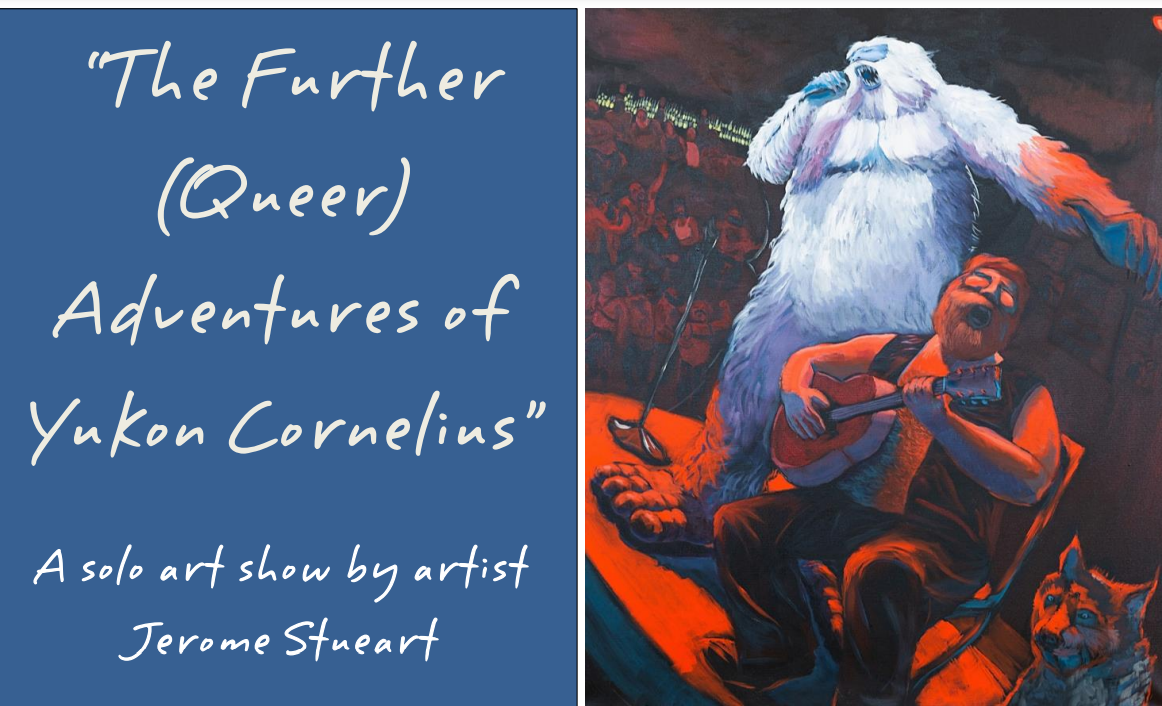
“The Further (Queer) Adventures of Yukon Cornelius”


You are cordially invited to “The Further (Queer) Adventures of Yukon Cornelius,” a solo art show by artist
Jerome Stueart, reimagining the boisterous red-bearded prospector from the 1964 Christmas special, “Rudolph
the Red-Nosed Reindeer,” as a gay man whose whole life is helping monsters, “Hiddens,” adapt to the world of
people around them. This exhibit of giant-sized acrylic paintings and smaller watercolor paintings examines
queer life and issues through the lens of monsters and heroes. Stueart, a World Fantasy Award nominee in
Short Fiction, has written stories to go with some of the paintings which you can read through QR codes on the
paintings or hear in a reading Sunday afternoon as part of an artist’s talk. Yukon Cornelius was created by
Romeo Muller and is in the public domain. A special wall will celebrate Muller, a gay Jewish writer who penned
many well-known, well-beloved movies. Event is FREE and open to the public. Light refreshments served.
Mature Content.

Thursday night: Soft opening 7:00-8:30pm
Formal Opening: Friday night, Dec. 16 ~ 6pm to 8:30pm
Light refreshments! Come join me!

Saturday, Dec. 17 ~ 12-5pm ~ Gallery is open!
Sunday, Dec. 18 ~ 11-4pm ~ Gallery is open!

Artist talk at 2pm there, but also broadcast on Facebook Live
or through ZOOM.


Where: Dayton Society of Artists, 48 High Street (in St. Anne’s Hill, Dayton)
with ample parking available across the street.

Note: Stories associated with the paintings will be up on HERE on this website
starting December 10, if you want to read stories ahead of the show!