My story, “Et Tu Bruté,” was just chosen to be on the longlist of finalists for the GEIST magazine Postcard Story Contest. Out of over 500 entries across Canada, they choose 15 stories for readers to read through and make comments about and vote on. And then they choose winners. Thank you, GEIST, for the exposure! It’s a prize in itself to be on their website and to have my work being read.
So, go by the site, give the story a read. Keep Brutus company.
UPDATE: The site for “Et Tu Bruté” was retired, so I brought him home to my site. So, while you can’t read it at Geist, you can read it at the new link above.
For more postcard stories, Geist is a wonderful spot.
I’ll be at Mac’s Fireweed, Friday April 23rd from 4-6pm signing copies of EVOLVE: Vampire stories of the new undead–an anthology edited by Nancy Kilpatrick, where I have a story, “How Magnificent is the Universal Donor.” It’s all-Canadian (or in my case, landed immigrant), all vampire and the theme is the evolution of vampires. As far as I know, this has never been done. Shaking up the old rules. These are new kinds of vampires.
Come and find out how vampires have evolved and what they’ve become. Or just come and say hi. I’ll be behind a lonely desk, and will want company.
This is the YUKON launch of the book–and we’re planning a reading in Tagish–sometime soon. It’s been launched now in Brighton, UK at the World Horror Convention in front of other horror writers; it’s been launched in Toronto in front of fantasy, science fiction and horror enthusiasts; and it’s being launched in Winnipeg, Montreal and Vancouver as well.
YUKON launch: Mac’s Fireweed, 4-6pm, Friday, April 23rd.
As a follow up to my last post about Star Trek: Reckoning, the hot, new, nearly top-secret co-produced ST series from Paramount and Fox, none other than Newt Gingrich has come aboard! It’s very rare for working politicians to take time out to create good television for honest folks in the Midwest and the Plains, but it looks like Sarah Palin and Newt Gingrich will be on board.
From my insider at Paramount, “The producers had actually wanted an actor, at first. Sarah Palin’s the one who pushed the idea of Newt, saying in effect, that he ‘has the chops’.”
I have to say, it’s an inspired choice. Not an actor, but a politician—those are close, so I can see Paramount going for that. But Gingrich is, shall we say, kind of from another era. Most popular from the 90s and the man who brought us the doomed “Contract with America” and subsequently hijacked the presidency of Bill Clinton. Now, I remember that. But I don’t think most people actually remember Newt Gingrich, so it might not be a problem. They won’t confuse his character with any thing of substance he might have done in the past.
Sometimes actors on Star Trek have such long-standing previous sci-fi characters (I’m looking at you Scott Bakula) that viewers can’t see them as something new. I know this hindered my viewing of ST:Enterprise—kept waiting for Al to pop in (although watching Dean Stockwell in BSG, i completely forget he was ever Al on QL). So, it may be that no one actually remembers anything important that Gingrich did, allowing him to kind of slip into this role and establish himself anew. I mean, did anything he did really amount to much? So that might allow him to start over as a character!
Just to recap: Palin will play Capt. Nalia Fergus of the USS Steadfast; she’s part of a group of rogue commanders who believe the dream prediction of the D’mi, that “the Reckoning” will destroy the Federation. Seeing a Federation President they don’t trust, nor believe he can protect everyone, they form an alliance to counter the Reckoning before it happens.
Gingrich will play the D’mi (unnamed as of April 8) on-board the Steadfast, who lives in two worlds at the same time. One is the dream and one is reality. He is constantly unsure which reality he is living in.
“Which makes Gingrich perfect,” my writer friend at Paramount said, “He has a bit of experience nowadays with living in both fantasy and reality.” He’s referring, of course, to Gingrich’s latest gaffe, putting words in Obama’s mouth that he never said. Gingrich’s character will try to give advice to Capt Fergus (Palin) about how to avoid the Reckoning. But he rarely ever sleeps—sleeping triggers the shift to the other reality–and so when he sleeps in one reality, he awakens in the other.
A great tension that the writers are building in is that he will begin to give information that proves false—about halfway through Season One. He will claim that something Fergus has done has altered the future so that a “certain” event won’t happen the same, but in effect, there’s an idea that he really doesn’t know what he’s talking about. I don’t even think that he knows that he lies; he’s a bit overwhelmed by the attention, by the focus, and by his power to direct Fergus, and the ships that follow her.
I’m excited by this new Series. I asked my friend why Paramount is delaying the formal announcement of Star Trek: Reckoning. I’ve already had several people ask me when there will be more confirmed reports–and several people are searching on google for it.
He says, “They’re testing the market right now, seeing what Red State America thinks about the idea. They’ve never done a conservative focused Star Trek like this before. They don’t know if they’ll have the audience. But they’re basing it off of O’Reilly and Beck, Hannity and Coulter, and the current Tea Party constituency. They figure people are tired of the way things have been done–and in that way, might be tired of Star Trek the old way—and want to see an overthrow, a rebellion—at least in science fiction, if they can’t have it in fact.”
I wonder if TV can play on that desire, that hope, of a people to want change so badly that they will accept the fictionalized version.
“Well, you’ve seen The West Wing? That was a George W. Bush era show–don’t tell me that wasn’t fantasy aimed at folks who wanted change!”
He has a point.
What I’m really interested in is this: if the rogue group actually overthrows the Federation, will they make it more vulnerable to everyone else? Will they make alliances with the Romulans? The Borg? Or will they naively think they can do better? Fergus isn’t a seasoned captain; the D’mi doesn’t know what reality looks like; and they’re following a culture that believes in a bad dream…. they are hyping a monster that doesn’t exist.
…will watching ST: Reckoning be akin to watching a train wreck in slow motion?
Wouldn’t you know that 11-18 year olds have plenty of reasonable, thoughtful ideas about the evolution of vampires? Because of the anthology I’m a part of that comes out next week (Evolve: Vampire Stories of the New Undead) I threw out the question —where do you think Vampires are going–or should go?— to my writing students. They are all voluntary writers who stay after school to work on their own writing (which usually has a horror-tinge to it) and they were freakin’ brilliant. I LOVE these guys.
Imagine them sitting around a grouping of four tables shoved together, in the French library of FH Collins.[Just gonna use their first names–they’re cooler that way] I didn’t do any editing to this dialogue. I have some pretty smart high school kids.
Here are their thoughts:
Santana: I’m looking for more variety in vampires. I think vampires have to move away from being either completely evil or sparkly good.
Franz: They used to be the icon of horror. I think people forget that vampires used to turn into bats.
Erin: They’re vampires. They have to eat. They’re not going to drag the carcass of a deer into the forest so they can revive it. They aren’t going to be helpful.
Zeb: They need to go back to the basics. They’ve moved from Dracula to whiny good guys, and I think they need to swing back to Dracula. I’ve seen quite a few vampires in between good and evil: Dresden Files has multiple “courts” of vampires. Some of them bad and some of them really bad.
Franz: Yes, I’m tired of angsty vampires. I read about this one vampire who was all angsty and then he was bloodthirsty and killed people, but he was a lot more interesting when he got older and more complex. He wasn’t as angsty and he wasn’t as bloodthirsty. He was light hearted and pretty hilarious.
Santana: Authors shouldn’t be afraid to expand the genre–to have vampires that are neither good nor evil, but neutral. I want them as complex as real people. I want them in modern day settings dealing with our own vampire crazy culture.
Zeb: Terry Pratchett had some really cheerful vampires called Magpires who wore bright clothing but they were really evil people!
We all started citing some places that vampires still haven’t gone yet….
______________
And then …. they started to come up with ideas about what THEY would write about these vampires. And they were such fantastic ideas, I can’t write them here… I have to let these kids tell them. But they are brilliant.
I’m hoping that they read Evolve: Vampire Stories of the New Undead and give us a review of the book–to see if authors were able to “expand the genre” as Santana mentioned. I’d like to see how this meets their expectations of where Vampires should be going…
Coming up, Evolve: Vampire Stories of the New Undead will be launched in Toronto at Ad Astra, the science fiction convention there. It happens April 9-10 in two separate events: one is a the Canadian Launch on Friday night, 7pm at the World’s Biggest Bookstore. And the other is a reading on Saturday at Toronto Don Valley Hotel and Suites which is hosting Ad Astra.
What is Evolve? Evolve is really 24 authors tackling the premise–what would happen if Vampires evolved? What would the new versions look like? When you have a history of Vampires that takes you from the ghoulish looking Nosferatu to the sexy, sparkling Edward, then you already have an evolution of vampires from their horrific beastial state–where being bitten was a life sentence–to teen girls hoping and praying they’ll be bitten by Edward… Where have we come to? What have vampires already become? And where will they evolve next?
As Nancy tells me, this is the first ever all Canadian effort to tackle contemporary vampire stories–and I think we have an exciting premise. If anyone is wondering if Vampires have lost their direction post-Meyers, here’s 24 things to think about for future reference.
Evolve: Vampire Stories of the New Undead includes writing from Kelley Armstrong, Tanya Huff, Claude Lalumière, Mary E. Choo, Sandra Kasturi, Bradley Somer, Kevin Cockle, Rebecca Bradley, Heather Clitheroe, Colleen Anderson, Sandra Wickham, Rhea Rose, Ronald Hore, Bev Vincent, Jennifer Greylyn, Steve Vernon, Michael Skeet, Kevin Nunn, Victoria Fisher, Rio Youers, Gemma Files, Natasha Beaulieu, Claude Bolduc, and Jerome Stueart.
If you’re in Toronto and want to stop by the World’s Largest Bookstore, or by Ad Astra for the readings, you’ll enjoy it.
My article on Ufology in the Yukon appears now in Yukon, North of Ordinary. The magazine is the inflight mag of Air North, one of the finest airlines. I love Air North for its service, the fact that I know all the flight attendants, and for the Midnight Sun coffee and the cheesecake. I’m proud that Air North ran the article. They were both skeptical and worried that an article about UFOs in a magazine you read on an airplane might get people to thinking they were pushing the idea that UFOs exist. But they ran the article, and I’m very happy to see it there. The article focusses on the people who see UFOs, that they are normal everyday people. Ronald Reagan saw a UFO, and the Pope just okayed the existence of extraterrestrials, so things are changing for aliens—we’re getting okay with them. This article just lets you know that folks do see them, that they are normal people, and that in any other condition 32 eyewitness accounts that matched would be enough to prove something of this magnitude. But, as of yet, no spaceship has dropped enough hard evidence to make us all believe. That doesn’t stop these brave men and women who sometimes speak out, sometimes against ridicule. Many keep it to themselves. It’s good to listen to their stories and make up your mind later….
The article doesn’t itself endorse UFOs, but, like every issue, it does seek to promote the good folks of the Yukon, those who have seen UFOs and those who want to believe. God bless Yukon, North of Ordinary.
For the article follow this link to What’s Going On Up There? (there is a place there to download the whole issue as a PDF)
If you have seen something unidentified in the day or night sky and want to report it, there is a website for that as well. Martin Jasek and friends keep the UFO*BC website open for sharing experiences and for reporting sightings. If you’ve seen something, fill out this online form.
What do you want when you get down the rabbit hole? Burton begs this question in his version of Alice in Wonderland. Folks will probably enjoy the visuals–they are delightful to watch. But in this age of CGI, there’s not as much fanfare left for special effects. It’s coming down quickly to who tells a good story, and I want to examine Burton’s story here.
What I like about the story of Alice in Burton’s Wonderland is that we get a detailed look at Alice’s life before the rabbit hole–especially her cloying debutante-shuffling world, where so little was expected from women, and so much was expected from their cooperation. I like the summer dance on the lawn, the hordes who like to watch when she’s proposed to. I like Alice. I liked that narrative so much that I was expecting more of it when we got to Wonderland and it wasn’t there, not immediately anyway. When I realized that Wonderland was reflecting her own re-vision of a forced duty, then it got more interesting–but that time in Wonderland feels off.
Two things happened when she got into Wonderland. I got confused, and Wonderland was reduced to a strip of land between two kingdoms. The premise of this movie is that Alice has been here before. In fact, she has recurring nightmares throughout her childhood and young adulthood, and yet nothing in Wonderland sparks her memory? Even a memory of the dream? I don’t buy it. If I was haunted by something, I would start recognizing people and things. She acts like she’s never even SEEN the place. Why doesn’t anyone try to jar her memory when they pull out the Calendria? (When we do see her previous journey in montages it looks vaguely like the same plot…and boring)
This plot seems very focused on the end of the movie. It’s like one big long foreshadowing. She has to fight the Jabberwocky–everyone tells her this. All the beautiful weird dialogue of Lewis Carroll is gone, pared away to focus on an ending that’s so inevitable we might as well have just skipped to the end. All the characters are focussed on Alice. This is so unlike Carroll’s version where everyone was focussed on themselves. Alice was merely observant. Here she does only what we expect her to do; she goes through the motions of the Eat Me/Drink Me sequence, a moment with the Mad Hatter, a second with the Cheshire cat. She’s not even curious anymore. Where’s Alice–Carroll’s Alice?
Wonderland really takes on the rivalry between Elizabeth and Mary, two queens that duked it out after Henry VIII died. I didn’t buy the petty rivalry of sisters. What’s there to fight over? Two courts, fully intact. The flashback involving the Jabberwocky smoking a White Queen party—well, there weren’t any consequences. The White Queen had a new castle, attendants, and enough white to choke the Arctic. I didn’t get the queens at all. There’s no reason for them to be upset, and in fact, the White Queen seems devoid of any will to fight–she has to be saved. Her court resembled the starchy-white English party Alice just left. And we hated that.
Remakes where characters revisit their original stories can be good. Hook is an excellent version of the grown up Peter Pan visiting Never Never Land. The script was brilliant. Burton’s Wonderland has very little wonder left–even for the characters involved.
Yes, Carroll’s original story is obtuse and playful–it isn’t easily figured out. But Burton scrapped the multiplicity of places in Wonderland, the depth of odd characters, and Alice’s curiosity in favor of a plot. If you’re going to put all your money on a plot, it better work. This one is so muddly in the middle, I just waited for there to be a reason for Alice to do something….until we see her realize that everyone is telling her what to do–in both worlds, and then she goes and does something else. But it’s not enough. She hurries through the epilogue in the world’s longest/shortest “I need a moment to think.”
I liked Burton’s rescuing of Alice’s real world experiences—though she doesn’t talk about them much in Wonderland any more. I like the ending, I like the beginning, but her time in Wonderland plays like nobody wants to be distracted by wonder anymore–they want the big battle. Carroll’s Wonderland was about the wandering, about the figuring things out, about the wonder— but this one had few choices for Alice, a lot of inevitably and no wonder.
Over at New Scientist, a fascinating article on a fascinating Tate Gallery, London, exhibition about the effect of pop culture–particularly Star Wars–on the late Saddam Hussein. At first, you chuckle. Then you hear some of the parallels–and you may still chuckle.
Saddam had an unpublished fantasy novel (which I’m dying to read now! Can you imagine that hitting the market–a Fantasy novel by Saddam Hussein??) and a few more than coincidental leanings towards the dark figure. However, from the article in New Scientist, the threads are thin. I would have loved seeing more than a few stretches of metaphorical underpinnings to Saddam’s tactics and beliefs. While the helmets are a nice touch; as they prove to be Vaderish, so are WW2 gasmasks…. and we aren’t making Hitler/Darth connections (though I would say that Darth was modeled after Hitler, obviously— Brown Shirts and Stormtroopers, no stretch there). Since the Darth mask was most probably modeled on a gasmask, I think the Gallery is taking a bit of liberty to say that Saddam had a Darth-fetish.
Consider this point the author, Jessica Griggs, makes:
Could this all be coincidence? Perhaps, but you’ll be convinced otherwise once you’ve read about Sadaam’s private militia’s uniform. Before his son, Uday, handed over control of the Fedayeen Sadaam (translation: “Saddam’s Men of Sacrifice”) to his younger brother he wanted to give his father something to remember his work by. So he presented Saddam with their new uniform: black shirt, black trousers and a ski-mask over which a strikingly Darth Vader-esque helmet was placed.
It seems more likely that Uday had a Star Wars ideal in mind for his father–since there are few other instances of Star Warsian artifacts. The upraised swords is, at best, coincidental, made more science fiction-y by the artist who makes the swords into light sabers. The “lurid” fantasy posters are from a different genre of literature. The fact that the artist is a friend of the person who designed the poster for Star Wars is called a streeeeetch. The paintings in Saddam’s “Safe House” were both by a fantasy artist. The link here.
It’s a stretch to see these fantasy paintings connected to Darth Vader of science fiction. Yep, Saddam might have been a fan of fantasy/science fiction…but beyond that is the artist’s license.
It is not unbelievable that science fiction pop culture might have an influence on dictators. Certainly their heroes have a powerful pull on the Western World; couldn’t their powerful dictators be enamored by fellow dictators? Since few of them survive in Science fiction past their novel series, I don’t think ANYONE would want to model an empire on them.
Unless, of course, you can make sure that you have no plucky twins, rescued and hidden at birth, lurking somewhere in the galaxy, ready and waiting to upset your glorious domination.
Now, I want to see the article on Saddam Hussein’s fantasy novel.
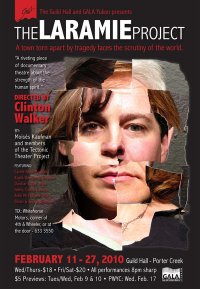
I gave Justine Davidson, the theatre reviewer for the Whitehorse Star, a long hug at the end of The Laramie Project, the Guild Society/GALA play.
Both of us were near tears.
She said over my shoulder, “Does this mean it’s good when the journalists are crying?”
We weren’t the only ones moved.
But don’t let this make you think the play is a downer. It isn’t.
It’s mostly a fascinating study of 80 people learning to cope with sudden and abrupt change. The tragedy of Matthew Shepard’s murder happens before the play begins — so this is, in effect, the aftermath.
This is a community coming to terms with what they think about it — and finding themselves at the centre of a media tornado. You find yourself rooting for them as they try to make it through. …
The Wolfman,(2010) directed by Joe Johnston, starring Benicio Del Toro, is a remake of The Wolfman, (1941) directed by George Waggner, and starring Lon Chaney, Jr. You know that. My biggest question through the movie is WHY REMAKE IT?
The first half hour is a snoozer, merely a recap of the film you’ve already seen. In fact, the writers so depend on you knowing the characters from the 1941 movie that hardly anyone is allowed screentime to develop as NEW characters. Who is Lawrence Talbot in this version? We don’t know. He’s cast in such dark and moody lighting, such gothic teasery, that we don’t get a sense of Lawrence as a person. They make the BIG SIN of Bad Movies–let the actors only talk about the Plot. So, every line, every snippet of dialogue is there to give us Backstory, Context, Tell Us Things We Should Know–but no one is allowed to actually talk about anything else. No one asks anyone to pass the salt. There’s no time. We must talk, and talk quickly, about the plot.
To the movie’s credit there are three new twists thrown in:
* * *SPOILERS * * *
1. Lawrence Talbot is an American Actor, starring in Hamlet in London. This is cool. I don’t mind there being some Shakespearian allusions in the movie! Yay! And Lawrence Talbot and Hamlet have some similarities— they’ve seen the truth about their fathers; they have seen their mothers ravaged by other men; they were gone for most of their adult life and are brought back for a funeral; they are in a quandary about what to do; their girlfriends think they are insane; they must kill their “fathers”. Brilliant idea to show these similarities. But where Shakespeare’s play develops characters, Johnston’s movie superimposes limp characters onto established patterns. Not only is Del Toro’s Talbot hoping you think of Chaney’s Talbot, but he’s hoping you think of Hamlet–except Hamlet was clever, Hamlet PLAYED insane, Hamlet had a plan… Talbot in this film has no plan. He’s a victim of the werewolf, a victim of his Father, and ultimately a victim of the town. The Comparison to Hamlet is an attempt to ride on Shakespeare’s coattails and give this film some depth it doesn’t earn.
IF they had started the movie on stage with Benicio Del Toro, playing Hamlet, going backstage to hear that his sister-in-law had written to him to come to the Family Manse, there’s been a murder–and he had to go back onstage—that would have been interesting. It would have been SCENE. We could have seen Talbot as an actor, as a person…. BEFORE he goes home to Goth House.
2. Anthony Hopkins is HIMSELF a Werewolf. Cool. In fact, I think both men are sexy as werewolves and the battle scene is beautifully done and fun to watch. In fact, I’m sure that battle scene is worth the whole movie to some. By making the dad a werewolf too, you add a great deal to the idea that Fathers make their Sons into monsters when they are monsters. And I kind of liked this aspect of the movie. It should add a depth to becoming a monster–abusive parents create abusive children, etc. But that’s not really explored. The Dad is completely heartless in that he’s finally decided to embrace his inner Werewolf and just kill at random. He has no reason and no regret. And so, we don’t care about him. He’s one-dimensional and speaks from the script. And neither man can stop himself from killing once he’s a werewolf…. so why bother with morality at all?
3. Lawrence Talbot was sent to a mental institution. VERY cool. I like this. It’s logical. He sees his father kill his mother and goes a little bonkers. And then they send him to America where those who are a little bonkers will fit in. One scene. That’s all the movie gives this beautiful, but underdeveloped, idea… so Talbot is dunked in icy water and given injections, and we get a flashback. That’s it. And, the second major transformation happens here…which is fun to watch. But the addition of this backstory is sewn on with big thread and doesn’t really match the rest of the movie. It isn’t utilized.
Some inconsistencies in this movie made this remake more confusing and tiresome.
A. Why wasn’t Lawrence killed when he saw his father eating his mother? None of the other werewolves have stopped to save a child…. Lawrence should be dead, or he should have never seen that incident.
B. Sometimes the moon comes through a cloud and changes you AT ONCE, and sometimes, you get to walk around outside or inside as a human being until you’ve finished your dialogue, and then you get to transform into the werewolf. There’s no clear rule about transformation. Bad.
C. What is the purpose of the Inspector or Gwen now? They are Wasted characters because they’re not given any screen time to really develop. In 1941, Lawrence Talbot was a normal man, flirting with a beautiful girl, come back to run the estate of his family. When he is bitten, that first “normal” life is taken from him.
Watch this here and see the development of character in a 1940’s way (and, wow, is Lon Chaney Jr. a hunk of a guy)
In 2010, Lawrence Talbot is already doom and gloom, and his bite is just further nightmare. Nothing is normal in this new Talbot’s life. The girl he’s flirting with now–that’s his dead brother’s fiance. His father? A werewolf who killed his own wife. There ain’t a happy moment in this film–and therefore, without that happier beginning, there is no tragedy.
This was the HEART of the 1941 film. That a good man could be destroyed by a bite from a werewolf. It has been ripped out of the chest of this story to make way for a kind of pre-ordained House of Usher doom….
So I come back to my first response: WHY remake such a classic film? To get neat special effects in and to get more gory. There are some scary moments in the film, but twice we are blatantly tricked, making us feel like fools: Samson the dog scare us at quiet moments. (Oops! Not a werewolf…shucks. Gotcha anyway!)
There’s lots of killing, lots of killing, and it’s so random, that after awhile, it all becomes white noise. Six people, ten people, there’s no challenge to the werewolf. THEY ALL have silver bullets, but not one of them can shoot straight? Yeah, right.
Bottom Line: Beautifully filmed and with stellar special effects, the Wolf Man gives us nothing else new and tarnishes what was good about the original. If you’re interested in seeing the classic, follow the Youtube connection above to see the whole film.
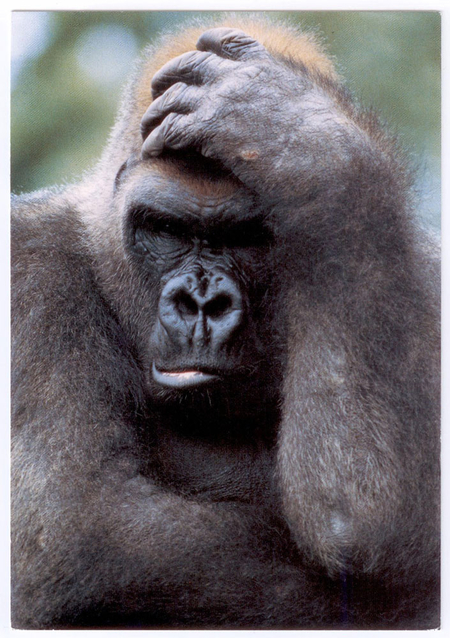 My story, “Et Tu Bruté,” was just chosen to be on the longlist of finalists for the GEIST magazine Postcard Story Contest. Out of over 500 entries across Canada, they choose 15 stories for readers to read through and make comments about and vote on. And then they choose winners. Thank you, GEIST, for the exposure! It’s a prize in itself to be on their website and to have my work being read.




 Bear Witness