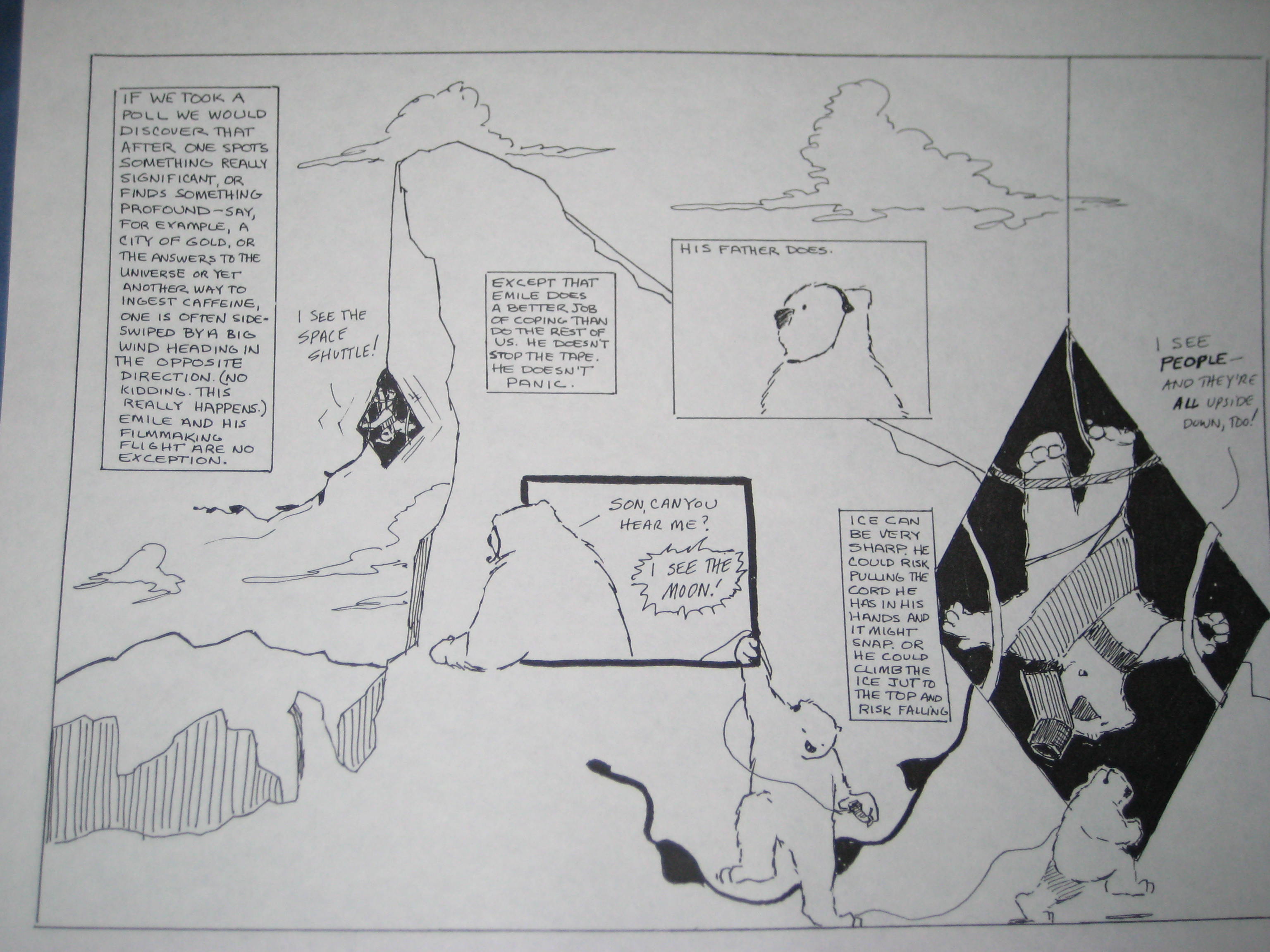
I used to be a cartoonist. I had a comic strip for 4 years in the local student paper, The Maneater, at the University of Missouri. I found that a visitor to Whitehorse had kindly uploaded some of my strips from a book called Captain Bly, 1994, as a way to show off my nifty book. Thanks, Aniko! So I decided to upload a short 6 page story not included in the book. (The pic on the left is actually a pastel of the same bears–these bears are reciting Shakespeare’s The Tempest)
I’m still working on those bears. They appeared a little in my short story “Lemmings in the Third Year” and I’m trying to work on a novel about them.
Below is a short story I did for a Comic Strip 101 class I had with Frank Stack, an artist and cartoonist teaching there. He is credited with the first underground comic book, The Adventures of Jesus. He was a great teacher. Had us draw comic strips and pin them to the wall for critique and then he would go about busting us! He thought we were a great class though. Full of potential. I’ve been playing with my cartooning roots, and working around in some other mediums. But here is that short story.
Fantasy Magazine, which published my short story, “The Moon Over Tokyo Through Leaves in the Fall,” did a companion interview, which I thought was incredibly thoughtful. When you write a story, you always hope for questions like this–that someone will ask what you meant when a character said this or that, or ask how you go about writing the story.
And secretly too, you hope you don’t sound like a dork.
I appreciate the interviewer, TJ McIntyre, and the work he put into the questions. Thank you.
An excerpt
There have been many controversies over the years relating to writing the “Other” or writing with a voice outside of one’s own natural experience. “The Moon Over Tokyo Through Leaves in the Fall” is written from the point of view of a modern Asian-American female. Did this create a challenge for you? What steps, if any, did you take to verify the authenticity of your voice in this piece? What tips do you have for other writers out there working on pieces where they are writing from the perspective of the “Other?”
Hmmm . . . This is a hard question for me because I think every character you write about is an “Other.” I do understand the argument, that writing something completely different from you is more challenging. But unless you are writing memoir, the characters have completely different childhoods, desires, relationships — all the characters, not just the POV one. So they all take a lot of work to understand and “get right,” so to speak.
But if someone wants to write a character which is “other” I wouldn’t stop them. Instead, I would encourage them to stretch themselves. I certainly don’t immediately identify with, or always find accurate to my experiences, the white, rural, college-educated, religious gay male characters I find. And I don’t always want to write that character. I would hate to stop someone else from writing them though.
So I think that’s my first tip: Feelfree to be whoever you need to be for the story, without holding yourself hostage to criteria. Criteria can turn into stereotype. I remember once writing a poem about Theodore Roosevelt surviving the Amazon River. A fellow writer said that I had no albino catfish in the poem and that it was a weakness. If I didn’t mention them, I would be called on the authenticity of place. Even worse may be the authenticity of race or gender or sexual orientation — since we are multi-faceted people. I go back to my first statement: Everyone in your story that isn’t yourself is an “Other” . . . and you are required to be careful with all of them.
Saying that, though, I think writing a nasty, mean, selfish gay character might be an accurate representation of one particular person, and might make a funny character, but I would trust that character more in the hands of a gay man who knows the consequences of pushing a bad stereotype in a culture that seems to want to believe the stereotype, than in someone else’s hands. I tried hard to be sympathetic to both Matsui and Yumi equally — showing their flaws, their desires, and hopefully helping a reader side with both at different times.
So, not that you have to always treat your Other characters with kid gloves, but that you make everyone understandable and as authentic as a human being as you possibly can through research, and through infusing them with your own flaws/desires. I infused Yumi with some of my own doubts about my relevancy/impact on the world, my own relationship experiences, the sometimes clash of cultures I find with people older than me. The story doesn’t have my exact experiences, but the shades of feelings are right, the tone is right, the need to be loved and validated is right, I think.
Run the draft through a close set of writerly friends to check for bias. I did run this through Clarion 2007 in San Diego, past a rigorous group of fellow writers, half of them women, who had some questions about the way I wrote Yumi, and I followed their advice. Not that a character can’t make bad decisions, or have perceptible flaws, only that they should be unique, individually motivated and free from OBVIOUS bias.
Be open to learning what it’s like to be someone other than you. It’s really difficult to shed Jerome in order to take on Yumi or Matsui, but I try. Like an actor taking a role.
I think if we only wrote within our experience we’d really limit our stories, and ourselves. I remember once writing from the perspective of my brother, and I learned a lot about what it felt like to have to make some of his decisions. The story moved radically away from my brother’s actual deeds, but the writing process allowed me to feel empathy and understanding for him in a way I had never felt before writing about him.
The process allows a writer to “put themselves in someone else’s shoes” and that’s good, both for the writer — who learns something outside him/herself — and the reader — who doesn’t have to put up with a bunch of main characters who are sci-fi movie buffs. Viva l’Other!
______________________________________________
Read the whole interview on the Fantasy Magazine Website here.
If you’re like me, you harvested a lot of vegetables this Fall. Gardening in the Yukon is amazing! With long hours of sunlight, a crop of vegetables can be yours in 10 weeks. But then you have a huge harvest. You can’t possibly eat them all in a few weeks. Outside of freezing, how do you store vegetables? Can someone store vegetables all winter and keep them as fresh as if they were still in the ground? Well, I know a way. Bruce Pedersen, local chiropractor, has been using a method that keeps tons of vegetables from his garden fresh all winter long. Try his method and see if it works for you.
1. For carrots, beets, turnips: get a large paint bucket and place an ordinary kitchen trash bag inside the bucket as a liner. Don’t use the drawstring, get the ones with those flaps you have to tie with.
2. Pull up your vegetables from the ground. Don’t wash them. Just shake the dirt off. Don’t wipe or try to clean them. “When people scrub a vegetable clean, they damage the skin and then they have to eat it right away or it will rot faster,” Dr. Pedersen says. So, don’t clean these.
3. Right at the truck, he had a cutting board and a knife. Take the knife and cut off the greens, slicing just at the top of the carrot, or beet. For carrots and beets, you only make one cut–to take off the greens. With beets, you leave on the long root if it has one. For turnips, you’re going to make two cuts: one to clear off the greens, and the second to cut off the roots, so it’s a round ball.
4. These headless carrots all go in the trash-bag lined bucket, all on top of each other. Don’t worry if you get dirt in there. Be careful putting them in the bucket. If they’re long and break off on impact, then you have to dispose of them (eat them right there!) They’ll rot if they go in the bucket broken.
This bucket actually needs more carrots in it first.
5. Fill the bucket till it’s 3/4 full or 4/5. Then shake the bucket a bit to settle the carrots. Then take ordinary peat moss and fill the bucket with peat moss till it is full.
6. Then take the trashbag flaps and nearly cover the peat moss, leaving a hole showing the peat that’s about the size of a tennis ball. “This is to help the peat moss breathe. You don’t want it all completely covered–but you don’t want more than a small hole either.” You’ll tape down the bag in place.
7. Store the buckets of vegetables in your garage over the winter, or a cool, dry place. Not a freezing place. And not in your house where it will be too warm. Maybe an entryway, or a back porch.
8. Over the winter, just dig out your carrots, beets, turnips, etc. from the buckets when you need them.
9. For potatoes, put the bunch of potatoes in a large styrofoam cooler, the kind you get at Canadian Tire. Fill that with peat moss too. Cover with a trashbag, stretched out over the top, taped down in places, but with enough space in other places to let the peat moss breathe. And just dig up a potato when you need it.
Why peat moss? Peat is a moisture regulator. It seems to draw in the extra moisture from the newly harvested vegetables and then gives it back to the vegetables when they get dry. It seems also to slow the decay of the vegetables, almost holding them in a stasis for a longer period of time. Sand doesn’t regulate moisture and is a lot messier to work with. Also you need more sand to cover the vegetables because it will sink down to the bottom. The peat mostly rests on top as a barrier to the cold dry air.
Bruce Pedersen has done this for several years and has had fresh vegetables all winter long. Hopefully, the method will work for you too.
If you found this information helpful, please consider donating just .99 cents. It keeps us writers fed.
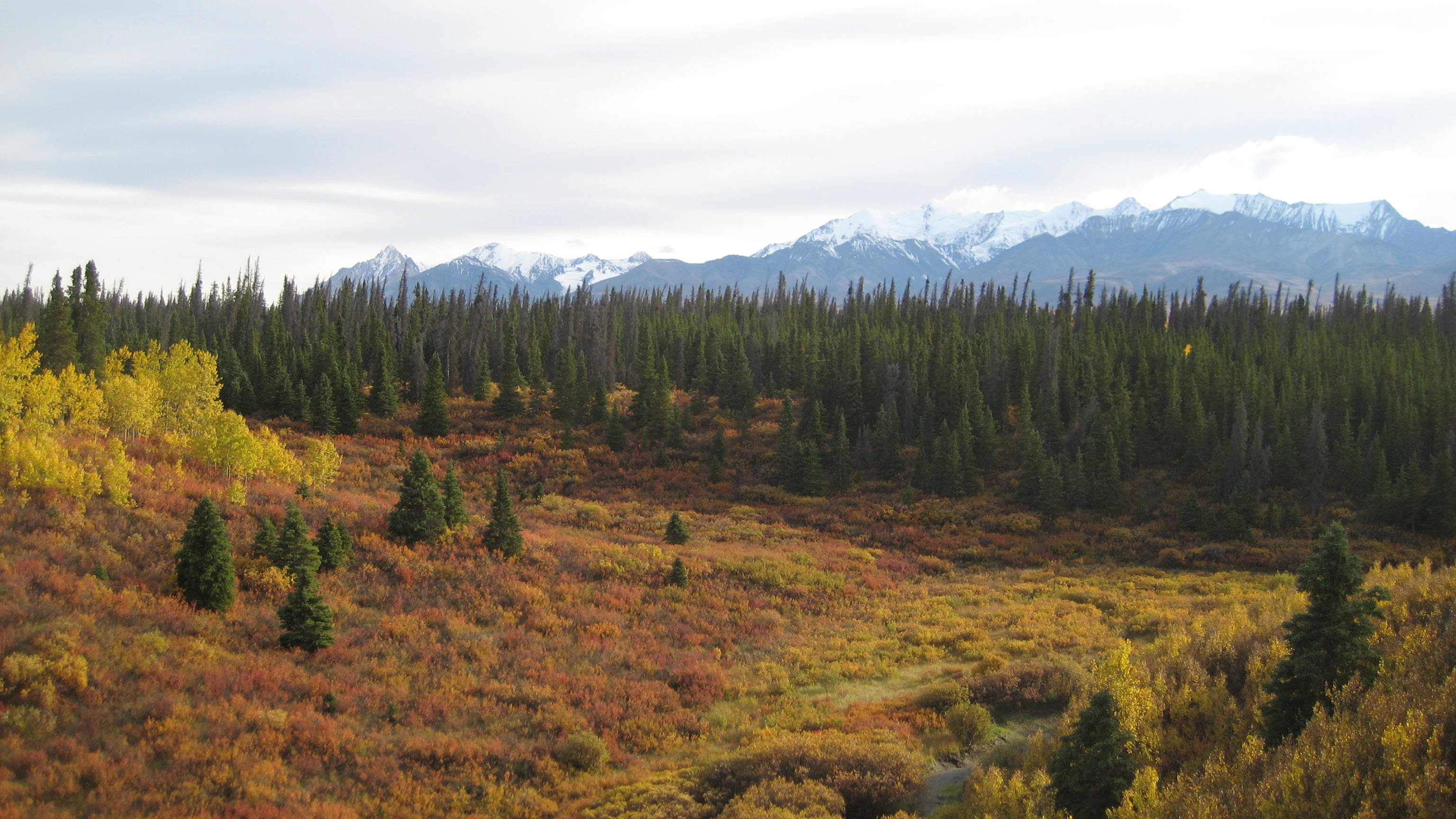
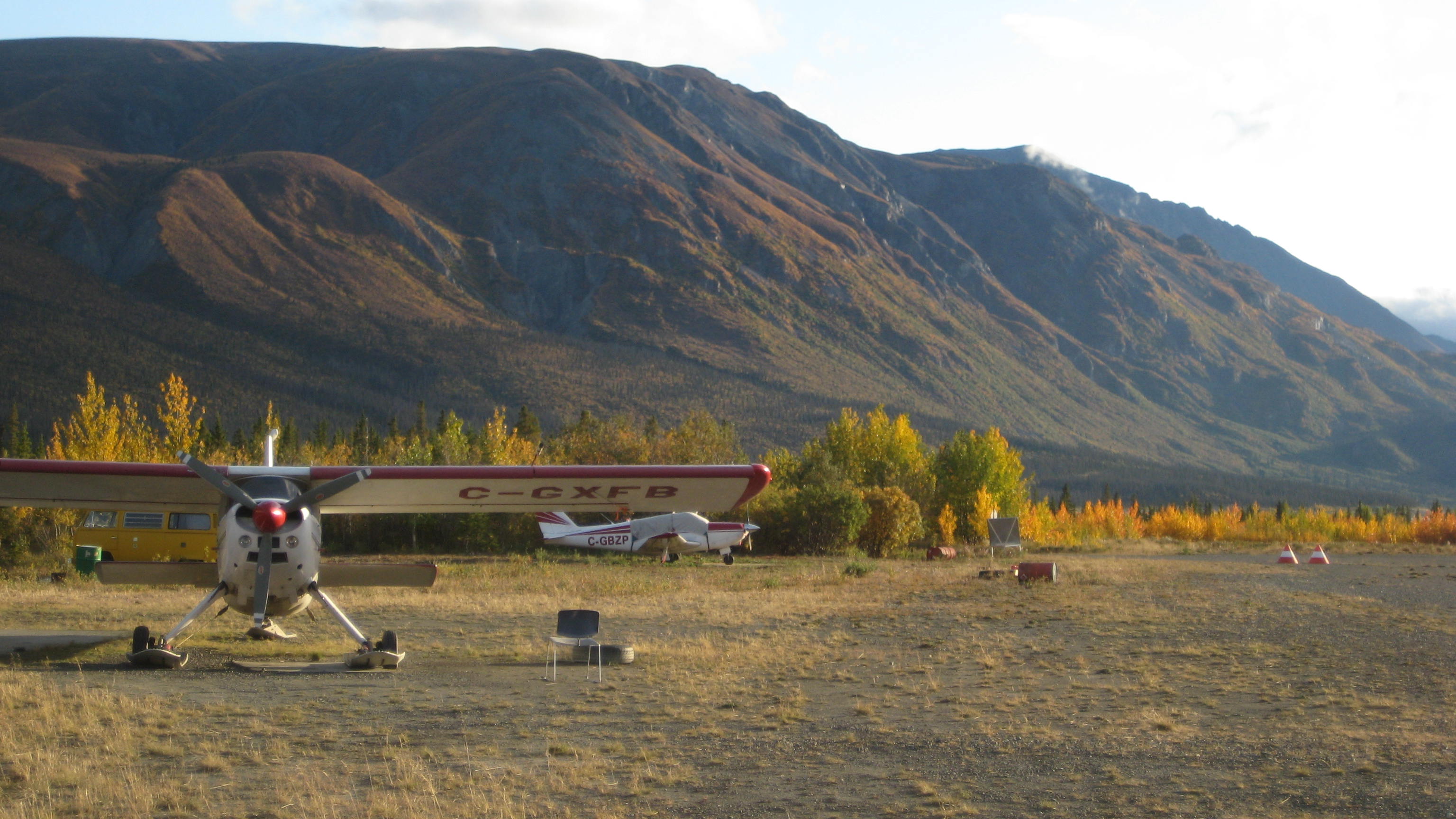
I had the chance of a lifetime this summer to work out at Kluane Lake. The drive from Haines Junction to Kluane Lake has to be one of the most beautiful drives ever, but it really glows in the fall. Holy Cow. I took 92 pictures and movies. This was my drive to work every week. Today it looked like everything had turned to gold in the Yukon.
Me looking adventurous and small.
At the airport at the Kluane Lake Research Station.
The fall is brief here, but it sings. Go outside and see the music.
Tesseracts Fourteen: OPEN FOR SUBMISSIONS (Sept. 1, 2009 – Nov. 30, 2009)
Submissions are now open (from September 1, 2009 to November 30, 2009) for volume 14 of the Tesseracts anthology. If you are a Canadian author and write speculative fiction, we want to see your stories, poetry, radio plays, flash fiction etc. [SEE GUIDELINES BELOW]
The editors for this antholgy are:
John Robert Colombo and Brett Alexander Savory.
GUIDELINES
This anthology is open to Canadians, landed immigrants, long-time residents, and expatriates.
Open to submissions in either English or French. (Francophone stories must be translated into English for publication if accepted.) Canadian authors who write in languages other than French or English are welcome to submit an English translation of their work, provided it otherwise falls within the parameters of this anthology. Please supply details of original publication for any submission that originally appeared in a language other than English.
Translation into English is the sole responsibility of the authors.
Genres: all the genres of imaginative literature, including but not limited to magic realism, science fiction, fantasy, dark fantasy, slipstream, supernatural horror, weird tales, alternate history, space opera, planetary adventure, surrealism, superheroes, mythic fantasy, etc.
The Tesseracts anthology series is open to both short fiction and poetry.
Payment is $20 for poetry, $50 for stories under 1,500 words, rising to a maximum of $100 for stories of over 5,000 words (longer stories are paid a slightly higher fee, but in order to exceed the word length limit of 7,500 words, the editors must judge a story to be of surpassing excellence.)
Deadline: 30 November 2009.
Do not query before submitting.
Email submissions: tess14@hadespublications.com
Emails MUST contain the word “submission” in the subject line, or they will be deleted automatically by the server. Please also include the story title in the subject line.
Submissions MUST come as an attachment: RTF is the only acceptable format.
Emails MUST contain a cover letter in the body of the email; for security reasons, email attachments with no cover letter will be deleted unread and unanswered.
Cover letter: include your name, the title of your story, your full contact information (address, phone, email), and a brief bio. Do not describe or summarize the story.
If your address is not within Canada, please indicate in the cover letter your status vis-à-vis Canada.
Reprints (stories having previously appeared in English in ANY format, print or electronic, including but not limited to any form of web publication) can be considered but will be a hard sell; reprints must come from a source not easily available in Canada. If your submission is a reprint, please supply full publication history of the story. If your story appeared previously, including but not limited to anywhere on the web, and you do not disclose this information to the editor upon submission, you will be disqualified from consideration.
Submission format: no strange formatting, colour fonts, changing fonts, borders, backgrounds, etc. Leave italics in italics, NOT underlined. Put your full contact information on the first page (name, address, email address, phone). No headers, no footers, no page numbering. DO NOT leave a blank line between paragraphs. Indent paragraphs. ALWAYS put a # to indicate scene breaks (a blank line is NOT enough).
ALWAYS include your full contact information (name/address/email/phone number) on the first page of the attached submission.
Rights: for original fiction, first World English publication, with a two-month exclusive from publication date; for all, non-exclusive anthology rights; all other rights remain with the author. (DO NOT INDICATE WHICH RIGHTS YOU ARE OFFERING; SUBMISSIONS MARKED WITH RESTRICTIVE RIGHTS WILL BE DELETED WITH NO REPLY.)
Spelling: please use Canadian spelling, as per the Canadian Oxford Dictionary.
Response time: initial responses (no / rewrite request / hold for further consideration) will be made within thirty days after the close of submissions. Final responses no later than 31 December 2009.
Submit up to three stories at the same time, butUNDER SEPARATE COVER (only one submission per email).
Simsubs are not encouraged but are acceptable. Should you receive a “rewrite request” or “hold for further consideration” response, please indicate immediately whether your story is under consideration anywhere else.
My new story is up at Fantasy Magazine. In honor of that, I took this footage out at Family Camp this weekend, a time where our church goes out and camps together. A spectacular full moon found us there, and I took this footage through spruce and pine and poplar there at Marsh Lake. It’s quiet at first, but wait for the screams at the end.
Enjoy the peace of the full moon over Marsh Lake (and the screams). Sorry it’s so black except for the moon….usually the moon lights up much more. And enjoy the story. Thanks!
Starting Sept 16 at FH and Oct 1 at PC, I will be offering science fiction and fantasy writing to interested secondary students.
The Little Girl and her Giant Crocodile, Mauro Lira
Are you attending Vanier, FH or PC this year? Do you like to read science fiction or fantasy, and do you like to write your own? Come join a group of dedicated young fantasy/sci fi writers like yourself on Wednesdays at FH Collins, or on Thursdays at PC, after school. Snacks will be provided for the hungry. Bring your own notebook paper and pen. A journal is best. We’ll play some writing games and get you pulling stuff out of your imagination–and then writing stories.
After two successful years of running the first group–which last year landed at FH Collins–I’m starting a group up at PC. If you think you’re interested or know someone who might be, get in contact with the Parks and Recreation folks at 668-8325 and register for either the FH or PC version. Registration begins on Sept 8–one week from today. Classes begin earlier at FH Collins—and their program is 13 weeks; PC, since we’re just starting out, has an 8 week run.
FH Collins begins: Sept 16
PC begins: Oct 1
Crocodiles will not be provided. Please bring your own.
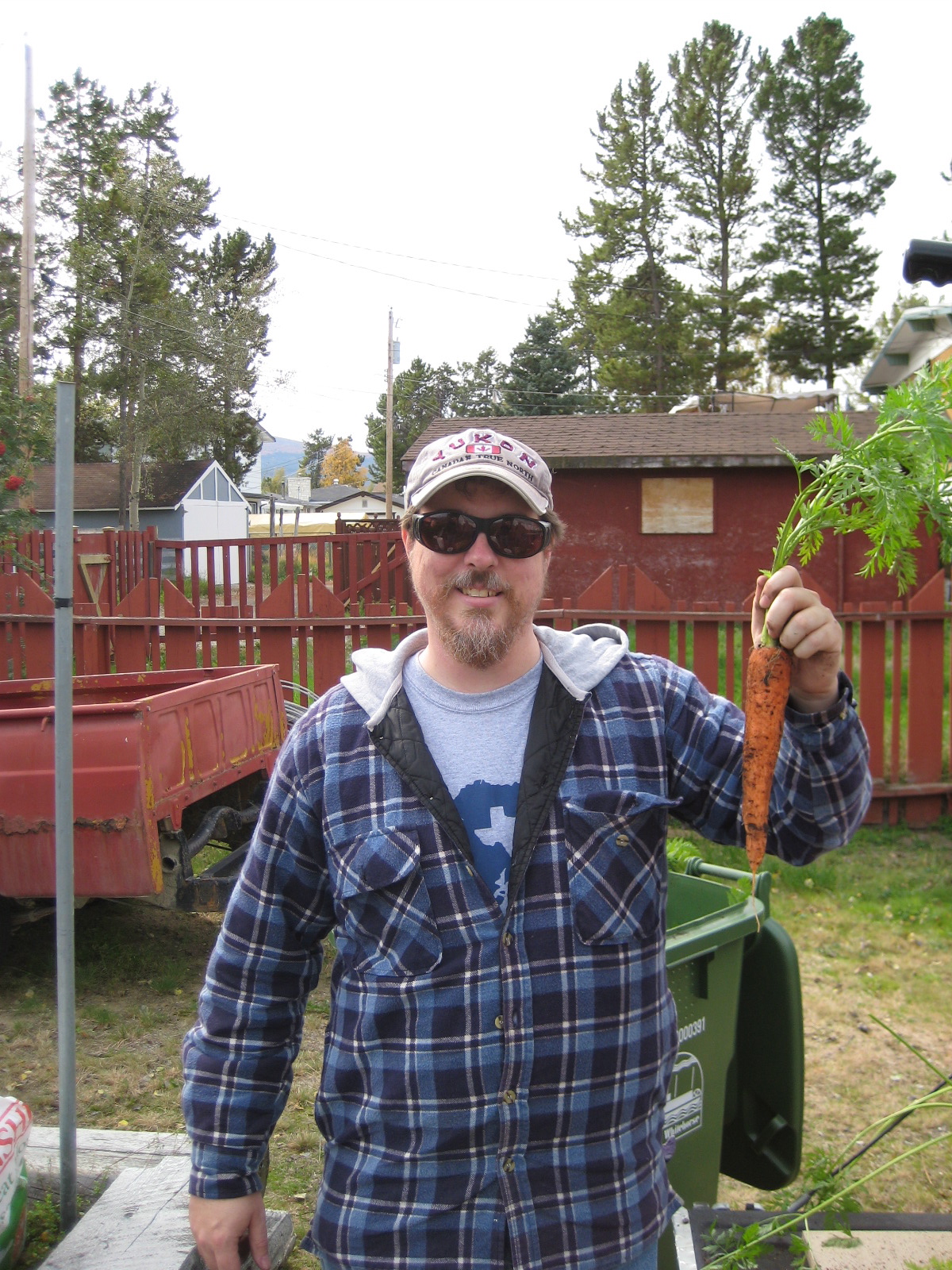
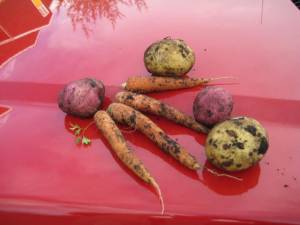
Had a great crop this year, and it’s not done. We just started harvesting. Wow. The vegetables are big. So I decided to showcase the vegetables next to objects you’d recognize….my pen, a bottle of T-3s, my truck.
The one next to the bottle made me think about the difference between something that comes out of the ground and something that comes out of a bottle. I like ’em both, but I think if I had more fresh garden vegetables that soon I wouldn’t need anything else.
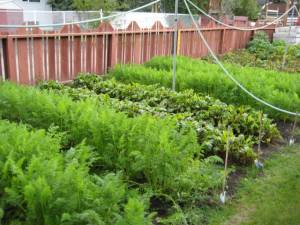
The garden was a work of art this year. I am so proud of the labor that went into it, into weeding, into caring for it. The carrots are big and sweet, the potatoes rich. And the greens they grow so high…
Yes, the Greens They Grow So High
I learned a lot from growing the garden. The patience. The time involved on your hands and knees rooting out the chickweed. Sweating in the Yukon sun. These are mini-accomplishments, like trophies. And it’s a nice thing to do in the Yukon on these long summer days inside a quick and dirty summer–10 weeks, maybe. We had so much sun this summer. If you were thinking about leaving the Yukon after the last three summers, this summer wooed you back.
Harvest on a Red Truck
I’m gonna fix a sheep stew tomorrow–fresh Dall Sheep that was walking around last week (I did not shoot it, but I did help cut it up)–and fresh vegetables. A lot of work went into that stew and I’ll remember the two guys who trekked across the mountains in gale-force winds and rain to get this sheep to my kitchen. And I’ll remember the hours I spent in the garden waiting for the vegetables to get big enough to leave the garden and enter my kitchen.
And I’ll say to myself—hey, this cures whatever ails me–this summer stew.
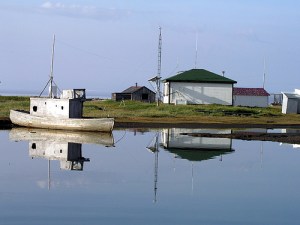
Herschel Island, a quiet pond, an old fishing boat, the old Canadian Signal Corps building--amazing photo by incredible photographer Hank Moorlag
Meagan Grabowski didn’t know she was coming up with a catch phrase, but a visit to Herschel Island for a couple of weeks, and she was a one-woman neologist. “It started at Pika Camp,” a remote camp for researchers a few kilometres away from the Kluane Lake Research Station. “We were coming up with an Inuvialuktan to English to Yorkshire dictionary…for fun…and the Yorkshire term for ‘it’s very cold’ turned out to be ‘positively Baltic.'” But when she was up for two weeks studying biomass on Herschel Island, and it got really, really cold, she slipped on the ‘baltic’ and said the weather was “positively Beaufort.” Meaning, it doesn’t get colder than that….the wet wind off the Beaufort Sea…beats everything.
Meagan was up there as part of International Polar Year, with a team of researchers, Scott Gilbert, Charlie and Alice Krebs, Don Reed, and others, all looking at Herschel Island as an ecosystem, finding out what made it tick, and how that information could be transferred, and compared, to other northern islands and our own Yukon high alpine tundra areas.
Meagan Grabowski is daughter to well-known taxidermist Tony Grabowski and you can hear more of her adventures up on Herschel Island, as well as how any young Yukoner can spend a summer in a such a positively Beaufort place. The last of my two radio shows this summer, coming Tuesday at 7:50am.
We’re hoping the weather stays warm for a long time, but in case it drops to -40 this winter, feel free to put “positively Beaufort” into circulation.
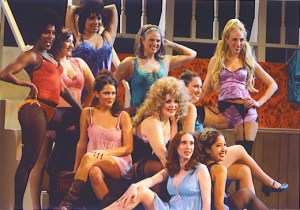
Looks like the cast of Best Little Whorehouse in Texas
Yep, you heard it right. An anthology about the “World’s Oldest Profession” is looking for submissions. Stories need to have a genre twist to them—science fiction, fantasy, something that makes them a bit different. The anthology is “Ladies of Trade Town” and the Press is a good one.
The stories selected for this anthology will build on that varied background to tell well-crafted tales of the women and men – and other sentient beings – who “ply the trade” in a variety of times and settings. I’m looking for original science fiction, fantasy, and related genre short stories that entertain and play to the imagination of the reader. Show me something I haven’t seen, read, or written. (For examples of that last, see “Lady Blaze” in Roby James’ Warrior Wisewoman 2 and the title cut of the filk CD that gives this volume its name.) Humor, characters of all orientations and gender-identities, and new writers all welcome.
Despite the theme, I am *not* looking for porn, erotica, or gore-soaked horror. Absolutely no child abuse, incest, or non-consensual situations. Also not looking for poetry, fanfic or proselytizing either for or against the theme.
STORY LENGTH:: between 3,000 – 10,000 words. Mostly looking for stories in the 5,000 – 6,000 word range, but I’d like to have a few stories on the upper and lower ends in the mix. The upper limit is firm for unsolicited stories.
PAYMENT: $0.02 a word on acceptance of completed anthology manuscript by the Publisher, as an advance against pro-rata share of the royalties after earnout, plus one contributor copy.
READING PERIOD: Opens January 5, 2010, closes June 9, 2010. Manuscripts received before or after this period will be discarded unread, unless prior arrangements have been made otherwise.
 I used to be a cartoonist. I had a comic strip for 4 years in the local student paper, The Maneater, at the University of Missouri. I found that a visitor to Whitehorse had kindly uploaded some of my strips from a book called Captain Bly, 1994, as a way to show off my nifty book. Thanks, Aniko! So I decided to upload a short 6 page story not included in the book. (The pic on the left is actually a pastel of the same bears–these bears are reciting Shakespeare’s The Tempest)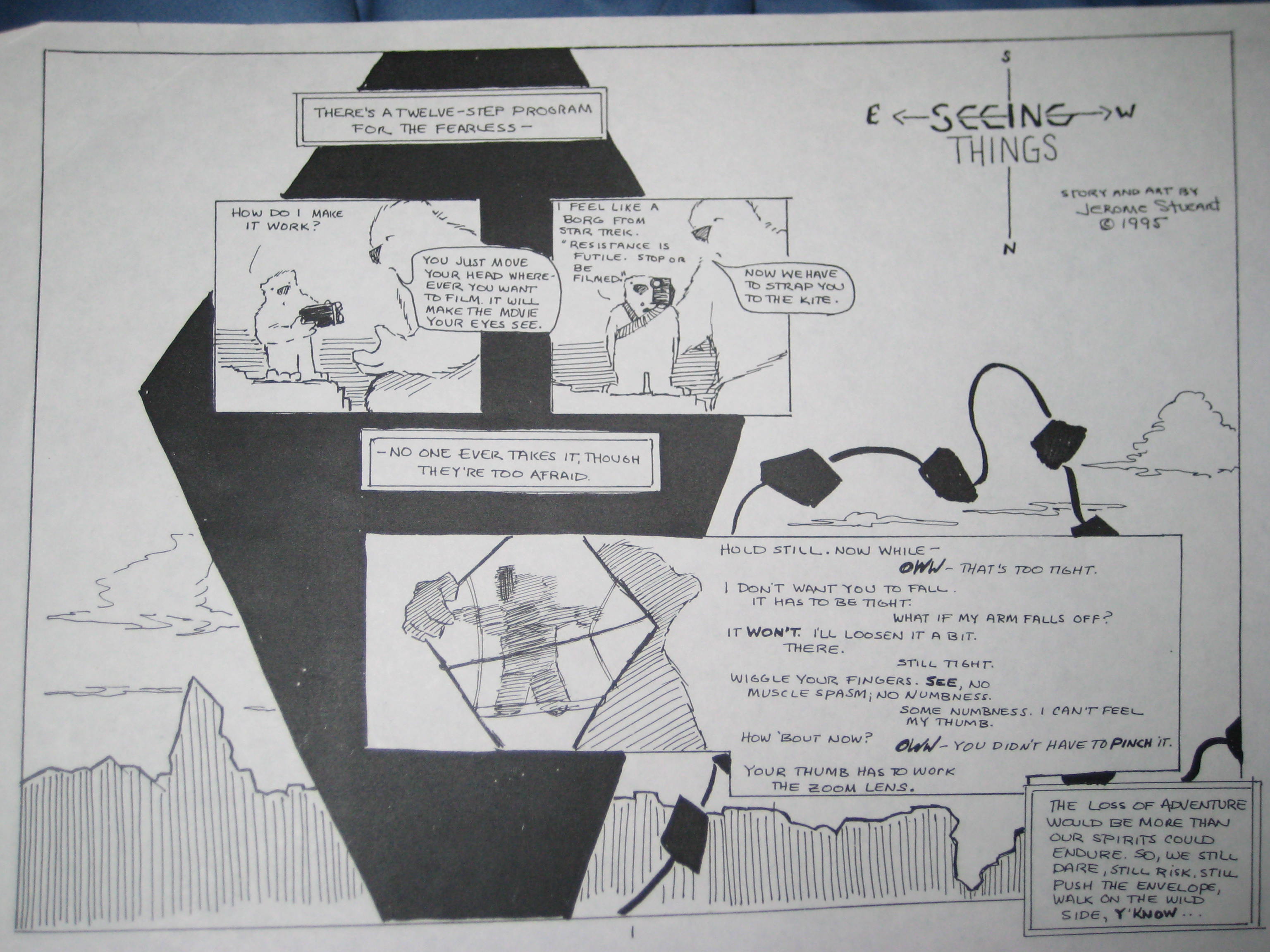










 Bear Witness