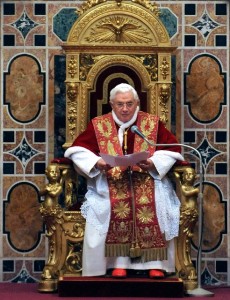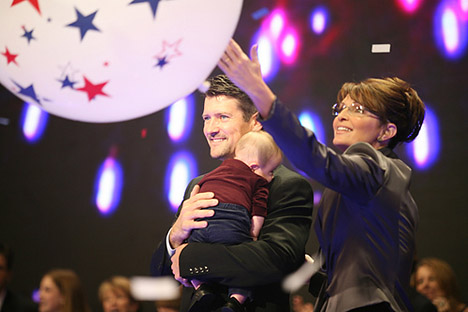
Gingrich cast as dreaming D’mi in new Star Trek Series

As a follow up to my last post about Star Trek: Reckoning, the hot, new, nearly top-secret co-produced ST series from Paramount and Fox, none other than Newt Gingrich has come aboard!  It’s very rare for working politicians to take time out to create good television for honest folks in the Midwest and the Plains, but it looks like Sarah Palin and Newt Gingrich will be on board.  

From my insider at Paramount, “The producers had actually wanted an actor, at first.  Sarah Palin’s the one who pushed the idea of Newt, saying in effect, that he ‘has the chops’.”  

I have to say, it’s an inspired choice.  Not an actor, but a politician—those are close, so I can see Paramount going for that.  But Gingrich is, shall we say, kind of from another era.  Most popular from the 90s and the man who brought us the doomed “Contract with America” and subsequently hijacked the presidency of Bill Clinton.  Now, I remember that.  But I don’t think most people actually remember Newt Gingrich, so it might not be a problem.  They won’t confuse his character with any thing of substance he might have done in the past.

Sometimes actors on Star Trek have such long-standing previous sci-fi characters (I’m looking at you Scott Bakula) that viewers can’t see them as something new.  I know this hindered my viewing of ST:Enterprise—kept waiting for Al to pop in (although watching Dean Stockwell in BSG, i completely forget he was ever Al on QL).  So, it may be that no one actually remembers anything important that Gingrich did, allowing him to kind of slip into this role and establish himself anew.  I mean, did anything he did really amount to much?  So that might allow him to start over as a character!

Just to recap: Palin will play Capt. Nalia Fergus of the USS Steadfast; she’s part of a group of rogue commanders who believe the dream prediction of the D’mi, that “the Reckoning”  will destroy the Federation.  Seeing a Federation President they don’t trust, nor believe he can protect everyone, they form an alliance to counter the Reckoning before it happens.  

Gingrich will play the D’mi (unnamed as of April 8) on-board the Steadfast, who lives in two worlds at the same time.  One is the dream and one is reality.  He is constantly unsure which reality he is living in.

“Which makes Gingrich perfect,” my writer friend at Paramount said, “He has a bit of experience nowadays with living in both fantasy and reality.”  He’s referring, of course, to Gingrich’s latest gaffe, putting words in Obama’s mouth that he never said.  Gingrich’s character will try to give advice to Capt Fergus (Palin) about how to avoid the Reckoning.  But he rarely ever sleeps—sleeping triggers the shift to the other reality–and so when he sleeps in one reality, he awakens in the other.

A great tension that the writers are building in is that he will begin to give information that proves false—about halfway through Season One.  He will claim that something Fergus has done has altered the future so that a “certain” event won’t happen the same, but in effect, there’s an idea that he really doesn’t know what he’s talking about.  I don’t even think that he knows that he lies; he’s a bit overwhelmed by the attention, by the focus, and by his power to direct Fergus, and the ships that follow her.  

I’m excited by this new Series.  I asked my friend why Paramount is delaying the formal announcement of Star Trek: Reckoning.  I’ve already had several people ask me when there will be more confirmed reports–and several people are searching on google for it.  

He says, “They’re testing the market right now, seeing what Red State America thinks about the idea.  They’ve never done a conservative focused Star Trek like this before.  They don’t know if they’ll have the audience.  But they’re basing it off of O’Reilly and Beck, Hannity and Coulter, and the current Tea Party constituency.  They figure people are tired of the way things have been done–and in that way, might be tired of Star Trek the old way—and want to see an overthrow, a rebellion—at least in science fiction, if they can’t have it in fact.”

I wonder if TV can play on that desire, that hope, of a people to want change so badly that they will accept the fictionalized version.  

“Well, you’ve seen The West Wing?  That was a George W. Bush era show–don’t tell me that wasn’t fantasy aimed at folks who wanted change!”  

He has a point.  

What I’m really interested in is this:  if the rogue group actually overthrows the Federation, will they make it more vulnerable to everyone else?  Will they make alliances with the Romulans?  The Borg?  Or will they naively think they can do better?  Fergus isn’t a seasoned captain; the D’mi doesn’t know what reality looks like; and they’re following a culture that believes in a bad dream….  they are hyping a monster that doesn’t exist.  

…will watching ST: Reckoning be akin to watching a train wreck in slow motion?

Young Yukon Writers Think About the Evolution of Vampires

Wouldn’t you know that 11-18 year olds have plenty of reasonable, thoughtful ideas about the evolution of vampires?  Because of the anthology I’m a part of that comes out next week (Evolve: Vampire Stories of the New Undead) I threw out the question —where do you think Vampires are going–or should go?— to my writing students.  They are all voluntary writers who stay after school to work on their own writing (which usually has a horror-tinge to it) and they were freakin’ brilliant.  I LOVE these guys.

Imagine them sitting around a grouping of four tables shoved together, in the French library of FH Collins.[Just gonna use their first names–they’re cooler that way]  I didn’t do any editing to this dialogue.  I have some pretty smart high school kids.

Here are their thoughts:

Santana:  I’m looking for more variety in vampires.  I think vampires have to move away from being either completely evil or sparkly good.  

Franz:  They used to be the icon of horror.  I think people forget that vampires used to turn into bats.  

Erin: They’re vampires.  They have to eat.  They’re not going to drag the carcass of a deer into the forest so they can revive it.  They aren’t going to be helpful.

Zeb:  They need to go back to the basics.  They’ve moved from Dracula to whiny good guys, and I think they need to swing back to Dracula.  I’ve seen quite a few vampires in between good and evil:  Dresden Files has multiple “courts” of vampires.  Some of them bad and some of them really bad.  

Franz:  Yes, I’m tired of angsty vampires.  I read about this one vampire who was all angsty and then he was bloodthirsty and killed people, but he was a lot more interesting when he got older and more complex.  He wasn’t as angsty and he wasn’t as bloodthirsty.  He was light hearted and pretty hilarious.

Santana:  Authors shouldn’t be afraid to expand the genre–to have vampires that are neither good nor evil, but neutral.  I want them as complex as real people.  I want them in modern day settings dealing with our own vampire crazy culture.  

Zeb:  Terry Pratchett had some really cheerful vampires called Magpires who wore bright clothing but they were really evil people!  

We all started citing some places that vampires still haven’t gone yet….

______________

And then …. they started to come up with ideas about what THEY would write about these vampires.  And they were such fantastic ideas, I can’t write them here… I have to let these kids tell them.   But they are brilliant.

I’m hoping that they read Evolve: Vampire Stories of the New Undead and give us a review of the book–to see if authors were able to “expand the genre” as Santana mentioned.  I’d like to see how this meets their expectations of where Vampires should be going…

Toronto Launch of Evolve: the all-Canadian Vampire anthology, April 9-10

Coming up, Evolve: Vampire Stories of the New Undead will be launched in Toronto at Ad Astra, the science fiction convention there.  It happens April 9-10 in two separate events: one is a the Canadian Launch on Friday night, 7pm at the World’s Biggest Bookstore.  And the other is a reading on Saturday at Toronto Don Valley Hotel and Suites which is hosting Ad Astra.  

You can read more about it here.

What is Evolve?  Evolve is really 24 authors tackling the premise–what would happen if Vampires evolved? What would the new versions look like?  When you have a history of Vampires that takes you from the ghoulish looking Nosferatu to the sexy, sparkling Edward, then you already have an evolution of vampires from their horrific beastial state–where being bitten was a life sentence–to teen girls hoping and praying they’ll be bitten by Edward…  Where have we come to?  What have vampires already become?  And where will they evolve next?

As Nancy tells me, this is the first ever all Canadian effort to tackle contemporary vampire stories–and I think we have an exciting premise.  If anyone is wondering if Vampires have lost their direction post-Meyers, here’s 24 things to think about for future reference.  

Evolve: Vampire Stories of the New Undead includes writing from Kelley Armstrong, Tanya Huff, Claude Lalumière, Mary E. Choo, Sandra Kasturi, Bradley Somer, Kevin Cockle, Rebecca Bradley, Heather Clitheroe, Colleen Anderson, Sandra Wickham, Rhea Rose, Ronald Hore, Bev Vincent, Jennifer Greylyn, Steve Vernon, Michael Skeet, Kevin Nunn, Victoria Fisher, Rio Youers, Gemma Files, Natasha Beaulieu, Claude Bolduc, and Jerome Stueart.

If you’re in Toronto and want to stop by the World’s Largest Bookstore, or by Ad Astra for the readings, you’ll enjoy it.  

Morgan Whibley Shot Me in the Alley and All I Could Say Was This: An Essay on Writing Genre

Morgan Whibley, Alley Series #44Some stunning work by Morgan Whibley, a Whitehorse based photographer.  The Alley Series.  (Yes, it was stunning and fun even before I was a subject.)  His rules are simple:

One alley from sidewalk to sidewalk.
Ambient light only.
A different person everyday.
Seven days a week.

He’d been doing this for 43 days in a row when he ran into me.  Follow the link, get stunned by his work.  All Yukoners, all beautiful pictures, wonderful, fun people.  They are our stories.

______________________________

But my story got me to thinking about being a writer of genre.

Morgan tells me to come into his shop, Photovision, and when I get there he cuts a piece of cardboard from a box, slaps down two markers and says, Draw.  What do I draw?  He’s made a speech bubble.  “Whatever you want to.”  I have NO idea what to put there.  He wants the first things I think of.  I hem and haw a bit.  Suddenly, I just sketch out a design and draw Mr. Spock with a latte from Baked Cafe there.  We shoot the photo in the alley.

And then, it’s over, so I think.  And I’m halfway back to my truck and I think–“You fool!  You could have said something important about the value of words.  That words can be healing, or words can be explosive and destructive.  And what did you do?  You did something frivolous.  And stupid–and highly derivative.  Are you just a Trekkie? Is that all you are?”  These were the voices in my head.

So I ran back to Morgan, grabbed him by the shirt collar.  “We have to do it again!” I said.  Okay, maybe I didn’t grab his shirt collar, but I was insistent that we do it again because I’ve thought of something more important to “say.”  So he patiently carves out another speech bubble for me, and I draw out the symbol for Medicine (you know, the two snakes wrapped around the staff with wings–started by Moses, so long ago)–cause I’m going for “Healing Words”….

Yeah.

So, we go out into the alley so I can get shot again.  And we’re both thinking the same thing, and we’re talking…maybe we’re overanalyzing, we both say.

And we take the shots.  And they are highly thought out…  and they say the “right thing.”  But they seem orchestrated, forced.

I think, later, that THIS is the argument that every writer has with him/herself.  Especially writers of any genre: humor, science fiction, romance, fantasy, western, children’s, young adult, gay, hairy monster, etc.

We think that we must say something IMPORTANT with what we write.  That we have to use our considerable talent, and all writers have “considerable talent” with words, and say something like “WORLD PEACE, IDIOTS!”  or “Stop oppressing us!!” or “Global Warming is REAL!”  or “Whales don’t deserve to be SHOT!”  And who can argue with these messages?  Certainly they are important.  We all know that.  And certainly other people will consider you a much weightier writer, a writer with HEFT, if you can tackle Global Warming, or Teen Pregnancy, or something important, in your writing.  They often give awards in that direction (and they do it in film too….).

But who’s to say that the person who laughs at my first photograph won’t be healed?  Who’s to say that you can’t heal someone with words without broadcasting that you are HEALING them?  Who wants to be hit over the head with a message?  And why can’t REALLY good genre do everything that you need it to do–be a damn good story, with a subtle message and a lot of entertainment?

I think, as writers, we all balance between these two photos: the need to say something important, and the need to say something fun and frivolous.  And we see them as two different categories.  That we can’t be fun and important.  We see this in many other areas too (religion, politics, leadership), but for me it resonates as the battle I fight every day:  What value, I think, is Fantasy writing? How does it help the world?   Shouldn’t I turn my skills to Environmental Literature?

No.  You should only do that if you are called to do that.  If you try to write Environmental Literature and you were born to write Children’s Books about Rockets and Squid–then you will be a very frustrated Environmental Literary Writer.  Where is your passion?  If you find your passion, I think you get the package deal.  You will affect people in important ways by being yourself.

There is no real dichotomy between writings—there is only being true and not being true to yourself.  The truth is–we need comedy, romance, westerns, mysteries, radio dramas, children’s picture books with gorillas in them–we need to laugh to fight the absurdity, we need to feel hope in the face of injustice, and we need to fantasize about escape.  We need it All.

Write your part of the All.

“One Nation Under Gods” finds home in Tesseracts 14

My story, “One Nation Under Gods,” was selected to be part of the Canadian Science Fiction and Fantasy anthology, Tesseracts 14, edited by Brett Savory and John Robert Colombo, due out in September 2010.  The Tesseracts series is devoted to Canadian Science Fiction and Fantasy and Horror, and has had, as you might have guessed, 14 other volumes (a Tesseracts Q was for Quebec, and the requisite 1-13 which came before). 

You might have caught me reading a portion of this at the Yukon Writers Festival a couple of years back.  It involves two kids and a history test, and a complete restructuring of the United States based on values Americans, like me, hold sacred: patriotism, freedom, the just war, independence, religion.  I just personified them a bit.  I’m very pleased it found a home.  I’m now going to start work on the novel version of this story.  

The picture on the left is the construction of the Statue of Liberty, a figure which looms large on the landscape at the beginning of my story.  And as I was now an immigrant to Canada, the Statue of Liberty loomed large on my new immigrant’s mind…what a dramatic beginning to a new life for those coming to America.  For me, I saw her on my way out.  On my drive from Texas to the Yukon, I parked my red truck in Calgary for one month, flew to Vermont to be part of a writer’s colony, and in that time, snuck down to see her.  Like some mistress I was breaking up with.  

How do you explain to her that you are leaving?   

I put her in my story, though, and so in this way, she haunts me.

Erasing The Fiction: Telling the Good News about the Prop 8 Trial

Occasionally, I stray from talking about science fiction and fantasy because something is important to say, or some event is happening that means a lot.  

The Prop 8 trial is happening in California right now, under the expert guidance of trial lawyers Olsen and Boies, best known for being on opposite sides during the Gore v. Bush Supreme Court moment in 2000.  Now they are together, and they are laying out the case for overturning Proposition 8, the nefarious way conservative folks ended marriage for the GLBT community in California.  

Thousands and thousands of people are watching this trial on liveblogging.  The Supreme Court has denied cameras and videotaping of the proceedings, with a ruling that happened only hours before the actual trial began last week.  Instead, we have had to follow some fantastic transcription of the trial.  

What we are learning is that we have been fed FICTION for a long long time.  And while it has been successful fiction, it’s not very good, and can’t really hold up to textual analysis, or any kind of scrutiny.  When you shine a light on it, it just because hatred, bigotry and discrimination, and very, very unchristian. 

The joy of reading the transcription—and please think of selling this as a book to people (I’d love a book of this trial for a donation to Courage Campaign Institute)–the joy of reading that transcription is the slow erasure of the lies that we’ve been told all our lives: that we will harm children, that we are living in direct violation to God and the scriptures, that we will hurt straight marriages, that we will bring destruction on America if allowed to marry (that last one has a Pat Robertson spin).  

Denying American citizens the right to marry each other is denying them the protections and promises of the Constitution.  First, we live as Americans and that document is our bible–it is what we rule by, live by, act by.  Second, there are countless, wonderful books—by theologians–that map out how the Bible is being used to discriminate, and that God loves everyone–including gay and lesbian people–and wants them, if they so choose, to find someone and love them as Christ loves people.  Christians who believe that gay people are not acceptable to God are treading a path away from God, away from Christ, and, unfortunately, away from the rest of us.  Just as they were some of the last holdouts on repealing slavery, and on granting the rights of women, so they are the last holdouts on accepting gay and lesbian people.  

It is so bad for the Church because many are walking away from God and Christ when they turn their backs on the church.  This goes against all that Christians stand for–they want no one to walk away from them empty-handed.  And yet….  I know they will be really upset when they figure this out.  It makes me sad.  What a horrible representation of God’s love.  

The trial is exposing those lies.  Though we have been blocked from seeing the trial ourselves, the truth is getting out there.  I am so proud of the people who are liveblogging this.  I am so proud to be a gay man right now, to see the truth unveiled, to see everyone slowly realize that we are not the scourge you made us believe we were.  

I encourage everyone to read the transcripts of each of the daily summaries.  You will be amazed.  And then, for folks who are still struggling with religion or faith and sexuality, this uncommonly simple, but thorough book, Jesus, the Bible and Homosexuality by Jack Rogers.  

To my fellow GLBT, God is not “theirs”—he is Ours.  They do not own Jesus, or the words of Jesus, and they cannot block you from his love.  There are plenty of churches now who accept us, and know that accepting us is perfectly good in the eyes of God.  You can go through those doors and receive love from everyone.  

Thank you, Olsen, Boies, and the rest of you for erasing the fiction that has been fooling us.  May everyone get the truth.

How to Read and Understand Science Fiction: Jo Walton’s Essay on Tor

Below is an excerpt and a link for the wonderful essay by Jo Walton on “SF Reading Protocols” or just how to understand Science Fiction and Fantasy when you’re reading it.   Her argument is that readers of Science Fiction actually read differently than other readers, and books in this genre require a different reading skillset.  

Genres are usually defined by their tropes—mysteries have murders and clues, romances have two people finding each other, etc. Science fiction doesn’t work well when you define it like that, because it’s not about robots and rocketships. Samuel Delany suggested that rather than try to define science fiction it’s more interesting to describe it, and of describing it more interesting to draw a broad circle around what everyone agrees is SF than to quibble about the edge conditions. (Though arguing over the borders of science fiction and fantasy is a neverending and fun exercise.) He then went on to say that one of the ways of approaching SF is to look at the way people read it—that those of us who read it have built up a set of skills for reading SF which let us enjoy it, where people who don’t have this approach to reading are left confused.

… My ex-husband once lent a friend Joe Haldeman’s The Forever War. The friend couldn’t get past chapter 2, because there was a tachyon drive mentioned, and the friend couldn’t figure out how that would work. All he wanted to talk about was the physics of tachyon drives, whereas we all know that the important thing about a tachyon drive is that it lets you go faster than light, and the important thing about the one in The Forever War is that the characters get relativistically out of sync with what’s happening on Earth because of it. The physics don’t matter—there are books about people doing physics and inventing things, and some of them are SF (The Dispossessed…) but The Forever War is about going away to fight aliens and coming back to find that home is alien, and the tachyon drive is absolutely essential to the story but the way it works—forget it, that’s not important.

This tachyon drive guy, who has stuck in my mind for years and years, got hung up on that detail because he didn’t know how to take in what was and what wasn’t important. How do I know it wasn’t important? The way it was signalled in the story. How did I learn how to recognise that? By reading half a ton of SF. How did I read half a ton of SF before I knew how to do it? I was twelve years old and used to a lot of stuff going over my head, I picked it up as I went along. That’s how we all did it. Why couldn’t this guy do that? He could have, but it would have been work, not fun…

Read More Here

Avatar: A Second Chance to Get It Right

In my last post, I reacted to critics who were convinced there was a racist motif in play in Avatar.  But I’d like to talk about what Avatar is all about: Second Chances.

The movie is riddled with “seconds”— a twin who takes over for his brother when his brother is killed, a man who has his legs taken away from him getting a second chance at walking, Sully who has a second chance at being useful to the Na’vi, humankind getting a second chance to be at peace with a Planet.  

Cameron in his acceptance speech for the Golden Globes says as much:

“‘Avatar’ asks us to see that everything is connected, all human beings to each other, and us to the Earth. And if you have to go four and a half light years to another, made-up planet to appreciate this miracle of the world that we have right here, well, you know what, that’s the wonder of cinema right there, that’s the magic,” Cameron said.

I was moved by the essay on Sully that I read over at the Respectable Negro Tribe blog

Jake Sully is emasculated in a literal sense because of a combination of physical injury, financial inadequacy and family tragedy. Not only is Jake Sully a Marine who cannot walk or fight, but more tragically he knows that there is a cure for his injury, but cannot afford it. Further, Jake’s closest relative, his twin brother, has been killed in a meaningless act of violence that Jake could not prevent, and now Jake is now forced to step forward into a position that he does not feel he is smart enough to handle.

He gets that second shot, for his brother, for himself, and in a representative way, for humans.  When he is at the tree with the glowing strands, he asks the ancients to link up with him, look into his past.  He’s trying to warn Erya that his kind are bloodthirsty, and that they would destroy the planet if given the chance.  “We killed our Mother,” he tells the planet.  And the planet steps up to save itself.  

One wonders what our story would have been like if we would have had a more respectful way of listening to our planet.  Is Climate Change the consequences of not listening?  

This is the stronger message of Avatar.  Not who saves who, but of having a second chance to save things at all….

Pope Says Okay to believe in E.T., But Not In Gay Marriage

Well, the Vatican seems to be open to aliens.  I like that.  It’s heartwarming.  It’s progressive.  Though only speculative reasoning by the Vatican’s chief astronomer, the Pope threw open his arms to his “brother aliens.”    Fr. Jose Gabriel Funes is Chief Astronomer for the Vatican.  

The astronomer began the interview titled, “The Alien is my Brother,” by saying that, “Astronomy has a profound human value. It is a science that opens the heart and the mind. It helps us to put our lives, our hopes, our problems in the right perspective. In this regard, and here I speak as a priest and a Jesuit, it is an apostolic instrument that can bring us closer to God”, said Fr. Funes in the interview. 

And further on the subject of the aliens, the good astronomer had this to say:

Asked is he sees a contradiction between the Catholic faith and believing in aliens, he said, “I think there isn’t (a contradiction). Just as there is a multiplicity of creatures over the earth, so there could be other beings, even intelligent (beings), created by God. This is not in contradiction with our faith, because we cannot establish limits to God’s creative freedom. To say it with St. Francis, if we can consider some earthly creatures as ‘brothers’ or ‘sisters’, why could we not speak of a ‘brother alien’? He would also belong to the creation.”

Alas this brings up lots of interesting questions and contradictions in the Vatican’s positional stance on other issues closer to home.  This excellent post from the Guardian sums up the contradiction nicely.

That the Catholic church isn’t freaking out at the possibility of alien existence for one thing gives me hope that they might stop freaking out about other things that really do exist. Contraception, perhaps, or homosexuality. The Vatican might become open to the possibility of married priests, or female ones. And that would be super.

But, yeah, no.

E.T. ain’t heavy, he’s my brother.  But the gay couple, we won’t carry them.

They’re now a threat to Creation itself. (Step back, Climate Change!).  Says the Pope in his address to world diplomats–a plea for the environment and creation:

“Creatures differ from one another and can be protected, or endangered, in different ways, as we know from daily experience. One such attack comes from laws or proposals which, in the name of fighting discrimination, strike at the biological basis of the difference between the sexes,” he said.

“I am thinking, for example, of certain countries in Europe or North and South America,” he said.

Well, this speech, January 5 2010, came just after Mexico City declared gay marriage legal, and as Portugese Parliament was doing the same.  Hmm.  

I love that the Vatican embraces Aliens and what had been only science fiction before, but I hope they turn their attention to more immediate matters: the millions of gays and lesbians who want equality, and would like just a little of that love the church wants to dole out on Extraterrestrials they’ve never seen.  Irony seems a paltry word to describe this kind of injustice.  It’s cruelty inscribed in Jesus’ name.   This would make Jesus weep a second time.  

God is not science fiction, and probably aliens are not science fiction (I’ll give the Pope two points there).  Pope Benedict, gays aren’t monsters, gay marriage no threat to reproduction or creation in the world.  But the Church, unfortunately, is fast scripting themselves as Fantasy–out of touch with their own directives, mandates and missions, even their own Author.  Instead of walking away from the Church, I challenge people to go back in and help fix it.  Update it.  Teach it.  Vote out the bad policies.  Uncover God where He’s been shrouded.  Shake the dust off people’s shoulders who have been sitting there comatose for years.  Tell them there’s more than singing, more than preaching, more than baptizing, more than dinners and potlucks—there is a host of things to do work on, a host of people to reach out to, a host of folks in need.  

This plot is slumping.  Cut to the action again.  Bring in new characters, better dialogue.  

This novel idea, Christianity, has more potential, and could be a bestseller–could even change the world— but it’s gonna take a lot of work.

Palin Eyes Role in New Star Trek Series

Fresh from her announcement that she’s accepting a position on Fox comes bigger leaked news.  Former governor Sarah Palin is in negotiations for a lead role on a new Star Trek series, tentatively titled Star Trek: Reckoning, going into production this fall, ready to be aired on both Paramount and Fox in the Fall of 2011.  

If she accepts, Palin would play Captain Nalia Fergus of the USS Steadfast, one of the ships convinced of an upcoming battle which the Federation won’t take seriously.  Unlike past series, this series concentrates on multiple ships and the Federation–so some political intrigue.  Palin, of course, has to be a “rogue” captain! [I love it!]  

The series takes place after Voyager, with an expansive Federation, a bit more difficult to govern, a bit too relaxed.  The title, Reckoning, refers to an Armageddon-like disaster predicted by the D’mi, a culture that sees dreams as predictions of the future.  They’ve had a collective, planet-wide dream that involves the whole Federation, but very few are listening.  The show is about their attempts to convince the Federation to do something about an impending attack that could destroy multiple sectors.  In the premiere and first season, they are able to convince three ships, who will work tirelessly through the series to undermine the current administration, all while trying to create alliances with other ships through deception, manipulation and controlling the media.

The President of the Federation, a very powerfully-minded, but peaceful, Betazed, is unphased by a dreaming culture predicting doom.  Fergus, believing D’mi predictions, forms an underground alliance with two other ships (writers are arguing over names like the USS Sun Tzu, USS Pearl Harbor, and the USS Buchanan) to protect Section 001, Earth.  This show will be about a bit of infighting in the Federation.  

“They’ve done it before,” says one of the writers.  “The TNG episode, Conspiracy, the Maquis, and the Dominion, and even the threats of Species 8472–but these were mostly alien attacks, people posing as humans.  The Maquis sequence really opened up the door to talking about multiple sides within the Federation–or even political parties,” say writers who want to remain anonymous till Paramount’s April announcement. 

Still they’re excited about the series.  And about these rogue captains.  “They really distrust the President.  He’s too peaceful.  He can read their minds–which they hate.  He’s a negotiator, a diplomat, at a time when they feel like war is coming. The constant question on the table will be–are the D’mi’s dreams really accurate, do they have a political agenda, and at what moment do you take matters into your own hands?”  

One of them quipped, “It’s kind of like writing a series in the Mirror Universe, except this one is bad.”

The coolest thing is that Fergus’ first officer is Commander Nuuk, a walking, talking polar bear from some ice planet.  Earth apparently dropped off its Arctic species on this planet (yeah, climate change wiped them out on Earth) and they mixed with the indigenous life there–very similar–so you get a polar bear.  Fergus used to hunt bears.  Nuuk doesn’t know that, so this is going to be a source of tension, as she doesn’t want to admit it, but thinks of him as a trophy first officer.  She’s gonna have a D’mi onboard too–who has these waking dreams–who’s living in both reality and fantasy all the time, but can’t tell the difference.  

These are three ships full of conservatives.  I do think that a ship of conservatives gives the writers what they’ve always waited for–the ability to write in closeted gay characters.  There won’t be much open romantic intrigue because everyone’s uptight, not wanting to be revealed.  

Palin has expressed interest, according to one former aide in Alaska.  “She likes the character.  It’s so much like her–bold, aggressive hunting woman, now commanding a starship of conservatives, who move with her every command.  They fight for Earth, and they seek to protect the planet from its own bad judgment.”  

Palin is reportedly brushing up on Federation policies, which like Kirk, she will ignore and bend at will, and she’s learning Klingon–just in case.  She does have some concerns.  She’s asked to be written in as a mother, with small children on board the ship.  She wants to be assured of a four year gig (no death in season two).  She also wants to have her own ghost writer write in folksy things she would normally say, but now in a command-sort of way.”  

Paramount and Fox want to give her as much latitude as possible.  “We’ve never been able to pick up this demographic.  Usually we just get intelligent, science-oriented, techno geeks with a liberal, compassionate viewpoint.  We have the potential to scoop Red State America–the O’Reilly viewers,” says one assistant producer.  “We wouldn’t just have a fan base–we’d have an electorate!” 

McCain, a trekkie since William Shatner was a child, has said he’d always wondered how the Earth in Star Trek ever resolved pluralistic ideas.  “Never made sense to me why everyone agreed on Earth.  What happened to pluralism?”  And he has a point.  How did this series eliminate differences of opinions?  Where did the all Israeli ship go?  Or the Chinese ships?  Where were the rivals to get spaceships into space?   Did they sabotage each other?  Surely there was more fighting before we conquered space.  This series, McCain indicates, will “bring back the lipstick in realistic.”  No one knows exactly what he means.  

It does bring up interesting possibilities for the writers.  Could they keep the Star Trek fan base intact–those rooting for the Federation?  But those fans just might like a quirky, folksy rogue captain–plucky enough to cause a conservative revolution.  

Palin as Captain of her own ship?  What do you think?  She does wear red well.


 Shatner giving Palin the baton, the formal written permission to be as “rogue as she wants to be.”

____________________________

(this is, of course, a parody.  A wink to Sarah Palin.)


For more on the new Star Trek Series, don’t miss these entries:  Gingrich as D’mi, and Palin citing Star Trek to promote Gun Rights  and Red State America Wants Their Star Trek