Like Love, but Chocolate

headerOkay, fast plug for Serotonin Chocolate from Vermillion Alberta. I am feeling something akin to love, a love that dare not speak its name, for Dark chocolate-covered potato chips. Amazing. I don’t know where my friends got these in Whitehorse, but when I find out I’ll let you know. You can’t put them down. They haunt you in that little bag with the cellophane window….and the two cows on the front…

The makers claim that chocolate releases serotonin in your brain–the same thing you feel when you are in love–which might explain my heart palpitations.  Thank you Dave  and Jaime!   You have brought us together–and I know love!  😉

chocolatechips

Hearing me read my story in On Spec [online]

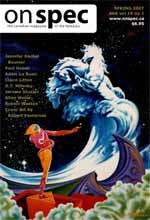
os_spr07Hey, you can hear me reading from my science fiction story, “Why the Poets were Banned from the City” online at On Spec: Follow this link here.

It originally appeared in the Spring 2007 issue that you see on the left. What I loved about the cover art by Robert Pasternak is that it is a wave of white horses, exactly how Whitehorse was named (for the rapids and their uncanny resemblance to white horses). It was a nice piece of synchronicity for me as a writer.

The piece is only 5 minutes long, but you can read the rest in the Spring 2007 back issue.

Much gratitude to Diane Walton and Colin Lynch of On Spec for asking me to do it. And for a great friend who helped me record it. Thanks!

On Spec is dedicated to publishing Canadian Speculative Fiction and is always looking for more. Hop around on their website this holiday and see what they’ve got.

Why You Should Subscribe to New Scientist, and why you have to put it down

phpthumbScience Fiction writers have a strange relationship to science. To write compelling science fiction, I think a writer has to do some research. Where would Crichton’s Jurassic Park have been without Chaos theory and real-life paleontologists? And you want your ideas to be ahead of the game, so get yourself some subscriptions.

I know, we are poor bastards and we can’t afford very much–certainly not expensive subscriptions.

I don’t think I could get more (Big) bang for my buck than through New Scientist. You can too.

1. It’s weekly. Meaning that when science is advancing, New Scientist doesn’t have to wait two months to come out with an issue. Discover is a monthly, and it’s a nice mag. But it can’t compete with 65-75 pages a week chock full of insightful articles.

2. It’s got short blurbs and longer indepth articles, and these can be read–some of them–online. Let me give you a sample of what’s out right now:

Why the Universe may be teeming with Aliens

Are Daughters-in-Law to blame for Menopause?

A healthy planet? Top 10 articles on the Environment in 2008

The glass universe: where astronomy meets art

Creationists Declare War on the Brain

These are the longer in-depth articles, yes, but the magazine is FULL of shorter articles. Shorter articles stimulate creativity in a way that is beneficial for a creative writer. You want a magazine that has plenty of short articles on broad topics–a whole mess of ’em.

3. It covers a lot of areas: space, environment, sex, health, physics and math, tech articles…. that’s good. Coming out once a week, it allows the magazine to be current on several areas. It allows you to cross-pollinate ideas.

4. It’s cheap. Yep, it’s from Britain, but it’s 36 bucks for 6 months or 24 issues. You can sign up online here for a subscription. Or you can browse the website first. With a subscription you get the magazine delivered to your door in uninterrupted service, and you get online access to back issues 24hrs a day. It’s cheap and it comes to you. If I had to have just one subscription to a science magazine, I would keep this one.

Writers of science fiction should certainly start with the stimulation that comes from reading science magazines–BUT, and this is where it gets interesting, I think they shouldn’t be bogged down in the details. If you are predicting the future, look how fast the present changes. I just did a radio piece talking about dark energy–which is about to be out of fashion, passé, even illusory–but in twenty years?? In fifty years?? It may be all the rage.

Science fiction writers need to be able to extrapolate from data, yes, but they also need to be able to make the Leap. Leaps are about prediction beyond what can be extrapolated. Go someplace wild with the information. Don’t be afraid to be wrong in twenty years, or in two weeks. Make it believable. But not predictable by any physics grad student. Combine fields, combine theories, and then move beyond them. Sure, it’s not real. But that’s the point of writing fiction–to be brave enough to make the leaps that science isn’t allowed to without hard fact.

If science fiction actually does lead the way in technology and science–then we’ve got to lead by going beyond what the best scientists can predict, and certainly past what the public can imagine. That’s our job–to help people imagine a believable, but still surprising and entertaining, future. That’s where your stimulated brain comes in handy……

You can start seeing that future by picking up a New Scientist issue, but you can’t create it till you’ve put the issue down.
Leaving America is All Here

Okay, I uploaded the rest of Leaving America.  All seven episodes are there.  Some of you heard this in a 5 episode run–don’t know what they (Toronto) cut, but they went from Seven 6.5 min episodes to Five 5 min episodes.  Here are the original versions where you even get to hear me do a bad Tiki Chorus at the Ft. Nelson hotel….forgive me.  I was having too much fun.

The 4000 mile road-trip journey is full of immigrants, storms, wild and woolly Oz, screaming Heads, funny interviews, a little history, a little death, a lot of song, and many hidden science fiction references–especially in the music.  After all, immigration is about being an alien who finds a home.

And that’s pure science fiction.

I want to thank everyone who allowed me to talk with them along the way, my family, my friends, CBC and Arnold Hedstrom for funding it and giving me complete creative freedom, the great musicians whose music runs through this.  And to all the listeners who liked it and told me about it.  Thanks for liking my story.

Enjoy.

Times to Hear Yukon 2058

Illustration from The Arrival by Shaun Tan

What do you think will happen in 50 years?

Starting Monday, you can hear Yukon 2058 at 7:20 and 4:50, daily through Friday morning,I think. It will also be on the website for CBC North if you miss it. It’ll be there for 24 hours.

Yukon 2058 is my speculation on what the North will be like in 50 years, written in honour of the 50th Anniversary of CBC in the North.

You can read more about the series here. Hope you enjoy my vision of the future, and please tell CBC about your vision of the future. You can make it happen by imagining what you want first. Remember, we create the future. Illustration from The Lost Thing by Shaun Tan

Illustrations here and above by Shaun Tan. I like to think of this one as the pot we grow the future in. Look at all the things the kid is throwing in there.

Bring Back the Woolly Mammoth? It’s the future again.

woolly_mammoth_siberian_tundraHey, right before you hear my new radio series, Yukon 2058, and get to hunt mammoths in Vuntut National Park on hoverdoos, read this editorial.

Bring Back the Woolly Mammoth?

I think one might find Vuntut National Park a logical place to put the mammoths and to grow the steppe grasses, some of which we still have.  Beringia didn’t lose everything to an ice age–and I think we could create a huge area of this grass for the mammoths.  Should we do it?  It’ll probably be expensive, but it’s not Canada who’s funding it.  Ethically?  I hear the author of the editorial–who still has Jurassic Park on his mind.  This is the equivalent of asking should you get a dog when you live in an apartment.  Is it good for the dog?  Who knows what dogs in apartments think?  And who knows what birthing a mammoth will do.  I don’t think it’s wrong to try. We’ve created Ligers before (lion and tiger mixes)–we breed purebred dogs and create breeds (this is NOT natural)–and we can learn a lot about mammoths by having a herd of them.  I see nothing wrong in trying.   But you decide.

I posit what we might do with mammoth in Yukon 2058, the radio series coming to CBC on December 1st.  I think they could have a positive impact, and certainly science has learned a lot through many other experiments.  Creating life is a much better idea than killing it.  Would it be torture?  Or would the apartment dweller adapt to the needs of the dog?  Create the grasses from the DNA of the seeds in the mammoth stomach–do the habitat research ahead of bringing back the mammoth.

Bring back Steppe Grasses?  Yes.  And do it a long time before you bring back the mammoth.  It’s always good if you can make the apartment livable for a big dog.

Everyone kills Hitler on their First time travel trip: short story share

Great, great flash fiction story. I submit this for your reading entertainment. This story, actually entitled Wikihistory, was authored by Desmond Warzel, and appears in Abyss and Apex. It’s a gem, and while you’re there, if you look around, there’s a lot more in this great online zine!

Wikihistory, Desmond Warzel

It’s a forum discussion for time travelers.

Write or Die: a new writing tool

Or new to me.

I was threatened by a fellow NaNoWriMo writer, and she sent me this link to help me fight procrastination. As you know, nearly every student of mine is ahead of me in word count—not that it MATTERS!–but it just looks soooo sooo bad.

Welcome to Write or Die, the website.  Below is a Youtube presentation on how it works.  I’m not gonna try it.  It scares me.  I’m a baby.  On kamikaze mode, if you stop writing, it ERASES YOUR WORDS….

So if you get desperate—or you are a spouse of a NaNoWriMo participant, you can switch them over to Write or Die and watch them put many many words on a page just to save themselves from the consequences….

(Actually there is a Gentle and Normal mode which merely prods you into writing….it’s the Kamikaze mode that scares me….)

Let me just say here that I am mucho impressed by the 14 writers in my Novel Writing Class and the 8 writers in my Fantasy and Science Fiction Novel Writing class at how they are SMOKIN’ along Waaaaaay past 10,000 words and we’re only into the second week.

Now that they’ve done it, I have to write 50,000 words!  Great.  Well, I gotta go write a novel…see ya.

Egalité at the World Fantasy Convention, a report

img_7941I have returned from Calgary where I attended the World Fantasy Convention, a yearly gathering of editors, publishers, writers of Fantasy literature. There were three of us from Whitehorse–Marcelle Dubé, Claire Eamer and me–forming a Contingency.

The convention for me was divided into four parts: the seminars, the networking, the readings and the dealer’s room.

The Seminars: The theme was Mystery in Fantasy Literature, with some seminars on how to put mystery elements into your fantasy fiction, or the best Fantasy novels of the last 20 years, etc. You can go and hear editors and publishers and writers speak about their writing strategies and their interests. Important was putting names and faces together in the editing and publishing world and getting an idea of what each editor might enjoy seeing in fantasy fiction, and how they might be to work with as editors and publishers. I also learned a lot about which authors were considered the best in the field, and how to catch up on authors I’d missed out on.

Networking: This is actually a lot of fun. Catching people for dinner, or talking with them in the convention suites after programming/seminars were over. You meet a lot of people you could never meet otherwise and this is for them–and you–to put names and faces together. I was able to hand out a few cards (ones that I’d made on my computer an hour before I left on the Air North plane), and meet a lot of people one on one who are exciting, interesting folks–fellow writers, and the aforementioned editors and publishers. You’d be surprised to learn, I’m sure, that I’m not a good schmoozer. I couldn’t last the many hours it requires. However, as the picture implies, we all got nametags and were encouraged to sit in the autograph room as equals–this is actually a very nice egalitarian maneuver. We’ve been hearing and talking to editors and publishers as they are movers, shakers, and opinion-makers–and then for two hours, we are all on the same level together. Nope, no one came up to have me sign anything. But it was nice–to feel like a writer, someone who COULD give autographs at any moment.

The readings: though I didn’t go to very many, I did enjoy the ones I went to. Mostly they were friends that I knew. Here you can hear about books you haven’t bought yet.

The dealer’s room: where books are sold. Ah, the joy of the dealer’s room. Lots of books. And I got to do an interview with Edge Books Website for a podcast. I even signed some books for them: Tesseracts Nine and Eleven. Edge Books and Hades Publications are fantastic people.

I’d like to do it again. But one of the biggest lessons I learned there was that you could be a well-known name despite publishing very much. If you send stuff out to be published, and are rejected, your name will still be more recognizable than if you had never submitted at all.

So, courage–even without publication–is rewarded with recognition. And recognition in a small cadre of people is worth its weight in gold.

(picture: l-r, Catherine Cheek, Derek Kunsken, me, Peter Atwood—Catherine and Peter were fellow Clarionites–and thanks to Liza Trombi of LOCUS for the pic!  Thanks, Liza!)

Predicting the Yukon of the Future: a new radio series

I’m excited to announce that there will be a new 5-part radio series beginning sometime in November, either next Monday, 17th, or the following Monday, lasting 5 days in a row, exploring life in the Yukon in 2058. In honour of CBC North’s 50th Anniversary, we take you flash-forward into a very positive look at the future.

Recently I read a column at Fantasy Magazine’s website entitled, Why We Need Scientist Heroes Again, and the author made a good case for thinking positive:

“Show of hands – who wants to retire to their grandchildren’s sub-prime one-room hovel in the decayed urban warzone that was once America?

Or perhaps roam the sweltering wasteland looking for gasoline while the mutants hunt you down?

Yeah, thought so.

Then let’s inspire some smart folks to get scientifical and create smart solutions to our stupid problems.”

So, in that spirit, I pitched Yukon 2058 to CBC North and they liked it. And I think things will get more and more interesting in the north over the next 50 years. Not every positive accomplishment will have positive consequences all the way round. And that too is a power science fiction has–to warn us. If everything turns out just hunky-dory we never have to change what we’re doing. But in the spirit of thinking positive– of actually dealing with climate change (cause it will happen), I hope you enjoy Yukon 2058, my own personal vision of the Yukon of the future. If you like some of the things, don’t wait 50 years to start them, or to think up things on your own. Create the place you want to live in, the place you want your kids to live in, the place you want to retire in. The world is going to turn its collective global head north very soon–let people know what you would like to see in fifty years.

Also, there’s a science fiction anthology in the works looking at optimistic near future science fiction, called Shine. Check out the website and submit your stories. I’ll write another post about Shine too.