Depicting the Divine in Epic Fantasy via Tor.com

From Brian Stavely comes a thoughtful post on depicting the divine in Fantasy over on Tor.com.  I’ve included a short beginning here, but read the whole thing at this link to the whole article. Essentially Stavely counts off the ways one can describe a god in epic fantasy fiction–and there are five options.  I was thinking through his list, and it’s good, but I think there are at least three more ways to depict a god in epic fantasy, and I humbly offer them up:

Option 6: Use other people’s understanding of the god as description.  They might not all be alike, but the confluence, the overlap of them, will give a mosaic feel to your god.  It will also create character development for the characters who have seen/or believe in this god, as we tend to see what we desire in our gods.  A god’s description in the mouth of one character as a “god of vengeance” is a very different character than someone who calls him “a god of protection.”  May be same god.

Option 7: Use tales of the deeds of a god to describe him or her.  Actually what a god does says more about him than his/her description.  And again, people have tales. If you can gather up the tales of a god, you can capture a character description that readers can fill in as they go.  Then if and when the god shows up in your text, it may already have a pretty firm description in the mind of the reader, based on what it has done in the world.  God is rarely described in the Bible, but his deeds let you know exactly what kind of God he is.

Option 8: Every culture uses Art to talk about its gods.  Can you pull together images of the divine from a culture’s art?  That will help form a picture in a reader’s mind through the cultural depictions of the gods, telling you a hell of a lot about the culture, as well as the god.  Michaelangelo’s God touching Adam who seems curly headed and benevolent, and other depictions of God as a fiery, anger-filled rage monster.

___________________________________

Depicting the Divine in Epic Fantasy

by Brian Stavely

There’s a striking moment near the end of the twenty-first canto of Dante’s Inferno, one that almost all readers tend to remember, when the demon Barbariccia “avea del cul fatto trombetta.” It’s hard to put it delicately: he turns his ass into a trumpet. Not the kind of thing you expect out of a writer recording the steps his salvation, but the image stays with you.

Likewise, readers of the Divine Comedy remember Ugolino, who, for the sin of eating his sons, is forever frozen to his neck in ice, gnawing on the brains of Archbishop Ruggieri. In fact, Dante has no trouble at all depicting sinners in the various postures of their suffering, and for seven centuries readers have kept turning the pages. Corporal violence sells. Electronic Arts even has an eponymously titled video game in which Dante looks less like a poet and more like a Muay Thai Knight Templar. The EA people are no fools—they understand that there’s a ready market for brain eating and ass trumpets.

When it comes to the celestial realm of heaven, however, Dante runs into trouble.

READ MORE HERE.

Thanks, Brian and Tor.com!!

Hopefully these suggestions help YOU when writing about Faith in your Fantasy or Science Fiction.  Let me know what you think.  And don’t forget, you can write about Faith in Fantasy and Science Fiction for the Tesseracts 18: Wrestling with Gods anthology, open for submissions right now over at http://www.tesseracts18.com!


Tesseracts 18: Wrestling with Gods open for submissions

Very proud to announce the new Tesseracts 18 is open for Submissions.  We’ve built a website for it at Tesseracts18.com  Come check out our conversations about faith and science fiction and fantasy.  This anthology is open to Canadian citizens, landed immigrants of Canada, longtime residents and, of course, Canadians living abroad. Yukoners, I hope to see you write a story and submit.

IMG_1094Tesseracts 18: Wrestling With Gods — Faith in Science Fiction & Fantasy

Well this is an all new topic for Tesseracts!  And possibly a completely new topic for an anthology: a multi-faith, creative faith anthology of science fiction and fantasy.  Who would have thought?

Here’s our thoughts on that kind of anthology:

______________

Jacob wrestled with an angel in the night, earning him the name “Israel”, which means “struggles with god.”  Buddha wrestled, and the hero of the Mahabarata wrestled too.   Wrestling is a part of faith.  Having a faith can help immensely with struggles in our lives, but we also must struggle against the rules, the boundaries, and the very doctrine at times.  We all wrestle with our cultures and our gods, whether we believe in them or not.  Faith is not passive.  Human progress has relied on brave souls willing to challenge convention through their beliefs.  And faith is not separate from Fantasy and Science Fiction.  Fantastic elements are integral to all major faiths–they have their gods, fantastic creatures, miracles, blessings, power and magic.  We continue that journey into space, possibly encountering worlds with their faiths.  Since our cultures all began with fantasy and struggling with faith, Tesseracts 18 will continue the Science Fiction and Fantasy tradition of wrestling with Faith, without declaring all-out war.

The anthology will include a diverse representation of both real-world religions and faiths of fictional cultures.   Instead of looking to pass historical or cultural judgement, it will feature character-driven stories including faith, doubt, miracles, spiritual journeys, and diversity of opinion within a faith.  It will avoid blanket stereotypes of faith-based cultures.  We’d love to see faith surprise us, and surprise science fiction and fantasy readers.

________________

Some questions we think naturally come from this:

How does Faith inform a culture, change a culture?  What does it mean to really believe?  What kinds of religions and faiths are out there in the universe?  How does faith play out already through established fantasy cultures?  How can people keep believing, sometimes with very little evidence?  Or is there evidence that is so personal, it is never shown to others?  How does faith effect an individual, a family, a city, a society, a race, a conflict, love?

Starting soon, we’ll start posting conversations about how science fiction and fantasy has dealt with faith and religion in the past—just to be able to talk about where we’ve come from, how those representations challenge the genre or challenge readers and writers.

Mostly we just want to create a conversation about faith in fantasy and science fiction–in all its diversity!  PLEASE join us.  We’ll talk a blue streak with ourselves, but we’d just as soon have as many voices as possible in this conversation.

TO SUBMIT: Borrowed straight from EDGE BOOKS.

SUBMISSION DETAILS:

    • This anthology will include as diverse a representation of both real-world religions and faiths of fictional cultures as possible. Stories should not be looking to pass historical or cultural judgment, instead they should feature character-driven plots that include faith, doubt, miracles, spiritual journeys, and diversity of opinion within a faith.  Please avoid blanket stereotypes of faith-based cultures.  The editors want to “see faith surprise us”, as well as “surprise science fiction and fantasy readers”.
    • The Tesseracts Eighteen anthology will reflect as broad a spectrum of stories as possible; highlighting unique styles and manners.
    • Submissions must be speculative fiction: science fiction, fantasy, dark fantasy, magic realism, slipstream, supernatural horror, weird tales, alternate history, space opera, planetary adventure, surrealism, superheroes, mythic fantasy, etc.
    • Submissions may be either short fiction or poetry.
    • The maximum length for stories is 5,000 words, with shorter works preferred.
    • The Tesseracts anthology series is only open to submissions from Canadians, landed immigrants living in Canada, longtime residents of Canada, and Canadian expatriates living abroad.
    • Canadian authors who write in languages other than English are welcome to submit an English translation of their work, provided it otherwise falls within the parameters of this anthology. Translation into English is the sole responsibility of the author. Please supply details of original publication for any submission that originally appeared in a language other than English.
    • Deadline: December 31, 2013 (midnight).
    • Do not query before submitting.
    • Email submissions to: tesseracts18@edgewebsite.com
    • Emails MUST contain the word “submission” in the subject line, or they will be deleted automatically by the server. Please also include the story title in the subject line.
    • Submissions MUST come in an attachment: only .RTF and/or .DOC formats are acceptable.
    • Emails MUST contain a cover letter in the body of the email; for security reasons, email attachments with no cover letter will be deleted unread and unanswered.
    • Cover letter: include your name, the title of your story, your full contact information (address, phone, email), and a brief bio. If you do not live in the place where you were born, please also include your place of birth.
    • Do not describe or summarize the story.
    • If your address is not within Canada, please indicate in the cover letter your status vis-à-vis Canada.
    • Reprints (stories having previously appeared in English in any format, print or electronic, including but not limited to any form of web publication) can be considered but will be a hard sell; reprints must come from a source not easily available in Canada. If your submission is a reprint, please supply full publication history of the story. If your story appeared previously, including but not limited to anywhere on the web, and you do not disclose this information to the editor upon submission, you will be disqualified from consideration.
    • Submission format: no strange formatting, colour fonts, changing fonts, borders, backgrounds, etc. Leave italics in italics, NOT underlined. Put your full contact information on the first page (name, address, email address, phone). No headers, no footers, no page numbering. DO NOT leave a blank line between paragraphs. Indent paragraphs. ALWAYS put a # to indicate scene breaks (a blank line is NOT enough).
    • ALWAYS include your full contact information (name/address/email/phone number) on the first page of the attached submission.
    • Payment for short poetry is $20.00. Payment for short stories is prorated as follows: $50 for stories up to 1,500 words, rising to a maximum of $150 for stories up to 5,000 words (longer stories are paid a slightly higher fee, but in order to exceed the word length limit of 5,000 words, the editors must judge a story to be of surpassing excellence.)
    • Rights: for original fiction, first World English publication, with a two-month exclusive from publication date; for all, non-exclusive anthology rights; all other rights remain with the author.
    • Spelling: please use Canadian spelling, as per the Canadian Oxford Dictionary.
    • Response time: initial responses (no / rewrite request / hold for further consideration) will be prompt, usually within fifteen days. Please query if you’ve not heard back within 30 days. Final responses no later than 15 February 2014.
    • Submit only one story or poem. Multiple submissions will not be accepted.
    • Simultaneous submissions will not be accepted.
 

*Image is from a Chihuly glass exhibit in Seattle, WA

How We Write About Faith: New Seminar and Workshop starting Feb 2

Buddhist, Pagan, Christian, Jewish, Muslim, Agnostic, Atheist—we all have a belief system–“faith” in something, a set of beliefs, a god, gods, guiding principles, morality.  It’s hard to express sometimes WHY we believe these things, or HOW they guide us, or how we know they are TRUE.  Sometimes we’ve been hurt by religion, disappointed by faith.  We want to talk about that too.  Maybe we want to pass our beliefs, our experiences down to our kids.  We want to explain it to ourselves, sometimes.  We’d like to keep a record.  But pinning down the inexpressible nature of faith and belief is difficult.
WRITING FAITH SEMINAR AND WORKSHOP
Come join a writing workshop that explores how we talk about faith.  Starting this Saturday, Feb 2, we’ll have a one day seminar/workshop from 10-4 that explores Writing Faith with writing tips, games, exercises, and a few readings that map out the basic writing techniques of writing about Faith.  Then Feb 8-March 22, join us on Fridays from 5-8 (potluck snacks), at the Whitehorse United Church to explore more in depth how others write about their faith and get some good feedback on writings you may write about your faith.  The group is always ecumenical and eclectic and supportive of new writers.  It has been a successful group four times now, three in the Yukon.  We teach mostly memoir, but fiction as well.
We don’t teach theology here; we teach writing.  We are including writings beyond Christian writings this time around—mostly from the Best Spiritual Writing 2013 that just came out.  We aim to be inclusive.  We have readings from Pulitzer prize winning author, Annie Dillard, as well as Anne Lamott, Andre Dubus, E.O. Wilson, Langston Hughes, Jhumpa Lahiri, Ron Hansen, Thich Nhat Hanh, and other writers covering a broad spectrum of spirituality—for techniques.  We play writing games.  We’re kind of like a summer camp for writers.  Only in the winter.

Speculating Canada reviews my story, “One Nation Under Gods”

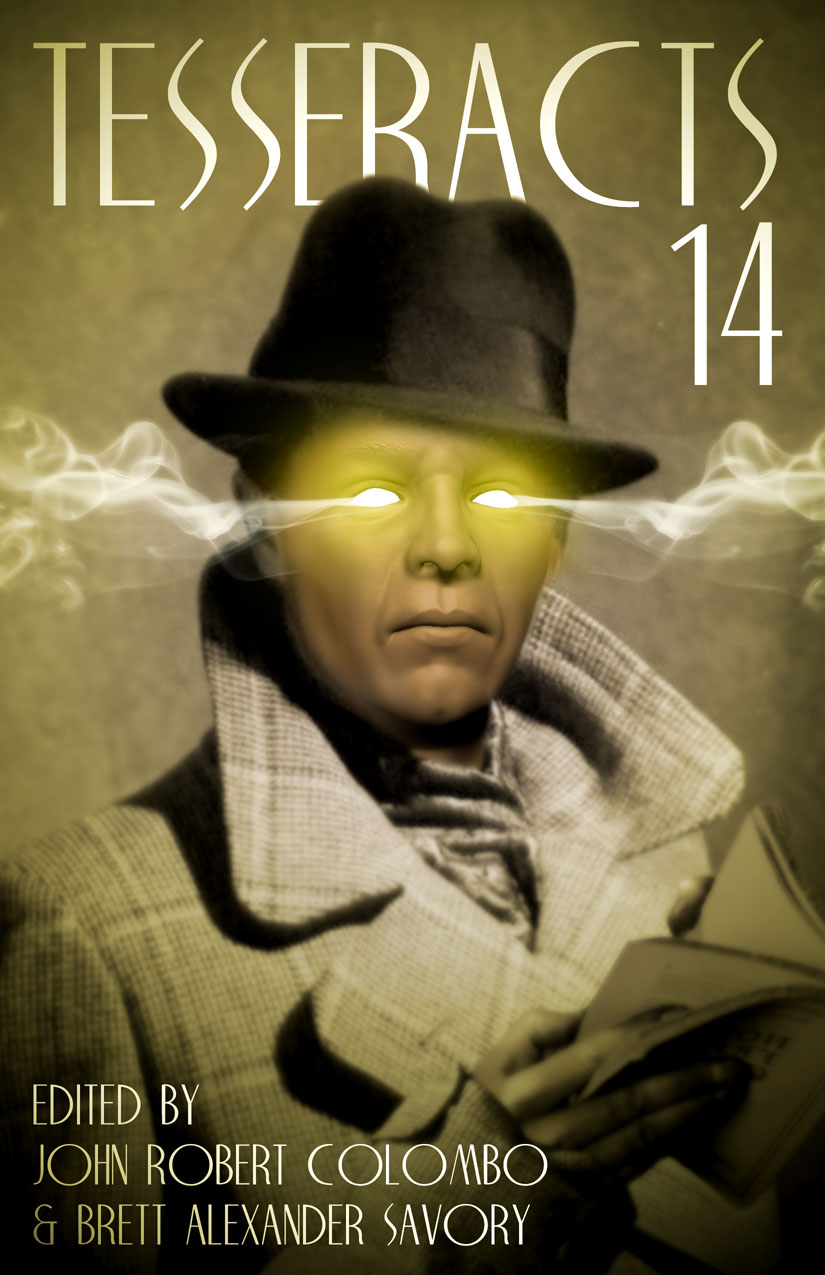
Really thrilled that Speculating Canada reviewed my short story, “One Nation Under Gods” which appeared in Tesseracts 14. It’s hard to get short fiction reviews and they are so valuable.  The SF/F/H community should hold tight and nurture as many reviewers as we can. With a growing market of books, the discerning reader looks to reviews to help choose what to read.  And reviewers who choose short fiction, new authors, and anthologies help support beginning writers who are starting their careers, hoping that someone notices.  So we can’t fete reviewers enough–we need them, we love them, we should be very kind to them.

I’d say this for any thoughtful reviewer, even if Derek had NOT liked my work.  It’s the way he liked my work that makes me happy. 

Speculating Canada has a really great aim:

This site has been created in response to the overwhelming number of people who are surprised that Canadian literature includes the fantastic. Canadian SF, fantasy, and horror have been cast into a literary ghetto under the power structure of CanLit, and cast as either inferior literatures, or literatures that are not ‘of here’, i.e. from abroad. Yet, Canadian speculative fiction has a long history in Canada and engages with ideas of Canadian identity, belonging, and concepts of nationhood, place and space (both ‘the final frontier’ type, and the geographical).

Realist fiction is often seen as the only ‘truly’ Canadian fiction, but even realist fiction speculates, postulates and creates a fantastic idea, just one that is based more closely on the normative world around us than most SF authors are inclined to do.

Canadian SF allows for the engagement with ideas such as What is Canada? What does belonging mean? What is the nature of ‘human’? Why are things the way they are? How do we change things? Can things change?

The appeal of Canadian SF is not just regional, but has implications for a wider audience. Canadians, long un/comfortable with our identity as a hybrid of the American and English, Francophones and Anglophones, Aboriginal and settlers, and the multicultural mix that is embedded in our philosophy, means that we are comfortable with questions of identity and the exploration of our place, ideas that naturally lend themselves to science fiction, fantasy, and horror. We live in a world that is unsure of itself, and uncomfortable with ideas of belonging, and Canadian SF plays with ideas of belonging, disrupts the normal (or what has come to be seen as normal) and allows for a new way of experiencing the world.

As for the review–well, I’ll let you read most of it as his site, but here’s a nice chunk:

Continue reading

CBC’s DNTO to air my story on Coming Out to My Church for “Lost Causes”

Definitely Not the Opera, (DNTO) a CBC Radio One program devoted to the art of storytelling in Canada, asked me to tell my story of coming out to my church for their Nov 3 show “Lost Causes”.

I had pitched the idea to them last year for a different show called “Making Enemies” but withdrew the pitch because a) I don’t think I meant to make enemies, nor do I think I have made enemies; and 2) because I didn’t want to restir a pot that has finally calmed down.

But they remembered my pitch.  And they sought me out.  Which is humbling, and cool.  We recorded on Friday morning and they are editing my lengthy story to 3-4 minutes.  I appreciate Andrew Friesen’s belief that my story was important and needed to be told.  I feel like the story is more appropriate under “Lost Causes” because trying to reason with people who don’t want to listen to you, or discuss with you–and believing that you alone have to spark change–well, it can feel like a “Lost Cause”.  But in the end–and the end hasn’t come yet–who knows if the cause is lost?  I think every person who says the church must look at the evidence, must consider the Christian testimonies of LGBT folks in the discussion, is a step towards change.  We need more people who realize how many people have fallen away from the faith, have decided against Christ, have been repelled from the church, and who, sometimes when there is no hope left, taken their own lives, all because the Church has historically refused to consider the scriptures in an accepting light–and this causes their members to refuse to accept their children in an accepting light.  This splits familes.  My God and my Christ are not what I encounter when I come into a Baptist Church anymore.  I daresay they wouldn’t recognize it.  Churches are not all one defined Mass though–as many churches are beginning to change their minds about LGBT people.  Episcopals, Lutherans, Presbyterians, United Church of Canada–all have begun seeing that this is just the next issue the church has to rethink.  As it did slavery, race, and its treatment of Women.  And divorce.  Change comes when people inside churches decide they can’t hold false doctrine anymore.  Christianity and Faith are not the problem.  Interpretation is.

Continue reading

Recreation of The Last Supper: Johnny’s Cafe remix

20120420-193015.jpg

Here’s a recreation of The Last Supper at Johnny’s Cafe on the campus of Calvin College in Grand Rapids Michigan. April 20 2012.

From Left to Right: Daniel VandeBunte, Kit Graham, Hannah Chee, Annie Bultheis, Seth Wilson, Emily Diener, Joe Gibson, Walter T. Runn, Kaile VanOene, Linda Anderson, Cotter Koopman, and Peter Rockhold. With great thanks to all participants! 🙂

Writing Faith Workshop begins, Feb 10, 5-8pm, Whitehorse United Church

  How do you write about your “faith”?  How do you describe the indescribable, the ineffable, the otherworldly? the grief or joy or miracle or peace or disappointment that you have because of your faith?  Everyone can argue about the value or lack of value in “religion”–and it’s an easy connect-the-dots to create your own pictures of what organized religion has done in the world.  It’s harder to write about personal faith or your personal interactions with religion–what keeps you going, what happened to you that you know no one would believe, about the anguish of trying to live in a real, faulty, fragile world, when others ask you to strive for peace, patience, happiness, even joy.

This writing workshop will explore how people write about these very personal experiences, or their thoughts about faith and religion and its very real presence in their lives, or the lives of those around them.  We’ve had students write about their relationships with their parents, their children, their grandchildren, experiences in nature, in confronting others who aren’t on the same page.  We have had students who are believers, non-believers, unsure, people of various faiths.  All faiths are welcome–come with what’s important to you, open to what is important to others. This isn’t a dogma class.  It’s not a class to teach you from the top down.  It’s for you to teach us from the ground up through your experiences, your writing.

Continue reading

My short piece in Geez Magazine #24, “Privilege” issue, on coming out

Ironically, my pastor at RBC suggested I write for Geez magazine.  I don’t think he imagined what piece I would eventually write for them.  But here it is, Issue #24, on “privilege”.  I wrote the fast version of my coming out at church.  I centered it on the idea of privilege–of the privileges I had as a single, white male Christian who had leadership potential and of the privileges I no longer had when I added “gay” to that mix.

The church has to change.  It has to.  It may not change from those fighting it on the outside, but it will have to incorporate change if it is to survive further.  It faces irrelevance, it postures with discrimination, it plays favorites, it values money.

Not all churches–no.  (When I say a statement like this I have to stop and say, Thank you, churches that are moving more towards inclusion, social justice, focusing on issues like poverty, the environment, civil rights.  You do exist, but I wouldn’t, yet, call you the “Church”–as the “Church” tends to be the monolithic Catholic Castle or the Evangelical Juggernaut.  One day, you will take on that mantle–you will be the “Church” and it will have a positive ring.  You will convince other churches that focusing on discrimination is not the answer.)

Anyway, there it is, in Geez #24.  If this brings you to Talking Dog, welcome.  There’s lots there, I hope, that will spark conversation.  If this entry leads you to Geez, welcome to Geez.  There’s lots there that will spark conversation as well.  It’s a valuable, important magazine carrying on “the” conversations we need to have happen.  It is intrepid, bold, and unflinching.

I would marry Geez magazine if it looked like a bear and loved me back.

*apologies to Kevin James, pictured, who is not gay.

“…his cultivation of genuine menace…”: a review of “One Nation Under Gods” at Portal

Val Grimm, over at the Portal, gave me a good review for my short story, “One Nation Under Gods”!  Thanks, Val.  I’m always thrilled that there are people who will review short fiction, and anthologies.  Thank you, Val!  Val reviews the whole anthology, Tesseracts 14, story by story.  Here is his review of mine:

The author of “One Nation Under Gods”, Jerome Stueart, emigrated to Yukon from the States in 2007, and his former citizenship is evident in the themes and content of his story. I’m not biased in its favor because of my nationality, nor simply because its dark vision seems in concord with my fears. This story succeeds, in my eyes, because of his detailed worldbuilding, the realistic relationship between the narrator and his sister, and his cultivation of genuine menace, an evocation of the way people can be treated as things. In the world of this story (which in outlook and some tropes puts me a bit in mind of Steve Darnall and Alex Ross’ 1997 comic Uncle Sam) concepts like Freedom and Patriot are incarnate as deities, administered by priests and priestesses, and the Statue of Liberty herself is known to walk abroad. The history of the gods is the history of the country, and its people are required to memorize that catechism or pay with their lives in particularly grotesque ways; if a child fails the standardized test which is a mandated rite of passage, he or she is transformed into a public object, anything from a soda shop to a garbage can. Stueart skillfully incorporates the conflict between individuality and vested religious and political powers; the way those powers can intertwine and what that merging means; the clash between idealism or perception cultivated through propaganda and reality, between history as the study of people in power versus the study of the people’s past; and the transformation of people into instruments, people into numbers.—Val Grimm at the Portal.

Hamlet: The Precipice of Belief and the Validity of Witness

I’m going to see Raoul Bhaneja’s one-man performance of Hamlet on Friday at the Yukon Arts Centre.  I’ve heard good things about it, and saw a good article in the Yukon News, and I love Shakespeare, but I’m going to see it because of the way Hamlet speaks about “belief.”  One of the main questions, arguably, is whether or not Hamlet should believe the ghost of his father.  He tells Hamlet that he was murdered by the King’s brother, Claudius, Hamlet’s uncle.  It is also this ghost that asks, begs, persuades Hamlet to avenge his murder.  Without the ghost, no play.  With the ghost, several dilemmas at once, not the least of which is whether you believe a spirit that you’ve seen.

I’m teaching a class this semester at the Whitehorse United Church in Writing about Faith, a nebulous topic, a difficult endeavor.  You neither want to sound as if you were deluded or over-zealous, but neither do you want to play down your experiences until they mean nothing.  The spiritual things that happen to us are a keen part of our lives–sometimes they are the anchor that holds us rooted when the world tosses us around, and other times, they are an anchor dragging behind us, stopping us from moving forward.  Either way, what value we give them determines how we proceed with our life: either our spiritual side is a nice addendum to everything else we have in our lives, or it is something profoundly different that affects our course of action. (Or we just ignore it altogether)

Hamlet is caught in a crisis of belief.  If he believes a ghost—just stop there to see how preposterous that sounds—then he has to believe that his father was murdered, and that his uncle is the villain, and that his mother could have been an accomplice.  Further, if that’s true, then the ghost must also be believed that he, Hamlet, can set it right.  That everything that Hamlet does hinges on the  believability of the words of a ghost means that the play is really about our belief, and how much it informs our real decisions.

Continue reading