Bringing Star Wars to the Research Station: Part I

Part I:  A New Thought

And now you will witness the full power of this        
         station….” General Tarkington, Star Wars: Episode   
         IV, A New Hope


Bronwyn Goodwin shows the power of the X-Wing Fighter kite at KLRS

As a science fiction writer embedded now as a science writer at a northern research station, I thought my job was pretty clear: bring northern science to a larger audience through whatever means were at my disposal.  Blogs, Facebook, press releases, radio series.  But then I found out that a few people there had not seen Star Wars.   Suddenly, my best, natural personality came to the fore.  I had a new mission: Bring science fiction to scientists.


While science fiction might be easily dismissed by those working in scientific fields, it is often the first place that the average person learns about scientific concepts like graviton waves, geodesic folds, Dyson spheres, and quantum mechanics.  It can also be a first introduction to Shakespeare, to history, to world cultures, and to understanding the alien—those different than us.  But it is also a huge asset when it comes to igniting the imagination about science and about the future.  In this way, fiction about science, or even science writing, aids the cause of science—by compelling the average person to both think about science now, and think about science as part of our future.

Star Wars: a New Hope was aptly named.   In 1977, it transformed the movie industry, making possible special effects that matched our imaginations.  And it also introduced science fiction to the masses of non-science fiction readers—making science fiction mainstream.  Star Wars was nominated for 10 academy awards, and won six of them, including Best Musical Score.  Of course, everyone reading this knows this.  We grew up with Star Wars.

But Bronwyn Goodwin, age 8, did not, and neither did her mother, Sian Goodwin, both raised at a Research Station.

This is hardly to their disadvantage—imagine having brilliant scientists traipsing through your living room on their way to amazing science exploits, and having your dad be the pilot that takes them up to many of the highest peaks in North America.  But they missed what turned out to be a seminal cultural event in Western Culture.  Star Wars entered into our collective psyche in the eighties and has re-emerged in many forms—whether it’s Reagan’s Star Wars defense system, or the idea of being “turned to the dark side” as a reference for negative behavior.  The characters are well known to us—Han Solo, Luke Skywalker, Princess Leia, Chewbacca, R2-D2. 

But there was a certain glee in bringing Star Wars to two people who had never been exposed to it.  And eventually, the audience at the research station grew…

Continued in Part II….

PUSH is surprisingly good, an Indie film for Heroes watchers

3300601976_4c9f34aab4Imagine if Sophia Coppola, of Lost in Translation, had directed a sci-fi thriller and you can imagine the quirky,smart, place- layered PUSH, a movie now available on DVD.  

PUSH is set in Hong Kong, which is hugely in its favor, and allows the nature of Hong Kong to decide scene shots and plot development.  Hong Kong is more than a setting choice, though.  The director lets Hong Kong seep into this film, with a colorful multi-racial cast, while crowds crowd the scenes.  The movie is about people with psychic abilities running from the government, which wants to bottle and control them.  It’s like the X-Men without costumes or hero complexes.  They are truly ordinary people who are lost among the crowds of humans living in the cities.  Some can “push” a thought into your mind, some can move objects, some can see the future, some can sniff out the past, some can make you think one thing looks like another.  But there are only a limited number of things a psychic can be in this movie.  And having powers do not make them invincible.  

It’s a seek-and-find/chase movie, but the characters have strong motivations of their own.  I found the first three scenes a bit hard to follow at first.  Listen carefully to the opening credits of the film when Dakota Fanning narrates a huge info-dump.  This will set up the whole movie.  I usually HATE info-dumps, but in this case, you are hitting the ground running, and you need this info.  This is not an easy film to watch, but it is rewarding.  If you can make it past the first three or four scenes without turning it off because you have too many questions–then your questions will be answered as you go.

Characters who might have been cyphers in a bad movie, actually have pasts—which is nice.  I felt as if all the characters had met in a previous movie somewhere and so they knew each other, had past interactions.  They didn’t get scripted for this movie only…. and with any luck, there will be a PUSH 2.

There are clever moments in this movie, choices made by characters who are reacting to the choices of others.  It feels as if the characters are making up the plot as it happens instead of a heavy-handed writer.  The last third of the film is incredibly clever, one choice after the next, and it gave it a Heist-plot feel, where the Oceans Eleven crew are going to do a caper.  Yes, these are people who have superpowers but they are being followed and are in danger from other characters with better superpowers.  Superpowers in this film doesn’t equal wealth or control.  And that’s refreshing.  In Hong Kong there are no Reed Richards, super millionaires, who live off their powers, and these powered-people are not heroes, really.  They are trying to survive, and help each other.  

Now I want to get back to that directorial choice to set this in Hong Kong. In an online interview, McGuigan talks about Hong Kong, about heroes-genre films and what he wanted to do with that kind of film:

And then I thought about the whole genre aspect of it and, you know, we’re up against big movies because of The Dark Knights and I call it the Tin Man, but what’s it called? Iron Man? (laughs) You know, those were great movies and I thought to myself that the only reason I would do a film like this would be if I could do it the way I want to do it. An important part of my decision making was to have a strong point of view of how I was going to shoot it. Decision making, i.e., do I want to do this movie? And I said, this is the way I would want to do it which was all kind of handheld and use a place like Hong Kong to its full advantage. And, also, it’s the first time I’ve actually worked in a country or a city that I was actually in that country and that city. It’s like that film logic where you say, “Well, this looks like New York” and you’re in the middle of…it could be anywhere, in Scotland or something, just because it makes more sense financially, but it was actually great that they wanted to shoot it in Hong Kong.

…Usually what happens is that when you make a movie, you see a street scene and you walk and you see the street and you take a picture because you’re on location. And then you go, “Okay, we’ll put in our own people. We’ll take everybody off the street and we’ll populate it with our own people.” You can’t really do that inHong Kong. I mean, one, we can’t afford that amount of extras and two, it’s not as interesting. So, we basically had to let Hong Kong dictate how we worked which was nice and essentially how I like to work, but sometimes you don’t want people to muck with the camera, you don’t want people to look in the camera, so the idea was we had these hidden cameras and then what we would do is we would shoot a master shot and then we would punch in if we had to or felt we needed to, and then we would populate it with our people afterwards. So, it was a bit of both but for the big shots, and that’s why it looks quite an expensive movie because we were smart enough to use the location and we were fortunate enough to be able to use the location because we weren’t shooting Hong Kongfor New York. (laughs)

Doing it his way, he layers in slower scenes, develops character, layers it with music.  This film is visually beautiful, with fewer special-effects to carry the superpowers or carry the plot.  The plot, thank God, is carried by interesting characters.  Paul McGuigan is a smart director–creating an indie film out of the Heroes-genre.  While it’s been compared to Heroes and X-Men, Push limits itself to “reported” psychic phenomena, from a time before WW2 when there were experiments done with psychics, and follows a natural progression forward in governmental experimentation.  It also limits its story to the characters involved, though intimating a larger backdrop of plots and world organizations and other pushers, movers, shifters, etc.  But it was the crowded city streets, the alienness of Hong Kong for the American actors, the purposeful pitting of an Asian gang against the American government/ american powers, and the quirky indie film quality that kept pulling me back visually into this movie.  

It could have been Jumpers-rehash, or any number of bad government vs. heroes films, but McGuigan seemed to want to paint something different, something fresh.  I was surprised and pleased with Push and I think you will be too.  Go rent it.

Shine Anthology Extends Deadline: spin positive, change the world

Incredible Art by Kater Cheek

Shine Anthology, edited by Jetse de Vries, has extended their deadline for submissions of positive, near future science fiction to August 1st.  You got less than a month.  Just a reminder--SHINE guidelines, SHINE expectations, and some fine essays:

Why I Can’t Write a Near Future, Optimistic SF Story–this one is a brilliant essay and really calls into question the nature of science fiction.  Have we been feeding off science to create doomsday scenarios and don’t-touch-this theologies?  These are great excuses about why people CAN’T write positive science fiction, but in the end, we should.

Optimistic Literature and SF Around the World:  5 parts just as the title suggests. Great reading.  Nice job, Jetse.  I wish these were published in a book, too, but then they wouldn’t be so graciously free!  Thanks!


So AUGUST 1st:  Get WRITING.  Create the World.  You have three weeks.  

Yes, Captain Kirk has a Character Arc

chris-pine-as-captain-kirkI don’t want anyone to miss this great discussion that Dave Wesley mentioned as a response to my earlier post.  He said that we ought to check out the discussion of character arcs in the new reboot of Star Trek

Frankly it’s a great discussion about writing.  Here’s KFM (Rogers) initial premise (SPOILERS):

“Captain James T. Kirk, the protagonist of the movie, does not have the development executive’s beloved “character arc.” He has no arc at all.

He starts as an arrogant sonovabitch, and becomes a slightly more motivated arrogant sonovabitch. He does not learn to sacrifice, he does not learn to work well with others — he takes over the goddam ship. He’s right all the time, he never doubts he’s right, and the only obstacle he occasionally faces is when other people aren’t sharp enough to see how frikkin’ awesome — and right — he is as quickly as they should.”

But read the responses and you’ll see a lot of varied ideas on character arcs.  Me, I think Kirk has a character arc.  (And I actually posted it on the responses to his post)–but in a nutshell:

Yes, he’s a sunovabitch through the whole movie, but he is a listless, aimless SOB at first, and he has to find purpose. He never thought his fighting, his rebelling, his go after the baddies ideas fit in well with tight-shirt Starfleet, ultra PC. And yet, it is a Kirk who transforms Starfleet.

Starfleet needs a person who thinks with his gut, and Kirk jumps into that role.  Both old Spock and Pike serve as catalysts to transform brawler Kirk into Captain Kirk.

I like Pike’s speech to him early in the movie:  “Have you ever felt you could be something more?”

I think this is one of the lines that resonates for the viewer.  Don’t we all wonder who we could be if we had the opportunity?  And the line from Spock’s past:  “You will always be a child of two worlds, fully capable of living in either one. “ And Spock has to make the decision where to be fully, and which side of himself to favor–Human or Vulcan.

The movie is about Destiny, and it screws around with time travel to ask the larger question about whether destiny is fixed or fixable.  I think the movie promotes fixable.

The whole discussion is worth reading, but here’s a great later post:

Both have arcs, and the arcs are definitely related because they are almost mirror images of each other. Even Kirk’s dead father is a mirror image of Spock’s dead mother.

Their arcs also cross each other when Kirk tries to gain control of the starship by picking a fight with Spock. Except this time, he doesn’t try to stage mutiny, but rather talks to Spock to get him to resign his post. Following this fight, Spock realizes that he has emotions and he can’t control them. At the end of the scene, Kirk realizes that if he is to be Captain, he has to stop being impulsive and Spock realizes that he can not be Captain with his spasms of rage, and that he will never be able to ignore his emotions.

The movie is good, but I think there’s a lot to discuss about how the movie moved towards good through the writing of characters we thought we already knew.  And character arc is important.  I don’t think that Abrams achieved his great story by NOT giving Kirk an arc–because Kirk is not static.  Kirk learns.  He learns how to adapt t0 and also transform Starfleet protocol to fit him–thereby creating the James T. Kirk of the TOS that we know, and the Starfleet that surrounds him.

In some ways, we learn a lot about how Kirk and Starfleet function with each other, and in spite of each other.

Star Trek: Playful, Exciting, Character-driven

spaceball-12947135322_30ab2b2c4fStar Trek has come a long way and just when you thought there were no surprises left, they show up.  I’ll admit, the last few Star Trek movies left me cold.  Nemesis bombed because the writer tried to copy too much from ST2 but without any of the heart.  Insurrection was a trite story line.  Abrams’ Star Trek reinvigorizes the franchise by giving us both old and new–it completely satisfies this Trekkie.

If you go, you will get a thrill ride, and you will also be reintroduced slowly to characters you thought you knew. Yes, everyone looks young and the sets look like Apple designed them, but that’s what it means to restart the series.  You will get your money’s worth from this movie.  Most people know these characters even if they aren’t fans–but they are reintroduced to us here in great detail.  And there’s lots in here for fans of the show–little touches that show that the writers know the whole series.

I’ll try to keep out all of the surprises.  But you already know that there is time travel involved, and it shows up at the very beginning.  And because of that, events are altered.  “Our destinies are not what they would have been,” says a young Spock.  This is okay.  Star Trek has thrived on the “might have been” storylines.  The Mirror Universe got a lot of play in nearly every incarnation of Star Trek; Tom Riker was a might-have-been Will Riker; Voyager had the two part episode “Year of Hell” and the Finale which changed and altered timelines.  Even ST: First Contact imagined a Borg-filled Earth.  So, it’s nothing illegal–it just gives the writers room to wiggle.  They got to play a little with the histories–legally –because a villain altered the timeline.

But that’s the premise.  The cool part of the movie is not what they changed, but what stayed the same.  We get to see some fine actors inhabit these characters and manage to put a bit of the former actor’s style into it.  You watch Chris Pine–slowly he becomes a bit of William Shatner; Quinto is a fantastic Spock.  I swear I can hear Kelley in this new McCoy!  Uhura shows her inner Nichols in a turbo-lift.  Sulu, Chekhov and Scotty all have their moments of channeling as well.  But the writers also let the actors play—play with these histories and parts.

The plot allows each character to be introduced separately. This is a brilliant maneuver.  instead of just dumping them all on the stage at once, we get to know each character in their context.  We meet Kirk and Spock as children, Uhura in a bar, McCoy on a shuttlecraft, Scotty in a Starfleet Outpost, Sulu as a pilot and in a fight, and Chekhov in a funny homage to ST4.

I wish Wolverine would have been this good.  This had just as much action as Wolvie, but ST had a unified plot, and well-developed characters we thought we knew completely.  In the same way Wolvie failed–by being a prequel with no surprises at all–Abrams managed to give us a bit of parallelism in the lives of these characters and the ones we already know.  And there are so many great and interesting surprises–what ifs–that are allowed to play out.

This is what revision should be.  The series was great, but Myth can revise a story and get to its essence, even if the details have somewhat changed.  I can accept both Roddenberry’s original and Abrams’ version–because this isn’t an arbitrary version.  It fits in with the timeline because Nero changed the timeline.  I’m cool with that.  Just as I’m cool with Janeway’s original arrival back on Earth, and “Yesterday’s Enterprise” (a fan favorite).

And J.J. Abrams, a big high-five to you and the writers from a long-time fan!  When I was seven, I took my photo with the wax figure of Mr. Spock, my dad on the other side of Spock.  I don’t have a costume–but I was once Spock at Halloween.  I don’t know Klingon, nor do I collect the series, or any of the paraphenalia, but I loved the stories, and I recognize Star Trek as American Mythos.  You’ve done a great job at bringing that to the surface.  Well done.  Do a sequel.

Wolverine: You can’t hurt him, so you can’t hurt us

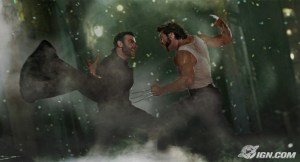
x-men-origins-wolverine-20090212020925195While Wolverine looked promising, it was a confusing mess of action with never a moment of tension. The problem was established early–in the credits–and this hindered us from caring about the characters.

If you make your characters indestructible, then you eliminate us from caring. It was the problem with Superman many years ago–he had no real vulnerability. So the writers rewrote him. Here with Wolverine and Sabertooth, they are given nearly immortal status at the beginning of the film. They don’t age slowly–they just don’t age once they hit their thirties. And they go through the Civil War, WW1, WW2, and the Vietnam War all in about ten minutes of screen time. They are always frontline, get shot at over and over, get hit, but never get hurt. There is no danger for these guys. None. That is established up front. So why would there be any tension in the film?

The film goes on to try and make Wolverine truly indestructible by giving him admantium bones. But since he was already invulnerable (yeah, he could get slightly bruised in a fight with his brother), the admantium claws gave him no discernible advantage. Ah, yes, in fights with Sabertooth, Sabe’s face was a bit more pained–but he was still walking tall after the fights. Spare me the argument that they can heal. 1) An ability to heal that quickly means there are no consequences. No consequences eliminate plot and choice–both essential to story. 2) Wolverine never healed that quickly in the comics. The point of Wolverine’s healing ability was to protect him in the long run, but he got beat up bad in the comics. Often, it would take him days and weeks to heal. And that’s good—it made him vulnerable, but gave him a slight advantage in the ICU. It made me care. But in this film, immediate healing meant that two shadows were boxing each other. I thought–so what?

The fights were scripted so that either Wolvie or his opponent should fall down so there could be a bit of dialogue, or a change of scene. If Sabertooth met up with any other character, that character was toast. It was just a matter of time. Because Sabertooth was established as indestructible.  Worse yet, I am now not sure what Sabertooth is really responsible for–since his main kill comes back to life.  The body count might have been high–but a viewer can’t care if the bodies spring back to life or never had much life to begin with.

Working against it too–the movie was a prequel. And if the survival of the main characters is the plot of a prequel, you’ve doomed yourself. The plot of a prequel needs to be another mystery–because their survival is assured. Here, we were told that we were going to learn the mystery of Wolverine’s origins–but there was no central goal for the main character, no puzzle to solve; just event after event happening to the main characters. No choices, no consequences, no mystery.

I was looking forward to Cyclops, to Gambit, Blob, etc. These characters were used more for the trailer than the movie. This movie had no arc, no plot, and characters who needed to wade through two hours of special effects to return them to X-Men 1, where they began.

Knowing: People Stuck in a Plot (a movie review)

knowing4Having just seen Knowing, the film starring Nicholas Cage as a man who’s been given a sheet of numbers predicting every accident that will happen, I’m having a hard time with Ebert’s review. Ebert gave it four stars. I would give it two.

It is a movie about whether events in life are random or predetermined and wants to be a movie about what you would do if you knew the end of the world was happening.

If you want to see the answer to that, go watch Deep Impact–a better film.

Knowing doesn’t uncover the “end of the world” plot until late in the movie. This movie is about  whether all events are preordained.  And should a coded sheet of these events fall into our hands–does it  indicate that higher forces are communicating with mankind–revealing these accidents?  But alas, it’s not to actually change them.  The list is stuck in a vault for fifty years. What’s the point of revealing numbers only to hide them away? Nicholas Cage would have us believe it is to give those numbers to his son, fifty years later. For what reason–there is no reason. Since Cage cannot do anything to affect or change the events, the paper communicates nothing but “proof” that someone knew what would happen.

Knowing is saddled with a predetermined plot too. The characters only talk about the plot; when they arrive in a scene, they say only what needs to be said to move the plot along, which I always find hard to believe.  When the sister enters the movie, her reason to be there is to tell us that Cage is estranged from the family, to establish that he is running from religion, to emphasize that the family is worried. The writers even realize that there is no real interaction in this scene because they have her tell Cage that he didn’t even ask “how are you? How’s your week been?” before telling her to leave. The characters know it is an awkward scene. All of the scenes are like this–leaping from plot point to plot point.

The revelation that the numbers are actually dates is so unnatural as to be funny.  It doesn’t happen because he actually strives to figure them out–he is drunk, it’s an “accident.” This plot is so much about determinism that it tries to get away with unbelievable coincidence. The author can always say–“Well, that was my point!” But that’s just bad writing. If you need coincidence that badly, then your characters are just puppets.

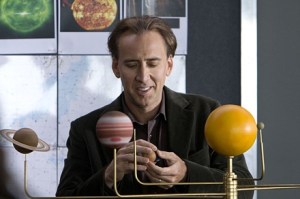
Cage is a morose father, drinking himself into a stupor every night. He’s supposed to be a MIT astrophysicist. Man, where did they get this classroom? That’s MIT?? It’s small. Only twenty students are there, most look around high school age. It’s supposedly his first lecture of the year–it’s completely philosophical, cosmological, lasts for ten minutes or less, with brilliant students who repeat back knowledge to the professor, and then our brilliant professor blanks when he’s talking about whether the world is random or not, and dismisses class. I never believed him as a professor. And I didn’t believe that was MIT, or any other university.

The worst foreshadowing happens here–when he takes up the models of planets and talks about them.

SPOILER: Cage is supposed to have worked on solar flares, was an expert in the field–but he doesn’t work on them now? He doesn’t mention this fact till the end of the film, when it becomes important. But one would suspect that the scientists who have already discovered that a major solar flare is coming would want to consult with the man who has solar flare knowledge.

This movie is full of Christian references to the inevitability of mankind’s destruction. You are sledgehammered over the head with it at times. Cage as prodigal son, makes the predictable return to his pastor/father. There’s even a convenient Christian message scrawled on a van in the last sequence–so that during watching destruction you might make a decision. The kids are taken in a “rapture” which makes angels look like a$$holes because they wouldn’t take Cage with them and save him too, or anyone else in those huge ships of theirs.

Take away the thin veil of science fiction and this is mere theology. Down to the “new adam and eve” and “tree of life” in the last frame… a very tired science fiction ending (we’ve seen it so much that On Spec and other sci-fi magazines reject all stories with “adam and eve” endings). Those people left behind are riotous and murderous, not many shown as kind; as destruction swoops down, you are made to think we are all sinners, murderous thieves. The writers have stacked the deck–giving us no choice on how to read the plot. Nobody really has a believable choice.  That may be honest theology, or philosophy–but it doesn’t make a good movie.

What Will You Do with this Symbiont You’ve Been Given?

jadzia_dax-002Recently saw a rerun of Deep Space Nine where Jadzia Dax is reviewing a possible Trill initiate. Just to clarify: Trills have the opportunity to join with a symbiotic species which will live through many hosts. Imagine a worm that lives off you, but also provides you with the lifetimes of all its previous hosts and the knowledge it’s accumulated. There are millions of Trills, but only a few thousand of these symbiants, so there’s quite a competition for them. It’s an honor to be joined. The host’s personality and the symbiant’s personality alters when they are joined, and they become a new person. “The two become one.” But because the symbiant has lived such a long time, its personality is pretty strong as an influence, and Trills try to choose for a host a pretty strong personality who has defined themselves before joining—not someone who has no personality or desires–someone who offers nothing to the symbiant, nor to society, but who just wants to live off the symbiant (ironic).

In “Playing God” in Season Two, Jadzia finds herself reviewing a potential host. The problem is that he is eager to get the nod from her, but not to add much to a symbiant’s life. He has no passions, no plans for his life. He is living his father’s dream–not his own.

I thought about this. Here was a man who was not doing anything with his life. He was hoping that the symbiant would give him a life….

How many times do we do that in a relationship? We cancel out ourselves to make sure there is room for someone else. We stop living because we want to be “joined” with someone. We’d do anything to be “joined” including becoming what they want…. and yet we forget that we could add to the mix too.

People are fascinating. We are attracted to them because they are fascinating. Even the most “serving” personality has thoughts and dreams that happen to no one else. We all can hear the death knell on a relationship when one person tries to eliminate what makes them “them” in order to get “joined.” And we all hear wedding bells when two strong interesting individuals get together–as two strong people, bringing something to the relationship.

So, what will you do with this life you have been given? And what will you contribute to your joining? How will you contribute to the world? What are your passions? Do this, find this, before you get “joined”—-you will contribute a lot to your joining–whether it’s a marriage, a workplace, a family, a faith.

Hmmm. We forget that sometimes–we Christians. God is not here to hollow out his creation and make them clones of Jesus. He needs something to work with. That’s why you gotta be the best Trill you can be as a host for such a cool symbiant. (Oh my, I’ve surely crossed a line—Jesus as Symbiant….) But I think it works. I’ve met too many Christian young adults who are empty vessels–no personality–save worry about not doing the right thing—who are hiding who they are and I think they get this message from well-meaning folks and colleges. Hey, good men and women, God doesn’t want “you” to be a robot, a device that he manipulates, downloads His thoughts and desires—he enjoys a cool person to talk with, to “join” with.

Give him one. The more interesting, the better.

2009 Yukon Writers Conference, April 3-5

scribo book cover by Kater CheekNorthern Writes is pleased to announce the 2009 Yukon Writers Conference, taking place at the Westmark Whitehorse, on April 3 through 5, 2009. The 2009 Yukon Writers Conference is an opportunity for Yukon writers to meet with and learn from six North American editors and one publisher representing a variety of genres.

The conference will include workshops, a panel discussion, individual pitch appointments and an open critique session.

The conference fee of $90 also covers an opening reception, lunches on Saturday and Sunday, and coffee breaks.

The following publisher and editors will present at the event:

Claire Eddy, Senior Editor, Tor/Forge Books, New York

Paula Eykelhof, Editor, Mira Books, Toronto

Lily Gontard, Editor, Yukon, North of Ordinary, Whitehorse

Shawna McCarthy, Editor, Realms of Fantasy and Agent, New Jersey

Lynne Missen, Executive Editor, Children’s Books, HarperCollins, Toronto

Kathleen Scheibling, Editor, Harlequin Books, Toronto

Howard White, Publisher, Harbour Publishing, Madeira Park, BC

________________________________________________________

Registration deadlines as follows: February 28 if submitting a writing sample/proposal March 15 if not submitting Registration forms and information sheets will be available at the Whitehorse Public Library starting on February 9, or by contacting Marcelle Dubé at (867) 633-4565, mdube@northwestel.net. Please feel free to share this information.

______________________________________________________

This conference is not to be missed if you live anywhere near the Yukon. You can’t see these people up close and personal in other venues in the States or in Canada. But here, in Whitehorse, you have a chance to talk with them personally, submit writing, receive critique, and get to know them.

I’ve said before that it was in the Yukon that I met and really got to know some amazing authors/editors from Outside. These meetings were all through conferences like this one that Barb Dunlop and Marcelle Dubé engineered.

If you believe in that Latin phrase on the book above–“I write”–then you’ll want to prepare for this conference. Have ready a manuscript by the end of February to submit to these editors. Come and join us for a chance to develop your writing and all Yukon writers.

_________________

Photo above is from my good friend, Kater Cheek, whose amazing art can be found here at www.catherinecheek.com