Tesseracts 14: Canadian Sci-fi/Fantasy Anthology Open for Submissions

2508955112_7a2d3e3312

Canadian authors of science fiction and fantasy, get your stories ready.  Tesseracts 14, is open for business.


Tesseracts Fourteen:
OPEN FOR SUBMISSIONS (Sept. 1, 2009 – Nov. 30, 2009)


Submissions are now open (from September 1, 2009 to November 30, 2009) for volume 14 of the Tesseracts anthology. If you are a Canadian author and write speculative fiction, we want to see your stories, poetry, radio plays, flash fiction etc. [SEE GUIDELINES BELOW]

The editors for this antholgy are:

John Robert Colombo and Brett Alexander Savory.    


GUIDELINES 


  • This anthology is open to Canadians, landed immigrants, long-time residents, and expatriates.


  • Open to submissions in either English or French. (Francophone stories must be translated into English for publication if accepted.) Canadian authors who write in languages other than French or English are welcome to submit an English translation of their work, provided it otherwise falls within the parameters of this anthology. Please supply details of original publication for any submission that originally appeared in a language other than English.


  • Translation into English is the sole responsibility of the authors.


  • Genres: all the genres of imaginative literature, including but not limited to magic realism, science fiction, fantasy, dark fantasy, slipstream, supernatural horror, weird tales, alternate history, space opera, planetary adventure, surrealism, superheroes, mythic fantasy, etc.


  • The Tesseracts anthology series is open to both short fiction and poetry.


  • Payment is $20 for poetry, $50 for stories under 1,500 words, rising to a maximum of $100 for stories of over 5,000 words (longer stories are paid a slightly higher fee, but in order to exceed the word length limit of 7,500 words, the editors must judge a story to be of surpassing excellence.)


  • Deadline: 30 November 2009.


  • Do not query before submitting.


  • Email submissions: tess14@hadespublications.com


  • Emails MUST contain the word “submission” in the subject line, or they will be deleted automatically by the server. Please also include the story title in the subject line.


  • Submissions MUST come as an attachment: RTF is the only acceptable format.


  • Emails MUST contain a cover letter in the body of the email; for security reasons, email attachments with no cover letter will be deleted unread and unanswered.


  • Cover letter: include your name, the title of your story, your full contact information (address, phone, email), and a brief bio. Do not describe or summarize the story.


  • If your address is not within Canada, please indicate in the cover letter your status vis-à-vis Canada.


  • Reprints (stories having previously appeared in English in ANY format, print or electronic, including but not limited to any form of web publication) can be considered but will be a hard sell; reprints must come from a source not easily available in Canada. If your submission is a reprint, please supply full publication history of the story. If your story appeared previously, including but not limited to anywhere on the web, and you do not disclose this information to the editor upon submission, you will be disqualified from consideration.


  • Submission format: no strange formatting, colour fonts, changing fonts, borders, backgrounds, etc. Leave italics in italics, NOT underlined. Put your full contact information on the first page (name, address, email address, phone). No headers, no footers, no page numbering. DO NOT leave a blank line between paragraphs. Indent paragraphs. ALWAYS put a # to indicate scene breaks (a blank line is NOT enough).


  • ALWAYS include your full contact information (name/address/email/phone number) on the first page of the attached submission.


  • Rights: for original fiction, first World English publication, with a two-month exclusive from publication date; for all, non-exclusive anthology rights; all other rights remain with the author. (DO NOT INDICATE WHICH RIGHTS YOU ARE OFFERING; SUBMISSIONS MARKED WITH RESTRICTIVE RIGHTS WILL BE DELETED WITH NO REPLY.)


  • Spelling: please use Canadian spelling, as per the Canadian Oxford Dictionary.


  • Response time: initial responses (no / rewrite request / hold for further consideration) will be made within thirty days after the close of submissions. Final responses no later than 31 December 2009.


  • Submit up to three stories at the same time, butUNDER SEPARATE COVER (only one submission per email).


  • Simsubs are not encouraged but are acceptable. Should you receive a “rewrite request” or “hold for further consideration” response, please indicate immediately whether your story is under consideration anywhere else.


  • Two After-School Fantasy/Sci-fi Writing Classes for Teens: PC and FH

    Starting Sept 16 at FH and Oct 1 at PC, I will be offering science fiction and fantasy writing to interested secondary students.  

    The Little Girl and her Giant Crocodile, Mauro Lira
    The Little Girl and her Giant Crocodile, Mauro Lira

    Are you attending Vanier, FH or PC this year?  Do you like to read science fiction or fantasy, and do you like to write your own?  Come join a group of dedicated young fantasy/sci fi writers like yourself on Wednesdays at FH Collins, or on Thursdays at PC, after school.  Snacks will be provided for the hungry.  Bring your own notebook paper and pen.  A journal is best.  We’ll play some writing games and get you pulling stuff out of your imagination–and then writing stories.  

    After two successful years of running the first group–which last year landed at FH Collins–I’m starting a group up at PC.  If you think you’re interested or know someone who might be, get in contact with the Parks and Recreation folks at 668-8325 and register for either the FH or PC version.  Registration begins on Sept 8–one week from today.  Classes begin earlier at FH Collins—and their program is 13 weeks; PC, since we’re just starting out, has an 8 week run.  

    FH Collins begins: Sept 16

    PC begins: Oct 1

    Crocodiles will not be provided.  Please bring your own.

    Flash Me, for short short fiction–all Fantasy Issue, due August 31

    Flash Me Magazine’s All Fantasy Issue
    FLASH ME MAGAZINE will be doing another ALL FANTASY ISSUE October 31, 2009. All stories submitted for the fantasy issue must contain some element of fantasy and be 1,000 words or less. The submission deadline is August 31, 2009.

    Special guidelines apply, so please visit our website prior to submission. You can view the fantasy issue submission guidelines here.

    The deadline’s coming up, and we’re still searching for spectacular stories – maybe yours?? 

    Yvonne
    FMM Admin Assistant

    (thanks Specfic Markets)

    The Media and the Flashlight in the Dark Room theory


    What do you want us to see now?
    What do you want us to see now?

    Imagine, if you will, a large room, completely dark.  The room is crowded with people, most of whom you can’t see.  Only those next to you can you see dimly.  You don’t know what others are doing, thinking, or what they look like.  

    However, a flashlight comes on and you can see a person, and also hear what he is saying.  

    Let’s say he’s ranting about something.  There is a murmur in the darkened crowd, and suddenly six other flashlights pop on.  The people highlighted now chat about that rant.   No one in your area.  But you can see all the others and hear them talking about it.  

    Then a strong murmur sweeps the crowd and seventeen new flashlights pop on, the people responding to the first flashlit rant.  Sometimes, you notice, they try and correct the rant, sometimes the person rants about the rant, and occasionally a spotlighted man or woman will talk about how this rant is felt through the entire room.  

    But you don’t know what everyone else is thinking about the rant.  And even more importantly, you don’t know if they would have been thinking about the rant had the first person not been flashlit.  Why was that person flashlit in the first place?  Hmmm.  Maybe those with flashlights enjoy the reaction of the crowd, or they may be paid by someone to flashlight on a regular basis, and sometimes those with flashlights are concerned about other people with flashlights getting more attention.  

    This is Media.  

    I work for the media, and I know that my flashlight is used to highlight something I want people to know or talk about.  To keep my job, I have to have things to light up.  To move up the career ladder, I must highlight things that will get people talking–and even to flashlight more people talking about what I talked about–to create the bigger murmur.  I can either join the chorus of voices, lead the chorus of voices, or attempt to highlight something else–and wrest the focus, the murmur of the crowd, the other flashlights, on a topic I want to highlight.

    Recent articles on Sarah Palin forget one thing–they turned the flashlight on her.  Her Facebook page is one of a billion Facebook pages; her opinion is one of a billion opinions.  She has no more sway if we don’t flashlight her.  We would never have known about her Facebook page, except that someone with a flashlight wanted to get the crowd’s attention.  Media control people’s knowledge and awareness.  In that darkened room, no one really is aware of my opinion without the media.  My blog comment here will reach exactly 120 people over the course of my life–only because these are my friends and they don’t need a flashlight to see me.  I’d be lucky if this post made it outside my close circle of friends.  My opinion here couldn’t make the murmur happen–and flashlighting someone without the expectation that this will cause a murmur is a waste of batteries, it seems.  Fluff stories.  Feature articles to pass the time.  

    I hope as new technology transforms all of us into Media—with our own flashlights–that we choose carefully what to highlight–that we don’t spread the rants of bigotry, lies, distortions, and divisive arguments around the internet or TV.  Let’s choose truth to highlight–even ugly truth, but we make sure it is truth first.  

    As flashlighters in a darkened room, we are responsible for vetting what we highlight—we are asking the whole room to turn and look at us.  We are asking the whole room to think about what we are flashlighting them to see.  What we flashlight may not be indicative of the thoughts of the whole room, but it can influence people so much that other people will think they are the thoughts of everyone, might even change their minds, or it might cause them to assume that the whole world is thinking this or that.  Gradually, that assumption will win over naysayers.  

    You can use this to the world’s detriment, or use it to sway the world for its good.  Palin may cry foul over the media’s flashlighting, but she loves the light.  And she knows how to manipulate it.  You can END this story by turning the flashlights off of her.  Ignoring someone is the fastest way to shut them up, to make them irrelevant.  You can kill “news” by putting it in a vacuum.  You can choose to flashlight INTELLIGENT opposition, not lies.  It doesn’t help the Republicans or the naysayers to the Healthcare plan to continue spotlighting Palin’s rants.  Turn off her light; let smarter voices be heard.

    The media, ultimately, is responsible for the life of a bad, or good, story.  

    Please, for the sake of our time and sanity, stop highlighting things that tear down truth, and spotlight the truth instead.  You can still get the murmur, get the crowd talking.  We have to train the crowd to murmur against real injustice, murmur about the making the world better–something that makes a difference, not that makes a buck out of a murmur.

    In the dark, the flashlights are the only way anyone can see.  Use them well.

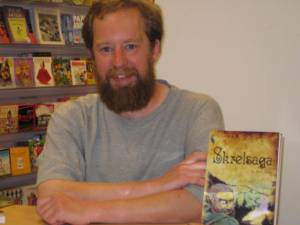
    Steve Parker, Yukon Author, publishes Skrelsaga


    Steve Parker looking pretty satisfied next to his book, Skrelsaga.  He lives to autograph!
    Steve Parker looking pretty satisfied next to his book, Skrelsaga. He lives to autograph!

    Good friend and Fantasy writer, Steve Parker, known to many of you as the man who holds the downstairs desk at Mac’s Fireweed Bookstore–ordering your books, being pleasant, being Welsh–is the proud author of a new book, Skrelsaga, now available at Mac’s.  Here are a few photographs of his signing.  


    This is, I think, the first Fantasy novel published in the Yukon.  Yay, Steve!  

    More on the book in a review that will come later. For now, we celebrate the achievement!


    IMG_0425IMG_0434

    IMG_0435IMG_0440

    Science Fiction and Fantasy Writing–at FH Collins and PC


    Artist: C. Gerber
    Artist: C. Gerber

    Starting in the fall, I’m going to be doing the afterschool programs for teen writers at FH Collins (our second year!) and now, at Porter Creek.  It’s for science fiction and fantasy writers, and everyone’s welcome.  There is a fee.  We do serve food.  


    It’s through the City of Whitehorse.  You can contact Mia Lee at 668-8327 or mia.lee@whitehorse.ca to be a participant.  More information to come.  Programs will start up in late September or early October.  The guide comes out in two weeks so we’ll have more info then.

    Bringing Star Wars to the Research Station: Part I

    Part I:  A New Thought

    And now you will witness the full power of this        
             station….” General Tarkington, Star Wars: Episode   
             IV, A New Hope


    Bronwyn Goodwin shows the power of the X-Wing Fighter kite at KLRS
    Bronwyn Goodwin shows the power of the X-Wing Fighter kite at KLRS

    As a science fiction writer embedded now as a science writer at a northern research station, I thought my job was pretty clear: bring northern science to a larger audience through whatever means were at my disposal.  Blogs, Facebook, press releases, radio series.  But then I found out that a few people there had not seen Star Wars.   Suddenly, my best, natural personality came to the fore.  I had a new mission: Bring science fiction to scientists.


    While science fiction might be easily dismissed by those working in scientific fields, it is often the first place that the average person learns about scientific concepts like graviton waves, geodesic folds, Dyson spheres, and quantum mechanics.  It can also be a first introduction to Shakespeare, to history, to world cultures, and to understanding the alien—those different than us.  But it is also a huge asset when it comes to igniting the imagination about science and about the future.  In this way, fiction about science, or even science writing, aids the cause of science—by compelling the average person to both think about science now, and think about science as part of our future.

    Star Wars: a New Hope was aptly named.   In 1977, it transformed the movie industry, making possible special effects that matched our imaginations.  And it also introduced science fiction to the masses of non-science fiction readers—making science fiction mainstream.  Star Wars was nominated for 10 academy awards, and won six of them, including Best Musical Score.  Of course, everyone reading this knows this.  We grew up with Star Wars.

    But Bronwyn Goodwin, age 8, did not, and neither did her mother, Sian Goodwin, both raised at a Research Station.

    This is hardly to their disadvantage—imagine having brilliant scientists traipsing through your living room on their way to amazing science exploits, and having your dad be the pilot that takes them up to many of the highest peaks in North America.  But they missed what turned out to be a seminal cultural event in Western Culture.  Star Wars entered into our collective psyche in the eighties and has re-emerged in many forms—whether it’s Reagan’s Star Wars defense system, or the idea of being “turned to the dark side” as a reference for negative behavior.  The characters are well known to us—Han Solo, Luke Skywalker, Princess Leia, Chewbacca, R2-D2. 

    But there was a certain glee in bringing Star Wars to two people who had never been exposed to it.  And eventually, the audience at the research station grew…

    Continued in Part II….

    Shine Anthology Extends Deadline: spin positive, change the world

    Incredible Art by Kater Cheek
    Incredible Art by Kater Cheek

    Shine Anthology, edited by Jetse de Vries, has extended their deadline for submissions of positive, near future science fiction to August 1st.  You got less than a month.  Just a reminder--SHINE guidelines, SHINE expectations, and some fine essays:

    Why I Can’t Write a Near Future, Optimistic SF Story–this one is a brilliant essay and really calls into question the nature of science fiction.  Have we been feeding off science to create doomsday scenarios and don’t-touch-this theologies?  These are great excuses about why people CAN’T write positive science fiction, but in the end, we should.

    Optimistic Literature and SF Around the World:  5 parts just as the title suggests. Great reading.  Nice job, Jetse.  I wish these were published in a book, too, but then they wouldn’t be so graciously free!  Thanks!


    So AUGUST 1st:  Get WRITING.  Create the World.  You have three weeks.  

    Yes, Captain Kirk has a Character Arc

    chris-pine-as-captain-kirkI don’t want anyone to miss this great discussion that Dave Wesley mentioned as a response to my earlier post.  He said that we ought to check out the discussion of character arcs in the new reboot of Star Trek

    Frankly it’s a great discussion about writing.  Here’s KFM (Rogers) initial premise (SPOILERS):

    “Captain James T. Kirk, the protagonist of the movie, does not have the development executive’s beloved “character arc.” He has no arc at all.

    He starts as an arrogant sonovabitch, and becomes a slightly more motivated arrogant sonovabitch. He does not learn to sacrifice, he does not learn to work well with others — he takes over the goddam ship. He’s right all the time, he never doubts he’s right, and the only obstacle he occasionally faces is when other people aren’t sharp enough to see how frikkin’ awesome — and right — he is as quickly as they should.”

    But read the responses and you’ll see a lot of varied ideas on character arcs.  Me, I think Kirk has a character arc.  (And I actually posted it on the responses to his post)–but in a nutshell:

    Yes, he’s a sunovabitch through the whole movie, but he is a listless, aimless SOB at first, and he has to find purpose. He never thought his fighting, his rebelling, his go after the baddies ideas fit in well with tight-shirt Starfleet, ultra PC. And yet, it is a Kirk who transforms Starfleet.

    Starfleet needs a person who thinks with his gut, and Kirk jumps into that role.  Both old Spock and Pike serve as catalysts to transform brawler Kirk into Captain Kirk.

    I like Pike’s speech to him early in the movie:  “Have you ever felt you could be something more?”

    I think this is one of the lines that resonates for the viewer.  Don’t we all wonder who we could be if we had the opportunity?  And the line from Spock’s past:  “You will always be a child of two worlds, fully capable of living in either one. “ And Spock has to make the decision where to be fully, and which side of himself to favor–Human or Vulcan.

    The movie is about Destiny, and it screws around with time travel to ask the larger question about whether destiny is fixed or fixable.  I think the movie promotes fixable.

    The whole discussion is worth reading, but here’s a great later post:

    Both have arcs, and the arcs are definitely related because they are almost mirror images of each other. Even Kirk’s dead father is a mirror image of Spock’s dead mother.

    Their arcs also cross each other when Kirk tries to gain control of the starship by picking a fight with Spock. Except this time, he doesn’t try to stage mutiny, but rather talks to Spock to get him to resign his post. Following this fight, Spock realizes that he has emotions and he can’t control them. At the end of the scene, Kirk realizes that if he is to be Captain, he has to stop being impulsive and Spock realizes that he can not be Captain with his spasms of rage, and that he will never be able to ignore his emotions.

    The movie is good, but I think there’s a lot to discuss about how the movie moved towards good through the writing of characters we thought we already knew.  And character arc is important.  I don’t think that Abrams achieved his great story by NOT giving Kirk an arc–because Kirk is not static.  Kirk learns.  He learns how to adapt t0 and also transform Starfleet protocol to fit him–thereby creating the James T. Kirk of the TOS that we know, and the Starfleet that surrounds him.

    In some ways, we learn a lot about how Kirk and Starfleet function with each other, and in spite of each other.

    Wolverine: You can’t hurt him, so you can’t hurt us

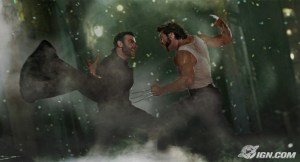
    x-men-origins-wolverine-20090212020925195While Wolverine looked promising, it was a confusing mess of action with never a moment of tension. The problem was established early–in the credits–and this hindered us from caring about the characters.

    If you make your characters indestructible, then you eliminate us from caring. It was the problem with Superman many years ago–he had no real vulnerability. So the writers rewrote him. Here with Wolverine and Sabertooth, they are given nearly immortal status at the beginning of the film. They don’t age slowly–they just don’t age once they hit their thirties. And they go through the Civil War, WW1, WW2, and the Vietnam War all in about ten minutes of screen time. They are always frontline, get shot at over and over, get hit, but never get hurt. There is no danger for these guys. None. That is established up front. So why would there be any tension in the film?

    The film goes on to try and make Wolverine truly indestructible by giving him admantium bones. But since he was already invulnerable (yeah, he could get slightly bruised in a fight with his brother), the admantium claws gave him no discernible advantage. Ah, yes, in fights with Sabertooth, Sabe’s face was a bit more pained–but he was still walking tall after the fights. Spare me the argument that they can heal. 1) An ability to heal that quickly means there are no consequences. No consequences eliminate plot and choice–both essential to story. 2) Wolverine never healed that quickly in the comics. The point of Wolverine’s healing ability was to protect him in the long run, but he got beat up bad in the comics. Often, it would take him days and weeks to heal. And that’s good—it made him vulnerable, but gave him a slight advantage in the ICU. It made me care. But in this film, immediate healing meant that two shadows were boxing each other. I thought–so what?

    The fights were scripted so that either Wolvie or his opponent should fall down so there could be a bit of dialogue, or a change of scene. If Sabertooth met up with any other character, that character was toast. It was just a matter of time. Because Sabertooth was established as indestructible.  Worse yet, I am now not sure what Sabertooth is really responsible for–since his main kill comes back to life.  The body count might have been high–but a viewer can’t care if the bodies spring back to life or never had much life to begin with.

    Working against it too–the movie was a prequel. And if the survival of the main characters is the plot of a prequel, you’ve doomed yourself. The plot of a prequel needs to be another mystery–because their survival is assured. Here, we were told that we were going to learn the mystery of Wolverine’s origins–but there was no central goal for the main character, no puzzle to solve; just event after event happening to the main characters. No choices, no consequences, no mystery.

    I was looking forward to Cyclops, to Gambit, Blob, etc. These characters were used more for the trailer than the movie. This movie had no arc, no plot, and characters who needed to wade through two hours of special effects to return them to X-Men 1, where they began.