Deadline Nov 30 for Tesseracts 14: Canadian Sci-fi and Fantasy Stories

from Woodleywonderworks on FlickrA reminder to all those thinking about submitting your short fiction (limit 7500 words) to Tesseracts 14, the latest in the series of anthologies featuring Canadian science fiction and fantasy.  It doesn’t have to be about Canada, or about the north.  Basically they are anthologies of Canadian writing.  (Okay, and a few stray Americans or other Nationalities who have immigrated to the fair shores of Canada)

Personally, Brian Hades, publisher of this series, would love to see greater representation of Canada in the anthology.  So, the Yukon needs to put out!  Haha.  Seriously, if you have fiction that strays just outside the everyday reality, consider submitting to Tesseracts 14.  Let’s wow Brian with Yukon writers!

More information at my previous post here:  Tesseracts 14 Open for Submissions

Kluane Lake Research Station Radio Series

Donjek, myself and Ruth Klinkhammer at KLRSI did a nine part radio series on research and science out at the Kluane Lake Research Station this Summer.  It was under the auspices of the International Polar Year and the Arctic Institute of North America (AINA).  AINA and Ruth Klinkhammer did a great job at compiling and showcasing my work at the Station and they set up a page of my radio series.  

If you’d like to listen to some of the fun that I had this summer with the gang at KLRS, stop by this website and check out the broadcasts.  

FOCUS ON RESEARCH:  KLUANE LAKE RESEARCH STATION

Who’d have thought they’d hire a science fiction writer to write about real science?  It taught me a lot, though.  And what I learned there will stick with me for a long time.

Bondsmen, my story, up at Metazen: James Bond meets himselves

secret-agent2My story, “Bondsmen”, is up at Metazen.  The story–meant to be a comedy– is a bit surreal, having the latest James Bond (an actor beyond Daniel Craig) really stifled by all the things he has to do as James Bond—he just wants to be himself, dang-it, but he finds himself trapped in the character roles that have been played in the past by other actors….  This is a story of a man who wants to be an individual, not controlled by things he can and cannot do.  James Bond ends up quarreling with all the other actors who’ve ever played Bond–or rather, all the other versions of Bond.  It is meant to be parody, but also a way to think about living life suppressed, even when you’re a dangerous secret agent.  Does James Bond really get a choice to be anything else?

Metazen, ” is an online fiction zine that publishes short fiction and poetry by various authors. Metazen is a fly trap for metafiction, existentialism and  absurdism. It harbors all kinds of filth such as neurotic characters, obscure philosophies, love for inanimate objects and quests toward enlightenment. Metazen occasionally follows the real life, meta-fictional exploits of Frank.  Metazen is edited by Frank Hinton, Jessica Alchesse and Dylan Cohen.”

Enjoy the story!

2012: The Last Movie Explosions and the End of an Era

Well, just saw a clip from the movie 2012, out in theatres in November.  After this movie, there will be no bigger explosions.  Hurray!   

I remember when Independence Day blew up the White House, and much of New York.  It was a cool special effect.  I remember when the Titanic split in two.  Wowzers!  But now, there’s not gonna be a special effect left to do using real places after 2012.  We’ll have seen the Eiffel Tower destroyed so many times, seen a realistic crumbling of the Rio Jesus, seen California being pushed into the sea, or dribbling into it as is the case here.

I mean, after that, the real end, when and if it does come, will seem like a rerun.  I bet when an earthquake hits California, one day, God forbid, but if it does, people will say “It looked just like 2012.”

Now, imagine filmmakers discussing options after 2012 comes out:  

“Well, there goes my next volcano film.  Can’t get more realistic than that!”

“And they just sunk Iowa into the ground.”

“We can’t redo the crumbling of the Statue of Liberty–we’ll be copying!”

“Exactly, boys.”  They’ll sigh.  Nod their heads.  “You know what this means?”

They’ll look around nervously.  

“We go back to plots and characters.  People won’t expect it.”

“What you mean is–they’ll yawn through another White House implosion.  No,” someone will shake his head, “we’ll go back to those all right—there’s nothing left to blow up, or blow up more realistically.  There’s nothing left but characters.  Damn.”

And this will be the END OF SPECIAL EFFECTS DRIVEN MOVIES.  Relief.  

It’s like the last ten years–post Jurassic Park–that directors have been like little boys with a new Chem Set and a set of bottles—what can we blow up?  Or Matthew Broderick and Ally Sheedy in Wargames, playing “Global Thermonuclear War.”   “What will we nuke first?” Broderick asks Sheedy.  “Las Vegas!  Seattle!” 

So many films destroying highways and bridges and houses and monuments…like Godzillas of the Green Screen.  Well, we’re all done with that!  Who can follow 2012?  The special effects people will be looking around for things to do and they’ll have to morph bodies on screen or something else….cause we’ve seen every conceivable iteration now.  Reality won’t be half as good! 

Either we move on now to plot/character driven movies whose special effects serve the moment, or this really is the end of the world….

God:  “Well, they’ve blown up everything they can on screen.  If I don’t cash in my chips, and call my peeps home, they’ll get bored…”

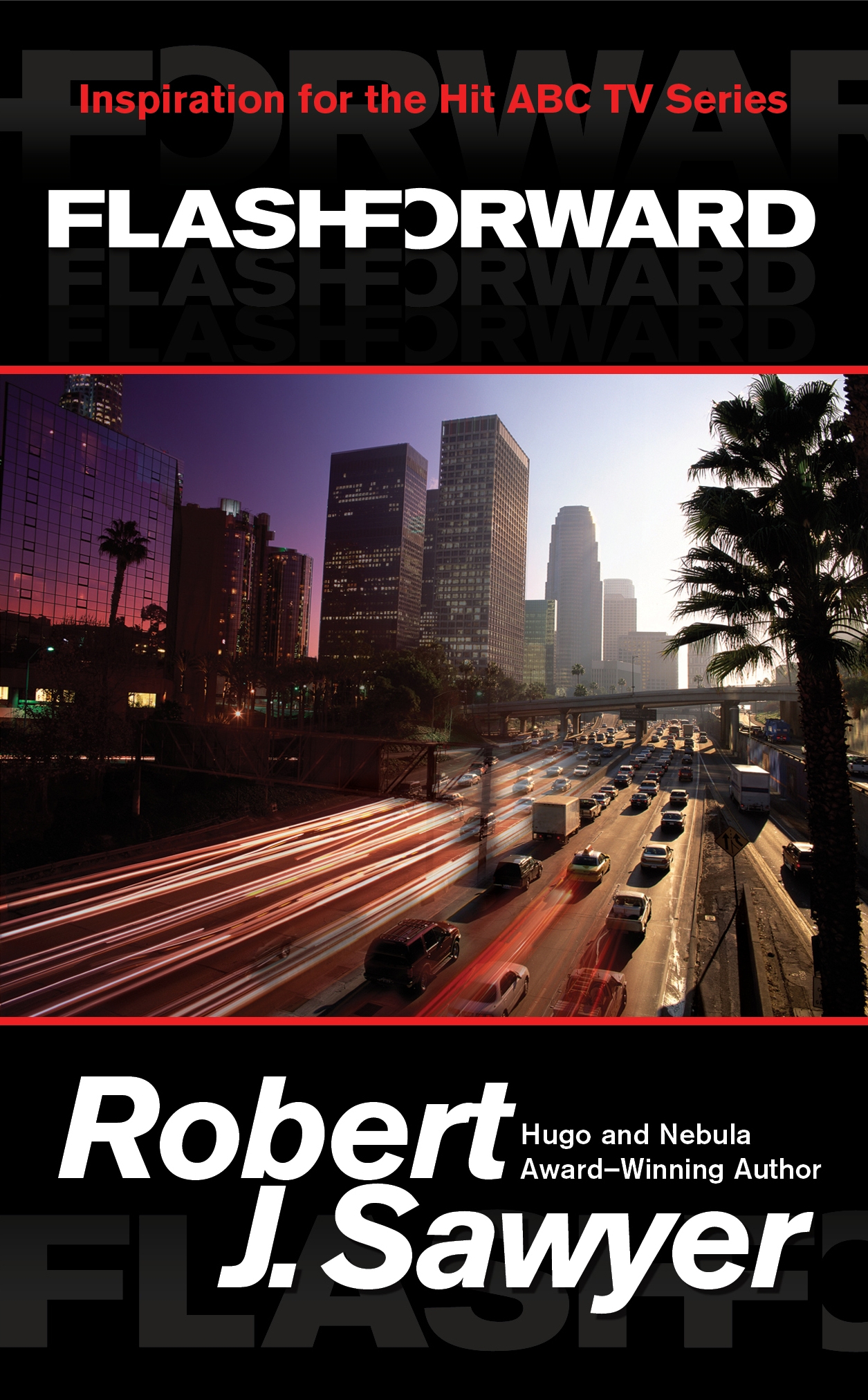
Flashforward: the Excellence that “Knowing” could have been

flashforward Watch Flashforward, Episode One

Robert Sawyer’s Flashforward has been made into an ABC miniseries. It is a masterpiece. I haven’t read the book, so I don’t know how faithful the series is to the original book, but the book won an Aurora Award.

The premise is that everyone blacks out at the same moment for 2 min and 17 seconds. In that time, they glimpse their futures. When they return to the present, mass chaos has already happened. Planes fell from the sky, cars crashed, trains derailed. People died, lots of people died. Everyone had blacked out, so no one was in control of all those vehicles.

The main characters, and there are several, include two FBI agents, a surgeon, a man who lost a daughter in Afghanistan, a doctor about to commit suicide, and several others. The series will be about them either trying to avoid their futures, or trying to get to them, depending on what they saw.

Oddly enough, the date they jump to, April 29, 2010, will be the season finale of the show–and at that moment you get to see if they reenact their futures or not.

Obviously, I don’t know how they can carry this through after that episode…BUT, I’m thoroughly pleased with watching till they get there. After this first episode I know that we have a great team of writers involved.

Now, this is what “Knowing” should have been. In my original review of “Knowing” I talked about how the movie, though predicting disasters, left very few for the main characters to experience, and I was troubled by the fact that it seemed the directors had determined that no one could change anything, so why bother.  That movie dripped with errant theology and left no doubt that everything was predetermined.  I don’t mind that fate or God may be a part of my life, but free-will is a human trait,and makes movies much more palatable.  To see someone struggle against their fate, to see them try.  It is what makes those who are given two weeks to live all the more heroic for skydiving or organizing a political rally.  How we react to what seems to be inevitable–THAT is interesting.

Already, I can tell that the show has set up five or six different beliefs about pre-determinism.  Some believe God gave them a gift, others that He gave them a punishment.  Some want to avoid the future, some to run to it.  For some it predicted a horrible mistake they will make.  

“Knowing” passed up all opportunities for real drama with real people, skidded ahead with bad dialogue and coincidence, to an ending which tried to justify the movie.  

Flashforward is like Mozart taking hold of the Salieri “Knowing” and actually making a great movie out of it.  Yes, I know, Knowing only had two hours…but still, this series is good solid writing.

1.  The characters are individuals, who walk onto the scene with their own problems, their own pasts.  They are well drawn and WHAT they do will determine the plot, not what others do.  Now that the big blackout is done, the characters guide the series.  They will push things forward accidentally or on purpose to meet up to April 29th.  They will determine their plots!

2.  Great dialogue, great stuff that isn’t about “the plot”— that Dimitri has to dance at his wedding to “Islands in the Stream.”  That the chief of the FBI has to lie about his vision because he’s embarrassed.  

3.  The plot starts with the action.  I can imagine this series beginning without the crash first.  But who would have waited the whole episode to have the blackout?  Nope, have the crash first, back up, and then take it slow.  Maybe this is just the difference between TV and reading….but I think starting as fast as you can into the action gets people involved with you.  I noticed in Robert’s book, first chapter, that he has a description of each character first…but within a page, he gets to the blackout.  He knows the blackout is a great hook, and that everything of importance happens afterwards.  

4.  I like the music in this series, already, the building, the back and forth between plots so quickly so that you know they are happening simultaneously–the music and this choice to flash around gives you a sense that everything is tied together.  In some sense it is like a trailer—when the trailer starts shuffling between images so fast that you get excited: all trailers seem to end this way these days.  The director took the music and that shuffling sequence to build suspense.  

I hope Robert Sawyer makes a huge amount of cash from this.  This is brilliant stuff.  And I’m glad to see a Canadian Science Fiction Writer land such an opportunity.  I hope they do more interviews with Robert Sawyer in the States.  

Well, I will keep watching the series.  I’ve already become a HUGE fan.
Seeing Things: a Captain Bly cartoon story of polar bears uploaded

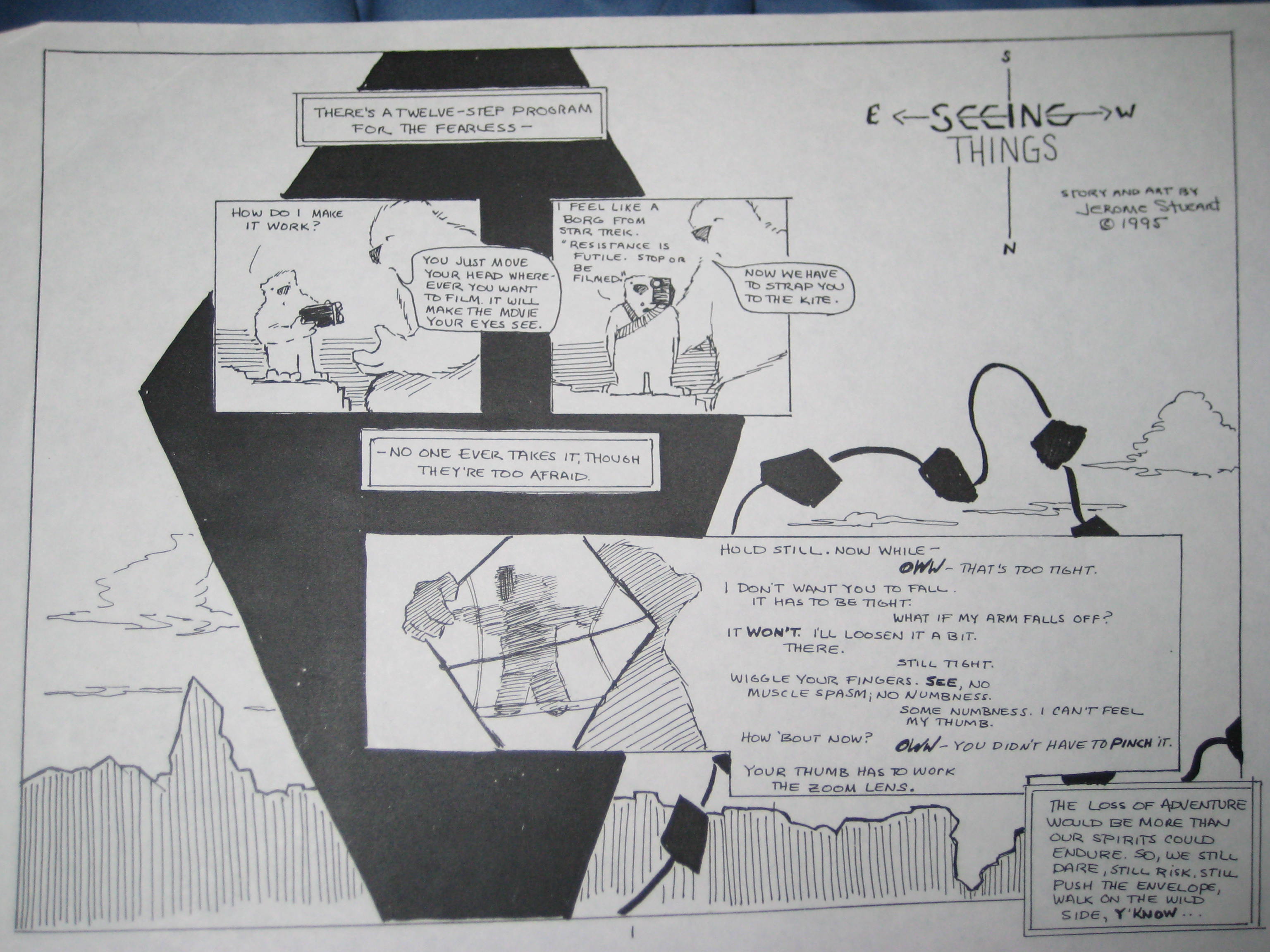
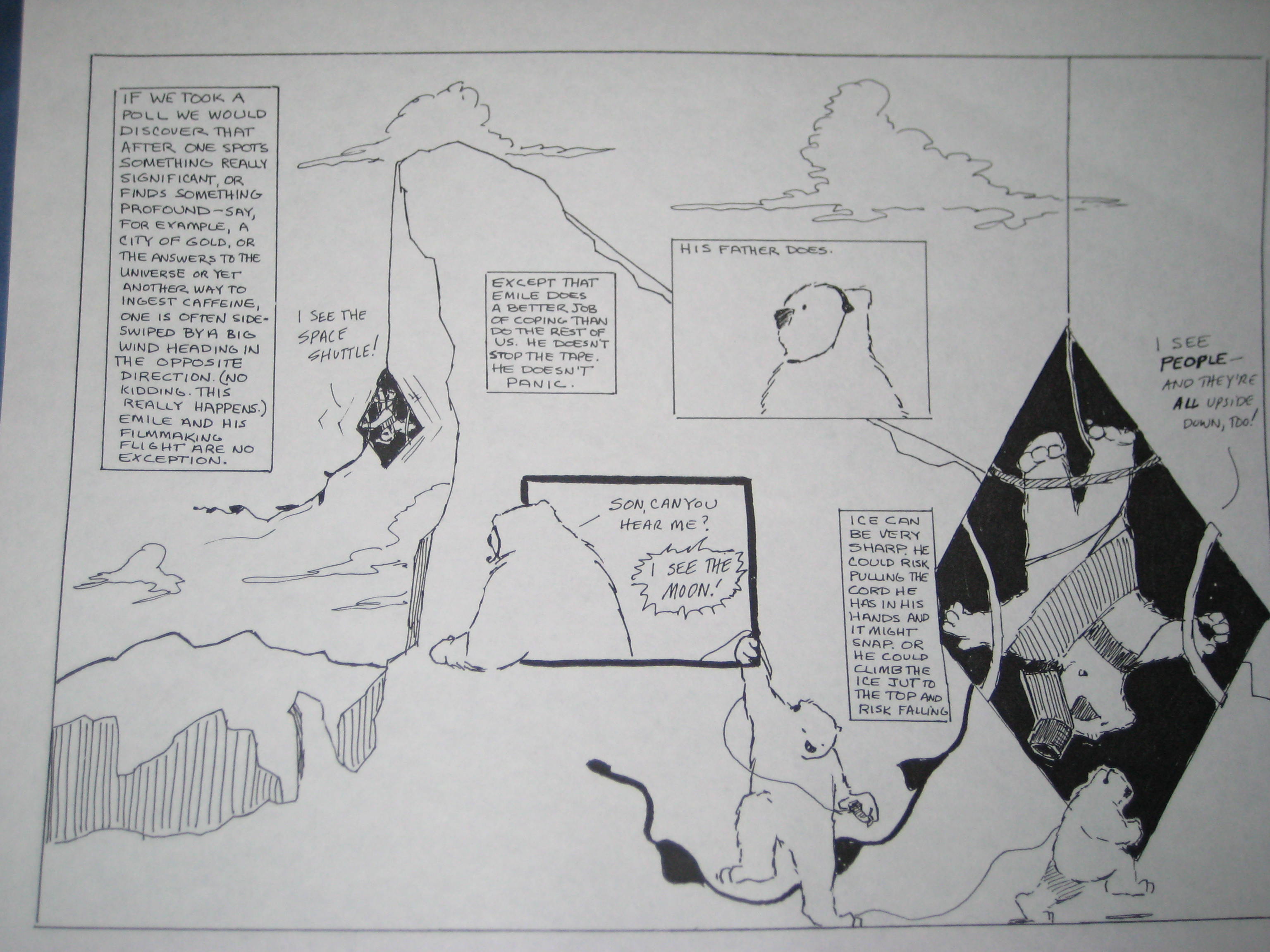
IMG_0677I used to be a cartoonist.  I had a comic strip for 4 years in the local student paper, The Maneater, at the University of Missouri.  I found that a visitor to Whitehorse had kindly uploaded some of my strips from a book called Captain Bly, 1994, as a way to show off my nifty book.  Thanks, Aniko!  So I decided to upload a short 6 page story not included in the book.   (The pic on the left is actually a pastel of the same bears–these bears are reciting Shakespeare’s The Tempest)

I’m still working on those bears.  They appeared a little in my short story “Lemmings in the Third Year” and I’m trying to work on a novel about them. 

Below is a short story I did for a Comic Strip 101 class I had with Frank Stack, an artist and cartoonist teaching there.  He is credited with the first underground comic book, The Adventures of Jesus.  He was a great teacher.  Had us draw comic strips and pin them to the wall for critique and then he would go about busting us!  He thought we were a great class though.  Full of potential.  I’ve been playing with my cartooning roots, and working around in some other mediums.  But here is that short story.


Seeing Things, Page 1, Jerome Stueart, 1995
Seeing Things, Page 2, Jerome Stueart, 1995
Seeing Things, Page 3, Jerome Stueart, 1995
Seeing Things, Page 4, Jerome Stueart, 1995
Seeing Things, Page 5, Jerome Stueart, 1995
Seeing Things, Page 6, Jerome Stueart, 1995

Fantasy Magazine Interviews Me: Writing the Other

DSC_0360_255Fantasy Magazine, which published my short story,  “The Moon Over Tokyo Through Leaves in the Fall,” did a companion interview, which I thought was incredibly thoughtful.  When you write a story, you always hope for questions like this–that someone will ask what you meant when a character said this or that, or ask how you go about writing the story.  

And secretly too, you hope you don’t sound like a dork.  

I appreciate the interviewer, TJ McIntyre, and the work he put into the questions.  Thank you.  


An excerpt

There have been many controversies over the years relating to writing the “Other” or writing with a voice outside of one’s own natural experience. “The Moon Over Tokyo Through Leaves in the Fall” is written from the point of view of a modern Asian-American female. Did this create a challenge for you? What steps, if any, did you take to verify the authenticity of your voice in this piece? What tips do you have for other writers out there working on pieces where they are writing from the perspective of the “Other?”

Hmmm . . . This is a hard question for me because I think every character you write about is an “Other.” I do understand the argument, that writing something completely different from you is more challenging. But unless you are writing memoir, the characters have completely different childhoods, desires, relationships — all the characters, not just the POV one. So they all take a lot of work to understand and “get right,” so to speak.

But if someone wants to write a character which is “other” I wouldn’t stop them. Instead, I would encourage them to stretch themselves. I certainly don’t immediately identify with, or always find accurate to my experiences, the white, rural, college-educated, religious gay male characters I find. And I don’t always want to write that character. I would hate to stop someone else from writing them though.

So I think that’s my first tip: Feel free to be whoever you need to be for the story, without holding yourself hostage to criteria. Criteria can turn into stereotype. I remember once writing a poem about Theodore Roosevelt surviving the Amazon River. A fellow writer said that I had no albino catfish in the poem and that it was a weakness. If I didn’t mention them, I would be called on the authenticity of place. Even worse may be the authenticity of race or gender or sexual orientation — since we are multi-faceted people. I go back to my first statement: Everyone in your story that isn’t yourself is an “Other” . . . and you are required to be careful with all of them.

Saying that, though, I think writing a nasty, mean, selfish gay character might be an accurate representation of one particular person, and might make a funny character, but I would trust that character more in the hands of a gay man who knows the consequences of pushing a bad stereotype in a culture that seems to want to believe the stereotype, than in someone else’s hands. I tried hard to be sympathetic to both Matsui and Yumi equally — showing their flaws, their desires, and hopefully helping a reader side with both at different times.

So, not that you have to always treat your Other characters with kid gloves, but that you make everyone understandable and as authentic as a human being as you possibly can through research, and through infusing them with your own flaws/desires. I infused Yumi with some of my own doubts about my relevancy/impact on the world, my own relationship experiences, the sometimes clash of cultures I find with people older than me. The story doesn’t have my exact experiences, but the shades of feelings are right, the tone is right, the need to be loved and validated is right, I think.

Run the draft through a close set of writerly friends to check for bias. I did run this through Clarion 2007 in San Diego, past a rigorous group of fellow writers, half of them women, who had some questions about the way I wrote Yumi, and I followed their advice. Not that a character can’t make bad decisions, or have perceptible flaws, only that they should be unique, individually motivated and free from OBVIOUS bias.

Be open to learning what it’s like to be someone other than you. It’s really difficult to shed Jerome in order to take on Yumi or Matsui, but I try. Like an actor taking a role.

I think if we only wrote within our experience we’d really limit our stories, and ourselves. I remember once writing from the perspective of my brother, and I learned a lot about what it felt like to have to make some of his decisions. The story moved radically away from my brother’s actual deeds, but the writing process allowed me to feel empathy and understanding for him in a way I had never felt before writing about him.

The process allows a writer to “put themselves in someone else’s shoes” and that’s good, both for the writer — who learns something outside him/herself — and the reader — who doesn’t have to put up with a bunch of main characters who are sci-fi movie buffs. Viva l’Other!

______________________________________________

Read the whole interview on the Fantasy Magazine Website here.

Tesseracts 14: Canadian Sci-fi/Fantasy Anthology Open for Submissions

2508955112_7a2d3e3312

Canadian authors of science fiction and fantasy, get your stories ready.  Tesseracts 14, is open for business.


Tesseracts Fourteen:
OPEN FOR SUBMISSIONS (Sept. 1, 2009 – Nov. 30, 2009)


Submissions are now open (from September 1, 2009 to November 30, 2009) for volume 14 of the Tesseracts anthology. If you are a Canadian author and write speculative fiction, we want to see your stories, poetry, radio plays, flash fiction etc. [SEE GUIDELINES BELOW]

The editors for this antholgy are:

John Robert Colombo and Brett Alexander Savory.    


GUIDELINES 


  • This anthology is open to Canadians, landed immigrants, long-time residents, and expatriates.


  • Open to submissions in either English or French. (Francophone stories must be translated into English for publication if accepted.) Canadian authors who write in languages other than French or English are welcome to submit an English translation of their work, provided it otherwise falls within the parameters of this anthology. Please supply details of original publication for any submission that originally appeared in a language other than English.


  • Translation into English is the sole responsibility of the authors.


  • Genres: all the genres of imaginative literature, including but not limited to magic realism, science fiction, fantasy, dark fantasy, slipstream, supernatural horror, weird tales, alternate history, space opera, planetary adventure, surrealism, superheroes, mythic fantasy, etc.


  • The Tesseracts anthology series is open to both short fiction and poetry.


  • Payment is $20 for poetry, $50 for stories under 1,500 words, rising to a maximum of $100 for stories of over 5,000 words (longer stories are paid a slightly higher fee, but in order to exceed the word length limit of 7,500 words, the editors must judge a story to be of surpassing excellence.)


  • Deadline: 30 November 2009.


  • Do not query before submitting.


  • Email submissions: tess14@hadespublications.com


  • Emails MUST contain the word “submission” in the subject line, or they will be deleted automatically by the server. Please also include the story title in the subject line.


  • Submissions MUST come as an attachment: RTF is the only acceptable format.


  • Emails MUST contain a cover letter in the body of the email; for security reasons, email attachments with no cover letter will be deleted unread and unanswered.


  • Cover letter: include your name, the title of your story, your full contact information (address, phone, email), and a brief bio. Do not describe or summarize the story.


  • If your address is not within Canada, please indicate in the cover letter your status vis-à-vis Canada.


  • Reprints (stories having previously appeared in English in ANY format, print or electronic, including but not limited to any form of web publication) can be considered but will be a hard sell; reprints must come from a source not easily available in Canada. If your submission is a reprint, please supply full publication history of the story. If your story appeared previously, including but not limited to anywhere on the web, and you do not disclose this information to the editor upon submission, you will be disqualified from consideration.


  • Submission format: no strange formatting, colour fonts, changing fonts, borders, backgrounds, etc. Leave italics in italics, NOT underlined. Put your full contact information on the first page (name, address, email address, phone). No headers, no footers, no page numbering. DO NOT leave a blank line between paragraphs. Indent paragraphs. ALWAYS put a # to indicate scene breaks (a blank line is NOT enough).


  • ALWAYS include your full contact information (name/address/email/phone number) on the first page of the attached submission.


  • Rights: for original fiction, first World English publication, with a two-month exclusive from publication date; for all, non-exclusive anthology rights; all other rights remain with the author. (DO NOT INDICATE WHICH RIGHTS YOU ARE OFFERING; SUBMISSIONS MARKED WITH RESTRICTIVE RIGHTS WILL BE DELETED WITH NO REPLY.)


  • Spelling: please use Canadian spelling, as per the Canadian Oxford Dictionary.


  • Response time: initial responses (no / rewrite request / hold for further consideration) will be made within thirty days after the close of submissions. Final responses no later than 31 December 2009.


  • Submit up to three stories at the same time, butUNDER SEPARATE COVER (only one submission per email).


  • Simsubs are not encouraged but are acceptable. Should you receive a “rewrite request” or “hold for further consideration” response, please indicate immediately whether your story is under consideration anywhere else.


  • Two After-School Fantasy/Sci-fi Writing Classes for Teens: PC and FH

    Starting Sept 16 at FH and Oct 1 at PC, I will be offering science fiction and fantasy writing to interested secondary students.  

    The Little Girl and her Giant Crocodile, Mauro Lira
    The Little Girl and her Giant Crocodile, Mauro Lira

    Are you attending Vanier, FH or PC this year?  Do you like to read science fiction or fantasy, and do you like to write your own?  Come join a group of dedicated young fantasy/sci fi writers like yourself on Wednesdays at FH Collins, or on Thursdays at PC, after school.  Snacks will be provided for the hungry.  Bring your own notebook paper and pen.  A journal is best.  We’ll play some writing games and get you pulling stuff out of your imagination–and then writing stories.  

    After two successful years of running the first group–which last year landed at FH Collins–I’m starting a group up at PC.  If you think you’re interested or know someone who might be, get in contact with the Parks and Recreation folks at 668-8325 and register for either the FH or PC version.  Registration begins on Sept 8–one week from today.  Classes begin earlier at FH Collins—and their program is 13 weeks; PC, since we’re just starting out, has an 8 week run.  

    FH Collins begins: Sept 16

    PC begins: Oct 1

    Crocodiles will not be provided.  Please bring your own.

    Flash Me, for short short fiction–all Fantasy Issue, due August 31

    Flash Me Magazine’s All Fantasy Issue
    FLASH ME MAGAZINE will be doing another ALL FANTASY ISSUE October 31, 2009. All stories submitted for the fantasy issue must contain some element of fantasy and be 1,000 words or less. The submission deadline is August 31, 2009.

    Special guidelines apply, so please visit our website prior to submission. You can view the fantasy issue submission guidelines here.

    The deadline’s coming up, and we’re still searching for spectacular stories – maybe yours?? 

    Yvonne
    FMM Admin Assistant

    (thanks Specfic Markets)