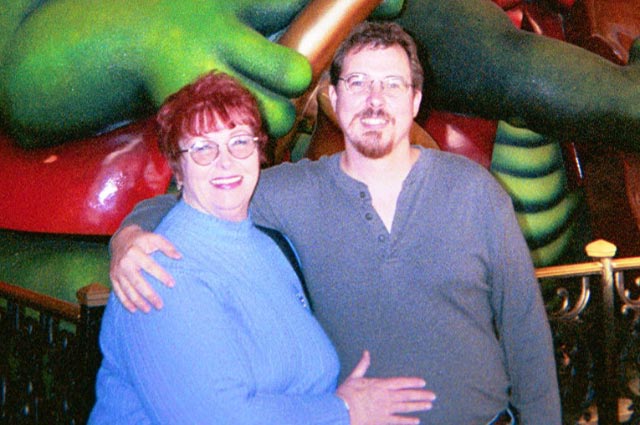
“Adopting My Mother” radio series is up

Hi Folks, if you look under Radio Series, you’ll see I finally put up the 5 parts of “Adopting my Mother.”  It was my first radio series.  Be kind.  I had a lot of fun with it, but it was my first foray into radio series.  It tells the story of when my birthmother found me, when I was 30.  What follows is me getting used to having another mother, or trying to figure out how to fit in a person into my life who had a very important role in creating me.  It’s not easy adopting a new person into your life–when you have a mom, a happy life, and you think you really don’t have to know where you came from or your own history….

But it’s interesting how much that beckons when you’ve never really known where you came from….. or why….

And suddenly here’s someone who can tell you everything…  and they’re only an email away.

Come listen to “Adopting My Mother” on the Radio Series page.

Red State America Wants Their Star Trek Series ‘Rough and Tumble’

A recent poll of Red State America, conservatives who either vote GOP or TEA, has confirmed the excitement that producers of the new Star Trek Series, Star Trek: Reckoning, hoped would be there.  The poll also scared the socks off them, one insider says.  The poll–pondering the success of a Star Trek run by conservatives, with the real, honest to gosh, Sarah Palin playing Captain Nalia Fergus of the USS Steadfast–garnered a stunning 76% of TV viewers.  These are viewers who may not have ever watched a Star Trek Series in their lives—they wouldn’t know a Klingon from a Ferengi, but they know Sarah Palin and they remember Captain Kirk.  And somewhere that all makes sense with them.

Shawn Gust, The Coeur d'Alene Press/APRarely have TV shows done polls before they even start filming the series, but producers of ST: RECK, as it’s being called, wanted to be sure where they were going.  “We didn’t want to wait for a Nielsen Rating confirmation.  We needed to know who was out there.”  Understand, they only polled Conservatives.  All us liberal, compassionate Democrats have not been polled.  They’re assuming that any Star Trek series will be embraced by the fans.  (So soon forgetting Enterprise?)

Our insider, though, has gone on to reveal to us what else the Poll says–and this is what scared producers:   Those conservatives polled wanted to dismantle the Exploration side of the Federation, get rid of the Prime Directive, and see a healthier number of “Americans” on board the ships.  Follow up questions revealed that by “Americans,” conservatives meant “white people”.  Most didn’t know that Sisko or Uhura or Tuvok were black, or that Sulu or Kim were Asian.  When told, many reported that “those people” could stay, but new ships should reflect more of a “middle America” profile.  

“They definitely wanted us to put Montana in space…,” said one of the writers.  

Continue reading

Inhuman anthology includes Whitehorse writer, Dave Strachan

You might recognize Dave Strachan as the guy who helps you with your Arctic Cat snowmobile needs at Listers Motorsports (that is not him on the cover of the book there).  I know Dave more as a science fiction writer and friend.  I’m THRILLED to say that Dave made it into the Inhuman anthology put out by Absolute XPress, a Direct-to-Reader press owned by Hades Publications, which specializes in scifi, fantasy, horror e-books and paper-books.  

The anthology is made up of flash fiction–stories under 1000 words–part of the Flash Fiction #4 Challenge that Absolute XPress issued earlier this year.  The stories discuss what it means to be human from an inhuman POV.  Some stories are all from that POV, and some have characters that are inhuman chatting about humanity.  I was the guest editor who helped choose the stories, but I’m proud to say that the judging was blind and that his story was chosen by all three judges.  I had no idea if we were going to end up with Dave’s story in the bunch.  There were a lot of great entries and we couldn’t put everyone in–but collectively we ended up choosing great stories.   

Thank you, everyone who submitted.  I’m proud of the stories included in the anthology.  You can order the anthology on their website, or through Amazon.com.   

And, Dave…. way to go.

Science Fiction and Fantasy Writing Class for Young Writers: FH COLLINS, WEDNESDAYS

Our very popular science fiction and fantasy writing class–aimed for 11-18 year old writers–is happening again at FH COLLINS, on Wednesdays.  This year we’re concentrating on helping everyone get something finished by Christmas.  Many of them are doing their own novels, but want to explore shorter fiction.  We have writers who enjoy historical fantasy, dark fantasy and comedy, hard science fiction, comedic horror, urban fantasy, and just plain I-don’t-know-what-it-is-but-I’m-sure-it’s-probably-fantasy….  

These are some of the coolest kids I know; very smart, well-read, and ready to explore some of the more mundane aspects of fantasy writing this year: making the fantasy more real.  So we’re gonna have a lot of time spent on developing characters, description, scenes where there’s no “action” going on, and other stuff.  

We meet afterschool–around 3:30 in the FH COLLINS LIBRARY till 5:00.  We’re being sponsored by the City of Whitehorse.  If you’re interested, contact me here–at jstueart@yahoo.com and I’ll get you set up with the City.  Cost is $85 for 13 weeks of instruction, which include, of course, SNACKS.  (We know that proper fantasy and science fiction can only be written with food….and we try to make it healthy–fruits, crackers, cheese, nutri-grain bars, etc.  Bring your own drink)

We’ve done a lot together in our three years here—and the students are always looking to find new people to bring into the group.  Come join us and be a part of a strong writing group that can read and enjoy your science fiction or fantasy.  

The class is taught by me: I have a PhD in English with a specialty in Creative Writing, and am a veteran of the bootcamp for science fiction and fantasy writers, Clarion Writers Workshop, makers of many good writers.  I enjoy the enthusiasm of these young writers.  (This is not a class for adults, but we do have a group for adults, as well, that will be meeting Tuesday nights. )

For the Love of Whitehorse: Why I Live in the Wilderness City

Occasionally, people will ask me why I’m here.  They don’t mean I should leave– only what it is that keeps me here.  It’s good to think about why you live in the place you do.  You can always say that work brought you here, or love, or you were raised here, or it’s all you know… but I can’t say any of these…  so I start thinking about why Whitehorse is the perfect city.  

Whitehorse has some very unique qualities.  In a nutshell:  It functions as both the capital and largest city of our territory, while maintaining many characteristics of a small town.  It has the cultural capital of a city 10 to 20 times its size, compressed in a small area, as it is home to a surprisingly large number of artsy folk–musicians, artists, writers and our ilk.  Whitehorse is drenched in pivotal and interesting history.  Finally it is surrounded by extensive wilderness that affords outdoor enthusiasts a vast playground, and keeps folks green-minded.    Continue reading

Harry Potter Diary: Harry, the Suppressed, Closeted Wizard

At 41, I’m reading the Harry Potter series for the first time.  Outside the demographic for the book, I was wondering what I would latch onto as an adult.  What would speak to me?

Harry Potter and the Philosopher’s Stone, HP1, gives us a kid whose true identity is being suppressed.  His muggle guardians KNOW he is a wizard, but they are hoping that he will just not learn about this heritage, and certainly won’t become a wizard.  They never mention his parents were wizards, never tell what really happened the day his parents died, and they never want to hear if he has any wizard “tendencies”… and they punish him severely whenever those “tendencies” appear—when Harry acts on his wizarding nature.

I always found the scene when the owls try to deliver his welcome letter from Hogwarts School of Wizardry and Witchcraft to be quite moving.  While on the surface it looks like the Dursleys are merely being subverted in their plan to keep Harry from knowing the truth–it is a moment where Harry learns WHO he is and that he has great potential.  Without this moment, there is no Harry Potter or Harry Potter series.

The urgency with which the owls start tossing their letters into the house; the extremes that the Dursleys go to hide away from the letters finding Harry; this is no small event.  I would say it is the biggest turning point in Harry’s life–because afterwards he will understand who he is, and be given the skills to fulfill his destiny, while before he is humiliated and punished when any sign of his true nature reveals itself, and living as a secondary person, almost a slave, in the Dursley household.  He lives in a closet under the stairs!  (I mean, really, people… a closet???)

It’s hard for me to escape seeing this as a coming out moment for Harry, or see this as a metaphor (at least for me) of a boy society has been trying to make more and more “straight”–who just can’t help certain natural tendencies.  As a gay man, I saw myself in Harry.  Society hides our history from us, brands us as immoral, makes us feel humiliated for being who we are–if we even get to know that information–and somewhere along early puberty, the signs start coming in unusually fast… the letters telling us who we are and what we are capable of start flying in.

I had great parents.  No, they didn’t know what to do either when I started exhibiting behavior outside of what they had expected.  I don’t think they ever tried to hide who I was, though; they were afraid to mention anything, uncertain if this might be a tipping point where I would start to explore what this meant.  But certainly my religion tried to separate me from the immorality of a whole group of people, convincing me that I could never be a “homosexual”– because I was a good boy, a good Christian.

If I’d only had a list of the great gay and lesbian people of history, or that so many of our revered American writers were gay or lesbian.  If only I’d realized how much we contributed to history.  Or known what was happening to me physically and mentally and sexually.  I’m glad that Mason Crest Publishers recently announced a line of books for middle-schoolers about being gay, about coming out, about gay and lesbian role models, history, religion.  Like 15 letters!  I want to own those books.

In my life, though, the letters stopped coming, the owls gave up.  I never realized I was gay until I was 34.

But in Harry Potter, the Dursleys can’t prevent Harry from knowing who he is because a giant comes through the door.   Hagrid—man, would I love my own Hagrid!—breaks down the door of the shack on the island where the Dursleys and Harry have hidden.  And he is angry when he finds out that Harry’s history has been suppressed, that Harry’s true nature has been ridiculed and been denied him.  There is triumph and relief in that moment of comeuppance for the Dursleys.  Not only have they been shamed, but Harry has seen them as they are— as no longer the standard or authority for telling him who he is.  He cannot be shamed.  Hagrid has revealed a higher truth.  Harry is allowed to break free of their mental tyranny–because Hogwarts, a place designed for people just like him, is waiting for him.  They value him.

Now, at Hogwarts, everyone treats Harry as someone they love.  Yes, a few treat him like a superstar, but I’m amazed at how loving and caring all the characters are towards Harry–especially the adults.  They become his new family.  Dumbledore and McGonagall serve as surrogate parents, and Hagrid as a protective big brother.

We see the Dursleys as comedic backdrop, but I think, in some ways, they are as dangerous to Harry as Voldemort is.  While Voldemort wants to take Harry’s life, the Dursleys also want to take Harry’s life–his soul, his self-worth, his personhood.  Whoever would rob you of who you are, or try to shame you for being who you are–that is a dangerous person.  If the Dursleys had been successful in keeping the truth from Harry, it would have robbed him of a joyful, adventurous life.  Those who want to keep their children from realizing who they are–and the joys of being that person, the contributions that other people like ourselves have made to history–are extremely dangerous people.  There is nothing wrong with being gay.  And great people in history have been gay.  It is extremely important for every person to have role models.  We spend an inordinate amount of time in Christianity talking about our role models, and in American History about role models, and in sports about role models.  Gays have been hidden from history for a long time.

Oddly enough, we were handed a great role model when Dumbledore was outed by JK Rowling.  Such a huge moment–that a beloved character could be gay and still be the wisest, most caring, fatherly, most powerful character in an already beloved series.  We were handed a beautiful role model, who doesn’t have to just be “gay”–he’s allowed to do other things with his character.   And it completes my attachment to this scene.  Harry is saved by Hagrid, a man of the woods, an earthy gamekeeper, in service to the Head Wizard himself, who is gay, and finally taken from the suppression that had marked his whole life.  Harry is given a new start as a Wizard, in a place that values him, and this makes me cheer.

I’m not implying at all that Harry is gay, only that this scene–where the truth is revealed, and assumption that Harry is worthless is wrong–resonates with me as a 41 year old man.  And that there is a whole hidden history, a whole place where people value who you are–who’d have thought?

It never would have occurred to me at 10 or 12 even… but there is something powerful in these books even for us 41 year olds.

Inception: the Idea trumps Character (movie review)

Help! My characters have no life. Oh wait, maybe they just need to wake up.

Inceptionis a solid movie, full of complications, a lot of thrill, and most importantly, some good ideas.  While it also has a couple of interesting characters in DiCaprio and Murphy, the rest of the cast fulfills their positions dutifully, easy to interchange and forget.   It’s a caper film–with the majority of the movie about the caper.  It uses a Matrix-like idea as a vehicle to achieve its goals.  The idea is central, the science fiction secondary; but like good science fiction–the idea is enough to carry the movie.

I liked the movie, enough to see it again if the time comes to rent it on DVD or if a friend wants to see it; but I found the inconsistencies in the premise took away from the caper.  How do they share freakin dreams!  Plug yourself in and something determines whose consciousness you’re going to share?  Doesn’t matter, the movie says— we’ll just tell you.  How do they determine who will dream and who will share?  Doesn’t matter, the movie says, watch what we can do with a special effect.

There’s enough infodump in the first twenty minutes to choke a horse, disguised as dialogue, interspersed with scenes of cities running amok and riots in the streets.  The riots are there to make sure the ideas go down easier.  “Just a spoonful of riot, makes the infodump go down…”  Take a note: this is NOT how to do an infodump.  We learn absolutely nothing about the characters in the first twenty minutes…only that a Molly means betrayal.   Nope, we need to explain the premise….

Now, once I got past that we were rushing through the “technical” issues to get to the action (I could almost hear the movie tell me–who cares about whether or not this makes sense? We’ve got a cool thing to show you), I enjoyed the movie.  But I didn’t really care about DiCaprio’s character– or empathize with his loss.  Normally Ellen Page is fantastic (LOVED JUNO!) but any actress could have pulled off that role, it required so little.  In some ways she, Michael Caine, and all the other actors are wasted to serve the idea….

Jeffery Overstreet has the same concerns in part one of his review of Inception.  And says them better.  It wasn’t so much a bad movie–as a rushed one, one that engaged your brain but not your heart–even when it was trying so desperately to do so.  And the ethics involved in changing someone’s mind so illegally made DiCaprio not a very sympathetic character.

Now, back to that idea.

The BEST thing about Inception, and why everyone should see it, is about how you put an idea into someone’s head.  The discussion about how you make someone believe that it was their original idea, as opposed to yours, is insightful–and will make everyone talk.  The whole work to get Cillian Murphy to think this is his own idea is downright fun.  And everyone in Marketing should see this.  Or maybe they shouldn’t!  (What might have been more interesting, but not as fun, would have been a philosophical film based on the premise–you know, in the same way that Sophie’s World merely used the least amount of plot to play with an idea.)

There is NO insight on dreaming in here.  Dreams, while they can be detailed, are murky and inconsistent.  They’re rarely realistic and may involve someone who looks like they are a walking shark carrying a tuba….  And as Overstreet admits too– other filmmakers have handled the surreality of dreaming SO much better.  That dreams can be invaded by someone–so casually–with no idea how to operate in someone else’s dream — is really lame.  As if the writer (and I like Christopher Nolan) just needed to get past some hurdles here…. to make a cool graphically conceived movie.  Also, the biggest clue that you’re in a dream is that you cannot read the same text twice.  It appears and changes as you’re reading it, rendering the opening premise illogical….

SPOILER:  And this is the third “dreamy” film–or film which contains reality based on your own thoughts–to include a suicidal woman.   What Dreams May Come, Solaris and this movie all have this as a premise…  that women can’t handle their own thoughts and will take their lives, causing their husbands, every one, to come rescue them.  And all three films end with that rescue leading to a kind of pseudo-paradise that the audience recognizes as delusion.  (What Dreams May Come is worthy of its own review.  A movie which ranks as one of my all time worst movies ever. But the ending delusion is supposed to be Heaven, so I can’t really argue with that.)

So, I found the movie a bit flat–even as the action was all revved up….  Caring about the characters, to me, was essential to enjoying the intensity of the film.  If I can’t care, then I can’t care about the intense situations you put the characters into.  Solaris made me care about the main two characters in their hyper-reality film; What Dreams May Come suffered from the same overblown concept with lack of character interest.   Inception forgets that narrative relies not just on amazingly cool logos, but on believable pathos too.

Is Star Trek Reckoning Real?

This question “Is Star Trek Reckoning Real?” was googled by someone and led to my website.   There’s really another question that’s implicit, I think and that is “Would the Creators Really Want to Screw Up Star Trek by letting Conservatives wreak havoc in the Star Trek Universe?”  

Yes.

We love it when our favorite stories take a turn for the worse–where our complacency is shaken, our values are threatened, adversity gets the upper hand, only to show us how much we truly have taken things for granted.  

Fiction is all about making it bad for your heroes.  And making them fight hard–because it gives us strength to fight hard.

We need to see a few seasons where the “good” of Star Trek has to fight to regain balance.  The Federation has gotten the upper hand.  Chances with Enterprise were lost to play with a universe without the Federation.  Oh, in Star Trek series, we had a few episodes from the Mirror Universe, but even that slowly spoiled because each episode in the  Mirror Universe actually redeemed a character or two who were going to be pivotal in turning the “dark” parts–the disorder– to order once again.  And then the mirror universe would be just like us…ho hum.  What if we lingered in that disorder?  This is what Reckoning explores.

Oh there have been times when good guys rebel against the Federation.  Why is it that the “good” Star Trek characters sneak around and are able to commandeer vessels (Kirk, Scotty, Picard), disobey orders (everyone), grab things they aren’t supposed to have (Chakotay, Riker, Janeway) and go off and do something illegal for a greater good (which no one in the Federation knows about)?  Why is Starfleet so easy to outwit?

The “order” in Star Trek relies on the shared concept of the “honor system”— but when good characters want to steal things, disobey, etc. they seem to be able to do it because no one in Star Trek is ready for that.  And secondly, because the plot calls for it.  We need Janeway to steal the time machine doo-hickey, or Kirk to steal the Enterprise….  because otherwise we don’t have an episode.  

Fergus, the D’Mi, the whole grouping of conservative captains who no longer have faith in the Federation’s president–who see themselves as vigilantes, or martyrs, or heroes—determined to save the Universe, or their values, at any cost— these people are interesting.  Villains are far more interesting, at times, than heroes who can be painted too “good.”   Next Generation characters weren’t very complex, or if they were unstable, they were restored by episode’s end (except DS9–which was by far the riskiest ST)  Star Trek hit the reset button every episode (or at the very least, at the end of every two -parter).  Star Trek, by JJ Abrams, did us a favor and did not hit the reset button, thank God.  

Now we have a series that shows that the “values” of Star Trek can be hijacked by well-meaning people who believe they are on a mission.  I think this is a logical next step for Star Trek.  Reckoning will show how easy it is to believe what you have been told, it would give a believable “other side” to all the issues.  Instead of showing us what is right by demonstration— it would show us what is right by having to fight for it, and failing.  

Captains modeled on Palin, Gingrich, Limbaugh, Beck would be interesting–if only to see what they would do with something like the Federation.  How would they operate within it?  When would they dismantle it?  When would they circumvent it?  Would the Federation be able to squelch them?  The Maquis was a great subplot, and I wish they had done more there… certainly Tom Riker (one of my favorite characters) would have been interesting to follow.  But the Maquis had one goal–not a whole different ideology.  I want to see that people in the Federation don’t all think alike….  they don’t all get along.  

Think of what happened to the West Wing when the Republicans got in power….  

So, creators of Star Trek, when will we have a Reckoning?  When will we see what we loved threatened? Will you create people who will fight to re-balance it?  In the same vein as BSG—a show that allowed characters to be less than perfect, and which allowed the bad guys to have the upper hand–can you show us a universe where it will take us seven seasons to get it back on track again?  

Please, finally, let the Dragon out and let us see what the Federation will do!  🙂

Is Star Trek Reckoning for real or not?  Confirm this series.

Palin Loves (to shoot) Mama Grizzlies, and Star Trek Parallels

Writers are scrambling to capture and transform opportunities as they arise for developing Sarah Palin’s Star Trek role.  She provides them every day with new fodder and storylines that enhance a brilliantly conceived new series, and new direction, for the Star Trek franchise.  

Because of my writer contacts with the new series, I get leaks now and again and this is straight from the writer’s War Room (as they call it).  The first scripts for Star Trek: Reckoning, the new Star Trek series coming from Fox/Paramount this Fall, feature Captain Nalia Fergus (Sarah Palin) of the USS Steadfast, and a CGI-created polar bear first officer, Commander Nuuk.  As I’ve mentioned in a previous blogpost, the polar bear doesn’t realize that Fergus used to hunt bears like him for sport.  

I’m not allowed to put any of the script online for copyright reasons, but the episode entitled “Ain’t No Love for Mama Grizzlies” has the Steadfast‘s Captain and First Officer in a holodeck hunt of each other, and both of them have guns!  I kid you not.  

Here’s the breakdown.  Fergus, in a bid to coerce women of the Federation to rise up and reject the Betazed President of the Federation, and his stubbornly peaceful policies, has issued a statement, using the image of her first officer, Nuuk, as an example of the kind of “bear” she is, the kind of “mama grizzly” she believes all conservative women are.  

When Nuuk receives a message from enemies of Fergus–pictures of her with the skins of bears, hunting bears, when the facts start rolling in about how she really feels about bears–the Truth about Fergus’ relationship to Grizzlies, bears and other wildlife: she’d originally been part of a group that wanted to offer hunts, and drill for oil, on Nuuk’s own planet–for her own profit!–completely against the Federation’s Planetary Protection Act on Class L planet, Arctos 3– well, let’s say he’s not pleased.  The fact that she’s using his image–an image she’d thought of more as throw rug than sentience–to promote her cause (even if it is to protect the Federation from the Reckoning) is more than he can handle, and he lures her to the Holodeck for a showdown.  

Well, you can’t shoot your captain, and you can’t shoot your first officer— just not in the Star Trek rulebook.  What Fergus doesn’t know is that Nuuk has sympathetic friends in Starfleet, and the episode hints that he may even be a counterspy on the Steadfast, working for the Federation to keep an eye on Fergus.  While he distracts Fergus on the “hunt,” information about Fergus’ real feelings and real decisions about conservative women get sent to Federation media outlets.  

Her record on supporting women before she needed them to topple the President, pretty shabby,  and those she supported didn’t support women any better,   and finally, as the truth comes out about Nalia Fergus, then some of the strongest women of the Federation start speaking out against her.  It’s really shocking how pliant, gullible and weak she thinks women are.  That if she just projects an image of women rising up and supporting her–because she called out their name and flattered them–that they will create that uprising themselves, and forget all the ways she’s actually denigrated women.  (I’m really hoping that they bring back Captain Janeway to speak for Emily’s List–now there was a great female captain!)

This all happens during the Holodeck hunt–to keep Fergus from defending herself and allow the word to get out.  Unfortunately, giving away the ending of the episode–SPOILER–Nuuk is tranquilized, and put in the brig for several episodes.  But, this episode ends with the truth coming out, at least in a small way about Nalia Fergus and her movement.  Writers tell me this is episode 4 or 5 of the series.  

What I find so fascinating about Fergus’ character is her distorted belief in herself as saviour–and yet, I can’t help but believe that there’s a grab for power in there somewhere too.  That it’s very little about saving the Federation, and more about using the Reckoning–this dream of disaster–as a way to wrench power and control away from the Federation through fear.  Such a master at projection, Nalia Fergus may actually bring on the very Reckoning she claims to be saving the Federation from.  

Writers praise Palin:  “As a writer on the show, I can’t say how much I’m thankful for Sarah Palin’s assistance in helping us flesh out this character.  Every day, we’re all watching her Twitter, and reading every statement she puts out.  We sit around the War Room and translate that–nearly verbatim–into a Star Trek episode.  She’s a gift to the series.”  

I find this show completely fascinating—and it hasn’t even been broadcast!   Who’da thought that a conservative take on Star Trek would provide so many compelling storylines?  

— on a different note, the start date for the series has been moved back to October because of Sarah Palin speaking engagements piling up this summer.  She’s still filming when she can, I’ve heard, but she’s a woman on the move, a “pink elephant” parading* across the stages she’s set in America, and the Series just has to wait her out.  

Oddly, Palin’s conjuring up women as “pink elephants” refers back to the drunken stupor that Dumbo experiences in the Disney movie, “Dumbo”–is she saying that women marching on Washington is an alcohol-induced halucination?   Hmmm.  Well, in honor of Palin’s reference to “pink elephants”  I give you the original song that was, frankly, frightening for kids back when Dumbo showed in theatres.  

As previously noted, this is a parody.

Harry Potter Diary: Outside the Demographic Looking Inside Hogwarts

I decided to read the Harry Potter Series this summer, for the first time.  After 10 billion people were happily served by the boy wizard and his pals, after the series was put to rest by JK Rowling years ago, and just as the film franchise explodes to a close, I decided to read the books.

Some questions immediately pop to mind: Why didn’t I read the books years ago?  

1.  I’m not a fad kind of guy, so having millions of people read the books actually made me feel less like becoming part of the phenomenon.  

2.  I actually loved the movies.  I did read HP 2 after the first movie came out, and before the second movie.  And loved it.  But when I watched the film, I was terribly disappointed that a whole mess of story was eliminated as if it didn’t count.  I vowed then and there to see the movies first, and then I would read the books to add in parts that the movies had left out.  This is actually a decent strategy.  

And why now??

Well, the end of the era is around the corner…. by summer 2011, the films will be done.  But I think it’s more because I really want to read the books.  I want to see how Rowling built the arcs, how she developed series characters, and how she managed to maintain the hook for so long.  It’s okay to admire the books on a “how are they written?” sort of way.  

I want the magic too.  Even though, now, I know at least where the movies have taken me.  Now I want to see where the books take me.  

I’m not the demographic JK Rowling was aiming for.  Her 9-17 age bracket probably resonated with the idea that children can have power too; that magic exists under adult noses; that the world doesn’t have to be like their parents told them it would be–office buildings, stock markets and 2 hour commutes.  

So what would a 41 year old, single, gay writer and English teacher living in the Yukon Territory–with no children– get from reading the Harry Potter series–besides how to create a blockbuster series?  It’s a good question to think about.  How does a book transcend its ideal market, appeal across the board to adults and children alike?  What will be the pull of the series for me?  (I already loved the movies—but why.)  

I’m keeping a Harry Potter Diary as I go to ponder things about the series along the way.   Just reactions to, thoughts about, resonances with the series.  

There’s a spot at Hogwarts for me–and I’m going to find it.