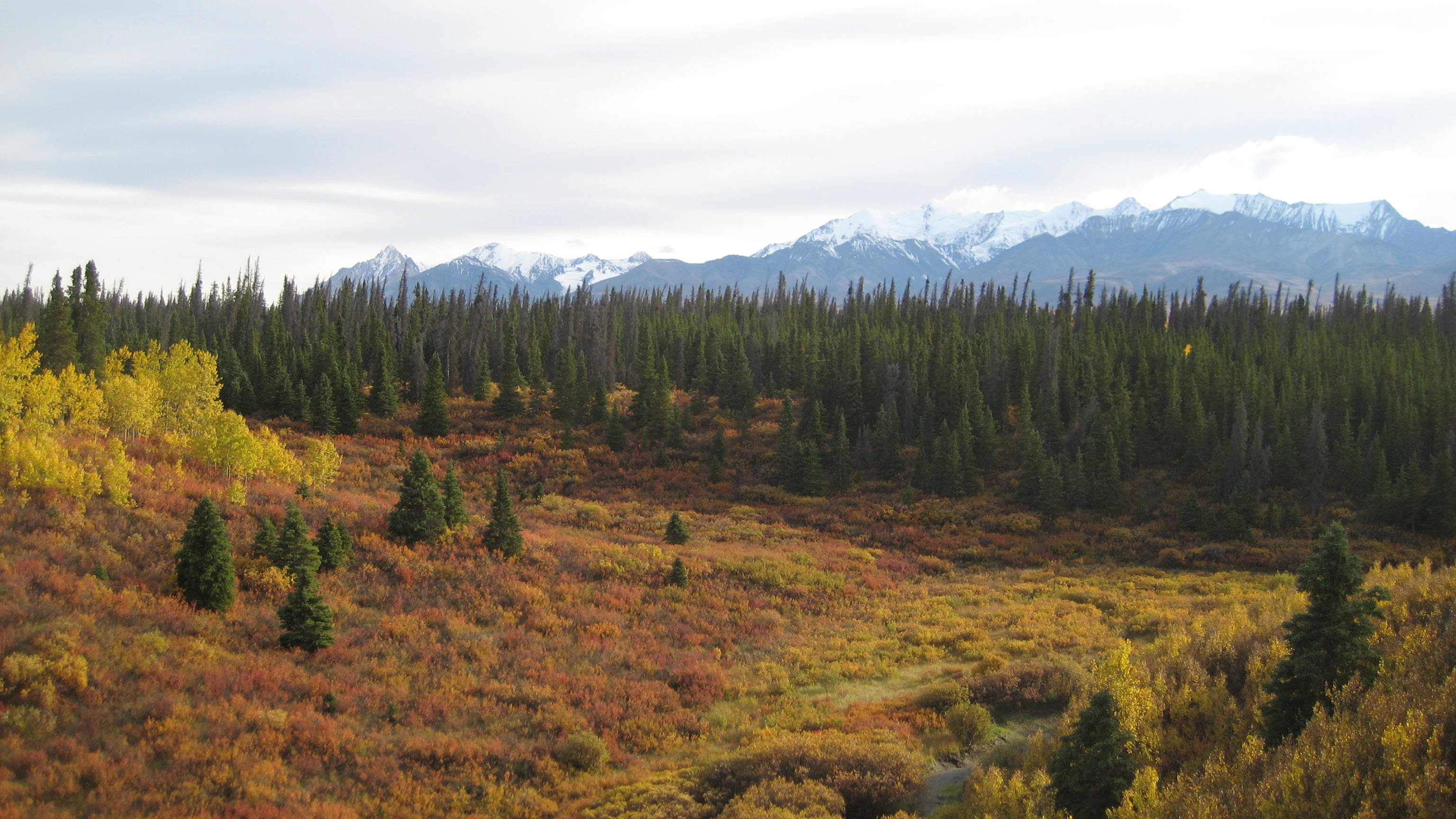
I had the chance of a lifetime this summer to work out at Kluane Lake. The drive from Haines Junction to Kluane Lake has to be one of the most beautiful drives ever, but it really glows in the fall. Holy Cow. I took 92 pictures and movies. This was my drive to work every week. Today it looked like everything had turned to gold in the Yukon.
Me looking adventurous and small.
At the airport at the Kluane Lake Research Station.
The fall is brief here, but it sings. Go outside and see the music.
Tesseracts Fourteen: OPEN FOR SUBMISSIONS (Sept. 1, 2009 – Nov. 30, 2009)
Submissions are now open (from September 1, 2009 to November 30, 2009) for volume 14 of the Tesseracts anthology. If you are a Canadian author and write speculative fiction, we want to see your stories, poetry, radio plays, flash fiction etc. [SEE GUIDELINES BELOW]
The editors for this antholgy are:
John Robert Colombo and Brett Alexander Savory.
GUIDELINES
This anthology is open to Canadians, landed immigrants, long-time residents, and expatriates.
Open to submissions in either English or French. (Francophone stories must be translated into English for publication if accepted.) Canadian authors who write in languages other than French or English are welcome to submit an English translation of their work, provided it otherwise falls within the parameters of this anthology. Please supply details of original publication for any submission that originally appeared in a language other than English.
Translation into English is the sole responsibility of the authors.
Genres: all the genres of imaginative literature, including but not limited to magic realism, science fiction, fantasy, dark fantasy, slipstream, supernatural horror, weird tales, alternate history, space opera, planetary adventure, surrealism, superheroes, mythic fantasy, etc.
The Tesseracts anthology series is open to both short fiction and poetry.
Payment is $20 for poetry, $50 for stories under 1,500 words, rising to a maximum of $100 for stories of over 5,000 words (longer stories are paid a slightly higher fee, but in order to exceed the word length limit of 7,500 words, the editors must judge a story to be of surpassing excellence.)
Deadline: 30 November 2009.
Do not query before submitting.
Email submissions: tess14@hadespublications.com
Emails MUST contain the word “submission” in the subject line, or they will be deleted automatically by the server. Please also include the story title in the subject line.
Submissions MUST come as an attachment: RTF is the only acceptable format.
Emails MUST contain a cover letter in the body of the email; for security reasons, email attachments with no cover letter will be deleted unread and unanswered.
Cover letter: include your name, the title of your story, your full contact information (address, phone, email), and a brief bio. Do not describe or summarize the story.
If your address is not within Canada, please indicate in the cover letter your status vis-à-vis Canada.
Reprints (stories having previously appeared in English in ANY format, print or electronic, including but not limited to any form of web publication) can be considered but will be a hard sell; reprints must come from a source not easily available in Canada. If your submission is a reprint, please supply full publication history of the story. If your story appeared previously, including but not limited to anywhere on the web, and you do not disclose this information to the editor upon submission, you will be disqualified from consideration.
Submission format: no strange formatting, colour fonts, changing fonts, borders, backgrounds, etc. Leave italics in italics, NOT underlined. Put your full contact information on the first page (name, address, email address, phone). No headers, no footers, no page numbering. DO NOT leave a blank line between paragraphs. Indent paragraphs. ALWAYS put a # to indicate scene breaks (a blank line is NOT enough).
ALWAYS include your full contact information (name/address/email/phone number) on the first page of the attached submission.
Rights: for original fiction, first World English publication, with a two-month exclusive from publication date; for all, non-exclusive anthology rights; all other rights remain with the author. (DO NOT INDICATE WHICH RIGHTS YOU ARE OFFERING; SUBMISSIONS MARKED WITH RESTRICTIVE RIGHTS WILL BE DELETED WITH NO REPLY.)
Spelling: please use Canadian spelling, as per the Canadian Oxford Dictionary.
Response time: initial responses (no / rewrite request / hold for further consideration) will be made within thirty days after the close of submissions. Final responses no later than 31 December 2009.
Submit up to three stories at the same time, butUNDER SEPARATE COVER (only one submission per email).
Simsubs are not encouraged but are acceptable. Should you receive a “rewrite request” or “hold for further consideration” response, please indicate immediately whether your story is under consideration anywhere else.
My new story is up at Fantasy Magazine. In honor of that, I took this footage out at Family Camp this weekend, a time where our church goes out and camps together. A spectacular full moon found us there, and I took this footage through spruce and pine and poplar there at Marsh Lake. It’s quiet at first, but wait for the screams at the end.
Enjoy the peace of the full moon over Marsh Lake (and the screams). Sorry it’s so black except for the moon….usually the moon lights up much more. And enjoy the story. Thanks!
Starting Sept 16 at FH and Oct 1 at PC, I will be offering science fiction and fantasy writing to interested secondary students.
The Little Girl and her Giant Crocodile, Mauro Lira
Are you attending Vanier, FH or PC this year? Do you like to read science fiction or fantasy, and do you like to write your own? Come join a group of dedicated young fantasy/sci fi writers like yourself on Wednesdays at FH Collins, or on Thursdays at PC, after school. Snacks will be provided for the hungry. Bring your own notebook paper and pen. A journal is best. We’ll play some writing games and get you pulling stuff out of your imagination–and then writing stories.
After two successful years of running the first group–which last year landed at FH Collins–I’m starting a group up at PC. If you think you’re interested or know someone who might be, get in contact with the Parks and Recreation folks at 668-8325 and register for either the FH or PC version. Registration begins on Sept 8–one week from today. Classes begin earlier at FH Collins—and their program is 13 weeks; PC, since we’re just starting out, has an 8 week run.
FH Collins begins: Sept 16
PC begins: Oct 1
Crocodiles will not be provided. Please bring your own.
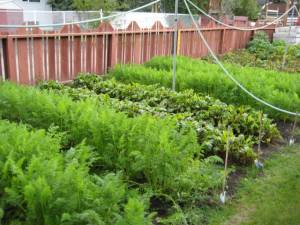
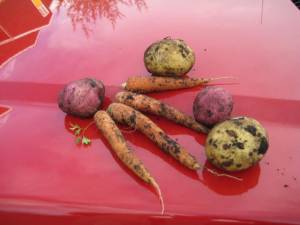
Had a great crop this year, and it’s not done. We just started harvesting. Wow. The vegetables are big. So I decided to showcase the vegetables next to objects you’d recognize….my pen, a bottle of T-3s, my truck.
The one next to the bottle made me think about the difference between something that comes out of the ground and something that comes out of a bottle. I like ’em both, but I think if I had more fresh garden vegetables that soon I wouldn’t need anything else.
The garden was a work of art this year. I am so proud of the labor that went into it, into weeding, into caring for it. The carrots are big and sweet, the potatoes rich. And the greens they grow so high…
Yes, the Greens They Grow So High
I learned a lot from growing the garden. The patience. The time involved on your hands and knees rooting out the chickweed. Sweating in the Yukon sun. These are mini-accomplishments, like trophies. And it’s a nice thing to do in the Yukon on these long summer days inside a quick and dirty summer–10 weeks, maybe. We had so much sun this summer. If you were thinking about leaving the Yukon after the last three summers, this summer wooed you back.
Harvest on a Red Truck
I’m gonna fix a sheep stew tomorrow–fresh Dall Sheep that was walking around last week (I did not shoot it, but I did help cut it up)–and fresh vegetables. A lot of work went into that stew and I’ll remember the two guys who trekked across the mountains in gale-force winds and rain to get this sheep to my kitchen. And I’ll remember the hours I spent in the garden waiting for the vegetables to get big enough to leave the garden and enter my kitchen.
And I’ll say to myself—hey, this cures whatever ails me–this summer stew.
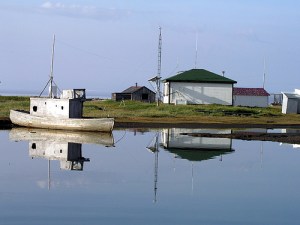
Herschel Island, a quiet pond, an old fishing boat, the old Canadian Signal Corps building--amazing photo by incredible photographer Hank Moorlag
Meagan Grabowski didn’t know she was coming up with a catch phrase, but a visit to Herschel Island for a couple of weeks, and she was a one-woman neologist. “It started at Pika Camp,” a remote camp for researchers a few kilometres away from the Kluane Lake Research Station. “We were coming up with an Inuvialuktan to English to Yorkshire dictionary…for fun…and the Yorkshire term for ‘it’s very cold’ turned out to be ‘positively Baltic.'” But when she was up for two weeks studying biomass on Herschel Island, and it got really, really cold, she slipped on the ‘baltic’ and said the weather was “positively Beaufort.” Meaning, it doesn’t get colder than that….the wet wind off the Beaufort Sea…beats everything.
Meagan was up there as part of International Polar Year, with a team of researchers, Scott Gilbert, Charlie and Alice Krebs, Don Reed, and others, all looking at Herschel Island as an ecosystem, finding out what made it tick, and how that information could be transferred, and compared, to other northern islands and our own Yukon high alpine tundra areas.
Meagan Grabowski is daughter to well-known taxidermist Tony Grabowski and you can hear more of her adventures up on Herschel Island, as well as how any young Yukoner can spend a summer in a such a positively Beaufort place. The last of my two radio shows this summer, coming Tuesday at 7:50am.
We’re hoping the weather stays warm for a long time, but in case it drops to -40 this winter, feel free to put “positively Beaufort” into circulation.
Flash Me Magazine’s All Fantasy Issue
FLASH ME MAGAZINE will be doing another ALL FANTASY ISSUE October 31, 2009. All stories submitted for the fantasy issue must contain some element of fantasy and be 1,000 words or less. The submission deadline is August 31, 2009.
Special guidelines apply, so please visit our website prior to submission. You can view the fantasy issue submission guidelines here.
The deadline’s coming up, and we’re still searching for spectacular stories – maybe yours??
Worldchanging.com is a nonprofit media organization headquartered in Seattle, WA, that comprises a global network of independent journalists, designers and thinkers. We cover the world’s most innovative solutions to the planet’s problems, and inspire readers around the world with stories of new tools, models and ideas for building a bright green future. We have brought awareness to issues like refugee aid, renewable energy and innovative solutions for improving building, transportation, communication and quality of life. Our readers are ready to change the world, and Worldchanging connects them with the latest ideas on how to do that.
In the five years since its founding, Worldchanging has produced more than 10,000 visionary articles and one bestselling book. and has become a go-to source for forward thinking, solutions-based journalism that takes a big-picture approach to sustainability. This approach has garnered us a great deal of attention, as Nielson recently ranked Worldchanging.com the second-largest sustainability website on the planet.
Our international network of experts and allies seek out new systems and ways of living from around the world. They report on those ideas with a healthy dose of curiosity and analysis, and ignite discussion and debate with you via comment threads on every page. Through our work, we introduce intelligent reasons for believing that action is possible, that better solutions are available, and that a brighter future can be built.
The blog is full of good news, and the newsletter is free. Find out what’s happening to make the world a better place.
WORLDCHANGING WAS FOUNDED ON THE IDEA THAT REAL SOLUTIONS ALREADY EXIST FOR BUILDING THE FUTURE WE WANT. IT’S JUST A MATTER OF GRABBING HOLD AND GETTING MOVING.
Blog entries are contributed by correspondents all over the globe.
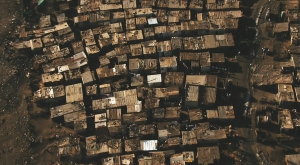
District 9, Neill Blomkamp’s stunning directorial debut, is an intelligent science fiction movie, a disturbing Apartheid metaphor, but it might also be, unintentionally, a good look at the coming Global Diaspora and the problems of moving a whole nation of people inside another nation.
The film asks what a country does when they are inundated, suddenly, with refugees or displaced peoples. Johannesburg has a huge mothership hovering over the city, malnourished aliens trapped inside, and the city must make a quick decision. To help or not to help? They help. But the problem of fitting a nation within nation becomes more than what the people can handle–more than what they want. Long term care. The people on the ground don’t want a whole nation moving into their world–people so alien. The government had no precedent for what to do. I know that Blomkamp is aiming for an Apartheid metaphor, but the sins of Apartheid will become our sins if we don’t come up with a plan on what to do with displaced peoples in the coming decades.
If Climate Change is occurring–whether man-made or not (the arguments shouldn’t stop precautionary measures)–Tuvalu, the island is sinking, and so are a number of other islands. Their sinking isn’t the only problem. The more water on the island, the more threat from disease, the more threat from storms, etc. A very real scenario is that island populations will be forced to find other places to live–on the mainland. That’s not a science fiction solution–that’s a practical prediction. These migrations are not a bit of immigration for one country. With the number of island nations we have in the world, this will be a LOT of immigration for every country.
How do you put American Samoa inside Kansas, let’s say? A nation within a nation. WIll there be sovereignty issues to think about? Yes. What control do Samoans have over their life if they are in Kansas? Or the Japanese inside Mainland China, or more likely, Canada?
Climate change isn’t just about some places getting hotter or wetter; it is about changing the map entirely.
District 9, then, plays as a fable of what NOT to do, what CAN happen if governments are unprepared to consider wider immigration revision, sovereignty issues, incorporating whole cultures within nations, relocation plans. I believe in the next thirty years that this will be a reality—that we will look at the country we’re living in and find separate, but integrated, countries within them, that people who lived on islands will have to choose new homes, erect temporary governments. They will need everyone’s help.
We can’t make it look like the photo from District 9 above. But we have to have infrastructure prepared for a global movement of people. I wonder when countries like ours in North America, China, Russia, with large land mass, and whole sections with low population, will realize that they may become the destination of a nation. Johannesburg in the movie was caught off guard. We don’t have to be. We can be ready for large scale movements of people, ready to know how to integrate cultures.
Canada has had some good prep already. Known to be a country which allows new immigrants to keep their cultures intact, and a country that has been negotiating Land Claims and First Nation Sovereignty issues, they might start looking at ways they might use their plans for the Final Agreement on Land Claims to accommodate millions of new people looking for a home.
I know, it’s freaky to think about, but I don’t think it’s far down the road.
Immigration is about the resettlement of one or two families at a time, not whole cultures. Refugees from Darfur come closer as a model. Look at how that played out. 4 Million people were displaced in Sudan, and into Chad. People escaping destruction. They are still recovering, even as half of those people have returned home. But what happens when it’s the whole nation and they can’t go back? What do you do about their governments, their cultures, their possessions, integrating them into the workforce? Can we wait to think about this? Or will we have to build our own crudely-constructed District 9? We are used to solving these problems by solving the political conflicts within a country—but water doesn’t recognize diplomacy.
Imagine, if you will, a large room, completely dark. The room is crowded with people, most of whom you can’t see. Only those next to you can you see dimly. You don’t know what others are doing, thinking, or what they look like.
However, a flashlight comes on and you can see a person, and also hear what he is saying.
Let’s say he’s ranting about something. There is a murmur in the darkened crowd, and suddenly six other flashlights pop on. The people highlighted now chat about that rant. No one in your area. But you can see all the others and hear them talking about it.
Then a strong murmur sweeps the crowd and seventeen new flashlights pop on, the people responding to the first flashlit rant. Sometimes, you notice, they try and correct the rant, sometimes the person rants about the rant, and occasionally a spotlighted man or woman will talk about how this rant is felt through the entire room.
But you don’t know what everyone else is thinking about the rant. And even more importantly, you don’t know if they would have been thinking about the rant had the first person not been flashlit. Why was that person flashlit in the first place? Hmmm. Maybe those with flashlights enjoy the reaction of the crowd, or they may be paid by someone to flashlight on a regular basis, and sometimes those with flashlights are concerned about other people with flashlights getting more attention.
This is Media.
I work for the media, and I know that my flashlight is used to highlight something I want people to know or talk about. To keep my job, I have to have things to light up. To move up the career ladder, I must highlight things that will get people talking–and even to flashlight more people talking about what I talked about–to create the bigger murmur. I can either join the chorus of voices, lead the chorus of voices, or attempt to highlight something else–and wrest the focus, the murmur of the crowd, the other flashlights, on a topic I want to highlight.
Recent articles on Sarah Palin forget one thing–they turned the flashlight on her. Her Facebook page is one of a billion Facebook pages; her opinion is one of a billion opinions. She has no more sway if we don’t flashlight her. We would never have known about her Facebook page, except that someone with a flashlight wanted to get the crowd’s attention. Media control people’s knowledge and awareness. In that darkened room, no one really is aware of my opinion without the media. My blog comment here will reach exactly 120 people over the course of my life–only because these are my friends and they don’t need a flashlight to see me. I’d be lucky if this post made it outside my close circle of friends. My opinion here couldn’t make the murmur happen–and flashlighting someone without the expectation that this will cause a murmur is a waste of batteries, it seems. Fluff stories. Feature articles to pass the time.
I hope as new technology transforms all of us into Media—with our own flashlights–that we choose carefully what to highlight–that we don’t spread the rants of bigotry, lies, distortions, and divisive arguments around the internet or TV. Let’s choose truth to highlight–even ugly truth, but we make sure it is truth first.
As flashlighters in a darkened room, we are responsible for vetting what we highlight—we are asking the whole room to turn and look at us. We are asking the whole room to think about what we are flashlighting them to see. What we flashlight may not be indicative of the thoughts of the whole room, but it can influence people so much that other people will think they are the thoughts of everyone, might even change their minds, or it might cause them to assume that the whole world is thinking this or that. Gradually, that assumption will win over naysayers.
You can use this to the world’s detriment, or use it to sway the world for its good. Palin may cry foul over the media’s flashlighting, but she loves the light. And she knows how to manipulate it. You can END this story by turning the flashlights off of her. Ignoring someone is the fastest way to shut them up, to make them irrelevant. You can kill “news” by putting it in a vacuum. You can choose to flashlight INTELLIGENT opposition, not lies. It doesn’t help the Republicans or the naysayers to the Healthcare plan to continue spotlighting Palin’s rants. Turn off her light; let smarter voices be heard.
The media, ultimately, is responsible for the life of a bad, or good, story.
Please, for the sake of our time and sanity, stop highlighting things that tear down truth, and spotlight the truth instead. You can still get the murmur, get the crowd talking. We have to train the crowd to murmur against real injustice, murmur about the making the world better–something that makes a difference, not that makes a buck out of a murmur.
In the dark, the flashlights are the only way anyone can see. Use them well.


 Me looking adventurous and small.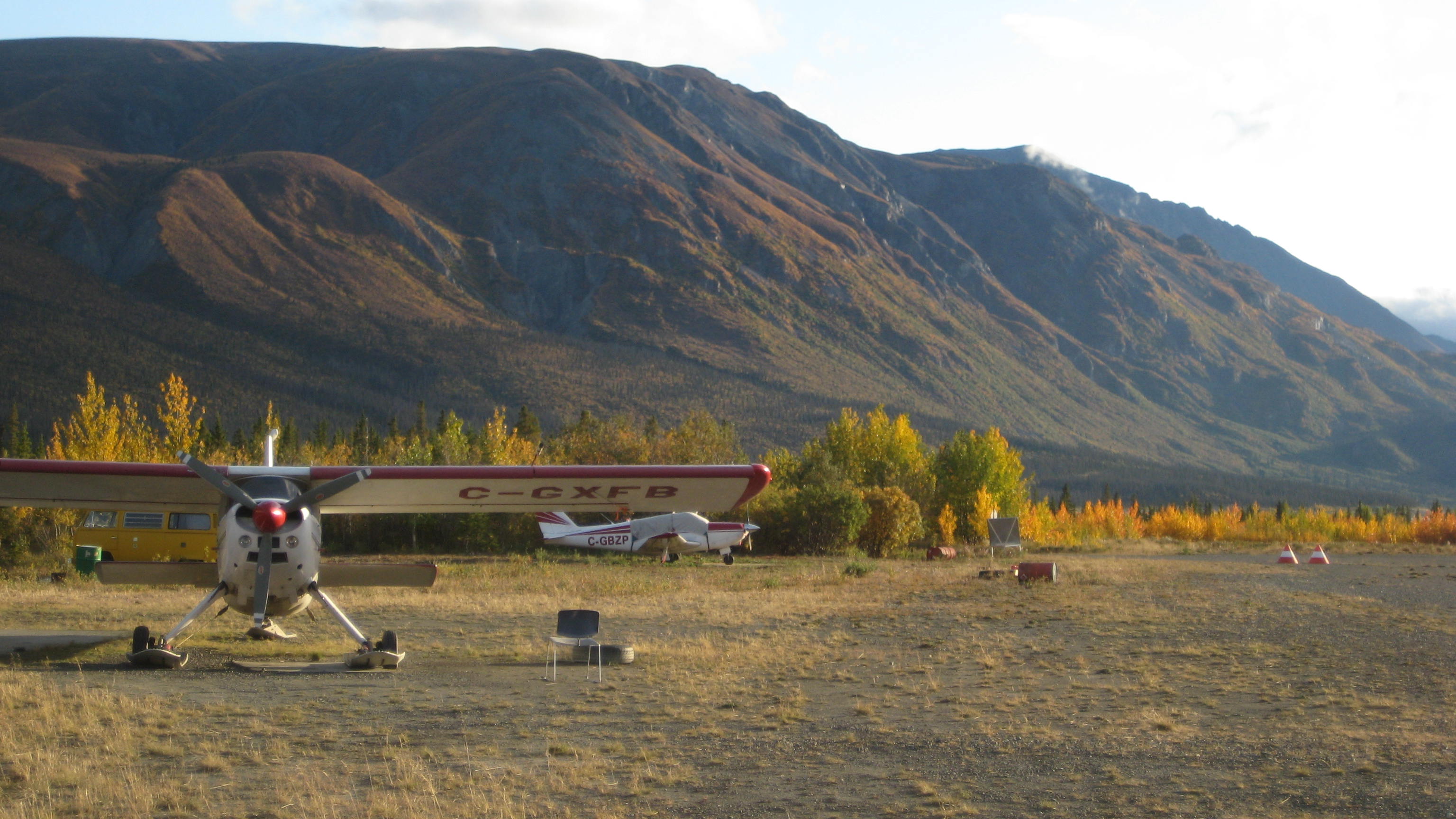




 WORLDCHANGING WAS FOUNDED ON THE IDEA THAT REAL SOLUTIONS ALREADY EXIST FOR BUILDING THE FUTURE WE WANT. IT’S JUST A MATTER OF GRABBING HOLD AND GETTING MOVING.