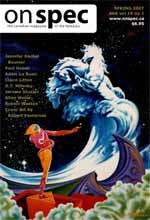
Hearing me read my story in On Spec [online]

os_spr07Hey, you can hear me reading from my science fiction story, “Why the Poets were Banned from the City” online at On Spec: Follow this link here.

It originally appeared in the Spring 2007 issue that you see on the left. What I loved about the cover art by Robert Pasternak is that it is a wave of white horses, exactly how Whitehorse was named (for the rapids and their uncanny resemblance to white horses). It was a nice piece of synchronicity for me as a writer.

The piece is only 5 minutes long, but you can read the rest in the Spring 2007 back issue.

Much gratitude to Diane Walton and Colin Lynch of On Spec for asking me to do it. And for a great friend who helped me record it. Thanks!

On Spec is dedicated to publishing Canadian Speculative Fiction and is always looking for more. Hop around on their website this holiday and see what they’ve got.

Jon Stewart on Canadian Politics

Jon Stewart sees beautiful PLOT  up here in Canada –Yes, kids, Canadian Politics can be unpredictable! fun! full of intrigue!!  I’m learning more about Canada in this political showdown than ever before.  And if you watch Stewart, you’ll learn a bit about what his audience knows about Canada.  Apparently they don’t understand the whole GG Connection thing either!

Why You Should Subscribe to New Scientist, and why you have to put it down

phpthumbScience Fiction writers have a strange relationship to science. To write compelling science fiction, I think a writer has to do some research. Where would Crichton’s Jurassic Park have been without Chaos theory and real-life paleontologists? And you want your ideas to be ahead of the game, so get yourself some subscriptions.

I know, we are poor bastards and we can’t afford very much–certainly not expensive subscriptions.

I don’t think I could get more (Big) bang for my buck than through New Scientist. You can too.

1. It’s weekly. Meaning that when science is advancing, New Scientist doesn’t have to wait two months to come out with an issue. Discover is a monthly, and it’s a nice mag. But it can’t compete with 65-75 pages a week chock full of insightful articles.

2. It’s got short blurbs and longer indepth articles, and these can be read–some of them–online. Let me give you a sample of what’s out right now:

Why the Universe may be teeming with Aliens

Are Daughters-in-Law to blame for Menopause?

A healthy planet? Top 10 articles on the Environment in 2008

The glass universe: where astronomy meets art

Creationists Declare War on the Brain

These are the longer in-depth articles, yes, but the magazine is FULL of shorter articles. Shorter articles stimulate creativity in a way that is beneficial for a creative writer. You want a magazine that has plenty of short articles on broad topics–a whole mess of ’em.

3. It covers a lot of areas: space, environment, sex, health, physics and math, tech articles…. that’s good. Coming out once a week, it allows the magazine to be current on several areas. It allows you to cross-pollinate ideas.

4. It’s cheap. Yep, it’s from Britain, but it’s 36 bucks for 6 months or 24 issues. You can sign up online here for a subscription. Or you can browse the website first. With a subscription you get the magazine delivered to your door in uninterrupted service, and you get online access to back issues 24hrs a day. It’s cheap and it comes to you. If I had to have just one subscription to a science magazine, I would keep this one.

Writers of science fiction should certainly start with the stimulation that comes from reading science magazines–BUT, and this is where it gets interesting, I think they shouldn’t be bogged down in the details. If you are predicting the future, look how fast the present changes. I just did a radio piece talking about dark energy–which is about to be out of fashion, passé, even illusory–but in twenty years?? In fifty years?? It may be all the rage.

Science fiction writers need to be able to extrapolate from data, yes, but they also need to be able to make the Leap. Leaps are about prediction beyond what can be extrapolated. Go someplace wild with the information. Don’t be afraid to be wrong in twenty years, or in two weeks. Make it believable. But not predictable by any physics grad student. Combine fields, combine theories, and then move beyond them. Sure, it’s not real. But that’s the point of writing fiction–to be brave enough to make the leaps that science isn’t allowed to without hard fact.

If science fiction actually does lead the way in technology and science–then we’ve got to lead by going beyond what the best scientists can predict, and certainly past what the public can imagine. That’s our job–to help people imagine a believable, but still surprising and entertaining, future. That’s where your stimulated brain comes in handy……

You can start seeing that future by picking up a New Scientist issue, but you can’t create it till you’ve put the issue down.
Leaving America is All Here

Okay, I uploaded the rest of Leaving America.  All seven episodes are there.  Some of you heard this in a 5 episode run–don’t know what they (Toronto) cut, but they went from Seven 6.5 min episodes to Five 5 min episodes.  Here are the original versions where you even get to hear me do a bad Tiki Chorus at the Ft. Nelson hotel….forgive me.  I was having too much fun.

The 4000 mile road-trip journey is full of immigrants, storms, wild and woolly Oz, screaming Heads, funny interviews, a little history, a little death, a lot of song, and many hidden science fiction references–especially in the music.  After all, immigration is about being an alien who finds a home.

And that’s pure science fiction.

I want to thank everyone who allowed me to talk with them along the way, my family, my friends, CBC and Arnold Hedstrom for funding it and giving me complete creative freedom, the great musicians whose music runs through this.  And to all the listeners who liked it and told me about it.  Thanks for liking my story.

Enjoy.

Leaving America Is Up

Hey folks, just placed the first three episodes of Leaving America, my radio series about my immigration journey, up on the site–as its own page.  I’m sorry you have to click on two separate pages–but I’m not as familiar with WordPress as I’d like to be.  Still, I’m very happy that the files are up somewhere.

Hope you enjoy them.  I will put up a page for Yukon 2058 as soon as the series is done on CBC.  They will not be putting them online, so I can place them here for those who missed episodes.

Thanks for your encouragement and kind words.

Jerome

Times to Hear Yukon 2058

Illustration from The Arrival by Shaun Tan

What do you think will happen in 50 years?

Starting Monday, you can hear Yukon 2058 at 7:20 and 4:50, daily through Friday morning,I think. It will also be on the website for CBC North if you miss it. It’ll be there for 24 hours.

Yukon 2058 is my speculation on what the North will be like in 50 years, written in honour of the 50th Anniversary of CBC in the North.

You can read more about the series here. Hope you enjoy my vision of the future, and please tell CBC about your vision of the future. You can make it happen by imagining what you want first. Remember, we create the future. Illustration from The Lost Thing by Shaun Tan

Illustrations here and above by Shaun Tan. I like to think of this one as the pot we grow the future in. Look at all the things the kid is throwing in there.

Educate me: What is Harper doing shutting down Parliament??

Let me get this straight: Harper can suspend parliament when he’s afraid of a no-confidence vote? What’s the point of having the power to oust the PM if the PM can stop the vote? And what kind of a third world country did we suddenly turn into? How can this be okay? How can a GG, representing another country–in a way–sanction this obvious grab to retain power.

Okay, I’m an American and I’m lost. I realize that. I’m also a permanent Resident of Canada, legally landed in a new country that feels like a third world country when I read headlines like this: Harper Suspends Parliament. Imagine if you read that Thailand suspended its parliament, or Russia, or if Hugo Chavez had suspended the Parliament of Venezuela (they may not have one anyway….)

Wouldn’t we think that was completely un-democratic? That a power-mad mogul had locked himself into power? Wouldn’t we think of that man as a dictator? Chaos? Cats and dogs sleeping together?

Help me out: how is Harper okay doing it when Chavez would be considered a dictator if he did it?

Yukon 2058, the radio series, starts Dec. 8

Well, it’s official. Yukon 2058, my newest radio series premieres Dec. 8th on CBC. They’ll play it in the mornings, in the afternoons and have it available on their website for 24hrs. If you miss it, you can go to their CBC North website.

What is it? It’s a story about a man who is working for CBC in 2058. By then, CBC is small. Only a few employees. Our hero, Michael, is wondering if he’s making a difference in the north. And he’s tempted by the offer of a job to go down south. But to get the job at CBC in Toronto–he’ll need three big stories. Can he get them? In a world where everyone can interview anyone at any time by patching into their earbud, news stories travel faster than they can get finished happening. Reporters tumble over each other to get scoops. But CBC North doesn’t work in scoops–they play by other rules.

Come to 2058. You’ll find trade wars over the Northwest Passage, mammoth hunting in Vuntut National Park, the creation of West Canada, a growing population, Holland America trains everywhere on magnetic rails, and kids you know all grown up and become important in the Yukon. Come find out what may happen to you in 50 years, what may happen in the Yukon. It’s not all bad in the future–it’s just different, and the future starts Dec. 8th. Or at least my version. Hope you enjoy it!

New Market: Federations Anthology–Get your Star Trek on!

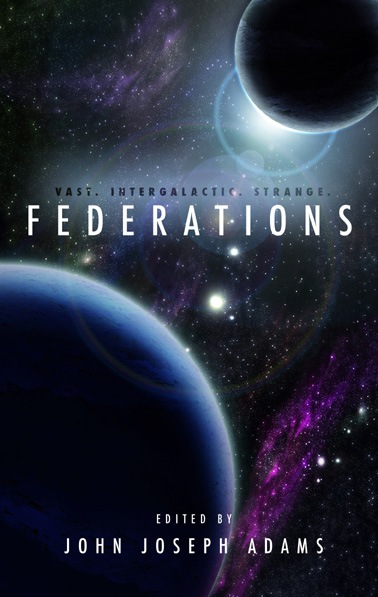
federations_3All right, Science Fiction Writers, you have another cool opportunity for publication. Remember back when you and me were discussing writing for Star Trek? Well, John Joseph Adams, editor of this year’s fun anthology of zombie stories, The Living Dead, (which has a great story from my BFF Catherine Cheek) is looking for stories about the impacts of far-flung galactic empires in a new anthology called Federations. I quote from his guidelines:

What are the social, religious, environmental, or technological implications of living in such a vast society? What happens when expansionist tendencies on a galactic scale come into conflict with the indigenous peoples of other planets, of other races? And what of the issue of communicating across such distances, or the problems caused by relativistic travel? These are just some of the questions and issues that the stories in Federations will take on.

So, if you have an idea you’d like to explore in an intergalactic empire sort of way, in 5000 words or less, submit it to Adams by Jan 1 2009. We may not get to write for Star Trek, but we can write out our Trek-like visions and still discuss the same issues in this anthology–and that may be a better thing than boldly going into Roddenberry’s universe. We get a universe of our own to play with.

The Short Happy Life of “The Snowman”

Okay, it’s going to get Christmasy soon, so I thought I would try to shape the Christmas I want. I think we all do it. Through decoration and choice of songs and events, we shape this important holiday. Well, I’d like to craft my holiday with “The Snowman,” my second favorite Christmas story, next to Jesus.

“The Snowman,” Raymond Briggs’ christmas story made into a wordless film about a boy who goes on a midnight adventure with his snowman–complete with a flight up to the north pole to dance with a whole bevy of snowmen, and a brief encounter with Claus–is beautiful and heart-breaking. The music that accompanies the story brilliantly illustrates the emotional mood of the story, and if you’ve ever heard the main song sung in the film, it probably gave you chills.

That driving piano rumbling–that rolling and rolling in a minor key makes the moment exist between wonder-filled and ominous. Some of the scenes of the flight show a whale as a shadow in the water; some have the boy almost falling; but through it all, the snowman keeps a-hold of him, and the other snowmen fly in formation like blue angels around the pair as they glide over a winter landscape.

With every snowman story there is a theme of how temporary life is. Even Frosty the Snowman lives a short happy life. I love how “The Snowman,” without words, is able to put the joy and sorrow of friendship in one story.

And there’s something about this scene that makes me long for a snowman of my own, someone that still might take me on an adventure. I’d like to think that’s the kid in me, maybe. But I know it’s something more grown-up and universal–a longing for companionship, a feeling of being chosen, and desire for the world to have real magic somewhere–a little surprise still.

Maybe this Christmas, eh?