What a difference the right church makes, eh? For queer and trans people, the right church can be a matter of life and death.
I grew up believing that you look for churches within the denomination you were raised in, and pretty much, if you stayed within those safe theological walls, you’d have a good experience, one that you were used to. Familiar. Like Church Branding. Stick with the Brand Name and you’d have the quality and taste you were looking for. If you grow up in “the church,” that concept is so ingrained in you. More than the brand of jeans you buy, your favorite burger place, the make of your car, even the teams you root for. None of those choices would affect the next ten thousand years of your happy eternal life. You will stick to your brand pretty strongly.
An “off-brand” church is an unknown path. I was raised to believe that Baptists (somehow) hold the Truth about Everything Spiritual and that Presbyterians were slightly off–like 10 degrees off to port. I know this is ludicrous, but follow the bouncing logic here…
“Open my mouth, and let me bear gladly the warm truth ev’rywhere; Open my heart, and let me prepare love with Thy children thus to share. Silently now I wait for Thee, ready, my God, Thy will to see; open my mouth, illumine me, Spirit divine!”
— Clara Scott (1895) “Open My Eyes that I May See”
What is it that we need to say today?
The loudest Christians, the ones interviewed, the ones that are commentators on roundtables and talk shows and discussions are conservative evangelicals. They are considered the “other side” of the argument when it comes to the value and worth of the lives of trans and queer people. I don’t like the premise. We should not be up for debate on whether we should have marriages, teach your kids, serve in the military, go to a public bathroom, or in some conversations, whether we deserve to live.
On the bright side, there are thousands of churches and many denominations of religion and faith that accept and affirm LGBTQ people as worthy of love and equal status and the right to choose their expression. I have been privileged to attend several churches like that in my life, but I know of many many more. The problem is that we just don’t hear those churches very often on the screens we are watching. Reverend Budde of the Episcopal Church made such a strong statement for the worth and care of every individual on the Inauguration of DT. She had a platform and she used it.
We don’t always get those platforms. Perhaps we are not naturally loud people. But we are going to have to speak up louder because a) people seem to think that Christianity and being LGBTQ are incompatible (they are not–and there are great books and websites which will explain the details to you if you are fuzzy on them or unsure), b) Queer people have been so hurt by evangelical churches that they can’t see the churches that will celebrate their true selves. There are whole denominations of Episcopalian Churches, Presbyterian Churches, United Church of Canada churches, United Methodist Churches, American Baptist Churches, just to name a few, that have fought for queer and trans inclusion so hard as to have endured a split in their denomination to do it.
I heard a sermon Sunday about one such divisive vote in the United Methodist Church.
How do we protect those we love from those who question their very worth, their humanity, their right to exist? How do we protect ourselves from that constant batt-le?
Bears are pretty powerful all by themselves, but sometimes armor is called for. Bears have claws and poundage and teeth and jaws. But these are bears I found inside music–and they work differently. In the Bible, Paul talks about putting on the armor of God–and describes breastplates of righteousness, helmets of salvation, sword of the spirit, etc. Far be it from me to edit SAINT Paul– known for his perfect wisdom about what to do with women in the church, about singleness, about sexuality– but I’m going to anyway.
The bears I had didn’t defend me by attacking others; they defended me by empowering me and equipping me with better armor, better defensive structures.
They gave me a Helmet of Empathy– a way to see others struggling to see me, a way of understanding where they were coming from so that I could see them as worthy of love too; frankly, a helmet of Salvation further divides us into “saved” and “unsaved,” worthy and unworthy. Empathy makes us all worthy of being saved, protected, understood.
In my new job, as a tarot reader (spiritual life coach), I meet a lot of people who have barely survived evangelical churches. A lot. Many of them are queer like me. Others may not be queer, but they too got judged, hurt, ostracized, and/or punished for years by a church.
Our shop, The Sacred Owl and Salt Room is a sanctuary and a destination for people in East Tennessee who want to still connect to their spirituality and their faith but they don’t know if a church and steeple should come with that faith. And that’s completely understandable. Who goes back to the places that hurt you? Or even the ones that look like those places? However, something is still calling to them, and they don’t know what it is, but they want to hold on to part of the faith they were brought up in, but leave behind the exclusion, the judgement.
They want a God who is strong enough to hold them, but loving enough not to hurt them.
They want this for themselves and they want this for their kids.
“All Our Griefs to Bear,” Jerome Stueart, (11 x 17), watercolor, mixed media on paper. Part of the Bears in the Baptist Hymnal series.
Bears were symbols for the protection I felt through music–through singing the word, “bear,” every Sunday, as if God were speaking to me and sending me strength. It helped guard me against the criticisms I received or the feelings of doubt. I wish all our LGBTQ folks still in conservative, evangelical churches, in communities and towns and cities full of evangelical church goers, this kind of protection–whether they, like me, need to mentally imagine a bear protecting them, or whether they need us to be that protection. Be the shield. Be the Bear. Be the physical, verbal, soulful protection they need to survive the horde of negative onslaught in their daily lives, in the news, in legislative and judicial places. They need us to stand with them, shield them. They too are holy. They too are divine. They need to be protected. Be the shield, be the bear, be the protection that bears their grief, bears with them the barbs and arrows aimed at them, strengthens them with presence and love so they can find safety at this time.
Queer and Trans folks have always been a part of churches, supporting them and bearing them up. You just might not have known who they were. Many chose to stay quiet and serve the church–a job they love–rather than risk that good work by coming out.
I remember once, in 2004 or 2005, when I had returned to the US after discovering I was gay, I was dating the pianist for an MCC church in Lubbock (a church that was created by and for and served the LGBTQ community and anyone else who wanted to participate and enjoy). He took me to a secret Saturday Board Game Day for queer men. These were friends of Jay, and met in someone’s home. They were all in their 50s and 60s, playing Snakes and Ladders on folding tables, laughing and calling each other “old queens.” I felt accepted and loved and pulled in to this “secret” meeting. Why was it secret?
They were the music ministers, pianists or organists at local churches in the Lubbock area. They were all closeted, except for the man who brought me there, and they told me stories of “little old women” who loved them because they reminded them of Liberace. And they would laugh, but you could tell that they loved being loved— who doesn’t?
But they couldn’t come out. They were beloved by their churches—but they were certain it would all disappear if they came out.
Every straight teen boy could stand up in a congregation and announce that he was engaged to the girl sitting beside him and the church would cheer for them, but for these men, they couldn’t talk about who they loved, and if they did, they had to mask. It was necessary to keep their jobs, homes, livelihoods, friends, all of it. Coming out in a church in Lubbock, you could just as easily trip on a snake and be sent to the bottom of the board.
Even in these conditions, in George W Bush’s America of 2004, 2005, a re-election won by scaring conservatives about gay marriage, these men, these “old queens” were happy to be here in this house, free to be themselves, playing games and reassuring each other that they were not alone. Their energy and joy was their survival and rebellion. They continued to serve their congregations that same energy and joy–and they were responsible for the feelings people had coming to church. Their joy translated into joy for everyone who came; their love for the music or the arts or the theatre had a ripple effect on everyone. They bear up the souls of every member of the congregation. I celebrate them today and hope that in the future they can all be fully loved and celebrated and affirmed for who they are in every aspect.
The song on the rainbow music here is “Be Still My Soul, the Lord is on your side. Bear patiently, the cross of grief or pain.” Let’s celebrate and send love and support to all those who love to give us joy through music and the arts in our churches (and in other areas) even when they have to erase part of themselves to survive in their churches. I hope there is a secret Board Game Saturday in all the cities for all of them.
_________________
“Bearing Up the Church,” Jerome Stueart, (11 x 15) watercolor, mixed media on paper. Part of my Meditations on the Bears in the Baptist Hymnal series. Prints available at Redbubble.
When I first came out, I stayed in my church for a year and a half to try and start a dialogue, and to help try and mend the rift that my coming out suddenly caused. I didn’t want to abandon friends and family that I loved. But I didn’t realize how hard staying in the church would be, and how much of a toll it can take on your mind and your heart to hear over and over again that God does not agree with you, and that friends are trying to tell you that you are wrong and need to change. It can wear your resolve down and make you doubt God and your own truth.
I used to tell others who come out to their church to stay, help reason with them and to show them love and to give them a queer or trans person to speak to and understand. But I can’t ask anyone to stay in a toxic environment–there are better churches, whole congregations out there who will love you, understand you and support you. Shout out to Whitehorse United Church and First Baptist Church, Dayton, OH for being two of those churches.
Go, my beautiful LGBTQ friends, families and allies, and find the love you were promised, free of judgment.
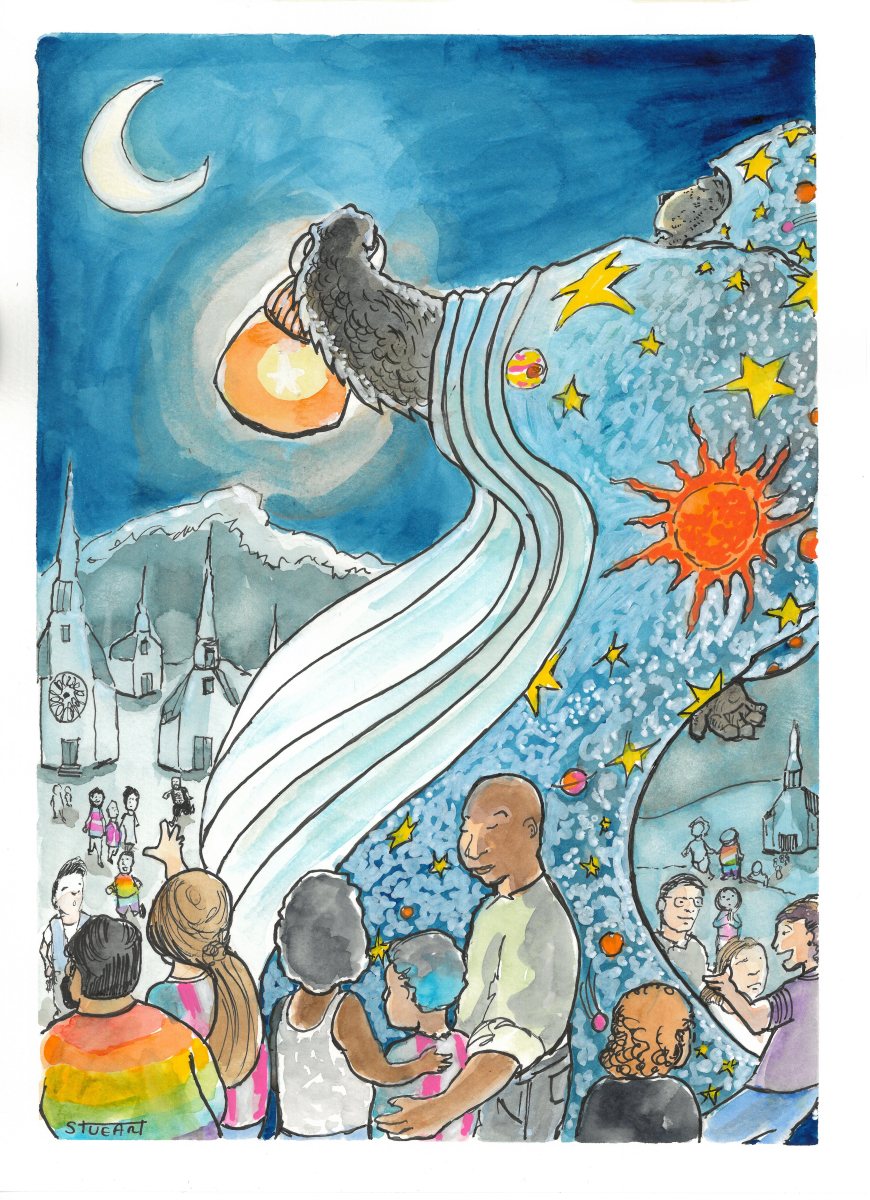
“Bear the Light,” (11 x 15) Jerome Stueart, watercolor, mixed media on paper. Second in the series, Meditations on the Bears in the Baptist Hymnal. Prints available at Redbubble in Bearnabas shop.
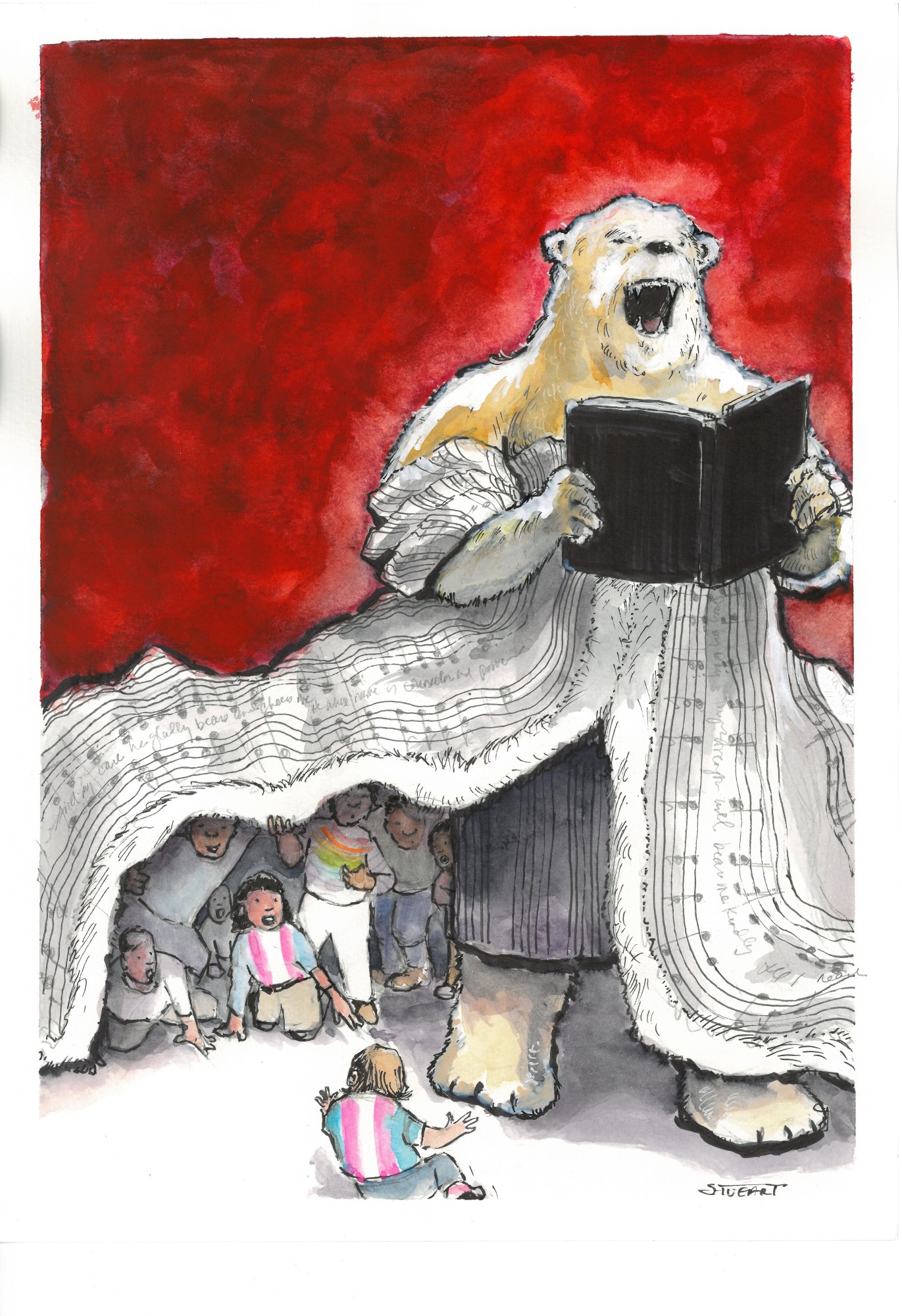
When I came out in 2009 to my church, it did not go as I’d hoped it would. But it was music that strengthened me. According to Hymnary, a database of all hymns and hymnals online, there are 6,165 bears in hymns that have been used in Christian churches. They might be “bearing the cross” or “bearing one another’s burdens” or ask us to help them “bear the light” or ask God to “bear us safely over.” Many hymns sung every week have a bear in them. Because I identified with the “bear” community of gay men, I felt like this was a little love note sent by God every Sunday to strengthen me, and so I would sing the hymns as I always would, but I’d be extra loud and strong on the word “bear.”
I’ve mentioned before that I had some leftover grief from that time fifteen years ago, some that bubbled up while I was watching Star Trek with Joey one night. I cried so hard and didn’t know why. I thought I’d worked through all of that years ago. So I went on a journey to find healing. Part of that journey involved creating 9 paintings that I want to share with you. They are images crafted by grief and pain and hope. I did them intuitively, just listening to what my heart was upset about, what it wanted to say, what it wanted to see. I discovered all these protective, strong bears were still there in my head and heart. Many of these paintings surprised me, but they also make my heart glad to see them. And I’m glad to start sharing them with you. I hope they make you glad too.
Originals and prints are available in the comments.
“Day by Day, He Gladly Bears and Cheers Me,” (11 x 15) Jerome Stueart, watercolor, mixed media on paper.
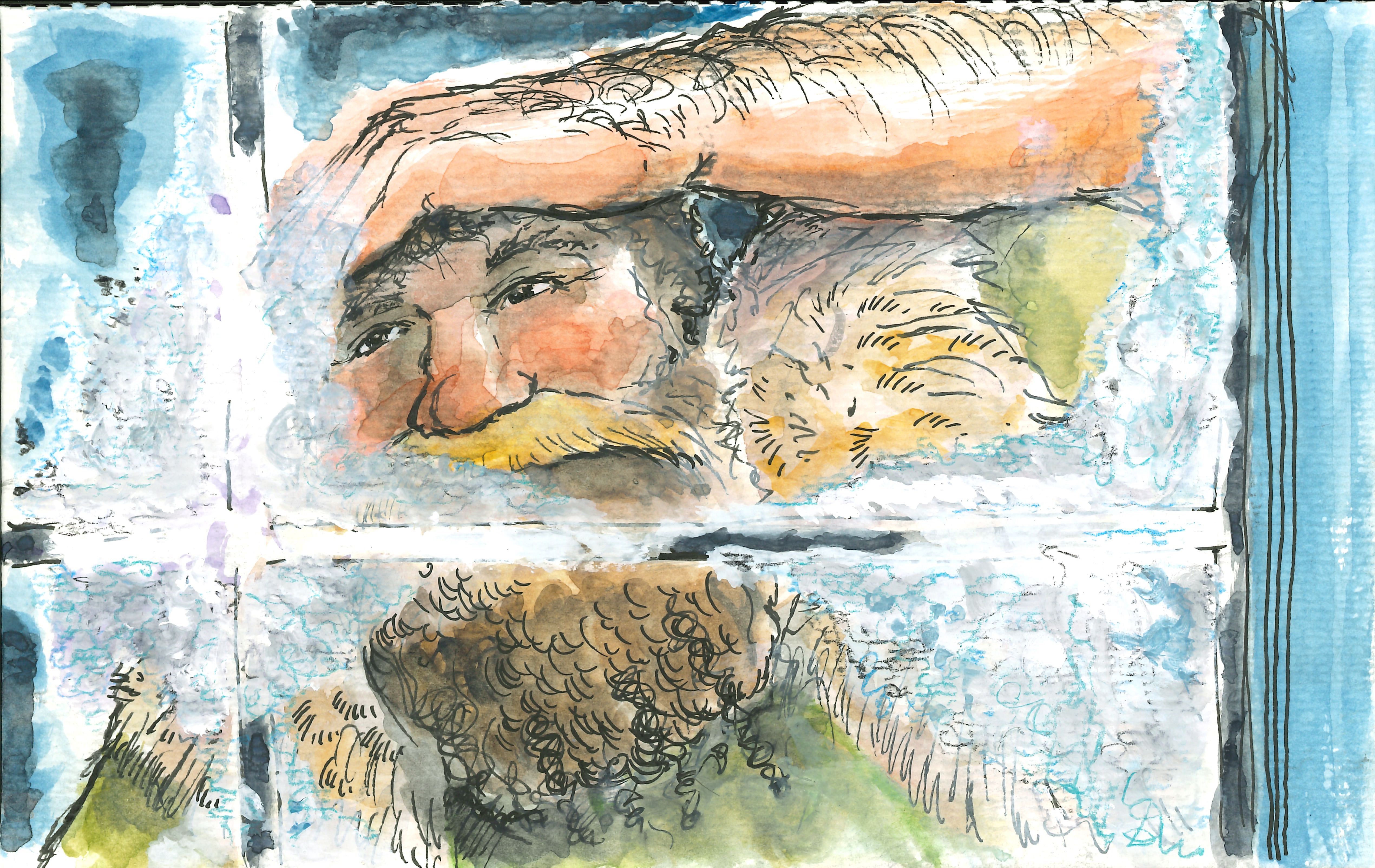
My Birthmother, Laurie, as a spiritualist on stage, listening to the dead who are trying to give her messages to relay to those in the audience. Part of the illustrations for the essay.
My essay, “The Dead Viking My Birthmother Gave Me,” is up over at GEIST Magazine online. It’s an essay about adoption, being queer, being lonely in the Yukon during Winter, and spiritual differences between a birthmother and son that include what one might do with a hunky centuries-old Viking spirit guide, and it’s all true from what I can remember.
Some of the illustrations that were published in the article that I did weren’t able to be put in the online version because of technical difficulties, so here they are:
(TW: this essay contains frank discussions about sex, sexuality, body image, religion and being queer.)
(a previous version of this essay originally appeared in Fat & Queer: An Anthology of Queer and Trans Bodies and Lives, ed. Morales, Grimm, Ferentini. Jessica Kingsley Publishers, 2021.)
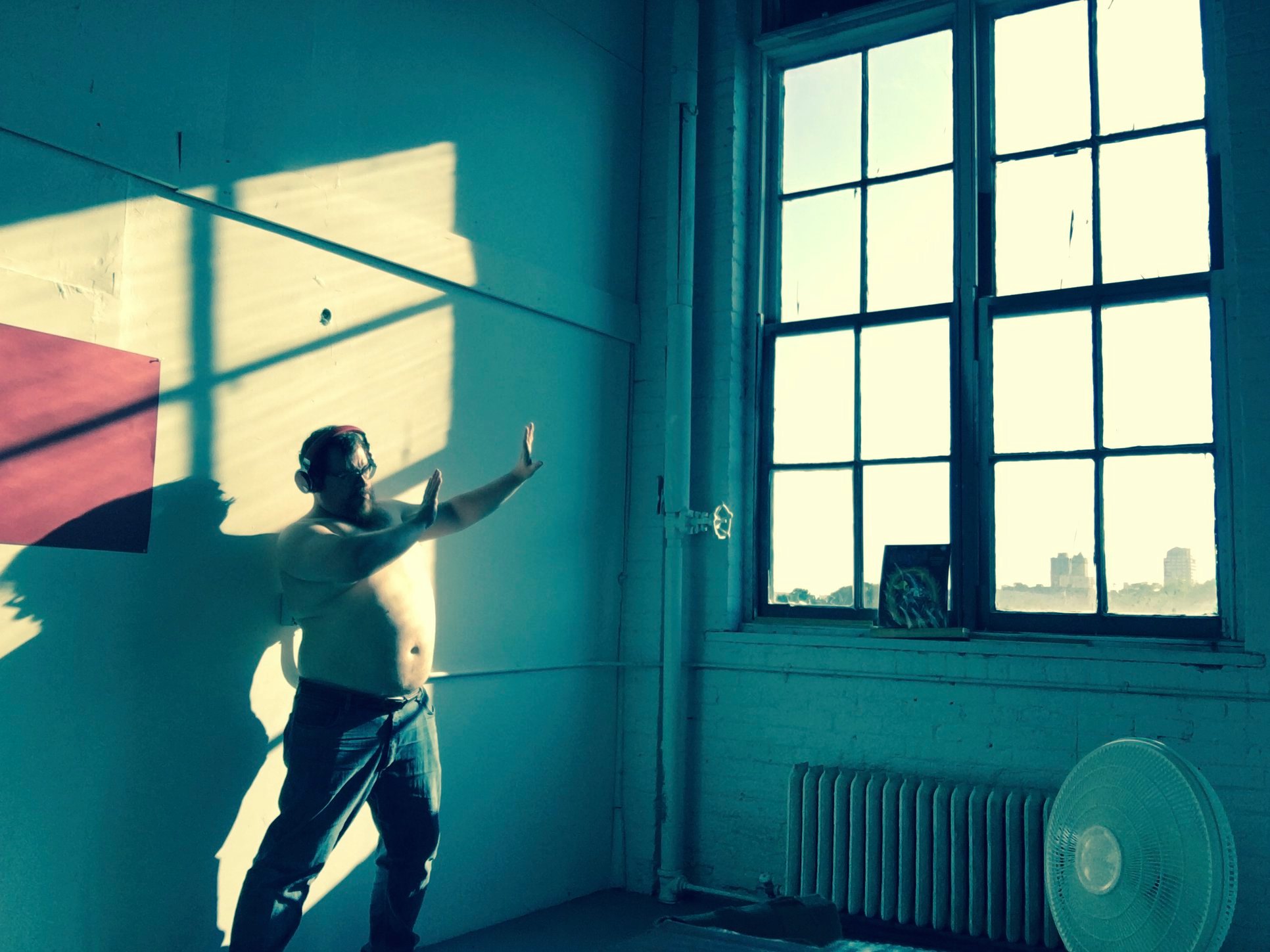
I had a little art studio for one year. A place for all my paints, my canvases, my artistic dreams. A place to be alone, to create masterpieces, to rock out to music, to be myself, to grow and learn.
Then, a year later, the art studio was completely erased, as if it had never been there.
All the walls were taken down; the room became a much larger gallery. You couldn’t find it if you didn’t know where it had been. If you didn’t know my window, you couldn’t see any fingerprint of where I had been.
While the studio was there, that brief year, it changed my life. It gave me a better understanding of my body — something I had never really seen before. It gave me back my sexuality — something taken from me by evangelical churches. It let me see myself as a work of Art — something I never would have believed.
While I struggled to create art, the studio worked on creating me.
For decades, Front Street Studios in Dayton, OH, had used an old Singer Sewing Machine factory as living space for artists. A set of imposing red brick buildings, some two story, some three, with giant fifteen foot windows, sat next to a very active set of railroad tracks, with a river not far away. Over a few decades, the old factory had gone to seed, become unlivable, a place for drug deals and fire hazards. A few years before I got there, it was taken over by new management. The new owners cleaned it up, bought out whoever was still there, and turned it into studio spaces for artists, with open studios twice a month where people from Dayton could come through, wine in hand, and visit your studio and buy your Art. The new owners brought in live bands outside, sold burgers and hot dogs on those open studio days. You’d never have known the place was abandoned and trashed just a few years before.









 Bear Witness