How Science Fiction has influenced Space exploration: video

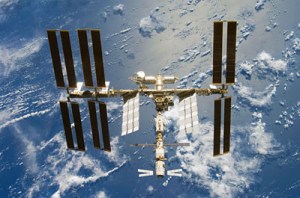
s124e009982_lThe European Space Agency has a wonderful educational video (which you can hear in any language you like) that tracks the inspiration of science fiction on space exploration. Going back to Jules Verne, the ESA makes the case that inspiration pushes science. “A lot of space scientists are actually science fiction writers.” And vice versa: Working scientists become sci fi writers, and help Science make the Leap. Let’s not underestimate inspiration–without it, people don’t think of launching rockets into space, and sometimes a writer can shake out a problem that science faces by making those leaps–but don’t take my word for it. Watch the video. It’s really good and only 6 minutes long. Here’s the link.
Or if you can’t reach that link–here’s the address:

http://www.esa.int/SPECIALS/Space_In_Bytes/SEMNJ0STGOF_0.html

If you are a teacher, on the right at the website you’ll see lesson plans to go with the video. Inspire your students to write science fiction that will inspire scientists, or inspire your future scientists to read science fiction. We’ll all benefit from the cross pollination of ideas.

(I found this link on http://www.planet-x.com. Thanks!)

Clarion 2009 open for submission Jan 2-Mar 1

Announcing the

2009 Clarion Science Fiction and Fantasy Writers’ Workshop

@ UC San Diego

June 28 to August 8, 2009

The Clarion Workshop is widely recognized as the premier training ground for aspiring writers of fantasy and science fiction short stories. Many graduates have become well-known writers, and a large number have won major awards. Instructors are among the most respected writers and editors working in the field today. The 2009 writers in residence are Holly Black, Larissa Lai, Robert Crais, Kim Stanley Robinson, Elizabeth Hand, and Paul Park. The six-week workshop is held on the beautiful beachside campus of the University of California at San Diego .

Since its inception in 1968, Clarion has been known as the “boot camp” for writers of speculative fiction. Each year 18-20 students, ranging in age from late teens to those in mid-career, are selected from applicants who have the potential for highly successful writing careers. Students are expected to write several new short stories during the six-week workshop, and to give and receive constructive criticism. Instructors and students reside together in campus apartments throughout the intensive six-week program.

The application period for the 2009 workshop is January 2 – March 1. Applicants must submit two short stories with their application. Scholarships are available. Additional information can be found here.

For my testimonial, click on Clarion Page above.

Hearing me read my story in On Spec [online]

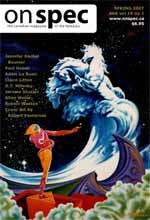
os_spr07Hey, you can hear me reading from my science fiction story, “Why the Poets were Banned from the City” online at On Spec: Follow this link here.

It originally appeared in the Spring 2007 issue that you see on the left. What I loved about the cover art by Robert Pasternak is that it is a wave of white horses, exactly how Whitehorse was named (for the rapids and their uncanny resemblance to white horses). It was a nice piece of synchronicity for me as a writer.

The piece is only 5 minutes long, but you can read the rest in the Spring 2007 back issue.

Much gratitude to Diane Walton and Colin Lynch of On Spec for asking me to do it. And for a great friend who helped me record it. Thanks!

On Spec is dedicated to publishing Canadian Speculative Fiction and is always looking for more. Hop around on their website this holiday and see what they’ve got.

Why You Should Subscribe to New Scientist, and why you have to put it down

phpthumbScience Fiction writers have a strange relationship to science. To write compelling science fiction, I think a writer has to do some research. Where would Crichton’s Jurassic Park have been without Chaos theory and real-life paleontologists? And you want your ideas to be ahead of the game, so get yourself some subscriptions.

I know, we are poor bastards and we can’t afford very much–certainly not expensive subscriptions.

I don’t think I could get more (Big) bang for my buck than through New Scientist. You can too.

1. It’s weekly. Meaning that when science is advancing, New Scientist doesn’t have to wait two months to come out with an issue. Discover is a monthly, and it’s a nice mag. But it can’t compete with 65-75 pages a week chock full of insightful articles.

2. It’s got short blurbs and longer indepth articles, and these can be read–some of them–online. Let me give you a sample of what’s out right now:

Why the Universe may be teeming with Aliens

Are Daughters-in-Law to blame for Menopause?

A healthy planet? Top 10 articles on the Environment in 2008

The glass universe: where astronomy meets art

Creationists Declare War on the Brain

These are the longer in-depth articles, yes, but the magazine is FULL of shorter articles. Shorter articles stimulate creativity in a way that is beneficial for a creative writer. You want a magazine that has plenty of short articles on broad topics–a whole mess of ’em.

3. It covers a lot of areas: space, environment, sex, health, physics and math, tech articles…. that’s good. Coming out once a week, it allows the magazine to be current on several areas. It allows you to cross-pollinate ideas.

4. It’s cheap. Yep, it’s from Britain, but it’s 36 bucks for 6 months or 24 issues. You can sign up online here for a subscription. Or you can browse the website first. With a subscription you get the magazine delivered to your door in uninterrupted service, and you get online access to back issues 24hrs a day. It’s cheap and it comes to you. If I had to have just one subscription to a science magazine, I would keep this one.

Writers of science fiction should certainly start with the stimulation that comes from reading science magazines–BUT, and this is where it gets interesting, I think they shouldn’t be bogged down in the details. If you are predicting the future, look how fast the present changes. I just did a radio piece talking about dark energy–which is about to be out of fashion, passé, even illusory–but in twenty years?? In fifty years?? It may be all the rage.

Science fiction writers need to be able to extrapolate from data, yes, but they also need to be able to make the Leap. Leaps are about prediction beyond what can be extrapolated. Go someplace wild with the information. Don’t be afraid to be wrong in twenty years, or in two weeks. Make it believable. But not predictable by any physics grad student. Combine fields, combine theories, and then move beyond them. Sure, it’s not real. But that’s the point of writing fiction–to be brave enough to make the leaps that science isn’t allowed to without hard fact.

If science fiction actually does lead the way in technology and science–then we’ve got to lead by going beyond what the best scientists can predict, and certainly past what the public can imagine. That’s our job–to help people imagine a believable, but still surprising and entertaining, future. That’s where your stimulated brain comes in handy……

You can start seeing that future by picking up a New Scientist issue, but you can’t create it till you’ve put the issue down.

Leaving America Is Up

Hey folks, just placed the first three episodes of Leaving America, my radio series about my immigration journey, up on the site–as its own page.  I’m sorry you have to click on two separate pages–but I’m not as familiar with WordPress as I’d like to be.  Still, I’m very happy that the files are up somewhere.

Hope you enjoy them.  I will put up a page for Yukon 2058 as soon as the series is done on CBC.  They will not be putting them online, so I can place them here for those who missed episodes.

Thanks for your encouragement and kind words.

Jerome

Times to Hear Yukon 2058

Illustration from The Arrival by Shaun Tan

What do you think will happen in 50 years?

Starting Monday, you can hear Yukon 2058 at 7:20 and 4:50, daily through Friday morning,I think. It will also be on the website for CBC North if you miss it. It’ll be there for 24 hours.

Yukon 2058 is my speculation on what the North will be like in 50 years, written in honour of the 50th Anniversary of CBC in the North.

You can read more about the series here. Hope you enjoy my vision of the future, and please tell CBC about your vision of the future. You can make it happen by imagining what you want first. Remember, we create the future. Illustration from The Lost Thing by Shaun Tan

Illustrations here and above by Shaun Tan. I like to think of this one as the pot we grow the future in. Look at all the things the kid is throwing in there.

New Market: Federations Anthology–Get your Star Trek on!

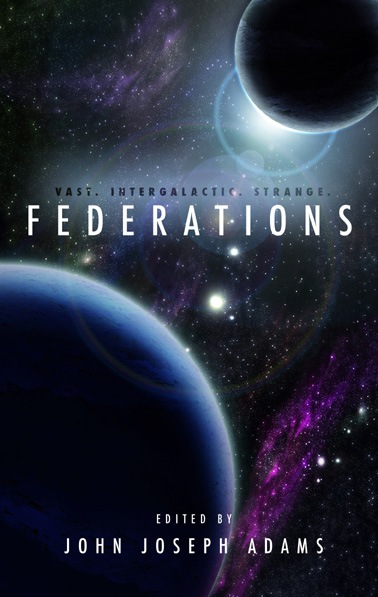
federations_3All right, Science Fiction Writers, you have another cool opportunity for publication. Remember back when you and me were discussing writing for Star Trek? Well, John Joseph Adams, editor of this year’s fun anthology of zombie stories, The Living Dead, (which has a great story from my BFF Catherine Cheek) is looking for stories about the impacts of far-flung galactic empires in a new anthology called Federations. I quote from his guidelines:

What are the social, religious, environmental, or technological implications of living in such a vast society? What happens when expansionist tendencies on a galactic scale come into conflict with the indigenous peoples of other planets, of other races? And what of the issue of communicating across such distances, or the problems caused by relativistic travel? These are just some of the questions and issues that the stories in Federations will take on.

So, if you have an idea you’d like to explore in an intergalactic empire sort of way, in 5000 words or less, submit it to Adams by Jan 1 2009. We may not get to write for Star Trek, but we can write out our Trek-like visions and still discuss the same issues in this anthology–and that may be a better thing than boldly going into Roddenberry’s universe. We get a universe of our own to play with.

Everyone kills Hitler on their First time travel trip: short story share

Great, great flash fiction story. I submit this for your reading entertainment. This story, actually entitled Wikihistory, was authored by Desmond Warzel, and appears in Abyss and Apex. It’s a gem, and while you’re there, if you look around, there’s a lot more in this great online zine!

Wikihistory, Desmond Warzel

It’s a forum discussion for time travelers.

Shine Anthology, and Dreaming of a Better World

In another post I talked about thinking positive about the future.  I linked to an anthology, SHINE, open to writers, that wants to make the world a better place in the future–a vision of how we WILL get it right eventually.  How  decisions we make technologically, politically, personally will solve–or begin to solve–global crises we face right now.  For years, scientists have been cast as Dr. Frankensteins in movies–playing God with forces we don’t understand–and rarely are they those who solve the problem.  If they do arch heroically at the end, it’s often to put back what went wrong, the Hamlets of a technological Denmark gone rotten.

When doing the radio series, Yukon 2058, I was sitting with Lil from Lil’s Diner and we were talking about Angel’s Nest, the future home for the homeless teens in our area, a cause Lil’s Diner has taken a personal investment in, literally.  For Halloween, the employees at the diner donated all wages made that day to Angel’s Nest and they kept the diner open most of the night to host a fund drive party.  We sat and talked about what teens need in this town, and I realized that science fiction could be used to describe what we want in the world–not just to warn people, not just a good story, but planting seeds in the minds of those who might be able to help us make those changes.  SF can be used to help people envision.

Who wants to walk into a post-apocalyptic future?  Why not place things in the future we need to see–and once seen, that we can create for real.  So, via radio, I created a youth center, the kind I would love to see the town create in the old Canadian Tire building.  And I put it on the air, and inside my vision for the future.

So, if you have ideas about what kinds of positive strides the world could make in the future–ways of solving crises in the world– allow me to suggest some positive outlets for you, outlets where your vision could inspire the vision of others who can make it happen:

1)  CBC North is going to want to interview you for your vision of the Yukon–a place that will be much changed in the next 50 years.  Imagine the future, and then talk about it on the radio.

2)  SHINE anthology, edited by Jetse de Vries, is open to writers this next spring who want to write optimistic science fiction.  This doesn’t mean that utopia comes without dramatic tension or story, only that it includes a positive vision of the world of the future.  If you want to write up your idea as story, read these guidelines.  This is going to be a great opportunity for writers and thinkers, since anthologies, collecting these positive views of science, will likely have a great distribution and put you in pages populated by well-known, world-class thinktankers/writers.  (If only there could be a weekend to gather engineers, scientists and science fiction writers to pool ideas…)

3) the 24hr Playwriting competition, held here in Whitehorse by Nakai Theatre in April, might be another place to launch a positive future in the Yukon, as local plays are funded, produced and showcased through the Homegrown Theatre Festival in the Yukon, in order to get them ready for possible Canadian distribution.

4) Write directly to the Governmental groups that might help implement your idea: help them see what impact your idea–all consequences considered–might have on the Yukon.  Write for funding to research it through the Northern Research Institute

5)  Don’t forget other Canadian science fiction magazines: On Spec needs you!  And loves you.  And wants to promote Canadian voices.

I think if a people down south, my fellow Americans, can be inspired to change by electing Barack Obama as President, then anything is possible.  I think we are being called on to help make that change ourselves, first by envisioning and then by doing.  I think science fiction writers inspire change.

Else why would the first American space shuttle be named Enterprise