Yukon Writers’ Conference: Deadline March 15th

Hey Everyone, just wanted to note the upcoming deadline for the Yukon Writers’ Conference happening April 3,4,5 here in Whitehorse.  If you are thinking of NOT going, let me give you some reasons to come.

We don’t often get to hear and work with writing professionals here in the North. Normally, you would have to go south to get this convergence of writing instruction.  The conference brings up six people you would never get to talk to otherwise.  I would never have ten minutes alone with Shawna McCarthy in Toronto or Vancouver.  She would be surrounded by other writers more important to Canada, and her time would be scheduled to meet the needs of hundreds of people.  Here, we can chat.  I can even buy her a Cranberry Wheat Ale.

This is not to discount in any way the professional writers we have here in the north–including Lily Gontard, editor of Yukon: North of Ordinary, who will be a speaker and participant in the conference.  I’m only highlighting the fact that she and other editors will be together pooling their knowledge in this conference–a rare occurence.  You can still, of course, get great writing instruction from any of the professional writers who live here—but you have us every year!  hehe.  And we’re gonna be there learning at the conference too!  We want to take advantage of this conference made to help writers in every stage.

Sure, you say, this conference is for people who are going to make a living writing.  I just want to write for myself. Actually, this conference, with its seminars, is aimed at a broad audience.  You will pick up many writing tips from these editors who have seen writing in every stage imaginable.  You will pick up tips to help you where you are.  While they do know the market and know how to get people ready for publishing, they are here for all writers to help you make your writing into what you want it to be.

If you are at all interested in possibly publishing, this is YOUR conference. While the conference accommodates a wide audience, these editors and publishers have expertise they want to share with writers in the North who seek to move their writing to a public level, who want to share their writing and Northern sensibilities with folks down South.  Highlighting a collective experience of over 70 years in the publishing industry, these seven voices (six from the South, one from the North) have a wide range of insight and a diversity of opinion on what makes a work publishable and how to make a story or article most effective.

We have 40 people–at least– in the Yukon working on novels.  You have completed a first draft.  Revising can be difficult–and editors know how to revise. I love hearing writers talk; they know how to create–but usually have experience with only their texts (discounting those who teach–who have seen a lot of other writers’ stuff too).  But editors and publishers can tell you what to do after you’ve created.  Their experience with thousands of manuscripts lead them to a wider knowledge of how to get different stories moving, how to motivate different writers.

It’s 90 bucks, which covers a weekend full of learning.  Hearing any one of the six editors from down South could cost you much, much more–just in travel expenses.  Contact Marcelle Dubé at mdube@northwestel.net or come hear her and Mitch Miyagawa read Thursday night a Whitehorse Public Library at 7:30 and ask her more about the conference there.

I hope to see you there.  The Deadline is March 15th!  Go now.  Sign up.

2009 Yukon Writers Conference, April 3-5

scribo book cover by Kater CheekNorthern Writes is pleased to announce the 2009 Yukon Writers Conference, taking place at the Westmark Whitehorse, on April 3 through 5, 2009. The 2009 Yukon Writers Conference is an opportunity for Yukon writers to meet with and learn from six North American editors and one publisher representing a variety of genres.

The conference will include workshops, a panel discussion, individual pitch appointments and an open critique session.

The conference fee of $90 also covers an opening reception, lunches on Saturday and Sunday, and coffee breaks.

The following publisher and editors will present at the event:

Claire Eddy, Senior Editor, Tor/Forge Books, New York

Paula Eykelhof, Editor, Mira Books, Toronto

Lily Gontard, Editor, Yukon, North of Ordinary, Whitehorse

Shawna McCarthy, Editor, Realms of Fantasy and Agent, New Jersey

Lynne Missen, Executive Editor, Children’s Books, HarperCollins, Toronto

Kathleen Scheibling, Editor, Harlequin Books, Toronto

Howard White, Publisher, Harbour Publishing, Madeira Park, BC

________________________________________________________

Registration deadlines as follows: February 28 if submitting a writing sample/proposal March 15 if not submitting Registration forms and information sheets will be available at the Whitehorse Public Library starting on February 9, or by contacting Marcelle Dubé at (867) 633-4565, mdube@northwestel.net. Please feel free to share this information.

______________________________________________________

This conference is not to be missed if you live anywhere near the Yukon. You can’t see these people up close and personal in other venues in the States or in Canada. But here, in Whitehorse, you have a chance to talk with them personally, submit writing, receive critique, and get to know them.

I’ve said before that it was in the Yukon that I met and really got to know some amazing authors/editors from Outside. These meetings were all through conferences like this one that Barb Dunlop and Marcelle Dubé engineered.

If you believe in that Latin phrase on the book above–“I write”–then you’ll want to prepare for this conference. Have ready a manuscript by the end of February to submit to these editors. Come and join us for a chance to develop your writing and all Yukon writers.

_________________

Photo above is from my good friend, Kater Cheek, whose amazing art can be found here at www.catherinecheek.com

Year’s Best Fantasy and Horror Ceases, Hope in the Comments

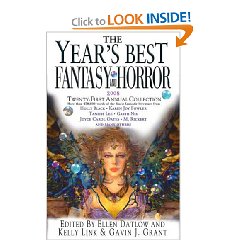
Year's Best Fantasy and HorrorLCRW announced the end of an era. The Anthology that praised the best in Horror and Fantasy published every year has ceased after 21 volumes. Year’s Best Fantasy and Horror collected two genres together, ones that complemented each other. It was good to have the cross-pollination. There’s much sadness in the Fantasy and Horror worlds, yes, but there seems to be glimmers of hope in the Comments section which has turned into a Who’s Who of Fantasy and Horror. In these comments, Ellen Datlow reveals that she has a new publisher for the Horror side of the anthology and Kathryn Cramer, publisher of Year’s Best Fantasy, reveals they have switched publishers. It’s the “narrowly dodged the bullet” reference that Cramer makes that causes me to think that the YBF&H closing might have been a publisher decision to cut costs in the rapidly diminishing American economy* (Ellen Datlow comments below that it was a combination of things, but most importantly it was an agreed-upon decision between the editors and publisher, not a sole publisher decision. My apologies for jumping to conclusions.).

Editors and authors alike send condolences in the nearly 100 comments that follow the announcement. The anthology was a huge part of the community–a way to celebrate and honor stories that represented what was happening in that community. Award shows can be fleeting celebrations–anthologies preserve and mark the year. I felt like a family gathering in the comments for a funeral or a wake. I look forward to seeing what new incarnations will arise from these decisions. And if there is a wake for the Anthology, I hope it is a big, raucous one for all the good they have done for the community!

To purchase a copy of the last volume of work, celebrating the best of 2007, follow the links above.

Stardust Shines: Character Motivation-ism

stardustSometimes it’s simply about giving everyone something to want, something realistic, and then setting them on their paths.  Stardust, the Neil Gaiman-inspired movie, does a great job of giving characters real desires and then setting them at odds with each other.

If you are writing science fiction or fantasy, even well-developed characters function at half-power until they have a goal.  Once they have a goal–man, they zip!  This is one of my favorite things to watch, as objectively as I can, that moment in my heart and interest level when the character finds a goal.  It has to be something they want, not just an interesting goal that should be “universally interesting.”  They have to want it enough to maneuver through a tangly set of obstacles.

Stardust Plot summary: To woo Victoria, poor boy Tristan promises to get her the falling star they just saw.  When he goes to get the star, he discovers Yvaine, a woman, is the star that fell.  Three witches want to eat Yvaine’s heart to make them younger, and seven scheming princes want the throne–which can only be had if they can find the necklace, which happens to be with Yvaine.  So people want Yvaine for what she can give them: eternal life, long lasting beauty, a kingdom.  Tristan wants her to impress Victoria.

Really clear goals: Tristan wants to win the heart of Victoria. When he meets up with Yvaine (Claire Danes) he doesn’t suddenly switch goals.  He could have life immortal or even Claire Danes!  But no, he wants Victoria.  He promised to have her this star and that’s what he’ll do.  Yvaine won’t budge until she sees he has a Babylon Candle which could actually get her home—so she goes with Tristan on his way to Victoria because he promises to send her back home when he gets done showing off in front of his girl.

The pirates collect lightning, the witches want beauty, the princes want the kingdom and to kill each other.  When all their plots become melded into a single objective–from different angles–it revs up into high gear.

I enjoyed this movie.  I think it’s well designed.  The narrative is strong and is propelled by the desire lines of each character.  I love how all of them use similar means to get them to where they need to go: runes.  Not a map, not a prophecy, but unpredictable magic that you have to keep checking over and over again.

It helps that the scenery–meaning the place, the occupations, the “world- building” is interesting–but without desire, it is just scenery.  With desire, it becomes charming.  There are few memorable lines in the movie–this isn’t “Princess Bride”, though I believe the plots are just as good.  The comedy isn’t as strong–too many characters for you to memorize everything.  And this is its only fault, I think, that the characters may be well-motivated, extremely well-motivated, but rarely rise above stereotype–even with all the “cool stuff” around them.  They are stock characters with bling.

Tristan IS his want.  Other than his desire, he is a bit of a goof whose entire existence seems to be winning the heart of Victoria.  No mention of what his life was like before, or his relationship with his dad and having no mom.  Yvaine has a bit more character–she has been spending her life as a star watching us (we’re so entertaining to celestial beings) so she’s always wanted to have an adventure and fall in love.  But really we can’t imagine her life as a star.  Which is why she is so much more interesting on Earth (she’s got motivation and means).   The witches seem obsessive—and we wonder how they spent their time before the star fell.  Oh, you know, the last three hundred years….  The princes are fiendish, but they have no personalities outside of good/bad/opportunistic.  They want the kingdom–they only exist to push their plotline.

So, after all is said and done: character motivation, aka desire, is essential to move characters along, but without more character work–as in WHO these people are that make them different than their archetypal roles–desire becomes plot without managing to deepen character.  I imagine that Gaiman packed more into the novel, but on screen we may only have time for one choice: character desire vs. character development.

Ebert gave this 2  1/2 stars out of 4, saying that plotlines were convoluted and that the movie never rose to the level of “Princess Bride.”  I didn’t think the plotlines were convoluted, but only that the plotlines were so well charted that it left little room for characters to grow beyond the plot necessities–but that doesn’t mean it doesn’t satisfy like the best story–especially the fairytale kind of story it represents.   I would still give it 3 out of 4 stars—it’s a great movie.  Really.  And not making it to Princess Bride Status is not necessarily a fault.  It’s a clever romp through a well-developed world.  All the pieces are in place and they interact with each other well, and you can learn a lot about the power of character motivation, and the power of character too.  Even when character shines less than character desires.

Why You Should Subscribe to New Scientist, and why you have to put it down

phpthumbScience Fiction writers have a strange relationship to science. To write compelling science fiction, I think a writer has to do some research. Where would Crichton’s Jurassic Park have been without Chaos theory and real-life paleontologists? And you want your ideas to be ahead of the game, so get yourself some subscriptions.

I know, we are poor bastards and we can’t afford very much–certainly not expensive subscriptions.

I don’t think I could get more (Big) bang for my buck than through New Scientist. You can too.

1. It’s weekly. Meaning that when science is advancing, New Scientist doesn’t have to wait two months to come out with an issue. Discover is a monthly, and it’s a nice mag. But it can’t compete with 65-75 pages a week chock full of insightful articles.

2. It’s got short blurbs and longer indepth articles, and these can be read–some of them–online. Let me give you a sample of what’s out right now:

Why the Universe may be teeming with Aliens

Are Daughters-in-Law to blame for Menopause?

A healthy planet? Top 10 articles on the Environment in 2008

The glass universe: where astronomy meets art

Creationists Declare War on the Brain

These are the longer in-depth articles, yes, but the magazine is FULL of shorter articles. Shorter articles stimulate creativity in a way that is beneficial for a creative writer. You want a magazine that has plenty of short articles on broad topics–a whole mess of ’em.

3. It covers a lot of areas: space, environment, sex, health, physics and math, tech articles…. that’s good. Coming out once a week, it allows the magazine to be current on several areas. It allows you to cross-pollinate ideas.

4. It’s cheap. Yep, it’s from Britain, but it’s 36 bucks for 6 months or 24 issues. You can sign up online here for a subscription. Or you can browse the website first. With a subscription you get the magazine delivered to your door in uninterrupted service, and you get online access to back issues 24hrs a day. It’s cheap and it comes to you. If I had to have just one subscription to a science magazine, I would keep this one.

Writers of science fiction should certainly start with the stimulation that comes from reading science magazines–BUT, and this is where it gets interesting, I think they shouldn’t be bogged down in the details. If you are predicting the future, look how fast the present changes. I just did a radio piece talking about dark energy–which is about to be out of fashion, passé, even illusory–but in twenty years?? In fifty years?? It may be all the rage.

Science fiction writers need to be able to extrapolate from data, yes, but they also need to be able to make the Leap. Leaps are about prediction beyond what can be extrapolated. Go someplace wild with the information. Don’t be afraid to be wrong in twenty years, or in two weeks. Make it believable. But not predictable by any physics grad student. Combine fields, combine theories, and then move beyond them. Sure, it’s not real. But that’s the point of writing fiction–to be brave enough to make the leaps that science isn’t allowed to without hard fact.

If science fiction actually does lead the way in technology and science–then we’ve got to lead by going beyond what the best scientists can predict, and certainly past what the public can imagine. That’s our job–to help people imagine a believable, but still surprising and entertaining, future. That’s where your stimulated brain comes in handy……

You can start seeing that future by picking up a New Scientist issue, but you can’t create it till you’ve put the issue down.

Leaving America is All Here

Okay, I uploaded the rest of Leaving America.  All seven episodes are there.  Some of you heard this in a 5 episode run–don’t know what they (Toronto) cut, but they went from Seven 6.5 min episodes to Five 5 min episodes.  Here are the original versions where you even get to hear me do a bad Tiki Chorus at the Ft. Nelson hotel….forgive me.  I was having too much fun.

The 4000 mile road-trip journey is full of immigrants, storms, wild and woolly Oz, screaming Heads, funny interviews, a little history, a little death, a lot of song, and many hidden science fiction references–especially in the music.  After all, immigration is about being an alien who finds a home.

And that’s pure science fiction.

I want to thank everyone who allowed me to talk with them along the way, my family, my friends, CBC and Arnold Hedstrom for funding it and giving me complete creative freedom, the great musicians whose music runs through this.  And to all the listeners who liked it and told me about it.  Thanks for liking my story.

Enjoy.

How to talk about Plot Shapes, or Don’t tell Creative writers they aren’t creative

Well, you live and learn as a teacher. One thing I will never do again: give my high school writing students a handout on plot shapes. My goal was to tell them that if they needed to have some help in shaping a plot, that they could look to these “shapes” —forms that would give them patterns that might help them complete a plot.

Of course, I prefaced this with saying that some people believed there “are only 20 plots” and that everything boils down to these forms in some way or another.

Wake Up Call: These are teenagers. Do they want to be told that there are only 20 plots!?? NO. Do they set about trying to prove you wrong? Yes. And that’s fine. It was their ire at being told they could only have 20 choices that saved them.

At first, they looked pretty crestfallen–how could I stand there and tell them “there’s nothing new under the sun”?

I had a math and science teacher who told me that once. I hated that. I hated that he might be right. You hear it in church sometimes–I think it’s in Ecclesiastes somewhere–that there is nothing new under the sun–but we are creative people. CREATIVE writers. We do create something new. What I am writing now has never, never been written before.

I think books like 20 Master Plots are good for a person who’s ready to read about how to master certain forms in the same way that people who sing learn the 20 or so songs in one book together—to work their muscles. Or the way that autoshop kids learn to rebuild a few classic cars–at least ONE Mustang!  But the book is not for everyone.  I find it helpful —when I know which shape I’m writing— to know what reader expectations are for that shape.  But it can be diminishing…

I did much better job when I talked about Motifs–and they all loved stealing motifs from the Folklore and Fairy Tale index–they created the coolest plots using plot skeletons. And if you talk about plot skeletons, this will work. Masterplots are really plot skeletons too. DO NOT tell them that any person (sorry Ronald Tobias) ever said there were only 20.

If I had it to do again, I might offer the 20 as plot skeletons–and ask them to create a story using one plot skeleton or two. But, at all costs, no one should bust the creative impulse or dampen it by suggesting that someone else’s plot fits neatly into one of 20 formulas.

Seeing that storm clouds had entered the French library, where we meet every Wednesday for fun and writing, I instead challenged them to break the formulas with their own version of the plots–how do you subvert a Rescue plot (#17) or a Sacrifice plot (#15)? How do you masterfully up-end the Adventure plot? Then I had their hearts back into it!

Don’t do this to adults either. Just don’t. It makes you look hoity-toity, like you know what they can possibly do, and limits creativity.

Yep, I’m writing a Quest plot (plot#1) but you ain’t seen nothing like this quest! hehe.

World Building, Renewed Interest, 9 Novelists to write 9 Novels

If you were thinking about signing up for a class in
Science Fiction /Fantasy writing this fall, do it next
week.

The class was officially canceled on Tuesday, as it had only five members, but will be re-instated next week on Wednesday because of renewed interest. We now have nine people–and room for many, many more. If you are a fantasy writer or a science fiction writer in town and want to be a part of a novel-writing push, this is your chance.

Sign up with Krista Mroz at Parks and Recreation (phone  633-8505) and join us for pushing out that novel. We’re now online too at Cold Fantasy, a google Group of the writers in the class. With nine other people churning out a novel–and they have day jobs–you can do it too!

Rocket Fuel May Not Make it Off the Ground

Our new afterschool program for High school students interested in Science Fiction and Fantasy writing may not make it off the ground if The City of Whitehorse doesn’t have enough registered people.

So far, we have five.  They need eight to make it.  But I know there are many many more young authors out there who love to write science fiction and fantasy.  The group is scheduled from Sept 17th through the first part of December.  The cost is $65 for 12 weeks of instruction–exercises, workshopping, brainstorming, building characters and plots–plus snacks.

I’m gonna do this:  I’ll meet on Wednesday, after school with whoever shows up.  If we don’t make the required numbers via the City of Whitehorse, we will figure out our options.  If you know of youth interested in writing science fiction and fantasy, have them sign up via Parks and Recreation, 668-8325, or 668-8360 at the Canada Games Centre.